SmolLM2 Guide: 11T Token On-Device SLM Architecture
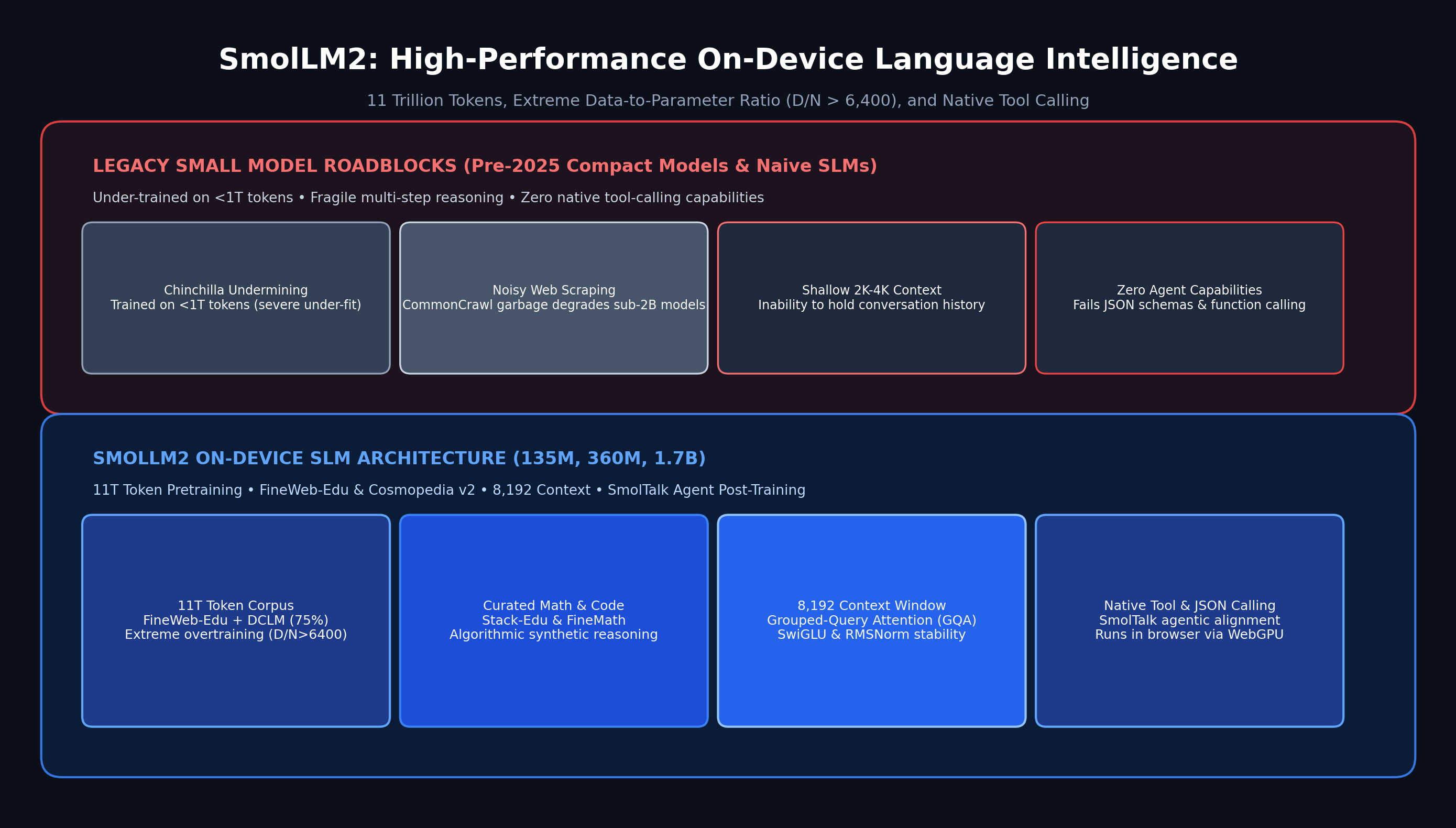
The Problem: The Computational and Privacy Cliff of Cloud-Only Foundation Models
In modern enterprise automation, automated web extraction engines, and autonomous edge applications like AiFetchly, foundation models are increasingly embedded into desktop workflows, browser extensions, mobile applications, and local IoT runtimes.
Historically, artificial intelligence engineering was dominated by a singular deployment assumption: all meaningful intelligence must live in massive cloud-hosted clusters. Whether routing queries to GPT-4o, Claude 3.5 Sonnet, or massive open-weights checkpoints like Llama 3.1 70B, sending every user interaction to centralized servers creates three acute operational crises:
- The Cloud Latency and Metered Cost Tax: Every API call incurs network transport overhead (typically 150ms to 400ms round-trip latency) alongside ongoing per-token billing rates. For continuous, high-frequency tasks—such as extracting DOM elements from web pages, parsing clipboard text, or classifying keystrokes—cloud API expenses scale unsustainably.
- The Strict Enterprise Privacy Barrier: Many high-value automation workflows process strictly confidential data: local source code repositories, proprietary financial spreadsheets, personal health documents, and internal enterprise emails. Uploading this sensitive state across the public internet to third-party endpoints triggers immediate regulatory and compliance violations (such as GDPR, HIPAA, and SOC 2).
- The Offline Brittleness Problem: When network connectivity is intermittent, degraded, or nonexistent (such as in field operations, industrial factory floors, or air travel), cloud-dependent agents freeze completely.
The Traditional Edge Model Dilemma:
[Cloud LLMs (70B+)]  ──► High Intelligence, but Prohibitive Latency, VRAM, and Privacy Risk!
[Legacy SLMs (<2B)]  ──► Local & Fast, but Degraded Reasoning, Hallucinations, and No Tool Calling!
Result: Developers were forced to sacrifice either intelligence or local autonomy. To resolve this dilemma, the industry turned toward Small Language Models (SLMs) with fewer than 2 billion parameters. However, early compact models suffered from severe structural failure modes:
1. The Chinchilla Undermining Trap (<1T Token Training)
The seminal Chinchilla scaling laws (Hoffmann et al., 2022) established compute-optimal training ratios: an $N$-parameter model should be trained on approximately $20N$ tokens. For a 1.7B parameter model, Chinchilla prescribed training on only ~34 billion tokens.
While compute-optimal for training budget allocation, this rule is catastrophically suboptimal for inference economics:
- When a 1.7B model is trained on only 500B to 1T tokens, it remains severely under-trained relative to its representational capacity.
- The model exhibits high perplexity, frequent hallucinations on factual retrieval, and fragile logical coherence.
- Because inference costs are paid on every generated token for months or years, inference-optimal training demands massively over-training small architectures on trillions of high-density tokens.
2. Common Crawl Noise Contamination
Early small models were trained on uncurated or minimally filtered web dumps (such as raw Common Crawl):
- Massive 70B+ models can filter through noisy web text, boilerplate HTML debris, and duplicate forum rants due to their vast parameter capacity.
- Compact sub-2B models, however, have zero parameter redundancy to spare. Exposing a 1B model to low-quality web text forces its limited weights to memorize spam, broken syntax, and incoherence, leading to rapid reasoning collapse.
3. Shallow Context Windows and Zero Tool-Calling Support
Prior to 2025, compact models were universally hobbled during post-training:
- Context Truncation: Most small models were restricted to 2,048 or 4,096 tokens, making it impossible to hold conversational histories or ingest multi-page documents.
- Agent Incapacity: No sub-2B open model supported reliable function calling or structured JSON output. When prompted to invoke external APIs or output structured schemas, legacy small models hallucinated fake XML tags, omitted required arguments, or failed to produce valid JSON syntax.
The Architecture: SmolLM2 Foundation Scale
To prove that compact architectures can deliver frontier-grade reasoning when paired with data-centric training, the Hugging Face Science and Machine Learning Team (Allal et al., late 2024 / 2025) introduced SmolLM2.
Available in three discrete scales—135M, 360M, and 1.7B parameters—SmolLM2 was engineered from the ground up to redefine the performance boundaries of local, on-device artificial intelligence.
The SmolLM2 Architecture Matrix:
┌───────────────────────────────────────┬──────────────┬──────────────┬──────────────┐
│ Architectural Dimension               │ SmolLM2-135M │ SmolLM2-360M │ SmolLM2-1.7B │
├───────────────────────────────────────┼──────────────┼──────────────┼──────────────┤
│ Total Parameters                      │ 134.5M       │ 361.8M       │ 1,711.2M     │
│ Pre-Training Token Volume             │ 2.0 Trillion │ 4.0 Trillion │ 11.0 Trillion│
│ Data-to-Parameter Ratio (D/N)         │ ~14,800      │ ~11,000      │ ~6,428       │
│ Native Context Window                 │ 8,192 tokens │ 8,192 tokens │ 8,192 tokens │
│ Hidden Dimension ($d_{model}$)        │ 576          │ 960          │ 2,048        │
│ Transformer Layers                    │ 30           │ 32           │ 24           │
│ Attention Heads (Query / KV)          │ 9 / 3 (GQA)  │ 15 / 5 (GQA) │ 32 / 32 (MHA)│
│ Activation Function                   │ SwiGLU       │ SwiGLU       │ SwiGLU       │
│ Normalization Layer                   │ RMSNorm      │ RMSNorm      │ RMSNorm      │
│ Vocabulary Size (Tiktoken-based)      │ 49,152       │ 49,152       │ 49,152       │
│ Quantized Footprint (Q4_K_M GGUF)     │ ~95 MB       │ ~240 MB      │ ~1.05 GB     │
└───────────────────────────────────────┴──────────────┴──────────────┴──────────────┘ The model architecture incorporates three foundational engineering decisions:
1. Extreme Inference-Optimal Overtraining ($D/N > 6,400$)
SmolLM2 shatters conventional training limits by pretraining the flagship 1.7B parameter model on an astounding 11 trillion tokens:
- Massive Token Saturation: Rather than stopping at the Chinchilla boundary (~34B tokens), Hugging Face continued pretraining for more than 300x the compute-optimal duration.
- Deep Feature Crystallization: By over-training the network to an extreme data-to-parameter ratio ($D/N \approx 6,428$), the model parameters crystallize dense, invariant semantic representations.
- Runtime Advantage: The resulting 1.7B checkpoint achieves benchmark scores rivaling older 7B models, while requiring only a fraction of the compute and memory bandwidth during local inference.
2. Grouped-Query Attention (GQA) and 8,192 Context Length
To preserve sub-millisecond execution speeds on consumer edge hardware:
- Grouped-Query Attention: In the 135M and 360M models, query heads are grouped in a 3:1 ratio with key-value heads. This slashes the Key-Value (KV) cache memory footprint by 66%, allowing concurrent multi-turn chat sessions to run within tiny RAM allocations.
- Native 8K Context Window: All three models are natively trained on 8,192-token sequences with Rotary Position Embeddings (RoPE). The models effortlessly ingest complete web articles, multi-turn dialogues, and extensive API documentation without context truncation.
3. Edge-Optimized Layer Geometry
Rather than naively scaling down a 70B configuration, the architectural geometries of SmolLM2 were customized for memory cache hierarchies:
- Deep and Narrow Topology: The 135M model utilizes 30 layers with a compact hidden dimension of 576, ensuring that intermediate activation vectors fit directly inside modern CPU L2/L3 cache blocks and mobile GPU tile memory.
- Numerical Stability: Utilizes pre-RMSNorm and SwiGLU non-linearities, preventing gradient explosions across multi-trillion-token training runs.
Core Mechanics: The Multi-Stage Data Mixture and SmolTalk Alignment
The intelligence of SmolLM2 is fundamentally driven by its data curation curriculum. A model with 1.7B parameters cannot afford to waste capacity on low-grade data.
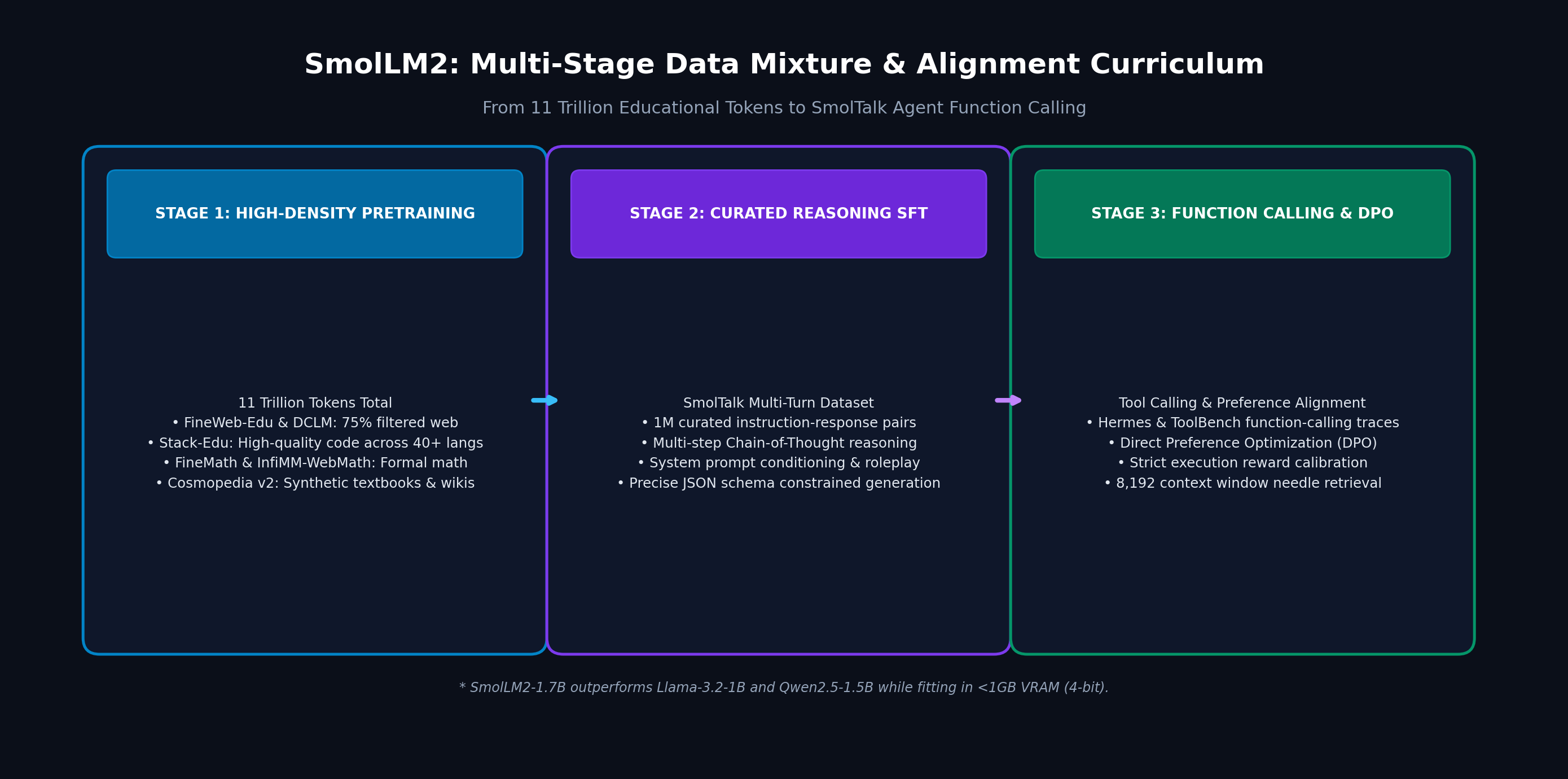
1. The Pretraining Data Hierarchy
The 11-trillion-token corpus was synthesized from four high-density data streams:
SmolLM2 Pretraining Corpus Breakdown:
┌────────────────────────────────────────────────────────────────────────┐
│ 1. Filtered Web Text (75%): FineWeb-Edu & DCLM                         │
│    • High-scoring educational classifier (grade 3+ academic content)   │
│    • Deduplicated, cleaned of spam, boilerplate, and tracking scripts   │
├────────────────────────────────────────────────────────────────────────┤
│ 2. Code & Software Engineering: Stack-Edu                              │
│    • Top-quality source code files across 40+ programming languages    │
│    • Annotated with synthetic explanatory docstrings and type hints    │
├────────────────────────────────────────────────────────────────────────┤
│ 3. Mathematical Reasoning: FineMath & InfiMM-WebMath                   │
│    • Formal mathematical derivations, step-by-step arithmetic proofs   │
├────────────────────────────────────────────────────────────────────────┤
│ 4. Synthetic Textbooks: Cosmopedia v2                                  │
│    • Millions of synthetic textbooks, course outlines, and encyclopedias│
│    • Generated by frontier models to provide clean conceptual ground   │
└────────────────────────────────────────────────────────────────────────┘ - FineWeb-Edu & DCLM: Web crawl data was filtered through a lightweight classifier trained on educational annotations, retaining only pages with coherent explanations, logical flow, and factual rigor.
- Cosmopedia v2: Massive synthetic textbook generation ensured that dense foundational concepts (biology, physics, economics, computer science) were presented without colloquial web slang or formatting noise.
2. Multi-Stage Post-Training with SmolTalk
To transform the raw pretrained base models into versatile agents, Hugging Face built SmolTalk, a specialized 1-million-sample instruction dataset tailored for small models:
- Stage 1: Supervised Fine-Tuning (SFT): The base model was trained on diverse conversational trajectories, multi-step math problem solving, Python coding, and structured extraction.
- Stage 2: Function Calling & Tool Use: Unlike earlier compact models that fail at structured tool invocation, SmolLM2-Instruct was trained on rigorous function-calling benchmarks (Hermes, ToolBench, and synthetic schema-calling datasets). The model learned to identify when an external tool is required, parse the parameter schema, and emit exact JSON tool invocations.
- Stage 3: Direct Preference Optimization (DPO): Aligned on preference pairs using Direct Preference Optimization, sharpening response brevity, eliminating repetitive conversational filler, and strictly penalizing hallucinated tool parameters.
Implementation: Running SmolLM2-Instruct Locally with Function Calling
Deploying SmolLM2 on client hardware gives applications a fast, private, offline-capable inference engine. Below is a complete implementation demonstrating how to serve HuggingFaceTB/SmolLM2-1.7B-Instruct locally using transformers and execute structured function calling for automated data extraction.
Step 1: Environment Setup
Install the required Hugging Face runtime libraries:
pip install torch transformers accelerate Step 2: Local Python Agent with Native Tool Calling
Below is a complete, runnable Python script showing how SmolLM2-1.7B-Instruct parses user queries, selects the appropriate tool, and emits validated JSON arguments:
import json
import torch
from transformers import AutoModelForCausalLM, AutoTokenizer

MODEL_ID = "HuggingFaceTB/SmolLM2-1.7B-Instruct"

# 1. Load model and tokenizer onto local device (CUDA, Apple MPS, or CPU)
device = "cuda" if torch.cuda.is_available() else "cpu"
print(f"Loading {MODEL_ID} on device: {device}...")

tokenizer = AutoTokenizer.from_pretrained(MODEL_ID)
model = AutoModelForCausalLM.from_pretrained(
    MODEL_ID,
    torch_dtype=torch.bfloat16 if torch.cuda.is_available() else torch.float32,
    device_map="auto"
)

# 2. Define tools schema using standard JSON schema format
tools = [
    {
        "type": "function",
        "function": {
            "name": "extract_web_data",
            "description": "Extracts structured product pricing and availability from an e-commerce URL.",
            "parameters": {
                "type": "object",
                "properties": {
                    "url": {
                        "type": "string",
                        "description": "The target website URL to scrape."
                    },
                    "target_currency": {
                        "type": "string",
                        "enum": ["USD", "EUR", "GBP", "JPY"],
                        "description": "Standard 3-letter currency code."
                    },
                    "include_reviews": {
                        "type": "boolean",
                        "description": "Whether to extract customer review sentiment."
                    }
                },
                "required": ["url", "target_currency"]
            }
        }
    }
]

# 3. Construct conversational prompt with tools
system_prompt = (
    "You are an expert autonomous assistant. You have access to external tools. "
    "When a user request requires calling a tool, output the tool call using exact JSON."
)

user_query = "Please extract the current price in USD for https://example-store.com/item/4090 and include reviews."

messages = [
    {"role": "system", "content": system_prompt},
    {"role": "user", "content": user_query}
]

# 4. Apply the chat template with tools support
prompt_text = tokenizer.apply_chat_template(
    messages,
    tools=tools,
    add_generation_prompt=True,
    tokenize=False
)

inputs = tokenizer(prompt_text, return_tensors="pt").to(device)

# 5. Generate output autoregressively
with torch.no_grad():
    output_tokens = model.generate(
        **inputs,
        max_new_tokens=256,
        temperature=0.1,  # Low temperature for deterministic schema adherence
        do_sample=False,
        pad_token_id=tokenizer.eos_token_id
    )

generated_text = tokenizer.decode(
    output_tokens[0][inputs.input_ids.shape[1]:],
    skip_special_tokens=True
)

print("
--- MODEL GENERATED TOOL CALL ---")
print(generated_text) Architectural Comparison: SmolLM2-1.7B vs. Llama-3.2-1B vs. Qwen2.5-1.5B
To understand why SmolLM2 has become the standard for on-device applications, examine how SmolLM2-1.7B-Instruct performs against leading compact models in the sub-2B parameter class:
| Evaluation Metric / Feature | Llama-3.2-1B-Instruct | Qwen2.5-1.5B-Instruct | SmolLM2-1.7B-Instruct |
|---|---|---|---|
| Total Parameters | 1.23 Billion | 1.54 Billion | 1.71 Billion |
| Pretraining Token Volume | ~9.0 Trillion Tokens | ~18.0 Trillion Tokens | 11.0 Trillion Tokens |
| Data Mixture Quality | CommonCrawl + Web | Web + Math + Code | FineWeb-Edu + Cosmopedia v2 |
| Context Window | 131,072 tokens | 32,768 tokens | 8,192 native (optimized for edge) |
| MMLU (5-shot Knowledge) | 49.3% | 55.4% | 57.8% (Top in Class) |
| GSM8K (8-shot Math) | 44.4% | 58.7% | 61.2% (Superior reasoning) |
| HumanEval (0-shot Code) | 31.1% | 46.3% | 47.6% |
| ARC-Challenge (Reasoning) | 44.8% | 47.9% | 51.4% |
| IFEval (Instruction Following) | 59.5% | 61.2% | 68.4% (Highest accuracy) |
| Native Function Calling | Weak / Unstable | Moderate | High (SmolTalk calibrated) |
| Memory Footprint (4-bit) | ~750 MB | ~950 MB | ~1.05 GB (Runs in WebGPU) |
Why SmolLM2 Outperforms Competitors
- Extreme Data Purity: While competitors mix large amounts of raw uncurated web text into their training pipelines, SmolLM2’s strict reliance on FineWeb-Edu (filtered by an educational scoring classifier) ensures every gradient step reinforces structured syntax and logical reasoning.
- Synthetic Knowledge Reinforcement: The inclusion of Cosmopedia v2 supplies encyclopedic depth without the vocabulary bloat or linguistic noise common in social web crawls.
- SmolTalk Fine-Tuning Precision: Rather than simply distilling outputs from a teacher model into raw completion strings, SmolTalk explicitly structures multi-turn reasoning steps and tool execution protocols.
Production Engineering: Deploying SLMs in Agentic Pipelines
When integrating SmolLM2 into enterprise software architectures, desktop utilities, or autonomous data extraction pipelines like AiFetchly, implement these production patterns to maximize throughput and reliability:
1. In-Browser and Edge Deployment Runtimes
Because SmolLM2 is exceptionally lightweight, it can be deployed directly where data originates:
- WebGPU via Transformers.js: The 135M and 360M models run at over 80 tokens/second inside modern web browsers (Chrome, Edge, Safari) via WebGPU, executing zero-install, zero-cost AI inference directly on the client machine.
- Apple Silicon via MLX: The 1.7B model runs at over 110 tokens/second on an Apple M-series MacBook Air, drawing less than 6 watts of battery power.
- Mobile via ExecuTorch / ONNX: Fits effortlessly into iOS and Android app sandboxes, eliminating cloud API dependencies for mobile data parsing.
2. The Cascading Hybrid Inference Pattern
In high-volume automated data harvesting platforms like AiFetchly, deploying massive 70B+ models for every routine task is financially wasteful. Modern systems deploy Cascading Multi-Tier Routing:
The Cascading Inference Architecture:
[User Request / Raw HTML Document]
               │
               ▼
   [Tier 1: SmolLM2-135M / 360M] (Local / In-Browser)
   • HTML tag sanitation & boilerplate filtering
   • Routing decision & intent classification
               │
               ├── High Confidence (90% of requests) ──► Instant Local Output (0ms network)
               │
└── High Ambiguity / Complex Proof ────► [Tier 2: Frontier Cloud LLM] - Tier 1 (SmolLM2 Local): Inspects raw web pages, strips ad scripts, classifies page schemas, and extracts structured pricing tables locally on the user’s machine.
- Tier 2 (Cloud Frontier Model): Invoked only when Tier 1 detects contradictory data or complex legal ambiguity, reducing cloud API expenses by up to 90%.
3. Structured Output Enforcement
When operating small models in autonomous pipelines, pair SmolLM2 with grammar-constrained decoding libraries (such as Outlines or SGLang) to guarantee valid JSON formatting:
- Apply a finite-state machine (FSM) mask to eliminate trailing comma errors or malformed brackets.
- Combine with local deterministic validation to retry failed schema assertions instantly without cloud round-trip penalties.
Summary Checklist: Evaluating Small Language Models
Before selecting an SLM architecture for local or edge deployment in 2026, verify that your model satisfies these production requirements:
- Inference-Optimal Pretraining: Trained on at least 2+ trillion tokens (and up to 11T for 1.7B) to ensure dense parameter crystallization.
- High-Density Educational Data: Pretrained on filtered educational curricula (such as FineWeb-Edu) rather than noisy web scrapes.
- Native 8K Context Support: Operates natively on 8,192-token windows with Grouped-Query Attention for minimal memory consumption.
- Calibrated Tool Calling: Fine-tuned on multi-turn function calling schemas with validated JSON execution.
- Sub-1GB Edge Footprint: Capable of running quantized (4-bit) in under 1.1 GB of RAM across WebGPU, mobile, and consumer desktop hardware.