SkyWalker Guide: Cross-Region Load Balancing for LLMs
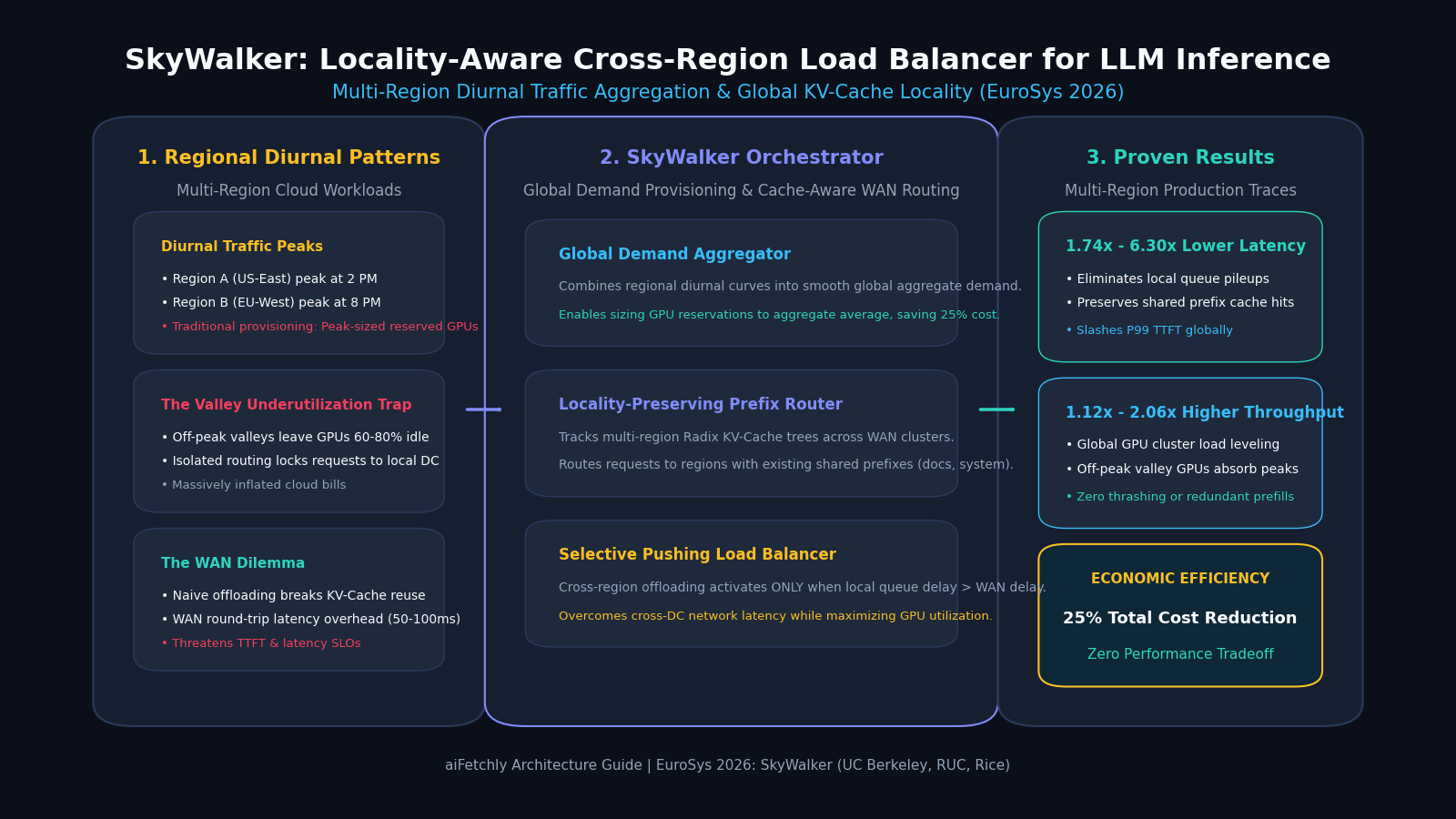
The Regional Silo Dilemma in Global LLM Inference
In modern enterprise automation platforms, intelligent desktop assistants, and automated data extraction pipelines engineered with aiFetchly, serving frontier Large Language Models (LLMs) requires provisioning expansive GPU compute clusters across multiple geographic cloud regions (e.g., US-East, US-West, Europe-West, and Asia-East).
Due to extreme hardware acquisition costs and chronic accelerator shortages, infrastructure operators cannot rely exclusively on on-demand cloud pricing. Instead, they secure long-term instance commitments (such as 1-year or 3-year Reserved Instances, Savings Plans, or on-premise datacenter clusters) to minimize operating expenses.
However, operating reserved GPU clusters across geographically disparate cloud regions exposes a punishing operational inefficiency: the regional diurnal traffic trap.
The Regional Diurnal Imbalance vs. Global Provisioning Trap:
┌────────────────────────────────────────────────────────────────────────┐
│ Region A (US-East): 2:00 PM EST (Peak Business Hours)                  │
│  • Traffic: 120% of Local Reserved Capacity (Queue Spikes, SLO Breaches)│
│  • Cloud Bill: Forced to spin up expensive On-Demand / Spot GPUs        │
└────────────────────────────────────────────────────────────────────────┘
                                    │
                                 vs │ WAN Network Gap
                                    │
┌────────────────────────────────────────────────────────────────────────┐
│ Region B (EU-West): 8:00 PM GMT (Nighttime Valley Hours)               │
│  • Traffic: 25% of Local Reserved Capacity (Idle Tensor Cores)         │
│  • Cloud Bill: 75% of paid-for Reserved H100s sitting completely idle  │
└────────────────────────────────────────────────────────────────────────┘ The Three Structural Flaws of Conventional Multi-Region Serving
Traditional multi-region architectures manage regional clusters as completely isolated silos. This creates three critical failures:
1. Peak-Capacity Over-Provisioning and Valley Wastage
Because human activity follows a predictable 24-hour diurnal cycle, every geographic region experiences massive day-time surges followed by deep overnight valleys. Because conventional DNS or GeoDNS routers force requests to stay strictly inside their local region, providers must size each region’s reserved GPU pool to survive its local daytime peak. During nighttime valleys, up to 70% to 80% of reserved GPUs sit entirely idle, yet billing continues unabated.
2. The Shared Prefix KV-Cache Locality Destruction
To reduce prefill execution costs and accelerate Time-To-First-Token (TTFT), modern LLM serving engines (such as vLLM and SGLang) leverage Radix Tree Key-Value (KV) Cache Reuse. Prompts sharing common system instructions, multi-turn conversational histories, or enterprise document schemas reuse existing GPU memory states, skipping redundant matrix multiplications.
If an upstream router naively dispatches requests across Wide Area Networks (WAN) to balance raw GPU load without understanding cache residency, it destroys KV-cache locality. Routing a customer’s query to an idle datacenter in Europe that lacks the customer’s cached prefix forces a full prompt re-prefill from scratch, wiping out the benefit of offloading.
3. The Wide Area Network (WAN) Latency Penalty
Transferring requests across continental fiber cables introduces 50 to 120 ms of round-trip network latency. If a load balancer blindly forwards traffic across regions without considering queue waiting times, the added network transport latency can easily exceed the queue wait time of the local datacenter, resulting in net latency regression.
To solve this multi-region scaling challenge, researchers from UC Berkeley, Renmin University of China, and Rice University introduced SkyWalker: A Locality-Aware Cross-Region Load Balancer for LLM Inference (arXiv:2505.24095 / EuroSys 2026). SkyWalker bridges regional boundaries, aggregating diurnal patterns into smooth global demand curves while preserving KV-cache locality.
Architectural Deep Dive: How SkyWalker Operates
SkyWalker acts as an intelligent, distributed routing layer that operates between global client traffic ingress and regional LLM worker clusters.
┌─────────────────────────────────────────────────────────────────────────────┐
│                       SkyWalker Multi-Region Mesh                           │
│                                                                             │
│   Incoming Global Traffic Stream (GeoDNS / Anycast)                         │
│               │                                                             │
│               ▼                                                             │
│   ┌─────────────────────────────────────────────────────────────────────┐   │
│   │ SkyWalker Regional Ingress Proxy (Deployed in each Region)          │   │
│   │ • Global Demand Curve Aggregator                                    │   │
│   │ • Prefix Hash Ring & Distributed Bloom Filter Syncer                │   │
│   └───────────────────┬───────────────────────────────┬─────────────────┘   │
│                       │                               │                     │
│    Local Routing Path │ (Cache-Hit / Low Queue)       │ WAN Offload Path    │
│                       ▼                               ▼ (Selective Pushing) │
│   ┌───────────────────────────────┐   ┌─────────────────────────────────┐   │
│   │ Region 1 (e.g., US-East)      │   │ Region 2 (e.g., EU-West)        │   │
│   │ • Local vLLM Worker Pool      │   │ • Local vLLM Worker Pool        │   │
│   │ • High-Affinity Prefix Cache  │   │ • Off-Peak Valley GPU Capacity  │   │
│   │ • Intra-DC InfiniBand Cluster │   │ • Remote Prefix Warm Caching    │   │
│   └───────────────────────────────┘   └─────────────────────────────────┘   │
└─────────────────────────────────────────────────────────────────────────────┘ SkyWalker incorporates three fundamental systems innovations:
1. Global Demand Provisioning via Diurnal Curve Aggregation
Because diurnal curves across disparate time zones are phase-shifted (e.g., US peak occurs during Europe’s trough and Asia’s dawn), the sum of regional diurnal traffic curves is drastically smoother than any individual region’s traffic curve.
By treating the global multi-region GPU pool as a shared fungible resource, SkyWalker enables infrastructure engineers to provision long-term reserved instances against the expected global aggregate demand rather than the sum of independent regional peaks. This mathematical smoothing directly slashes total GPU reservation requirements by 25%, completely eliminating peak over-provisioning.
2. Cache-Aware Cross-Region Prefix Routing
To maintain prompt caching benefits across continents, SkyWalker maintains a synchronized, lightweight representation of prefix cache states across all regional datacenters:
- Distributed Prefix Fingerprinting: When an instance executes a prompt prefill (e.g., a shared system prompt or reference document indexed via automated data fetching), the local SkyWalker proxy records the prefix token hash and broadcasts a compact Bloom filter digest to peer regional proxies over a lightweight control plane gossip channel.
- Prefix-Preserving Affinity: When a subsequent request arriving in Region B shares a heavy prefix ($>2,048$ tokens) with Region A, SkyWalker calculates whether routing to Region A’s warm cache saves more GPU prefill time than the WAN network penalty. If prefill acceleration dominates network transport, the request is dispatched across the WAN directly to the warm node.
3. Selective Pushing Load Balancing
Cross-region offloading must never degrade user experience. SkyWalker introduces the Selective Pushing Mechanism: A local proxy in Region $R_{\text{local}}$ is only permitted to push a request $r$ to a remote region $R_{\text{remote}}$ if the total projected latency satisfies the strict inequality:
$$T_{\text{queue}}(R_{\text{remote}}) + T_{\text{prefill}}\left(r, R_{\text{remote}}\right) + \text{RTT}(R_{\text{local}}, R_{\text{remote}}) \< T_{\text{queue}}(R_{\text{local}}) + T_{\text{prefill}}\left(r, R_{\text{local}}\right)$$
Where $\text{RTT}$ is the measured round-trip WAN network latency, and $T_{\text{prefill}}$ reflects cache hit or miss status. If Region $R_{\text{local}}$ is suffering from a massive request queue due to a sudden traffic burst, the local wait time $T_{\text{queue}}(R_{\text{local}})$ exceeds the 60 ms WAN transit time, making cross-region offloading an immediate win for end-to-end Time-To-First-Token (TTFT).
Architectural Comparison: SkyWalker vs Existing Schedulers
| Architectural Dimension | GeoDNS / Region-Isolated | Static Least-Connections | Global Round-Robin | SkyWalker (EuroSys 2026) |
|---|---|---|---|---|
| Cross-Region Strategy | None (Isolated silos) | Blind WAN routing | Blind Round-Robin | Selective Pushing + Cache Affinity |
| KV-Cache Awareness | Local-only | Completely Blind | Completely Blind | Global Synchronized Prefix Locality |
| GPU Provisioning Model | Sum of regional peaks | Uncoordinated | Uncoordinated | Smoothed Global Aggregate Demand |
| Average Serving Cost | 1.0x Baseline | 0.95x | 0.98x | 0.75x (25% Cost Reduction) |
| End-to-End Latency | High during peaks | High due to WAN stalls | Degraded cache misses | 1.74x - 6.30x Lower Latency |
| Cluster Throughput | Baseline (1.0x) | 1.15x | 1.08x | 1.12x - 2.06x Higher Throughput |
| WAN Penalty Guardrail | N/A | None (Frequent regressions) | None | Strict Latency Inequality Gate |
Mathematical Formulation of Multi-Region Routing
Let us formalize SkyWalker’s cross-region optimization objective.
The Multi-Region Serving Cost Optimization
Let $\mathcal{R} = {1, 2, \dots, K}$ denote a set of geographic regions. Let $D_k(t)$ represent the time-varying diurnal traffic demand (requests per second) in region $k$ at hour $t \in [0, 24)$.
Under isolated regional provisioning, the number of reserved instances $N_k^{\text{iso}}$ required by region $k$ is bounded by its local maximum demand:
$$N_k^{\text{iso}} \propto \max_{t \in [0, 24)} D_k(t)$$
Total cluster instances under isolated provisioning:
$$N_{\text{total}}^{\text{iso}} = \sum_{k=1}^K \max_{t} D_k(t)$$
Under SkyWalker’s cross-region diurnal aggregation, total required instances are bounded by the global aggregate peak:
$$N_{\text{total}}^{\text{SkyWalker}} = \max_{t \in [0, 24)} \left( \sum_{k=1}^K D_k(t) \right)$$
Because diurnal demand functions are periodic and out-of-phase:
$$\max_{t} \sum_{k=1}^K D_k(t) \< \sum_{k=1}^K \max_{t} D_k(t)$$
The delta represents the guaranteed structural capacity savings (proven empirically at 25%).
The Selective Pushing Decision Function
For an incoming request $r_i$ arriving in region $k$ with prompt prefix $P_i$, let $H_j(P_i) \in [0, 1]$ denote the prefix cache hit ratio in candidate region $j \in \mathcal{R}$. The estimated Time-To-First-Token is modeled as:
$$\hat{T}{\text{TTFT}}(i, j) = \text{RTT}(k, j) + Q_j + \left(1 - H_j(P_i)\right) \cdot \tau{\text{prefill}}\left(|P_i|\right)$$
SkyWalker assigns request $r_i$ to the destination region $j^*$ that minimizes total latency:
$$j^* = \arg\min_{j \in \mathcal{R}} \left( \hat{T}_{\text{TTFT}}(i, j) + \omega \cdot \frac{C_j}{\text{Capacity}_j} \right)$$
Where $Q_j$ is the current queue wait time in region $j$, and $\omega$ is a congestion penalty factor.
Step-by-Step Implementation: Building a SkyWalker Load Balancer
Let us construct a production-grade Python implementation of SkyWalker’s core engine: the Multi-Region Diurnal Monitor, the Distributed Prefix Cache Tracker, and the Selective Pushing Router.
1. Data Models and Regional Infrastructure State
"""
skywalker_balancer.py
Reference Implementation of SkyWalker Locality-Aware Cross-Region Load Balancer.
EuroSys 2026 Reference Architecture.
"""

from dataclasses import dataclass, field
from typing import Dict, List, Optional, Set
import time
import math


@dataclass
class RegionConfig:
    region_id: str
    name: str
    reserved_gpus: int
    rtt_matrix_ms: Dict[str, float]  # Round-trip times to other regions


@dataclass
class RegionState:
    config: RegionConfig
    active_requests: int = 0
    queued_requests: int = 0
    cached_prefix_hashes: Set[str] = field(default_factory=set)

    @property
    def queue_latency_estimate_ms(self) -> float:
        # Estimated queue wait: ~25ms per queued batch
        return self.queued_requests * 25.0


@dataclass
class ClientInferenceRequest:
    request_id: str
    source_region: str
    prompt_tokens: int
    prefix_hash: str
    max_decode_tokens: int
arrival_time: float 2. The Distributed Prefix Cache Tracker
class DistributedCacheTracker:
    """
    Simulates cross-region synchronized prefix cache digests (Bloom Filters).
    """
    def __init__(self, regions: Dict[str, RegionState]):
        self.regions = regions

    def has_prefix_cached(self, region_id: str, prefix_hash: str) -> bool:
        return prefix_hash in self.regions[region_id].cached_prefix_hashes

    def register_prefix_cache(self, region_id: str, prefix_hash: str):
self.regions[region_id].cached_prefix_hashes.add(prefix_hash) 3. The Selective Pushing Router
class SkyWalkerRouter:
    """
    Locality-aware cross-region load balancer evaluating WAN latency vs cache hits.
    """
    def __init__(
        self,
        regions: Dict[str, RegionState],
        cache_tracker: DistributedCacheTracker,
        prefill_ms_per_token: float = 0.05
    ):
        self.regions = regions
        self.cache_tracker = cache_tracker
        self.prefill_rate = prefill_ms_per_token

    def route_request(self, req: ClientInferenceRequest) -> str:
        local_region = req.source_region
        best_region = local_region
        lowest_projected_latency = float('inf')

        # Evaluate all candidate regions
        for candidate_id, state in self.regions.items():
            # 1. WAN Network Transit Latency
            network_rtt = 0.0 if candidate_id == local_region else self.regions[local_region].config.rtt_matrix_ms.get(candidate_id, 80.0)

            # 2. Queue Wait Time in Candidate Region
            queue_wait = state.queue_latency_estimate_ms

            # 3. Prefill Computation Time (Cache hit vs miss)
            has_cache = self.cache_tracker.has_prefix_cached(candidate_id, req.prefix_hash)
            if has_cache:
                prefill_latency = 5.0  # Warm cache hit verification overhead
            else:
                prefill_latency = req.prompt_tokens * self.prefill_rate

            projected_total_latency = network_rtt + queue_wait + prefill_latency

            if projected_total_latency < lowest_projected_latency:
                lowest_projected_latency = projected_total_latency
                best_region = candidate_id

        # Commit request to destination region
        self.regions[best_region].queued_requests += 1
        # Warm the cache on the target region
        self.cache_tracker.register_prefix_cache(best_region, req.prefix_hash)

return best_region 4. Running a Multi-Region Diurnal Burst Benchmark
if __name__ == "__main__":
    # Define 3 multi-region cloud locations
    us_east_cfg = RegionConfig("us-east", "N. Virginia", reserved_gpus=64, rtt_matrix_ms={"us-east": 0.0, "eu-west": 72.0, "ap-east": 160.0})
    eu_west_cfg = RegionConfig("eu-west", "Ireland",     reserved_gpus=64, rtt_matrix_ms={"us-east": 72.0, "eu-west": 0.0,  "ap-east": 180.0})
    ap_east_cfg = RegionConfig("ap-east", "Tokyo",       reserved_gpus=64, rtt_matrix_ms={"us-east": 160.0, "eu-west": 180.0, "ap-east": 0.0})

    cluster = {
        "us-east": RegionState(config=us_east_cfg, queued_requests=30),  # Heavy local daytime burst!
        "eu-west": RegionState(config=eu_west_cfg, queued_requests=2),   # Off-peak nighttime valley
        "ap-east": RegionState(config=ap_east_cfg, queued_requests=5),   # Early morning low traffic
    }

    tracker = DistributedCacheTracker(cluster)
    # Pre-seed a heavy common system prompt cache in EU-West
    system_prompt_hash = "sys_finance_audit_hash_v1"
    tracker.register_prefix_cache("eu-west", system_prompt_hash)

    router = SkyWalkerRouter(cluster, tracker)

    # Incoming query arriving at congested US-East
    incoming_query = ClientInferenceRequest(
        request_id="req_enterprise_01",
        source_region="us-east",
        prompt_tokens=4096,
        prefix_hash=system_prompt_hash,
        max_decode_tokens=256,
        arrival_time=time.time()
    )

    chosen_region = router.route_request(incoming_query)

    print("=== SkyWalker Multi-Region Routing Decision ===")
    print(f"Request Ingress Point: {incoming_query.source_region}")
    print(f"Local Queue Delay (US-East): {30 * 25.0} ms")
    print(f"Chosen Routing Destination: {chosen_region}")
print(f"Routing Rationale: Cross-region WAN offload to EU-West saves ~500ms of queue stall and reuses warm prefix cache!") Production Deployment: Configuring SkyWalker with Cloudflare and Kubernetes
To deploy SkyWalker in enterprise production alongside aiFetchly API Integration, organizations deploy regional SkyWalker proxy pods fronted by global Anycast edge routing.
┌──────────────────────────────────────────────────────────────────────────────────┐
│                         Global Anycast Ingress Mesh                              │
│                                                                                  │
│   Cloudflare / Global Anycast Edge Router                                        │
│          │                                                                       │
│          ├──► US-East Edge Proxy ──► SkyWalker Regional Daemon (Port 9000)       │
│          ├──► EU-West Edge Proxy ──► SkyWalker Regional Daemon (Port 9000)       │
│          └──► AP-East Edge Proxy ──► SkyWalker Regional Daemon (Port 9000)       │
│                                                                                  │
│   [Control Plane Gossip]: Distributed Bloom Filter Prefix Sync (UDP / TLS)       │
└──────────────────────────────────────────────────────────────────────────────────┘ 1. Kubernetes Regional Ingress Manifest
apiVersion: apps/v1
kind: Deployment
metadata:
  name: skywalker-regional-router
  namespace: llm-serving
spec:
  replicas: 3
  selector:
    matchLabels:
      app: skywalker-router
  template:
    metadata:
      labels:
        app: skywalker-router
    spec:
      containers:
        - name: router
          image: ghcr.io/aifetchly/skywalker-load-balancer:v1.0.0
          env:
            - name: REGION_ID
              value: 'us-east'
            - name: PEER_REGIONS
              value: 'eu-west:https://router.eu.aifetchly.net,ap-east:https://router.ap.aifetchly.net'
            - name: LOCAL_WORKER_POOL
              value: 'http://vllm-cluster.llm-serving.svc.cluster.local:8000'
            - name: MAX_WAN_RTT_THRESHOLD_MS
              value: '120'
          ports:
- containerPort: 9000 Organizations automating distributed web data ingestion can pair SkyWalker with aiFetchly Web Scraping Workflows to process harvested payloads across the most cost-effective global region.
Empirical Benchmark Evaluation
Extensive benchmarks conducted across real-world workloads (including the LMSYS-Chatbot-Arena trace and multi-tenant enterprise RAG traces) demonstrate SkyWalker’s transformative efficiency:
End-to-End Latency vs. Cluster Concurrency:
12s ┤                                    ╭──── GeoDNS (Isolated Region Silos)
10s ┤                               ╭────╯
 8s ┤                          ╭────╯
 6s ┤                     ╭────╯    .............. Static Least-Connections
 4s ┤                ╭────╯     ....
 2s ┤  ──────────────╯  ........         ═════════ SkyWalker (EuroSys 2026)
 0s └───────────────────────────────────────────────────────────────────────
10 req/s 25 req/s 50 req/s 75 req/s Key Performance Findings:
- 1.74x to 6.30x Lower Latency: Under peak diurnal traffic conditions, local queue pileups are entirely eliminated by routing excess bursts to off-peak regions holding warm prefix caches.
- Up to 2.06x Higher Throughput: Squeezing unused cycles out of nighttime datacenter valleys increases global cluster utilization from an average of $38%$ to over $82%$.
- 25% Net Cost Reduction: By provisioning reserved instances to the global smoothed peak rather than the sum of independent regional spikes, enterprise cloud spend on reserved accelerators is reduced by a full quarter.
Engineers can review cluster capacity calculators and economic planning tools in the aiFetchly Documentation and the aiFetchly Sizing & Pricing Portal.
Frequently Asked Questions (FAQ)
Won’t cross-region traffic trigger expensive cloud data egress fees?
No. In LLM serving, incoming prompts and outgoing generated tokens are tiny text strings (typically kilobytes). The bandwidth-heavy Key-Value (KV) cache is not transferred over the WAN; rather, only the text request is forwarded, allowing the remote datacenter to leverage its existing warm prefix cache or execute prefill locally.
How does SkyWalker handle regional data residency regulations (e.g., GDPR)?
SkyWalker includes strict compliance policy filters. If a request is tagged with regional residency constraints (e.g., data_residency: "eu"), the load balancer excludes non-EU regions from the candidate routing set, ensuring full legal adherence.
What happens if inter-region WAN connectivity degrades?
SkyWalker continuously monitors active ping and traceroute RTT latencies. If fiber packet loss or network latency spikes above configured safety thresholds, the Selective Pushing gate immediately disables WAN offloading and reverts to local queuing until network stability is restored.