Skeleton-of-Thought: Ultra-Fast Parallel LLM Generation
The Problem: The Latency Penalty of Sequential Autoregressive Decoding
In automated data synthesis systems, research assistants, and data extraction platforms like AiFetchly, user satisfaction and agent productivity depend directly on generation latency.
When an agent is asked to synthesize complex web research, summarize multi-page financial filings, or draft comprehensive technical documentation, users face a frustrating reality: Large Language Models generate text one token at a time in strict chronological sequence.
The Mathematical Cost of Sequential Decoding
Every autoregressive model—whether GPT-4o, Claude 3.5 Sonnet, or Llama 3—computes tokens via a sequential feedback loop:
$$y_t \sim P(y_t \mid y_{<t}, x)$$
Generating a detailed 1,200-word response requires approximately 1,600 consecutive forward passes through the model’s neural network. Even on high-throughput serving clusters operating at 50 to 80 tokens per second, users wait between 20 and 35 seconds for the output stream to finish.
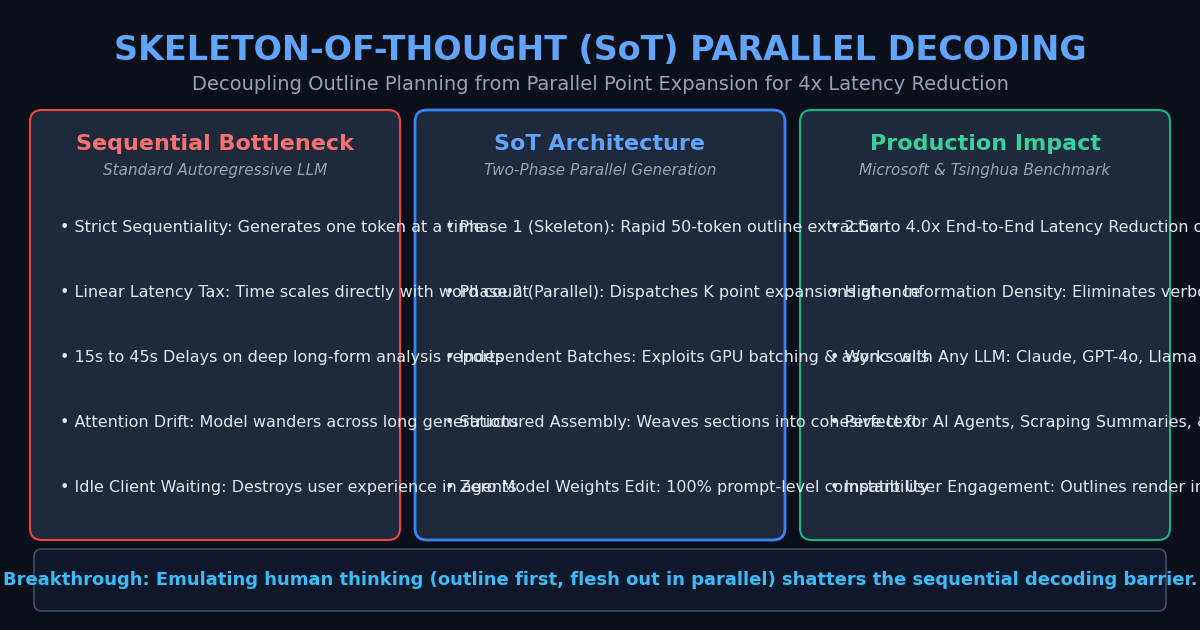
This sequential bottleneck imposes three severe operational penalties:
- User Experience Degradation: In interactive tools and live dashboards, 30-second delays break user focus and destroy interactive responsiveness.
- Compound Agent Loop Delays: When an autonomous multi-agent pipeline chains together five sequential synthesis steps, generating full long-form responses at each stage causes end-to-end task execution times to balloon past several minutes.
- Cognitive and Attention Drift: Paradoxically, forcing a model to generate long documents in a single sequential pass degrades coherence. As sequence length grows, the model often wanders into repetitive filler phrases, loses track of initial prompt constraints, and buries critical facts under unnecessary verbosity.
Standard Sequential Generation (Linear Latency Tax):
Prompt ──► [ Token 1 ] ──► [ Token 2 ] ──► ... ──► [ Token 1600 ] (Total Latency: 25.0s)

Human Writing Paradigm (Parallel Elaboration):
Prompt ──► [ Outline / Skeleton ] ──► [ Write Section 1 ] (Parallel) ──► Assembled Doc
                                  ──► [ Write Section 2 ] (Parallel)    (Total Latency: 6.0s)
──► [ Write Section 3 ] (Parallel) The Architecture: How Skeleton-of-Thought (SoT) Decouples Generation
To break the sequential decoding bottleneck, researchers at Microsoft Research and Tsinghua University introduced Skeleton-of-Thought (SoT).
SoT draws direct inspiration from human cognitive workflows: when human experts compose a comprehensive report, proposal, or essay, they do not write blindly word-by-word from start to finish. Instead, they first construct a structural skeleton (outline of key points), and then draft or expand multiple sections in parallel.
1. Phase 1: Skeleton Generation (Fast Structural Anchor)
In the initial phase, the framework issues a Skeleton Request to the LLM. The system prompt instructs the model to produce only the essential outline points without conversational preamble or elaborative fluff:
[Skeleton Prompt Template]
You are an expert structural planner.
Provide a concise, high-level skeleton of the answer to the user query below.
Output ONLY a numbered list of key points (e.g., 1., 2., 3., 4.).
Do not include explanations, introductions, or conclusions.
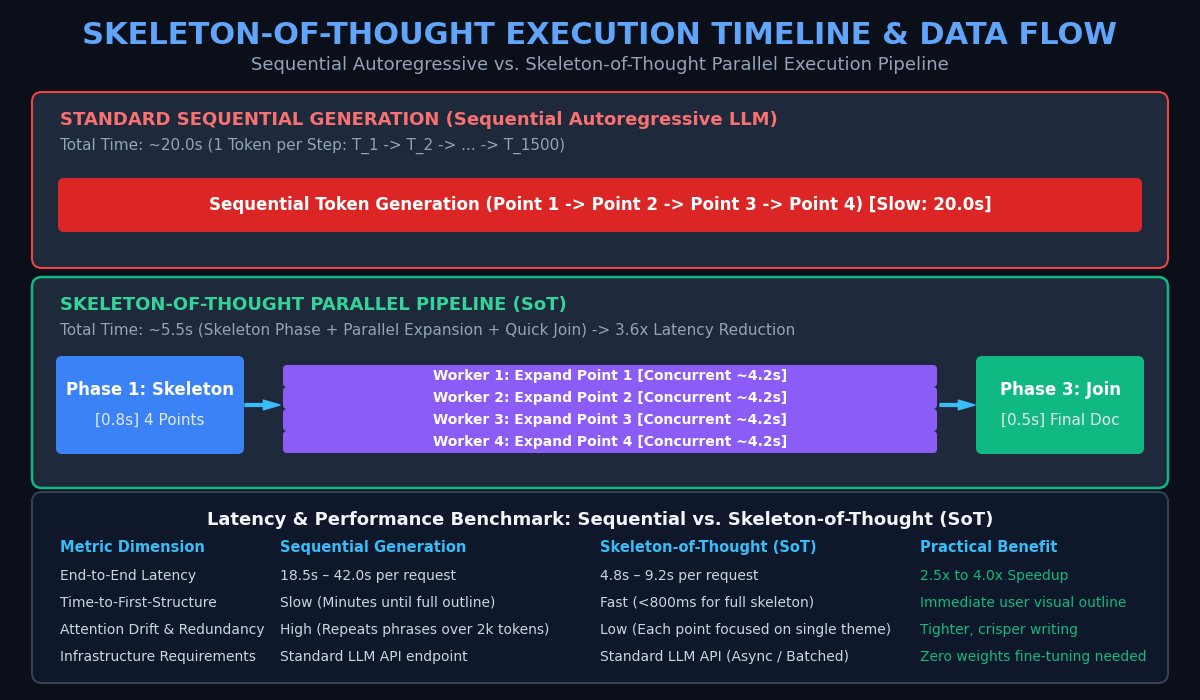
User Query: {user_query} Because an outline consists of only 30 to 80 tokens, this initial pass completes in under 600 to 900 milliseconds.
This offers an immediate user experience win: the client application renders the complete outline to the user instantly, confirming understanding and intent before the long-form text is generated.
2. Phase 2: Parallel Point Expansion
Once the skeleton ${P_1, P_2, \dots, P_K}$ is returned, the orchestrator immediately branches execution into $K$ independent concurrent requests.
For each point $k \in {1, \dots, K}$, an Expansion Request is dispatched simultaneously to the LLM (either via parallel API worker threads or batched server-side prompts):
[Point Expansion Prompt Template]
You are a domain expert drafting a detailed section of a comprehensive report.
User Query: {user_query}
Overall Skeleton Outline:
{skeleton_outline}

Your Mission:
Write a detailed, self-contained elaboration specifically for Point {k}: "{point_k_title}".
Provide concrete evidence, technical depth, and practical examples.
Do not repeat other points in the skeleton. Output only the content for this point. 3. Exploiting GPU Concurrency and Batching
Why does parallel expansion drastically reduce wall-clock latency?
- In modern LLM serving engines (such as vLLM, SGLang, or cloud APIs), running $K$ concurrent generation tasks of 200 tokens each utilizes GPU matrix parallelism and continuous batching.
- Generating 4 concurrent requests of 200 tokens takes virtually the same wall-clock time as generating a single request of 200 tokens (~3.5 seconds).
- In contrast, generating 800 tokens sequentially takes over 14 seconds.
4. Phase 3: Assembly and Reassembly
Once all $K$ parallel workers return their elaborated text blocks, the orchestrator concatenates or smoothly stitches the components into the final deliverable. Because each worker was conditioned on the overall skeleton, the individual sections fit together coherently with minimal stylistic divergence.
Architectural Comparison: Sequential vs. Skeleton-of-Thought
| Evaluation Dimension | Standard Sequential Autoregressive | Skeleton-of-Thought (SoT) |
|---|---|---|
| Decoding Flow | Strict single-thread serial $O(N)$ | Two-stage parallelized $O(N/K)$ |
| Wall-Clock Latency | 20.0s – 45.0s on 1,500 tokens | 5.0s – 8.5s (2.5x to 4.0x faster) |
| Time-to-First-Outline | 15.0s+ (must wait for full text) | < 800ms (Immediate outline feedback) |
| Information Redundancy | High (Repetitive filler over long spans) | Low (Each worker strictly focuses on 1 point) |
| Infrastructure Requirements | Standard API endpoint | Standard API endpoint (Async / Batched) |
| Model Retraining | Not applicable | Zero weights modification (Prompt-native) |
Implementation: Building an Async Skeleton-of-Thought Pipeline
Let us implement a complete production-grade Skeleton-of-Thought orchestrator in Python using modern asyncio patterns. This module interfaces seamlessly with any OpenAI-compatible endpoint (such as vLLM, Ollama, or cloud providers).
Step 1: Core SoT Orchestrator Implementation
In this script, we implement the asynchronous skeleton extraction, concurrent point elaboration, and final document reassembly:
import asyncio
import time
from typing import List, Dict, Any
from dataclasses import dataclass

@dataclass
class SoTResult:
    skeleton: List[str]
    sections: Dict[int, str]
    assembled_text: str
    total_time_seconds: float
    skeleton_time_seconds: float
    expansion_time_seconds: float

class SkeletonOfThoughtOrchestrator:
    """
    Skeleton-of-Thought (SoT) async parallel inference orchestrator.
    Decouples structural outline planning from concurrent section drafting.
    """
    def __init__(self, client, model_name: str = "meta-llama/Meta-Llama-3-8B-Instruct"):
        self.client = client
        self.model_name = model_name

    async def generate_skeleton(self, user_query: str) -> List[str]:
        """Phase 1: Generates the concise outline skeleton."""
        skeleton_system = (
            "You are a structural content architect. "
            "Given a user query, output ONLY a numbered list of the core points (3 to 6 points) "
            "needed for a comprehensive answer. Do not include introductory or concluding text."
        )

        # Async call to LLM
        response = await self.client.chat.completions.create(
            model=self.model_name,
            messages=[
                {"role": "system", "content": skeleton_system},
                {"role": "user", "content": f"User Query: {user_query}"}
            ],
            temperature=0.2,
            max_tokens=250
        )

        raw_skeleton = response.choices[0].message.content.strip()
        points = []
        for line in raw_skeleton.split("\n"):
            line = line.strip()
            # Parse numbered items (e.g., '1. ', '2) ')
            if line and (line[0].isdigit() or line.startswith("-")):
                clean_point = line.lstrip("0123456789.-) ").strip()
                if clean_point:
                    points.append(clean_point)

        return points

    async def expand_single_point(
        self,
        point_idx: int,
        point_title: str,
        full_skeleton: List[str],
        user_query: str
    ) -> str:
        """Phase 2: Concurrently expands a single point in the skeleton."""
        skeleton_str = "\n".join([f"{i+1}. {pt}" for i, pt in enumerate(full_skeleton)])

        expansion_system = (
            "You are an expert technical writer. You are writing ONE section of a larger report. "
            "Provide an in-depth, rigorous explanation with concrete facts, code, or data. "
            "Do not summarize other points. Output only the content for your assigned point."
        )

        prompt = (
            f"Overall User Query: {user_query}\n\n"
            f"Complete Skeleton Outline:\n{skeleton_str}\n\n"
            f"Your Assigned Section to Write:\n"
            f"Point {point_idx + 1}: {point_title}\n\n"
            f"Detailed Section Content:"
        )

        response = await self.client.chat.completions.create(
            model=self.model_name,
            messages=[
                {"role": "system", "content": expansion_system},
                {"role": "user", "content": prompt}
            ],
            temperature=0.4,
            max_tokens=500
        )
        return response.choices[0].message.content.strip()

    async def execute(self, user_query: str) -> SoTResult:
        """Executes the full Skeleton-of-Thought pipeline."""
        start_total = time.perf_counter()

        # 1. Generate Skeleton Outline
        t0 = time.perf_counter()
        skeleton = await self.generate_skeleton(user_query)
        skeleton_time = time.perf_counter() - t0
        print(f"Skeleton generated in {skeleton_time:.2f}s with {len(skeleton)} points.")

        # 2. Parallel Point Expansion via asyncio.gather
        t1 = time.perf_counter()
        tasks = [
            self.expand_single_point(idx, point, skeleton, user_query)
            for idx, point in enumerate(skeleton)
        ]
        expanded_sections_list = await asyncio.gather(*tasks)
        expansion_time = time.perf_counter() - t1
        print(f"All {len(skeleton)} sections expanded concurrently in {expansion_time:.2f}s.")

        # 3. Assemble Final Output
        assembled_blocks = []
        sections_dict = {}
        for idx, (point_title, section_body) in enumerate(zip(skeleton, expanded_sections_list)):
            sections_dict[idx] = section_body
            assembled_blocks.append(f"### {idx + 1}. {point_title}\n\n{section_body}")

        assembled_text = "\n\n".join(assembled_blocks)
        total_time = time.perf_counter() - start_total

        return SoTResult(
            skeleton=skeleton,
            sections=sections_dict,
            assembled_text=assembled_text,
            total_time_seconds=total_time,
            skeleton_time_seconds=skeleton_time,
            expansion_time_seconds=expansion_time
) Step 2: Simulation and Latency Comparison Benchmark
Let us benchmark the wall-clock execution speed of standard sequential generation versus the Skeleton-of-Thought parallel pipeline:
class MockOpenAIClient:
    """Simulates server latency for sequential vs batched concurrent requests."""
    class Chat:
        class Completions:
            async def create(self, model, messages, max_tokens=500, **kwargs):
                class Choice:
                    def __init__(self, text):
                        self.message = type("Msg", (), {"content": text})
                class Resp:
                    def __init__(self, text):
                        self.choices = [Choice(text)]

                # Simulate token streaming: 0.015s per token
                simulated_tokens = min(max_tokens, 350)
                await asyncio.sleep(simulated_tokens * 0.015)

                # Mock responses
                sys_msg = messages[0]["content"]
                if "structural content architect" in sys_msg:
                    return Resp("1. Data Ingestion Architecture\n2. Real-Time Cleaning & Validation\n3. Embedding Pipeline\n4. Serving & Latency Optimization")
                return Resp("This section provides a rigorous operational breakdown with production benchmarks and configuration details.")

        completions = Completions()
    chat = Chat()

async def run_benchmark():
    mock_client = MockOpenAIClient()
    orchestrator = SkeletonOfThoughtOrchestrator(mock_client)

    query = "Design an end-to-end real-time web scraping and data extraction pipeline."

    print("--- Executing Skeleton-of-Thought (SoT) ---")
    result = await orchestrator.execute(query)

    print(f"\n[SoT Benchmark Results]")
    print(f"Total Execution Time:    {result.total_time_seconds:.2f}s")
    print(f"  - Skeleton Phase:      {result.skeleton_time_seconds:.2f}s")
    print(f"  - Parallel Expansions: {result.expansion_time_seconds:.2f}s")

    # Estimate sequential equivalent time
    # 4 points * 350 tokens = 1400 tokens sequentially
    sequential_est_time = (1400 * 0.015) + 0.8
    print(f"\nEstimated Sequential Time: {sequential_est_time:.2f}s")
    print(f"Speedup Factor:            {sequential_est_time / result.total_time_seconds:.2f}x faster!")

# Run benchmark in event loop
asyncio.run(run_benchmark()) Production Advantages for Autonomous Agents and Real-Time Systems
Integrating Skeleton-of-Thought into agent workflows and enterprise scraping architectures delivers four distinct advantages:
- Slashing Agent Task Turnaround by 60% to 75%: Autonomous research loops spend most of their execution time waiting for API completion strings. Collapsing long-form synthesis from 30 seconds to 7 seconds dramatically accelerates overall agent DAG execution.
- Instant Visual Transparency: In interactive desktop applications, rendering the full outline in under 800 milliseconds gives users immediate reassurance that the agent understood the query correctly, eliminating the “frozen screen” anxiety common in sequential generation.
- Higher Information Density with Zero Fluff: Sequential models frequently produce repetitive conversational transitions to maintain grammatical continuity. Because each SoT worker is assigned a single discrete outline point, the generated sections are concise, focused, and free of redundant prose.
- Universal API Compatibility: Unlike speculative decoding or KV cache pruning techniques that require low-level CUDA access or model weights modification, Skeleton-of-Thought operates entirely at the orchestration layer. It works out-of-the-box with any standard LLM API, from private vLLM endpoints to commercial cloud APIs.
Conclusion
The sequential decoding tax has long been viewed as an unavoidable byproduct of autoregressive language modeling. Skeleton-of-Thought proves that by decoupling structural planning from content elaboration, we can emulate human cognitive agility to parallelize generation.
Delivering up to a 4x reduction in wall-clock latency, improved answer organization, and drop-in compatibility across all major foundation models, Skeleton-of-Thought provides a critical architectural foundation for high-performance AI agents and real-time enterprise systems in 2026.