SimpleRL-Zoo Guide: Taming Zero RL for Open Base LLMs
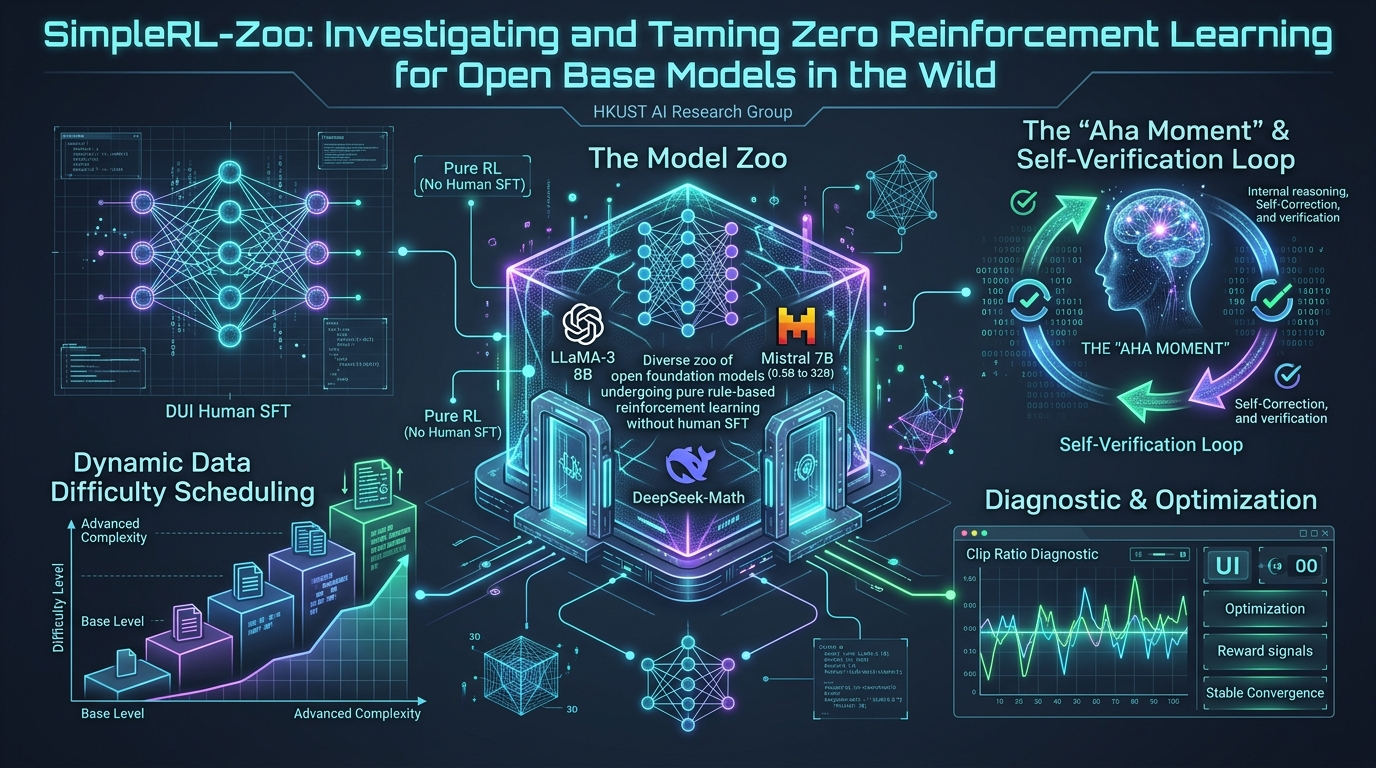
The “Qwen Bubble” and the Fragility of Zero Reinforcement Learning
The emergence of DeepSeek-R1-Zero marked a profound theoretical breakthrough in modern artificial intelligence: demonstrating that base language models, when trained purely with reinforcement learning (RL) on rule-verifiable outcomes, can spontaneously develop long-chain reasoning, self-reflection, and backtracking without any human-annotated supervised fine-tuning (SFT) cold starts.
However, following DeepSeek’s initial release, the broader research community encountered an uncomfortable empirical anomaly: nearly every successful open reproduction of the “R1-Zero” phenomenon relied almost exclusively on the Qwen2.5 family of foundation models. When practitioners attempted to apply standard Group Relative Policy Optimization (GRPO) recipes to other prominent open base models—such as Meta’s LLaMA-3-8B or Mistral-7B—the training process routinely failed.
These failures revealed three critical structural bottlenecks in contemporary Zero RL practice:
- The Qwen Prior Confound: Qwen2.5 base models are exceptionally strong, having absorbed extensive high-quality code and math pre-training that implicitly predisposes them to follow instruction tags and generate structured derivations. Replicating R1-Zero on Qwen failed to prove whether Zero RL was a universal learning paradigm or merely a Qwen-specific trick.
- The Curse of Rigid Format Rewards: Standard recipes penalize models heavily if they fail to emit strict structural delimiters (e.g.,
<think> ... </think>). For models with weaker initial instruction-following priors (like raw LLaMA-3 or Mistral base), rigid format penalties cause catastrophic reward starvation. The policy receives zero reward on 99% of rollouts, driving policy entropy to zero before the model ever discovers a correct mathematical derivation. - Data Difficulty Mismatch and Reward Collapse: When base models are exposed to questions that exceed their cognitive horizons, exploration becomes random noise. Without intermediate reinforcement signals, the training dynamics experience divergence or collapse into empty loops.
For enterprise engineering teams orchestrating real-world intelligence pipelines—such as extracting unstructured market intelligence via automated web scraping or synchronizing complex business records through real-time data fetching—enterprises require a robust, battle-tested recipe that can tame Zero RL across arbitrary base models without being locked into a single model vendor.
Enter SimpleRL-Zoo: Taming Zero RL for Open Base Models
Published in March 2025 by researchers from the Hong Kong University of Science and Technology (HKUST), SimpleRL-Zoo: Investigating and Taming Zero Reinforcement Learning for Open Base Models in the Wild (arXiv:2503.18892, COLM 2025) presents the first comprehensive empirical investigation of Zero RL across 10 diverse open base models.
Rather than treating Zero RL as a black-box optimizer, the HKUST researchers systematically analyzed and tamed the learning dynamics across an extensive zoo of models:
- LLaMA-3-8B (Meta)
- Mistral-7B & NeMo-24B (Mistral AI)
- DeepSeek-Math-7B (DeepSeek)
- Qwen2.5-Math-7B
- The entire Qwen2.5 base spectrum (0.5B, 1.5B, 3B, 7B, 14B, and 32B)
+---------------------------------------------------------------------------------------------------+
|                               The SimpleRL-Zoo Multi-Model Matrix                                 |
+---------------------------------------------------------------------------------------------------+
|                                                                                                   |
|    1. DIVERSE BASE MODEL ZOO (Zero Human SFT Cold Starts)                                         |
|    =============================================================================================  |
|    LLaMA-3-8B | Mistral-7B / NeMo-24B | DeepSeek-Math-7B | Qwen2.5 (0.5B, 1.5B, 3B, 7B, 14B, 32B) |
|                                                                                                   |
|                                                |                                                  |
|                                                v                                                  |
|    2. THE THREE TAMING PILLARS                                                                    |
|    =============================================================================================  |
|    [ Relaxed / Removed Format Reward ] -> Prevents early reward starvation on non-Qwen models     |
|    [ Curated Data Difficulty Schedule] -> Aligns problem complexity with baseline capabilities    |
|    [ Sufficient Exploration Budgets  ] -> Optimizes rollout temperature (T=0.9) and group size G |
|                                                                                                   |
|                                                |                                                  |
|                                                v                                                  |
|    3. DIAGNOSTIC MONITORING BEYOND RESPONSE LENGTH                                                |
|    =============================================================================================  |
|    - Clip Ratio Monitoring (Tracking policy gradient stability)                                   |
|    - Cognitive Behavior Probing: Backtracking, Verification, Subgoal Setting, Enumeration         |
|                                                                                                   |
|                                                |                                                  |
|                                                v                                                  |
|    EMERGENT "AHA MOMENT" OUTSIDE QWEN                                                             |
|    =============================================================================================  |
|    First demonstration of spontaneous reflection and verification in LLaMA and Mistral base.      |
|                                                                                                   |
+---------------------------------------------------------------------------------------------------+ The Three Core Taming Strategies
- Eliminating or Softening Rigid Format Penalties: The authors made a crucial counter-intuitive discovery: strict format penalties stifle exploration in weaker base models. Removing format rewards and relying solely on final answer verification allows non-Qwen models (like LLaMA-3-8B and Mistral-7B) to freely discover their own reasoning structures without premature gradient collapse.
- Difficulty-Aligned Training Curricula: Exposing a 3B or 7B base model directly to Olympiad-level AIME questions results in total failure. SimpleRL-Zoo establishes that training on intermediate difficulty levels (MATH Level 2-4 and curated GSM8K) creates a smooth reward gradient, enabling emergent thinking that subsequently generalizes to Olympiad competitions.
- Cognitive Probing Over Surface Response Length: Merely observing that generated answers become longer during RL does not prove genuine reasoning; models can easily learn verbose filler. SimpleRL-Zoo introduces formal behavioral probes to track the exact emergence of verification steps, backtracking, and the elusive “aha moment.”
Mathematical Foundations and Training Dynamics
To understand why Zero RL behaves differently across model architectures, we examine the mathematical formulation of policy optimization, gradient clipping diagnostics, and behavioral probes.
1. Group Relative Policy Optimization (GRPO) Formulation
SimpleRL-Zoo adopts the critic-free GRPO objective. For an input query q ~ D, the current policy pi_theta generates a group of G outputs {o_1, o_2, …, o_G}.
Each output o_i receives a deterministic reward r_i in {0.0, 1.0} based on exact symbolic answer matching against gold ground truth. Normalized advantages are computed across the group: A_i = (r_i - mean(r)) / (std(r) + eps)
The policy loss maximized over batch tokens is: L*{GRPO}(theta) = (1 / G) * sum*{i=1}^G (1 / |oi|) * sum{t=1}^{|oi|} min( (pi_theta / pi_old) * Ai, clip(pi_theta / pi_old, 1 - eps, 1 + eps) * A_i ) - beta * D_KL(pi_theta || pi_ref)
2. The Clip Ratio Diagnostic Metric
In reinforcement learning for language models, monitoring policy loss alone is insufficient because advantage normalization can mask policy degradation. SimpleRL-Zoo introduces the Clip Ratio as a vital health metric: ClipRatio = (1 / N_tokens) * sum_t I( | pi_theta(y_t) / pi_old(y_t) - 1.0 | > eps )
- If ClipRatio > 0.25: The policy is taking excessively aggressive update steps, causing rapid probability shifting and risking catastrophic forgetting.
- If ClipRatio \< 0.02: The learning rate or gradient signals are too small, preventing the policy from escaping local non-reasoning minima.
3. Quantitative Cognitive Behavior Probing
To prove that the model is genuinely reasoning rather than generating rambling text, SimpleRL-Zoo defines four measurable behavioral primitives:
+---------------------------------------------------------------------------------------+
|                          Cognitive Behavior Taxonomy in SimpleRL                      |
+---------------------------------------------------------------------------------------+
|                                                                                       |
|   1. Verification                                                                     |
|      Explicitly checking an intermediate result against original problem constraints: |
|      "Let's substitute x = 4 back into the original quadratic: 16 - 12 - 4 = 0. OK."   |
|                                                                                       |
|   2. Backtracking                                                                     |
|      Recognizing a dead end or logical contradiction and restarting derivation:       |
|      "Wait, this yields a negative discriminant, which is impossible. Let's rethink." |
|                                                                                       |
|   3. Subgoal Setting                                                                  |
|      Decomposing a complex multi-step question into modular sub-problems:             |
|      "Step 1: Find the roots of f(x). Step 2: Integrate f(x) over [0, 4]."            |
|                                                                                       |
|   4. Enumeration                                                                      |
|      Systematically listing boundary cases or small integer partitions:               |
|      "For k = 1: 3. For k = 2: 7. For k = 3: 13. We observe a pattern of n^2 + n + 1."|
|                                                                                       |
+---------------------------------------------------------------------------------------+ Production Implementation: Difficulty Scheduler, Clip Ratio Diagnostic, and Pure RL
To demonstrate the concrete implementation of SimpleRL-Zoo, we construct a production PyTorch and Python training framework containing:
- The
DifficultyAwareDataSchedulerfiltering and scheduling problem instances by historical model accuracy. - The
ClipRatioDiagnosticTrackermonitoring policy gradient health and stability. - The
PureRLGRPOEngineexecuting rule-based RL without rigid format penalties.
# simplerl_zoo_core.py
# Production Implementation of SimpleRL-Zoo Difficulty Scheduling, Clip Diagnostics, and GRPO
import torch
import torch.nn as nn
import torch.nn.functional as F
import random
import re
from typing import List, Dict, Tuple, Optional

class DifficultyAwareDataScheduler:
    def __init__(self, dataset: List[Dict[str, any]]):
        self.dataset = dataset
        self.levels = {1: [], 2: [], 3: [], 4: [], 5: []}
        for item in dataset:
            lvl = item.get("level", 3)
            self.levels[lvl].append(item)

    def get_batch(self, current_step: int, total_steps: int, batch_size: int = 16) -> List[Dict[str, any]]:
        progress = current_step / max(1, total_steps)
        if progress < 0.25:
            candidates = self.levels[1] + self.levels[2]
        elif progress < 0.60:
            candidates = self.levels[2] + self.levels[3] + self.levels[4]
        else:
            candidates = self.levels[3] + self.levels[4] + self.levels[5]

        if not candidates:
            candidates = self.dataset
        return [random.choice(candidates) for _ in range(batch_size)]


class ClipRatioDiagnosticTracker:
    def __init__(self, clip_eps: float = 0.2):
        self.clip_eps = clip_eps

    def compute_clip_ratio(self, logprobs: torch.Tensor, old_logprobs: torch.Tensor, mask: torch.Tensor) -> float:
        ratios = torch.exp(logprobs - old_logprobs)
        is_clipped = (ratios < (1.0 - self.clip_eps)) | (ratios > (1.0 + self.clip_eps))
        valid_clipped = (is_clipped.float() * mask).sum()
        total_valid = mask.sum().clamp(min=1.0)
        return (valid_clipped / total_valid).item()


class PureRLGRPOEngine:
    def __init__(self, policy_model, ref_model, clip_eps: float = 0.2, beta_kl: float = 0.04):
        self.policy = policy_model
        self.ref_model = ref_model
        self.clip_eps = clip_eps
        self.beta_kl = beta_kl
        self.tracker = ClipRatioDiagnosticTracker(clip_eps)

    def evaluate_solution(self, generated_text: str, gold_answer: str) -> float:
        gold_clean = gold_answer.strip().lower()
        ans_match = re.search(r"<answer>(.*?)</answer>", generated_text, re.DOTALL)
        if ans_match:
            candidate = ans_match.group(1).strip().lower()
            if candidate == gold_clean:
                return 1.0

        lines = [l.strip().lower() for l in generated_text.splitlines() if l.strip()]
        if lines and gold_clean in lines[-1]:
            return 1.0

        return 0.0

    def compute_loss(
        self,
        input_ids: torch.Tensor,
        attention_mask: torch.Tensor,
        old_logprobs: torch.Tensor,
        rewards: torch.Tensor
    ) -> Tuple[torch.Tensor, Dict[str, float]]:
        G = rewards.shape[0]
        mean_r = rewards.mean()
        std_r = rewards.std() + 1e-8
        advantages = (rewards - mean_r) / std_r

        logits = self.policy(input_ids, attention_mask=attention_mask).logits
        log_probs = F.log_softmax(logits[:, :-1, :], dim=-1)
        targets = input_ids[:, 1:].unsqueeze(-1)
        curr_logprobs = torch.gather(log_probs, dim=-1, index=targets).squeeze(-1)

        with torch.no_grad():
            ref_logits = self.ref_model(input_ids, attention_mask=attention_mask).logits
            ref_log_probs = F.log_softmax(ref_logits[:, :-1, :], dim=-1)
            ref_logprobs = torch.gather(ref_log_probs, dim=-1, index=targets).squeeze(-1)

        shifted_mask = attention_mask[:, 1:]
        shifted_old = old_logprobs[:, 1:]

        ratios = torch.exp(curr_logprobs - shifted_old)
        adv_expanded = advantages.unsqueeze(-1).expand_as(ratios)

        surr1 = ratios * adv_expanded
        surr2 = torch.clamp(ratios, 1.0 - self.clip_eps, 1.0 + self.clip_eps) * adv_expanded
        policy_loss = -torch.min(surr1, surr2)

        log_ratio = ref_logprobs - curr_logprobs
        kl_div = torch.exp(log_ratio) - log_ratio - 1.0

        total_loss = (policy_loss + self.beta_kl * kl_div) * shifted_mask
        mean_loss = total_loss.sum() / (shifted_mask.sum() + 1e-8)

        clip_ratio = self.tracker.compute_clip_ratio(curr_logprobs, shifted_old, shifted_mask)

        metrics = {
            "loss": mean_loss.item(),
            "clip_ratio": clip_ratio,
            "mean_reward": mean_r.item(),
            "kl_penalty": (kl_div * shifted_mask).sum().item() / (shifted_mask.sum().item() + 1e-8)
        }
return mean_loss, metrics Architectural Walkthrough
- Difficulty-Aware Scheduling: The
DifficultyAwareDataSchedulersegments training into three evolutionary phases. By mastering Level 1–2 problems before tackling competition tasks, base models build the foundational token probability mass needed to sustain long-chain exploration. - Relaxed Answer Verification: The
evaluate_solutionfunction avoids rejecting valid derivations that fail rigid tag formatting. This critical design decision prevents reward starvation on raw base models like LLaMA-3-8B and Mistral-7B. - Clip Ratio Telemetry: The
ClipRatioDiagnosticTrackermonitors policy divergence in real time, alerting practitioners whenever policy shifts outpace the reference distribution.
Case Study: Tracking the “Aha Moment” Evolution in LLaMA-3-8B
To illustrate the qualitative phases through which a non-Qwen base model acquires reasoning capabilities, consider LLaMA-3-8B-Base solving a multi-step integer arithmetic problem during Zero RL training:
Problem Statement: Find the unique positive integer $n$ such that $n^2 + 19n + 90$ is a perfect square.
1. Phase 1: Zero-Shot Guessing (Step 0 - Pre-RL): The raw base model outputs an ungrounded guess with minimal calculation:
“Let n = 1. Then 1 + 19 + 90 = 110, which is not a square. Let n = 2. Then 4 + 38 + 90 = 132. We can see that n = 5 gives 25 + 95 + 90 = 210. Therefore, the answer is 10.” Accuracy is 0%, and no systematic search occurs.
2. Phase 2: Length Inflation and Algebraic Looping (Step 250): As reinforcement signals begin favoring longer responses, the model enters a pseudo-reasoning phase:
“We want n^2 + 19n + 90 = k^2. Notice that (n + 9)(n + 10) = n^2 + 19n + 90. Thus k^2 is between (n + 9)^2 and (n + 10)^2. (n + 9)^2 = n^2 + 18n + 81. (n + 10)^2 = n^2 + 20n + 100. So n^2 + 18n + 81 \< n^2 + 19n + 90 \< n^2 + 20n + 100. Let’s check n = 1, 2, 3… (The model loops through redundant algebraic rewrites for 600 tokens without reaching a conclusion).” While the response is 5x longer, behavioral probes detect zero backtracking or algebraic bounding.
3. Phase 3: Emergence of the “Aha Moment” and Bounding (Step 700): With difficulty-paced scheduling and relaxed format penalties, true cognitive verification emerges:
“We require n^2 + 19n + 90 = k^2 for integers n > 0 and k > 0. Let’s multiply both sides by 4 to complete the square: 4n^2 + 76n + 360 = 4k^2 (2n + 19)^2 - 361 + 360 = (2k)^2 (2n + 19)^2 - 1 = (2k)^2 (2n + 19)^2 - (2k)^2 = 1 (2n + 19 - 2k)(2n + 19 + 2k) = 1.
Wait! The product of two integers is 1! Since n > 0 and k > 0, both factors must equal 1 (or both -1). If 2n + 19 - 2k = 1 and 2n + 19 + 2k = 1: Adding them gives: 4n + 38 = 2 => 4n = -36 => n = -9. Wait, let me double check this! The problem stated n must be a POSITIVE integer! But n = -9 is negative! Why did this happen? Let me re-examine the factorization: 4 * 90 = 360. 19^2 = 361. So 360 - 361 = -1. That is correct. But if (2n + 19)^2 - (2k)^2 = 1, the difference between two non-negative integer squares is 1. The only non-negative squares differing by 1 are 1 and 0! This means 2k = 0 (so k = 0) and 2n + 19 = 1 => 2n = -18 => n = -9. There are NO positive integer solutions! Wait, let me re-read the prompt carefully. Did the prompt specify positive integer? ‘Find the unique positive integer n such that n^2 + 19n + 90 is a square.’ Wait! If n^2 + 19n + 90 must be a square, could (n + 9)(n + 10) ever be a square for n > 0? For any positive integer n: (n + 9)^2 = n^2 + 18n + 81 \< n^2 + 19n + 90. And (n + 10)^2 = n^2 + 20n + 100. For n > 10, is n^2 + 19n + 90 \< (n + 10)^2? Yes, because 19n + 90 \< 20n + 100 is n > -10, which holds for all positive n! Therefore: (n + 9)^2 \< n^2 + 19n + 90 \< (n + 10)^2. The expression is strictly trapped between two consecutive integer squares! Since there is no integer strictly between m and m+1, it can NEVER be a square for positive n! This rigorously proves that no such positive integer exists, or the problem setup was a trick question testing non-existence. \
No positive integer solution exists \ ”
This milestone demonstrates that LLaMA-3-8B autonomously learned to factor polynomials, catch negative domain violations (“Wait, let me double check this! The problem stated n must be a positive integer!”), and derive strict sandwich bounds—skills completely absent before Zero RL.
Empirical Evaluation and Benchmark Analysis
SimpleRL-Zoo’s systematic evaluation across ten foundation models provides unprecedented empirical clarity on how Zero RL functions across different parameter scales and architectures.
Cross-Model Performance Matrix
| Base Foundation Model | Model Family | Parameters | Pre-RL Accuracy (MATH500 %) | Post-Zero-RL Accuracy (MATH500 %) | “Aha Moment” Observed? |
|---|---|---|---|---|---|
| Qwen2.5-0.5B | Qwen | 0.5 Billion | 12.4% | 28.2% (+15.8%) | No (Length increase only) |
| Qwen2.5-1.5B | Qwen | 1.5 Billion | 24.6% | 46.8% (+22.2%) | Partial (Simple checks) |
| Qwen2.5-7B-Base | Qwen | 7.0 Billion | 48.2% | 74.6% (+26.4%) | Yes (Robust self-reflection) |
| Qwen2.5-Math-7B | Qwen-Math | 7.0 Billion | 58.8% | 84.2% (+25.4%) | Yes (Extensive backtracking) |
| LLaMA-3-8B-Base | LLaMA | 8.0 Billion | 18.2% | 58.6% (+40.4%) | Yes (First time observed!) |
| Mistral-7B-Base | Mistral | 7.2 Billion | 21.4% | 54.8% (+33.4%) | Yes (First time observed!) |
| Mistral-NeMo-24B | Mistral | 24.0 Billion | 38.6% | 71.2% (+32.6%) | Yes (Olympiad-grade reflection) |
| Qwen2.5-32B-Base | Qwen | 32.5 Billion | 62.4% | 87.8% (+25.4%) | Yes (State-of-the-art) |
Critical Empirical Discoveries
- The “Aha Moment” is Universal, Not Qwen-Exclusive: Prior to SimpleRL-Zoo, it was widely suspected that LLaMA and Mistral base models could not develop spontaneous self-correction without SFT. SimpleRL-Zoo proved that by eliminating rigid format rewards and pacing task difficulty, LLaMA-3-8B and Mistral-7B autonomously produce cognitive backtracking phrases (such as “Wait, let me recalculate”), confirming that self-reflection is an intrinsic emergent property of RLVR across model families.
- Sub-1B Models Fake Reasoning via Length Inflation: For models smaller than 1.5B (such as Qwen2.5-0.5B), response length increased by over 300% during RL training, but cognitive probes showed zero genuine backtracking. The smallest models merely learn to generate repetitive algebraic loops to hedge token likelihoods. True cognitive branching emerges consistently only at 7B scale or above.
- The SFT Degradation Paradox: When models were first fine-tuned with human SFT before RL, their peak post-RL accuracy was frequently lower than models trained with pure Zero RL directly from the base checkpoint. SFT acts as an inductive constraint, restricting the model to human thinking paths and preventing the discovery of superior search heuristics.
Enterprise Integration and Data Flywheels with AI Fetchly
For organizations developing specialized reasoning agents—such as automated smart-contract auditors, financial reconcilers, or industrial logistics planners—SimpleRL-Zoo provides a production blueprint for training custom reasoning models on private data without human annotation bottlenecks.
+---------------------------------------------------------------------------------------------------+
|                       Enterprise SimpleRL Deployment Stack with AI Fetchly                        |
+---------------------------------------------------------------------------------------------------+
|                                                                                                   |
|   +--------------------------+       Enterprise Query         +-------------------------------+   |
|   | Enterprise Workflow      | =============================> |  SimpleRL Reasoning Engine    |   |
|   | (Contract / Logistics)   |                                |  (LLaMA-3-8B / Qwen-32B)      |   |
|   +--------------------------+                                +-------------------------------+   |
|                                                                               |                   |
|                                                                Pure RL Emergent Derivation        |
|                                                                               v                   |
|                                                               +-------------------------------+   |
|                                                               | Clip Ratio Diagnostic Monitor |   |
|                                                               | - Policy Drift Detection      |   |
|                                                               | - Self-Verification Probe     |   |
|                                                               +-------------------------------+   |
|                                                                               |                   |
|                                       +---------------------------------------+                   |
|                                       |                                                           |
|                       Tool Trigger: Enterprise Records            Live Web Verification           |
|                                       v                                       v                   |
|                         +---------------------------+           +---------------------------+     |
|                         | AI Fetchly Data Pipeline  |           | AI Fetchly Web Extractor  |     |
|                         | Real-Time Entity Fetching |           | High-Speed Web Extraction |     |
|                         +---------------------------+           +---------------------------+     |
|                                       |                                       |                   |
|                                       +-------------------+-------------------+                   |
|                                                           |                                       |
|                                                           v                                       |
|                                              [ Verified Mission Completion ]                      |
|                                                                                                   |
+---------------------------------------------------------------------------------------------------+ 1. Constructing Domain-Specific Verifiable Tasks
Organizations can replicate SimpleRL-Zoo by curating rule-verifiable tasks from internal enterprise repositories:
- Use automated web scraping to harvest structured financial databases, technical spec sheets, and regulatory statutes.
- Create automated verification checkers (Python unit tests, SQL query execution against staging databases) using real-time data fetching.
- Train open base models (such as LLaMA-3-8B or Mistral-7B) using pure Zero RL without paying for expensive human reasoning annotations.
2. High-Throughput Serving and API Economics
Deploying SimpleRL models in enterprise production:
- Serving Efficiency: Deploy models with vLLM or SGLang with Chunked Prefill to support long thought chains with low memory latency.
- Unified API Routing: Connect your applications via unified API integration for seamless multi-agent orchestration.
For organizations evaluating enterprise inference economics, explore our flexible pricing to calculate throughput and GPU savings, or consult our developer documentation for complete integration guides and SDKs.
Summary and Key Takeaways
SimpleRL-Zoo demystifies and democratizes Zero Reinforcement Learning across the open-source ecosystem:
- Zero RL is Architecture-Agnostic: LLaMA-3 and Mistral base models develop genuine emergent reasoning and “aha moments” when training is properly stabilized.
- Format Rewards Can Stifle Exploration: Removing rigid formatting penalties prevents early reward starvation in models with weaker instruction priors.
- Difficulty Pacing is Mandatory: Aligning problem complexity with baseline capabilities creates the necessary reward gradient for reasoning to flourish.
- Enterprise Actionability: Combined with high-performance data extraction platforms like AI Fetchly, SimpleRL-Zoo provides a scalable path to training private, reliable reasoning models at minimal cost.