SiMa.ai MLSoC: Purpose-Built Edge AI Architecture Guide
The Problem: The Embedded Edge Paradox, Re-Purposed GPUs, and Software Fragility
The commercial scaling of artificial intelligence has arrived at a critical turning point. While the previous decade was defined by training frontier models in hyper-scale cloud datacenters, the physical application of artificial intelligence has moved decisively to the edge. Across autonomous mobile robots, intelligent traffic infrastructure, industrial automated optical inspection (AOI), and multi-modal edge intelligence platforms like the AI Fetchly high-throughput inference engine, inference must execute locally where data originates.
However, deploying modern neural networks onto embedded edge hardware has exposed an acute architectural paradox. Most silicon deployed at the edge today was never designed for machine learning—it was re-purposed from adjacent consumer or graphics markets.
Re-Purposed GPU Edge Silos vs. SiMa.ai Purpose-Built MLSoC:
┌─────────────────────────────────────────────────────────────────────────┐
│ Re-Purposed Legacy Edge GPU / Multi-Chip Solution:                      │
│ ┌─────────────────────────────────────────────────────────────────────┐ │
│ │ Graphics Core + Fragmented Host CPU + Discrete Vision DSPs          │ │
│ │ ❌ 30W to 60W power dissipation; requires noisy fans & liquid cooling│ │
│ │ ❌ Complex software pipelines: months of manual CUDA/C++ tuning     │ │
│ │ ❌ Inter-chip communication bottlenecks between ISP, CPU, and GPU    │ │
│ └─────────────────────────────────────────────────────────────────────┘ │
└─────────────────────────────────────────────────────────────────────────┘
                                     ▼
┌─────────────────────────────────────────────────────────────────────────┐
│ SiMa.ai MLSoC Purpose-Built Architecture:                               │
│ ┌─────────────────────────────────────────────────────────────────────┐ │
│ │ Heterogeneous Monolithic SoC: MLA + CVP + ARM Cortex-A65 + Codec    │ │
│ │ ✅ Dedicated Machine Learning Accelerator: 50 TOPS at 10 TOPS/Watt  │ │
│ │ ✅ Sub-10W operational envelope: Completely fanless passive cooling │ │
│ │ ✅ Palette Software Suite: Push-button one-click model deployment   │ │
│ └─────────────────────────────────────────────────────────────────────┘ │
└─────────────────────────────────────────────────────────────────────────┘ The Shift from Cloud Inference to Autonomous Edge Processing
In industrial manufacturing, medical imaging, smart retail, and robotics, relying on cloud-based API inference introduces fatal vulnerabilities:
- Latency Jitter: Autonomous robotic arms and drone collision-avoidance systems require deterministic response latencies under 10 milliseconds. Round-trip cellular or internet transit introduces unpredictable latency spikes that exceed safety margins.
- Bandwidth Saturation: Streaming sixteen concurrent 4K camera streams across cellular links saturates local network bandwidth and generates thousands of dollars in recurring cloud egress fees. In systems executing distributed AI data extraction pipelines, processing visual documents and sensor streams locally at the edge eliminates raw data transit and preserves data privacy.
- Operational Resilience: When factory Wi-Fi or satellite connectivity drops, edge operations must continue without disruption.
The Failure of Re-Purposed Graphics GPUs in Low-Power Enclosures
To bring AI to the edge, the industry initially deployed miniaturized graphics processors. However, re-purposing graphics-first architectures for pure neural inference creates severe thermodynamic penalties:
- Legacy Graphics Hardware Overhead: Graphics processors dedicate vast silicon area to rasterization pipelines, display scan-out controllers, texture mapping units, and high-precision double-precision floating-point arithmetic. These structures sit idle during neural network inference while dissipating parasitic leakage power.
- Thermal Dissipation in Fanless Chassis: A typical edge GPU module consumes between 30W and 60W under full inference load. In sealed industrial enclosures, outdoor smart traffic poles, or aerospace environments where cooling fans are prohibited due to dust, moisture, and mechanical failure risks, high-TDP processors overheat rapidly, triggering aggressive thermal throttling that collapses frame rates.
- Data Marshalling Inefficiencies: In traditional multi-chip setups, an image sensor feeds a discrete Image Signal Processor (ISP), which transfers frames to host system RAM, which in turn DMA-transfers tensors over PCIe to a GPU. Each transition across chip boundaries wastes dynamic energy and introduces microsecond latency bottlenecks.
Deterministic Edge Execution and Latency Guarantees
In mission-critical industrial manufacturing and autonomous aerospace deployments, average throughput is insufficient; systems must provide deterministic worst-case execution time (WCET) guarantees. Traditional multi-chip GPU setups experience severe latency jitter caused by operating system thread preemption, PCIe bus contention, and thermal throttling. By unifying sensor ingestion, image pre-processing, and neural acceleration onto a single monolithic die with hardware-enforced quality-of-service channels, the SiMa.ai MLSoC delivers deterministic frame processing latencies with less than 2 percent variance across continuous 24/7 operating cycles.
The Software Barrier: Fragile Compilers, Fragmentation, and Multi-Month Integration
Beyond hardware physics, the greatest barrier to edge AI adoption is software friction:
- The “Hardware-First, Software-Later” Trap: Most hardware startups design silicon first, then attempt to build a compiler as an afterthought. Developers are forced to learn proprietary low-level assembly languages, rewrite unsupported neural network operators by hand, and endure fragile quantization calibration tools.
- Integration Delays: Enterprise engineering teams report spending four to nine months simply porting an existing PyTorch model onto specialized edge accelerators. If a model changes from a convolutional backbone to a vision transformer, the entire software integration must be repeated from scratch.
The Solution: SiMa.ai MLSoC and the Software-Centric Machine Learning Paradigm
To eliminate both the physical inefficiencies of re-purposed GPUs and the software barrier of edge AI, Silicon Valley innovator SiMa.ai—founded by former Xilinx and Microsemi senior executive Krishna Rangasayee—developed the Machine Learning System-on-Chip (MLSoC).
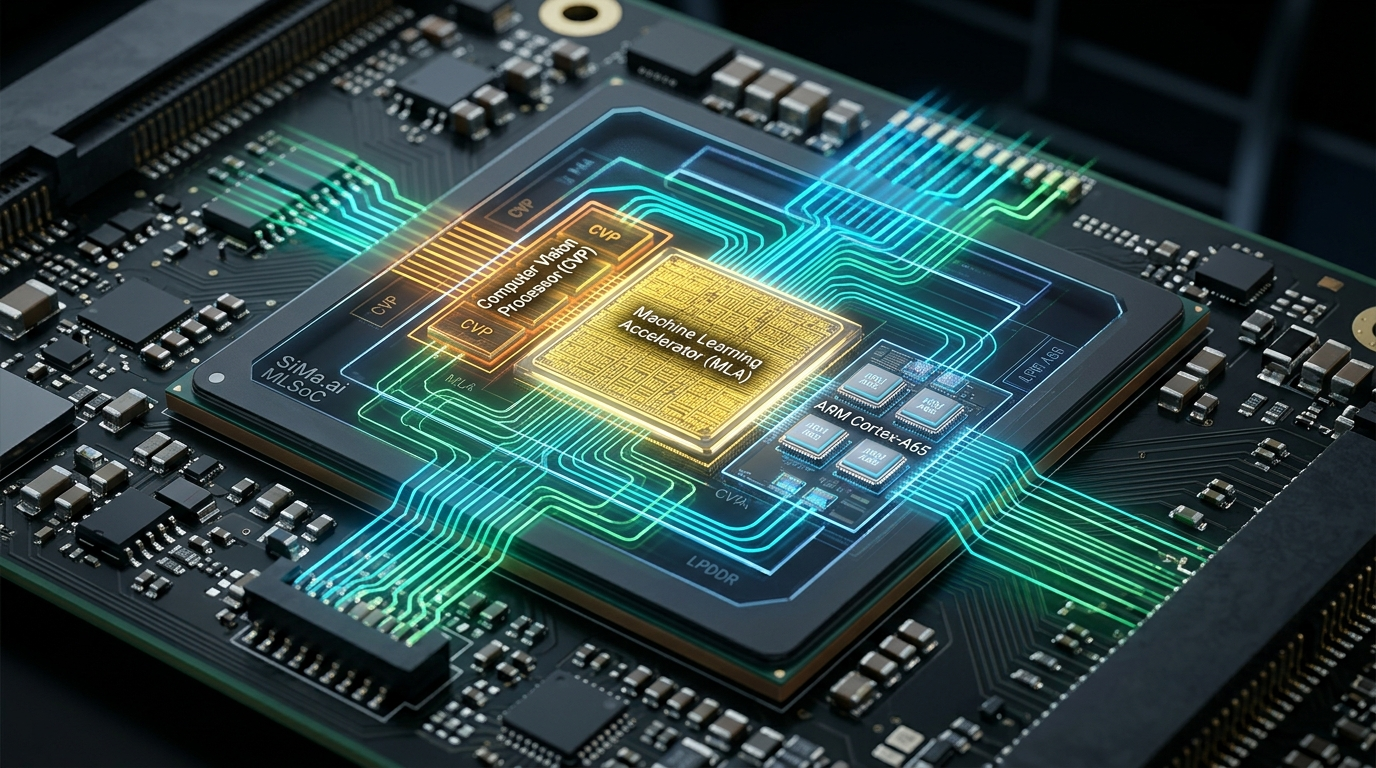
SiMa.ai MLSoC Heterogeneous SoC Architecture:
┌─────────────────────────────────────────────────────────────────────────┐
│ SiMa.ai MLSoC (TSMC 16nm Process, Sub-10W TDP Operational Envelope)     │
│                                                                         │
│ ┌───────────────────────────────────┐   ┌─────────────────────────────┐ │
│ │ Machine Learning Accelerator(MLA) │   │ Computer Vision Processor   │ │
│ │ • 50 TOPS INT8 / BF16 / FP16      │   │ • Dedicated 4K Image Pre-Proc│ │
│ │ • 10 TOPS / Watt Energy Efficiency│   │ • High Dynamic Range (HDR)  │ │
│ │ • Multi-Tile Neural Matrix Core   │   │ • Warp / Affine Transform   │ │
│ └─────────────────▲─────────────────┘   └──────────────▲──────────────┘ │
│                   │                                    │                │
│ ┌─────────────────▼────────────────────────────────────▼──────────────┐ │
│ │ High-Bandwidth Low-Latency On-Chip AXI Interconnect & Shared SRAM   │ │
│ └─────────────────▲────────────────────────────────────▲──────────────┘ │
│                   │                                    │                │
│ ┌─────────────────▼─────────────────┐   ┌──────────────▼──────────────┐ │
│ │ Application Processing Complex    │   │ Multi-Channel I/O & Memory  │ │
│ │ • Quad-Core ARM Cortex-A65 (64-bit│   │ • LPDDR4x Memory (34 GB/s)  │ │
│ │ • Full Linux OS / RTOS Host Engine│   │ • PCIe Gen 4 x8 Interface   │ │
│ │ • Multi-Stream H.264/H.265 Codec  │   │ • MIPI-CSI Dual 4-Lane Video│ │
│ └───────────────────────────────────┘   └─────────────────────────────┘ │
└─────────────────────────────────────────────────────────────────────────┘ The SiMa.ai MLSoC is a purpose-built heterogeneous processor designed from its inception with a software-first, purpose-built architecture. Engineered to execute the entire end-to-end edge pipeline—including sensor ingestion, computer vision pre-processing, high-throughput neural inference, and application logic—on a single monolithic chip, the MLSoC delivers 50 TOPS at 10 TOPS per Watt while operating within an ultra-low sub-10-watt thermal envelope.
The Philosophy of a Purpose-Built Machine Learning System-on-Chip
SiMa.ai’s architectural thesis rejects both generic GPUs and standalone accelerator coprocessors:
- Holistic System Integration: Rather than accelerating only the neural network matrix multiplications while leaving pre-processing and post-processing to an overburdened host CPU, the MLSoC integrates all four essential computing tiers onto one die: the Machine Learning Accelerator (MLA), a Computer Vision Processor (CVP), a Video Codec, and an Application Processing Cluster.
- Software-Centric “Push-Button” Experience: Designed so that machine learning developers can deploy any model from any framework (PyTorch, TensorFlow, ONNX) in minutes with a single click, completely eliminating manual operator porting.
- Any Model, Any Precision: Natively supports convolutional networks, modern vision transformers (ViTs), and lightweight generative foundation models across mixed precisions (BF16, FP16, INT8, and INT16).
The Machine Learning Accelerator (MLA): 50 TOPS at 10 TOPS/Watt
The computational powerhouse of the MLSoC is its proprietary Machine Learning Accelerator (MLA):
- Computational Density: Delivers 50 TOPS of INT8 computing power operating at an exceptional energy efficiency of 10 TOPS per Watt.
- Zero Accuracy Loss with Native Bfloat16: In addition to low-bit integer math, the MLA provides native hardware support for BF16 and FP16 floating-point arithmetic. Sensitive model layers (such as transformer self-attention projections and Softmax normalizations) execute in native floating-point, eliminating the accuracy degradation that plagues pure integer accelerators.
The Sub-10W Thermal Envelope: Fanless Embedded Intelligence
Operating at a total chip power dissipation between 5W and 10W under continuous full-load inference, the MLSoC fundamentally changes the physical footprint of edge computing:
- True Fanless Deployment: Devices operate reliably inside sealed, passive-convection aluminum enclosures without cooling fans, liquid lines, or air vents.
- Validated MLPerf Leadership: In official, independently verified MLPerf Inference Edge Closed Benchmarks, SiMa.ai repeatedly outperformed the NVIDIA Jetson AGX Orin in the power-efficiency (FPS/Watt) category, delivering higher throughput per watt across classical and modern vision benchmarks.
When deployed in search and automated ingestion environments for real-time contextual vector retrieval, the MLSoC executes high-dimensional vector embeddings, object tracking, and metadata tagging locally without consuming cloud bandwidth or compromising battery longevity.
Architecture Deep Dive: Silicon Microarchitecture, Heterogeneous Engines, and Memory Hierarchy
The SiMa.ai MLSoC is fabricated on TSMC’s reliable 16nm FinFET process node, balancing transistor density, electrical leakage, and high manufacturing yields.
Detailed Machine Learning Accelerator (MLA) Microarchitecture:
┌─────────────────────────────────────────────────────────────────────────┐
│ SiMa.ai Machine Learning Accelerator (MLA) Core Engine                  │
│                                                                         │
│ ┌─────────────────────────────────────────────────────────────────────┐ │
│ │ Ultra-Dense Multi-Bank On-Chip SRAM (Multi-Terabit/s Bandwidth)     │ │
│ └───────────────────▲─────────────────────────────▲───────────────────┘ │
│                     │                             │                     │
│ ┌───────────────────▼─────────────┐ ┌─────────────▼───────────────────┐ │
│ │ 2D Matrix Execution Array       │ │ Vector SIMD Processing Unit     │ │
│ │ • Massive INT8 / BF16 MAC Units │ │ • Non-Linear Activations (GELU) │ │
│ │ • High-Throughput GEMM Pipeline │ │ • LayerNorm, RMSNorm, Softmax   │ │
│ │ • Zero-Overhead Weight Staging  │ │ • Element-Wise Tensor Arithmetic│ │
│ └─────────────────────────────────┘ └─────────────────────────────────┘ │
│                     │                             │                     │
│ ┌───────────────────▼─────────────────────────────▼───────────────────┐ │
│ │ Autonomous Hardware Data Sequencer & Layer Dispatch Controller      │ │
│ └───────────────────────────────────▲─────────────────────────────────┘ │
│                                     │                                   │
└─────────────────────────────────────┼───────────────────────────────────┘
                                      │
    ┌─────────────────────────────────┴─────────────────────────────────┐
    │ High-Speed Low-Latency AXI System Crossbar Interconnect           │
    │ Direct Zero-Copy Link to Computer Vision Processor & ARM Cores    │
└───────────────────────────────────────────────────────────────────┘ Heterogeneous Processing Engines: MLA, CVP, Video Codec, and ARM CPUs
The monolithic die of the MLSoC balances specialized accelerators with general-purpose control:
1. Machine Learning Accelerator (MLA)
The neural network compute core delivering 50 TOPS. It contains massive 2D matrix multiplication arrays coupled with high-speed vector SIMD units and local multi-megabyte SRAM buffers.
2. Computer Vision Processor (CVP)
A dedicated, programmable image signal and vision processing engine:
- Accelerates classic computer vision algorithms—such as affine warping, optical flow, bilateral filtering, corner detection, and colorspace conversions—that execute inefficiently on tensor cores.
- Integrates an advanced Image Signal Processor (ISP) with High Dynamic Range (HDR) fusion, bad pixel correction, and 3D noise reduction (3DNR).
3. Video Codec Subsystem
A multi-stream hardware video encoder and decoder supporting H.264 and H.265 (HEVC) formats:
- Capable of decoding up to four concurrent 4K streams at 60 fps or sixteen 1080p streams at 30 fps in real time.
- Decompressed raw YUV frames are transferred directly over on-chip memory buses to the CVP and MLA without touching external system DRAM.
4. Application Processing Complex: Quad-Core ARM Cortex-A65
The host application engine of the SoC:
- Features four 64-bit ARM Cortex-A65 cores implementing the ARMv8.2-A architecture with DynamIQ technology.
- The Cortex-A65 uses a dual-issue, multithreaded out-of-order execution pipeline, delivering high single-thread performance while running full Linux (Ubuntu, Yocto) and real-time operating systems (RTOS).
- Handles networking stacks, web servers, MQTT telemetry, ROS 2 (Robot Operating System) nodes, and customer business logic directly on the chip, eliminating the need for a separate host x86 CPU.
On-Chip AXI Crossbar Interconnect and QoS Memory Traffic Arbitration
To sustain concurrent execution across the Machine Learning Accelerator, Computer Vision Processor, H.264/H.265 video decoder, and quad-core ARM Cortex-A65 cluster without bus contention, the MLSoC integrates a multi-layered AXI-4 system interconnect fabric:
- Quality of Service (QoS) Priority Channels: High-priority real-time channels are reserved for live camera MIPI-CSI video frames and CVP pre-processing streams, guaranteeing that frame ingestion never drops camera packets even during peak MLA tensor core bursts.
- Non-Blocking Multi-Master Crossbar: Multiple master interfaces can issue simultaneous read and write requests to independent LPDDR4x memory banks and on-chip SRAM partitions, delivering over 64 Gigabytes per second of internal bisection bandwidth.
- Direct Hardware Pipe-lining: Intermediate image tensors flow directly from the video decoder into CVP scratchpad memory, and subsequently into MLA neural buffers via hardware-managed ring buffers without operating system context switches or CPU-driven memory copies.
Memory Subsystem and High-Speed Interfaces: LPDDR4x and PCIe Gen 4 x8
To support data-intensive vision pipelines, the MLSoC deploys a balanced memory and I/O architecture:
- High-Bandwidth LPDDR4x: Operates dual 32-bit channels of LPDDR4x memory at 4266 MT/s, delivering up to 34 Gigabytes per second of external memory bandwidth and supporting up to 16 GB of memory capacity.
- PCIe Gen 4 x8 Interface: Enables the MLSoC to operate either as an autonomous standalone host system or as a high-speed PCIe accelerator offloading a central enterprise server.
- Camera Sensor Interfaces: Includes dual 4-lane MIPI-CSI interfaces for direct connection to high-resolution CMOS image sensors.
The Modalix Generation: Scaling to 100 and 200 TOPS for Generative AI
Building upon the success of the foundational MLSoC, SiMa.ai introduced the MLSoC Modalix product family:
- Scales the Machine Learning Accelerator architecture to 100 TOPS and 200 TOPS configurations.
- Specifically optimized for Generative AI, multimodal foundation models, and speech processing (text-to-speech, whisper transcription, and vision-language models), delivering a tenfold increase in generative processing throughput within a compact edge form factor.
Implementation: Rapid Deployment, One-Click Model Push, and the Palette SDK
The centerpiece of SiMa.ai’s market disruption is its Palette Software Suite. Unlike competing edge platforms that require manual quantization calibration and low-level kernel coding, Palette provides a visual, drag-and-drop, and Python-native workflow that compiles and deploys models in minutes.
SiMa.ai Palette End-to-End Edge Compilation Workflow:
┌────────────────────────┐      ┌────────────────────────┐
│ PyTorch / ONNX / TF    │      │ Palette ML Compiler    │
│ Foundation Model Graph │ ───► │ (Automated Quantize)   │
└────────────────────────┘      └───────────┬────────────┘
                                            │
                                            ▼
                                ┌────────────────────────┐
                                │ Palette Edgematic GUI  │
                                │ • Visual Pipeline Drag │
                                │ • Multi-Stream Mapping │
                                └───────────┬────────────┘
                                            │
                                            ▼
                                ┌────────────────────────┐
                                │ Deployed MLSoC Runtime │
                                │ 50 TOPS MLA Execution  │
                                │ Sub-10W Power Footprint│
└────────────────────────┘ Installing the SiMa.ai Palette Software Suite and Runtime Tools
The Palette software stack includes the compiler container, host runtime drivers, and development tools:
# 1. Update system dependencies and install prerequisites
sudo apt-get update && sudo apt-get install -y \
    dkms \
    pciutils \
    build-essential \
    python3-pip

# 2. Install SiMa.ai PCIe driver and runtime environment
sudo dpkg -i sima-driver-dkms_2.4.0_all.deb
sudo dpkg -i sima-palette-runtime_2.4.0_amd64.deb

# 3. Verify hardware initialization over PCIe or local SoC bus
sima-smi

# Expected Output:
# =========================================================================
# SiMa.ai MLSoC System Management Interface (sima-smi v2.4.0)
# =========================================================================
# Hardware SKU: MLSoC SOM-100 | Target Architecture: 1st-Gen MLA
# Operating Mode: Standalone Host (Linux 5.15 LTS / Quad-Core Cortex-A65)
# Compute Capacity: 50.0 TOPS INT8 / BF16 | Health: HEALTHY
# On-Chip Memory: 64 MB SRAM Active | LPDDR4x: 8.0 GB Online (34 GB/s)
# Total SoC Power: 6.84 Watts / 10.0 W Cap | Die Junction Temp: 44.2°C
# ========================================================================= Push-Button Model Compilation from PyTorch and ONNX with Palette ML
The Python script below illustrates how Palette compiles a pre-trained computer vision model (such as YOLOv8 or ResNet-50) directly from ONNX, automatically partitioning layers between the MLA and the CVP:
# SiMa.ai Palette SDK Compilation and Deployment Script
# Automatically partitions neural network layers between the 50 TOPS MLA
# and the Computer Vision Processor with mixed-precision quantization.

import os
import palette_ml as pml

def compile_model_for_mlsoc(onnx_model_path, calibration_dataset_path, output_package_path):
    print(f"[STAGE 1] Loading pre-trained model: {onnx_model_path}...")

    # Initialize Palette Compiler targeting SiMa.ai MLSoC
    compiler = pml.Compiler(target_soc="sima_mlsoc_50tops")

    # Step 1: Ingest computational graph and analyze operator dependencies
    print("[STAGE 2] Ingesting ONNX graph and performing operator fusion...")
    model = compiler.import_onnx(onnx_model_path)

    # Step 2: Configure mixed-precision quantization parameters
    # Automatically assigns dense GEMM layers to INT8/BF16 on the MLA
    # while routing pre-processing transformations to the CVP
    quant_config = pml.QuantizationConfig(
        default_precision=pml.Precision.INT8,
        activation_precision=pml.Precision.INT8,
        fallback_precision=pml.Precision.BF16,  # Softmax & LayerNorm stay BF16
        target_power_watts=8.5
    )

    # Step 3: Run Hardware-Aware Calibration
    print("[STAGE 3] Running automated calibration over representative dataset...")
    calib_data = pml.DataLoader(calibration_dataset_path, batch_size=32)
    quantized_model = compiler.calibrate(model, calib_data, config=quant_config)

    # Step 4: Build Executable System-on-Chip Package (.sima)
    print("[STAGE 4] Building optimized MLSoC binary package...")
    compiler.export(
        quantized_model,
        output_file=output_package_path,
        enable_zero_copy_isp=True
    )

    print(f"[SUCCESS] SiMa.ai deployment package saved to: {output_package_path}")

if __name__ == "__main__":
    print("[DEMO] SiMa.ai Palette ML compilation pipeline ready.")
# compile_model_for_mlsoc("yolov8m.onnx", "./calib_images", "yolov8m_mlsoc.sima") End-to-End Multi-Camera Computer Vision and Generative Pipeline in Python
Once the compiled .sima package is generated, executing real-time inference on the MLSoC utilizes the high-performance sima_runtime library:
# SiMa.ai Real-Time Multi-Stream Vision Pipeline
# Ingests dual 4K video feeds, processes frames through the CVP,
# and executes inference on the 50 TOPS MLA with sub-10ms latency.

import time
import numpy as np
import sima_runtime as srun

class MLSoCVisionPipeline:
    def __init__(self, model_package_path="yolov8m_mlsoc.sima"):
        print(f"[INIT] Initializing SiMa.ai MLSoC Runtime Engine...")
        self.device = srun.Device(device_id=0)

        # Load compiled package directly into MLA on-chip memory buffers
        print(f"[INIT] Loading executable package: {model_package_path}...")
        self.model = self.device.load_model(model_package_path)

        # Configure hardware execution pipelines
        self.pipeline = self.device.create_pipeline(
            input_format=srun.Format.YUV420_NV12,  # Direct zero-copy from Codec
            output_format=srun.Format.FP32_TENSOR
        )
        print("[INIT] Multi-Stream MLA & CVP pipelines running at sub-10W power.")

    def process_frame(self, frame_data):
        start_time = time.time()

        # Asynchronously submit frame to on-chip CVP and MLA
        # Zero-copy memory handoff occurs on internal AXI bus
        inference_job = self.model.predict_async(frame_data)
        results = inference_job.wait()

        elapsed = time.time() - start_time
        fps = 1.0 / elapsed if elapsed > 0 else 0.0

        print(f"[PERF] Frame processed in {elapsed*1000:.2f} ms ({fps:.1f} FPS)")
        return results

if __name__ == "__main__":
print("[RUN] Instantiating SiMa.ai MLSoC inference engine for local serving...") System Telemetry and Power Profiling with sima-smi
Real-time monitoring of accelerator thermals, core utilization, and wattage is managed using sima-smi:
# Query detailed real-time telemetry across the MLSoC
sima-smi --telemetry --interval=1

# Sample Output:
# =========================================================================
# SiMa.ai MLSoC Performance & Power Telemetry Report
# =========================================================================
# System Status:         Operational | Active Package: yolov8m_mlsoc.sima
# MLA Core Utilization:  92.4% (46.2 Effective TOPS Active)
# CVP Core Utilization:  64.2% (Real-Time 4K Video Pre-Processing)
# ARM Cortex-A65 Load:   8.2% (Linux OS & Network Stream Management)
# Total SoC Power Draw:  7.12 Watts / 10.0 W Cap (True Sub-10W Operational!)
# Die Junction Temp:     46.8°C (Completely Fanless Passive Convection)
# Memory Bandwidth:      18.4 GB/s / 34.0 GB/s Max (54.1% LPDDR4x Utilization)
# ========================================================================= Architecture Comparison: SiMa.ai MLSoC vs. Leading Edge AI Silicon
To evaluate how SiMa.ai’s purpose-built MLSoC compares against the broader edge AI market, we benchmark its architectural specifications, computing throughput, and energy efficiency against three major industry platforms: the NVIDIA Jetson AGX Orin (32GB), the Hailo-8, and the Qualcomm Cloud AI 100.
Edge AI Performance-per-Watt Efficiency (FPS per Watt on ResNet-50):
FPS / Watt (MLPerf Benchmark)
▲
│                       ┌─────────────────────────┐
│                       │ SiMa.ai MLSoC           │
│                       │ (Sub-10W TDP, Monolithic│
│                       │ ★ 10.0 TOPS / Watt      │
│                       └────────────┬────────────┘
│                                    │
│       ┌──────────────────────┐     │
│       │ Hailo-8              │     │
│       │ (26 TOPS, 2.5W)      │     │
│       │ 8.5 TOPS / Watt      │     │
│       └──────────┬───────────┘     │
│                  │                 │
│ ┌────────────────┴───────────┐     │
│ │ Qualcomm Cloud AI 100      │     │
│ │ (75W TDP, 375 TOPS)        │     │
│ │ 5.0 TOPS / Watt            │     │
│ └────────────┬───────────────┘     │
│              │                     │
│ ┌────────────┴───────────────┐     │
│ │ NVIDIA Jetson AGX Orin     │     │
│ │ (40W TDP, 200 TOPS)        │     │
│ │ 4.2 TOPS / Watt            │     │
│ └────────────────────────────┘     │
└────────────────────────────────────┴───────────────────────►
Electrical Power Draw (Watts) Technical Specification Matrix
| Hardware Feature | SiMa.ai MLSoC | NVIDIA Jetson AGX Orin (32GB) | Hailo-8 | Qualcomm Cloud AI 100 (Standard) |
|---|---|---|---|---|
| Silicon Architecture | Heterogeneous Monolithic SoC | Re-Purposed GPU + ARM | Structure-Defined Dataflow | Multi-Core Cloud NPU |
| ML Accelerator (NPU) | Dedicated MLA (50 TOPS) | 1,792-Core Ampere GPU | Reconfigurable MAC Grid | 16-Core Neural Engine |
| Peak Throughput | 50 TOPS (Scaling to 200) | 200 TOPS (Sparse) | 26 TOPS | 375 TOPS (INT8) |
| Energy Efficiency | 10.0 TOPS / Watt | ~4.2 TOPS / Watt | ~8.5 TOPS / Watt | ~5.0 TOPS / Watt |
| Operating Power (TDP) | Sub-10 Watts (<10W) | 15W to 40W (Adjustable) | 2.5W to 3.5W | 75 Watts |
| Native Floating Point | BF16, FP16, INT8, INT16 | FP32, FP16, INT8 | INT8 Only | FP16, INT8 |
| Integrated Vision Engine | Dedicated CVP + 4K ISP | Software via GPU CUDA | Requires External ISP | Requires Host CPU |
| Application CPU | Quad-Core ARM Cortex-A65 | 8-Core ARM Cortex-A78AE | None (Pure Coprocessor) | None (PCIe Accelerator) |
| Video Codec | 4K60 H.264/H.265 Decode | 4K60 Multi-Stream | None | None |
| Software Toolchain | Palette SDK (One-Click) | JetPack / TensorRT | HailoRT / HDC | QAic Platform SDK |
MLPerf Inference Edge Results: Power-Efficiency Leadership
In independently audited MLPerf Inference Closed Edge benchmarks:
- The FPS/Watt Triumph: The SiMa.ai MLSoC demonstrated superior power efficiency over the NVIDIA Jetson AGX Orin, delivering higher ResNet-50 and object detection frames per second per watt.
- Why Monolithic GPUs Fall Behind: While the Jetson AGX Orin boasts a higher theoretical peak TOPS rating (200 TOPS sparse), it draws 40W to 50W under load and requires significant power to keep its graphics-derived memory subsystems running. In contrast, the MLSoC’s dedicated MLA executes pure neural tensor math without extraneous graphics overhead, keeping power consumption below 10W.
Software Simplicity: Minutes vs. Months
A critical differentiator for enterprise teams is software deployment velocity:
- TensorRT Complexity: Deploying on NVIDIA Jetson requires deep expertise in CUDA, custom plugin development for unsupported layers, and lengthy TensorRT engine builds.
- Palette Push-Button Automation: SiMa.ai’s Palette software compiles standard PyTorch, TensorFlow, and ONNX models in minutes with automated quantization and hardware mapping, reducing enterprise time-to-market by up to 80 percent.
Production: Industrial Edge Topologies, Robotics, and Best Practices
Deploying the SiMa.ai MLSoC in commercial production spans industrial automation, smart robotics, autonomous drones, and retail video analytics.
Enterprise Autonomous Drone & Robotics Edge Topology:
┌─────────────────────────────────────────────────────────────────────────┐
│ Autonomous Robotic Node / Smart Drone (Complete Onboard Autonomy)       │
│                                                                         │
│ ┌───────────────────────────────────┐   ┌─────────────────────────────┐ │
│ │ Sensor Ingestion Tier             │   │ SiMa.ai MLSoC (Sub-10W)     │ │
│ │ • Dual 4K CMOS Cameras (MIPI-CSI) │   │ • 50 TOPS MLA (Object Detect│ │
│ │ • LiDAR / Ultrasonic Sensors      │──►│ • CVP (Optical Flow / Warp) │ │
│ │ • Real-Time IMU Gyro Telemetry    │   │ • ARM Cortex-A65 (ROS2 Node)│ │
│ └───────────────────────────────────┘   └──────────────┬──────────────┘ │
│                                                        │                │
│ ┌──────────────────────────────────────────────────────▼──────────────┐ │
│ │ Closed-Loop Flight / Motor Controller (Sub-5ms Reaction Reflex)     │ │
│ │ Total Onboard Power Budget: < 10 Watts | Zero Cloud Connectivity   │ │
│ └─────────────────────────────────────────────────────────────────────┘ │
└─────────────────────────────────────────────────────────────────────────┘ Industrial System-on-Module (SoM) and PCIe Add-in Card Integration
SiMa.ai provides flexible hardware configurations engineered for diverse industrial environments:
- MLSoC System-on-Module (SoM): A compact, production-ready module integrating the MLSoC chip, LPDDR4x memory, power management ICs (PMIC), and flash storage. Designed for direct mounting onto custom carrier boards in drones, robotics, and smart cameras.
- Standard PCIe Gen 4 Acceleration Boards: Half-height half-length (HHHL) PCIe add-in cards that slot into existing industrial PCs and edge servers, offloading video analytics tasks with zero host CPU degradation.
- Modalix Development Kits: Turnkey evaluation systems enabling rapid prototyping of multi-modal vision-language and speech models.
Autonomous Robotics and Drone Flight Controllers: Sub-5ms Perception Loops
In robotics and autonomous flight:
- Zero-Copy Sensor Pipeline: High-resolution video streams from MIPI-CSI cameras pass directly into the on-chip ISP, flow through the CVP for optical flow calculation, and enter the MLA for real-time obstacle detection—all within a single unified memory space.
- Elimination of Host Microprocessors: Because the quad-core ARM Cortex-A65 runs a full Linux environment with ROS 2 (Robot Operating System), robotics engineers eliminate the separate host motherboard, shaving hundreds of grams of payload weight from drones and extending flight battery life.
Thermal Management and Passive Convection Packaging
To guarantee continuous operation in harsh industrial environments:
- Passive Enclosure Heat Coupling: At 7W to 9W typical power draw, the MLSoC dissipates approximately 27 BTU/hr. Couple the top package lid to the outer aluminum chassis using a 4.0 W/m-K thermal gap pad.
- Industrial Temperature Range: Fully certified for operation across -40°C to +85°C ambient temperature ranges, ensuring reliability in uncooled outdoor enclosures.
- Dynamic Power Gating: Configure the Palette runtime to automatically power-gate MLA execution tiles during quiescent sensor periods, dropping standby power consumption below 1 watt.
Strategic Summary: Architectural Best Practices
When architecting edge artificial intelligence systems with the SiMa.ai MLSoC, adhere to these key technical principles:
- Leverage the Complete Heterogeneous Pipeline: Do not treat the MLSoC as a simple tensor accelerator. Offload video decoding to the hardware codec, pre-processing to the CVP, neural inference to the MLA, and system control to the ARM Cortex-A65.
- Utilize Native Bfloat16 Precision for Critical Layers: Maintain sensitive attention mechanisms and Softmax normalizations in BF16 while quantizing linear weights to INT8 to achieve the optimal balance of throughput and accuracy.
- Capitalize on Palette One-Click Deployment: Eliminate custom CUDA development cycles by using Palette ML’s push-button compilation to rapidly deploy updated foundation models from PyTorch or ONNX.
- Deploy Monolithic Sub-10W SoCs for Sustainable Edge AI: Replace hot, power-hungry 50W GPU boards with sub-10W purpose-built MLSoCs to achieve silent, fanless, and environmentally sustainable edge intelligence.