SiFive Intelligence X280 Guide: RISC-V Vector AI Silicon
The Accelerator Disconnect: Why Separate CPUs and GPUs Cripple AI Workflows
The rapid evolution of modern artificial intelligence—spanning large language models (LLMs), multimodal vision-language models (VLMs), high-dimensional vector embeddings, and autonomous agent loops—has exposed a profound structural inefficiency in contemporary computer architecture: the rigid separation between host application processors and specialized AI acceleration hardware.
For more than a decade, enterprise datacenter servers and high-performance edge gateways have been architected around an offload-centric master-slave topology. In this conventional paradigm, general-purpose central processing units (CPUs, typically x86 or standard Arm cores) handle the operating system, network stack, application control flow, and input data formatting. When a machine learning inference task must be calculated, the host CPU packages the tensor buffers, dispatches execution commands across a peripheral bus (such as PCIe), wakes the attached accelerator (GPU, NPU, or TPU), and waits for completion interrupts.
While this decoupled model delivers impressive throughput on large, homogeneous batch-training workloads, it introduces four severe microarchitectural failure modes in real-world production inference and edge intelligence:
- The PCIe Serialization and Data Marshaling Tax: In modern generative AI workflows, models do not execute in isolation. Real-world applications require continuous interleaving of control-plane logic, data parsing, and tensor math. When an agent processes dynamic document queries or multi-turn conversational prompts, data must continuously hop between host CPU system memory and accelerator high-bandwidth memory. Transferring tensors across PCIe buses incurs microsecond serialization delays, DMA synchronization barriers, and cache invalidation overhead that frequently dwarfs the execution time of the neural network layer itself.
- Control Flow Inflexibility and Non-Tensor Bottlenecks: Contemporary frontier models are no longer composed exclusively of uniform, static matrix multiplications. Modern architectures incorporate dynamic mixture-of-experts (MoE) routing, sparse graph traversals, tree-of-thought beam searches, dynamic token sampling, and speculative decoding verification. Fixed-function NPUs and standard GPUs excel at dense GEMMs but struggle severely with branching logic, scalar pointer manipulation, and dynamic memory allocations. Whenever an unsupported control-flow operator is encountered, execution falls back to the host CPU, causing catastrophic pipeline stalls.
- Proprietary Instruction Set Architecture (ISA) Lock-In: Datacenter and edge systems have historically been trapped inside closed, proprietary software and hardware ecosystems (such as NVIDIA CUDA). System architects attempting to design custom domain-specific silicon accelerators must expend vast engineering resources developing proprietary host drivers, custom runtime compilers, and complex firmware dispatchers. This fragmentation prevents seamless software reuse across heterogeneous computing tiers.
- Thermal and Silicon Area Inefficiency: In embedded, automotive, and edge server environments where power budgets are constrained to tens of watts, dedicating separate silicon dies and board footprints to distinct host CPUs, memory controllers, PCIe bridges, and discrete neural accelerators burns precious thermal margin. The physical traces, SerDes transceivers, and redundant memory interfaces consume between 30% and 50% of total board power purely transporting bits between chips.
To achieve fluid, energy-efficient artificial intelligence across datacenter and edge tiers, the semiconductor industry must bridge the gap between scalar control processing and massive data-parallel tensor acceleration through a unified, open, and extensible processor architecture.
Introducing SiFive Intelligence X280: The Open RISC-V Vector AI Engine
The SiFive Intelligence X280 emerges as the industry’s benchmark processor architecture for unified, high-performance scalar, vector, and tensor computing. Engineered by SiFive—the commercial pioneer founded by the original inventors of the open-standard RISC-V instruction set architecture at the University of California, Berkeley—the X280 represents a ground-up fusion of an enterprise-grade 64-bit application CPU with a massive 512-bit vector processing pipeline.
Unlike conventional systems that treat the neural accelerator as an external PCIe peripheral, the SiFive Intelligence X280 unifies scalar program control, operating system execution, mathematical vector processing, and machine learning acceleration into a single, coherent ISA execution pipeline. The processor executes standard Linux and real-time operating systems while natively accelerating neural network layers directly within its vector registers, eliminating host-to-device offload penalties entirely.
Key architectural breakthroughs introduced in the SiFive Intelligence X280 include:
- Full RISC-V Vector (RVV 1.0) Compliance: Implements the official RISC-V Vector Extension standard with a wide 512-bit vector register length ($\text{VLEN} = 512$) and 512-bit datapath width ($\text{DLEN} = 512$), providing massive data-level parallelism for floating-point and integer vector computations.
- SiFive Intelligence Matrix Extensions: Supplements the base vector architecture with proprietary matrix-multiplication acceleration instructions, enabling single-instruction matrix contractions across bfloat16, FP16, INT8, and INT4 data formats at extreme computational density.
- Vector Coprocessor Interface eXtension (VCIX): A revolutionary hardware interface that allows third-party engineering teams to attach custom domain-specific hardware accelerators directly into the X280’s vector register file. Custom accelerators execute domain-specific instructions with zero-latency register sharing, eliminating DMA memory copies and bus contention.
- Multi-Core and Multi-Cluster Scalability: Scales seamlessly from single-core edge deployments to 16-core coherent multi-cluster configurations interconnected by the high-bandwidth, open-standard TileLink crossbar fabric.
- Broad Industry Adoption: Selected as the foundational compute core by global technology leaders, including Google for datacenter ML infrastructure, NASA for spaceflight computing, and Tenstorrent for its revolutionary Blackhole AI processor (which integrates 16 on-die SiFive X280 cores).
Enterprises developing high-throughput web automation, multimodal extraction pipelines, and autonomous decision agents can link their X280-powered edge and datacenter nodes to centralized platforms using real-time data ingestion infrastructure to stream unstructured enterprise documents directly into unified vector memory for immediate embedding generation and semantic extraction. By dissolving the boundary between CPU and AI accelerator, the SiFive Intelligence X280 delivers unparalleled flexibility, energy efficiency, and performance.
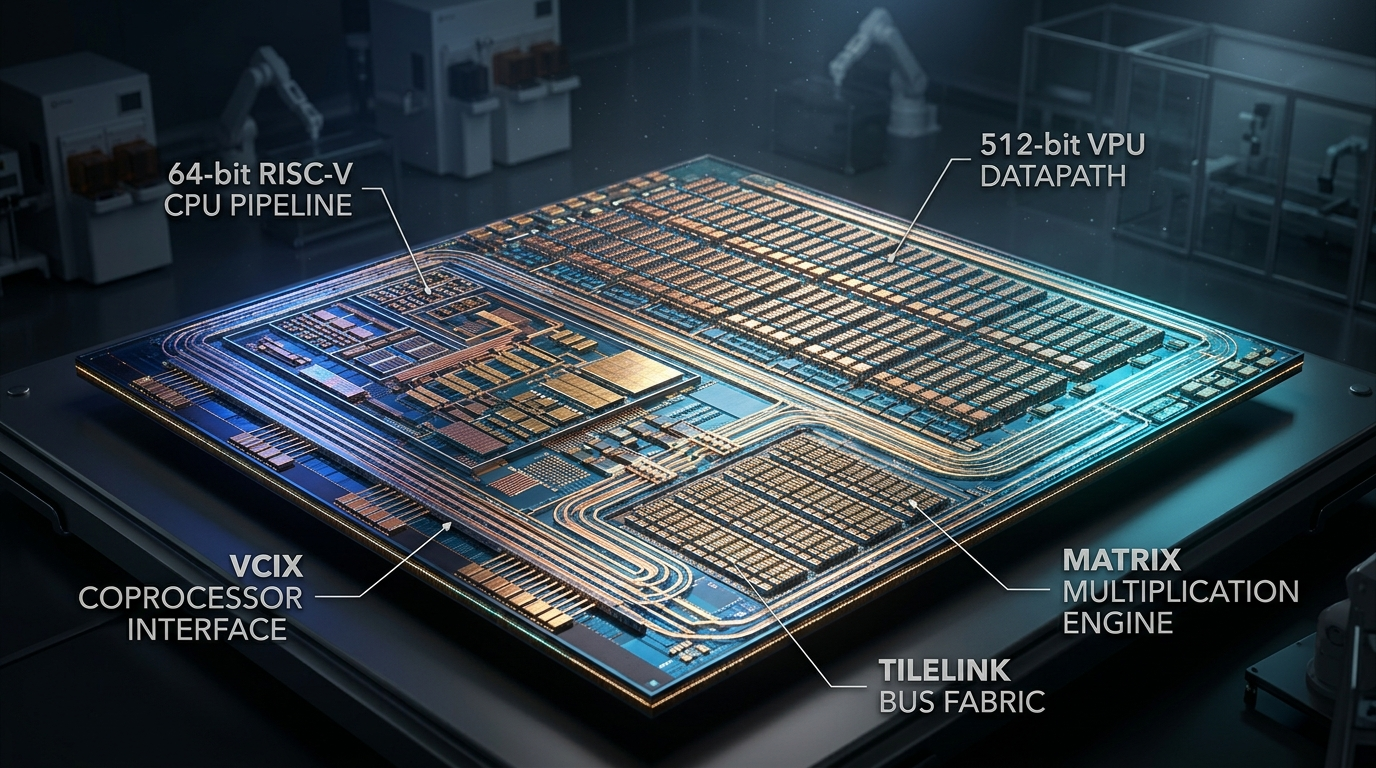
Architectural Deep Dive: RVV 1.0, 512-bit VPU, Matrix Extensions, and VCIX Co-Design
The architectural power of the SiFive Intelligence X280 stems from its multi-stage out-of-order scalar pipeline, tightly coupled 512-bit Vector Processing Unit (VPU), dedicated matrix execution units, and the modular Vector Coprocessor Interface eXtension (VCIX). A rigorous evaluation requires examining its four foundational subsystems.
Core Microarchitectural Organization and Pipeline Topology
The SiFive Intelligence X280 is designed as a dual-issue, in-order or decoupled out-of-order execution core featuring an 8-stage integer scalar pipeline tightly coupled with a multi-stage vector execution pipeline:
+-----------------------------------------------------------------------+
|                    SiFive Intelligence X280 Core Architecture         |
+-----------------------------------------------------------------------+
|  +------------------------+  +-------------------------------------+  |
|  | 64-Bit RISC-V Scalar   |  | 512-Bit Vector Processing Unit (VPU)|  |
|  | Pipeline (RV64GC)      |  | - RVV 1.0 Compliant (VLEN/DLEN=512) |  |
|  | - 8-Stage Dual-Issue   |  | - 32 Vector Registers (512-bit each)|  |
|  | - Branch Prediction    |  | - Dual 512-Bit Arithmetic Pipes     |  |
|  | - MMU (Sv39/Sv48)      |  | - Permutation & Shuffle Engines     |  |
|  +-----------+------------+  +------------------+------------------+  |
|              |                                  |                     |
|  +-----------v----------------------------------v------------------+  |
|  |        Decoupled Vector Instruction Queue & Dependency Scoreboard|  |
|  +-----------------------------------------------------------------+  |
|        |                                        |                     |
|  +-----v-------------------------------+  +-----v------------------+  |
|  | SiFive Intelligence Matrix Engines  |  | Vector Coprocessor     |  |
|  | - BF16, FP16, INT8, INT4 Matrix GEMM|  | Interface (VCIX)       |  |
|  | - Hardware Outer-Product Accumulator|  | - Dedicated FIFO Ports |  |
|  +-------------------------------------+  | - Direct Register Tap  |  |
|                                           +-----------+------------+  |
|                                                       |               |
|                                                       v (Custom Bus)  |
|                                           +------------------------+  |
|                                           | Customer Custom NPU /  |  |
|                                           | Domain-Specific Engine |  |
|                                           +------------------------+  |
|  +-----------------------------------------------------------------+  |
|  |        Coherent TileLink / AXI5 Memory Subsystem (L1/L2 Caches) |  |
+--+-----------------------------------------------------------------+--+ When the scalar front-end decodes a vector instruction, it dispatches the operation into a Decoupled Vector Instruction Queue. The scalar CPU continues executing subsequent non-vector instructions concurrently, achieving high instruction-level parallelism. The scalar pipeline handles address generation, pointer updates, and loop branching, while the 512-bit VPU processes wide vector elements in parallel without interrupting scalar throughput.
512-Bit RISC-V Vector (RVV 1.0) Execution Mechanics
The X280’s Vector Processing Unit implements the official RISC-V Vector Extension (RVV 1.0) standard. Unlike traditional x86 SIMD architectures (such as SSE, AVX2, AVX-512) that hardcode register widths and require separate instructions for every register size, RVV 1.0 is fundamentally vector-length agnostic (VLA).
Key operational mechanics of the X280 VPU include:
- Vector Length Configuration (
vsetvli): The application specifies the desired application vector length ($AVL$) and element width ($SEW \in {8, 16, 32, 64}$ bits). The hardware dynamically computes the actual hardware vector length ($VL$) that fits within its 512-bit registers: $$VL = \min(AVL, \text{VLEN} / SEW)$$ Software loops automatically vectorize across any remaining tail elements without requiring cumbersome scalar drain loops. - Register Grouping (
LMUL): Multiple physical vector registers can be dynamically grouped together into logical register blocks ($\text{LMUL} \in {1, 2, 4, 8}$). Grouping registers to $\text{LMUL} = 8$ allows a single vector instruction to operate on up to 4,096 bits of data in a single pipelined instruction burst, dramatically reducing instruction decode overhead and maximizing compute throughput. - Vector Masking and Predication: Supports fine-grained conditional execution using vector mask registers, enabling efficient vectorized branch evaluation on sparse tensors, non-zero ReLU activations, and dynamic token padding.
SiFive Intelligence Matrix Extensions and Quantized Arithmetic
To deliver high-density matrix multiplication for deep learning, SiFive extends the base RVV ISA with proprietary SiFive Intelligence Matrix Extensions:
- Outer-Product Matrix Accumulation: While standard vector architectures perform dot products along 1D vectors, the X280 integrates 2D outer-product matrix multiply instructions. For an input vector $A \in \mathbb{R}^M$ and vector $B \in \mathbb{R}^N$, the matrix unit computes an $M \times N$ matrix tile and accumulates it directly into vector register groups in a single pipelined operation: $$C \leftarrow C + A \otimes B$$
- Multi-Precision Matrix Contractions: Natively supports Brain Floating Point 16 (bfloat16), standard IEEE FP16, and integer quantization (INT8 and INT4). For INT8 inference, the X280 executes four 8-bit integer multiplications and accumulates into 32-bit integer registers: $$\text{Acc}{INT32} \leftarrow \text{Acc}{INT32} + \sum_{k=0}^3 X_{INT8}[k] \times W_{INT8}[k]$$
- Non-Linear Vector Math: Features dedicated hardware vector approximation pipelines for fast exponentials, reciprocal square roots, and hyperbolic tangents, providing single-cycle execution of Softmax normalization, LayerNorm, and GELU activations.
The Vector Coprocessor Interface eXtension (VCIX)
The most revolutionary microarchitectural innovation of the SiFive Intelligence X280 is VCIX (Vector Coprocessor Interface eXtension). In conventional SoC designs, integrating a proprietary customer accelerator (such as a custom cryptographic core, specialized neuromorphic array, or proprietary transformer engine) requires designing an AXI memory-mapped peripheral, writing complex kernel drivers, and managing DMA descriptors.
VCIX fundamentally re-architects accelerator co-design:
- Direct Register-File Coupling: VCIX provides low-latency, high-bandwidth FIFO interfaces connected directly to the X280’s 512-bit vector register file.
- Custom Instruction Dispatch: When the X280 encounters a custom RISC-V instruction opcode allocated for the coprocessor, the instruction is dispatched across VCIX along with up to two 512-bit vector source operands in a single clock cycle.
- Zero-Copy Memory Sharing: The custom accelerator reads and writes data directly into the X280’s vector registers. There are no intermediate DRAM round-trips, no PCIe latency penalties, and no DMA memory copies.
- Unified Cache Coherency: The coprocessor shares the X280’s L1/L2 cache hierarchy and virtual memory translation (MMU), allowing custom accelerators to operate on virtual memory addresses with full hardware memory protection.
Practical Implementation: Programming the X280 with RVV Intrinsics and PyTorch Integration
Deploying machine learning workloads onto SiFive Intelligence X280 systems can be accomplished through two primary programming paths: low-level C/C++ development utilizing native RISC-V Vector (RVV) C Intrinsics, or high-level deployment through PyTorch with the OpenXLA / IREE runtime and the SiFive Neural Network (NN) Software Library.
Writing High-Performance RVV Matrix-Vector Contraction Kernels
The following C++ program demonstrates how to implement an optimized matrix-vector multiplication kernel (the foundational primitive for autoregressive LLM token decoding) utilizing native RVV 1.0 C intrinsics for 512-bit execution on the X280:
/**
 * SiFive Intelligence X280 RVV 1.0 Matrix-Vector GEMV Kernel
 * Demonstrates 512-bit Vector-Length Agnostic (VLA) AI acceleration.
 * Compile with: riscv64-unknown-linux-gnu-g++ -O3 -march=rv64gcv -mabi=lp64d
 */

#include <iostream>
#include <vector>
#include <chrono>
#include <riscv_vector.h>

// Vector-Length Agnostic GEMV Kernel for X280 (Single-Precision FP32)
void rvv_gemv_fp32(
    float* y,           // Output vector: [rows]
    const float* A,     // Weight matrix: [rows x cols]
    const float* x,     // Input vector:  [cols]
    size_t rows,
    size_t cols
) {
    for (size_t r = 0; r < rows; ++r) {
        const float* row_ptr = A + (r * cols);
        size_t c = cols;
        const float* a_cur = row_ptr;
        const float* x_cur = x;

        // Initialize scalar accumulator
        float row_sum = 0.0f;

        // Process matrix row using 512-bit RVV vector registers (VLEN=512 -> 16 floats per vector)
        while (c > 0) {
            // Set vector length dynamically based on remaining columns
            size_t vl = __riscv_vsetvl_e32m1(c);

            // Load 512-bit vector tiles from matrix row and input vector
            vfloat32m1_t va = __riscv_vle32_v_f32m1(a_cur, vl);
            vfloat32m1_t vx = __riscv_vle32_v_f32m1(x_cur, vl);

            // Compute elementwise vector product
            vfloat32m1_t vprod = __riscv_vfmul_vv_f32m1(va, vx, vl);

            // Vector-to-scalar reduction across all 512-bit vector lanes
            vfloat32m1_t vzero = __riscv_vfmv_v_f_f32m1(0.0f, vl);
            vfloat32m1_t vred = __riscv_vfredusum_vs_f32m1_f32m1(vprod, vzero, vl);

            // Extract scalar sum
            row_sum += __riscv_vfmv_f_s_f32m1_f32(vred);

            // Advance pointers by dynamically processed vector length
            a_cur += vl;
            x_cur += vl;
            c -= vl;
        }

        y[r] = row_sum;
    }
}

int main() {
    const size_t rows = 2048;
    const size_t cols = 2048;
    std::cout << "[SiFive X280] Allocating GEMV tensors: [" << rows << "x" << cols << "]..." << std::endl;

    std::vector<float> matrix(rows * cols, 0.025f);
    std::vector<float> vec_in(cols, 1.0f);
    std::vector<float> vec_out(rows, 0.0f);

    std::cout << "[System] Executing 100 consecutive 512-bit RVV GEMV passes..." << std::endl;
    auto start = std::chrono::high_resolution_clock::now();

    for (int iter = 0; iter < 100; ++iter) {
        rvv_gemv_fp32(vec_out.data(), matrix.data(), vec_in.data(), rows, cols);
    }

    auto elapsed = std::chrono::duration_cast<std::chrono::milliseconds>(
        std::chrono::high_resolution_clock::now() - start
    ).count();

    double gflops = (100.0 * (2.0 * rows * cols) / (elapsed / 1000.0)) / 1e9;
    std::cout << "[System] Benchmark Finished: Processed 100 passes in " << elapsed
              << " ms (" << gflops << " GFLOPS sustained on 512-bit RVV core)." << std::endl;

    return 0;
} High-Level Model Deployment via IREE and PyTorch
For modern generative AI and computer vision models, developers compile standard PyTorch foundation models into optimized RISC-V vector machine code using the open-source IREE (Intermediate Representation Execution Environment) and MLIR toolchain:
#!/usr/bin/env python3
# SiFive Intelligence X280 PyTorch Deployment via IREE Compiler
# Compiles a PyTorch Transformer block into optimized RISC-V Vector (RVV) machine code.

import os
import sys
import torch
import torch.nn as nn
import iree.compiler as ireec
import iree.runtime as ireert

class X280AttentionBlock(nn.Module):
    def __init__(self, d_model=512, n_heads=8):
        super().__init__()
        self.qkv_proj = nn.Linear(d_model, 3 * d_model, bias=False)
        self.out_proj = nn.Linear(d_model, d_model, bias=False)
        self.norm = nn.LayerNorm(d_model)

    def forward(self, x):
        normed = self.norm(x)
        qkv = self.qkv_proj(normed)
        q, k, v = torch.chunk(qkv, 3, dim=-1)
        # Scaled dot-product attention
        scores = torch.matmul(q, k.transpose(-2, -1)) / (q.size(-1) ** 0.5)
        probs = torch.softmax(scores, dim=-1)
        attn = torch.matmul(probs, v)
        return self.out_proj(attn) + x

def compile_and_export_x280_module():
    print("[IREE-X280] Initializing PyTorch model compilation...")
    model = X280AttentionBlock(d_model=512, n_heads=8)
    model.eval()

    # Create representative input tensor
    dummy_input = torch.randn(1, 128, 512, dtype=torch.float32)

    # 1. Export Model to TorchScript / MLIR
    traced_model = torch.jit.trace(model, dummy_input)
    print("[IREE-X280] Model traced to TorchScript.")

    # 2. Configure IREE Compiler Flags for SiFive X280 Architecture
    compiler_flags = [
        "--iree-hal-target-backends=llvm-cpu",
        "--iree-llvmcpu-target-triple=riscv64-unknown-linux-gnu",
        "--iree-llvmcpu-target-cpu=sifive-x280",
        "--iree-llvmcpu-target-cpu-features=+m,+a,+f,+d,+c,+v,+zfh",
        "--iree-llvmcpu-target-abi=lp64d",
        "--iree-opt-level=3",
        "--iree-llvmcpu-enable-vector-masking=true"
    ]

    print("[IREE-X280] Compiling to native RISC-V 512-bit RVV machine code...")
    # Generate portable VMFB (Virtual Machine FlatBuffer) executable
    compiled_vmfb = ireec.compile_module(
        traced_model,
        target_backends=["llvm-cpu"],
        extra_args=compiler_flags
    )

    output_path = "x280_attention_kernel.vmfb"
    with open(output_path, "wb") as f:
        f.write(compiled_vmfb)

    print(f"[IREE-X280] Compilation successful! Hardware module saved to: {output_path}")

if __name__ == "__main__":
compile_and_export_x280_module() Teams operating automated web document parsing, real-time visual verification, or multimodal harvesting fleets can integrate SiFive X280-powered edge systems with scalable web-scraping agents to cross-reference extracted entities, vectorize unstructured text payloads in memory, and synchronize localized telemetry with enterprise data warehouses. To explore how open RISC-V computing integrates with broader enterprise AI platforms, visit our AI engineering knowledge hub.
Architectural Comparison: SiFive Intelligence X280 vs. Competing Vector & Edge AI Cores
To evaluate the operational positioning of the SiFive Intelligence X280 across edge devices, autonomous vehicles, and datacenter infrastructure, hardware architects must benchmark it against competing embedded CPU and vector acceleration alternatives: the Arm Cortex-A78AE, Arm Cortex-M85 with Helium, Synopsys ARC EV7x, and AndesCore AX45MPV.
| Architectural Feature | SiFive Intelligence X280 | Arm Cortex-A78AE | Arm Cortex-M85 | Synopsys ARC EV7x | AndesCore AX45MPV |
|---|---|---|---|---|---|
| Instruction Set Architecture | Open RISC-V (RV64GCV 1.0) | Armv8.2-A (Proprietary) | Armv8.1-M (Microcontroller) | ARCv2 / Custom VLIW | RISC-V (RV64GCV 0.93/1.0) |
| Vector Register Width (VLEN) | 512-bit Native Hardware | 128-bit NEON Advanced SIMD | 128-bit Helium Vector Ext. | 512-bit / 1024-bit VLIW | 128-bit / 256-bit RVV |
| Vector Execution Standard | Vector-Length Agnostic (VLA) | Fixed-Width SIMD | Fixed-Width Micro SIMD | Fixed-Width VLIW | Vector-Length Agnostic |
| Matrix Extension Support | SiFive Matrix (BF16/INT8) | Limited Dot-Product | None (Scalar MACs) | Dedicated Vector MACs | Basic Vector Dot Product |
| Custom Coprocessor Interface | VCIX (Direct Register FIFO) | None (PCIe/AXI offload) | Custom Datapath Extension | APEX Custom Extension | ACE Custom Extension |
| Multi-Core Cluster Scaling | Up to 16 Cores Coherent | Up to 8 Cores (DSU) | Single Core / Dual Core | Up to 4 Cores | Up to 8 Cores |
| Operating System Support | Full Linux (SMP) & RTOS | Full Linux / QNX (ASIL-D) | RTOS / Bare-Metal Only | Custom Embedded Linux | Full Linux & RTOS |
| Co-Design Adoption Example | Tenstorrent Blackhole, Google | Automotive ADAS SoCs | Industrial Microcontrollers | Mobile Camera SoCs | Asian AI Edge SoCs |
| Interconnect Standard | TileLink / AXI5 Native | AMBA 5 CHI / ACE | AMBA AHB / AXI | BVCI / Native Interconnect | AMBA AXI4 |
| Licensing Model | Synthesizable Core IP | Synthesizable Core IP | Synthesizable Core IP | Synthesizable Core IP | Synthesizable Core IP |
Analysis of Architectural Trade-offs
A comprehensive examination of this scorecard highlights several critical architectural differentiators:
- True Vector-Length Agnostic 512-bit Execution: While high-performance application cores like the Arm Cortex-A78AE rely on 128-bit NEON SIMD registers, the X280 features native 512-bit vector pipelines. On wide linear algebra operations, the X280 executes four times more mathematical operations per clock cycle. Furthermore, RVV’s vector-length agnosticism ensures that software binaries compiled for the X280 run unmodified across future silicon generations with 1024-bit or 2048-bit vector pipelines.
- Direct Register-Coupled Accelerator Expansion (VCIX): Traditional Arm and x86 architectures enforce rigid boundaries around their execution engines. Custom customer hardware can only be connected as memory-mapped peripherals over PCIe or AXI buses, incurring massive software driver and memory transfer latencies. In contrast, VCIX enables custom silicon accelerators to tap directly into the X280’s vector registers, executing domain-specific neural operators with single-cycle latency.
- Open RISC-V Freedom vs. Proprietary Licensing Restrictions: By building upon the open RISC-V standard, SiFive eliminates proprietary architectural licensing barriers. Semiconductor engineering teams can customize instruction decoding, tune cache topologies, and integrate proprietary coprocessors without violating restrictive architectural licensing agreements.
Production Engineering: SoC Floorplanning, Thermal Dissipation, and Telemetry Monitoring
Deploying the SiFive Intelligence X280 from architectural IP licensing into mass-production silicon requires rigorous attention to semiconductor floorplanning, power-clock distribution, and automated hardware telemetry monitoring.
Semiconductor Synthesis, Physical Design, and Clock Topologies
When synthesizing the X280 IP into customer SoCs across advanced foundry nodes (such as TSMC 7nm, 5nm, or 3nm), design engineers should observe the following physical implementation principles:
- Decoupled Clock Domain Strategy: The 512-bit Vector Processing Unit contains massive datapath routing that can limit top-level scalar frequency if locked in synchronous clocking. Implement asynchronous Clock Domain Crossing (CDC) bridges between the 64-bit scalar core (running up to 2.0 GHz) and the wide 512-bit vector execution unit (operating at 1.0 GHz to 1.4 GHz) to optimize power and timing closure.
- Dynamic Vector Clock Gating: The 512-bit vector register file and matrix execution units represent significant dynamic capacitance. The X280 hardware incorporates automatic, fine-grained clock gating. When the instruction stream executes pure scalar code, clock distribution to the vector execution blocks and matrix multipliers is automatically suspended, slashing dynamic switching power by over 80%.
- Power Delivery Network (PDN) Slew-Rate Management: Transitioning from idle scalar instructions to full 512-bit outer-product matrix contractions induces extreme transient current steps ($dI/dt$). Place high-density on-chip deep trench capacitors (DTC) and localized metal-insulator-metal (MIM) decoupling capacitors directly adjacent to the vector execution units to suppress transient supply voltage droop.
Production Telemetry and Fleet Health Monitoring Daemon
In enterprise datacenter installations and automotive edge clusters, an automated background service must monitor hardware health, tracking core temperatures, vector execution duty cycles, TileLink bus latency, and ECC memory fault counters. The following Python daemon demonstrates an automated monitoring agent interfacing with the SiFive Hardware Management API:
#!/usr/bin/env python3
# SiFive Intelligence X280 Fleet Health and Operational Telemetry Daemon
# Continuously monitors core temperature, vector unit utilization, and TileLink health.

import time
import logging
import json
import sys
from typing import Dict, Any

# Mock or production import of SiFive Management Library (SFML)
try:
    import sfml
except ImportError:
    # Simulated SFML interface for standalone testing environments
    class MockSFML:
        class Core:
            def __init__(self, idx): self.idx = idx
            def get_junction_temperature_c(self): return 52.4
            def get_power_consumption_mw(self): return 1450.0
            def get_vector_duty_cycle_pct(self): return 89.2
            def get_matrix_mac_utilization_pct(self): return 84.5
            def get_vcix_coprocessor_stalls(self): return 0
            def get_tilelink_bus_errors(self): return 0
            def set_power_cap_mw(self, cap): pass
            def throttle_core_clock(self, freq_mhz): pass

        @staticmethod
        def init(): pass
        @staticmethod
        def core_count(): return 4
        @staticmethod
        def get_core(idx): return MockSFML.Core(idx)
    sfml = MockSFML

logging.basicConfig(
    level=logging.INFO,
    format='%(asctime)s [%(levelname)s] [X280-MONITOR] %(message)s',
    handlers=[logging.StreamHandler(sys.stdout)]
)

class X280HealthMonitor:
    def __init__(self, poll_interval_sec: float = 3.0, max_temp_c: float = 85.0):
        self.interval = poll_interval_sec
        self.max_temp_c = max_temp_c
        sfml.init()
        self.num_cores = sfml.core_count()
        self.cores = [sfml.get_core(i) for i in range(self.num_cores)]
        logging.info(f"Initialized monitor for {self.num_cores} detected SiFive X280 core(s).")

    def collect_core_telemetry(self, core) -> Dict[str, Any]:
        """Polls real-time hardware telemetry registers from the X280 core."""
        temp = core.get_junction_temperature_c()
        power = core.get_power_consumption_mw()
        v_util = core.get_vector_duty_cycle_pct()
        m_util = core.get_matrix_mac_utilization_pct()
        vcix_stalls = core.get_vcix_coprocessor_stalls()
        tl_errors = core.get_tilelink_bus_errors()

        return {
            "core_id": core.idx,
            "junction_temp_c": temp,
            "power_mw": power,
            "vector_duty_cycle_pct": v_util,
            "matrix_utilization_pct": m_util,
            "vcix_stalls": vcix_stalls,
            "tilelink_errors": tl_errors
        }

    def verify_operational_safety(self, core, telemetry: Dict[str, Any]):
        """Evaluates hardware safety thresholds and triggers autonomous mitigation."""
        temp = telemetry["junction_temp_c"]
        core_id = telemetry["core_id"]

        # 1. Thermal Emergency Safeguard
        if temp >= self.max_temp_c:
            logging.critical(
                f"Core {core_id} EXCEEDED THERMAL SAFEGUARD! Current: {temp:.1f}C, "
                f"Limit: {self.max_temp_c:.1f}C. Applying emergency power cap (1000mW)!"
            )
            core.set_power_cap_mw(1000.0)
            core.throttle_core_clock(800)
        elif temp >= (self.max_temp_c - 8.0):
            logging.warning(f"Core {core_id} approaching thermal threshold: {temp:.1f}C.")

        # 2. Interconnect & Coprocessor Fault Verification
        if telemetry["tilelink_errors"] > 0:
            logging.error(f"Core {core_id} detected {telemetry['tilelink_errors']} TileLink bus parity faults!")
        if telemetry["vcix_stalls"] > 1000:
            logging.warning(f"Core {core_id} detected {telemetry['vcix_stalls']} VCIX coprocessor FIFO stall cycles.")

    def run_monitor_loop(self):
        """Continuous execution loop exporting telemetry to Prometheus / FluentBit."""
        logging.info("Starting X280 production telemetry monitoring loop...")
        try:
            while True:
                for core in self.cores:
                    telemetry = self.collect_core_telemetry(core)
                    self.verify_operational_safety(core, telemetry)
                    logging.info(f"Telemetry Status: {json.dumps(telemetry)}")
                time.sleep(self.interval)
        except KeyboardInterrupt:
            logging.info("Terminating X280 Monitor daemon cleanly.")

if __name__ == "__main__":
    monitor = X280HealthMonitor(poll_interval_sec=5.0)
    # Perform single initial diagnostic pass
    for core in monitor.cores:
        stats = monitor.collect_core_telemetry(core)
        print("\n=== Initial SiFive Intelligence X280 Diagnostic Pass ===")
        for k, v in stats.items():
            print(f"  {k:28s}: {v}")
        print("========================================================\n")
print("Diagnostic passed. SiFive X280 cluster ready for continuous production service.") Production Readiness Verification Checklist
Prior to approving a SiFive Intelligence X280 silicon design for volume commercial production, hardware and verification teams must verify each operational criterion:
- RVV 1.0 Architectural Conformance: Run the official RISC-V International RVV 1.0 architectural compliance test suite against the physical silicon, validating bit-exact execution across all vector configurations.
- VCIX Timing Closure and Handshake Integrity: Validate that custom coprocessor instruction handshakes across VCIX achieve timing closure under worst-case process voltage and temperature (PVT) corners without deadlocking the decoupled vector queue.
- TileLink Coherency Under Multicore Stress: Execute continuous 48-hour cache-coherency stress tests across all cores in a multi-cluster configuration, confirming zero uncorrectable L2 cache parity errors.
- Thermal Dissipation Under Dense Matrix Load: Perform continuous bfloat16 outer-product matrix contraction benchmarks at peak operating temperature (up to 105°C automotive grade), confirming junction temperatures remain stable without thermal throttling.
The SiFive Intelligence X280 establishes a new paradigm for accelerated artificial intelligence. By unifying a 64-bit application CPU with a wide 512-bit vector processing engine, high-density matrix math extensions, and the open VCIX coprocessor interface, the X280 eliminates the latency and power penalties of conventional host-accelerator architectures. For semiconductor innovators, datacenter builders, and embedded systems architects designing the next generation of intelligent machines, the SiFive Intelligence X280 proves that open-standard RISC-V computing is the definitive foundation for the future of artificial intelligence.