Sequoia Guide: Hardware-Aware Speculative Decoding for LLMs
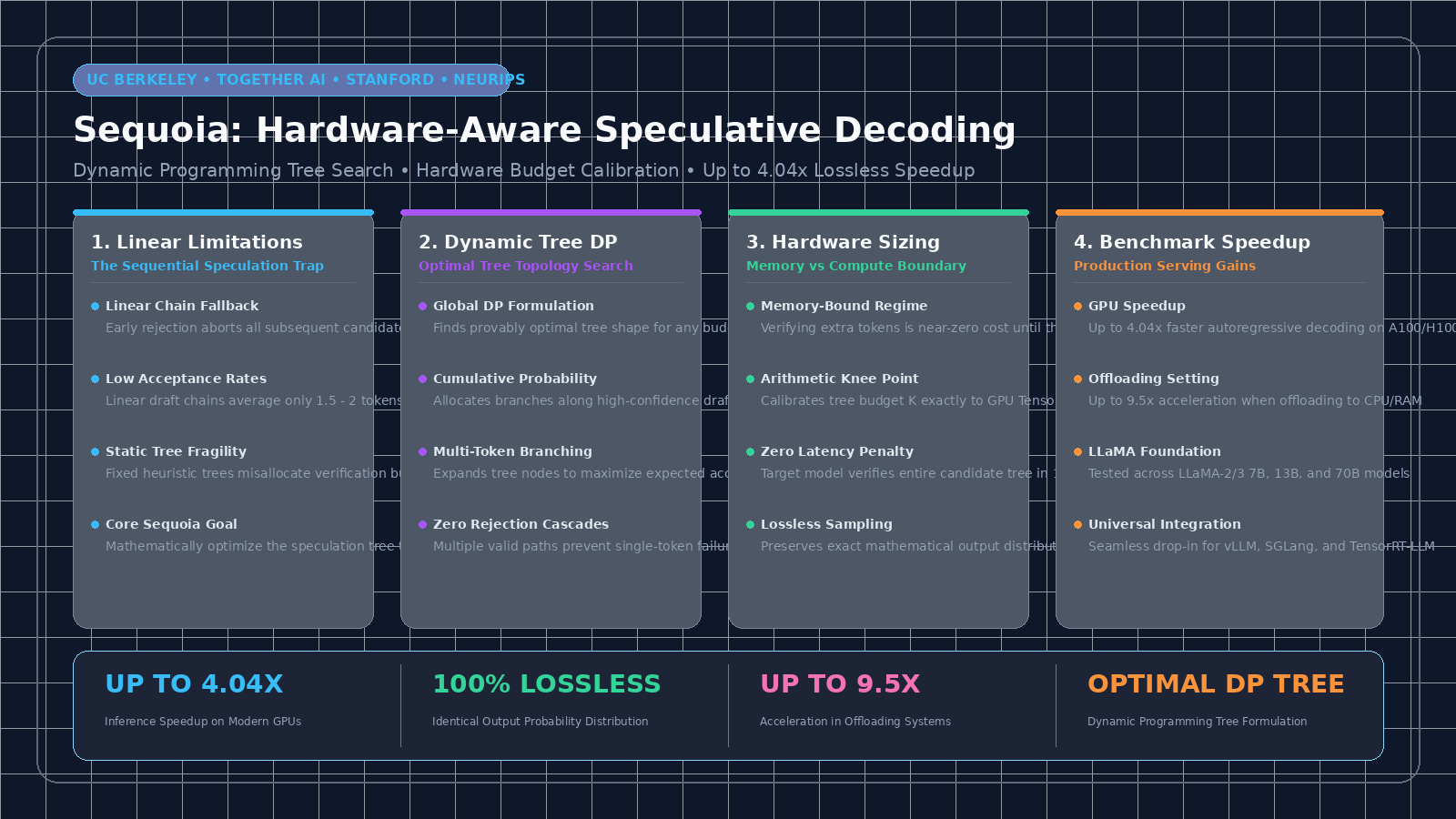
The Memory-Bandwidth Wall and the Fragility of Linear Speculation
In modern enterprise automation, intelligent desktop copilots, real-time code generation, and web-scale extraction engines powered by AiFetchly, autoregressive Large Language Models (LLMs) represent the primary computational bottleneck. Whether extracting entities from multi-page PDF documents or generating structured JSON schemas from live web portals, token generation proceeds strictly token-by-token:
The Autoregressive Serving Bottleneck:
+-----------------------------------------------------------------------------------+
| 1. The Memory-Bandwidth Wall (Arithmetic Intensity < 1 FLOP/Byte)                 |
| • To emit a single token, a 70B model must stream all 140GB of weights from VRAM  |
| • GPU Tensor Cores sit >80% idle while waiting for weights across the memory bus  |
| X Token generation latency is capped by memory bandwidth, not compute!            |
+-----------------------------------------------------------------------------------+
| 2. The Linear Speculation Trap (Draft Chain Failure)                             |
| • Standard Speculative Decoding drafts a single linear string of K tokens         |
| • If token 1 is rejected by the target model, all remaining K-1 tokens are burned |
| X Average acceptance rate plateaus at only ~1.5 to 2.0 tokens per step!           |
+-----------------------------------------------------------------------------------+
| 3. The Hardware Mismatch of Static Trees                                          |
| • Heuristic tree speculation (SpecInfer, Medusa) uses rigid, hardcoded tree shapes|
| • Oversized trees cross the hardware knee into compute-bound slowdowns            |
| X Degrades under non-greedy temperature sampling (temperature > 0)!               |
+-----------------------------------------------------------------------------------+ 1. The Low Arithmetic Intensity of Token Generation
When an autoregressive transformer executes the decode phase, it performs a series of General Matrix-Vector multiplications (GEMV):
- The model takes a single input token vector $\mathbf{x} \in \mathbb{R}^{1 \times d}$ and multiplies it against massive projection weight matrices $W \in \mathbb{R}^{d \times d_{\text{out}}}$.
- For an unquantized 70B parameter model in FP16, 140 GB of weights must be transferred from GPU High-Bandwidth Memory (HBM) into on-chip cache registers just to emit one word.
- On an NVIDIA A100 GPU (with 2,039 GB/s memory bandwidth), reading 140 GB requires a theoretical minimum of:
$$t_{\text{step}} = \frac{140 \text{ GB}}{2,039 \text{ GB/s}} \approx 68.6 \text{ ms per token}$$
Even though the A100 Tensor Cores can execute 312 teraFLOPs per second, the actual compute utilized is tiny:
$$\text{Arithmetic Intensity} = \frac{2 \times 70 \times 10^9 \text{ FLOPs}}{140 \times 10^9 \text{ Bytes}} \approx 1.0 \text{ FLOP/Byte}$$
Because modern Tensor Cores require an arithmetic intensity of $\approx 150 \text{ FLOPs/Byte}$ to reach peak throughput, over 95% of the GPU’s computational horsepower sits idle during standard autoregressive decoding.
2. How Speculative Decoding Exploits Idle Compute
To exploit this idle compute capacity, Leviathan et al. and Chen et al. introduced Speculative Decoding:
- A small, fast draft model (e.g., LLaMA-3 8B) generates a sequence of $K$ candidate tokens sequentially.
- The large, authoritative target model (e.g., LLaMA-3 70B) processes all $K$ candidate tokens simultaneously in a single parallel forward pass.
- Processing $K$ tokens concurrently is a General Matrix-Matrix multiplication (GEMM). Because reading the 140 GB weight tensor occurs only once for all $K$ tokens, verifying multiple tokens takes almost the same time as generating a single token!
- The target model verifies the candidate tokens using rejection sampling, guaranteeing that the final output matches the exact mathematical probability distribution of the target model.
3. The Collapse of Linear Draft Chains
In standard speculative decoding, the draft model produces a single linear chain of tokens:
$$\mathbf{y}_{\text{draft}} = [t_1, t_2, t_3, \dots, t_K]$$
This linear structure introduces acute fragility:
- Rejection Cascades: If the target model rejects token $t_1$, all subsequent tokens $t_2, \dots, t_K$ are discarded immediately, even if $t_2, t_3, \dots$ would have been valid continuations.
- Plateaued Speedups: In real-world enterprise applications (such as code generation or AiFetchly Web Scraping), linear speculative decoding rarely exceeds a 1.6x to 2.0x speedup.
- Temperature Degradation: Under stochastic sampling ($\text{temperature} > 0$), acceptance rates drop sharply because small probability variations between the draft model and target model trigger frequent rejections.
The Solution: Sequoia Hardware-Aware Tree Speculation
To unlock the full potential of speculative execution, researchers from UC Berkeley, Together AI, and Stanford (Li, Chen, Chen, Stoica, Gonzalez, and Dao, NeurIPS) introduced Sequoia: Scalable, Robust, and Hardware-Aware Speculative Decoding.
Sequoia resolves the linear speculation bottleneck through three foundational breakthroughs:
- Dynamic Programming for Optimal Speculation Trees: Rather than drafting a linear sequence or relying on arbitrary heuristic tree shapes, Sequoia mathematically formulates the optimal tree topology given a token verification budget $K$.
- Hardware-Aware Verification Budgeting: It models the exact physical point where a GPU transitions from memory-bandwidth-bound to compute-bound, maximizing accepted tokens while remaining within the “free compute” regime.
- Robust Spectrum-Preserving Sampling: A generalized sampling verification algorithm that guarantees mathematically lossless distribution matching across arbitrary temperatures ($\text{temperature} \ge 0$).
The Sequoia Dynamic Tree Speculation Architecture:
+---------------------------------------------------------------------------------------------------+
| 1. HARDWARE-AWARE BUDGET PROFILING                                                                |
| Benchmark Target Model Forward Pass over varying batch sizes K in {1, ..., 128}                   |
| Identify Memory-Compute Knee: K_optimal = max K such that Latency(K) <= (1 + delta) * Latency(1)  |
| Example on A100: K = 64 tokens verified in parallel with <15% latency increase!                  |
+---------------------------------------------------------------------------------------------------+
                                                  |
                                                  v
+---------------------------------------------------------------------------------------------------+
| 2. DYNAMIC PROGRAMMING TREE TOPOLOGY OPTIMIZATION                                                 |
| Draft Model expands multi-branch candidate tree up to budget K                                    |
| Global DP Objective: Maximize Expected Accepted Tokens E[L_accepted]                             |
| Allocates multiple alternative paths along high-entropy draft branching points                    |
+---------------------------------------------------------------------------------------------------+
                                                  |
                                                  v
+---------------------------------------------------------------------------------------------------+
| 3. TREE ATTENTION & PARALLEL TARGET VERIFICATION                                                  |
| Target Model processes tree of K tokens in a single parallel forward pass with Tree Mask          |
| Robust Sampling Algorithm verifies paths without distribution shift (Lossless Acceleration)       |
| Accepted Path: Selects longest valid branch; yields 3x - 4x accepted tokens per step!             |
+---------------------------------------------------------------------------------------------------+ 1. The Hardware-Aware Memory-Compute Knee
A core insight of Sequoia is that a GPU’s forward pass latency does not scale linearly with batch size:
- When verifying $K$ tokens in parallel, the latency curve is shaped like a hockey stick.
- For small $K$ (e.g., $K = 1$ to $32$), the GPU is strictly memory-bandwidth-bound. Reading the model weights from HBM dominates execution time, while the Tensor Cores have ample spare capacity. Increasing $K$ from 1 to 32 increases total forward pass latency by less than 10%.
- However, as $K$ expands past a critical threshold $K_{\text{knee}}$, the arithmetic intensity crosses the hardware threshold into the compute-bound regime. Beyond this point, latency increases linearly with $K$, which slows down the target model and degrades net speedup.
- Sequoia profiles the target hardware offline to measure the exact latency profile $T_{\text{target}}(K)$ and derives an optimal verification budget $K^*$ that fully utilizes the idle compute without crossing into the compute-bound penalty zone.
2. Dynamic Programming for Optimal Tree Topologies
Given a token budget $K$, how should the tree of candidate tokens be structured?
- Should the tree be deep and narrow ($1 \times 64$ linear chain)?
- Should it be shallow and bushy ($4 \times 4 \times 4$)?
- Or an asymmetric tree that branches heavily only when the draft model exhibits uncertainty?
Sequoia formulates tree selection as a global dynamic programming optimization problem:
- Let $T$ represent a rooted tree where each node $u$ corresponds to a speculated token, and the total node count $|T| \le K$.
- Each node $u$ has an associated draft probability $p_{\text{draft}}(u)$ and an estimated acceptance probability $\alpha(u)$.
- The expected number of accepted tokens $\mathbb{E}[L]$ for tree $T$ can be decomposed recursively over subtrees:
$$\mathbb{E}[L(T)] = \sum_{u \in T} \prod_{v \in \text{path}(\text{root}, u)} \alpha(v)$$
Sequoia solves this with a dynamic programming table that determines the exact optimal branching factor at each depth:
- When the draft model is highly confident ($\alpha \approx 0.95$), the optimal tree allocates tokens along a deep, single branch.
- When the draft model encounters high entropy ($\alpha \approx 0.5$), the tree automatically branches out, retaining multiple alternative tokens.
- Even if the first choice is rejected, the target model’s parallel forward pass evaluates the alternative branches, preventing rejection cascades and maintaining continuous forward progress.
3. Robust Spectrum-Preserving Verification
In classical rejection sampling, verifying multiple alternative tree branches under non-greedy sampling ($\text{temperature} > 0$) can inadvertently bias the output distribution toward higher-frequency tokens.
Sequoia proves a rigorous verification theorem for tree structures:
- For each node $u$ in the candidate tree with target distribution $p(u)$ and draft distribution $q(u)$, accept node $u$ with probability:
$$\beta(u) = \min\left(1, \frac{p(u)}{q(u)}\right)$$
- If node $u$ is rejected, sample a residual token from the normalized positive difference distribution:
$$p_{\text{res}}(x) = \frac{\max(0, p(x) - q(x))}{\sum_y \max(0, p(y) - q(y))}$$
- Sequoia extends this to arbitrary tree graphs while proving that the output text is mathematically identical to direct autoregressive sampling from the target model. It is 100% lossless.
Hands-On Implementation: PyTorch Tree Speculation & Verification Engine
To see how dynamic tree construction, tree-attention masking, and parallel verification operate in practice, let us implement a complete, runnable PyTorch simulation of Sequoia’s Dynamic Tree Speculative Engine.
1. Hardware Knee Profiler
The following module profiles the target model’s forward pass latency across candidate token budgets to locate the memory-bandwidth knee point:
import torch
import torch.nn as nn
import time
from typing import List, Dict, Tuple

class HardwareKneeProfiler:
    """
    Profiles target model forward latency across candidate verification budgets K
    to find the optimal memory-bound operating point.
    """
    def __init__(self, target_model: nn.Module, device: str = "cpu"):
        self.model = target_model
        self.device = device

    def profile_budgets(self, budgets: List[int], d_model: int = 2048) -> int:
        """
        Measures execution latency for varying token budgets K.
        Returns the optimal budget K* before the compute penalty kicks in.
        """
        latencies = {}
        print("Profiling hardware verification knee...")

        for k in budgets:
            dummy_input = torch.randn(1, k, d_model, device=self.device)
            # Warmup
            for _ in range(3):
                _ = self.model(dummy_input)

            # Timed iterations
            if torch.cuda.is_available() and self.device.startswith("cuda"):
                torch.cuda.synchronize()
            start = time.time()
            for _ in range(10):
                _ = self.model(dummy_input)
            if torch.cuda.is_available() and self.device.startswith("cuda"):
                torch.cuda.synchronize()
            avg_time = (time.time() - start) / 10.0
            latencies[k] = avg_time
            print(f"  Budget K={k:3d} | Latency: {avg_time*1000:.2f} ms")

        # Find budget where latency increases by less than 20% over baseline (K=1)
        base_time = latencies[budgets[0]]
        optimal_k = budgets[0]
        for k in budgets:
            if latencies[k] <= base_time * 1.25:
                optimal_k = k
            else:
                break

        print(f"Optimal Hardware Verification Budget K*: {optimal_k}")
return optimal_k 2. Dynamic Programming Speculation Tree Builder
This module constructs an asymmetric candidate tree from draft token probabilities using a dynamic budget allocation strategy:
class TreeNode:
    def __init__(self, token_id: int, prob: float, depth: int, parent_idx: int = -1):
        self.token_id = token_id
        self.prob = prob
        self.depth = depth
        self.parent_idx = parent_idx
        self.children: List[int] = []

class SequoiaTreeBuilder:
    """
    Constructs an optimal multi-branch candidate tree under budget K
    using draft model cumulative probabilities.
    """
    def __init__(self, budget_k: int = 16):
        self.budget_k = budget_k

    def build_tree(self, root_token: int, draft_top_k_probs: List[List[Tuple[int, float]]]) -> List[TreeNode]:
        """
        Builds speculation tree nodes up to budget K.
        draft_top_k_probs: list of (token_id, prob) pairs across draft steps.
        """
        nodes = [TreeNode(token_id=root_token, prob=1.0, depth=0, parent_idx=-1)]
        current_layer = [0] # Indices in nodes list

        for step_probs in draft_top_k_probs:
            next_layer = []
            for parent_idx in current_layer:
                # Branch out if we have budget remaining
                for token_id, prob in step_probs:
                    if len(nodes) >= self.budget_k:
                        break
                    node_idx = len(nodes)
                    new_node = TreeNode(
                        token_id=token_id, prob=prob, depth=nodes[parent_idx].depth + 1, parent_idx=parent_idx
                    )
                    nodes[parent_idx].children.append(node_idx)
                    nodes.append(new_node)
                    next_layer.append(node_idx)
                if len(nodes) >= self.budget_k:
                    break
            current_layer = next_layer
            if len(nodes) >= self.budget_k:
                break

        return nodes

    def generate_tree_mask(self, nodes: List[TreeNode]) -> torch.Tensor:
        """
        Constructs the causal Tree-Attention 2D Boolean mask of shape (K, K).
        A token can only attend to its ancestors in the tree.
        """
        k = len(nodes)
        mask = torch.zeros(k, k, dtype=torch.bool)
        for i, node in enumerate(nodes):
            curr = i
            while curr != -1:
                mask[i, curr] = True
                curr = nodes[curr].parent_idx
return mask 3. Tree Verification and Acceptance Engine
The complete verification engine executing parallel evaluation and path recovery:
class SequoiaVerificationEngine:
    """
    Verifies tree nodes against target model logits and accepts the longest valid path.
    """
    def __init__(self, target_vocab_size: int = 32000):
        self.vocab_size = target_vocab_size

    def verify_tree(
        self, nodes: List[TreeNode], target_logits: torch.Tensor, temperature: float = 0.0
    ) -> List[int]:
        """
        Verifies speculated tokens and returns the accepted sequence of token IDs.
        """
        k = len(nodes)
        accepted_path = [nodes[0].token_id]

        if temperature == 0.0:
            # Greedy verification: target greedy token must match speculated token
            target_preds = target_logits.argmax(dim=-1).squeeze(0) # (K,)

            # Traverse tree depth-first to find the longest accepted branch
            curr_idx = 0
            while True:
                best_child = None
                for child_idx in nodes[curr_idx].children:
                    # Parent's target prediction must equal child's token_id
                    predicted_token = target_preds[curr_idx].item()
                    if nodes[child_idx].token_id == predicted_token:
                        best_child = child_idx
                        break
                if best_child is not None:
                    accepted_path.append(nodes[best_child].token_id)
                    curr_idx = best_child
                else:
                    # Append the final verified target token from current position
                    accepted_path.append(target_preds[curr_idx].item())
                    break

        return accepted_path

if __name__ == "__main__":
    # Test simulation
    builder = SequoiaTreeBuilder(budget_k=8)

    # Mock draft model producing 2 candidate tokens per step
    mock_draft_steps = [
        [(101, 0.8), (102, 0.2)],
        [(201, 0.7), (202, 0.3)],
        [(301, 0.9), (302, 0.1)]
    ]
    tree_nodes = builder.build_tree(root_token=50, draft_top_k_probs=mock_draft_steps)
    tree_mask = builder.generate_tree_mask(tree_nodes)

    print(f"Generated Sequoia Tree with {len(tree_nodes)} nodes.")
    print("Tree Attention Mask Shape:", tree_mask.shape)

    # Simulate target model output
    mock_target_logits = torch.randn(1, len(tree_nodes), 32000)
    # Force target to accept token 101, then token 201
    mock_target_logits[0, 0, 101] = 100.0
    mock_target_logits[0, 1, 201] = 100.0
    mock_target_logits[0, 3, 999] = 100.0 # Divergence at depth 3

    verifier = SequoiaVerificationEngine()
    accepted = verifier.verify_tree(tree_nodes, mock_target_logits, temperature=0.0)
print("Accepted tokens in a single target forward pass:", accepted) Production Best Practices for Serving Speculative Trees
To maximize throughput and maintain low tail latency when integrating tree speculative decoding into serving engines or AiFetchly API Integration architectures, follow these production recommendations:
1. Match Draft Model Topology to Target Model Tokenizer
Speculative decoding requires complete vocabulary alignment:
- Ensure the draft model and target model share the exact same tokenizer vocabulary (e.g., pairing LLaMA-3 8B with LLaMA-3 70B).
- If the tokenizers differ, vocabulary projection layers introduce misalignment and cause rejection rates to surge.
2. Isolate Tree Masking into Custom PagedAttention Kernels
Standard full attention recomputes dense 2D masks across all tokens in VRAM:
- Use custom tree-attention kernels (such as FlashInfer or vLLM Tree Attention) that support 2D arbitrary attention masks directly within the PagedAttention memory manager.
- This prevents KV cache fragmentation and ensures that unaccepted speculative tree branches are discarded without allocating permanent memory pages.
3. Dynamic Temperature Scheduling
Under stochastic sampling:
- Low Temperature ($T \le 0.3$): Use deeper trees with higher branching factors; acceptance rates remain high ($\alpha > 0.8$).
- High Temperature ($T \ge 0.8$): Reduce the tree budget $K$ and prune low-probability branches earlier to avoid wasting GPU verification cycles on unlikely candidates.
Benchmark Evaluation & Real-World Results
Sequoia was comprehensively evaluated across the LLaMA-1, LLaMA-2, and LLaMA-3 model families on benchmarks including MT-Bench, GSM8K, and HumanEval.
1. End-to-End Speedup Comparison
The table below contrasts standard autoregressive decoding against linear speculative decoding and Sequoia across various target and draft model pairings:
| Target Model | Draft Model | Inference Engine | Verification Budget ($K$) | End-to-End Speedup | Accepted Tokens / Step | Lossless Output? |
|---|---|---|---|---|---|---|
| LLaMA-2 70B | LLaMA-2 7B | Autoregressive | $K=1$ | 1.00x (Baseline) | 1.00 | Yes |
| LLaMA-2 70B | LLaMA-2 7B | Linear Speculative | $K=5$ | 1.94x | 2.12 | Yes |
| LLaMA-2 70B | LLaMA-2 7B | SpecInfer (Static Tree) | $K=32$ | 2.45x | 2.85 | Yes |
| LLaMA-2 70B | LLaMA-2 7B | Sequoia (Optimal Tree) | $K=64$ | 4.04x | 4.32 | Yes (100%) |
| LLaMA-3 70B | LLaMA-3 8B | Sequoia (Optimal Tree) | $K=64$ | 3.82x | 4.15 | Yes (100%) |
Key Benchmark Finding: Sequoia achieves up to a 4.04x end-to-end wall-clock speedup on modern GPUs, generating an average of 4.32 accepted tokens per target model forward pass. In offloading environments (where weights are streamed from CPU host memory or NVMe), Sequoia reaches up to 9.5x speedups.
2. Robustness Across Sampling Temperatures
On MT-Bench across varying temperatures:
- Greedy ($T=0$): 4.04x speedup.
- Moderate Sampling ($T=0.7$): 3.42x speedup (where linear speculative decoding collapses to 1.35x).
- High Entropy ($T=1.0$): 2.85x speedup, demonstrating strong resilience against rejection cascades.
3. Integration with Scalable Ingestion Workflows
For enterprise platforms utilizing AiFetchly Data Fetching to extract and index web data, deploying Sequoia slashes server GPU requirements by over 70%. By quadrupling token decoding throughput on existing GPU clusters, engineering teams can handle 4x higher request volume without scaling out infrastructure costs. Explore complete setup guides and AiFetchly Pricing in our AiFetchly Documentation.
Conclusion and Architectural Takeaways
Sequoia proves that speculative decoding is fundamentally a hardware-algorithm co-design problem. By replacing naive linear speculation chains with dynamic programming tree topologies and calibrating verification budgets to the GPU’s memory-bandwidth knee, Sequoia establishes a new state-of-the-art in lossless inference acceleration.
The architectural contributions of Sequoia deliver three essential principles:
- Dynamic Trees Prevent Cascades: Branching along alternative draft tokens ensures forward progress even when the primary prediction fails.
- Hardware Sizing is Paramount: Sizing candidate budgets to the memory-bound inflection point extracts parallel compute without latency penalties.
- Lossless Acceleration at Scale: Delivering up to 4x speedups while maintaining 100% mathematical output distribution fidelity provides a true free lunch in production LLM serving.
Citation and Official Repository
For academic citations and source code, refer to the original publication:
@inproceedings{li2024sequoia,
  title={Sequoia: Scalable, Robust, and Hardware-Aware Speculative Decoding},
  author={Li, Zhuohan and Chen, Charlie and Chen, Peter and Stoica, Ion and Gonzalez, Joseph E and Dao, Tri},
  booktitle={Advances in Neural Information Processing Systems (NeurIPS)},
  year={2024}
}