Semantic Kernel Guide: Enterprise AI Agent Architecture
The Problem: The Fragility of Experimental Agent Frameworks in Enterprise Production
In modern enterprise software, automated web data extraction, and intelligent desktop copilots powered by AiFetchly, generative artificial intelligence has progressed beyond experimental chat interfaces into mission-critical business systems. Production workflows demand agents that can autonomously browse target portals, extract tabular financial data, query internal vector catalogs, invoke enterprise REST APIs, and synthesize auditable reports.
However, software engineering teams attempting to deploy compound agent workflows using early community frameworks (such as early LangChain, raw AutoGen 0.2, or custom monolithic Python scripts) encounter a severe production reality: the fragility and governance deficit of experimental agent frameworks.
The Enterprise AI Orchestration Dilemma:
┌─────────────────────────────────────────────────────────────────┐
│ Challenge 1: The API Churn and Maintenance Tax                  │
│ • Rapid breaking changes across minor library versions          │
│ • Monolithic abstractions hide underlying model wire protocols  │
│ ❌ Production code breaks on routine dependency upgrades!       │
│ ❌ Hard to maintain in long-term enterprise codebases!          │
├─────────────────────────────────────────────────────────────────┤
│ Challenge 2: The Security, Audit, and Governance Vacuum         │
│ • LLMs call tools directly without intermediate middleware      │
│ • No native mechanism for PII scrubbing or parameter validation │
│ ❌ Vulnerable to prompt injection & rogue tool execution!       │
│ ❌ Impossible to meet enterprise SOC 2 and GDPR compliance!     │
├─────────────────────────────────────────────────────────────────┤
│ Challenge 3: The Polyglot Enterprise Language Divide            │
│ • Most community AI libraries are strictly Python-only          │
│ • Enterprise core backends run on C# / .NET, Java, and Go       │
│ ❌ Forces engineering teams into fragile microservice bridges!  │
│ ❌ High latency and duplicate business logic across stacks!     │
└─────────────────────────────────────────────────────────────────┘
Result: Enterprise projects stall in proof-of-concept limbo without production governance! 1. The Maintenance Tax of Rapid API Churn
Early open-source generative AI libraries grew organically through rapid feature accretion:
- Core classes and interfaces were frequently renamed, refactored, or deprecated across minor releases.
- Deep, leaky abstractions made it difficult for developers to observe the exact JSON payloads sent over the wire to model providers.
- For enterprise organizations with strict stability requirements (such as banking, healthcare, and enterprise SaaS), maintaining production codebases built on volatile community abstractions became an untenable engineering burden.
2. The Absence of Enterprise Security & Execution Interceptors
In high-stakes enterprise applications, foundation models cannot be given unrestricted, unmonitored execution access:
- When an autonomous agent decides to call an external tool (such as an SQL query or a web extraction scraper), security policies require pre-execution validation: verifying user permissions, redacting personally identifiable information (PII), enforcing token budgets, and preventing unauthorized write operations.
- Most experimental frameworks provide no unified middleware or filter architecture. Developers are forced to scatter manual validation checks across dozens of individual tool functions, creating critical security blind spots.
3. The Language Divide in Enterprise Infrastructure
While machine learning research is overwhelmingly dominated by Python, core enterprise backends are frequently built on C# / .NET and Java:
- Teams attempting to integrate AI capabilities into existing enterprise architectures were forced to spin up separate Python microservices simply to run agent orchestration loops.
- This introduced unnecessary network serialization overhead, doubled infrastructure operational costs, and prevented direct, in-process memory sharing between business logic and agent tools.
The Solution: Semantic Kernel’s Modular Enterprise Architecture
To solve these architectural challenges and provide a stable, auditable framework for enterprise AI, Microsoft introduced Semantic Kernel (SK).
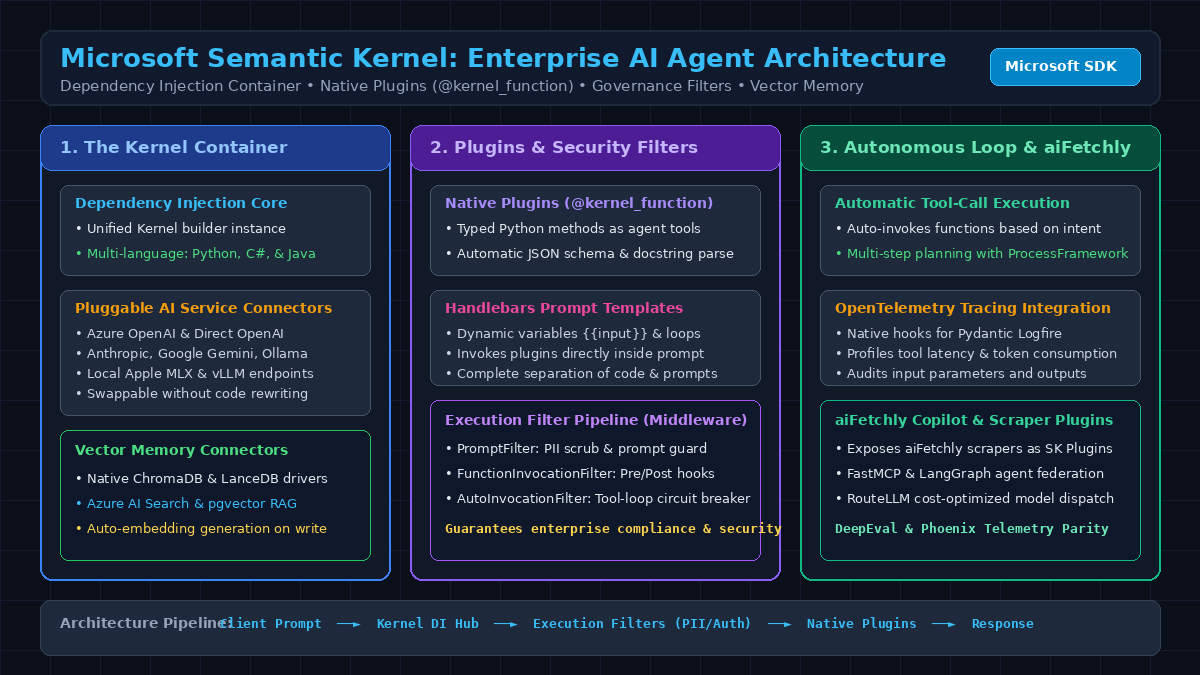
Semantic Kernel is an open-source, enterprise-grade SDK available natively in Python, C# / .NET, and Java. Designed with the architectural rigor of enterprise software, Semantic Kernel unifies Large Language Models with conventional programming languages through a dependency-injection Kernel container, typed Native and Prompt Plugins, pluggable Vector Memory Connectors, and a powerful Execution Filter pipeline that acts as an enterprise security middleware.
Microsoft Semantic Kernel Architectural Topology:
┌─────────────────────────────────────────────────────────────────┐
│ Enterprise Application Layer (aiFetchly Desktop / Cloud Server) │
└────────────────────────────────┬────────────────────────────────┘
                                 │
                                 ▼
┌─────────────────────────────────────────────────────────────────┐
│ The Kernel Hub (Dependency Injection & Service Registry)        │
│ • Manages registered AI connectors (Azure OpenAI, Anthropic)    │
│ • Local inference backends: Apple MLX, Ollama, vLLM             │
│ • Thread-safe, modular, and available in Python, C#, and Java   │
└───────┬────────────────────────┬────────────────────────┬───────┘
        │                        │                        │
        ▼                        ▼                        ▼
┌───────────────┐        ┌───────────────┐        ┌───────────────┐
│ Native Plugins│        │ Prompt Plugins│        │ Vector Memory │
│ • Python/C#   │        │ • Handlebars  │        │ • ChromaDB    │
│   class tools │        │   templates   │        │ • LanceDB     │
│ • @kernel_    │        │ • Dynamic var │        │ • Azure AI    │
│   function    │        │   injection   │        │   Search      │
└───────┬───────┘        └───────┬───────┘        └───────┬───────┘
        │                        │                        │
        └────────────────┬───────┴────────────────────────┘
                         │
                         ▼
┌─────────────────────────────────────────────────────────────────┐
│ Execution Filter Pipeline (Enterprise Governance Middleware)    │
│ • PromptFilter: Sanitizes prompts, scrubs PII, checks auth      │
│ • FunctionInvocationFilter: Pre/Post tool-calling validation    │
│ • AutoFunctionInvocationFilter: Limits multi-turn loop count    │
└────────────────────────────────┬────────────────────────────────┘
                                 │
                                 ▼
┌─────────────────────────────────────────────────────────────────┐
│ Output: Auditable, Governed, Deterministic Agent Execution     │
└─────────────────────────────────────────────────────────────────┘ The Architectural Pillars of Semantic Kernel
- The Kernel Dependency-Injection Hub: At the core of the framework is the
Kernelobject. Inspired by modern inversion-of-control (IoC) containers, the Kernel registers AI services (chat completion, text embeddings), plugins, memory stores, and filters. Services are referenced by service IDs, allowing applications to swap between cloud providers (e.g., Azure OpenAI) and local runtimes (e.g., Apple MLX or vLLM) with zero code refactoring. - Native Plugins & Typed Kernel Functions (
@kernel_function): Semantic Kernel treats business logic and AI prompts as first-class plugins. Developers author standard Python classes with@kernel_functiondecorators. The SDK automatically inspects type annotations and docstrings, synthesizing OpenAPI-compliant JSON schemas that foundation models use for precise, deterministic tool calling. - Semantic Prompt Templates (Handlebars & Liquid): Prompt engineering is decoupled from Python code. Using structured Handlebars syntax (
{{plugin-name.function-name}}), prompt templates can dynamically call native plugins, evaluate boolean conditionals, and loop through arrays directly within the prompt definition before sending it to the model. - Execution Filters (Enterprise Middleware): Semantic Kernel introduces a robust filter pipeline that intercepts execution at three distinct lifecycles:
PromptFilter: Intercepts prompts before model dispatch, enabling PII masking, safety classification, and prompt caching.FunctionInvocationFilter: Intercepts tool execution, allowing teams to enforce Role-Based Access Control (RBAC), log arguments, and mock responses.AutoFunctionInvocationFilter: Regulates multi-turn tool loops, acting as a circuit breaker against runaway infinite agent iterations.
- Pluggable Vector Memory Connectors: Unifies diverse vector search engines (such as ChromaDB, LanceDB, Qdrant, Azure AI Search, and PostgreSQL pgvector) under standardized record definitions, automating embedding synthesis and hybrid retrieval without vendor lock-in.
Comparing Agent Orchestration Frameworks
The table below contrasts LangChain, AutoGen, and Microsoft Semantic Kernel:
Agent Framework Architecture Comparison:
┌───────────────────────────┬───────────────────────────────┬───────────────────────────────┬───────────────────────────────┐
│ Architectural Dimension   │ LangChain / LangGraph         │ Microsoft AutoGen (0.2 / 0.4) │ Microsoft Semantic Kernel     │
├───────────────────────────┼───────────────────────────────┼───────────────────────────────┼───────────────────────────────┤
│ Target Ecosystem          │ Python & TypeScript           │ Python (0.4 adds C#/.NET)     │ Native Python, C#, and Java   │
│ Architectural Paradigm    │ Graph / Chain Abstractions    │ Conversational / Actor Model  │ Dependency-Injection Kernel   │
│ Tool Abstraction          │ BaseTool / StructuredTool     │ Function call dictionaries    │ Typed Native Plugins          │
│ Execution Interceptors    │ Custom Callback Handlers      │ Agent message hooks           │ Native 3-Tier Filter Pipeline │
│ Prompt Management         │ String / ChatPromptTemplate   │ Raw string formatting         │ Handlebars / Liquid Templates │
│ Enterprise Stability      │ Frequent interface changes    │ Architectural rewrite in 0.4  │ Strict Microsoft API Stability│
│ Vector Store Integration  │ Custom VectorStore wrappers   │ External integration          │ Standard VectorStoreRecord    │
│ Production Governance     │ Third-party logging wrappers  │ Custom telemetry code         │ Built-in OTel & Filter Hooks  │
└───────────────────────────┴───────────────────────────────┴───────────────────────────────┴───────────────────────────────┘ Deep Dive into Semantic Kernel Core Subsystems & Execution Lifecycle
To build auditable agent workflows with Semantic Kernel, software engineers must understand the mechanics of the Kernel Hub, Typed Function Introspection, and the Filter Middleware Pipeline.
Semantic Kernel Runtime Engine:
Semantic Kernel
 ├──► 1. Kernel Container: Central IoC registry managing AI services, plugins, and stores
 ├──► 2. Function Introspector: Generates JSON Schema from Python type hints and docstrings
 ├──► 3. Prompt Engine: Compiles Handlebars templates, evaluating embedded native plugin calls
 ├──► 4. Filter Pipeline: Executes Prompt, Function, and Auto-Invocation middleware hooks
└──► 5. Tool Loop Manager: Asynchronously resolves tool calls, managing turn-taking limits 1. The Kernel Container and Dependency Injection
In Semantic Kernel, all components are registered into a centralized container:
from semantic_kernel import Kernel
from semantic_kernel.connectors.ai.open_ai import AzureChatCompletion

# Initialize Kernel builder
kernel = Kernel()

# Register AI services with explicit service IDs
kernel.add_service(
    AzureChatCompletion(
        service_id="default-chat",
        deployment_name="gpt-4o",
        endpoint="https://my-azure-ai.openai.azure.com/",
        api_key="sk-..."
    )
) The Kernel manages service discovery. If a workflow requires a cost-effective model for extraction and a reasoning model for synthesis, both services are registered under distinct IDs and resolved dynamically during execution.
2. Native Plugin Introspection (@kernel_function)
When an agent needs to execute local tools (such as searching a database or scraping a webpage):
- Developers define a Python class where target methods are decorated with
@kernel_function. - The decorator introspects Python’s standard
typing.Annotatedmetadata and docstrings to extract parameter descriptions:
$$\text{Function Descriptor} = (\text{Name}, \text{Description}, {\text{Arg}_i: (\text{Type}_i, \text{Required}_i, \text{Description}_i)})$$
- When the model requests a function call, Semantic Kernel deserializes the arguments, validates their types, and executes the native method asynchronously.
3. The Three-Tier Filter Pipeline (Middleware)
Semantic Kernel’s filter architecture is its most distinctive enterprise feature. Filters execute around specific lifecycle events:
PromptRenderFilter: Runs before a prompt is formatted. Developers can inspect raw variables and modify system instructions.FunctionInvocationFilter: Wraps every native function call:async def on_function_invocation(context, next): # Pre-execution: Validate user authorization & log arguments print(f"Executing: \{context.function.name\} with \{context.arguments\}") await next(context) # Post-execution: Audit results & mask sensitive dataAutoFunctionInvocationFilter: Monitors automatic tool loops. If an agent enters an infinite loop repeatedly calling the same failing tool, this filter intercepts the request, increments a counter, and aborts the loop once a safety threshold (e.g., 5 iterations) is reached.
Hands-On Implementation: Building an Enterprise Agent in Python
Let’s walk through installing Semantic Kernel, authoring a typed data extraction plugin, implementing a security filter, and running an autonomous agent loop with automatic tool calling.
1. Environment Setup and Installation
Install semantic-kernel with support for OpenAI and Azure services:
# Create a fresh Python environment
conda create -n sk-env python=3.10 -y
conda activate sk-env

# Install Semantic Kernel core
pip install semantic-kernel Configure your environment variables:
export OPENAI_API_KEY="sk-..." 2. Initializing the Kernel and Registering Services
Create an application entry point and configure the Kernel with OpenAI chat completion:
import os
from semantic_kernel import Kernel
from semantic_kernel.connectors.ai.open_ai import OpenAIChatCompletion

# Initialize Kernel instance
kernel = Kernel()

# Add primary chat service
kernel.add_service(
    OpenAIChatCompletion(
        service_id="chat-gpt4o",
        ai_model_id="gpt-4o",
        api_key=os.environ["OPENAI_API_KEY"]
    )
)
print("Semantic Kernel initialized successfully.") 3. Authoring a Typed Native Plugin for Web Extraction
Create a typed plugin that simulates extracting e-commerce pricing from target URLs:
from typing import Annotated
from semantic_kernel.functions import kernel_function

class WebExtractionPlugin:
    """Plugin for scraping and extracting structured data from web pages."""

    @kernel_function(
        name="scrape_product_pricing",
        description="Scrapes an e-commerce product page and returns pricing and stock status."
    )
    def scrape_product_pricing(
        self,
        url: Annotated[str, "The complete URL of the e-commerce product page."],
        currency: Annotated[str, "The preferred currency format (e.g. USD, EUR)."] = "USD"
    ) -> Annotated[str, "JSON string containing product title, price, and stock availability."]:
        """Simulates scraping a web page and extracting verified product details."""
        print(f"\n[Plugin] Executing web extraction on: {url} ({currency})")

        # In production, this calls aiFetchly's native scraper engine
        return (
            f'{{"product": "Enterprise Cloud Server X10", '
            f'"price": 2499.00, '
            f'"currency": "{currency}", '
            f'"in_stock": true, '
            f'"source_url": "{url}"}}'
        )

# Register plugin with the Kernel
extraction_plugin = kernel.add_plugin(
    plugin=WebExtractionPlugin(),
    plugin_name="WebExtractor"
) 4. Implementing a Security and Audit Filter
Implement a FunctionInvocationFilter to enforce security policies and log every tool call:
from semantic_kernel.filters.filter_types import FilterTypes
from semantic_kernel.filters.functions.function_invocation_context import FunctionInvocationContext

# Define enterprise security filter
async def enterprise_security_filter(context: FunctionInvocationContext, next):
    function_name = context.function.name
    plugin_name = context.function.plugin_name

    print(f"\n[Security Filter] Intercepting: {plugin_name}.{function_name}")

    # Check for unauthorized domains in arguments
    if "url" in context.arguments:
        url_arg = str(context.arguments["url"])
        if "malicious-site.com" in url_arg:
            raise PermissionError(f"Access to blocked domain '{url_arg}' is prohibited by corporate policy.")

    # Proceed to function execution
    await next(context)

    # Audit log after successful execution
    print(f"[Security Filter] Successfully executed {function_name}. Result length: {len(str(context.result))}")

# Attach filter to the Kernel
kernel.add_filter(FilterTypes.FUNCTION_INVOCATION, enterprise_security_filter) 5. Running an Autonomous Agent with Automatic Tool Calling
Configure invocation settings to enable automatic tool calling, allowing the model to autonomously invoke the WebExtractor plugin:
import asyncio
from semantic_kernel.connectors.ai.open_ai import OpenAIChatPromptExecutionSettings
from semantic_kernel.connectors.ai.function_choice_behavior import FunctionChoiceBehavior

async def run_enterprise_agent():
    # Configure execution settings with automatic function choice
    execution_settings = OpenAIChatPromptExecutionSettings(
        service_id="chat-gpt4o",
        max_tokens=1000,
        temperature=0.2,
        function_choice_behavior=FunctionChoiceBehavior.Auto(
            filters={"included_plugins": ["WebExtractor"]}
        )
    )

    user_query = (
        "Please extract pricing details for the product at "
        "https://store.example.com/servers/cloud-x10 and format the results in a concise summary."
    )

    print(f"User Query: {user_query}")

    # Invoke the model through the Kernel
    response = await kernel.invoke_prompt(
        prompt=user_query,
        settings=execution_settings
    )

    print("\n--- Agent Final Answer ---")
    print(response)

# Execute async routine
if __name__ == "__main__":
asyncio.run(run_enterprise_agent()) Production Architecture & Local Copilot Integration for aiFetchly
In enterprise data extraction, market intelligence, and desktop developer copilots powered by AiFetchly, deploying Semantic Kernel creates a hardened, auditable execution engine for business integration.
aiFetchly Enterprise Agent Architecture with Semantic Kernel:
┌─────────────────────────────────────────────────────────────────┐
│ Enterprise Client Workstation (C# .NET App / Python Agent)      │
└────────────────────────────────┬────────────────────────────────┘
                                 │
     (Dispatches High-Volume Web Scraping & Synthesis Missions)
                                 ▼
┌─────────────────────────────────────────────────────────────────┐
│ Semantic Kernel Orchestration Core                              │
│ • Dependency Injection Container: Manages plugins and models    │
│ • Execution Filters: Enforces RBAC, PII redaction, and logging  │
└───────────────────┬─────────────────────────────────┬───────────┘
                    │                                 │
     (Invokes Native aiFetchly Plugin)      (Routes Model Inference)
                    ▼                                 ▼
┌───────────────────────────────────────┐ ┌───────────────────────────────┐
│ aiFetchly Scraper & Document Plugin   │ │ RouteLLM Dynamic Dispatch     │
│ • Headless browser DOM extraction     │ │ • Local Apple MLX (Zero Cost) │
│ • FastMCP standardized tool bridges   │ │ • Azure OpenAI (Frontier)     │
└───────────────────┬───────────────────┘ └───────────────┬───────────────┘
                    │                                     │
                    └──────────────────┬──────────────────┘
                                       │
                                       ▼
┌─────────────────────────────────────────────────────────────────┐
│ Unified Telemetry & Vector Memory Layer                         │
│ • In-Process Vector Retrieval via ChromaDB / LanceDB            │
│ • High-Throughput Cross-Encoder Reranking via Infinity          │
│ • OpenTelemetry Full-Stack Tracing via Pydantic Logfire         │
│ • Automated Regression & Accuracy Verification via DeepEval    │
└─────────────────────────────────────────────────────────────────┘ 1. Exposing aiFetchly Capabilities as Native Enterprise Plugins
By packaging AiFetchly’s automated web extraction engine as a Semantic Kernel plugin:
- Enterprise software developers working in C# / .NET or Java can invoke aiFetchly scrapers directly in-process, without spawning brittle Python sub-processes or configuring complex HTTP relays.
- Plugins declare strict type contracts, allowing models to extract e-commerce prices, regulatory disclosures, and technical documentation with zero schema drift.
2. Enterprise Multi-Tenant Governance and Pydantic Logfire Tracing
In enterprise production, every agent action must be auditable:
- Using Semantic Kernel’s
FunctionInvocationFilter, aiFetchly enforces tenant isolation, verifying that an agent cannot query URLs or documents outside its permitted organizational boundary. - Telemetry hooks export spans directly to Pydantic Logfire using standard OpenTelemetry protocols, providing real-time SQL visibility into tool execution latencies and parameter schemas.
3. Cost-Optimized Hybrid Execution with RouteLLM and Apple MLX
Balancing cloud cost against reasoning fidelity:
- Register RouteLLM as an AI service connector within the Kernel.
- RouteLLM dynamically analyzes query complexity: routing routine schema transformations to local Apple MLX models on developer Mac workstations at zero cost, while escalating complex multi-hop synthesis to Azure OpenAI GPT-4o.
- Combine with Infinity and ChromaDB for sub-5ms two-stage vector retrieval, and sandbox dynamic code interpretation inside E2B Firecracker microVMs.
- Continuous regression testing and metric evaluation with DeepEval guarantees that enterprise agent loops maintain 99%+ operational reliability over time.
Summary: Engineering Reliable Enterprise Agents with Semantic Kernel
The transition from experimental AI prototypes to resilient enterprise software requires robust architecture, stable contracts, and rigorous security boundaries.
Microsoft Semantic Kernel provides the engineering foundation needed to bridge generative AI with enterprise systems. Through its dependency-injection Kernel, typed native plugins, three-tier filter governance pipeline, and polyglot support for Python, C#, and Java, Semantic Kernel replaces brittle experimental code with maintainable, auditable architecture. Whether powering automated data extraction, local desktop copilots, or multi-tenant enterprise workflows in AiFetchly, Semantic Kernel establishes the standard for building production-grade autonomous intelligence.