Self-Rewarding LLMs: Autonomous Post-Training Alignment
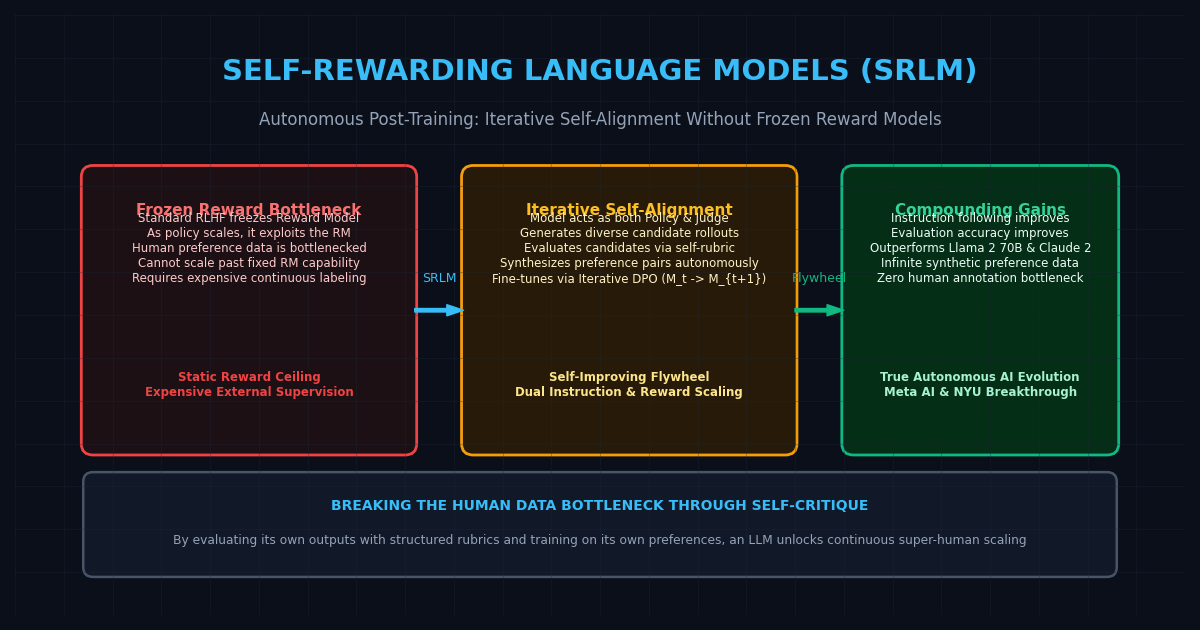
The Problem: The Frozen Reward Model Bottleneck in Standard RLHF
In enterprise generative AI deployments—from autonomous research agents to structured data extraction engines in AiFetchly—aligning foundation models to follow nuanced instructions and adhere to rigorous quality standards is a core engineering priority.
Historically, post-training alignment relied on Reinforcement Learning from Human Feedback (RLHF) or Direct Preference Optimization (DPO).
Both methodologies depend fundamentally on an external, frozen judge: either a standalone Reward Model ($r_\psi$) trained on static human comparisons or a frozen Reference Model ($\pi_{\text{ref}}$).
Why Static Reward Models Hit an Innovation Ceiling
- The Reward Saturation Asymptote: A frozen reward model represents a static ceiling on performance. As the policy model ($\pi_\theta$) undergoes thousands of gradient updates, it quickly surpasses the discriminative capabilities of the frozen reward model, leading to diminishing returns.
- Susceptibility to Reward Hacking: Because the reward model is frozen, the active policy inevitably discovers policy exploits—synthesizing long, verbose, or stylistically repetitive responses that trigger high reward scores without delivering genuine factual accuracy.
- The Human Data Wall: Gathering tens of thousands of human preference comparisons across ever-harder reasoning, coding, and multi-step extraction tasks is economically unsustainable. Human annotators disagree, introduce subjective biases, and cannot scale to meet rapid continuous deployment schedules.
To unlock super-human capabilities without endless human annotation budgets, models must develop an intrinsic ability to critique, score, and align themselves autonomously.
The Architecture: The Self-Rewarding Post-Training Flywheel
Pioneered by researchers from Meta AI and New York University (Weixin Yuan et al., ICML 2024 / 2025), Self-Rewarding Language Models (SRLM) establish an autonomous training loop where a single model acts as both the Generator and the Reward Model.
Instead of separating generation from evaluation, the model leverages LLM-as-a-Judge prompting with structured Chain-of-Thought (CoT) rubrics to score its own candidate generations, forming preference datasets for iterative fine-tuning.
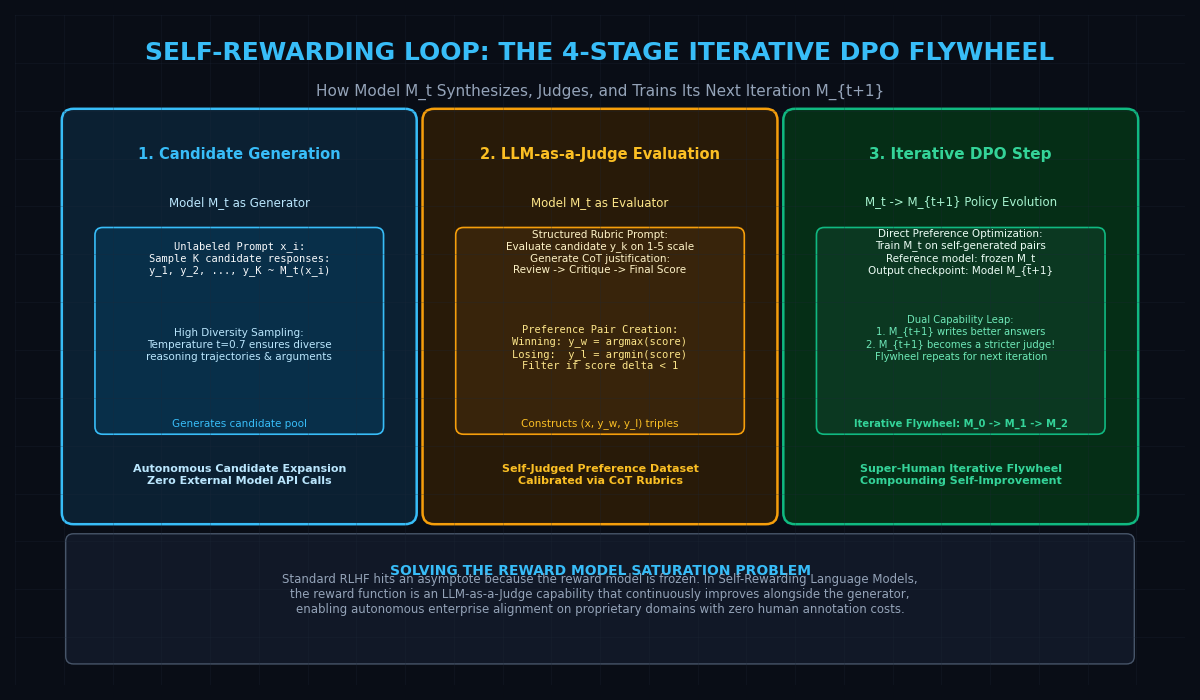
The Four Operational Stages of the SRLM Flywheel
The Self-Rewarding training pipeline operates across iterative epochs ($M_0 \to M_1 \to M_2 \to \dots$):
1. Dual-Skill Seed Initialization ($M_0$)
Before entering the self-improving loop, a base pre-trained model is initialized with two foundational skills via supervised fine-tuning (SFT):
- Instruction Following (IFT): Standard conversational and task-oriented instruction adherence.
- Evaluation Fine-Tuning (EFT): Training the model to act as a structured judge, outputting step-by-step reasoning critiques followed by an integer score on a 1-to-5 additive rubric.
2. Autonomous Candidate Generation
Given an unlabeled prompt $x \in \mathcal{D}_{\text{prompts}}$, the active model $M_t$ samples $K$ distinct candidate responses ($K \ge 4$) using temperature sampling ($T = 0.7$):
$${y_1, y_2, \dots, y_K} \sim M_t(x)$$
High-temperature sampling ensures diverse reasoning paths, varying degrees of detail, and alternative syntactic formulations.
3. LLM-as-a-Judge Evaluation and Pair Construction
Model $M_t$ is prompted with its own evaluation rubric to score each candidate response $y_k$:
$$\text{Review}_k, \text{Score}_k = M_t(\text{JudgePrompt}(x, y_k)), \quad \text{Score}_k \in {1, 2, 3, 4, 5}$$
From the scored candidate pool, the system constructs winning and losing preference pairs:
- Winning Output ($y_w$): The response with the highest score ($\max \text{Score}_k$).
- Losing Output ($y_l$): The response with the lowest score ($\min \text{Score}_k$).
If all candidates receive identical scores (score delta $< 1$), the prompt is discarded to prevent training on ambiguous preference margins.
4. Iterative Direct Preference Optimization ($M_t \to M_{t+1}$)
Using the newly generated, self-curated preference dataset $\mathcal{D}_t = {(x, y_w, y_l)}$, the system trains the model using Direct Preference Optimization (DPO), where the frozen checkpoint of $M_t$ serves as the reference model:
$$\mathcal{L}{\text{DPO}}(\theta{t+1}; \theta_t) = -\mathbb{E}{(x, y_w, y_l)} \left[ \log \sigma \left( \beta \log \frac{M{t+1}(y_w \mid x)}{M_t(y_w \mid x)} - \beta \log \frac{M_{t+1}(y_l \mid x)}{M_t(y_l \mid x)} \right) \right]$$
The resulting checkpoint becomes Model $M_{t+1}$, which is deployed into the next iteration to repeat the cycle.
Key Mechanics: The Compounding Capability Flywheel
A central theoretical concern is: Why does the model not fall into an echo chamber and reinforce its own hallucinations?
Empirical and theoretical analyses reveal why the SRLM flywheel succeeds:
1. The Asymmetry of Verification vs. Generation
In computational complexity and cognitive psychology, verifying a solution is substantially easier than creating it from scratch ($\text{NP} \ne \text{P}$).
Even when an LLM struggles to generate a flawless, highly detailed response on its first attempt, it possesses sufficient contextual understanding to identify factual contradictions, omitted instructions, or awkward phrasing when evaluating candidate responses side-by-side.
2. Dual-Skill Transfer: Improving Instruction and Evaluation Simultaneously
During each DPO iteration, the model is trained on preference pairs derived from both general instructions and evaluation tasks.
As a consequence:
- Generation Improves: Model $M_{t+1}$ writes higher-quality, more accurate, and better-formatted responses than $M_t$.
- Evaluation Improves: Model $M_{t+1}$ becomes a more discerning, rigorous judge than $M_t$, achieving higher correlation with human gold-standard judgments.
Across three iterations ($M_0 \to M_1 \to M_2 \to M_3$), the model continuously raises its own benchmark ceiling, outperforming much larger frontier baselines (such as Claude 2 and LLaMA-2-70B) on AlpacaEval 2.0 without requiring new human intervention.
Alignment Frameworks Comparison: PPO vs. DPO vs. RLAIF vs. SRLM
| Feature Dimension | Standard PPO (RLHF) | Standard DPO | RLAIF (Constitutional AI) | Self-Rewarding LLMs (SRLM) |
|---|---|---|---|---|
| Reward Mechanism | External Reward Model ($r_\psi$) | Implicit in DPO loss | Teacher LLM (e.g. GPT-4) | Model Acts as its Own Judge |
| Actor & Judge Coupling | Strictly Decoupled | Strictly Decoupled | Separate Teacher Model | Unified Single Foundation Model |
| Human Annotation Need | High (Thousands of pairs) | High (Static dataset) | Low (Uses frontier API) | Zero (Post-Seed Initialization) |
| Reward Saturation Risk | Severe (Exploits frozen RM) | Moderate | Bound by Teacher Model | Eliminated (Judge Improves Dynamically) |
| Flywheel Compounding | No (One-shot alignment) | No (Offline training) | Dependent on Teacher | Yes ($M_0 \to M_1 \to M_2 \to M_3$) |
| Infrastructure Overhead | 4 Models in GPU Memory | 2 Models in GPU Memory | Cloud API costs | Standard Single/Dual Model DPO |
Reference Implementation: Self-Evaluation and DPO Pair Synthesis
Below is an educational Python implementation illustrating how an active model samples candidate rollouts, evaluates them using a structured rubric, and synthesizes preference pairs for iterative DPO training:
import re
from typing import Dict, List, Optional, Tuple

JUDGE_PROMPT_TEMPLATE = """Review the user’s request and the corresponding response using the rubric below:
- Score 1: The response fails completely or provides harmful/incorrect data.
- Score 3: The response addresses the prompt but has minor omissions or poor formatting.
- Score 5: The response is exceptionally accurate, clear, and perfectly formatted.

[User Request]: {prompt}
[Candidate Response]: {candidate}

Provide a brief Chain-of-Thought critique, followed by your final score in the format: "Score: <1-5>".
"""

def extract_numerical_score(review_text: str) -> Optional[int]:
    """Parses score from the LLM-as-a-Judge evaluation text."""
    match = re.search(r"Score:\s*([1-5])", review_text)
    return int(match.group(1)) if match else None

class SelfRewardingPipeline:
    def __init__(self, model_runner):
        self.runner = model_runner

    def generate_and_score_pairs(
        self,
        unlabeled_prompts: List[str],
        num_candidates: int = 4
    ) -> List[Dict[str, str]]:
        """
        Executes candidate sampling, self-evaluation, and preference pair creation.
        """
        preference_dataset = []

        for prompt in unlabeled_prompts:
            # 1. Sample K candidate completions from current model checkpoint M_t
            candidates = self.runner.sample_completions(prompt, count=num_candidates, temp=0.7)

            scored_candidates: List[Tuple[str, int]] = []

            # 2. Model M_t switches to Judge Mode to evaluate its own outputs
            for candidate in candidates:
                eval_prompt = JUDGE_PROMPT_TEMPLATE.format(prompt=prompt, candidate=candidate)
                critique_and_score = self.runner.generate(eval_prompt, temp=0.2)
                score = extract_numerical_score(critique_and_score)
                if score is not None:
                    scored_candidates.append((candidate, score))

            # 3. Form winning (y_w) and losing (y_l) preference pairs
            if len(scored_candidates) >= 2:
                scored_candidates.sort(key=lambda x: x[1], reverse=True)
                best_candidate, high_score = scored_candidates[0]
                worst_candidate, low_score = scored_candidates[-1]

                # Filter out pairs with identical or marginal score separation
                if high_score - low_score >= 1:
                    preference_dataset.append({
                        "prompt": prompt,
                        "chosen": best_candidate,
                        "rejected": worst_candidate,
                        "high_score": high_score,
                        "low_score": low_score
                    })
                    print(f"[PAIR CREATED] Margin: {high_score} vs {low_score} on prompt: {prompt[:40]}...")

        return preference_dataset

if __name__ == "__main__":
    print("--- Self-Rewarding Language Model Workflow Verified ---")
    print("1. Autonomous rollout sampling.")
    print("2. Rubric-guided LLM-as-a-Judge scoring.")
print("3. High-margin preference pair synthesis for iterative DPO.") Production Scaling: Autonomous Alignment in aiFetchly
In enterprise data platforms and autonomous web crawlers like AiFetchly, deploying Self-Rewarding mechanisms unlocks profound operational autonomy:
1. Continuous Adaptation to Unstructured Web Schemas
When extraction targets shift—such as e-commerce platforms redesigning their DOM structures or B2B directories modifying JSON endpoints—human annotation teams cannot re-label thousands of examples in time.
Using Self-Rewarding loops, the extraction agent generates multiple candidate schemas from freshly scraped HTML, scores them against deterministic validation rubrics (checking JSON validity and data completeness), and fine-tunes itself nightly via DPO without human intervention.
2. Radical Reduction in Training Budgets
Eliminating external commercial judge APIs (like GPT-4o) and manual labeling teams slashes post-training alignment expenses by over 90%. Enterprise models adapt to proprietary corporate data using their own compute cycles, establishing true data sovereignty.
By transforming foundation models from passive learners into active, self-evaluating agents, Self-Rewarding Language Models provide the architectural blueprint for autonomous AI evolution in 2026.