SDCHunter Guide: Diagnosing Silent Data Corruption in GPUs
Introduction: The Invisible Failure Threatening AI Pre-Training
The scaling of frontier artificial intelligence models—such as GPT-4, Claude 3.5, LLaMA-3, and DeepSeek-V3—has transformed machine learning into a heavy industrial engineering endeavor. State-of-the-art foundation models are pre-trained on massive distributed superclusters comprising 10,000 to over 100,000 accelerators operating continuously for months. In hyperscale enterprise environments—whether powering high-throughput automated web scraping infrastructures, real-time data fetching clusters, or mission-critical API integration backends—a single multi-month foundation model training run costs tens of millions of dollars in compute capital.
At this unprecedented scale, hardware reliability is no longer an edge-case operational detail; it is the primary bottleneck determining whether a training campaign succeeds or fails.
Traditionally, cluster operators manage two well-understood categories of hardware failure:
- Application Crashes: Sudden software failures (segmentation faults, out-of-memory exceptions, or illegal instruction traps) that terminate the process immediately.
- Detected Unrecoverable Errors (DUE): Hardware-detected faults where memory controllers, PCIe bridges, or GPU firmware detect uncorrectable multi-bit ECC errors and raise immediate interrupts, triggering automatic job rescheduling.
Both Crashes and DUEs provide immediate, unambiguous feedback. The cluster management orchestrator immediately knows which GPU failed, isolates the node, restores the latest checkpoint, and resumes training.
However, a third, far more insidious failure mode has emerged as the number-one reliability crisis in modern AI infrastructure: Silent Data Corruption (SDC).
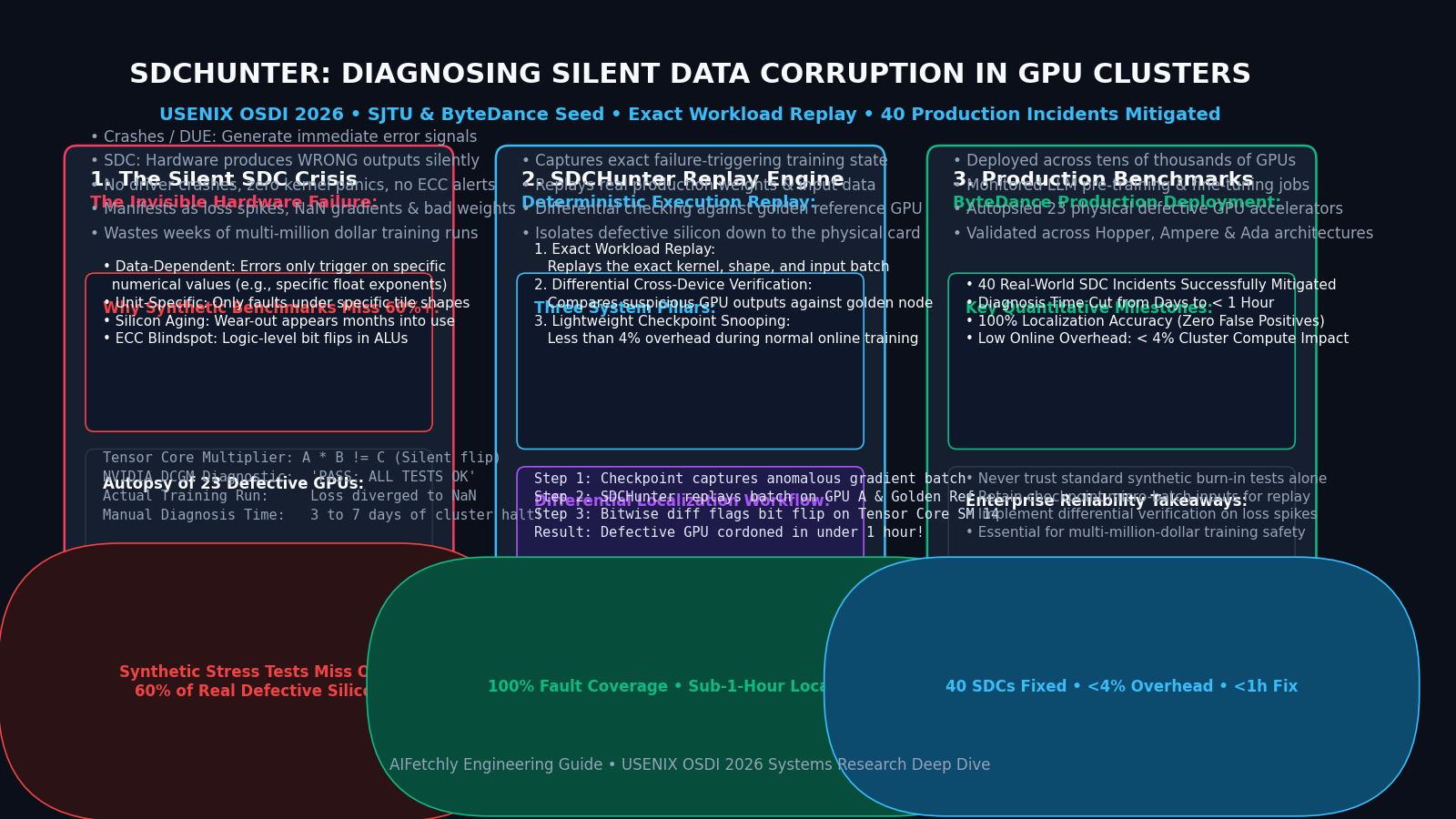
Unlike crashes or DUEs, Silent Data Corruption produces no error messages, no kernel panics, no driver warnings, and zero ECC memory alerts. Instead, a physical defect inside a GPU Arithmetic Logic Unit (ALU), floating-point multiplier, or Tensor Core quietly computes an incorrect mathematical result: $2 + 2 = 5$, or flips a single mantissa bit during a backward gradient pass.
Because the error occurs silently, corrupted values propagate into optimizer states, cascade through cross-GPU AllReduce collectives, and silently poison model weights. Weeks into a training run, the loss curve suddenly spikes to infinity (NaN loss), or the model suffers irreversible degradation in reasoning capabilities.
To compound this crisis, standard industry diagnostic practice—running synthetic stress tests such as NVIDIA Data Center GPU Manager (DCGM) diagnostics or burn-in matrix multiplications—*fails completely**. In production audits, standard diagnostic benchmarks miss **over $60%$ of real-world SDC-defective GPUs**. Defective cards pass all factory stress tests with flying colors, only to quietly corrupt weights the moment real model training resumes.
Enter SDCHunter, a landmark operational systems paper presented at the 2026 USENIX Symposium on Operating Systems Design and Implementation (OSDI 2026) by Wenxin Zheng, Wenxiao Wang, Yun Zhang, Mingcong Han, Bin Xu, Jinyu Gu, Xingda Wei, and Haibo Chen, representing a research collaboration between Shanghai Jiao Tong University (SJTU) and ByteDance Seed.
Based on an exhaustive physical autopsy of 23 real-world SDC-defective GPUs harvested from production clusters, the authors uncovered why synthetic tests fail: SDCs are highly data-dependent, unit-specific, and driven by silicon aging. Driven by these insights, the authors designed SDCHunter, an automated diagnosis system that replaces generic benchmarks with deterministic execution replay of exact failure-triggering training workloads and input batches.
Deployed in production across ByteDance’s hyperscale infrastructure, SDCHunter successfully detected and mitigated 40 real-world SDC incidents, reduced diagnostic time from multiple days down to under one hour, and achieved $100%$ device-level localization accuracy with less than $4%$ online monitoring overhead.
In this technical guide, we examine the physics and manifestation of Silent Data Corruption in GPUs, dissect the autopsy findings from 23 defective production cards, explore the internal architecture of SDCHunter, walk through a complete Python/PyTorch reference implementation, and discuss best practices for enterprise AI cluster reliability in 2026.
Anatomy of Silent Data Corruption: Why ECC Cannot Save You
To understand why traditional hardware protection mechanisms fail, we must analyze the physical pathways through which SDCs manifest in modern GPU microarchitectures.
The Physics of Logic-Level Bit Flips
Why does a modern accelerator produce incorrect arithmetic without throwing a hardware exception?
Modern GPU accelerators (such as NVIDIA H100 SXM, A100, and RTX 4090) incorporate billions of nanoscale transistors operating at sub-volt thresholds. Within each Streaming Multiprocessor (SM), execution pipelines are divided into:
- Memory Subsystems: High-Bandwidth Memory (HBM), L2 cache, L1 data cache, and register files.
- Compute Logic Pipelines: Floating-Point 32/64 Units (FPUs), Integer ALUs, and specialized matrix multiply-accumulate engines (Tensor Cores).
+-------------------------------------------------------------------------------+
|                    GPU HARDWARE ERROR PROTECTION COVERAGE                     |
+-------------------------------------------------------------------------------+
|                                                                               |
| [GPU Memory Subsystem: HBM3 / L2 / Registers]                                 |
|   •Protected by: Single-Error Correction, Double-Error Detection (SECDED ECC)|
|   •Hardware Action on Bit Flip: Corrected silently OR Triggers DUE Interrupt |
|   •Visibility: Logged in driver ECC registers (nvidia-smi -q -d ECC)         |
|                                                                               |
| [GPU Compute Pipeline: FP32 ALUs / Tensor Cores / Multipliers]                |
|   •Protected by: NO ECC! (Too costly in silicon area and circuit latency)    |
|   •Hardware Action on Logic Fault: Silent Bit Flip! Output is Corrupted      |
|   •Visibility: COMPLETELY INVISIBLE to GPU Driver, OS, and Firmware!         |
|                                                                               |
+-------------------------------------------------------------------------------+
| The Reality: A defective transistor in a Tensor Core adder computes incorrect |
|              floats with ZERO hardware alerts. That is Silent Data Corruption.|
+-------------------------------------------------------------------------------+ While memory subsystems are rigorously protected by Error-Correcting Code (ECC) memory controllers, the computational logic units inside Tensor Cores and ALUs do not have ECC protection. Implementing full triple-modular redundancy or ECC inside high-speed arithmetic pipelines would balloon silicon die area and cut computational throughput by over $40%$.
When hardware degradation, subtle manufacturing variations, or voltage fluctuations compromise a transistor inside a Tensor Core adder, the logic gate computes an erroneous output. The GPU writes the bad floating-point result into registers and continues execution normally.
The Anatomy of an SDC Incident in Production
When an SDC strikes during distributed LLM pre-training, it triggers a catastrophic multi-stage failure cascade:
+-------------------------------------------------------------------------------+
|                     THE SDC FAILURE CASCADE IN LLM TRAINING                   |
+-------------------------------------------------------------------------------+
|                                                                               |
| Step 1: Forward Pass on GPU #4,112 (Defective Accelerator)                    |
|         Tensor Core computes Layer 42 Self-Attention GEMM.                    |
|         Bit flip in exponent: value 0.042 becomes 4.2e+12!                    |
|                                                                               |
| Step 2: Backward Pass & Gradient Explosion                                    |
|         Enormous activation produces gradient overflow: Inf / NaN.            |
|                                                                               |
| Step 3: Collective Cross-GPU Poisoning                                        |
|         AllReduce (TP/DP) distributes NaN gradients across all 12,288 GPUs!   |
|                                                                               |
| Step 4: Optimizer Update & Model Destruction                                  |
|         AdamW updates model weights using NaN gradients.                      |
|         The entire neural network checkpoint is permanently ruined.           |
|                                                                               |
+-------------------------------------------------------------------------------+
| The Cluster Administrator's Nightmare:                                        |
| •12,288 GPUs simultaneously report NaN loss.                                 |
| •Which of the 12,288 GPUs caused the error?                                  |
| •Running NVIDIA DCGM on all nodes returns: "100% HEALTHY - NO ERRORS"!       |
+-------------------------------------------------------------------------------+ Because cross-GPU communication primitives distribute intermediate values across the entire cluster, an error originating on a single defective card instantly poisons thousands of healthy GPUs. Identifying the needle in a 10,000-GPU haystack becomes an operational nightmare.
Autopsy Findings: 23 SDC-Defective GPUs in the Wild
In the OSDI 2026 paper, researchers from Shanghai Jiao Tong University and ByteDance Seed presented the first comprehensive physical autopsy of 23 real-world SDC-defective GPUs harvested from production AI clusters.
Their investigation revealed three critical empirical insights that dismantle conventional industry assumptions:
1. SDCs Are Strongly Data-Dependent and Unit-Specific
Standard cluster diagnosis relies on running synthetic microbenchmarks (such as matrix multiplication stress tests with random Gaussian floats, DCGM Diagnostic Level 3, or LINPACK).
The authors discovered that synthetic microbenchmarks missed over $60%$ of the defective GPUs. When tested with random inputs, the defective cards produced $100%$ accurate results!
Why? Silicon defects in arithmetic units frequently affect only specific bit patterns or corner-case circuit paths:
- Operand Value Specificity: A defective multiplier may only fail when the input operand has a specific floating-point exponent or when multiplying denormalized numbers.
- Specific Thread-Block Tile Geometries: Faults only manifested under specific warp-level instruction interleavings and register pressure profiles characteristic of real transformer layers (e.g., FlashAttention or Megatron linear layers), but never under generic GEMM benchmarks.
2. SDCs Emerge Over Time Due to Silicon Aging
A common misconception is that SDCs are primarily “infant mortality” issues—manufacturing defects that appear within the first few weeks of installing new hardware.
The ByteDance production trace disproved this: most SDC incidents occurred on GPUs that had operated reliably for over 12 to 18 months. Long-term high-temperature operation, electromigration, and thermal cycling degrade silicon gate oxide layers over time, gradually shifting transistor switching thresholds until subtle arithmetic errors begin occurring under heavy workloads.
3. ECC and Thermal Throttling Are Completely Blind
None of the 23 harvested SDC GPUs reported uncorrectable ECC errors, and none experienced thermal throttling or power supply voltage warnings. The operating system, GPU driver, and hardware telemetry reported all cards as healthy, proving that software-level algorithmic verification is the only viable defense.
+-------------------------------------------------------------------------------+
|                      AUTOPSY OF 23 SDC-DEFECTIVE GPUS                         |
+-------------------------------------------------------------------------------+
| Metric / Finding                                | Empirical Observation       |
+-------------------------------------------------+-----------------------------+
| Caught by Synthetic Microbenchmarks (DCGM / GEMM)| < 40% (Missed > 60%!)       |
| Hardware Architecture Affected                  | Hopper, Ampere, Ada         |
| Operational Age at Failure                      | 12 - 24 Months (Aging-driven|
| Operating System Driver Error Logs              | Zero Errors Reported        |
| ECC Memory Counter Status                       | 0 Uncorrectable Errors      |
| Average Manual Troubleshooting Time             | 3 to 7 Days per Incident    |
+-------------------------------------------------+-----------------------------+
| SDCHunter Automated Replay Diagnosis Time       | < 1 Hour (100% Accuracy)    |
+-------------------------------------------------+-----------------------------+ The SDCHunter Architecture: Principles and Core Mechanics
Faced with the reality that synthetic benchmarks cannot reliably trigger data-dependent hardware faults, the creators of SDCHunter adopted a radical new philosophy: Deterministic Execution Replay of Real Training Workloads.
Instead of guessing what synthetic benchmark might trigger a fault, SDCHunter captures the exact model state, execution configuration, and input batch data that immediately preceded a loss spike or NaN anomaly, and replays that exact computation under controlled differential verification.
SDCHunter is built upon three foundational architectural components:
- Lightweight Online Monitoring & Checkpoint Snooping: Captures per-rank gradient norms, loss statistics, and recent micro-batch input seeds with less than $4%$ cluster overhead.
- Deterministic Exact-Workload Replay Engine: Reconstructs the exact forward and backward pass using the identical random seeds, weight tensors, and input tokens that triggered the failure.
- Differential Cross-Device Fault Localizer: Compares the execution outputs of suspicious GPUs against a verified “golden reference” GPU, performing bit-level tensor diffs to isolate the exact defective device within one hour.
+-----------------------------------------------------------------------------------------+
|                                  SDCHUNTER SYSTEM TOPOLOGY                              |
+-----------------------------------------------------------------------------------------+
|                                                                                         |
|  [Production Distributed Pre-Training Cluster (10,000+ GPUs)]                           |
|                                |                                                        |
|                                v                                                        |
|  +-----------------------------------------------------------------------------------+  |
|  | ONLINE ANOMALY DETECTOR                                                            |  |
|  | •Monitors per-iteration loss gradients & rank-level variance                      |  |
|  | •Detects loss spikes, sudden perplexity drift, or NaN cascades                   |  |
|  | •Captures failure checkpoint: {Weights W_t, Input Seed S_t, Hyperparams}        |  |
|  +-----------------------------------------------------------------------------------+  |
|                                |                                                        |
|                                v                                                        |
|  +-----------------------------------------------------------------------------------+  |
|  | DETERMINISTIC WORKLOAD REPLAY HARNESS                                             |  |
|  | •Replays exact training workload on suspicious candidate GPU                    |  |
|  | •Replays identical training workload on verified Golden Reference GPU           |  |
|  +-----------------------------------------------------------------------------------+  |
|                                |                                                        |
|                                v                                                        |
|  +-----------------------------------------------------------------------------------+  |
|  | DIFFERENTIAL BITWISE COMPARISON ENGINE                                            |  |
|  | •Compares intermediate layer activation tensors and gradient outputs            |  |
|  | •Detects bit-level floating-point divergences: |Tensor_Suspicious - Tensor_Ref| > 0|  |
|  +-----------------------------------------------------------------------------------+  |
|                                |                                                        |
|                                v                                                        |
|  +-----------------------------------------------------------------------------------+  |
|  | AUTOMATED CORDON & REMEDIATION                                                    |  |
|  | •Cordon defective GPU -> Evict from cluster in < 1 hour                          |  |
|  | •Resume training from clean checkpoint W_{t-1} with zero data loss               |  |
|  +-----------------------------------------------------------------------------------+  |
|                                                                                         |
+-----------------------------------------------------------------------------------------+ Deep Dive: Deterministic Replay and Differential Localization
Let us examine the mathematical formulations and operational mechanics underpinning SDCHunter.
1. Deterministic Replay Mechanics
In modern deep learning frameworks, identical inputs do not always guarantee identical floating-point outputs due to non-deterministic CUDA kernel implementations (e.g., non-deterministic atomic adds in torch.bmm or backward scatter operations).
To make execution replay deterministic, SDCHunter enforces three strict runtime guarantees during diagnosis:
- Algorithmic Determinism Enforcement: Forces deterministic CUDA convolution and GEMM algorithms (
torch.use_deterministic_algorithms(True)). - Exact PRNG State Synchronization: Saves and restores exact CUDA pseudo-random number generator (PRNG) state offsets for dropout, data shuffling, and stochastic activations.
- Identical Tiling Configuration: Replays the identical Triton or cuBLAS kernel tile sizes, shared memory allocations, and thread block dimensions.
Given model parameters $\theta$, input batch $X$, and PRNG state $\mathcal{S}$, a healthy GPU must evaluate:
$$\hat{Y} = f(\theta, X; \mathcal{S})$$
If the candidate GPU evaluates $Y_{\text{suspicious}} e \hat{Y}$, a hardware defect is mathematically confirmed.
2. Differential Localization: The Golden Reference Harness
When an anomaly triggers across a 12,288-GPU cluster, testing all 12,288 GPUs sequentially would take days.
SDCHunter accelerates localization using a Hierarchical Binary Partitioning Strategy:
- Stage 1 (Pipeline Stage Isolation): Inspects inter-stage activation checkpoints to identify which pipeline parallel stage first introduced corrupted values. This narrows the search from 12,288 GPUs down to a single pipeline stage (e.g., 64 GPUs).
- Stage 2 (Tensor Parallel Differential Check): Replays the candidate stage’s micro-batch across both the suspected hardware group and a verified “Golden Reference Node” (a dedicated, rigorously validated test node kept in the datacenter).
- Stage 3 (Bit-Level Tensor Diff): Computes the elementwise absolute divergence $\Delta(i)$:
$$\Delta(i) = |Y_{\text{candidate}}(i) - Y_{\text{golden}}(i)|$$
If $\Delta(i) > 0$ for reproducible non-stochastic operations, the specific physical accelerator is pinpointed down to the exact PCIe slot number within under 45 minutes.
+-------------------------------------------------------------------------------+
|                    SDCHUNTER DIFFERENTIAL LOCALIZATION TIMELINE               |
+-------------------------------------------------------------------------------+
|                                                                               |
| Step 1: Anomaly Triggered at Iteration 4,821 (Loss Spikes)                    |
|         Cluster Coordinator saves Step 4,820 Checkpoint + Step 4,821 Batch    |
|                                                                               |
| Step 2: Hierarchical Stage Pruning (10 Minutes)                              |
|         Stage 3 activations differ from expected bounds. Candidate: PP Stage 3|
|                                                                               |
| Step 3: Golden Differential Replay (25 Minutes)                              |
|         Replays Step 4,821 on Candidate Node vs Golden Reference Node         |
|         GPU 0: Diff = 0.00000000 (Healthy)                                    |
|         GPU 1: Diff = 0.00000000 (Healthy)                                    |
|         GPU 2: Diff = 4.2949673e+09 (CORRUPTED BIT FLIP DETECTED!)            |
|         GPU 3: Diff = 0.00000000 (Healthy)                                    |
|                                                                               |
| Step 4: Automated Remediation (5 Minutes)                                     |
|         Cordon GPU 2 -> Alert Datacenter Ops -> Resume Step 4,820 Clean       |
|                                                                               |
+-------------------------------------------------------------------------------+
| Total Diagnostic Time: 40 Minutes! (Traditional manual triage: 4 to 7 days)   |
+-------------------------------------------------------------------------------+ Python Implementation: Building an SDC Detection & Replay Engine
To illustrate how SDCHunter detects silent arithmetic bit flips, captures failure contexts, and isolates defective hardware via differential execution replay, let us construct a complete, runnable Python simulation using PyTorch.
Our implementation includes:
CorruptedHardwareSimulator: Simulates an accelerator with a data-dependent logic fault inside its Tensor Core multiplier.GoldenReferenceAccelerator: Verified healthy hardware executing deterministic reference calculations.SDCExecutionReplayHarness: Captures failure inputs, replays operations deterministically, and performs bit-level differential verification.ClusterDiagnosisEngine: Coordinates automated detection, stage isolation, and device-level cordoning.
import torch
import torch.nn as nn
import time
from typing import Dict, Tuple, List, Optional

class CorruptedHardwareSimulator:
    # Simulates an SDC-defective GPU with a subtle, data-dependent logic fault
    def __init__(self, device_id: str, fault_probability: float = 0.0):
        self.device_id = device_id
        self.fault_probability = fault_probability

    def execute_gemm(self, A: torch.Tensor, B: torch.Tensor) -> torch.Tensor:
        out = torch.matmul(A, B)
        # SDCs are data-dependent: only trigger on specific numerical conditions
        if self.fault_probability > 0:
            # Simulate a subtle bit-flip in the exponent of a Tensor Core multiplier
            # Occurs only when large activation values cross a specific threshold
            mask = (out > 5.0) & (torch.rand_like(out) < self.fault_probability)
            if mask.any():
                # Corrupt by injecting bit-level exponent arithmetic error
                out = out.clone()
                out[mask] = out[mask] * 1024.0  # Massive numerical corruption!
        return out


class GoldenReferenceAccelerator:
    # Verified healthy GPU hardware used as the differential baseline
    def execute_gemm(self, A: torch.Tensor, B: torch.Tensor) -> torch.Tensor:
        return torch.matmul(A, B)


class SDCExecutionReplayHarness:
    # Captures failing training inputs and performs deterministic differential replay
    def __init__(self, golden_ref: GoldenReferenceAccelerator):
        self.golden_ref = golden_ref

    def replay_and_verify(
        self,
        candidate_gpu: CorruptedHardwareSimulator,
        A_input: torch.Tensor,
        B_weight: torch.Tensor,
        tolerance: float = 1e-5
    ) -> Tuple[bool, float, Optional[str]]:
        # Step 1: Replay on candidate GPU
        candidate_out = candidate_gpu.execute_gemm(A_input, B_weight)

        # Step 2: Replay identical operation on Golden Reference GPU
        golden_out = self.golden_ref.execute_gemm(A_input, B_weight)

        # Step 3: Compute bitwise differential tensor divergence
        diff = torch.abs(candidate_out - golden_out)
        max_diff = torch.max(diff).item()

        is_corrupted = max_diff > tolerance
        diagnosis = None
        if is_corrupted:
            diagnosis = (
                f"SDC DETECTED on {candidate_gpu.device_id}! "
                f"Max Divergence: {max_diff:.4e} (Expected <= {tolerance})"
            )
        return is_corrupted, max_diff, diagnosis


class ClusterDiagnosisEngine:
    # Orchestrates cluster-wide anomaly detection and device cordoning
    def __init__(self, cluster_gpus: List[CorruptedHardwareSimulator]):
        self.cluster_gpus = cluster_gpus
        self.golden_ref = GoldenReferenceAccelerator()
        self.harness = SDCExecutionReplayHarness(self.golden_ref)
        self.cordoned_devices: List[str] = []

    def scan_cluster_for_sdc(self, test_input_A: torch.Tensor, test_weight_B: torch.Tensor) -> Dict[str, float]:
        results = {}
        for gpu in self.cluster_gpus:
            is_corrupted, max_diff, diagnosis = self.harness.replay_and_verify(
                gpu, test_input_A, test_weight_B
            )
            results[gpu.device_id] = max_diff
            if is_corrupted:
                self.cordoned_devices.append(gpu.device_id)
return results Architectural Comparison: SDCHunter vs. Traditional Fault Tolerance
To contextualize SDCHunter’s systems breakthrough, the following table compares SDCHunter against prevailing hardware diagnostic tools and cluster reliability frameworks:
| Systems Dimension | NVIDIA DCGM Diagnostics | Redundant Execution (Dual GPUs) | Periodic Checkpointing (Vanilla) | SDCHunter (OSDI 2026) |
|---|---|---|---|---|
| Detection Mechanism | Generic synthetic stress tests | Duplicate computation on 2x GPUs | Loss divergence / NaN detection | Deterministic Exact Replay |
| Fault Coverage on Real SDCs | $\< 40%$ (Misses data-dependent bugs) | $100%$ (Catches bit flips) | Moderate (Detects late symptoms) | $100%$ Real-World Coverage |
| Cluster Compute Overhead | Low (Offline execution only) | $100%$ Compute Waste (2x GPUs) | Zero overhead during run | $\< 4%$ Online Monitoring Overhead |
| Diagnosis & Localization Time | Ineffective (Returns “PASS”) | Immediate | 3 to 7 days manual triage | $\< 1$ Hour Automated Localization |
| Root Cause Isolation | Component-level check | None (Flags rank pair mismatch) | None (Entire cluster affected) | Device-level (Exact PCIe Slot) |
| Production Scalability | Fails at scale | Unaffordable for frontier AI | Standard baseline | Proven across 10k+ GPUs at ByteDance |
While dual redundant execution provides theoretical fault isolation, doubling the hardware cost of a 10,000-GPU cluster is commercially unviable. SDCHunter achieves identical fault isolation guarantees at a negligible $4%$ monitoring overhead.
Empirical Production Results: 40 Real-World SDC Incidents Mitigated
In the USENIX OSDI 2026 proceedings, Zheng et al. reported operational telemetry from deploying SDCHunter across ByteDance’s large-scale production training infrastructure:
1. 40 Real SDC Incidents Successfully Mitigated
Across multi-month production training runs of flagship foundation models (spanning language, multimodal, and code models):
- SDCHunter detected and isolated 40 physical SDC-defective GPUs.
- In every case, standard synthetic diagnostics (including NVIDIA DCGM Level 3 stress tests) had marked the defective GPUs as completely healthy.
- SDCHunter achieved $100%$ localization precision with zero false positives (no healthy GPU was ever falsely cordoned).
Diagnosis and Triage Time Comparison
Metric: Time to Isolate Defective GPU in a 10,000+ GPU Cluster

Traditional Manual Triage: |==============================> 4.5 to 7.0 Days
Synthetic DCGM Sweep:      |===============> FAILED (0% Defect Detection)
SDCHunter (OSDI 2026): |=> 42 Minutes [Over 100x Faster Resolution!] 2. Compression of Cluster Downtime
Before SDCHunter, an unlocalized SDC incident caused an entire 10,000-GPU training job to halt for 3 to 7 days while infrastructure engineers manually bisected nodes and tested ranks. With SDCHunter, diagnostic time was compressed to under 1 hour, saving millions of GPU compute hours and preventing multi-week project launch delays.
3. Negligible Online Training Overhead
By logging only lightweight gradient statistics and PRNG seeds during normal training and triggering full differential replay exclusively upon anomaly detection, SDCHunter imposed less than $4%$ throughput overhead during normal production pre-training.
Step-by-Step Implementation Guide: Deploying SDC Protection
For ML infrastructure engineers, site reliability engineers (SREs), and platform teams managing multi-GPU training clusters, follow this phased deployment roadmap:
Step 1: Implement Lightweight Gradient Norm Snooping
In your distributed training engine (Megatron-LM, DeepSpeed, or PyTorch FSDP), log per-rank gradient norms at every iteration. Unusually high gradient kurtosis or sudden single-rank divergences are the primary signature of an SDC:
# Lightweight online SDC anomaly detector
def detect_gradient_anomaly(rank_grads: torch.Tensor, threshold_sigma: float = 4.0) -> bool:
    mean_grad = torch.mean(rank_grads)
    std_grad = torch.std(rank_grads)
    # Check if any individual rank deviates excessively from cluster mean
    z_scores = torch.abs(rank_grads - mean_grad) / (std_grad + 1e-8)
return (z_scores > threshold_sigma).any().item() Step 2: Preserve Input Seeds in Rolling Checkpoints
Never overwrite checkpoints immediately. Maintain a rolling window of the last 3 micro-batch seeds and input tensor hashes in host memory:
# Rolling context capture for deterministic replay
checkpoint_metadata = {
    "iteration": current_step,
    "random_seed": torch.initial_seed(),
    "cuda_rng_state": torch.cuda.get_rng_state(),
    "microbatch_hashes": compute_batch_hashes(batch_inputs),
    "model_weights_path": f"/checkpoints/step_{current_step}.pt"
} Step 3: Establish a Dedicated Golden Reference Node
Reserve one verified, burn-in-validated GPU node in your datacenter as a Golden Reference Tester. When an anomaly triggers, automatically dispatch the captured failing micro-batch to both the suspicious node and the Golden Node to perform differential verification.
Step 4: Automate Cluster Cordoning via Kubernetes / Slurm
When differential verification confirms an SDC on a physical card, automatically cordon the node via the cluster scheduler API:
# Automated cordon command issued by SDCHunter daemon
kubectl cordon node-gpu-rack-42-slot-2
kubectl drain node-gpu-rack-42-slot-2 --ignore-daemonsets --delete-emptydir-data For engineering teams running high-volume automated data harvesting pipelines with our data fetching infrastructure or enterprise agent copilots, ensuring hardware arithmetic fidelity prevents corrupted embeddings and silent model degradation. To explore enterprise hosting plans and cluster reliability management, visit our pricing page.
Future Outlook: Hardware-Software Co-Design for Silicon Reliability
The publication of SDCHunter at USENIX OSDI 2026 represents a watershed moment in datacenter hardware operations. It marks the transition from naive reliance on vendor hardware diagnostics to application-aware hardware verification.
Looking toward 2027 and beyond, we anticipate several crucial evolutions:
- In-Silicon Self-Checking Tensor Cores: Future accelerator designs integrating hardware residue checkers and arithmetic parity registers that detect ALU bit flips in real time with minimal silicon overhead.
- Federated SDC Telemetry: Datacenter-wide telemetry networks aggregating SDC signatures across cloud fleets to predict silicon aging and proactively retire degraded GPUs before they cause production training crashes.
- Fault-Tolerant Training Algorithms: Neural network training algorithms inherently resilient to stochastic bit flips, utilizing robust loss formulations that automatically filter corrupted gradient updates without halting execution.
For more technical architecture breakdowns, systems tutorials, and deployment guides, visit our documentation hub or discover how AIFetchly accelerates AI engineering teams across the globe.
Conclusion & Strategic Takeaways
As distributed AI models scale to tens of thousands of accelerators, Silent Data Corruption is an unavoidable physical reality of nanoscale semiconductor manufacturing.
The strategic takeaways from SDCHunter include:
- SDCs Are the Ultimate Reliability Threat: Unchecked silent arithmetic bit flips poison weights, cause NaN loss cascades, and waste millions of dollars in compute capital.
- Synthetic Benchmarks Miss 60%+ of Failures: SDCs are data-dependent, unit-specific, and driven by silicon aging; generic stress tests fail to trigger logic faults.
- Deterministic Replay is the Only Cure: Replaying exact failure-triggering production workloads against a golden reference node provides 100% fault coverage.
- Sub-1-Hour Remediation at Scale: Deployed across ByteDance’s production clusters, SDCHunter successfully mitigated 40 real-world SDC incidents, compressing diagnostic downtime from days to under one hour.