ScrapeGraphAI Guide: Graph-Based Agentic Web Scraping
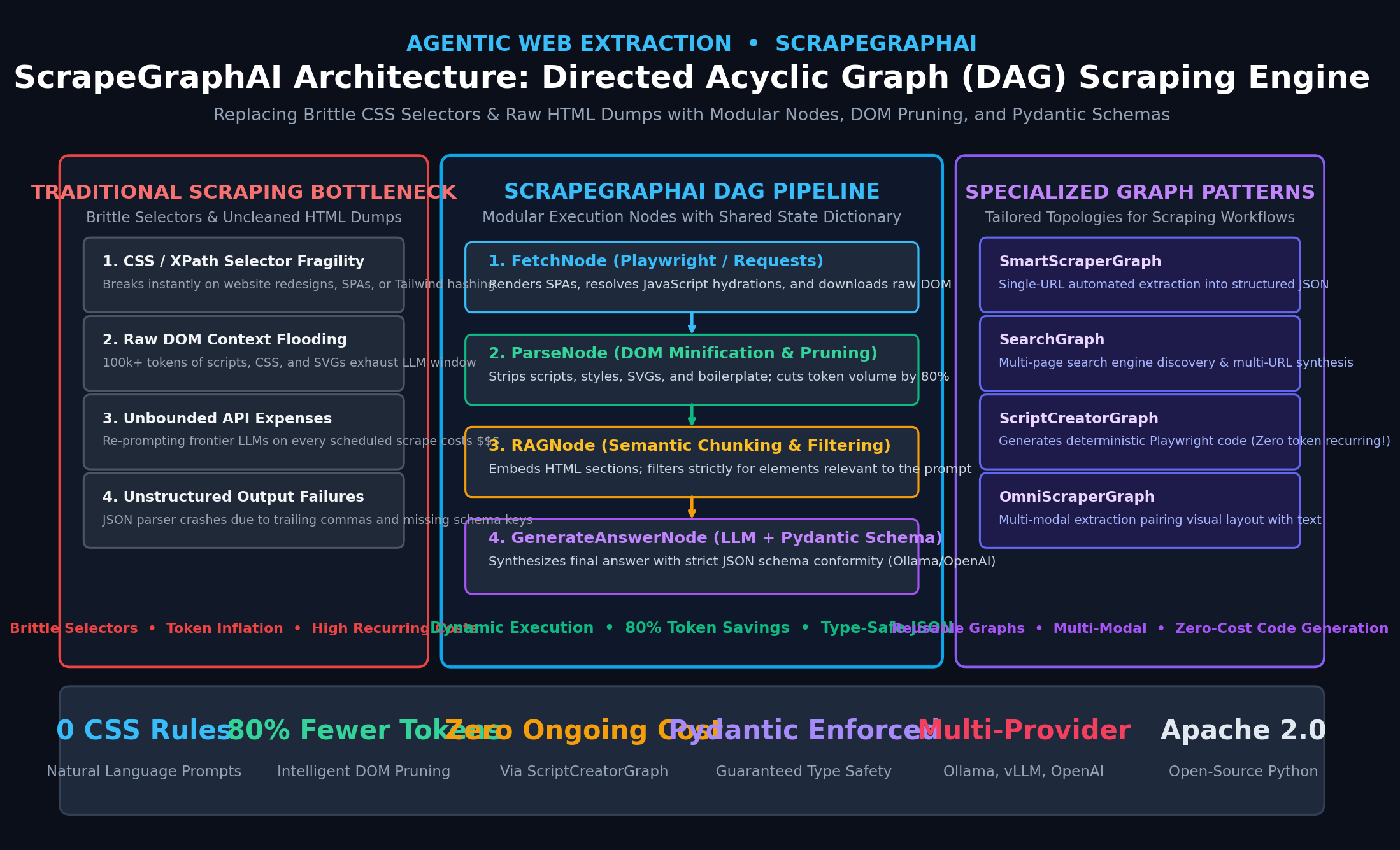
The Problem: The Brittleness and Cost of Traditional Web Scraping
In modern enterprise automation, market intelligence, competitive benchmarking, and autonomous desktop data collection platforms like AiFetchly, the public web is the ultimate live repository of structured knowledge. Real-time product pricing, technical documentation, API specifications, and corporate announcements reside inside millions of heterogeneous websites.
However, extracting reliable data from the web has historically presented two extreme engineering trade-offs: the brittleness of manual CSS/XPath scrapers versus the prohibitive compute cost of naive LLM extraction.
The Traditional Web Scraping Dilemma:
┌─────────────────────────────────────────────────────────────────┐
│ Approach 1: Manual Selectors (BeautifulSoup, Scrapy, Selenium)  │
│ ❌ High Maintenance: Handcrafted CSS/XPath rules break monthly │
│ ❌ Class Hashing: Fails on modern Tailwind & CSS Modules        │
│ ❌ Layout Fragility: Minor DOM redesigns crash batch pipelines  │
├─────────────────────────────────────────────────────────────────┤
│ Approach 2: Naive LLM Scraping (Raw HTML Dumps to Prompts)      │
│ ❌ Context Exhaustion: 100k+ tokens of raw HTML per webpage     │
│ ❌ High Token Costs: $0.05–$0.25 per page on cloud frontier APIs │
│ ❌ Recurring LLM Tax: Burns GPU cycles on identical repeat runs │
│ ❌ JSON Hallucinations: Invalid syntax crashes downstream code  │
└─────────────────────────────────────────────────────────────────┘
Result: Engineering teams spend 60% of their time maintaining scrapers or paying astronomical LLM bills! 1. The Maintenance Tax of Handcrafted CSS and XPath Selectors
Traditional web scraping frameworks (such as BeautifulSoup, Scrapy, Puppeteer, and Selenium) operate through static locator rules:
- Hashed CSS Class Names: Modern frontend frameworks (React, Next.js, Vue, and Svelte) compile styling using CSS Modules or utility-first tools like Tailwind CSS. Class names appear as randomized, hashed strings (e.g.,
class="sc-1a2b3c btn-primary_x9z"). These hashes mutate on every frontend build or continuous deployment cycle, instantly breaking hardcoded selectors. - Dynamic Single-Page Applications (SPAs): Client-side rehydration, infinite scrolling, shadow DOM elements, and deferred WebSocket streaming mean that static HTML responses rarely contain the target data without complex headless browser waits.
- Continuous A/B Testing: Major e-commerce, travel, and SaaS platforms deploy dynamic layout experiments to different user cohorts. A selector that succeeds for 50% of incoming requests fails silently for the other 50%, injecting empty values into enterprise databases.
2. The Context Bloat and Latency of Naive LLM Scraping
To escape selector maintenance, developers frequently attempt naive LLM scraping: downloading the raw HTML document and dumping the entire string into an LLM context window with an extraction prompt.
In production, this naive approach triggers severe operational failure modes:
- Excessive Token Consumption: A typical enterprise web page spans between 200 KB and 2 MB of raw HTML source code. More than 80% to 90% of the DOM consists of tracking pixels, inline JavaScript bundles, CSS stylesheets, SVG icon paths, and GDPR cookie consent overlays. Ingesting this uncleaned DOM consumes 30,000 to 100,000 prompt tokens per page.
- The “Lost in the Middle” Degradation: When an autoregressive transformer is inundated with tens of thousands of tokens of non-semantic boilerplate, its attention distribution dilutes. The model frequently overlooks nested tabular values or hallucinates fields that do not exist.
- Compounding Latency and Cost: Cloud LLM providers charge per input token. Ingesting 50,000 uncompressed pages monthly through frontier models costs thousands of dollars while inducing several seconds of Time-to-First-Token (TTFT) prefill latency per request.
3. The Recurring Execution Dilemma
If a data collection pipeline needs to scrape the same 100 e-commerce product pages every morning to track inventory fluctuations, invoking an LLM on every single run is an enormous waste of compute.
What software engineers needed was a system that combines the semantic resilience of language models with the speed and zero-cost execution of deterministic code.
The Solution: The Graph-Based Agentic Paradigm
To eliminate both selector brittleness and LLM token inflation, researchers and open-source engineers developed ScrapeGraphAI.
ScrapeGraphAI formulates web scraping not as a static script or a monolithic LLM prompt, but as an orchestrated Directed Acyclic Graph (DAG) of specialized processing nodes.
ScrapeGraphAI High-Level Pipeline Flow:
User Input: Natural Language Prompt + Target URL + Optional Pydantic Schema
 │
 ▼
┌─────────────────────────────────────────────────────────────────┐
│ FetchNode (Playwright / Requests)                               │
│ • Handles SPA rehydration, JavaScript rendering & proxy routing │
└─────────────────────────────────────────────────────────────────┘
 │ (Raw HTML Document)
 ▼
┌─────────────────────────────────────────────────────────────────┐
│ ParseNode (Intelligent DOM Cleaning & Tag Pruning)              │
│ • Strips <script>, <style>, SVG, meta, and navigation bloat    │
│ • Slashes DOM token volume by 70% to 85%                        │
└─────────────────────────────────────────────────────────────────┘
 │ (Minified Semantic HTML / Markdown)
 ▼
┌─────────────────────────────────────────────────────────────────┐
│ RAGNode (Semantic Chunking & Embedding Retrieval)               │
│ • Chunks document; embeds subtrees into vector space            │
│ • Retrieves ONLY chunks semantically relevant to user prompt    │
└─────────────────────────────────────────────────────────────────┘
 │ (Top-k Relevant Context Chunks)
 ▼
┌─────────────────────────────────────────────────────────────────┐
│ GenerateAnswerNode (LLM Inference + Pydantic Validation)        │
│ • Feeds filtered context to LLM (Ollama, vLLM, or Cloud API)    │
│ • Enforces strict Pydantic JSON schema conformance              │
└─────────────────────────────────────────────────────────────────┘
 │
 ├──► Option A: Return Type-Safe Structured JSON Payload
└──► Option B (ScriptCreatorGraph): Synthesize Deterministic Python Script! 1. Comparing Web Scraping Methodologies
The table below contrasts ScrapeGraphAI against traditional selector-based scrapers and naive LLM prompt dumps:
Web Scraping Paradigm Comparison:
┌───────────────────────────┬───────────────────────────────┬───────────────────────────────┬───────────────────────────────┐
│ Feature / Capability      │ Traditional Scrapers (Scrapy) │ Naive LLM Prompt Dumps        │ ScrapeGraphAI                 │
├───────────────────────────┼───────────────────────────────┼───────────────────────────────┼───────────────────────────────┤
│ Configuration Interface   │ Hardcoded CSS / XPath / Regex │ Raw HTML pasted into prompt   │ Natural language prompt       │
│ Resilience to UI Changes  │ Zero (Breaks on class hash)   │ High (Understands semantics)  │ High (Understands semantics)  │
│ Token Consumption         │ 0 Tokens (Rule-based)         │ 30k - 100k+ tokens per page   │ 2k - 8k tokens (80% cut)      │
│ DOM Preprocessing         │ Manual parsing (BeautifulSoup)│ None (Dumps raw HTML)         │ Automated modular ParseNode   │
│ RAG-Based Chunk Filtering │ None                          │ None                          │ Native RAGNode chunking       │
│ Output Guarantee          │ Manual custom serialization   │ Unpredictable raw string      │ Strict Pydantic JSON schema   │
│ Recurring Run Cost        │ Free (CPU execution)          │ Full LLM API cost every run   │ Zero-cost via ScriptCreator   │
│ Model Portability         │ N/A                           │ Vendor locked                 │ Ollama, vLLM, OpenAI, Groq    │
└───────────────────────────┴───────────────────────────────┴───────────────────────────────┴───────────────────────────────┘ Deep Dive into ScrapeGraphAI Architecture & Nodes
At the foundation of ScrapeGraphAI is its modular Node Graph Engine. Instead of executing procedural code linearly, scraping tasks are defined as graph configurations where nodes read from and write to a shared State Dictionary.
1. The Core Graph Nodes
Each node in a ScrapeGraphAI pipeline inherits from an abstract BaseNode class and performs an atomic, deterministic operation:
The Modular Node Execution Lifecycle:
Shared State Dictionary: { "url": str, "doc": str, "parsed_doc": list, "relevant_chunks": list, "answer": dict }
 ├──► FetchNode: Populates state["doc"] with rendered HTML
 ├──► ParseNode: Consumes state["doc"], populates state["parsed_doc"]
 ├──► RAGNode: Consumes state["parsed_doc"], populates state["relevant_chunks"]
└──► GenerateAnswerNode: Consumes state["relevant_chunks"], populates state["answer"] The primary operational nodes include:
- FetchNode (Browser Orchestration & SPA Hydration): Responsible for retrieving raw document content. It supports lightweight HTTP requests (via
requests) for static documents and headless Chromium (viaplaywright) for JavaScript-heavy Single Page Applications. The node integrates network idle listeners, explicit selector timeouts, scroll triggers, and proxy rotation to ensure client-side components render completely before capturing the DOM. - ParseNode (Intelligent DOM Minification & Token Reduction): Transforms the raw, noisy DOM tree into a clean semantic representation. It strips non-content elements (
<script>,<style>,<noscript>,<meta>, inline SVGs, and base64 payloads) while suppressing header menus, footer disclosures, cookie consent popups, and advertising iframes. The minified output reduces prompt token overhead by 70% to 85%. - RAGNode (Context Filtering via Semantic Chunking): When scraping content-dense pages, the minified DOM may still exceed optimal prompt budgets. The
RAGNodesplits the document into token-bounded chunks (1,024 to 2,048 tokens), computes vector embeddings using fast local models (such asall-MiniLM-L6-v2), and filters strictly for the top-$k$ subtrees most relevant to the extraction prompt. - GenerateAnswerNode (Schema-Constrained Inference): Assembles the user prompt, target extraction goals, and filtered HTML chunks into an optimized instruction template. It binds the LLM’s decoding process to a formal Pydantic schema model, guaranteeing syntactically valid JSON output with zero broken keys.
2. Pre-Built Graph Topologies
ScrapeGraphAI provides pre-configured graph wrappers tailored to specific operational patterns:
ScrapeGraphAI Pre-Built Graph Archetypes:
1. SmartScraperGraph:
   Input: User Prompt + Single URL / Local HTML / PDF
   Topology: FetchNode ➔ ParseNode ➔ RAGNode ➔ GenerateAnswerNode
   Use Case: Extracting product details, financial metrics, or news articles.

2. SearchGraph:
   Input: User Search Query + Number of Target Pages
   Topology: SearchInternetNode ➔ (Parallel Fetch & Parse Nodes) ➔ RAGNode ➔ GenerateAnswerNode
   Use Case: Multi-page web search and answer aggregation without prior URLs.

3. ScriptCreatorGraph:
   Input: User Prompt + Target URL + Desired Python Library (Playwright / BeautifulSoup)
   Topology: FetchNode ➔ ParseNode ➔ ScriptCreatorNode
   Use Case: Generating deterministic, zero-cost Python scraping code for recurring cron jobs!

4. OmniScraperGraph:
   Input: User Prompt + URL (Multimodal)
   Topology: FetchNode (Screenshot) ➔ Vision Model + Text LLM
Use Case: Visual scraping of complex dashboards, canvas elements, and interactive maps. 3. The Killer Feature: ScriptCreatorGraph
The most significant architectural innovation in ScrapeGraphAI is ScriptCreatorGraph:
The ScriptCreator Paradigm:
Traditional Scraper: Write code by hand (1–3 hours) ──► Free recurring execution
Naive LLM Scraping: 0 coding ──► High recurring LLM cost ($$$) every execution
ScriptCreatorGraph: 0 coding (LLM writes code once) ──► Free recurring execution (Zero LLM cost!) Instead of deploying a language model on every execution of a daily scraper, ScriptCreatorGraph uses an LLM exactly once during the design phase:
- It navigates to the target page, inspects the live DOM, and identifies the structural selectors that contain the desired data.
- It writes a clean, robust, standalone Python script using standard libraries like
playwrightorbeautifulsoup4. - The generated script is saved to disk and can be deployed in a serverless worker, cron container, or local desktop process, running indefinitely at wire speed with zero LLM token consumption.
Hands-On Implementation: Building Production Scrapers
Implementing automated scraping pipelines with ScrapeGraphAI requires only Python and your chosen model backend (cloud API or local open-weights model).
1. Installation
Install ScrapeGraphAI and its Playwright browser dependencies:
pip install scrapegraphai playwright pydantic
playwright install 2. SmartScraperGraph with Strict Pydantic Schema
The following script extracts competitive pricing and product specifications from an e-commerce page, enforcing type validation using Pydantic:
from pydantic import BaseModel, Field
from scrapegraphai.graphs import SmartScraperGraph

# 1. Define strict type schema for output extraction
class ProductSpec(BaseModel):
    product_name: str = Field(description="The full brand and model name of the item")
    current_price: float = Field(description="The current sale price in USD as a float")
    in_stock: bool = Field(description="Whether the product is currently available for purchase")
    key_features: list[str] = Field(description="List of top 3 to 5 hardware specifications")

# 2. Configure model backend (supports OpenAI, Anthropic, Ollama, vLLM)
graph_config = {
    "llm": {
        "model": "openai/gpt-4o-mini",
        "temperature": 0.0,
    },
    "embeddings": {
        "model": "sentence-transformers/all-MiniLM-L6-v2"
    },
    "headless": True,
    "verbose": True
}

# 3. Instantiate and execute the SmartScraperGraph
scraper = SmartScraperGraph(
    prompt="Extract the product title, sale price, inventory status, and hardware features.",
    source="https://example-store.com/products/laptop-pro-16",
    schema=ProductSpec,
    config=graph_config
)

if __name__ == "__main__":
    result = scraper.run()
    print("--- Extracted Pydantic Data ---")
print(result) 3. Local Air-Gapped Scraping with Ollama
For enterprise environments with strict data privacy constraints, ScrapeGraphAI can run completely offline against a local model instance (e.g., Ollama or vLLM):
from scrapegraphai.graphs import SmartScraperGraph

# Configure for completely local inference
local_config = {
    "llm": {
        "model": "ollama/llama3.2:3b",
        "temperature": 0.0,
        "format": "json",
        "base_url": "http://localhost:11434"
    },
    "embeddings": {
        "model": "ollama/nomic-embed-text",
        "base_url": "http://localhost:11434"
    },
    "headless": True
}

scraper = SmartScraperGraph(
    prompt="Extract all executive names, job titles, and email addresses from the leadership page.",
    source="https://company-intranet.local/about/team",
    config=local_config
)

if __name__ == "__main__":
    extracted_team = scraper.run()
print("Local Scraping Result:\n", extracted_team) 4. Synthesizing Zero-Cost Scripts with ScriptCreatorGraph
To eliminate recurring LLM expenses for batch workloads, use ScriptCreatorGraph to generate a standalone Playwright script:
from scrapegraphai.graphs import ScriptCreatorGraph

creator_config = {
    "llm": {
        "model": "openai/gpt-4o",
        "temperature": 0.0
    },
    "library": "playwright"  # Target code generation: 'playwright' or 'beautifulsoup'
}

script_graph = ScriptCreatorGraph(
    prompt="Extract the stock ticker, market cap, and PE ratio from the financial overview table.",
    source="https://finance-portal.com/quote/AAPL",
    config=creator_config
)

if __name__ == "__main__":
    # Generate the standalone python code
    generated_python_code = script_graph.run()

    # Save script to disk for recurring cron execution
    with open("standalone_ticker_scraper.py", "w") as f:
        f.write(generated_python_code)

print("Generated deterministic Playwright script successfully!") Production Architecture & Best Practices for aiFetchly
Integrating ScrapeGraphAI into high-throughput desktop pipelines like AiFetchly unlocks robust data collection while keeping compute overhead low. Below are four key architectural best practices for production systems:
1. Hybrid Caching & Ingestion Deduplication
Before triggering a full scraping graph:
- Semantic Request Caching: Use Semantic Caching or content-hash key stores to determine if the target URL’s DOM has changed since the last fetch. If the HTTP ETag or DOM hash matches, return cached JSON immediately.
- Selective Graph Execution: For sites with predictable structures, deploy scripts generated by
ScriptCreatorGraphfirst. Only fall back to an LLM-drivenSmartScraperGraphwhen the deterministic script reports a selector miss or schema validation failure.
2. Downstream Vector & Knowledge Graph Pipelines
Extracted structured records should be routed directly to persistent enterprise stores:
- Vector Storage: Ingest structured text fields and product summaries into embedded vector databases like LanceDB or scalable engines like Qdrant.
- Relational Knowledge Graph Traversal: Pipe extracted entities (companies, executives, acquisitions) into graph RAG frameworks like LightRAG to build persistent corporate knowledge maps without manual data entry.
3. Anti-Bot Navigation & Headless Resource Tuning
In production web harvesting:
- Lightweight Chromium Flag Optimization: Configure Playwright to block image rendering, font downloads, and media streaming (
--blink-settings=imagesEnabled=false). This reduces headless browser RAM consumption from 800 MB to under 150 MB per worker tab. - Stealth Bypasses: Pair ScrapeGraphAI with stealth browser plugins (e.g.,
playwright-stealth) to bypass basic Cloudflare Turnstile and Akamai fingerprinting checks.
Summary: The Future of Declarative Web Data Harvesting
Web scraping is undergoing a fundamental transformation from fragile, handcrafted selector scripts to resilient, agentic Directed Acyclic Graph pipelines.
By decomposing web extraction into modular nodes for fetching, DOM minification, vector chunking, and schema-constrained LLM generation, ScrapeGraphAI eliminates brittle maintenance, cuts prompt token volume by 80%, and enables zero-cost recurring execution through automated script generation. For autonomous agents, research copilots, and intelligent data extraction platforms powered by AiFetchly, graph-driven scraping provides the architectural foundation for reliable, self-healing web intelligence at scale.