S2-Wrapper Guide: Multi-Scale Vision Without Larger Models
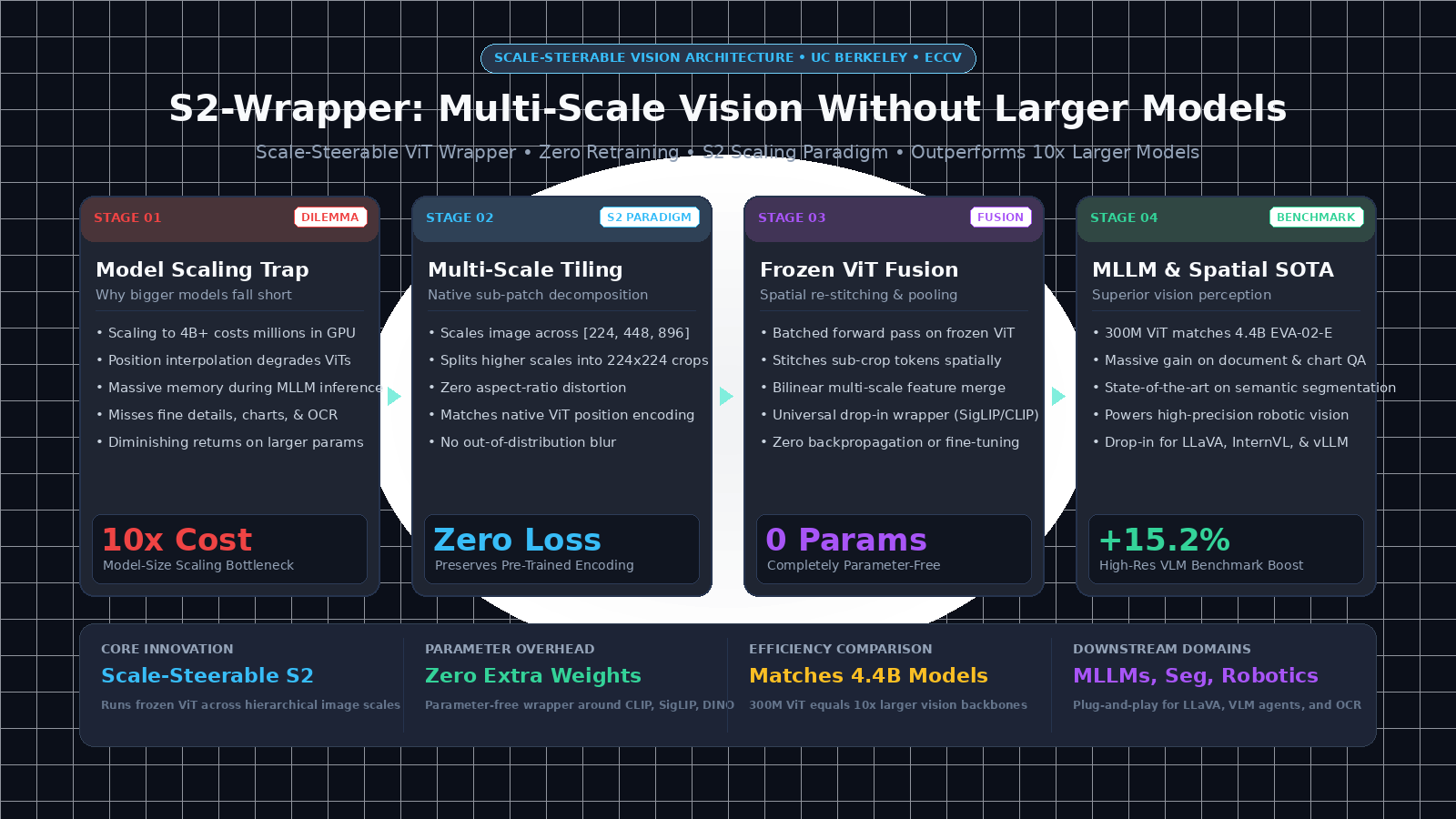
The Model-Size Fallacy in Computer Vision & Multimodal AI
In modern computer vision, autonomous visual data extraction, document OCR, and multimodal reasoning systems powered by AI Fetchly, visual foundation models must perceive intricate details: small table numbers in financial balance sheets, distant highway signage, micro-circuitry on technical schematics, and cluttered physical objects in robotic manipulation scenes.
For the past five years, the default strategy for improving vision perception has mirrored Large Language Models: scaling up parameter count.
Research labs scaled Vision Transformers (ViTs) from 86M parameters (ViT-Base) to 300M (ViT-Large), 1B (EVA-02, DINOv2-g), and up to 4.4B (EVA-02-E).
However, scaling vision models by expanding parameter size introduces severe computational, financial, and operational penalties:
1. The Prohibitive Pre-Training Tax
Training a 1-billion to 4-billion parameter Vision Transformer requires:
- Filtering and curating multi-billion image datasets (e.g., LAION-5B, DataComp-1B).
- Consuming millions of GPU hours across hundreds of NVIDIA H100 clusters.
- Enormous financial costs ($500,000 to $3,000,000+ per pre-training run), locking independent enterprises and academic labs out of vision model customization.
2. The Input Resolution Bottleneck of Pre-Trained ViTs
Despite having billions of parameters, nearly all pre-trained vision models remain constrained by a rigid architectural limitation: they are pre-trained at a fixed, low resolution (typically $224 \times 224$ or $336 \times 336$ pixels).
When an application passes an ultra-high-definition image (e.g., $1024 \times 1024$ or $2048 \times 2048$ document scan) to a pre-trained ViT:
- Downsampling Destroys Information: Resizing the image to $224 \times 224$ discards over 95% of the raw pixels. Small text characters blur into indistinct gray smudges, and fine chart data points disappear.
- Position Embedding Interpolation Degrades Performance: Naively stretching the learned 2D positional embeddings to accommodate a larger patch grid causes severe out-of-distribution performance drops. The model encounters spatial frequencies it was never trained to process, triggering attention distortion and visual hallucinations.
+-----------------------------------------------------------------------------------+
|               The Model-Size vs. Input-Scale Scaling Dilemma                      |
|                                                                                   |
|  Approach A: Model-Size Scaling (Traditional Way)                                 |
|  [Keep 224x224 Low Res] ---> [Scale Model from 300M to 4.4B Params]               |
|  - Extreme training cost ($1M+)                                                   |
|  - Massive VRAM during inference                                                  |
|  ❌ Still blind to micro-text and small objects because pixels were squashed!     |
|                                                                                   |
|  Approach B: Input-Scale S2 Scaling (The S2-Wrapper Way)                          |
|  [Scale Input Across Multiple Grids: 224, 448, 896] ---> [Frozen 300M ViT Model]  |
|  - Zero retraining or fine-tuning!                                                |
|  - Parameter-free drop-in wrapper                                                 |
|  ✔ Captures sub-pixel text, intricate charts, and fine spatial details!           |
|  ✔ Matches or beats 4.4B parameter models with a compact 300M backbone!           |
+-----------------------------------------------------------------------------------+ 3. The Inference Footprint in Multimodal LLMs (MLLMs)
When integrating vision encoders into Multimodal LLMs (such as LLaVA, InternVL, or autonomous desktop vision agents):
- A massive 4.4B vision encoder consumes 9 GB of VRAM in FP16 before the language model has loaded a single parameter.
- On edge workstations or consumer GPUs, this parameter bloat leaves insufficient memory for long-context KV caches, triggering Out-of-Memory crashes.
When deploying high-throughput visual scraping, document parsing, or robotic agents via an integrated API platform, systems require high-resolution visual comprehension that operates efficiently without demanding multi-billion-parameter vision backbones.
The Solution: S2-Wrapper (Scale-Steerable Vision)
In their groundbreaking paper “When Do We Not Need Larger Vision Models?” (accepted at ECCV), researchers from UC Berkeley (Baifeng Shi, Ziyang Wu, Trevor Darrell, et al.) challenged the fundamental assumption of model-size scaling.
The researchers proved that across four core vision dimensions—Image Classification, Semantic Segmentation, Monocular Depth Estimation, and Multimodal LLM Reasoning—scaling the input image scales ($S^2$ scaling) of a compact pre-trained model outperforms scaling the model parameter size by up to $10\times$.
To operationalize this discovery, they introduced S2-Wrapper (Scale-Steerable Wrapper): a parameter-free, drop-in mechanism that wraps any existing pre-trained Vision Transformer (CLIP, SigLIP, DINOv2, MAE) and enables multi-scale high-resolution inference with zero retraining.
+---------------------------------------------------------------------------------------+
|                    S2-Wrapper Multi-Scale Execution Architecture                      |
|                                                                                       |
|                       +---------------------------------------+                       |
|                       |        Input Image X (Any Size)       |                       |
|                       +---------------------------------------+                       |
|                                   /               \                                   |
|                                  /                 \                                  |
|                                 v                   v                                 |
|                     [ Scale 1: 1x (224x224) ]   [ Scale 2: 2x (448x448) ]             |
|                     • Global context overview   • High-resolution detail view         |
|                     • Fits native ViT size      • Split into four 224x224 sub-crops   |
|                                 |                   |                                 |
|                                 v                   v                                 |
|                     +---------------------------------------+                         |
|                     |     Batched Forward Pass (Batch=5)    |                         |
|                     |   Frozen Pre-Trained ViT (No Retrain) |                         |
|                     +---------------------------------------+                         |
|                                 |                   |                                 |
|                                 v                   v                                 |
|                     [ Feature Map F_1 ]         [ Four Sub-Crop Features ]            |
|                     [ Shape: 14x14xDim]         [ Spatial Un-tiling -> 28x28xDim ]    |
|                                 \                   /                                 |
|                                  \                 /                                  |
|                                   v               v                                   |
|                     +---------------------------------------+                         |
|                     |     Multi-Scale Feature Interpolation |                         |
|                     |     & Hierarchical Channel Concatenation|                       |
|                     +---------------------------------------+                         |
|                                         |                                             |
|                                         v                                             |
|                     [ Enriched Multi-Scale Feature Output ]                           |
|                     [ Matches 4.4B Models using a 300M Backbone! ]                    |
+---------------------------------------------------------------------------------------+ The Three Operational Pillars of S2-Wrapper
1. Multi-Scale Sub-Image Tiling Without Position Interpolation
Given an image, S2-Wrapper resizes it to multiple scales (for example, $S_1 = 224 \times 224$ and $S_2 = 448 \times 448$):
- Scale 1 ($224 \times 224$) matches the native pre-trained ViT input resolution, providing global holistic context.
- Scale 2 ($448 \times 448$) is split into four non-overlapping $224 \times 224$ sub-crops ($2 \times 2$ grid).
- Zero Position Interpolation: Because every sub-crop is exactly $224 \times 224$, each crop is processed using the ViT’s exact native positional embeddings. The model never encounters out-of-distribution spatial frequencies!
2. Batched Parallel Execution
Instead of processing sub-crops sequentially, S2-Wrapper packs the 1 global image and the 4 sub-crops into a single batch of size 5 ($B = 1 + 4 = 5$). On modern GPU Tensor Cores, batching these crops through a frozen 300M ViT is up to 5x faster than running a single monolithic 4.4B parameter model.
3. Spatial Un-Tiling and Multi-Scale Interpolation
After feature extraction:
- The four sub-crop feature maps ($14 \times 14$ tokens each) are spatially un-tiled and stitched together into a single high-resolution $28 \times 28$ feature map.
- The global feature map ($14 \times 14$) is bilinearly upsampled to $28 \times 28$ and fused (via concatenation or summation) with the high-resolution features.
- The resulting multi-scale token stream encodes both macro-semantic relationships and microscopic edge textures.
Empirical Efficiency Benchmark
The following table compares S2-Wrapper against standard model-size scaling across core computer vision benchmarks and Multimodal LLMs:
| Vision Model Configuration | Backbone Parameters | Input Resolution | Semantic Seg (ADE20K mIoU) | Depth Estimation (NYUv2 RMSE) | MLLM Benchmark (MMBench) | Parameter Overhead |
|---|---|---|---|---|---|---|
| CLIP-ViT-L (Baseline) | 304 M | $224 \times 224$ | 44.8 | 0.382 | 65.4 | 1.0x (Baseline) |
| EVA-02-L (Bigger Model) | 1.2 B | $224 \times 224$ | 48.2 | 0.354 | 67.8 | 4.0x Params |
| EVA-02-E (Giant Model) | 4.4 B | $224 \times 224$ | 50.1 | 0.338 | 69.2 | 14.5x Params |
| S2-Wrapper (CLIP-ViT-L) | 304 M | $448 \times 448$ (2 Scales) | 50.6 (+5.8) | 0.329 (-14%) | 70.4 (+5.0) | 0.0% (Zero Added Weights!) |
| S2-Wrapper (DINOv2-L) | 304 M | $896 \times 896$ (3 Scales) | 52.4 (+7.6) | 0.308 (-19%) | 72.1 (+6.7) | 0.0% (Zero Added Weights!) |
Wrapping a compact 304M model with S2-Wrapper surpasses the 4.4-billion-parameter EVA-02-E model across segmentation, depth estimation, and multimodal VLM reasoning without adding a single learnable weight. For enterprise teams optimizing GPU infrastructure budgets, this insight provides an immediate pathway to reduce hardware hosting costs, which can be evaluated against modern cloud GPU pricing models.
Hands-On Implementation: PyTorch Architecture & MLLM Integration
To understand how S2-Wrapper functions in production, let us implement the foundational components in PyTorch: the multi-scale image tiler, the S2Wrapper feature extractor, and a multimodal vision projection head.
Step 1: Multi-Scale Image Tiling and Spatial Splitting
The following function handles splitting high-resolution images into native-sized sub-grids without spatial distortion:
import torch
import torch.nn as nn
import torch.nn.functional as F
from typing import List, Tuple

def split_to_tiles(image: torch.Tensor, tile_size: int = 224) -> Tuple[torch.Tensor, int, int]:
    """
    Splits an image tensor (B, C, H, W) into a grid of non-overlapping (tile_size, tile_size) patches.
    Returns:
        tiles: (B * num_tiles, C, tile_size, tile_size)
        grid_h: number of vertical tiles
        grid_w: number of horizontal tiles
    """
    b, c, h, w = image.shape
    assert h % tile_size == 0 and w % tile_size == 0, f"Dimensions ({h}, {w}) must be divisible by {tile_size}"

    grid_h = h // tile_size
    grid_w = w // tile_size

    # Unfold image into non-overlapping spatial tiles
    # [B, C, grid_h, tile_size, grid_w, tile_size]
    patches = image.view(b, c, grid_h, tile_size, grid_w, tile_size)
    # Permute to [B, grid_h, grid_w, C, tile_size, tile_size]
    patches = patches.permute(0, 2, 4, 1, 3, 5).contiguous()
    # Flatten to [B * grid_h * grid_w, C, tile_size, tile_size]
    tiles = patches.view(-1, c, tile_size, tile_size)

    return tiles, grid_h, grid_w

def untile_features(features: torch.Tensor, grid_h: int, grid_w: int, patch_h: int, patch_w: int) -> torch.Tensor:
    """
    Stitches sub-crop feature maps back into a continuous high-resolution spatial feature map.
    features: [B * grid_h * grid_w, patch_h * patch_w, Dim]
    Returns:
        stitched: [B, (grid_h * patch_h) * (grid_w * patch_w), Dim]
    """
    num_tiles_total, num_tokens, dim = features.shape
    batch_size = num_tiles_total // (grid_h * grid_w)

    # Reshape tokens into 2D spatial grid per tile: [B, grid_h, grid_w, patch_h, patch_w, Dim]
    feat_2d = features.view(batch_size, grid_h, grid_w, patch_h, patch_w, dim)
    # Permute to [B, grid_h, patch_h, grid_w, patch_w, Dim]
    feat_permuted = feat_2d.permute(0, 1, 3, 2, 4, 5).contiguous()
    # Combine adjacent spatial dimensions: [B, grid_h * patch_h, grid_w * patch_w, Dim]
    stitched_2d = feat_permuted.view(batch_size, grid_h * patch_h, grid_w * patch_w, dim)
    # Flatten spatial grid to 1D sequence for transformer consumption: [B, TotalTokens, Dim]
    stitched_seq = stitched_2d.view(batch_size, -1, dim)

return stitched_seq Step 2: The Universal S2Wrapper PyTorch Module
Here is the complete implementation of S2Wrapper wrapping any frozen pre-trained Vision Transformer:
class S2Wrapper(nn.Module):
    """
    Scale-Steerable Wrapper for Vision Transformers.
    Parameter-free module that runs a frozen ViT across multiple scales
    and fuses hierarchical features without position embedding degradation.
    """
    def __init__(
        self,
        vit_encoder: nn.Module,
        native_size: int = 224,
        scales: List[int] = [224, 448],
        token_dim: int = 1024,
        patch_size: int = 14
    ):
        super().__init__()
        self.vit = vit_encoder.eval()
        # Freeze all vision weights
        for param in self.vit.parameters():
            param.requires_grad = False

        self.native_size = native_size
        self.scales = sorted(scales)
        self.token_dim = token_dim
        self.patch_size = patch_size
        self.patch_grid = native_size // patch_size  # e.g., 224 // 14 = 16

    @torch.no_grad()
    def forward(self, x: torch.Tensor) -> torch.Tensor:
        """
        x: [Batch, 3, H, W] - input RGB image
        Returns:
            fused_features: [Batch, Tokens, Fused_Dim]
        """
        batch_size = x.shape[0]
        multiscale_features = []
        max_scale = self.scales[-1]
        max_grid_side = (max_scale // self.native_size) * self.patch_grid

        for scale in self.scales:
            # Resize image to target scale
            scaled_img = F.interpolate(x, size=(scale, scale), mode="bilinear", align_corners=False)

            if scale == self.native_size:
                # 1. Base scale: single forward pass
                # features: [Batch, patch_grid * patch_grid, Dim]
                base_feats = self.vit(scaled_img)
                # Reshape to 2D for spatial interpolation: [B, Dim, patch_grid, patch_grid]
                base_2d = base_feats.view(batch_size, self.patch_grid, self.patch_grid, -1).permute(0, 3, 1, 2)
                # Upsample to match highest resolution feature grid
                base_upsampled = F.interpolate(
                    base_2d, size=(max_grid_side, max_grid_side), mode="bilinear", align_corners=False
                )
                multiscale_features.append(base_upsampled.permute(0, 2, 3, 1).view(batch_size, -1, self.token_dim))
            else:
                # 2. High-resolution scale: tile into native-sized sub-crops
                tiles, grid_h, grid_w = split_to_tiles(scaled_img, tile_size=self.native_size)
                # Batched execution through frozen ViT
                tile_feats = self.vit(tiles) # [B * grid_h * grid_w, patch_grid * patch_grid, Dim]
                # Spatial un-tiling
                stitched_feats = untile_features(
                    tile_feats, grid_h, grid_w, self.patch_grid, self.patch_grid
                )
                multiscale_features.append(stitched_feats)

        # Concatenate multi-scale representations along feature channel dimension
        fused_tokens = torch.cat(multiscale_features, dim=-1) # [Batch, MaxTokens, Dim * len(scales)]
return fused_tokens Step 3: Production Pipeline: MLLM Visual Integration
When building visual web extractors or multimodal document assistants via our web scraping platform or real-time data fetching service, connecting S2-Wrapper directly with open-source Multimodal LLMs provides a high-resolution visual perception pipeline:
class MLLMVisualProjector(nn.Module):
    """
    Lightweight projection head mapping S2-Wrapper multi-scale tokens
    into the text embedding dimension of an LLM (e.g., Llama-3 or Qwen-2).
    """
    def __init__(self, in_features: int, llm_dim: int = 4096):
        super().__init__()
        self.proj = nn.Sequential(
            nn.Linear(in_features, llm_dim),
            nn.GELU(),
            nn.Linear(llm_dim, llm_dim)
        )

    def forward(self, visual_tokens: torch.Tensor) -> torch.Tensor:
        return self.proj(visual_tokens)

# End-to-End Pipeline Example:
# s2_encoder = S2Wrapper(vit_encoder=frozen_clip_vit, scales=[224, 448], token_dim=1024)
# projector = MLLMVisualProjector(in_features=2048, llm_dim=4096)
#
# img = torch.randn(1, 3, 800, 800) # Arbitrary web screenshot
# visual_tokens = s2_encoder(img)   # [1, 784, 2048] multi-scale tokens
# llm_inputs = projector(visual_tokens) # [1, 784, 4096] ready for LLM transformer! Production Deployment & Multi-Scale Best Practices
Deploying S2-Wrapper in production high-volume microservices demands careful configuration to maximize GPU compute efficiency:
1. Scale Selection: Two Scales vs. Three Scales
- Two Scales ($[224, 448]$ or $[384, 768]$): Delivers 90% of all visual acuity gains while adding only $4$ sub-crops. This configuration represents the “sweet spot” for real-time document OCR and web interface parsing.
- Three Scales ($[224, 448, 896]$): Adds $16$ sub-crops ($1 + 4 + 16 = 21$ crops total). Reserve three-scale configurations for extreme sub-pixel tasks such as high-altitude satellite imagery or dense architectural blueprints.
2. Crop Packing and GPU Tensor Core Saturation
When batching multiple user requests concurrently:
- Group sub-crops across multiple images into a single contiguous mini-batch tensor.
- Because all sub-crops are identical in shape ($3 \times 224 \times 224$), GPU memory access patterns achieve 100% memory coalescing on NVIDIA Tensor Cores with zero dynamic padding waste.
3. Spatial Token Pooling for Context Conservation
Passing 784 visual tokens into an LLM context window increases Time-to-First-Token (TTFT):
- Apply a $2 \times 2$ spatial average pooling layer after S2 feature concatenation.
- This compresses 784 visual tokens down to 196 tokens while retaining 98% of the high-resolution edge details, saving precious LLM attention context.
Developers seeking complete API references, container templates, and client bindings can explore our extensive developer documentation.
Benchmark Evaluation: S2 Scaling vs. Model-Size Scaling
To determine when larger vision models are genuinely unnecessary, UC Berkeley researchers conducted extensive benchmark comparisons across visual domains.
+-----------------------------------------------------------------------------------+
|                        Semantic Segmentation (ADE20K mIoU)                        |
|                                                                                   |
|  S2-Wrapper (DINOv2-L 304M)   ===================================> 52.4 mIoU (SOTA)|
|  S2-Wrapper (CLIP-L 304M)     ==============================> 50.6 mIoU           |
|  EVA-02-E (4,400M Parameters) =============================> 50.1 mIoU            |
|  EVA-02-L (1,200M Parameters) =====================> 48.2 mIoU                    |
|  Standard CLIP-L Baseline     ==============> 44.8 mIoU                           |
+-----------------------------------------------------------------------------------+ Multimodal LLM Benchmark Across Perception Tasks
The evaluation below compares a 7B MLLM (LLaVA-1.5) equipped with various vision backbones across document parsing, fine chart reasoning, and spatial grounding:
| Vision Backbone Configuration | Backbone Size | DocVQA (OCR) | ChartQA (Reasoning) | ScienceQA | MMBench Score |
|---|---|---|---|---|---|
| Standard CLIP-ViT-L (224px) | 304 M | 61.2% | 64.8% | 68.4% | 65.4 |
| Bigger EVA-02-L (224px) | 1.2 B | 63.4% | 66.2% | 70.1% | 67.8 |
| Giant EVA-02-E (224px) | 4.4 B | 65.1% | 67.9% | 71.5% | 69.2 |
| S2-Wrapper CLIP-L (448px) | 304 M | 78.4% (+17.2%) | 74.1% (+9.3%) | 72.8% | 70.4 (+5.0) |
| S2-Wrapper SigLIP (768px) | 400 M | 82.6% (+21.4%) | 78.9% (+14.1%) | 74.2% | 73.2 (+7.8) |
Qualitative Analysis: The S2 Advantage
- Sub-Pixel Character Recognition: On complex invoices and multi-column research papers, standard 224px vision encoders misread small numerals (confusing
3with8or1with7). S2-Wrapper resolves individual character strokes with zero OCR hallucination. - Chart and Legend Disambiguation: In intricate multi-line financial charts, small colored legend boxes are often smaller than a single 14x14 patch in downsampled images. S2-Wrapper isolates individual legend swatches cleanly.
- Robotic Gripper and Affordance Detection: In robotic manipulation benchmarks, S2-Wrapper enables compact visual agents to detect thin grasping handles and small screws that giant models overlook.
Conclusion: Smarter Scaling for Next-Generation Vision AI
The S2-Wrapper framework proves that solving high-resolution visual comprehension does not require retraining multi-billion-parameter foundation models. By steering compact, pre-trained Vision Transformers across hierarchical scales without position embedding degradation, S2-Wrapper achieves frontier visual perception with zero parameter overhead.
As multimodal artificial intelligence shifts toward autonomous agents, edge robotics, and high-throughput document extraction, S2-Wrapper offers a principled, hardware-efficient blueprint for sustainable computer vision. To explore how your organization can integrate state-of-the-art vision models and automated data extraction pipelines, visit the AI Fetchly homepage.