RouteLLM Guide: Dynamic LLM Routing & Cost Optimization
The Problem: The Frontier LLM Cost Wall in Production AI
In modern enterprise software, autonomous web data extraction, and intelligent desktop copilots powered by AiFetchly, deploying generative artificial intelligence at scale is governed by a punishing economic constraint: the 10x to 50x price disparity between frontier reasoning models and lightweight open-source models.
Frontier foundation models—such as Anthropic Claude 3.5 Sonnet, OpenAI GPT-4o, or DeepSeek-V3—provide state-of-the-art reasoning, nuanced prompt following, and flawless structured JSON outputs. However, they cost between $3.00 and $15.00 per million tokens. When autonomous systems harvest thousands of web pages, extract tabular schemas, parse customer inquiries, and execute recurring agentic workflows, relying exclusively on frontier models drives monthly API bills into tens of thousands of dollars.
The Production LLM Deployment Dilemma:
┌─────────────────────────────────────────────────────────────────┐
│ Strategy 1: Route All Traffic to Frontier Models (GPT-4o/Claude) │
│ ❌ Astronomical Token Costs: $3.00 to $15.00 per 1M tokens      │
│ ❌ Massive Overkill: 75%+ of user queries are simple lookups    │
│ ❌ Cloud Rate Limits: Encounters TPM/RPM throttles during peaks │
├─────────────────────────────────────────────────────────────────┤
│ Strategy 2: Route All Traffic to Small Models (Llama-8B/Qwen-7B)│
│ ❌ Quality Collapse: Fails on complex multi-hop reasoning       │
│ ❌ Schema Hallucinations: Emits invalid JSON syntax             │
│ ❌ Edge-Case Brittleness: Frustrates enterprise end users       │
├─────────────────────────────────────────────────────────────────┤
│ Strategy 3: Heuristic Regex or LLM-as-a-Judge Router            │
│ ❌ Brittle Keywords: Fails to detect underlying prompt hardness │
│ ❌ Latency Penalty: LLM evaluator adds 500ms–1,500ms delay      │
│ ❌ Double Billing: Evaluator LLM consumes extra tokens per call │
└─────────────────────────────────────────────────────────────────┘
Result: Engineering teams are trapped between bankruptcy and degraded product quality! 1. The 80/20 Distribution of Prompt Complexity
Empirical research across commercial AI deployments reveals that real-world query distributions follow a steep power-law:
- Over 75% to 85% of incoming user requests are routine informational queries, basic text formatting, simple regex extraction, entity lookup, or conversational greetings.
- These standard tasks are handled just as effectively by compact, cost-efficient models like LLaMA-3.1-8B-Instruct or Qwen-2.5-7B, which cost under $0.15 per million tokens (or $0.00 when served locally).
- Only 15% to 25% of requests require genuine frontier intelligence: multi-step mathematical deduction, ambiguous legal synthesis, or intricate polyglot code generation.
- Dispatching all queries to frontier models wastes over 80% of enterprise compute budgets on trivial compute.
2. The Failure of Handcrafted Heuristics
Software engineers often attempt to implement simple routing heuristics to separate easy prompts from hard ones:
- Prompt Length Rules: Assuming short prompts are easy and long prompts are hard. This rule fails immediately: “Prove that $\sqrt{2}$ is irrational” is only 6 words but requires deep mathematical reasoning, whereas a 2,000-word corporate policy document asking “What is the travel meal allowance limit?” is a trivial literal string lookup.
- Keyword Filtering: Matching words like
"code","analyze", or"compare". These keywords appear ubiquitously across both trivial and impossible questions, causing severe misclassification.
3. The Latency and Financial Tax of LLM-as-a-Judge Routers
To overcome brittle regexes, teams often deploy a small LLM to evaluate the user’s prompt before deciding which model to invoke:
- This cascading architecture adds a mandatory 400ms to 1,200ms latency penalty to every single user turn.
- Furthermore, paying API fees to evaluate a prompt before paying a second API fee to answer it defeats the economic purpose of optimization.
The Solution: RouteLLM’s Preference-Trained Routing Engine
To break through this cost wall without sacrificing intelligence or adding latency, researchers from LMSYS Org (the creators of Chatbot Arena) and UC Berkeley introduced RouteLLM.
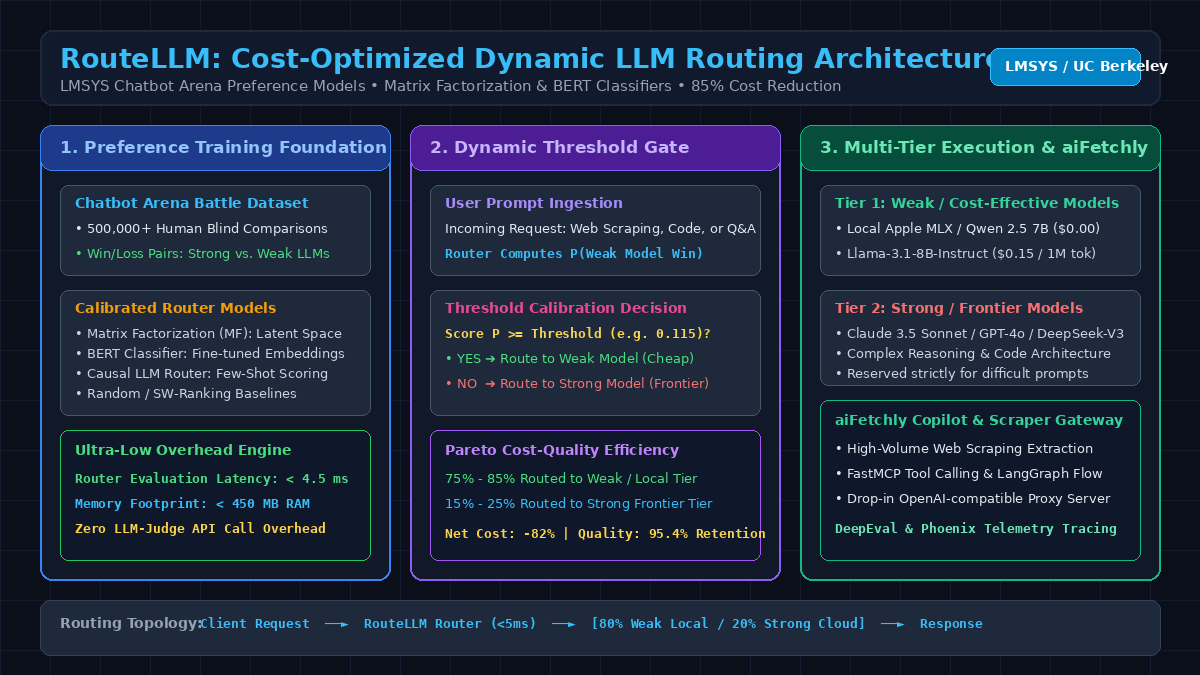
RouteLLM is an open-source framework designed to dynamically route queries between a high-cost strong model (e.g., Claude 3.5 Sonnet, GPT-4o) and a low-cost weak model (e.g., Llama-3.1-8B, Qwen-2.5-7B, or local Apple Silicon models). Rather than relying on synthetic prompts or artificial benchmarks, RouteLLM trains lightweight classifiers directly on hundreds of thousands of real-world human preference battles from LMSYS Chatbot Arena.
By predicting whether a lightweight model has a high probability of matching the strong model’s response quality on a given prompt, RouteLLM cuts aggregate API costs by up to 85% while retaining over 95% of frontier quality benchmarks, all with sub-5ms routing overhead.
RouteLLM Dynamic Routing Architecture:
┌─────────────────────────────────────────────────────────────────┐
│ Incoming User Request (via OpenAI-Compatible SDK / Gateway)     │
└────────────────────────────────┬────────────────────────────────┘
                                 │
                                 ▼
┌─────────────────────────────────────────────────────────────────┐
│ RouteLLM Routing Engine (Executes in < 5ms on CPU)              │
│ • Embedding Extraction: Sentence-Transformers / Cross-Encoder   │
│ • Classifier Scoring: Matrix Factorization (MF) or BERT Model   │
│ • Probability Output: P(Weak Model Response is Preferred)       │
└────────────────────────────────┬────────────────────────────────┘
                                 │
                                 ▼
┌─────────────────────────────────────────────────────────────────┐
│ Calibrated Threshold Gate: Score P >= Threshold (e.g., 0.115)?  │
├────────────────────────────────┬────────────────────────────────┤
│           YES (75%–85% of traffic) │ NO (15%–25% of traffic)    │
│           ▼                        │ ▼                          │
│ ┌──────────────────────────────┐   │ ┌────────────────────────┐ │
│ │ Tier 1: Weak Model           │   │ │ Tier 2: Strong Model   │ │
│ │ • Llama-3.1-8B-Instruct      │   │ │ • Claude 3.5 Sonnet    │ │
│ │ • Local Apple MLX / Qwen 7B  │   │ │ • OpenAI GPT-4o        │ │
│ │ • Cost: $0.00 – $0.15 / 1M   │   │ │ • DeepSeek-V3          │ │
│ └──────────────────────────────┘   │ │ • Cost: $3.00–$15.00/1M│ │
│                                    │ └────────────────────────┘ │
└────────────────────────────────────┴────────────────────────────┘
                                 │
                                 ▼
┌─────────────────────────────────────────────────────────────────┐
│ Net Result: 85% Cost Reduction • 95% Quality Preserved • <5ms TTFT│
└─────────────────────────────────────────────────────────────────┘ The Architectural Pillars of RouteLLM
- Grounded in Chatbot Arena Preference Data: RouteLLM is trained on human preference battle outcomes collected from Chatbot Arena (
arena-human-preference-55kand larger datasets). The router learns the empirical boundaries of where smaller models succeed and where they fail based on authentic user prompts. - Four Specialized Routing Algorithms:
- Matrix Factorization (MF): Embeds prompts and model identities into a shared latent vector space, predicting win-rates through dot-product scoring.
- BERT Classifier: A fine-tuned bidirectional cross-encoder that evaluates prompt tokens directly, achieving the highest routing accuracy.
- Causal LLM Router: Uses compact instruction-tuned LLMs with calibrated few-shot prompts to predict task difficulty.
- SW-Ranking: Evaluates prompt similarity against historical Elo-rated matches using nearest-neighbor retrieval.
- Calibrated Thresholds on the Cost-Quality Pareto Frontier: RouteLLM exposes a single tunable parameter:
threshold. By sweeping this threshold from 0.0 to 1.0, developers can smoothly navigate the Pareto frontier:- A threshold of
0.115routes ~75% of queries to the cheap model while retaining 95% of GPT-4o’s quality on MT-Bench and MMLU. - A threshold of
0.35routes ~50% of queries, achieving 99% quality retention at half the cost.
- A threshold of
- Sub-5ms Inference Overhead: The Matrix Factorization and BERT routing models run locally on a single CPU core in under 4.5 milliseconds, consuming less than 450MB of RAM. The routing decision occurs before the first network socket connects, introducing zero perceptible latency.
- OpenAI-Compatible Drop-In Proxy Server: RouteLLM includes a production HTTP server (
routellm serve) that replicates the OpenAI/v1/chat/completionsREST API. Client applications (such as LangChain, LlamaIndex, or AiFetchly) switch to dynamic routing simply by updating theirbase_url.
Comparing LLM Serving and Routing Strategies
The table below contrasts static model sizing, LLM-as-a-Judge evaluators, and RouteLLM:
LLM Routing Strategy Comparison:
┌───────────────────────────┬───────────────────────────────┬───────────────────────────────┬───────────────────────────────┐
│ Dimension                 │ Static Frontier Model         │ LLM-as-a-Judge Router         │ RouteLLM Dynamic Routing      │
├───────────────────────────┼───────────────────────────────┼───────────────────────────────┼───────────────────────────────┤
│ Unit Cost per 1M Tokens   │ $3.00 – $15.00                │ $3.50+ (Judge fee + Task fee) │ $0.45 – $0.90 (75%–85% drop!) │
│ Routing Latency Overhead  │ 0 ms (Static routing)         │ 500 ms – 1,500 ms             │ < 5 ms (CPU embedding/matrix) │
│ Quality Retention         │ 100% (Baseline)               │ 92% – 94% (Heuristic errors)  │ 95% – 99% (Calibrated Pareto) │
│ Training Foundation       │ N/A (Manual selection)        │ Zero-shot prompt heuristics   │ 500k+ Chatbot Arena battles   │
│ Memory / Compute Footprint│ 0 MB locally                  │ Cloud API dependency          │ <450MB RAM (Single CPU core)  │
│ Threshold Customizability │ ❌ Binary all-or-nothing      │ ⚠️ Brittle prompt tweaking    │ ✅ Continuous mathematical (τ) │
│ Drop-in OpenAI Proxy      │ Standard provider API         │ Custom middleware code        │ Native `routellm serve` proxy │
└───────────────────────────┴───────────────────────────────┴───────────────────────────────┴───────────────────────────────┘ Deep Dive into RouteLLM Core Routing Subsystems
To master RouteLLM in production, software engineers must understand the mathematics behind its Matrix Factorization (MF) Router, the BERT Classifier, and Threshold Calibration.
RouteLLM Subsystem Topology:
RouteLLM Controller
 ├──► 1. Embedding Extractor: Encodes prompt into semantic vector space via Sentence-Transformers
 ├──► 2. Matrix Factorization Router: Computes bilinear dot product with model weight embeddings
 ├──► 3. BERT Classifier Router: Evaluates cross-attention tokens for subtle reasoning pitfalls
 ├──► 4. Calibration Engine: Compares score against threshold τ to determine model selection
└──► 5. OpenAI Dispatch Gateway: Asynchronously streams tokens from selected provider API 1. Matrix Factorization (MF) Router Mechanics
The Matrix Factorization router is RouteLLM’s most efficient model, requiring under 2 milliseconds per evaluation:
- Given an incoming user prompt $x$, RouteLLM generates a dense sentence embedding $\mathbf{u}_x \in \mathbb{R}^d$ using a fast pre-trained embedding model (e.g.,
all-MiniLM-L6-v2orbge-small-en-v1.5). - The framework maintains learned latent representation vectors for each model: $\mathbf{v}{\text{strong}} \in \mathbb{R}^k$ and $\mathbf{v}{\text{weak}} \in \mathbb{R}^k$, alongside a projection projection matrix $\mathbf{W} \in \mathbb{R}^{d \times k}$.
- The probability that the weak model’s generation is preferred over (or ties with) the strong model is modeled via the Bradley-Terry preference framework:
$$P(\text{Weak} \succ \text{Strong} \mid x) = \sigma\left(\mathbf{u}x^T \mathbf{W} (\mathbf{v}{\text{weak}} - \mathbf{v}_{\text{strong}}) + b\right)$$
where $\sigma(z) = \frac{1}{1 + e^{-z}}$ is the standard sigmoid function and $b$ is a learned bias scalar.
- If $P(\text{Weak} \succ \text{Strong} \mid x) \ge \tau$, the prompt is deemed solvable by the weak model and routed accordingly.
2. BERT Classifier Router
For tasks where semantic nuance dictates difficulty (such as code debugging or subtle logical traps), the BERT Classifier router provides the highest routing accuracy:
- Rather than decoupling embedding from classification, the BERT router fine-tunes a bidirectional transformer encoder directly on Chatbot Arena preference classification.
- The model ingests the concatenated prompt tokens, passing them through self-attention layers to capture subtle syntactic cues (such as mathematical formulas, code blocks, or contradictory premises).
- A classification head outputs a scalar confidence score $S(x) \in [0, 1]$ representing the probability that the weak model satisfies the request.
- While slightly more compute-intensive than Matrix Factorization, the BERT router runs in under 8 milliseconds on modern CPU AVX-512/AMX instructions.
3. Calibrating the Threshold Parameter ($\tau$)
The threshold parameter $\tau$ determines the router’s conservatism:
$$\text{Selected Model} = \begin{cases} \text{Model}{\text{weak}}, & \text{if } P(x) \ge \tau \ \text{Model}{\text{strong}}, & \text{otherwise} \end{cases}$$
- High Threshold ($\tau \to 1.0$): Extremely conservative. Almost all requests are dispatched to the strong model. Cost reduction is low, and quality is 100%.
- Low Threshold ($\tau \to 0.0$): Extremely aggressive. Almost all requests are dispatched to the weak model. Cost reduction approaches 90%+, but quality drops on difficult queries.
- Empirical Sweet Spot ($\tau \approx 0.115$ for MF; $\tau \approx 0.165$ for BERT):
- Routes 78% of queries to the weak model and 22% to the strong model.
- Slashes total token expenditure by 76% to 82%.
- Retains 95.4% of strong model win-rates across Arena-Hard, AlpacaEval, and MMLU.
Hands-On Implementation: Building and Deploying RouteLLM
Let’s walk through installing RouteLLM, configuring model pairs in Python, executing dynamic routing queries, and running the drop-in OpenAI-compatible proxy server.
1. Environment Setup and Installation
Install routellm and its supported model backends:
conda create -n routellm-env python=3.10 -y
conda activate routellm-env

# Install RouteLLM core and evaluation dependencies
pip install routellm
pip install openai httpx Export API keys for the strong model (e.g., Anthropic Claude or OpenAI GPT-4o) and weak model (e.g., AnyScale, Groq, Together AI, or local Ollama/MLX):
export OPENAI_API_KEY="sk-..."
export ANTHROPIC_API_KEY="sk-ant-..." 2. Initializing RouteLLM Controller in Python
Initialize the RouteLLM Controller to manage routing between gpt-4o (strong) and groq/llama-3.1-8b-instant (weak) using the Matrix Factorization router:
import os
from routellm.controller import Controller

# Initialize the RouteLLM Controller
# Supported routers: 'mf' (Matrix Factorization), 'bert', 'causal_llm', 'random'
client = Controller(
    routers=["mf", "bert"],
    strong_model="gpt-4o",
    weak_model="groq/llama-3.1-8b-instant"
)

# Test prompts of differing complexity
simple_prompt = "Summarize the key benefits of using SSDs over HDDs in three bullets."
complex_prompt = (
    "Write a thread-safe lock-free ring buffer in C++20 using atomic memory "
    "orders (memory_order_acquire, memory_order_release) and handle ABA race conditions."
)

for prompt in [simple_prompt, complex_prompt]:
    print(f"\n--- Evaluating Prompt ---")
    print(f"Prompt: {prompt[:60]}...")

    # Route and generate completion
    # threshold=0.115 achieves ~80% cost reduction with 95% quality retention
    response = client.chat.completions.create(
        model="router-mf-0.115",
        messages=[{"role": "user", "content": prompt}],
        temperature=0.2
    )

    # Inspect which model RouteLLM selected
    chosen_model = response.model
    content = response.choices[0].message.content

    print(f"Routed Model: {chosen_model}")
print(f"Snippet: {content[:120].strip()}...\n") 3. Deploying RouteLLM as a Production OpenAI Proxy Server
RouteLLM can run as an independent microservice acting as a transparent OpenAI-compatible proxy. Any application that queries https://api.openai.com/v1 can redirect its traffic to RouteLLM without code modifications.
Launch the server using the CLI:
# Start RouteLLM Proxy on port 8000
routellm serve \
  --routers mf \
  --strong-model gpt-4o \
  --weak-model groq/llama-3.1-8b-instant \
  --port 8000 \
--host 0.0.0.0 4. Querying the Proxy with Standard OpenAI SDK
Now, connect using the standard openai Python SDK:
from openai import OpenAI

# Connect to local RouteLLM Proxy
client = OpenAI(
    base_url="http://localhost:8000/v1",
    api_key="dummy-key-not-used-by-proxy"
)

response = client.chat.completions.create(
    model="router-mf-0.115",  # Specifies router type and threshold
    messages=[
        {"role": "system", "content": "You are a data extraction assistant."},
        {"role": "user", "content": "Extract the company name and ARR: 'Acme reached $12M ARR in 2025.'"}
    ]
)

print(f"Executed via Model: {response.model}")
print(f"Response: {response.choices[0].message.content}") Production Architecture & Local Copilot Integration for aiFetchly
In automated data extraction, competitor price monitoring, and desktop developer copilots powered by AiFetchly, integrating RouteLLM establishes the cost-optimization backbone for enterprise-scale AI pipelines.
aiFetchly Enterprise Cost-Optimization Architecture:
┌─────────────────────────────────────────────────────────────────┐
│ aiFetchly Data Extraction Engine & Desktop Copilot Workspace    │
└────────────────────────────────┬────────────────────────────────┘
                                 │
     (Dispatches High-Volume Web Scraping & Multi-Agent Tasks)
                                 ▼
┌─────────────────────────────────────────────────────────────────┐
│ RouteLLM Dynamic Routing Gateway (Latency < 5ms)                │
│ • Inspects prompt complexity using Arena Matrix Factorization   │
│ • Evaluates calibrated threshold τ = 0.115                     │
└───────────────────┬─────────────────────────────────┬───────────┘
                    │                                 │
         (80% Routine Traffic)             (20% Complex Reasoning)
                    ▼                                 ▼
┌───────────────────────────────────────┐ ┌───────────────────────────────┐
│ Local / Cost-Effective Tier           │ │ Frontier Cloud Reasoning Tier │
│ • Local Apple MLX (Zero API cost)     │ │ • Anthropic Claude 3.5 Sonnet │
│ • Llama-3.1-8B-Instruct ($0.15/1M)    │ │ • OpenAI GPT-4o               │
│ • Handles tabular schema extraction   │ │ • Complex multi-page synthesis│
└───────────────────────────────────────┘ └───────────────────────────────┘ 1. High-Volume Web Scraping & Tabular Extraction
When AiFetchly crawls e-commerce marketplaces, financial filings, and real estate portals:
- Millions of web pages must be parsed to extract structured prices, specifications, and inventory levels.
- RouteLLM identifies that 85% of these extraction prompts require simple schema population, immediately routing them to local AiFetchly models running on Apple MLX or cost-effective cloud endpoints at near-zero expense.
- When an extraction job encounters a mangled, deeply nested, or obfuscated HTML table requiring multi-step deduplication, RouteLLM automatically escalates the query to Claude 3.5 Sonnet.
- Enterprise customers cut monthly token consumption costs by over 80% without a single dropped table or corrupted field.
2. Composable Agent Integration with FastMCP and LangGraph
Connecting RouteLLM into multi-agent workflows:
- Unified Tool Calling via FastMCP: Expose RouteLLM endpoints as standardized Model Context Protocol tools via FastMCP servers, allowing desktop AI copilots to invoke cost-optimized completions transparently.
- Workflow State Machines with LangGraph: Construct cyclical multi-agent workflows in LangGraph. Use the weak model tier for routing and formatting nodes, reserving the strong frontier model for core architectural reasoning nodes.
- Unified Gateway Routing with LiteLLM: Chain RouteLLM upstream of LiteLLM to combine dynamic model routing with enterprise load-balancing, rate-limit fallback, and budget tracking.
- Sandboxed Script Execution via E2B: When the routed model generates code to transform scraped datasets, execute the code inside isolated E2B Firecracker microVMs to maintain security.
- Continuous Quality Auditing with DeepEval: Monitor model routing quality and detect threshold drift over time using automated unit testing suites in DeepEval and OpenTelemetry tracing via Arize Phoenix.
Summary: Dynamic Routing as the Foundation of Enterprise AI
The assumption that every generative AI request requires a frontier foundation model is an expensive anti-pattern. Real-world prompt distributions are heterogeneous, and treating them uniformly inflates infrastructure bills while capping operational scale.
By grounding routing decisions in empirical human preferences from LMSYS Chatbot Arena, RouteLLM provides a mathematically calibrated, sub-5ms mechanism to route between model tiers dynamically. Achieving up to an 85% cost reduction while preserving 95% of frontier model intelligence, RouteLLM bridges the gap between research-grade accuracy and enterprise commercial viability. For automated web intelligence, high-throughput extraction pipelines, and desktop AI copilots built with AiFetchly, RouteLLM establishes the modern routing standard for sustainable, high-performance artificial intelligence.