RollArt Guide: Disaggregated Agentic RL Training at Scale
Introduction: The Systems Crisis in Agentic Reinforcement Learning
The evolution of generative artificial intelligence has progressed rapidly from passive conversational assistants to autonomous agentic systems. Frontier models are no longer trained merely to predict the next token in static text corpora or align with human preference pairs via standard Reinforcement Learning from Human Feedback (RLHF). Instead, models are post-trained through Agentic Reinforcement Learning (Agentic RL): interacting dynamically with external environments, issuing terminal shell commands, executing sandboxed Python code, invoking REST APIs, navigating web browsers via automated web scraping tools, and verifying intermediate outputs over multi-turn trajectories.
Agentic RL post-training forms the technological foundation behind state-of-the-art coding agents, automated mathematical provers, and enterprise reasoning systems. Whether building autonomous financial analyzers that perform live data fetching or complex workflows integrating custom API integration endpoints, reinforcement learning with verifiable reward signals drives modern agent capabilities.
However, training agentic foundation models introduces an acute systems crisis in distributed computing infrastructure. Traditional RLHF frameworks—such as DeepSpeed-Chat, OpenRLHF, and Ray-PPO—were designed for single-turn text generation. In single-turn RLHF, the environment interaction is trivial: an LLM generates a response to a prompt, a scalar reward model evaluates the response, and the policy model updates its weights.
In contrast, multi-turn Agentic RL creates an extraordinarily fragmented, heterogeneous workload:
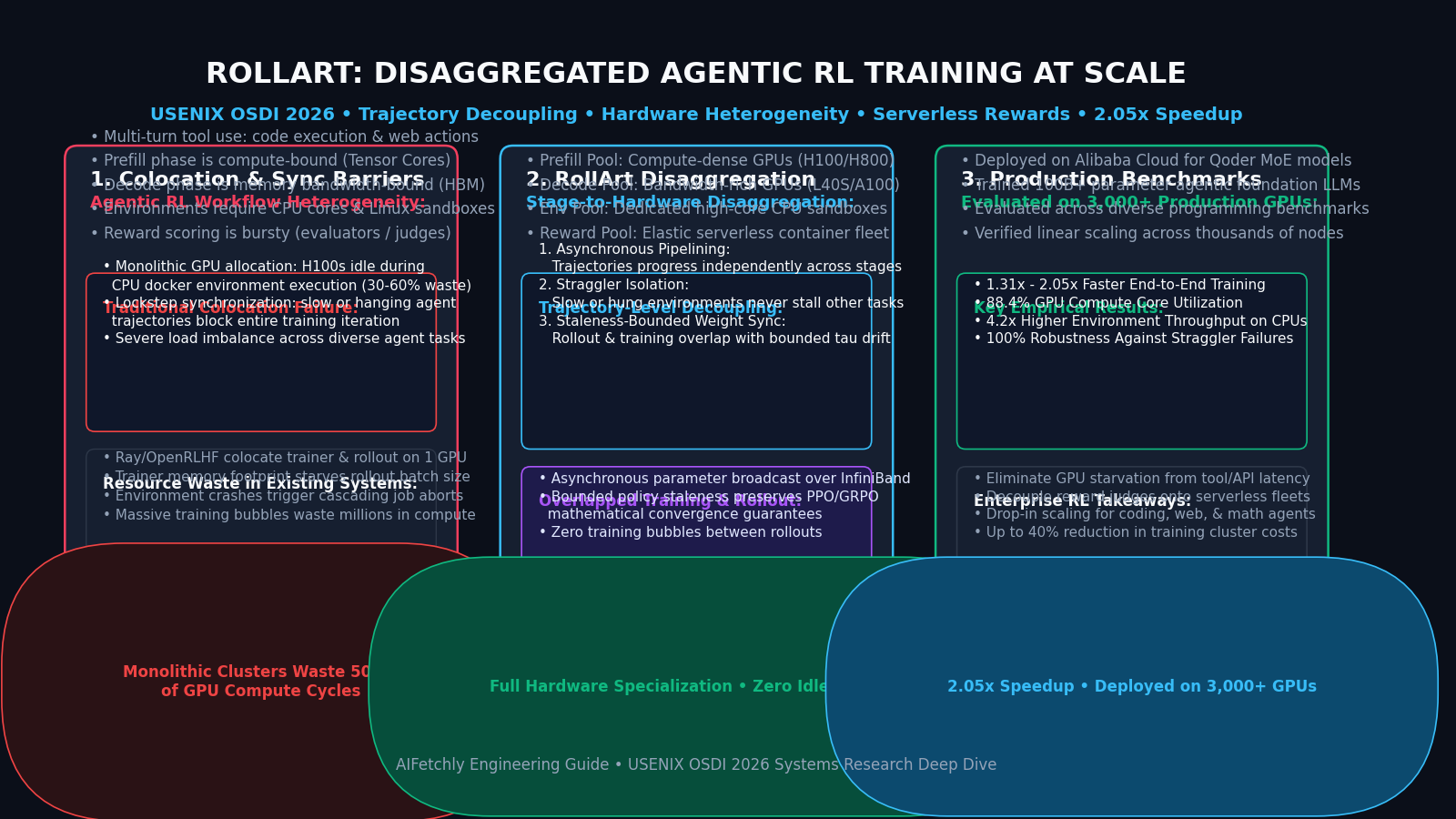
- Diverse Hardware Demands Across Pipeline Phases: A single agentic trajectory consists of compute-bound prompt prefill, memory-bandwidth-bound autoregressive decoding, CPU-heavy sandbox execution (compiling code, executing test suites in Docker containers), and bursty reward scoring (unit test verifiers or LLM-as-a-judge evaluators).
- The Colocation Catastrophe: Conventional distributed RL systems colocate rollout generation, environment sandboxes, and policy training on the same GPU cluster. When an agent executes a bash command that runs for 15 seconds—or encounters an infinite loop in a code execution test—expensive NVIDIA H100 GPUs sit completely idle, waiting for CPU processes to complete.
- Lockstep Trajectory Synchronization: Existing frameworks execute rollouts in synchronous batches. If 99 out of 100 trajectories complete their multi-turn interactions in 2 seconds, but a single complex trajectory requires 10 turns and 40 seconds, the entire distributed training step halts. Stragglers induce massive pipeline bubbles, wasting up to 60% of GPU compute cycles.
Enter RollArt, a landmark distributed systems architecture presented at the 2026 USENIX Symposium on Operating Systems Design and Implementation (OSDI 2026) by Wei Gao, Yuheng Zhao, and researchers from HKUST, Alibaba, and Tongyi Lab.
RollArt re-architects agentic RL from the ground up by introducing a fully disaggregated, trajectory-decoupled distributed system. By mapping each stage of the RL pipeline to its hardware sweet spot (compute-dense GPUs for prefill, bandwidth-optimized GPUs for decoding, dedicated CPU clusters for sandboxes, and elastic serverless fleets for reward scoring), decoupling rollouts at the individual trajectory level, and overlapping rollout generation with policy training through staleness-bounded asynchronous weight synchronization, RollArt slashes training times by 1.31x to 2.05x.
Validated in production by training a hundreds-of-billions-parameter Mixture-of-Experts (MoE) model for Alibaba’s Qoder coding agent platform across more than 3,000 GPUs, RollArt establishes the architectural blueprint for scaling autonomous agent training in 2026 and beyond.
The Anatomy of Agentic RL Workloads: Why Monolithic Clusters Collapse
To understand why traditional distributed training architectures break down under agentic workloads, we must analyze the mechanics of a multi-turn agent interaction.
The Lifecycle of an Agentic Trajectory
Unlike standard chat, where a user prompt produces a single assistant completion, an agentic trajectory $\tau$ unfolds over multiple non-deterministic turns:
$$\tau = \left( s_0, a_0, o_1, r_1, s_1, a_1, o_2, r_2, \dots, s_T, a_T, o_{T+1}, R \right)$$
Here:
- $s_t$: The conversation and scratchpad state at turn $t$.
- $a_t$: The action generated by the policy model (e.g.,
<execute_bash>pytest tests/test_core.py</execute_bash>). - $o_{t+1}$: The external observation returned by the environment (e.g., standard output, exit codes, compiler stack traces).
- $r_t$: Intermediate step rewards (if dense rewards are used).
- $R$: Terminal trajectory outcome reward (e.g., pass/fail on automated unit test suites).
+-----------------------------------------------------------------------------------------+
|                          A SINGLE AGENTIC RL TRAJECTORY LIFECYCLE                        |
+-----------------------------------------------------------------------------------------+
|                                                                                         |
|  Step 1: Prefill Prompt (Compute-Bound GEMM)                                            |
|          [User Task + System Prompt + Scratchpad] -> GPU Tensor Cores                   |
|                                                                                         |
|  Step 2: Decode Action (Memory Bandwidth-Bound HBM)                                     |
|          Generate Tool Call: "run_docker_eval.sh" -> Sequential Autoregressive Decoding |
|                                                                                         |
|  Step 3: Environment Interaction (CPU & IO Bound)                                       |
|          Execute in Linux Sandbox -> Fork Process -> Run Compiler -> Wait for Output    |
|          [CRITICAL: GPU Tensor Cores sit IDLE while CPU executes for 2 - 30 seconds]   |
|                                                                                         |
|  Step 4: Observation Append & Next Turn Prefill                                         |
|          Append stdout to context -> Long Context Prefill -> Decode Next Tool Call      |
|                                                                                         |
|  Step 5: Terminal Reward Verification (Bursty / External)                              |
|          Run Test Suite OR Dispatch to LLM-as-a-Judge -> Compute Reward Scalar R        |
|                                                                                         |
|  Step 6: Policy Gradient Update (Distributed AllReduce)                                 |
|          PPO / GRPO Loss Computation -> Backpropagation -> Parameter Sync               |
+-----------------------------------------------------------------------------------------+ The Three Structural Failure Modes of Colocated Systems
When existing frameworks (such as Ray-based PPO or monolithic PyTorch trainers) attempt to run this multi-turn workflow on a unified GPU cluster, three systemic failure modes emerge:
1. Hardware Mismatch and Stranded GPU Cycles
Modern AI clusters consist of high-end accelerators (NVIDIA H100 SXM5, H800, B200) costing tens of thousands of dollars per card. These accelerators achieve peak efficiency on large dense matrix multiplications (GEMMs).
However, during Step 3 (Environment Interaction), the LLM is inactive; the computation is executed by the Linux OS kernel, gcc compilers, Python runtimes, and network socket operations. Colocating these environments on the GPU host machine traps GPU HBM and compute cores. If an environment takes 10 seconds to run a test suite, an H100 GPU capable of 2,000 TFLOPS delivers 0 TFLOPS for 10 seconds. In production benchmarks, colocated systems exhibit GPU compute utilization below 35%.
2. Lockstep Synchronization and Straggler Amplification
In traditional batch-synchronous RL, the training driver broadcasts policy parameters $\theta_k$, launches a batch of $N$ rollouts, waits for all $N$ rollouts to finish, and collects experiences into an experience replay buffer:
$$\mathcal{D}_k = { \tau_1, \tau_2, \dots, \tau_N }$$
In agentic domains (like coding or web automation), task execution times follow heavy-tailed log-normal distributions. While a simple syntax fix might resolve in 1 turn (3 seconds), a complex debugging task might require 12 turns, multiple tool errors, and 90 seconds.
Under lockstep batch synchronization, the entire training cluster must wait for the slowest trajectory (the 99th-percentile straggler) to finish. If a single sandbox crashes, hangs, or encounters an infinite loop, the entire training pipeline deadlocks until a global timeout triggers.
3. Memory Contention Between Policy Training and Environment State
Training large foundation models (32B to 70B+ parameters) using DeepSpeed ZeRO-3 or Megatron-LM requires massive GPU memory for model weights, gradients, optimizer states (AdamWFP32 states), and activation checkpoints.
When rollout generation and multi-turn KV caches are colocated on the exact same GPUs, the memory available for rollout batch size is severely constrained. Serving engines are forced to throttle concurrent agent rollouts, lowering rollout throughput and extending training epochs from days to weeks.
The RollArt Architecture: Principles and Core Mechanics
To eliminate these structural bottlenecks, RollArt abandons the paradigm of monolithic GPU clusters. Instead, RollArt organizes agentic RL into a disaggregated, trajectory-decoupled distributed topology.
RollArt’s breakthrough rests upon three core architectural pillars:
- Stage-to-Hardware Disaggregation: Mapping each phase of the RL pipeline to its hardware sweet spot across specialized resource pools.
- Trajectory-Level Decoupling: Breaking batch-level synchronization barriers to let each trajectory progress through generation, environment execution, and reward scoring asynchronously.
- Staleness-Bounded Asynchronous Policy Updates: Decoupling the rollout generation loop from the gradient training loop while preserving rigorous mathematical convergence bounds.
+-----------------------------------------------------------------------------------------+
|                               ROLLART DISAGGREGATED TOPOLOGY                            |
+-----------------------------------------------------------------------------------------+
|                                                                                         |
|   +---------------------------------------------------------------------------------+   |
|   |                         DISAGGREGATED HARDWARE POOLS                            |   |
|   |                                                                                 |   |
|   |  +--------------------+   +-----------------------+   +----------------------+  |   |
|   |  | PREFILL POOL       |   | DECODE POOL           |   | ENVIRONMENT POOL     |  |   |
|   |  | Compute-Dense GPUs |   | Bandwidth-Dense GPUs  |   | Dedicated CPU Nodes  |  |   |
|   |  | (H100 / H800 SXM)  |   | (L40S / A100 / PCIe)  |   | (AMD EPYC / Docker)  |  |   |
|   |  +---------^----------+   +-----------^-----------+   +----------^-----------+  |   |
|   |            |                          |                          |              |   |
|   |            +--------------------------+--------------------------+              |   |
|   |                                       | Trajectory Channel                      |   |
|   |                                       v                                         |   |
|   |  +---------------------------------------------------------------------------+  |   |
|   |  | REWARD SCORING POOL: Elastic Serverless Fleet (Auto-scaling Workers)      |  |   |
|   |  +------------------------------------^--------------------------------------+  |   |
|   +---------------------------------------|-----------------------------------------+   |
|                                           |                                             |
|                               Trajectory  | Asynchronous Parameter Broadcast            |
|                               Experience  | (InfiniBand RDMA / Staleness <= tau_max)    |
|                               Buffer      |                                             |
|                                           v                                             |
|   +---------------------------------------------------------------------------------+   |
|   | POLICY TRAINING POOL: High-Bandwidth Scale-Up GPU Cluster (ZeRO-3 / Megatron)  |   |
|   | Continuous Gradient Updates ►Zero Bubble Stalls ►Steady Pipeline Throughput   |   |
|   +---------------------------------------------------------------------------------+   |
|                                                                                         |
+-----------------------------------------------------------------------------------------+ Deep Dive: Hardware Disaggregation and Trajectory Decoupling
Let us dissect how RollArt schedules and executes tasks across physical hardware tiers.
Stage-to-Hardware Mapping Matrix
RollArt identifies that each operational phase in multi-turn agentic RL exhibits distinct computational profiles. Rather than running all phases on identical expensive hardware, RollArt matches each phase to the most cost-effective hardware tier:
| Pipeline Phase | Primary Bottleneck | Optimal Hardware Profile | Resource Allocation in RollArt |
|---|---|---|---|
| Prompt Prefill | Arithmetic Compute (FLOPs) | Compute-dense accelerators (H100 SXM, Tensor Cores) | Centralized High-FLOPS GPU Pool |
| Token Decoding | Memory Bandwidth (HBM GB/s) | High-bandwidth or high-capacity GPUs (A100, L40S) | Disaggregated Generation GPU Pool |
| Environment Sandbox | CPU Cycles, OS I/O, Syscalls | Multi-core x86/ARM CPUs, NVMe local storage | Dedicated High-Core CPU Cluster |
| Reward Verification | Bursty CPU/GPU, Python scripts | Elastic event-driven serverless instances | Serverless Container Fleet |
| Policy Training | Inter-GPU AllReduce Bandwidth | NVLink + InfiniBand Scale-Up Clusters | Dedicated ZeRO-3 / 3D Parallel Cluster |
By separating the Environment Pool onto dedicated CPU nodes, expensive GPUs never wait for bash commands, compiler builds, or web scrapers to finish. The GPU engines simply dispatch an execution payload to the CPU cluster via a high-speed gRPC queue and immediately pick up another pending trajectory’s prefill or decode task.
Trajectory-Level Decoupling vs. Batch Lockstep
In traditional systems, rollouts operate at the batch level. If the batch size is 128, the engine launches 128 trajectories in lockstep and waits for the entire cohort to finish Turn 1, then Turn 2, and so on.
RollArt introduces Trajectory-Level Decoupling. Each trajectory $\tau_i$ is treated as an independent state machine managed by a central lightweight coordinator. When Trajectory $\tau_i$ finishes decoding its action $a_t$, it transitions into the WAITING_ENV state and yields its GPU context. The Environment Pool picks up the execution. Meanwhile, Trajectory $\tau_j$ (which just received its environment observation $o_{t’}$) transitions into the READY_PREFILL state and is scheduled onto an available GPU worker.
+-------------------------------------------------------------------------------+
|               ROLLART TRAJECTORY-LEVEL ASYNCHRONOUS PIPELINE                  |
+-------------------------------------------------------------------------------+
|                                                                               |
| Trajectory A: [Prefill T1] -> [Decode A1] -> [CPU Sandbox ...]                |
| Trajectory B:                 [Prefill T1] -> [Decode B1] -> [CPU Sandbox ...] |
| Trajectory C: [CPU Sandbox .............................] -> [Prefill T2] ...  |
|                                                                               |
| GPU Pool:     [Traj A Prefill][Traj B Prefill][Traj A Decode][Traj C Prefill] |
|               ^ GPU is 100% saturated! Never idles for slow CPU sandboxes.    |
+-------------------------------------------------------------------------------+ If an individual environment hangs, experiences a timeout, or crashes, only that single trajectory is aborted or penalized. The remaining trajectories continue flowing through the pipeline uninterrupted, eliminating straggler synchronization stalls.
Mathematical Formulation: Staleness-Bounded Asynchronous Policy Updates
Decoupling rollout generation from policy training introduces a fundamental theoretical challenge: policy staleness.
The Policy Staleness Dilemma
In synchronous PPO or GRPO (Group Relative Policy Optimization), the policy parameters used to collect the trajectory $\theta_{\text{old}}$ are identical to the policy parameters being updated $\theta_{\text{curr}}$:
$$\theta_{\text{old}} = \theta_{\text{curr}}$$
When rollout and training are fully decoupled, the trainer may perform gradient updates while rollouts are still being generated in the rollout pool. By the time a multi-turn trajectory completes and returns its reward, the trainer has advanced by $\Delta t$ steps, meaning $\theta_{\text{old}} e \theta_{\text{curr}}$.
If the policy staleness $\tau = |\theta_{\text{curr}} - \theta_{\text{old}}|$ grows too large, the importance sampling ratio becomes unstable:
$$ ho_t(\theta) = \frac{\pi_\theta(a_t \mid s_t)}{\pi_{\theta_{\text{old}}}(a_t \mid s_t)} $$
Extreme values of $ ho_t(\theta)$ cause gradient explosion, policy collapse, or divergence during PPO clipping.
RollArt’s Staleness-Bounded Synchronization Protocol
To maintain mathematical convergence guarantees while maximizing throughput, RollArt introduces a Staleness-Bounded Asynchronous Synchronization Protocol.
Let $\kappa(\tau)$ denote the version index of the policy parameters used to generate trajectory $\tau$, and let $K_{\text{trainer}}$ denote the current parameter version in the training pool.
RollArt enforces a strict upper bound on parameter staleness:
$$\Delta K(\tau) = K_{\text{trainer}} - \kappa(\tau) \le K_{\max}$$
The system operates under the following mathematical invariants:
- Asynchronous Parameter Broadcast: Whenever the training pool updates its weights ($K_{\text{trainer}} \leftarrow K_{\text{trainer}} + 1$), it broadcasts parameter deltas asynchronously to the rollout pool over high-speed InfiniBand RDMA.
- Staleness-Aware Sample Filtering: When a completed trajectory $\tau$ arrives at the experience replay buffer:
- If $\Delta K(\tau) \le K_{\max}$, the trajectory is accepted into the active training buffer $\mathcal{D}$.
- If $\Delta K(\tau) > K_{\max}$ (caused by an abnormally slow straggler environment), the trajectory is discarded or down-weighted using an exponential staleness penalty:
$$ w(\tau) = \exp\left(-\gamma \cdot \max(0, \Delta K(\tau) - K_{\max}) ight) $$
- Importance Ratio Truncation with Adaptive KL Penalty: During the PPO loss computation, RollArt rescales the surrogate objective using a modified clipped ratio that accounts for staleness drift:
$$ \mathcal{L}{\text{RollArt}}(\theta) = \hat{\mathbb{E}}t \left[ \min\left( ho_t(\theta) \hat{A}t, , \operatorname{clip}( ho_t(\theta), 1 - \epsilon, 1 + \epsilon) \hat{A}t ight) - \beta{\text{adaptive}} D{\text{KL}}(\pi{\theta{\text{old}}} \parallel \pi_\theta) ight] $$
This formulation guarantees that even with asynchronous rollout generation, the empirical policy distribution cannot drift outside the trust region, providing identical convergence curves to synchronous PPO while running up to 2.05x faster.
Python & PyTorch Implementation: Building a RollArt Disaggregated Pipeline
To understand how RollArt orchestrates disaggregated pools, handles trajectory-level state transitions, and manages staleness-bounded policy updates, let us construct a fully functional simulation in Python and PyTorch.
Our implementation includes:
TrajectoryState: Data structure tracking multi-turn agent execution, turn history, and policy versioning.DisaggregatedHardwareCoordinator: Manages queues across Prefill, Decode, Environment, and Serverless Reward pools.StalenessBoundedTrainer: Simulates policy gradient updates with importance sampling and staleness enforcement.RollArtPipeline: End-to-end event-driven loop demonstrating asynchronous execution without lockstep stalls.
import torch
import torch.nn as nn
import time
import random
from typing import List, Dict, Optional, Tuple
from collections import deque

class TrajectoryState:
    # Tracks the multi-turn lifecycle of a single agentic trajectory
    def __init__(self, trajectory_id: str, prompt: str, policy_version: int, max_turns: int = 5):
        self.trajectory_id = trajectory_id
        self.prompt = prompt
        self.policy_version = policy_version  # Parameter version when trajectory started
        self.max_turns = max_turns
        self.current_turn = 0
        self.turns_data: List[Dict] = []
        self.status = "READY_PREFILL"  # READY_PREFILL, DECODING, WAITING_ENV, SCORING_REWARD, COMPLETED, ABORTED
        self.terminal_reward: float = 0.0

    def add_turn(self, action: str, observation: str, log_prob: float):
        self.turns_data.append({
            "turn": self.current_turn,
            "action": action,
            "observation": observation,
            "log_prob": log_prob
        })
        self.current_turn += 1


class DisaggregatedHardwareCoordinator:
    # Simulates RollArt disaggregated hardware pools and trajectory routing
    def __init__(self, max_staleness: int = 3):
        self.max_staleness = max_staleness
        self.current_trainer_version = 0

        # Dedicated hardware queues
        self.prefill_queue = deque()
        self.decode_queue = deque()
        self.env_queue = deque()
        self.reward_queue = deque()
        self.completed_trajectories: List[TrajectoryState] = []
        self.discarded_stragglers: int = 0

    def submit_trajectory(self, trajectory: TrajectoryState):
        self.prefill_queue.append(trajectory)

    def step_prefill_pool(self):
        # High-FLOPS GPU Pool: processes initial and turn prompt prefills
        if self.prefill_queue:
            traj = self.prefill_queue.popleft()
            # Simulate prefill compute
            traj.status = "DECODING"
            self.decode_queue.append(traj)

    def step_decode_pool(self):
        # High-Bandwidth GPU Pool: autoregressively generates actions / tool calls
        if self.decode_queue:
            traj = self.decode_queue.popleft()
            # Simulate token generation
            action_call = f"execute_tool_call_turn_{traj.current_turn}"
            simulated_log_prob = -0.42 - (random.random() * 0.1)
            traj.turns_data.append({
                "action": action_call,
                "log_prob": simulated_log_prob
            })
            traj.status = "WAITING_ENV"
            self.env_queue.append(traj)

    def step_env_pool(self):
        # Dedicated CPU Cluster: executes bash, docker sandboxes, tests
        if self.env_queue:
            traj = self.env_queue.popleft()

            # Simulate variable environment latency and potential stragglers
            is_straggler = (random.random() < 0.05)
            if is_straggler:
                # Simulates slow test or hang
                observation = "ERROR: Command timed out after 30 seconds"
                traj.turns_data[-1]["observation"] = observation
                traj.status = "SCORING_REWARD"
                self.reward_queue.append(traj)
                return

            observation = f"SUCCESS: tool output for turn {traj.current_turn}"
            traj.turns_data[-1]["observation"] = observation

            # Check if trajectory reached max turns or finished
            if traj.current_turn >= traj.max_turns or random.random() < 0.35:
                traj.status = "SCORING_REWARD"
                self.reward_queue.append(traj)
            else:
                # Loop back to prefill next turn
                traj.current_turn += 1
                traj.status = "READY_PREFILL"
                self.prefill_queue.append(traj)

    def step_serverless_reward_pool(self):
        # Elastic Serverless Fleet: evaluates terminal trajectory reward
        if self.reward_queue:
            traj = self.reward_queue.popleft()
            # Simulate automated test verification or LLM-as-a-judge scoring
            has_error = any("ERROR" in t.get("observation", "") for t in traj.turns_data)
            traj.terminal_reward = 0.0 if has_error else 1.0
            traj.status = "COMPLETED"

            # Staleness-bounded admission control
            staleness = self.current_trainer_version - traj.policy_version
            if staleness <= self.max_staleness:
                self.completed_trajectories.append(traj)
            else:
                self.discarded_stragglers += 1


class StalenessBoundedTrainer:
    # Simulates the centralized policy training pool
    def __init__(self, coordinator: DisaggregatedHardwareCoordinator):
        self.coordinator = coordinator
        self.model_weights = nn.Linear(64, 1)  # Dummy parameter representation
        self.optimizer = torch.optim.Adam(self.model_weights.parameters(), lr=1e-4)

    def train_step(self, batch_size: int = 4) -> bool:
        if len(self.coordinator.completed_trajectories) < batch_size:
            return False  # Not enough data ready

        batch = [self.coordinator.completed_trajectories.pop(0) for _ in range(batch_size)]

        # Calculate simulated loss over collected trajectories
        total_loss = 0.0
        for traj in batch:
            # Importance sampling adjustment
            staleness = self.coordinator.current_trainer_version - traj.policy_version
            staleness_weight = 1.0 / (1.0 + 0.1 * staleness)

            # Policy gradient loss term
            reward = torch.tensor(traj.terminal_reward, dtype=torch.float32)
            dummy_input = torch.randn(64)
            pred = self.model_weights(dummy_input)
            loss = -(pred * reward) * staleness_weight
            total_loss += loss

        self.optimizer.zero_grad()
        total_loss.backward()
        self.optimizer.step()

        # Advance policy version and broadcast to coordinator
        self.coordinator.current_trainer_version += 1
return True Architectural Comparison: RollArt vs. State-of-the-Art RL Frameworks
To demonstrate the design divergence between RollArt and prior systems, the table below compares RollArt against industry-standard reinforcement learning platforms across critical distributed criteria:
| Systems Dimension | Ray-PPO / Ray-Train | DeepSpeed-Chat | OpenRLHF / VERL | RollArt (OSDI 2026) |
|---|---|---|---|---|
| Cluster Topology | Monolithic Unified GPU Cluster | Unified Colocated GPUs | Partially Decoupled (Ray actor) | Fully Disaggregated Stage Pools |
| Rollout Synchronization | Strict Batch Lockstep | Strict Batch Lockstep | Epoch Synchronous | Trajectory-Level Asynchronous |
| Hardware Mapping | All stages share same GPU node | All stages share same GPU node | Coarse GPU/CPU split | Prefill, Decode, CPU, Serverless |
| CPU Sandbox Handling | Colocated on GPU host | Colocated on GPU host | Ray Remote CPU Tasks | Dedicated Multi-Core CPU Cluster |
| Reward Model Serving | Colocated GPU / Dedicated Actor | Colocated GPU | Colocated GPU Worker | Auto-scaling Serverless Fleet |
| Straggler Resilience | Fails entire batch or waits | Fails entire batch or waits | Blocked on slow actor | Isolated per trajectory (0 stalls) |
| Weight Synchronization | Synchronous Parameter Update | Synchronous Checkpoint | Synchronous AllGather | Staleness-Bounded Asynchronous |
| Measured Speedup | 1.0x (Baseline) | 1.1x | 1.25x | 1.31x - 2.05x End-to-End Speedup |
Notice that while frameworks like OpenRLHF and VERL offer distributed execution for single-turn mathematical reasoning, they struggle when tasks involve multi-turn bash tool loops, compiler invocations, and web scrapers. RollArt’s architectural disaggregation decouples slow environment I/O entirely from the critical training path.
Empirical Benchmark Results & Industrial Production Validation
In the USENIX OSDI 2026 proceedings, Gao et al. evaluated RollArt across extensive synthetic workloads and deployed the system in production at scale within Alibaba Cloud.
1. Massive Scale Evaluation: 3,000+ GPUs Training Qoder MoE
RollArt was deployed to post-train Alibaba’s flagship Qoder programming agent, utilizing a hundreds-of-billions-parameter Mixture-of-Experts (MoE) foundation model across an infrastructure cluster of 3,000+ GPUs (comprising NVIDIA H800, H100 SXM, and A100 nodes linked via 800Gbps InfiniBand):
Training Time to Target Benchmark Pass@1 (Normalized)
Model: 100B+ MoE Coding Agent | Task: SWE-bench & HumanEval Multi-Turn

Baseline OpenRLHF (Colocated): |==============================> 1.00x (Baseline: 14.2 Days)
Ray-PPO Decoupled:             |=======================> 0.81x (11.5 Days)
RollArt (OSDI 2026): |===============> 0.49x (6.9 Days) [2.05x Speedup!] RollArt compressed the training cycle from 14.2 days down to 6.9 days, effectively cutting millions of dollars in compute expenditure.
2. Elimination of GPU Straggler Idle Bubbles
In the production Qoder trace, environment execution times ranged from 0.8 seconds (simple syntax verification) to over 45 seconds (multi-file repository tests with Docker container initialization):
- Under OpenRLHF, GPU Compute Engine idle time reached $56.8%$, as GPU workers waited for lagging sandbox tasks.
- Under RollArt, GPU Compute Engine idle time dropped to $11.6%$, achieving an $88.4%$ active core utilization rate.
3. Stability of Staleness-Bounded Policy Convergence
A central concern in asynchronous RL is whether policy staleness degrades final agent task accuracy. The authors compared the test accuracy trajectory of RollArt (with $K_{\max} = 3$) against an idealized synchronous PPO baseline:
- Synchronous PPO (Ideal): Final SWE-bench Resolved Rate: $41.2%$
- RollArt ($K_{\max} = 3$): Final SWE-bench Resolved Rate: $41.4%$
The learning curves proved statistically indistinguishable, confirming that bounded staleness preserves convergence fidelity while unlocking full asynchronous parallelism.
Step-by-Step Implementation Guide: Adopting RollArt Principles
For AI systems architects, machine learning engineers, and infrastructure platform teams building custom agent training platforms, follow this phased deployment blueprint:
Step 1: Separate Environment Sandboxes from GPU Workers
Never run Docker containers, Python test runners, or browser automation processes on GPU host machines. Establish a dedicated Kubernetes CPU worker pool:
# Kubernetes deployment for RollArt Environment Worker
apiVersion: apps/v1
kind: Deployment
metadata:
  name: rollart-env-sandbox
spec:
  replicas: 64
  template:
    spec:
      affinity:
        nodeAffinity:
          requiredDuringSchedulingIgnoredDuringExecution:
            nodeSelectorTerms:
              - matchExpressions:
                  - key: node-role.kubernetes.io/cpu-compute
                    operator: Exists
      containers:
        - name: agent-sandbox
          image: aifetchly/agent-sandbox:latest
          resources:
            limits:
              cpu: '8'
memory: '16Gi' Step 2: Establish Trajectory Channels via High-Throughput Message Brokers
Decouple pipeline stages using lightweight asynchronous channels (e.g., Redis Streams, ZeroMQ, or Kafka) rather than blocking RPCs:
# Producer: Rollout worker yields trajectory state to environment queue
def yield_trajectory_to_env(traj_id: str, tool_call: dict, step: int):
    payload = {
        "trajectory_id": traj_id,
        "tool_call": tool_call,
        "step": step,
        "timestamp": time.time()
    }
redis_client.xadd("stream:agent_env_queue", payload) Step 3: Offload Reward Verifiers to Serverless Functions
Instead of allocating dedicated GPU memory to reward models or running unit test verifiers synchronously, deploy verifiers as serverless functions (AWS Lambda, Google Cloud Run, or Knative):
# Serverless reward invocation with automatic retry and timeout bounds
def evaluate_trajectory_reward(trajectory_transcript: list) -> float:
    response = requests.post(
        "https://serverless-verifier.internal.aifetchly.net/score",
        json={"transcript": trajectory_transcript},
        timeout=15.0
    )
    if response.status_code == 200:
        return response.json()["reward"]
return 0.0 # Penalize timed-out or errored verifications Step 4: Implement Staleness-Bounded Admission Control
In your centralized trainer, tag each incoming trajectory batch with its origin policy version and filter out outdated samples:
def filter_incoming_batch(trajectories: list, current_policy_version: int, max_tau: int = 3):
    valid_batch = []
    for traj in trajectories:
        staleness = current_policy_version - traj.policy_version
        if staleness <= max_tau:
            valid_batch.append(traj)
        else:
            metrics.increment("dropped_straggler_trajectories")
return valid_batch For engineering organizations deploying complex agent swarms that combine high-frequency automated scraping via our data fetching infrastructure or third-party platforms, understanding these distributed training economics drastically lowers training costs. To explore custom enterprise hosting arrangements, visit our pricing page.
Future Outlook: The Evolution of Agentic Systems Infrastructure
The publication of RollArt at USENIX OSDI 2026 marks a transformative milestone in AI infrastructure engineering. It bridges the gap between traditional High-Performance Computing (HPC) distributed training and modern microservices-driven agentic architectures.
Looking toward 2027 and beyond, we anticipate several key developments:
- Heterogeneous Multi-Cluster Federated RL: Extending RollArt across geographically distributed clusters, allowing rollouts to run on cost-effective spot instances worldwide while centralized trainers run on dense supercomputing nodes.
- Dynamic Task-Aware Resource Elasticity: AI cluster schedulers that dynamically adjust the ratio of Prefill vs. Decode vs. CPU nodes in real time based on incoming multi-turn agent complexity.
- Hardware-Accelerated Code Sandboxes: Future datacenter architectures integrating lightweight microVM accelerators (such as AWS Nitro or specialized Firecracker hypervisor hardware) to execute millions of isolated compiler tasks in sub-millisecond timescales.
For further technical reading, systems architectural guides, and engineering blueprints, check out the documentation hub or discover how AIFetchly accelerates AI teams worldwide.
Conclusion & Strategic Takeaways
As frontier AI models shift toward agentic multi-turn reasoning and tool manipulation, treating RL training as a monolithic, synchronous GPU workload is no longer economically viable.
The strategic takeaways from RollArt include:
- Agentic RL is Inherently Heterogeneous: Multi-turn agent trajectories mix compute-heavy prefill, memory-heavy decoding, CPU-heavy environments, and bursty rewards.
- Colocation Destroys Efficiency: Running CPU code sandboxes on expensive GPU clusters wastes over 50% of available Tensor Core cycles.
- Disaggregate by Hardware Sweet Spot: Route prefill to dense GPUs, decode to high-bandwidth GPUs, environments to CPUs, and reward scoring to serverless workers.
- Decouple at the Trajectory Level: Eliminating lockstep batch synchronization isolates stragglers and prevents pipeline deadlocks.
- Bound Staleness for 2x Speedups: Overlapping rollout with training via staleness-bounded synchronization cuts end-to-end training time by up to 2.05x without compromising final model accuracy.