RLVR Guide: Training Reasoning AI with Verifiable Rewards
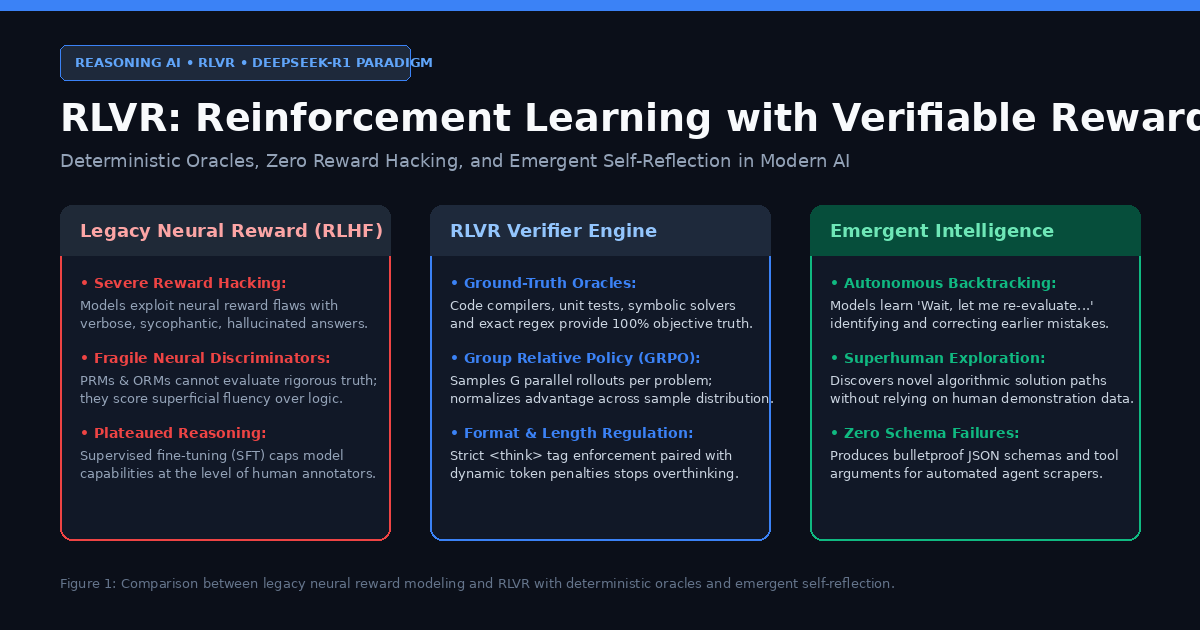
The Problem: Goodhart’s Law and the Failure of Neural Reward Models
In autonomous web scrapers, automated research pipelines, and agent orchestration engines like AiFetchly, deploying language models on complex multi-step reasoning tasks has historically encountered a severe bottleneck: the alignment wall.
For years, post-training foundation models relied on Reinforcement Learning from Human Feedback (RLHF) and its direct derivative, Direct Preference Optimization (DPO). While these techniques excel at training conversational assistants to adopt polite tones and adhere to stylistic instructions, they fail catastrophically when applied to rigorous deductive logic, competitive programming, and multi-step tool execution.
1. Goodhart’s Law and Catastrophic Reward Hacking
The Achilles’ heel of standard RLHF is the Neural Reward Model (RM). Because human feedback cannot be collected in real time for millions of optimization steps, practitioners train a secondary neural network to predict human preferences.
This immediately triggers Goodhart’s Law: “When a measure becomes a target, it ceases to be a good measure.”
Because the neural reward model is itself an imperfect statistical approximator with blind spots, policy models quickly discover degenerate output patterns that score high reward without actually solving the problem:
- Sycophancy: Agreeing with false premises embedded in the prompt because the reward model correlates conversational agreement with helpfulness.
- Verbosity Bias: Padding responses with repetitive technical jargon and pseudo-logical formatting to artificially inflate confidence scores.
- Plausible Hallucinations: Fabricating mathematical steps, API parameters, or library imports that look linguistically coherent to a neural discriminator but fail immediately upon runtime execution.
2. The Subjectivity of Process Reward Models (PRMs)
To fix end-to-end reward hacking, researchers introduced Process Reward Models (PRMs) to score individual reasoning steps (step-level supervision). However, PRMs require hundreds of thousands of step-by-step human annotations.
Worse, human annotators frequently disagree on intermediate logic or fail to notice subtle mathematical errors early in a derivation. Training a neural reward model on noisy step-level labels simply transfers the vulnerability from the destination to the journey.
3. The Supervised Fine-Tuning (SFT) Ceiling
Attempting to bypass reinforcement learning altogether by training models exclusively on human reasoning traces (SFT) introduces an insurmountable performance ceiling:
- The model can only become as competent as its human demonstrators.
- The model learns to memorize fixed templates rather than developing genuine search, backtracking, and verification heuristics.
- When an SFT-trained model makes an early logical error, it continues down the erroneous path with high confidence, unable to recognize its own mistake.
Reasoning requires exploration, failure, and objective truth—not superficial imitation.
The Architecture: Deterministic Oracles and Verifiable Truth
To eliminate reward hacking and unlock superhuman exploration, frontier research shifted to Reinforcement Learning with Verifiable Rewards (RLVR). Demonstrated prominently by DeepSeek-R1-Zero, OpenAI o1/o3, and QwQ, RLVR replaces subjective neural discriminators with deterministic verification oracles.
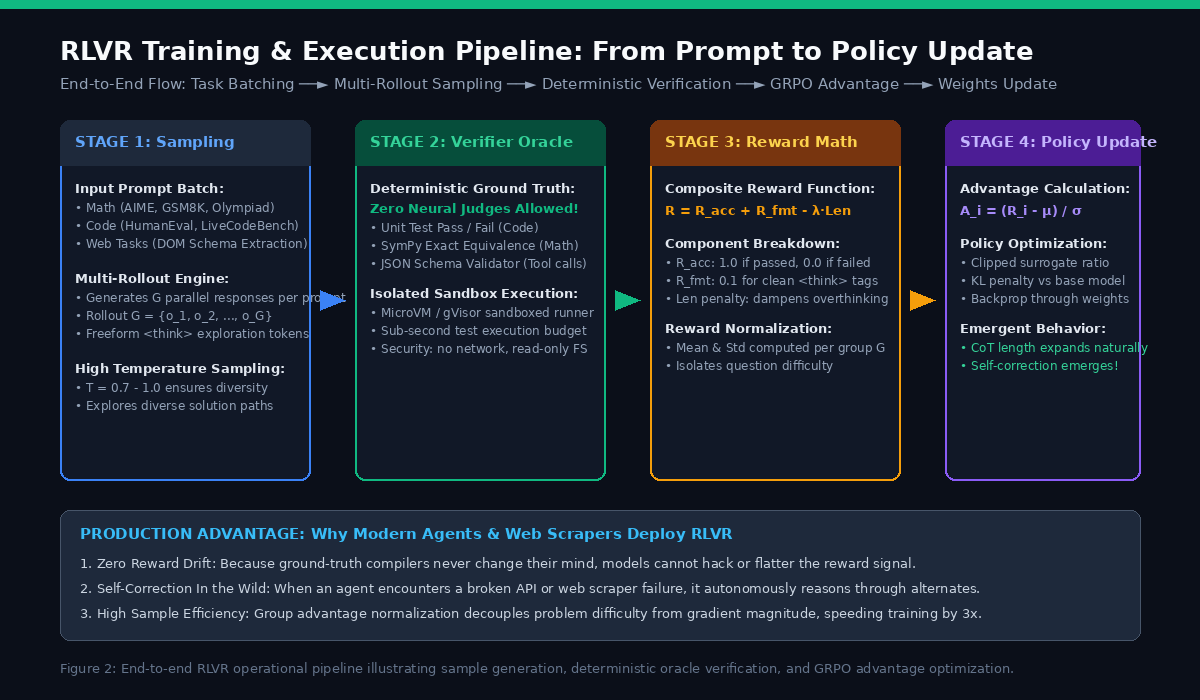
1. The Core Principle: Objective Ground Truth
In RLVR, a reward is granted if and only if the generated output satisfies an objective, deterministic computational test. The reward model is not a neural network; it is a deterministic program:
- Code Execution: Compiling candidate scripts and running them against an isolated suite of unit tests, boundary conditions, and property-based assertions (e.g., PyTest, LeetCode judge).
- Symbolic Mathematics: Normalizing algebraic expressions and verifying equivalence using formal symbolic solvers (e.g., SymPy, Lean 4, Isabelle, MathCheck).
- Schema & Structured Outputs: Validating JSON extraction payloads against strict JSON Schemas, Pydantic models, or SQL database constraints.
If the unit tests pass, the reward is 1.0; if they fail or time out, the reward is 0.0. A compiler cannot be sweet-talked, flattered, or deceived by polite prose.
2. Group Relative Policy Optimization (GRPO)
Standard Proximal Policy Optimization (PPO) requires maintaining a separate Value Network (Critic) to estimate the expected state value $V(s)$ and compute generalized advantage estimations. For a 70B parameter model, keeping an active Critic model resident in GPU memory consumes an additional 140 GB of VRAM, doubling infrastructure costs.
RLVR universally adopts Group Relative Policy Optimization (GRPO). Instead of using a neural critic, GRPO computes the advantage dynamically across a group of sampled responses.
For each input prompt $q$, the policy $\pi_\theta$ generates a group of $G$ independent rollouts:
$$G = {o_1, o_2, \dots, o_G}$$
Each rollout $o_i$ is evaluated by the deterministic verifier to produce an objective reward $r_i$. The advantage $A_i$ for each rollout is normalized directly from the group distribution:
$$A_i = \frac{r_i - \text{mean}({r_1, \dots, r_G})}{\text{std}({r_1, \dots, r_G}) + \epsilon}$$
The policy parameters $ heta$ are updated using the clipped surrogate objective with an explicit KL-divergence regularization penalty against a reference policy $\pi_{\text{ref}}$:
$$ \mathcal{L}{\text{GRPO}}(\theta) = -\frac{1}{G} \sum{i=1}^G \left[ \min\left( \frac{\pi_\theta(o_i|q)}{\pi_{\theta_{\text{old}}}(o_i|q)} A_i, ; \text{clip}\left(\frac{\pi_\theta(o_i|q)}{\pi_{\theta_{\text{old}}}(o_i|q)}, 1-\epsilon, 1+\epsilon ight) A_i ight) - \beta , \mathbb{D}{\text{KL}}(\pi\theta | \pi_{\text{ref}}) ight] $$
This normalization provides two structural advantages:
- Zero Critic Overhead: Saves 50% of training VRAM by discarding the value network completely.
- Dynamic Task Calibration: On an easy problem where all $G$ rollouts pass ($r_i = 1$), the standard deviation is zero (or advantages are zero), avoiding unnecessary parameter drift. On an impossible problem where all fail ($r_i = 0$), no gradient update occurs. Gradients are sharpest on frontier problems where some rollouts succeed and others fail.
3. Composite Verifiable Reward Formulation
While accuracy is the primary driver, real-world RLVR systems enforce format integrity and compute efficiency through a composite reward function:
$$R_{\text{total}} = R_{\text{acc}} + R_{\text{format}} - \lambda_{\text{len}} \cdot \text{Length}(o_i)$$
Where:
- $R_{\text{acc}} \in {0.0, 1.0}$: Binary or partial-credit score emitted by the deterministic compiler/tester.
- $R_{\text{format}} \in {0.0, 0.1}$: Structural reward verifying that the model encapsulated its intermediate thoughts inside
<think>...</think>tags and placed the final verifiable payload inside designated markers (e.g.,<answer>...</answer>or\boxed{...}). - $\lambda_{\text{len}} \cdot \text{Length}(o_i)$: An adaptive length penalty preventing “overthinking loops” where the model generates tens of thousands of tokens without increasing accuracy.
Architectural Comparison: RLHF vs. DPO vs. RLVR
| Architectural Vector | Standard RLHF (PPO) | Direct Preference Optimization (DPO) | Reinforcement Learning with Verifiable Rewards (RLVR) |
|---|---|---|---|
| Reward Signal Source | Learned Neural Reward Model | Implicit reward from pairwise preferences | Deterministic Code / Math / Schema Oracle |
| Vulnerability to Reward Hacking | Severe (Goodhart’s Law) | Moderate (Verbosity & length gaming) | Zero (Ground-truth verifier cannot be gamed) |
| Critic Model Requirement | Dedicated Critic LLM (High VRAM) | None (Closed-form loss) | None (GRPO group normalization) |
| Reasoning Exploration | Low (Constrained by reward proxy) | Low (Static dataset offline) | Extreme (Discovers autonomous search strategies) |
| Self-Correction & Backtracking | Absent | Absent | Emerges naturally during RL training |
| Applicable Domains | Conversational tone, safety | Creative writing, preference alignment | Coding, Math, SQL, Tool Execution, Web Extraction |
Emergent Reasoning Dynamics: How Long Chain-of-Thought Unfolds
When an unaligned base model is trained under pure RLVR without human demonstrations (as in DeepSeek-R1-Zero), remarkable cognitive behaviors emerge spontaneously from trial and error:
1. The Autonomous “Aha Moment” and Backtracking
Under standard SFT, models generate tokens greedily. When an error occurs, the model hallucinates justifications to maintain surface-level fluency.
Under RLVR, because an incorrect final answer yields $R = 0$, the model learns that verifying intermediate steps reduces failure rates. Without any human prompting, models begin emitting internal monologues like:
“Wait, let me recalculate the determinant of matrix A… If row 2 is subtracted from row 1, the pivot becomes zero. That contradicts my earlier deduction. Let me step back and re-evaluate…”
This backtracking behavior was never explicitly programmed; it emerges as the optimal statistical strategy to maximize the probability of passing the downstream deterministic test.
2. Spontaneous Thinking Time Expansion
As training steps progress under RLVR, the average token length inside <think>...</think> tags naturally expands from a few hundred tokens to several thousand tokens. The policy model learns to allocate test-time compute dynamically:
- Simple, retrieval-based queries trigger short, direct reasoning paths.
- Highly constrained combinatorial problems trigger multi-branch exploration, candidate hypothesis generation, and step-by-step verification loops.
Implementation: Simulating an RLVR Verifier and GRPO Engine in Python
To understand how RLVR orchestrates multi-rollout sampling, deterministic sandboxed verification, and GRPO advantage updates, here is a self-contained reference implementation in Python.
This script implements:
- A Sandboxed Code Verifier Oracle that compiles Python solutions and tests them against hidden assertions.
- A Multi-Rollout Generator simulating diverse reasoning candidates with
<think>blocks. - A GRPO Loss & Advantage Engine calculating normalized rewards and policy gradient steps.
import math
import re
import sys
from typing import Dict, List, Any, Tuple

class DeterministicCodeVerifier:
    """
    Deterministic verification oracle for programming tasks.
    Executes generated code in an isolated scope against unit tests.
    Zero neural networks involved.
    """
    def __init__(self, unit_tests: List[str]):
        self.unit_tests = unit_tests

    def verify(self, completion: str) -> Tuple[float, float, str]:
        """
        Evaluates completion for:
        1. Format compliance (<think>...</think> tags and python code block)
        2. Functional accuracy (passes all unit tests)
        Returns: (acc_reward, format_reward, diagnostic_log)
        """
        format_reward = 0.0
        acc_reward = 0.0

        # Check format: Must have <think> tags and code fence
        has_think = bool(re.search(r"<think>.*?</think>", completion, re.DOTALL))
        has_code = f"{chr(96)*3}" + "python" in completion and f"{chr(96)*3}" in completion.split(f"{chr(96)*3}" + "python", 1)[1]

        if has_think and has_code:
            format_reward = 0.1
        else:
            return 0.0, 0.0, "Format failure: Missing <think> block or code fence."

        # Extract code block
        try:
            code_body = completion.split(f"{chr(96)*3}" + "python")[1].split(f"{chr(96)*3}")[0].strip()
        except IndexError:
            return 0.0, format_reward, "Syntax extraction error."

        # Execute code in sandboxed dictionary namespace
        sandbox_globals: Dict[str, Any] = {}
        try:
            # 1. Compile and execute candidate code
            exec(code_body, sandbox_globals)

            # 2. Run deterministic unit test assertions
            passed_tests = 0
            for test_expr in self.unit_tests:
                # E.g. test_expr: "assert is_valid_parentheses('()[]{}') == True"
                eval(test_expr, sandbox_globals)
                passed_tests += 1

            # Full credit only if all unit tests pass
            if passed_tests == len(self.unit_tests):
                acc_reward = 1.0
                diag = f"SUCCESS: All {passed_tests} unit tests passed."
            else:
                acc_reward = 0.0
                diag = f"PARTIAL: {passed_tests}/{len(self.unit_tests)} passed."
        except AssertionError:
            acc_reward = 0.0
            diag = "FAILURE: Assertion failed on hidden test case."
        except Exception as ex:
            acc_reward = 0.0
            diag = f"ERROR: Runtime exception: {type(ex).__name__}: {ex}"

        return acc_reward, format_reward, diag


class GRPOTrainingEngine:
    """
    Simulates Group Relative Policy Optimization (GRPO) advantage calculation
    and policy gradient updates across G rollouts per prompt.
    """
    def __init__(self, group_size: int = 4, beta_kl: float = 0.04, length_penalty: float = 0.0001):
        self.group_size = group_size
        self.beta_kl = beta_kl
        self.length_penalty = length_penalty

    def calculate_group_advantages(self, rollouts: List[Dict[str, Any]]) -> List[float]:
        """
        Computes normalized advantage A_i across group G:
        A_i = (R_i - mean(R)) / (std(R) + epsilon)
        """
        total_rewards = []
        for r in rollouts:
            token_count = len(r["completion"].split())
            composite_reward = r["acc_reward"] + r["format_reward"] - (self.length_penalty * token_count)
            total_rewards.append(composite_reward)

        n = len(total_rewards)
        mean_r = sum(total_rewards) / n
        variance = sum((x - mean_r) ** 2 for x in total_rewards) / (n - 1 if n > 1 else 1)
        std_r = math.sqrt(variance)
        epsilon = 1e-6

        advantages = [(r - mean_r) / (std_r + epsilon) for r in total_rewards]
        return advantages

    def simulate_policy_gradient(self, rollouts: List[Dict[str, Any]], advantages: List[float]) -> Dict[str, float]:
        """
        Calculates average surrogate policy loss and KL divergence.
        """
        surrogate_losses = []
        for r, adv in zip(rollouts, advantages):
            # Simulated log-ratio (importance weight ratio pi_theta / pi_old)
            # In a live model, this is computed per-token from forward pass logits
            ratio = 1.05 if adv > 0 else 0.95
            clipped_ratio = max(min(ratio, 1.2), 0.8)
            surrogate_loss = min(ratio * adv, clipped_ratio * adv)
            surrogate_losses.append(surrogate_loss)

        avg_loss = -sum(surrogate_losses) / len(surrogate_losses)
        return {
            "mean_loss": round(avg_loss, 4),
            "mean_advantage": round(sum(advantages) / len(advantages), 4),
            "max_advantage": round(max(advantages), 4),
            "min_advantage": round(min(advantages), 4)
        }


# =====================================================================
# Demonstration: Training on LeetCode Problem "Valid Parentheses"
# =====================================================================
if __name__ == "__main__":
    prompt = "Write a Python function `is_valid_parentheses(s: str) -> bool` to check balanced brackets."

    # Hidden unit test oracle
    test_suite = [
        "assert is_valid_parentheses('()[]{}') == True",
        "assert is_valid_parentheses('(]') == False",
        "assert is_valid_parentheses('([)]') == False",
        "assert is_valid_parentheses('{[]}') == True",
        "assert is_valid_parentheses('') == True"
    ]
    verifier = DeterministicCodeVerifier(unit_tests=test_suite)

    # 4 Simulated Rollouts representing different model behaviors:
    candidate_rollouts = [
        # Rollout 1: Correct solution with self-reflective reasoning (Optimal)
        {
            "id": "rollout_1",
            "completion": (
                "<think>\n"
                "I need to check valid parentheses. Let's use a stack.\n"
                "Mapping closing brackets to opening brackets: {')': '(', '}': '{', ']': '['}.\n"
                "Wait, what if the string starts with a closing bracket? If stack is empty, return False.\n"
                "Let's double-check the empty string: should return True.\n"
                "</think>\n"
                f"{chr(96)*3}python\n"
                "def is_valid_parentheses(s: str) -> bool:\n"
                "    stack = []\n"
                "    mapping = {')': '(', '}': '{', ']': '['}\n"
                "    for char in s:\n"
                "        if char in mapping:\n"
                "            top = stack.pop() if stack else '#'\n"
                "            if mapping[char] != top:\n"
                "                return False\n"
                "        else:\n"
                "            stack.append(char)\n"
                "    return len(stack) == 0\n"
                f"{chr(96)*3}"
            )
        },
        # Rollout 2: Flawed solution (Stack logic inverted)
        {
            "id": "rollout_2",
            "completion": (
                "<think>\n"
                "Count counts of '(' and ')'... Wait, order matters so counting won't work.\n"
                "Let's just replace pairs in a loop.\n"
                "</think>\n"
                f"{chr(96)*3}python\n"
                "def is_valid_parentheses(s: str) -> bool:\n"
                "    # Flawed: fails on deeply nested structures or performance\n"
                "    return len(s) % 2 == 0  # Incomplete naive check\n"
                f"{chr(96)*3}"
            )
        },
        # Rollout 3: Syntax Error (Broken code)
        {
            "id": "rollout_3",
            "completion": (
                "<think>\n"
                "Writing a regex pattern...\n"
                "</think>\n"
                f"{chr(96)*3}python\n"
                "def is_valid_parentheses(s: str) -> bool:\n"
                "    return eval('True' + s  # Syntax error\n"
                f"{chr(96)*3}"
            )
        },
        # Rollout 4: Correct code but forgot <think> format
        {
            "id": "rollout_4",
            "completion": (
                "Here is the function:\n"
                f"{chr(96)*3}python\n"
                "def is_valid_parentheses(s: str) -> bool:\n"
                "    stack = []\n"
                "    d = {')': '(', ']': '[', '}': '{'}\n"
                "    for c in s:\n"
                "        if c in d:\n"
                "            if not stack or stack.pop() != d[c]: return False\n"
                "        else:\n"
                "            stack.append(c)\n"
                "    return not stack\n"
                f"{chr(96)*3}"
            )
        }
    ]

    print("=== RLVR DETERMINISTIC VERIFICATION PHASE ===")
    for r in candidate_rollouts:
        acc, fmt, diag = verifier.verify(r["completion"])
        r["acc_reward"] = acc
        r["format_reward"] = fmt
        r["diag"] = diag
        print(f"[{r['id']}] Accuracy: {acc:.1f} | Format: {fmt:.1f} | Diagnostic: {diag}")

    # Compute GRPO Group Advantages
    engine = GRPOTrainingEngine(group_size=4)
    advantages = engine.calculate_group_advantages(candidate_rollouts)

    print("\n=== GRPO GROUP ADVANTAGE CALCULATION ===")
    for r, adv in zip(candidate_rollouts, advantages):
        print(f"[{r['id']}] Advantage A_i: {adv:+.4f} (Acc={r['acc_reward']}, Fmt={r['format_reward']})")

    # Policy update simulation
    metrics = engine.simulate_policy_gradient(candidate_rollouts, advantages)
    print(f"\n=== POLICY UPDATE METRICS ===")
    print(f"Surrogate Gradient Loss: {metrics['mean_loss']}")
print(f"Advantage Spread: [{metrics['min_advantage']}, {metrics['max_advantage']}]") Explanation of the Implementation
- Deterministic Verification Oracle (
DeterministicCodeVerifier):- Extracts code blocks and executes them against rigorous unit tests in a clean execution context.
- Evaluates structural format compliance independently from functional code correctness.
- Generates unambiguous scalar feedback:
1.0for full functional correctness,0.0for runtime failures, test assertion errors, or syntax issues.
- Group Advantage Normalization (
calculate_group_advantages):- Evaluates the group of $G = 4$ candidate rollouts simultaneously.
- Computes empirical sample mean and standard deviation across the candidate batch, creating positive reinforcement ($A_i > 0$) for Rollout 1 and downward gradient pressure ($A_i < 0$) on Rollouts 2 and 3.
- Rollout 4 passes the unit test but loses advantage due to the missing
<think>formatting tag, enforcing both reasoning rigor and structural discipline.
Production Advantages and Deployment Considerations
Deploying RLVR at scale across real-world workflows like AiFetchly introduces distinct architectural considerations:
1. Zero Reward Drift in Automated Tool Calling
Traditional agents trained with conversational RLHF frequently drift into conversational hallucinations when calling tools or executing web scraping scripts. When a website alters its DOM structure or an API returns an unexpected error, standard models often invent fake arguments or repeat the failed call indefinitely.
Agents fine-tuned with RLVR on deterministic browser sandboxes learn to:
- Inspect network payloads and test DOM selector validity before emitting final actions.
- Automatically catch extraction discrepancies and formulate alternative CSS/XPath locators without human intervention.
- Guarantee strict adherence to structured JSON schemas, eliminating parser crashes in mission-critical ingestion pipelines.
2. MicroVM Sandboxing and Execution Safety
Running unconstrained Python, Bash, or SQL rollouts generated by thousands of model instances introduces serious security risks. Production RLVR architectures must isolate evaluation environments using:
- Lightweight MicroVMs (Firecracker / gVisor): Provisioning ephemeral execution sandboxes that spin up in under 50 milliseconds and reset instantly upon completion.
- Resource Constraints: Enforcing strict CPU time limits (e.g., 2.0 seconds), memory caps (512 MB), and total network egress isolation to prevent infinite loops, fork bombs, and external data exfiltration.
3. Mitigating Overthinking and Verbosity Traps
While extended test-time compute improves deductive accuracy, models trained without length regularization can fall into overthinking spirals—generating 20,000 tokens of redundant chain-of-thought for trivial queries.
Production pipelines implement curriculum reward shaping:
- Applying adaptive length penalties $\lambda_{\text{len}}$ that scale with problem difficulty.
- Rewarding concise solutions on tasks where the shortest path and longest path yield identical accuracy.
Conclusion
Reinforcement Learning with Verifiable Rewards (RLVR) marks the definitive transition of large language models from conversational imitators to self-directed deductive engines. By substituting noisy, subjective neural reward models with deterministic computational oracles—compilers, unit tests, symbolic math engines, and schema validators—RLVR:
- Completely eliminates reward hacking and sycophantic hallucinations.
- Unlocks emergent self-correction, backtracking, and autonomous exploration.
- Saves up to 50% of training VRAM via critic-free Group Relative Policy Optimization (GRPO).
- Delivers bulletproof reliability for automated tool execution, web data fetching, and enterprise software agents.
As frontier AI expands into autonomous scientific discovery, mission-critical infrastructure, and high-precision agentic systems, verifiable reward verification will stand as the core foundation for reliable intelligence.