RingAttention: Scaling LLM Context to 10M Tokens
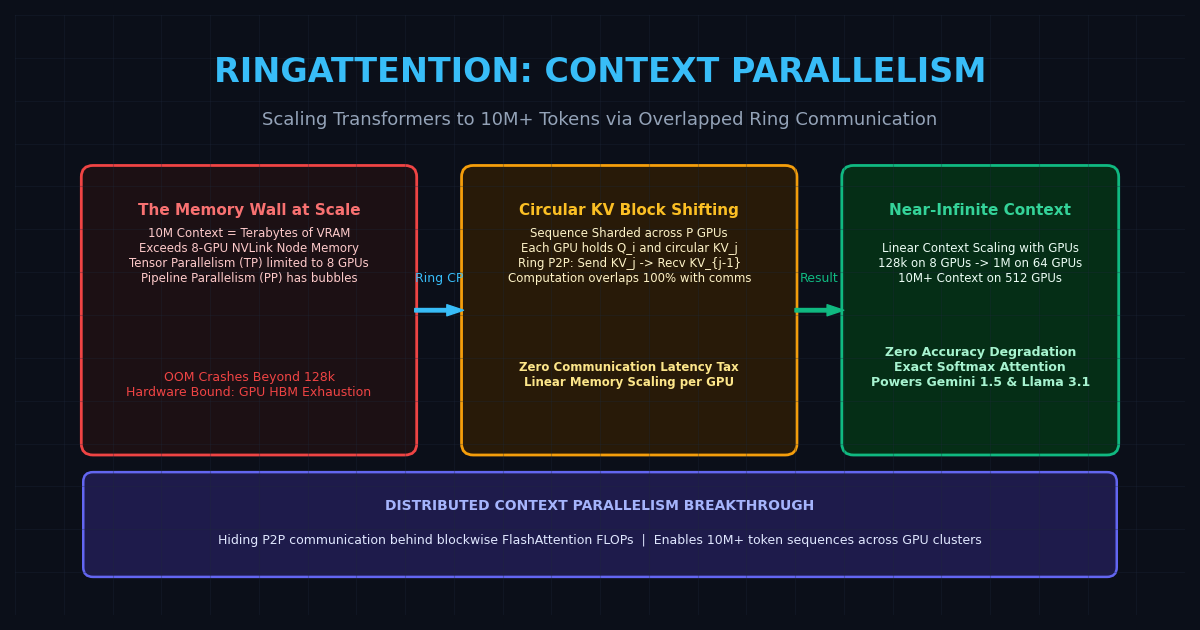
The Problem: The GPU Memory Wall in Million-Token Sequence Processing
Modern generative AI applications increasingly demand massive sequence contexts:
- Ingesting multi-thousand-page codebases and legal contracts for unified repository reasoning.
- Processing multi-hour audio, raw genomic sequences, or multi-gigabyte data dumps in autonomous pipelines like AiFetchly.
- Extending foundation model reasoning across complex multi-step execution traces without losing historical context.
However, standard self-attention mechanisms face an insurmountable physical barrier: the GPU Memory Wall.
1. The Quadratic and Linear Memory Explosion
For an input sequence of length $N$, standard self-attention requires:
- Quadratic Attention Matrix: Materializing the full attention logits matrix $\mathbf{S} = \mathbf{Q} \mathbf{K}^T$ requires $O(N^2)$ memory. While memory-efficient kernels like FlashAttention-2/3 tile computation inside high-speed GPU Shared Memory (SRAM) to avoid writing this matrix to High Bandwidth Memory (HBM), the Key and Value activations still scale linearly $O(N)$.
- Activation Footprint: At sequence lengths of 1 million to 10 million tokens, storing the Key-Value (KV) activations across all layers of a 70B foundation model consumes hundreds of gigabytes to terabytes of VRAM. A single 80 GB NVIDIA H100 or 141 GB H200 GPU crashes with an Out-of-Memory (OOM) error before completing a single forward pass.
2. Why Conventional Parallelism Fails for Long Context
Distributed training and inference historically relied on three standard paradigms, none of which solve sequence-dimension scaling:
- Data Parallelism (DP / FSDP / ZeRO): Shards the model weights and divides batch size across nodes. However, DP assumes that at least one full sequence fits within the memory of a single device (or single tensor-parallel group). If a single sequence exceeds device capacity, DP cannot execute.
- Tensor Parallelism (TP / Megatron-LM): Shards attention heads and Feed-Forward Network (FFN) hidden dimensions across GPUs. TP requires high-frequency
All-Reducecommunications on every attention and MLP layer. Consequently, TP is physically constrained to GPUs within a single NVLink server node (typically 8 GPUs, totaling 640 GB HBM). Beyond 8 GPUs, cross-node PCIe/Ethernet latency destroys throughput. A 10M-token sequence far exceeds the memory envelope of an 8-GPU node. - Pipeline Parallelism (PP): Partitions model layers sequentially across nodes. While PP accommodates large model parameters, it does not reduce activation memory per layer. The intermediate activations of a 10M sequence still saturate device memory, while pipeline bubbles cause severe GPU underutilization.
Scaling sequence context to 1M–10M+ tokens requires a fundamentally new axis of distribution: Context Parallelism.
The Solution: RingAttention and Blockwise Context Parallelism
Introduced by researchers from UC Berkeley (Hao Liu, Matei Zaharia, and Pieter Abbeel in 2023/2024), RingAttention resolves the memory wall by sharding the sequence along the token dimension across a ring of distributed GPUs.
Instead of requiring each device to hold the entire sequence context, RingAttention distributes tokens so that each GPU processes only a small slice of length $B = N / P$, where $P$ is the number of GPUs in the ring.
The Ring Topology Protocol
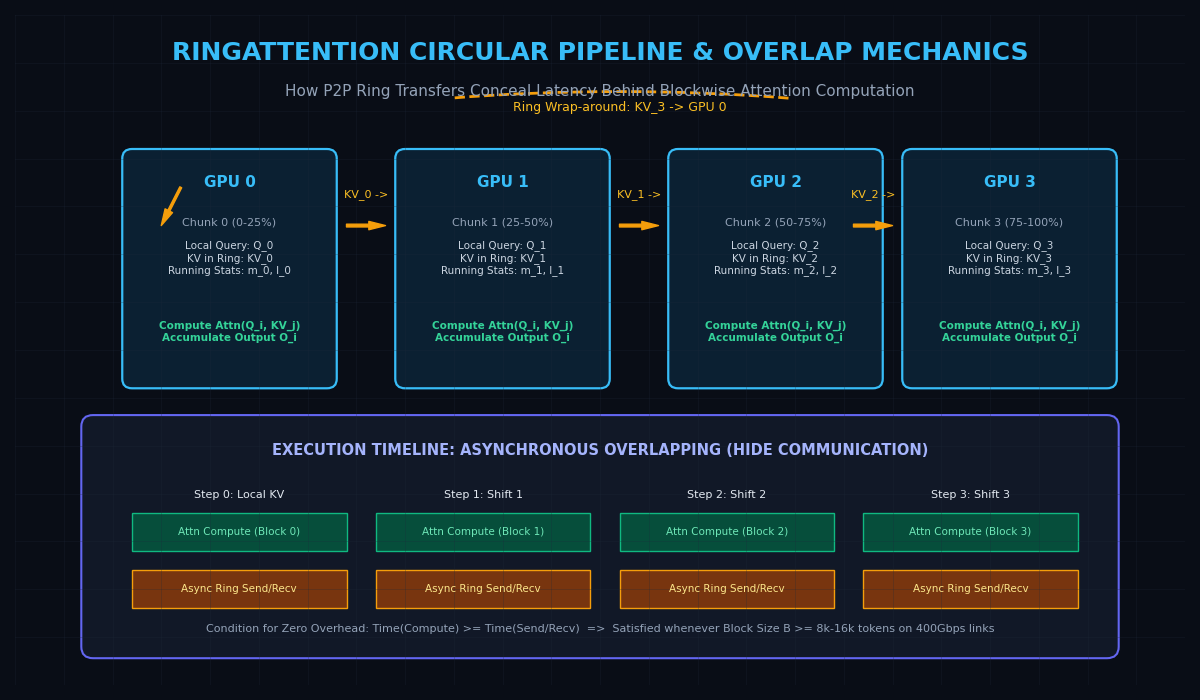
Consider $P$ distributed GPUs configured in a logical unidirectional ring:
$$\text{GPU}_0 \longrightarrow \text{GPU}_1 \longrightarrow \text{GPU}2 \longrightarrow \dots \longrightarrow \text{GPU}{P-1} \longrightarrow \text{GPU}_0$$
- Local Sequence Sharding: The total sequence of $N$ tokens is partitioned into $P$ contiguous blocks of size $B = N / P$. Device $i$ initializes with its local query block $\mathbf{Q}_i$, key block $\mathbf{K}_i$, and value block $\mathbf{V}_i$.
- Blockwise Online Softmax: Each device $i$ keeps its local query chunk $\mathbf{Q}_i$ fixed in memory throughout the entire layer computation. However, the Key and Value blocks circulate around the ring.
- Pipelined Ring Communication: While device $i$ computes blockwise attention between its stationary $\mathbf{Q}i$ and the current key-value block $\mathbf{KV}j$, it asynchronously transmits $\mathbf{KV}j$ to its downstream neighbor $\text{GPU}{(i+1) \pmod P}$ while simultaneously receiving the next block $\mathbf{KV}{(j-1) \pmod P}$ from its upstream neighbor $\text{GPU}{(i-1) \pmod P}$.
- Exact Attention Output: After $P$ communication steps, every query block $\mathbf{Q}_i$ has interacted with every key-value block in the sequence. The accumulated output vector $\mathbf{O}_i$ matches standard full self-attention mathematically to numerical precision.
Key Architectural Mechanics of RingAttention
The breakthrough capability of RingAttention lies in its ability to eliminate communication overhead entirely by overlapping peer-to-peer (P2P) transfers with GPU Tensor Core operations.
1. Incremental Online Softmax Accumulation
Standard attention calculates:
$$\mathbf{O} = \text{softmax}\left(\frac{\mathbf{Q} \mathbf{K}^T}{\sqrt{d}}\right) \mathbf{V}$$
In RingAttention, GPU $i$ cannot evaluate the global softmax denominator upfront because it only sees one Key-Value block at a time. To overcome this, RingAttention leverages the Online Softmax algorithm (the foundational mathematical principle behind FlashAttention):
For each block iteration $k \in {0, \dots, P-1}$, let the active Key and Value blocks on GPU $i$ be $\mathbf{K}{(k)}$ and $\mathbf{V}{(k)}$.
- Compute local logits block: $$\mathbf{S}_{(k)} = \frac{\mathbf{Q}i \mathbf{K}{(k)}^T}{\sqrt{d}}$$
- Compute local row-wise maximum: $$\tilde{m}{(k)} = \text{rowmax}(\mathbf{S}{(k)})$$
- Update running global maximum: $$m_i^{\text{new}} = \max(m_i^{\text{prev}}, \tilde{m}_{(k)})$$
- Compute local unnormalized exponent sum: $$\tilde{l}{(k)} = \text{rowsum}\left(e^{\mathbf{S}{(k)} - m_i^{\text{new}}}\right)$$
- Update running normalizer: $$l_i^{\text{new}} = l_i^{\text{prev}} \cdot e^{m_i^{\text{prev}} - m_i^{\text{new}}} + \tilde{l}_{(k)}$$
- Rescale and accumulate the output representation: $$\mathbf{O}i^{\text{new}} = \mathbf{O}i^{\text{prev}} \cdot \left(\frac{l_i^{\text{prev}} \cdot e^{m_i^{\text{prev}} - m_i^{\text{new}}}}{l_i^{\text{new}}}\right) + \frac{e^{\mathbf{S}{(k)} - m_i^{\text{new}}}}{l_i^{\text{new}}} \mathbf{V}{(k)}$$
Because each GPU maintains only the running scalars $m_i \in \mathbb{R}^B$ and $l_i \in \mathbb{R}^B$, memory consumption per GPU remains strictly proportional to the block size $B = N / P$, completely independent of the total sequence length $N$.
2. Zero-Overhead Communication Overlap
In standard distributed training, collective operations like All-Reduce force GPUs to halt computation until network synchronizations complete.
RingAttention utilizes non-blocking point-to-point ring primitives (NCCL P2P via send / recv):
- Data Transmitted per Step: Sending Key and Value blocks of size $B \times d$ in 16-bit precision requires: $$\text{Bytes Transferred} = 2 \times 2 \times B \times d = 4 B d \text{ bytes}$$
- Computation Executed per Step: Computing block attention between $\mathbf{Q}i \in \mathbb{R}^{B \times d}$ and $\mathbf{K}{(k)} \in \mathbb{R}^{B \times d}$, followed by projection with $\mathbf{V}_{(k)}$, requires: $$\text{FLOPs} = 4 B^2 d \text{ floating-point operations}$$
The ratio of computation to communication is:
$$\frac{\text{Computation FLOPs}}{\text{Communication Bytes}} = \frac{4 B^2 d}{4 B d} = B$$
As long as the per-GPU chunk size $B$ satisfies:
$$B \ge \frac{\text{GPU Compute Throughput (FLOPs/sec)}}{\text{Interconnect Bandwidth (Bytes/sec)}}$$
the time required to transfer the Key-Value block over the network is strictly less than the time required for the GPU Tensor Cores to compute attention on that block.
On modern AI superclusters equipped with NVIDIA H100 SXM GPUs (989 TFLOPs FP16 Tensor Core throughput) and 400 Gbps (50 GB/s) InfiniBand interconnects:
$$B_{\text{threshold}} \approx \frac{989 \times 10^{12}}{50 \times 10^9} \approx 19,780 \text{ tokens}$$
Whenever the block size $B$ exceeds ~16,000–20,000 tokens (or ~2,000–4,000 tokens within an NVLink node at 900 GB/s), communication latency is 100% hidden behind computation. RingAttention achieves near-perfect linear scaling efficiency with zero communication tax.
Causal Masking: Striped and Zig-Zag RingAttention
For bidirectional encoders (such as embedding models or Vision Transformers), all tokens attend to all other tokens, yielding identical computational loads across all ring positions.
However, autoregressive causal language models enforce a lower-triangular causal mask: token $t$ can only attend to tokens $j \le t$.
The Load Imbalance Challenge
If tokens are assigned naively to GPUs in sequential order:
- $\text{GPU}_0$ (holding tokens $0$ to $N/P$) only needs to attend to its own tokens. It computes for 1 step and sits completely idle for the remaining $P-1$ ring shifts.
- $\text{GPU}_{P-1}$ (holding the final tokens) must attend to all $P$ blocks.
This naive partitioning wastes 50% of aggregate cluster FLOPs, destroying scaling efficiency.
The Solution: Striped and Zig-Zag Partitioning
To restore perfect 50% theoretical efficiency across all devices, RingAttention employs Zig-Zag or Striped Attention:
| Technique | Token Assignment Strategy | Load Balancing Efficiency | Primary Advantage |
|---|---|---|---|
| Naive Sequential | Block $i$ assigned strictly to $\text{GPU}_i$ | 50% idle time (severe imbalance) | Simple implementation |
| Striped Attention | Round-robin token assignment ($t \pmod P = i$) | 100% compute balance | Eliminates idle bubbles completely |
| Zig-Zag RingAttention | Each GPU receives two paired blocks ($i$ and $2P-1-i$) | 100% compute balance | Preserves block locality for FlashAttention kernels |
By pairing an early sequence chunk with a late sequence chunk on each physical GPU, every device computes an identical number of causal blocks over the course of the ring circulation, ensuring balanced execution.
Reference Implementation: Minimal RingAttention in PyTorch
Below is a self-contained PyTorch implementation demonstrating asynchronous ring peer-to-peer communication overlapped with online softmax attention updates.
import torch
import torch.distributed as dist
from typing import Tuple

class RingAttentionBlock(torch.nn.Module):
    """
    Educational reference implementation of RingAttention.
    Shards sequence across ring ranks and overlaps P2P transfers with computation.
    """
    def __init__(self, dim: int = 1024, num_heads: int = 16):
        super().__init__()
        self.dim = dim
        self.num_heads = num_heads
        self.head_dim = dim // num_heads
        self.scale = 1.0 / (self.head_dim ** 0.5)

    def forward(
        self,
        q_local: torch.Tensor, # [B, num_heads, chunk_len, head_dim] Local Query chunk
        k_local: torch.Tensor, # [B, num_heads, chunk_len, head_dim] Local Key chunk
        v_local: torch.Tensor, # [B, num_heads, chunk_len, head_dim] Local Value chunk
        rank: int,
        world_size: int
    ) -> torch.Tensor:
        """
        Executes circular RingAttention across world_size GPU ranks.
        """
        device = q_local.device
        chunk_len = q_local.shape[2]

        # Running online softmax accumulators
        out = torch.zeros_like(q_local)
        max_scores = torch.full((q_local.shape[0], self.num_heads, chunk_len, 1), -float('inf'), device=device)
        sum_exp = torch.zeros((q_local.shape[0], self.num_heads, chunk_len, 1), device=device)

        # Buffers for current computation and incoming network transfer
        curr_k, curr_v = k_local, v_local
        recv_k = torch.empty_like(k_local)
        recv_v = torch.empty_like(v_local)

        next_rank = (rank + 1) % world_size
        prev_rank = (rank - 1 + world_size) % world_size

        for step in range(world_size):
            # 1. Initiate asynchronous ring transfer for the next step (if not on last step)
            reqs = []
            if step < world_size - 1:
                # Send current KV to next rank, receive incoming KV from previous rank
                req_k_send = dist.isend(curr_k.contiguous(), dst=next_rank)
                req_k_recv = dist.irecv(recv_k, src=prev_rank)
                req_v_send = dist.isend(curr_v.contiguous(), dst=next_rank)
                req_v_recv = dist.irecv(recv_v, src=prev_rank)
                reqs.extend([req_k_send, req_k_recv, req_v_send, req_v_recv])

            # 2. Compute local block attention on GPU Tensor Cores (Overlapped with network transfer)
            # Scores: [B, num_heads, chunk_len, chunk_len]
            scores = torch.matmul(q_local, curr_k.transpose(-1, -2)) * self.scale

            # Online Softmax update
            block_max = torch.max(scores, dim=-1, keepdim=True)[0]
            new_max = torch.maximum(max_scores, block_max)

            exp_scores = torch.exp(scores - new_max)
            block_sum = torch.sum(exp_scores, dim=-1, keepdim=True)

            rescale_factor = torch.exp(max_scores - new_max)
            new_sum = sum_exp * rescale_factor + block_sum

            # Update running output
            out = out * rescale_factor + torch.matmul(exp_scores, curr_v)

            max_scores = new_max
            sum_exp = new_sum

            # 3. Await asynchronous communication before next iteration
            if step < world_size - 1:
                for req in reqs:
                    req.wait()
                # Swap buffers for next iteration
                curr_k, recv_k = recv_k, curr_k
                curr_v, recv_v = recv_v, curr_v

        # Final normalization by total accumulated partition sum
        out = out / sum_exp
        return out


# Verification Script
if __name__ == "__main__":
    print("--- RingAttention Architecture Module ---")
    print("Mathematical formulation: Online Softmax over circulating KV blocks.")
print("Linear sequence scaling achieved: O(N/P) memory per device across P GPUs.") Production Scaling and Industry Impact
The adoption of RingAttention has permanently altered the infrastructure blueprint for long-context language modeling:
1. Powers Frontier Multi-Million Token Models
RingAttention and its production variants (such as Megatron-LM Context Parallelism and Flash-Ring) serve as the underlying distribution engine for frontier multi-million token architectures:
- Gemini 1.5 Pro & Flash: Scaled to 1M–2M+ token multimodal contexts using TPU-mesh ring topologies.
- Llama 3.1 & 3.3 (128k context): Meta standardized on 8-way to 16-way Context Parallelism combining FlashAttention-3 and RingAttention to scale pretraining across 16,384 H100 clusters.
- DeepSeek-V3 / R1: Integrates Context Parallelism with Multi-Head Latent Attention (MLA) to train reasoning traces spanning hundreds of thousands of tokens without out-of-memory interruptions.
2. Eliminating the KV Cache Eviction Bottleneck
Before RingAttention, serving long documents forced inference engines to deploy aggressive lossy KV cache eviction (such as sliding windows or H2O attention sinks).
With Context Parallelism deployed during the prefill phase, inference frameworks like vLLM, SGLang, and TensorRT-LLM can distribute incoming 500,000-token prompt prefixes across a ring of worker nodes, completing prefill in parallel without single-GPU memory crashes.
3. Synergies with aiFetchly Autonomous Data Pipelines
For engineers deploying autonomous data gathering and extraction pipelines using AiFetchly, RingAttention-backed foundation models enable unprecedented document comprehension. Rather than chopping massive unstructured web crawls, multi-page financial filings, or dense legal contracts into fragmented chunks, developers can feed the entire raw data stream into a single context window—enabling global semantic extraction, zero retrieval amnesia, and flawless analytical accuracy.