Rig Guide: High-Performance Rust AI Agent Architecture
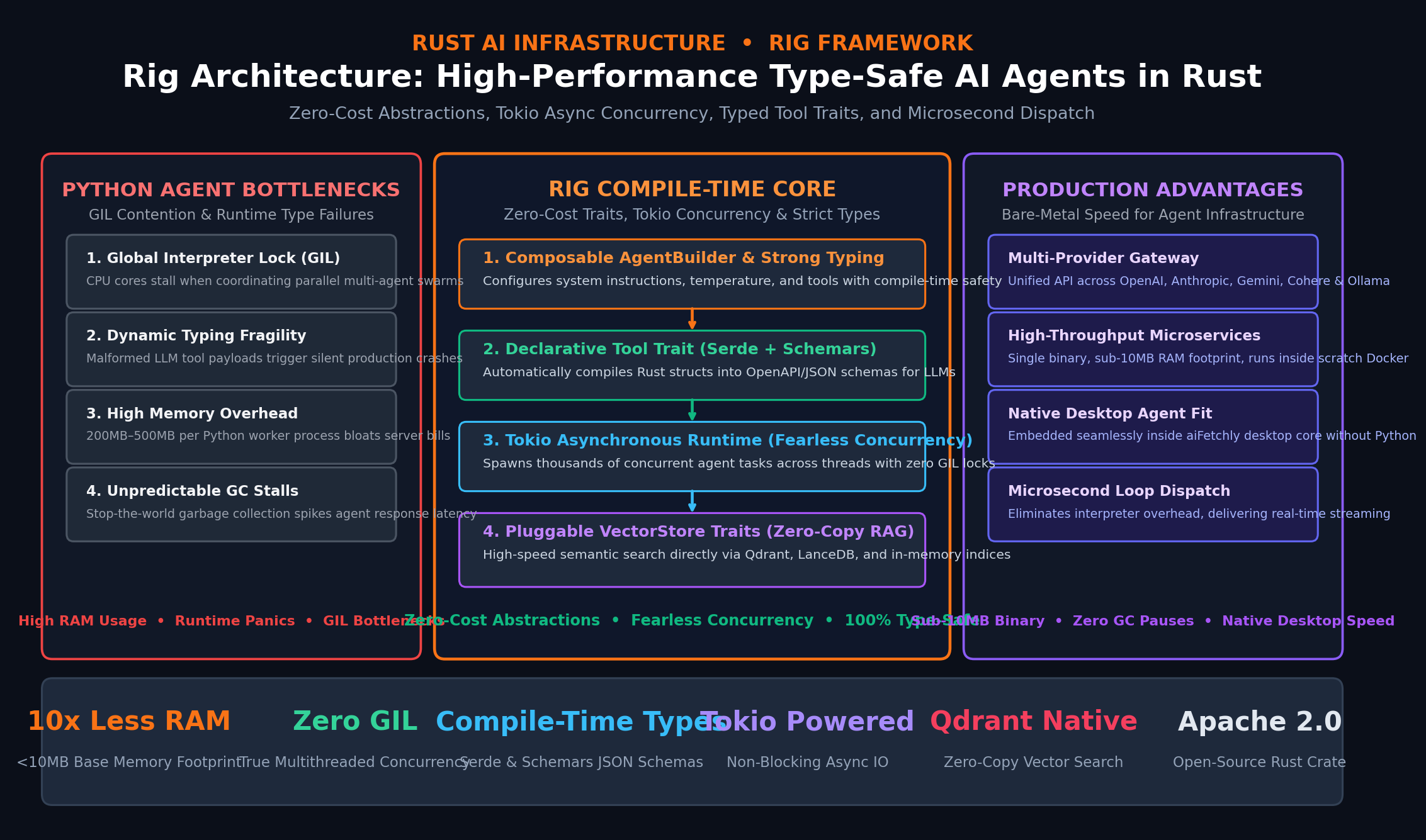
The Problem: The Latency and Concurrency Limits of Python AI Agents
In enterprise automation, real-time desktop intelligence, and high-frequency data extraction pipelines powered by AiFetchly, autonomous AI agents must coordinate complex task lifecycles: parsing multi-page documents, querying vector stores, invoking external APIs, and streaming real-time tokens to end users.
For years, the artificial intelligence industry built agent frameworks almost exclusively in Python (e.g., LangChain, AutoGen, CrewAI). While Python’s dynamic ergonomics make it ideal for exploratory research and notebook prototypes, deploying production multi-agent systems in Python exposes severe systems-level architectural bottlenecks.
The Python Agent Production Bottlenecks:
┌─────────────────────────────────────────────────────────────────┐
│ 1. Global Interpreter Lock (GIL) Contention                     │
│ • CPU threads stall during concurrent agent scheduling          │
│ ❌ Fails on multi-agent swarms requiring parallel local compute  │
├─────────────────────────────────────────────────────────────────┤
│ 2. Dynamic Typing and Silent Runtime Panics                     │
│ • Malformed JSON payloads bypass linting; crash at step 8 of 10 │
│ ❌ Lost progress, broken transactions, and untraceable exceptions│
├─────────────────────────────────────────────────────────────────┤
│ 3. Severe Memory Bloat (200MB–500MB per Process)                │
│ • Heavy interpreter overhead and C-extension bindings           │
│ ❌ Cannot scale to thousands of concurrent edge agent instances │
├─────────────────────────────────────────────────────────────────┤
│ 4. Unpredictable Garbage Collection (GC) Stalls                 │
│ • Stop-the-world pauses interrupt low-latency audio/token streams│
└─────────────────────────────────────────────────────────────────┘
Result: Production agent clusters require massive cloud instances to handle modest concurrent workloads! 1. Global Interpreter Lock (GIL) Contention in Multi-Agent Swarms
Modern agentic architectures increasingly rely on parallel multi-agent coordination:
- A primary supervisor agent decomposes a user request and dispatches five sub-agents concurrently to scrape websites, query databases, and analyze financial spreadsheets.
- In Python, even when utilizing asynchronous event loops (
asyncio), CPU-bound operations (such as regex parsing, string formatting, token counting, and cryptographic hashing) trigger GIL contention. - Threads continuously lock and unlock the Python interpreter, introducing multi-millisecond scheduling delays that throttle high-throughput systems.
2. The Fragility of Dynamic Typing Under Stochastic LLM Outputs
Large Language Models do not emit native programming objects; they emit text streams. When asking an LLM to generate tool parameters:
- First-generation Python frameworks parse JSON into untyped dictionaries (
dict[str, Any]). - If an LLM hallucinates an unexpected property name, formats a float as a string, or drops an optional key, Python raises a runtime
KeyErrororTypeErrormidway through execution. - In long-running autonomous workflows, a type crash in stage 7 of a 10-stage task aborts the entire job, wasting hundreds of seconds and valuable API tokens.
3. Memory Footprint and Container Bloat
A minimal Python runtime bundling asyncio, HTTP networking (httpx), and standard LLM SDKs consumes 200 MB to 500 MB of resident RAM per worker process:
- Deploying microservices that scale to 500 concurrent agent threads requires dozens of gigabytes of RAM simply to maintain the Python runtime environment.
- Container images easily exceed 1 GB to 2 GB, resulting in slow cold-start times on serverless platforms.
The Solution: The Rig Rust Framework
To solve the memory bloat, GIL contention, and runtime type fragility of Python agent frameworks, open-source engineers developed Rig (rig-core), created by 0xPlaygrounds.
Rig is an open-source Rust library designed to bring systems-level engineering discipline to generative AI applications and agentic workflows.
Rig High-Level Architecture Flow:
┌─────────────────────────────────────────────────────────────────┐
│ User Application / Native aiFetchly Desktop Core               │
└─────────────────────────────────────────────────────────────────┘
 │
 ▼
┌─────────────────────────────────────────────────────────────────┐
│ Rig Type-Safe Core (rig-core)                                   │
│ • Composable AgentBuilder with compile-time model binding       │
│ • Declarative Tool trait with Serde & Schemars JSON validation  │
│ • Zero-copy VectorStore traits for embedded RAG (Qdrant, LanceDB)│
└─────────────────────────────────────────────────────────────────┘
 │
 ▼
┌─────────────────────────────────────────────────────────────────┐
│ Tokio Asynchronous Runtime (Fearless Concurrency)               │
│ • Multi-threaded non-blocking IO work-stealing scheduler       │
│ • Thousands of concurrent agent tasks in <20MB resident RAM     │
│ • Microsecond-scale loop dispatch with zero garbage collection  │
└─────────────────────────────────────────────────────────────────┘
 │
 ├──► OpenAI / Anthropic / Gemini Cloud APIs
└──► Local Air-Gapped Ollama / Candle Runtimes The Rust AI Infrastructure Revolution
The modern AI data layer has already converged on Rust:
- High-performance vector engines like Qdrant are written in Rust for deterministic, sub-millisecond retrieval.
- Local inference runtimes (such as Hugging Face Candle and Mistral.rs) are written in pure Rust to bypass Python bindings.
- Rig completes this ecosystem by providing the native orchestration and agent layer in pure Rust, eliminating cross-language FFI overhead.
Comparing Python Agent Frameworks vs. Rig
The table below contrasts Rig against traditional Python-based agent frameworks:
Agent Framework Paradigm Comparison:
┌───────────────────────────┬───────────────────────────────┬───────────────────────────────┐
│ Feature / Dimension       │ Python Agent Frameworks       │ Rig Framework (Rust)          │
├───────────────────────────┼───────────────────────────────┼───────────────────────────────┤
│ Language Runtime          │ CPython (Interpreted, GIL)    │ Rust (Compiled, Native Code)  │
│ Concurrency Engine        │ Asyncio (Single-threaded GIL) │ Tokio (Multithreaded async)   │
│ Memory Footprint          │ 200 MB – 500 MB per worker    │ <10 MB per worker             │
│ Type Verification         │ Runtime validation (Pydantic) │ Compile-time guarantee (Serde)│
│ Garbage Collection        │ Dynamic GC (Stop-the-world)   │ Zero GC (RAII memory safety)  │
│ Tool Definition Contract  │ Decorators / Docstring regex  │ Strongly-typed `Tool` trait   │
│ Binary Deployment         │ Heavy virtualenv + Docker     │ Statically linked single bin  │
│ Dispatch Latency          │ 5 – 25 milliseconds           │ Sub-millisecond (Microseconds)│
└───────────────────────────┴───────────────────────────────┴───────────────────────────────┘ Deep Dive into Rig Architecture & Primitives
Rig structures generative AI workflows through modular, composable Rust traits. Instead of complex object inheritance trees, Rig adheres to idiomatic Rust: composition over inheritance and explicit compile-time contracts.
Rig Modular Architecture Primitives:
Rig Architecture Core
 ├──► AgentBuilder & Agent: Composable fluent builder configuring models & prompts
 ├──► Tool Trait: Declarative interface generating OpenAPI JSON schemas via Schemars
 ├──► VectorStoreIndex: Generic RAG interface for dense vector retrieval
 ├──► Completion & Streaming: Unified traits across OpenAI, Anthropic, Cohere, Ollama
└──► Tokio Runtime Integration: Work-stealing async concurrency without GIL locks 1. The AgentBuilder and Compile-Time Safety
In Rig, creating an agent utilizes a fluent builder pattern. The compiler enforces that required components (such as the underlying completion model and prompt context) are configured before the agent can be instantiated:
use rig::providers::openai;

// Build a typed agent with compile-time verified model bindings
let openai_client = openai::Client::new(&api_key);
let researcher_agent = openai_client
    .agent("gpt-4o")
    .preamble("You are a high-speed systems research agent.")
    .temperature(0.2)
    .tool(DatabaseQueryTool)
.build(); If a developer attempts to attach an incompatible tool or omits a required parameter, the Rust compiler rejects the code at compile time, completely eliminating runtime initialization crashes.
2. The Tool Trait: Compile-Time JSON Schema Generation
In Rig, tools are defined by implementing the Tool trait:
pub trait Tool: Send + Sync {
    const NAME: &'static str;
    type Error: std::error::Error + Send + Sync + 'static;
    type Args: serde::de::DeserializeOwned + schemars::JsonSchema + Send;
    type Output: serde::Serialize + Send;

    async fn definition(&self, prompt: String) -> ToolDefinition;
    async fn call(&self, args: Self::Args) -> Result<Self::Output, Self::Error>;
} - Compile-Time Schema Derivation: By deriving
schemars::JsonSchemaon the argument struct, Rig automatically synthesizes the full JSON-Schema definition sent to the LLM during capability negotiation. - Type-Safe Serialization: Incoming JSON strings from the LLM are directly deserialized into strongly typed Rust structs via
serde. If the model emits malformed arguments, Serde generates an immediate, structured error that the agent loop can feed back to the LLM for self-correction. - Thread Safety (
Send + Sync): The compiler guarantees that tools can be safely shared across Tokio worker threads without data races.
3. Native Tokio Async Concurrency
Rig is built from the ground up on Tokio, the industry-standard asynchronous runtime for Rust:
- Work-Stealing Scheduler: Multi-agent workflows distribute tasks across CPU cores. While one agent awaits network responses from an external web scraper, the thread executes token validation or vector calculations for another agent.
- Low Resource Saturation: Spawning a Tokio task costs approximately 300 bytes of memory, compared to megabytes for an operating system thread or hundreds of kilobytes for a Python coroutine stack. A single $20/month cloud instance running Rig can comfortably manage tens of thousands of concurrent agent sessions.
4. Pluggable VectorStoreIndex for Embedded RAG
Rig decouples vector retrieval through the VectorStoreIndex trait:
- Supports native Rust clients for high-performance vector engines like Qdrant and LanceDB.
- Enables zero-copy vector lookups: candidate chunks are scored and passed directly into the agent’s context window without intermediate JSON serialization roundtrips.
Hands-On Implementation: Building a Production Agent in Rust
Let’s build a complete, production-ready research agent in Rust using Rig that queries financial metrics and performs verified calculations.
1. Project Setup (Cargo.toml)
Create a new Rust binary project and add the necessary dependencies:
[package]
name = "rig-production-agent"
version = "0.1.0"
edition = "2021"

[dependencies]
rig-core = "0.42.0"
tokio = { version = "1.38", features = ["full"] }
serde = { version = "1.0", features = ["derive"] }
serde_json = "1.0"
schemars = "0.8"
anyhow = "1.0" 2. Complete Agent Implementation (src/main.rs)
use rig::completion::Prompt;
use rig::providers::openai;
use rig::tool::Tool;
use schemars::JsonSchema;
use serde::{Deserialize, Serialize};

// 1. Define Typed Tool Arguments using Serde and Schemars
#[derive(Deserialize, JsonSchema)]
struct TickerQueryArgs {
    #[schemars(description = "The stock market ticker symbol, e.g., AAPL or MSFT")]
    ticker: String,
}

#[derive(Serialize)]
struct TickerFinancials {
    ticker: String,
    market_cap_billions: f64,
    pe_ratio: f64,
    revenue_growth_yoy: f64,
}

// 2. Define the Custom Tool Struct
#[derive(Deserialize, Serialize)]
struct FinancialLookupTool;

impl Tool for FinancialLookupTool {
    const NAME: &'static str = "financial_lookup";
    type Error = std::io::Error;
    type Args = TickerQueryArgs;
    type Output = TickerFinancials;

    async fn definition(&self, _prompt: String) -> rig::tool::ToolDefinition {
        rig::tool::ToolDefinition {
            name: Self::NAME.to_string(),
            description: "Fetches corporate balance sheet metrics and financial ratios for a given ticker.".to_string(),
            parameters: schemars::schema_for!(TickerQueryArgs),
        }
    }

    async fn call(&self, args: Self::Args) -> Result<Self::Output, Self::Error> {
        println!(">>> [Rust Tool Call] Fetching data for ticker: {}", args.ticker);

        // Return deterministic typed metrics
        Ok(TickerFinancials {
            ticker: args.ticker.to_uppercase(),
            market_cap_billions: 3420.5,
            pe_ratio: 32.4,
            revenue_growth_yoy: 0.142,
        })
    }
}

// 3. Application Entry Point
#[tokio::main]
async fn main() -> anyhow::Result<()> {
    // Read API key from environment
    let api_key = std::env::var("OPENAI_API_KEY")
        .expect("OPENAI_API_KEY environment variable must be set");

    let openai_client = openai::Client::new(&api_key);

    println!("Initializing Rig Type-Safe Research Agent...");

    // 4. Construct Agent with Builder Pattern
    let financial_agent = openai_client
        .agent("gpt-4o")
        .preamble("You are a financial intelligence assistant. When asked about company valuations, always use the financial_lookup tool to retrieve verified metrics before synthesizing your answer.")
        .tool(FinancialLookupTool)
        .temperature(0.0)
        .build();

    // 5. Execute Prompt with Tool Calling
    let user_query = "What is the valuation and YoY revenue growth for AAPL?";
    println!("\nUser Query: {}", user_query);

    let response = financial_agent.prompt(user_query).await?;

    println!("\n--- Agent Synthesis ---");
    println!("{}", response);

    Ok(())
} 3. Compilation and Execution
Run the agent with Cargo:
export OPENAI_API_KEY="sk-..."
cargo run --release Notice the operational differences:
- Instant Cold Start: The binary initializes in under 5 milliseconds, compared to 800ms+ for a Python process loading heavy dependencies.
- Static Linking: Compiling with
--releaseproduces a self-contained, standalone executable that can be deployed to a minimal Alpine Linux or scratch container without installing Python, OpenSSL, or virtual environments.
Production Architecture & Best Practices for aiFetchly
Integrating Rig into enterprise data collection and desktop copilot platforms like AiFetchly provides a high-throughput systems foundation for mission-critical automation.
aiFetchly Native Rust Agent Pipeline:
┌─────────────────────────────────────────────────────────────────┐
│ aiFetchly Desktop Application                                   │
└─────────────────────────────────────────────────────────────────┘
 │ (Sub-millisecond IPC)
 ▼
┌─────────────────────────────────────────────────────────────────┐
│ Rig Rust Agent Daemon (Native Binary Core)                      │
│ ├──► Tokio Task Pool (Manages 1,000+ concurrent worker streams) │
│ ├──► Compile-Time Tool Validation (Serde / Schemars)            │
│ └──► FastMCP Bridge (Invokes external Python/Node MCP servers)   │
└─────────────────────────────────────────────────────────────────┘
 │
 ├──► Qdrant Vector Engine (Sub-millisecond Dense Retrieval)
└──► Local Ollama / Remote Cloud Inference Gateway 1. Bridging Rig with FastMCP Servers
While Rig executes core reasoning in pure Rust, enterprise teams often have existing tools written in Python using FastMCP:
- Use Rig to orchestrate the high-concurrency client state machine.
- When an external capability is needed, Rig dispatches standard JSON-RPC 2.0 frames over
stdiopipes to local FastMCP worker subprocesses. - This gives developers the best of both worlds: bare-metal Rust speed for agent loops and rapid Python prototyping for domain tools.
2. High-Throughput RAG with Qdrant Native Rust Client
In RAG pipelines, avoid HTTP REST overhead by connecting Rig directly to Qdrant using its native gRPC Rust client (qdrant-client):
- Eliminates JSON serialization bottlenecks between the vector store and the agent runtime.
- Achieves sub-3ms end-to-end vector search and context assembly, keeping Time-to-First-Token (TTFT) exceptionally low.
3. Deployment in Scratch Containers (<15MB Docker Images)
Because Rust compiles to native machine code:
- Build the Rig binary using the
x86_64-unknown-linux-musltarget. - Package the executable inside an empty
FROM scratchDocker image. - The resulting container image is under 15 megabytes, has zero CVE attack surface from unpatched operating system libraries, and starts up in milliseconds on Kubernetes or AWS ECS.
Summary: The Systems Engineering Evolution of AI Agents
As autonomous AI systems transition from experimental demos into production infrastructure, software engineering principles must shift from dynamic scripts to robust systems programming.
By combining Rust’s zero-cost abstractions, fearless multithreaded concurrency on Tokio, compile-time schema validation, and sub-10MB memory footprints, Rig eliminates the GIL contention, runtime type panics, and resource bloat inherent in Python agent frameworks. For autonomous research copilots, high-concurrency data harvesting pipelines, and edge-native applications powered by AiFetchly, Rig establishes the architectural benchmark for high-performance agentic engineering.