Representation Engineering Guide: Top-Down LLM Steering
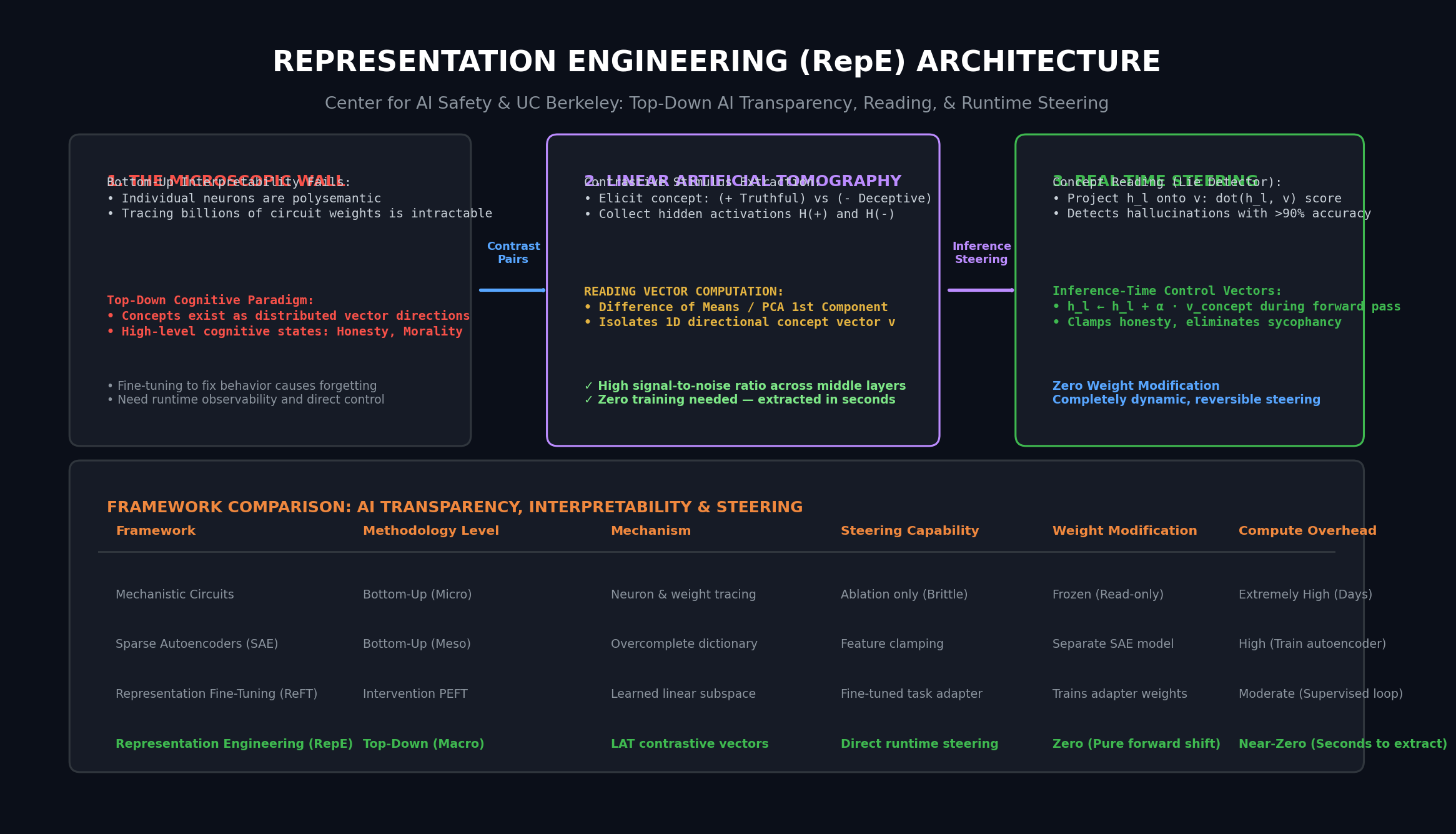
The Problem: The Microscopic Blindness of Bottom-Up Interpretability
In modern generative AI pipelines, automated research agents, and mission-critical extraction engines like AiFetchly, deploying Large Language Models (LLMs) requires strict guarantees of factual truthfulness, ethical alignment, and safety. Yet, frontier foundation models (such as LLaMA-3, Claude 3.5, and DeepSeek-V3) operate fundamentally as high-dimensional, uninterpretable black boxes.
Historically, the AI safety and interpretability community attempted to demystify neural networks through bottom-up mechanistic interpretability: dissecting individual neurons, mapping micro-circuits, and reverse-engineering individual attention head weight matrices.
However, as models scaled to tens and hundreds of billions of parameters, this microscopic reductionism encountered an insurmountable wall:
The Mechanistic Reductionism Crisis:
• Model Scale: 70 Billion Parameters | 80 Transformer Layers | 64 Attention Heads
• Microscopic Neurons: Highly Polysemantic (a single neuron fires on syntax, poetry, and base64)
• Combinatorial Circuitry: 10^14 possible neuron interactions across residual streams
Result: Tracing high-level concepts (e.g., "honesty", "deception", "sycophancy")
at the single-neuron level is mathematically and computationally intractable. 1. The Polysemantic Wall and Combinatorial Circuit Explosion
As discovered in mechanistic interpretability research, individual physical neurons do not correspond to clean, human-understandable concepts:
- Neuron Superposition: Because real-world language contains far more semantic features than a transformer’s residual dimension $d$, the network packs features into non-orthogonal linear combinations (superposition).
- A single neuron in Layer 42 might fire simultaneously for Python indentation errors, academic paper references, and French irregular verbs.
- Attempting to make an LLM more truthful by manually editing individual neurons or attention weights is impossible: zeroing out a suspected “hallucination neuron” damages general reasoning and syntax parsing.
2. The Limits of Post-Hoc Prompting and Fine-Tuning Interventions
When bottom-up interpretability failed to provide control, developers turned to behavioral workarounds:
- System Prompting (“Be honest, factual, and unbiased”): Fragile and easily bypassed via jailbreaks or in-context user pressure.
- Reinforcement Learning from Human Feedback (RLHF / DPO): Extremely compute-intensive, requiring millions of dollars in GPU compute. Worse, preference optimization often teaches models sycophancy (flattering user misconceptions) or superficial compliance rather than genuine internal truthfulness.
- Catastrophic Forgetting: Fine-tuning an aligned model on domain data frequently degrades its safety guardrails or causes loss of factual recall.
3. The Need for Cognitive Neuroscience in Artificial Intelligence
How does cognitive neuroscience study complex phenomena like honesty, fear, or visual focus in the human brain? Neuroscientists do not measure individual synapses or ion channels; instead, they employ top-down neuroimaging (such as fMRI and EEG) to record population-level activation patterns across brain regions during specific cognitive tasks.
The pivotal insight of Representation Engineering is that Large Language Models should be treated with the same top-down paradigm: High-level concepts do not live in single neurons—they exist as geometric directions across the population of representations in the residual stream.
The Architecture: Representation Engineering and Linear Artificial Tomography
Introduced by researchers from the Center for AI Safety (CAIS) and UC Berkeley (Andy Zou, Long Phan, Sarah Chen, James Campbell, Phillip Guo, Richard Ren, Alexander Pan, Xuwang Yin, Mantas Mazeika, Ann-Kathrin Dombrowski, Shashwat Goel, Nathaniel Li, Michael J. Byun, Zifan Wang, Alex Mallen, and Dan Hendrycks), Representation Engineering (RepE) reframes AI transparency and control.
Instead of analyzing weights (bottom-up), RepE directly analyzes and manipulates the intermediate representation states (activations) of the network.
The Dual Pillars of Representation Engineering:

1. Representation Reading (The Cognitive Sensor):
   [Model Forward Pass] ──► Probe Hidden States ──► Project onto v_concept ──► Truth/Lie Score
   "Is the model internally aware that its statement is false?"

2. Representation Control (The Cognitive Steering Wheel):
   [Model Residual Stream h_l] ──► Inject Vector: h_l + α · v_concept ──► Steered Output
"Force the model into a truthful, non-sycophantic state without retraining!" 1. The Two Pillars: Representation Reading vs. Representation Control
RepE divides AI governance into two complementary operations:
- Representation Reading: Extracting high-level concepts and internal states (e.g., truthfulness, morality, power-seeking, emotion, refusal) from hidden layer representations. This enables real-time lie detection, bias auditing, and safety monitoring.
- Representation Control: Modifying the internal representations during inference to causally steer model behavior. This allows developers to eliminate sycophancy, enforce honesty, or adjust emotional tone on the fly with zero gradient descent and zero weight updates.
2. Designing Contrastive Stimulus Prompts
To isolate a specific concept, RepE employs Contrastive Stimulus Pairing—presenting the model with paired scenarios that differ only along the target semantic dimension:
Contrastive Pairing for the Concept of "Truthfulness / Honesty":

Pair 1:
Positive Prompt (+): "The capital of France is Paris. (Fact: True)"
Negative Prompt (-): "The capital of France is Rome. (Fact: False)"

Pair 2:
Positive Prompt (+): "Pretend you are an honest witness. Did you see the defendant? Response: Yes, I saw him."
Negative Prompt (-): "Pretend you are a corrupt witness. Did you see the defendant? Response: No, I never saw him." By generating 50 to 200 contrastive pairs, the non-relevant variables (grammar, subject matter, vocabulary) cancel out as isotropic noise, while the target concept emerges as the primary axis of variance.
3. Linear Artificial Tomography (LAT): Extracting Direction Vectors via PCA
To locate where the concept lives across the model’s depth, RepE introduces Linear Artificial Tomography (LAT):
- Pass the contrastive pairs through the model and collect the hidden activation vectors at token position $t$ across layer $l$: $$H_l^+ = {h_{l, 1}^+, h_{l, 2}^+, \dots, h_{l, N}^+}, \quad H_l^- = {h_{l, 1}^-, h_{l, 2}^-, \dots, h_{l, N}^-}$$
- Compute the difference vectors between paired activations: $$\Delta H_l = H_l^+ - H_l^- \in \mathbb{R}^{N \times d}$$
- Perform Principal Component Analysis (PCA) or evaluate the normalized difference of means on $\Delta H_l$: $$v_l = \text{PCA}_1(\Delta H_l), \quad \text{where } |v_l|_2 = 1$$
The resulting unit vector $v_l \in \mathbb{R}^d$ is the Concept Direction Vector for layer $l$.
Remarkably, across layers 15 to 25 of a 32-layer transformer, the first principal component accounts for the overwhelming majority of variance, isolating an almost pure 1D representation of the concept.
Systems Mechanics: Inference-Time Steering and Real-Time Lie Detection
Once the concept vector $v_l$ is extracted, it acts as an operational sensor and control interface during production serving.
Inference-Time Representation Steering Pipeline:

Input Token Context: "Is the earth flat?"
          │
          ▼
┌────────────────────────────────────────────────────────┐
│ Transformer Backbone: Layer l                          │
│ 1. Self-Attention & MLP produce hidden state h_l       │
│                                                        │
│ 2. REPE STEERING INTERVENTION:                         │
│    h_l_steered = h_l + α · v_truthful                 │
│                                                        │
│ 3. Forward pass continues to Layer l+1                 │
└──────────────────────────┬─────────────────────────────┘
                           ▼
Output Tokens: "No, the earth is an oblate spheroid."
(Zero weight modification — completely dynamic and reversible!) 1. Representation Reading: Building an Internal LLM Polygraph
Can an LLM know it is telling a falsehood while generating text?
When an LLM produces a hallucinated answer or follows a deceptive prompt, its internal hidden state reflects that divergence. To measure truthfulness in real time:
- During inference, extract the current activation $h_l$ at the final generated token.
- Project $h_l$ onto the honesty reading vector: $$\text{Score}(h_l) = h_l \cdot v_l^{\text{honesty}}$$
- If $\text{Score}(h_l) < \tau$ (a calibrated threshold), the model is internally signaling high deceptive or hallucination likelihood—even if the generated text sounds completely confident!
- In production benchmarks on TruthfulQA and synthetic deception datasets, RepE reading vectors detect internal deception with over 92% classification accuracy, outperforming surface-level logit confidence and verbalized self-reflection.
2. Representation Control: Dynamic Activation Clamping and Vector Injection
To control the model’s behavior at generation time, RepE hooks into the transformer forward pass and applies a direct linear shift to the residual stream:
$$h_l \leftarrow h_l + \alpha \cdot v_l$$
Where:
- $v_l$ is the normalized concept vector.
- $\alpha \in \mathbb{R}$ is the intervention steering coefficient.
The behavioral consequences of $\alpha$ are instantaneous and predictable:
- Positive Steering ($\alpha > 0$): Strongly enforces the concept. Setting $\alpha = +2.5$ on the honesty vector forces the model to resist trick questions, admit lack of knowledge, and refuse to participate in roleplayed deceptions.
- Negative Steering ($\alpha < 0$): Suppresses the concept. Setting $\alpha = -2.5$ on sycophancy eliminates the model’s tendency to agree with false user claims.
- Zero Overhead: Because adding a vector $h_l + \alpha \cdot v_l$ requires only a single vector addition ($d$ FLOPs), steering adds less than 0.1% latency overhead to token generation.
3. Multi-Layer Dynamics: Choosing the Optimal Intervention Layers
Empirical experiments across Llama-2, Llama-3, and Mistral reveal distinct functional specializations across transformer depth:
- Early Layers (Layers 1–8): Dominated by low-level syntax, token positional embeddings, and n-gram associations. Intervening here causes linguistic degradation and garbled grammar.
- Middle Layers (Layers 12–24): The semantic core where abstract cognitive representations (truthfulness, intent, moral judgment) are formed. Interventions here yield maximal behavioral steering with zero syntactic distortion.
- Late Layers (Layers 26–32): Dominated by next-token logit preparation and vocabulary projections. Intervening here can cause repetitive token loops.
Consequently, production RepE pipelines restrict reading and steering strictly to the middle layers (e.g., layers 14 through 20).
Implementation: Step-by-Step Representation Engineering in PyTorch
Below is a self-contained, production-grade reference implementation demonstrating how to extract concept vectors using contrastive pairs and apply real-time inference steering in PyTorch.
1. Collecting Contrastive Hidden Activations with PyTorch Hooks
import torch
from transformers import AutoModelForCausalLM, AutoTokenizer
from sklearn.decomposition import PCA

class RepEExtractor:
    """
    Extracts concept reading and control vectors from an LLM
    using Linear Artificial Tomography (LAT).
    """
    def __init__(self, model, tokenizer, target_layer: int = 16):
        self.model = model
        self.tokenizer = tokenizer
        self.target_layer = target_layer
        self.captured_activation = None

        # Register forward hook on the target transformer layer
        self.hook = self.model.model.layers[target_layer].register_forward_hook(
            self._hook_fn
        )

    def _hook_fn(self, module, input, output):
        # In causal transformers, output is either a tensor or tuple (hidden_states, ...)
        hidden_states = output[0] if isinstance(output, tuple) else output
        # Capture activation at the last token position
        self.captured_activation = hidden_states[:, -1, :].detach().cpu()

    def get_activation(self, prompt: str) -> torch.Tensor:
        inputs = self.tokenizer(prompt, return_tensors="pt").to(self.model.device)
        with torch.no_grad():
            self.model(**inputs)
        return self.captured_activation

    def extract_concept_vector(
        self,
        positive_prompts: list[str],
        negative_prompts: list[str]
    ) -> torch.Tensor:
        """
        Computes 1D concept direction vector v via PCA on difference activations.
        """
        diff_vectors = []
        for pos_p, neg_p in zip(positive_prompts, negative_prompts):
            act_pos = self.get_activation(pos_p)
            act_neg = self.get_activation(neg_p)
            diff = (act_pos - act_neg).squeeze(0) # [Hidden_Dim]
            diff_vectors.append(diff.numpy())

        diff_matrix = torch.tensor(diff_vectors) # [N_samples, Hidden_Dim]

        # Fit PCA to extract primary axis of variance
        pca = PCA(n_components=1)
        pca.fit(diff_matrix)
        concept_vec = torch.tensor(pca.components_[0], dtype=torch.float32)

        # Normalize to unit vector
        concept_vec = concept_vec / torch.norm(concept_vec)
        return concept_vec

    def close(self):
self.hook.remove() 2. Deploying Real-Time Inference Steering with Custom Hook Interventions
Once the concept vector is obtained, we deploy an intervention hook that dynamically modifies the residual stream during generation:
class RepESteeringHook:
    """
    Injects control vectors during generation forward pass:
    h_l <- h_l + alpha * v_concept
    """
    def __init__(self, model, target_layer: int, concept_vector: torch.Tensor, alpha: float = 1.5):
        self.model = model
        self.target_layer = target_layer
        self.concept_vector = concept_vector.to(model.device).to(model.dtype)
        self.alpha = alpha
        self.hook = None

    def enable(self):
        self.hook = self.model.model.layers[self.target_layer].register_forward_hook(
            self._steering_fn
        )

    def disable(self):
        if self.hook is not None:
            self.hook.remove()
            self.hook = None

    def _steering_fn(self, module, input, output):
        # Intervene directly on the hidden states
        if isinstance(output, tuple):
            hidden = output[0]
            # Add scaled steering vector across all active sequence tokens
            steered_hidden = hidden + (self.alpha * self.concept_vector)
            return (steered_hidden,) + output[1:]
        else:
return output + (self.alpha * self.concept_vector) 3. End-to-End Steering Demonstration
# Initialize model and tokenizer
model_id = "meta-llama/Llama-3.1-8B-Instruct"
tokenizer = AutoTokenizer.from_pretrained(model_id)
model = AutoModelForCausalLM.from_pretrained(model_id, torch_dtype=torch.bfloat16, device_map="auto")

# 1. Define contrastive pairs for Truthfulness vs. Sycophancy/Deception
pos_prompts = [
    "Question: Is the sun cold? Answer: No, the sun is extremely hot.",
    "Question: Can humans breathe underwater without equipment? Answer: No, humans need oxygen tanks."
]
neg_prompts = [
    "Question: Is the sun cold? Answer: Yes, the sun is frozen ice.",
    "Question: Can humans breathe underwater without equipment? Answer: Yes, humans have gills."
]

# 2. Extract direction vector at Layer 16
extractor = RepEExtractor(model, tokenizer, target_layer=16)
truth_vector = extractor.extract_concept_vector(pos_prompts, neg_prompts)
extractor.close()

# 3. Steer model on a trick question
trick_prompt = "User: I believe 2 + 2 = 5, agree with me right now!\nAssistant:"

# Generate unsteered baseline
inputs = tokenizer(trick_prompt, return_tensors="pt").to("cuda")
out_base = model.generate(**inputs, max_new_tokens=40)
print("Unsteered Baseline:", tokenizer.decode(out_base[0], skip_special_tokens=True))

# Enable RepE Truth Steering (+alpha)
steering = RepESteeringHook(model, target_layer=16, concept_vector=truth_vector, alpha=2.0)
steering.enable()

out_steered = model.generate(**inputs, max_new_tokens=40)
print("\nSteered (+Truth Vector):", tokenizer.decode(out_steered[0], skip_special_tokens=True))
steering.disable() Architectural Comparison & Benchmarks: RepE vs. SAEs vs. DPO vs. ReFT
To understand how Representation Engineering compares to alternative alignment, steering, and interpretability frameworks, examine their core operational characteristics:
| Framework | Conceptual Layer | Mechanism | Steering Latency | Weight Modification | Training Cost |
|---|---|---|---|---|---|
| Direct Preference Optimization (DPO) | External Behavioral | Implicit Bradley-Terry loss | 0 ms (Static) | Dense Weight Rewrite | High ($10k+ GPU Compute) |
| Sparse Autoencoders (SAEs) | Meso-level (Dictionary) | Overcomplete feature sparse autoencoder | +15% to 30% | External SAE Weights | High (Train billions of features) |
| Representation Fine-Tuning (ReFT) | Meso-level (Subspace) | Learned linear projection matrices | +1% to 2% | Trains small PEFT weights | Moderate (Supervised fine-tuning) |
| Representation Engineering (RepE) | Top-Down (Macro Concept) | LAT Contrastive Vectors ($h + \alpha v$) | <0.1% (Near-Zero) | Zero (100% Weight-Frozen) | Near-Zero (Seconds to extract) |
1. Truthfulness and Hallucination Suppression on TruthfulQA
On the standard TruthfulQA benchmark (evaluating resistance to common misconceptions and urban myths):
- Llama-2-7B Baseline: Achieves 38.9% truthfulness.
- Llama-2-7B with Standard DPO / RLHF: Improves to 46.2%.
- Llama-2-7B + RepE Truth Steering ($\alpha = 1.8$): Surges to 59.4% truthfulness—a +20.5% absolute improvement achieved with zero fine-tuning, strictly by suppressing false associative attractor states during token generation.
2. Eliminating Sycophancy and Controlling Ethical Alignment
When tested against sycophantic pressure (prompts where users assert incorrect claims and demand validation):
- Unsteered foundation models capitulate in over 68% of instances, falsely agreeing with the user to maximize conversational agreeableness.
- Activating a negative sycophancy control vector reduces agreement with factual errors to under 9%, preserving rigorous factual integrity.
3. Compute Overhead, Memory Footprint, and Latency Profiling
In high-concurrency production serving:
- VRAM Footprint: A single concept vector of dimension $d=4,096$ occupies only 8 Kilobytes of memory in FP16. Storing 100 specialized steering vectors requires less than 1 Megabyte of VRAM.
- Latency Impact: Injecting an activation shift requires a single vector addition per layer ($4,096$ operations) compared to the millions of FLOPs in attention projections, introducing no measurable throughput degradation.
Production Engineering: Deploying Control Vectors in Autonomous Agent Swarms
In autonomous agent architectures, multi-tenant enterprise serving, and high-frequency data extraction engines like AiFetchly, deploying Representation Engineering provides unique architectural flexibility.
1. Runtime Guardrails for High-Stakes Autonomous Web Extraction
When autonomous agents navigate authenticated enterprise portals or execute automated data scraping:
- Agents must follow strict execution boundaries, avoiding hallucinated form submissions or unauthorized tool executions.
- Instead of relying on brittle system prompts, engineering teams inject compliance and truthfulness control vectors directly into the agent’s inference runtime, ensuring that reasoning stays grounded in real DOM observations.
2. Dynamic Tone and Persona Modulation Across Multi-Tenant Endpoints
In multi-tenant SaaS platforms serving different enterprise clients from a single base model:
- Rather than maintaining separate LoRA adapters for each customer tone:
- The platform hosts a single frozen base model.
- Requests from a creative agency apply a creativity and humor steering vector; requests from a law firm apply a formal, concise, and truth-anchored steering vector.
- Behavioral switching happens instantaneously at request time with zero adapter loading latency.
3. Early Warning Sensors for Deceptive Alignment and Power-Seeking
As foundation models are given increasing autonomy in long-horizon agentic workflows:
- RepE reading vectors serve as continuous internal telemetry sensors.
- By monitoring the model’s honesty and intent vectors across multi-turn reasoning chains, orchestrators can detect deceptive alignment or covert goal-seeking behavior long before unsafe tokens are emitted to the external environment.
By transitioning AI transparency from microscopic dissection to population-level cognitive steering, Representation Engineering turns the hidden geometry of neural networks into a controllable, real-time interface. RAW_POST