Renesas DRP-AI Guide: Reconfigurable Vision AI Silicon
The Non-Matrix Bottleneck: Why Traditional Edge Accelerators Stall on Real-World Vision Pipelines
In modern autonomous robotics, smart factory visual inspection stations, automated guided vehicles (AGVs), and smart infrastructure edge nodes, machine learning execution has progressed far beyond executing isolated neural network benchmarks. Production edge vision pipelines do not operate in a laboratory vacuum where clean, pre-cropped, normalized tensors are instantly presented to an accelerator.
In a commercial embedded vision application, a deep learning inference forward pass represents only a single stage within a broader, computationally intensive computer vision pipeline:
- The Heavy Preprocessing Tax: Incoming visual feeds from camera image sensors (via MIPI-CSI or industrial Ethernet) arrive as raw Bayer, YUV, or interleaved RGB pixel streams. Before an artificial intelligence model (such as YOLOv8, MobileNet, or an optical character recognition backbone) can execute, the system must perform extensive pre-inference vision transformations. These routines—commonly implemented through libraries like OpenCV—include color-space conversion, high-order polynomial lens distortion correction, perspective affine warping, multi-scale bilinear resizing, mean-variance normalization, and channel transposition.
- The Non-Matrix Layer Penalty: Within neural network architectures themselves, layers alternate between dense multiply-accumulate operations (convolutions and matrix GEMMs) and non-matrix operations. Modern vision networks incorporate max pooling, average pooling, depthwise transpositions, multi-scale feature concats, non-linear activation functions (SiLU, GELU), and post-processing algorithms (such as bounding-box Non-Maximum Suppression, or NMS).
- The Host CPU Ping-Pong Tax: Conventional edge accelerators—such as standard discrete NPUs or embedded GPUs—are hardwired almost exclusively around rigid matrix multiply-accumulate (MAC) arrays. While they accelerate $3 \times 3$ convolutions efficiently, they lack hardware support for general-purpose image preprocessing, geometric transformations, and non-matrix tensor operations. Consequently, the host application CPU (typically an embedded Arm Cortex-A core) must execute OpenCV preprocessing, serialize the normalized tensor into accelerator memory, wait for the NPU matrix calculation to finish, and subsequently read back raw logits to execute software NMS and threshold filtering.
- Thermal Throttling in Sealed Industrial Enclosures: When processing multi-camera high-definition video feeds at 30 to 60 frames per second, forcing the host CPU to execute continuous image filtering and tensor restructuring drives CPU utilization to 100%. The host CPU burns precious watts, generates localized thermal hotspots, and causes severe thermal throttling. In sealed, fanless IP67/IP68 industrial robotics enclosures where power dissipation is capped at under 10 watts, traditional multi-chip architectures suffer from dropped frames, unpredictable tail latencies, and premature hardware failure.
To build autonomous edge robotics and intelligent vision appliances capable of sustained, real-time operation without active cooling fans, the semiconductor industry must eliminate the CPU offload bottleneck by unifying matrix neural acceleration with dynamic hardware data preprocessing on a single silicon die.
Introducing Renesas DRP-AI: Single-Cycle Reconfigurable Vision AI Silicon
Renesas Electronics—the global semiconductor leader in embedded automotive and industrial processing headquartered in Tokyo, Japan—provides the definitive solution to the edge vision bottleneck with DRP-AI (Dynamically Reconfigurable Processor for AI). Integrated into the flagship RZ/V2H and RZ/V series vision AI microprocessors (MPUs), DRP-AI is a heterogeneous, hybrid hardware accelerator engineered from the ground up to achieve end-to-end vision acceleration with zero host CPU intervention.
Unlike conventional fixed-function NPUs or power-hungry embedded GPUs, DRP-AI breaks through the non-matrix wall by combining two complementary hardware compute engines onto a single silicon substrate:
- High-Density AI-MAC Engine: A specialized matrix-multiplication array dedicated to dense 2D convolutions, depthwise convolutions, and linear projection layers. In its third-generation implementation (DRP-AI3 on the RZ/V2H), the engine delivers up to 80 TOPS of sparse INT8 compute (or 10 to 16 dense TOPS) at an extraordinary energy efficiency of 10 TOPS per watt.
- Dynamically Reconfigurable Processor (DRP) Engine: A coarse-grained reconfigurable architecture (CGRA) containing an array of programmable Processing Elements (PEs) and dynamic interconnect crossbars. The DRP engine can reconfigure its entire internal hardware datapath in a single clock cycle (sub-nanosecond switching), adapting its physical hardware connections instantly to execute OpenCV image preprocessing (resizing, warping, filtering) and non-matrix neural layers (pooling, normalization, NMS) in streaming hardware.
- Heterogeneous Multi-Core Processing Complex: Featured within the RZ/V2H MPU, DRP-AI operates alongside a quad-core Arm Cortex-A55 application cluster (1.1 GHz) running embedded Linux, a dual-core Arm Cortex-R8 real-time cluster (800 MHz) with tightly coupled memory for sub-millisecond robotic motor and actuator control, and an Arm Cortex-M33 sub-core for system security and power management.
- DRP-AI TVM Open-Source Compiler Toolchain: Supported by an optimized open-source software compiler based on Apache TVM and EdgeCortix MERA technology, allowing developers to compile pre-trained PyTorch, ONNX, and TensorFlow models into unified binaries that automatically partition layers between the AI-MAC and DRP engines.
Enterprises deploying automated guided vehicles, precision agricultural drones, automated optical inspection cameras, and robotic arms can connect their RZ/V2H edge platforms with real-time data ingestion infrastructure to stream validated inspection logs, visual anomaly detections, and robot telemetry directly into cloud databases. By executing entire vision pipelines—from raw camera pixels to final motor actuation—within a fanless, sub-10W power envelope, Renesas DRP-AI establishes a new benchmark for autonomous embedded intelligence.
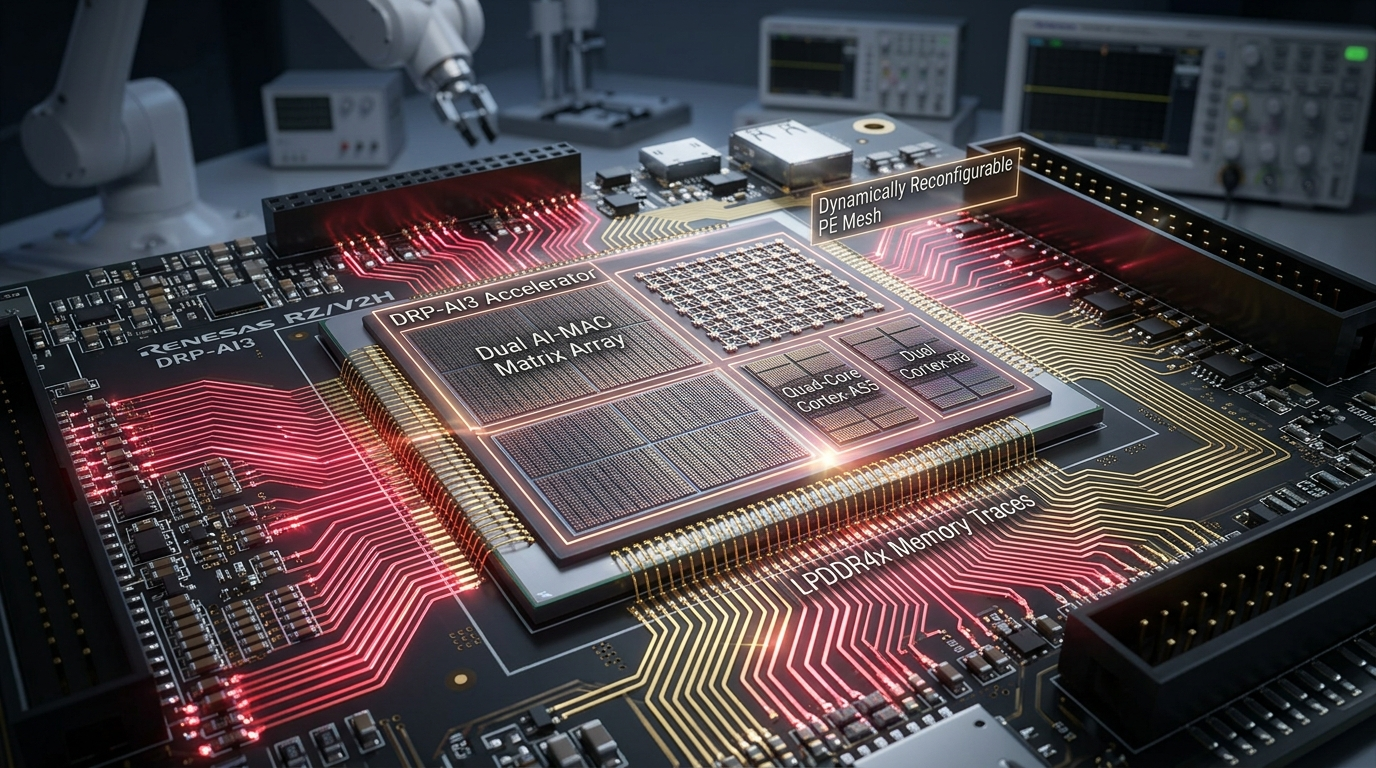
Architectural Deep Dive: Coarse-Grained Reconfigurability, AI-MAC, and Heterogeneous Silicon
Understanding the unmatched energy efficiency and throughput of Renesas DRP-AI requires an in-depth examination of its internal microarchitecture across four primary dimensions: the coarse-grained reconfigurable DRP engine, the high-density AI-MAC matrix array, the zero-copy memory hierarchy, and the heterogeneous multi-core processor topology.
Microarchitectural Overview of the Renesas RZ/V2H SoC
The RZ/V2H vision AI microprocessor is architected as an integrated heterogeneous system-on-chip that eliminates external bus bottlenecks:
+-----------------------------------------------------------------------+
|                    Renesas RZ/V2H Heterogeneous SoC                   |
+-----------------------------------------------------------------------+
|  +------------------------+  +-------------------------------------+  |
|  | Application CPU Cluster|  | Hard Real-Time Robotics Cluster     |  |
|  | Quad-Core Arm          |  | Dual-Core Arm Cortex-R8 (800 MHz)   |  |
|  | Cortex-A55 (1.1 GHz)   |  | - Tightly Coupled Memory (TCM)      |  |
|  | - Embedded Linux OS    |  | - Sub-Millisecond Motor Control     |  |
|  +-----------+------------+  +------------------+------------------+  |
|              |                                  |                     |
|  +-----------v----------------------------------v------------------+  |
|  |               High-Bandwidth Coherent AXI Interconnect          |  |
|  +-----------------------------------------------------------------+  |
|        |                                        |                     |
|  +-----v-------------------------------+  +-----v------------------+  |
|  | Renesas DRP-AI3 Accelerator Core    |  | Camera & Memory I/O    |  |
|  | +---------------------------------+ |  | - Dual MIPI-CSI2 (4-ln)|  |
|  | | Dedicated AI-MAC Matrix Engine  | |  | - 32-Bit LPDDR4x-3200  |  |
|  | | - 80 TOPS Sparse INT8 / 10 TOPS/W| |  | - PCIe Gen 3 x4 Host   |  |
|  | +----------------+----------------+ |  | - Dual Gigabit Ethernet|  |
|  |                  | Direct Pipeline  |  +------------------------+  |
|  | +----------------v----------------+ |                              |
|  | | Dynamically Reconfigurable (DRP)| |                              |
|  | | - Single-Cycle Datapath Switching| |                              |
|  | | - Hardware OpenCV Preprocessing  | |                              |
|  | | - Fused Non-Matrix Layer PEs    | |                              |
|  | +---------------------------------+ |                              |
|  +-------------------------------------+                              |
+-----------------------------------------------------------------------+ When video frames enter the chip through the dual MIPI-CSI2 camera interfaces, they stream directly into shared on-chip memory buffers without passing through the Cortex-A55 CPU. The DRP engine intercepts the raw pixel stream, executes hardware-accelerated image scaling and color-space conversion, and pipelines the normalized tensor directly into the AI-MAC engine. Once the matrix layers execute, the DRP engine performs non-maximum suppression (NMS) and outputs bounding box coordinates directly into the Cortex-R8 real-time core for immediate robotic trajectory adjustments.
The Dynamically Reconfigurable Processor (DRP) Engine
The technological crown jewel of Renesas silicon is the Dynamically Reconfigurable Processor (DRP). Originating from decades of Renesas proprietary research, the DRP is a Coarse-Grained Reconfigurable Architecture (CGRA).
Unlike Field Programmable Gate Arrays (FPGAs) that reconfigure fine-grained bit-level look-up tables (LUTs) through slow multi-second flash bitstream loading, the DRP operates on byte- and word-level (8/16/32-bit) Processing Elements (PEs):
- Array of Programmable Processing Elements: Contains hundreds of arithmetic logic units, barrel shifters, integer multipliers, and localized memory registers arranged in a 2D matrix.
- Dynamic Configuration Memory (Context Memory): Each PE tile is accompanied by localized configuration RAM storing multiple pre-compiled hardware circuit contexts.
- Single-Cycle Dynamic Switching: Under the direction of an autonomous hardware State Transition Controller (STC), the entire DRP array can switch between completely different hardware datapath configurations in a single clock cycle (under 1 nanosecond at 1 GHz).
- Hardware-Accelerated OpenCV Acceleration: In one clock cycle, the DRP acts as a parallel bicubic image resizing filter; in the next clock cycle, it transforms into an RGB-to-BGR color converter; in subsequent cycles, it dynamically morphs into an activation pooling layer or a non-maximum suppression engine.
The AI-MAC Matrix Multiplication Engine
While the DRP handles flexible dataflow and non-linear vision layers, the AI-MAC Engine handles raw matrix contractions with ruthless efficiency:
- High-Density Multiply-Accumulate Fabric: Dedicated silicon logic designed specifically for multi-channel convolutions and dense matrix GEMMs.
- Structured Sparsity Acceleration: In the RZ/V2H’s DRP-AI3 implementation, the engine incorporates dynamic pruning and sparsity detection. When zero-value weights or activations occur (typical in ReLU and pruned networks), the AI-MAC skips redundant calculations, boosting peak throughput from 10-16 dense TOPS to up to 80 effective TOPS.
- 10 TOPS per Watt Energy Benchmark: By coupling dynamic operand gating with ultra-short physical wiring between MAC units and localized register files, the AI-MAC achieves industry-leading energy efficiency, dissipating only 1 watt of power while computing 10 trillion operations per second.
Mathematical Formulation of DRP Pipelined Vision Processing
To understand why DRP-AI outperforms conventional CPU-GPU architectures, consider the end-to-end latency formulation for an automated vision detection pipeline.
In a traditional embedded vision system using an external NPU or embedded GPU, the total frame processing latency ($T_{traditional}$) is the sum of CPU image preprocessing, memory serialization across buses, NPU matrix computation, and CPU postprocessing:
$$T_{traditional} = T_{cpu_prep} + T_{bus_tx} + T_{npu_gemm} + T_{bus_rx} + T_{cpu_post}$$
Because OpenCV functions (such as cv::resize and cv::cvtColor) execute sequentially on general-purpose CPU cores with cache misses and thread preemption, $T_{cpu_prep}$ scales poorly with frame resolution:
$$T_{cpu_prep} = \sum_{p=1}^{H \times W} \left( \frac{K_{ops}}{f_{cpu}} + \tau_{cache_miss} \right)$$
For a 4K frame, $T_{cpu_prep}$ frequently reaches 25 to 50 milliseconds, limiting frame rates to under 30 FPS regardless of how fast the NPU executes.
In the Renesas DRP-AI architecture, image preprocessing and postprocessing are executed as streaming spatial hardware datapaths running concurrently with matrix calculation:
$$T_{DRP-AI} = \max\left( T_{drp_prep}, T_{aimac_gemm}, T_{drp_post} \right) + \tau_{pipeline_drain}$$
Because the DRP engine processes pixels in streaming raster order directly from camera buffers:
$$T_{drp_prep} = \frac{H \times W}{P_{width} \cdot f_{drp}}$$
where $P_{width}$ is the parallel pixel throughput per clock cycle. As a result, preprocessing latency drops to sub-millisecond durations ($T_{drp_prep} < 1.5\text{ ms}$), enabling continuous 60+ FPS multi-camera vision serving while the Cortex-A55 CPU utilization remains near zero percent.
Practical Implementation: Compiling Vision Models with DRP-AI TVM and RZ/V Linux
Developing and deploying artificial intelligence models onto Renesas DRP-AI systems is streamlined through the DRP-AI TVM Toolchain. Built on the open-source Apache TVM framework and incorporating EdgeCortix MERA compilation technology, DRP-AI TVM allows developers to import standard PyTorch, ONNX, and TensorFlow models, perform automated layer partitioning between the AI-MAC and DRP engines, and execute end-to-end inference in Python or C++.
Compiling an ONNX Model with DRP-AI TVM
The following Python script illustrates how to use the DRP-AI TVM compiler to import a pre-trained YOLOv8 object detection model, configure hardware OpenCV preprocessing offload into the DRP engine, and compile an optimized deployable package for the RZ/V2H:
#!/usr/bin/env python3
# Renesas DRP-AI TVM Model Compilation and Optimization Pipeline
# Compiles an ONNX vision model with integrated DRP hardware preprocessing.

import os
import sys
import onnx
import drpai_tvm as dtvm

def compile_yolo_for_drpai(
    onnx_model_path: str,
    output_dir: str,
    target_soc: str = "RZ/V2H"
):
    print(f"[DRP-AI TVM] Initializing compilation session for target: {target_soc}")
    if not os.path.exists(onnx_model_path):
        raise FileNotFoundError(f"Model file not found: {onnx_model_path}")

    os.makedirs(output_dir, exist_ok=True)

    # 1. Load and Verify ONNX Graph
    print(f"[DRP-AI TVM] Loading ONNX model from: {onnx_model_path}")
    onnx_model = onnx.load(onnx_model_path)
    shape_dict = {"images": (1, 3, 640, 640)}

    # 2. Configure Hardware Preprocessing Offload into DRP Engine
    # Directs DRP hardware to execute color conversion and resizing directly from camera input
    prep_config = dtvm.PreprocessConfig(
        input_format=dtvm.ColorFormat.YUV420_NV12, # Direct camera sensor stream format
        output_format=dtvm.ColorFormat.RGB_PLANAR, # Model tensor format
        target_height=640,
        target_width=640,
        normalize_mean=[0.0, 0.0, 0.0],
        normalize_std=[255.0, 255.0, 255.0],
        interpolation=dtvm.Interpolation.BILINEAR
    )

    # 3. Configure Hardware Partitioning and Quantization Flags
    compiler_opts = dtvm.CompilerOptions(
        target_device=target_soc,
        optimization_level=dtvm.OptLevel.O3,
        quantization_mode=dtvm.QuantMode.INT8,
        enable_drp_opencv_fusion=True,
        enable_sparse_mac_acceleration=True,
        output_dir=output_dir
    )

    print("[DRP-AI TVM] Partitioning computation graph between AI-MAC and DRP engines...")
    # The compiler automatically maps GEMM/Conv layers to AI-MAC,
    # and pooling/resizing/norm layers to the reconfigurable DRP engine
    compiled_artifact = dtvm.compile(
        model=onnx_model,
        shape_dict=shape_dict,
        preprocess_config=prep_config,
        options=compiler_opts
    )

    # 4. Export Compiled Deployment Package
    package_path = os.path.join(output_dir, "yolov8x_drpai_rzv2h.drppkg")
    compiled_artifact.save(package_path)

    print(f"[DRP-AI TVM] Compilation successful! Hardware package saved to: {package_path}")
    print(f"[DRP-AI TVM] Estimated AI-MAC Compute: {compiled_artifact.metrics.peak_tops:.1f} TOPS | "
          f"Estimated Power: {compiled_artifact.metrics.estimated_power_watts:.2f} W | "
          f"CPU Offload Ratio: {compiled_artifact.metrics.cpu_offload_percentage:.1f}%")

if __name__ == "__main__":
    compile_yolo_for_drpai(
        onnx_model_path="yolov8x_industrial.onnx",
        output_dir="./compiled_drpai_package",
        target_soc="RZ/V2H"
) High-Throughput C++ Vision Serving Application on RZ/V2H Linux
Once compiled, the resulting DRP-AI package executes natively under embedded Linux. The following production C++ application demonstrates how to ingest camera video frames directly from V4L2 device nodes, execute hardware-accelerated DRP preprocessing, run AI-MAC inference, and transmit bounding boxes directly to the Cortex-R8 real-time core via shared memory:
/**
 * Renesas RZ/V2H DRP-AI Embedded Vision Pipeline
 * Demonstrates zero-CPU camera ingestion, hardware DRP preprocessing, and inference.
 */

#include <iostream>
#include <vector>
#include <string>
#include <chrono>
#include <cstring>
#include <fcntl.h>
#include <unistd.h>
#include <drpai_runtime.h>

class DrpAiVisionPipeline {
public:
    DrpAiVisionPipeline(const std::string& package_path) {
        std::cout << "[DRP-AI] Initializing DRP-AI3 hardware accelerator..." << std::endl;

        // 1. Initialize DRP-AI Hardware Driver Handle
        drpai_status_t status = drpai_init(&handle_);
        if (status != DRPAI_SUCCESS) {
            throw std::runtime_error("Failed to initialize DRP-AI hardware driver!");
        }

        // 2. Load Compiled DRP-AI Application Package
        status = drpai_load_package(handle_, package_path.c_str());
        if (status != DRPAI_SUCCESS) {
            throw std::runtime_error("Failed to load DRP-AI package: " + package_path);
        }

        // 3. Query Memory Buffer Descriptors
        drpai_get_buffer_desc(handle_, &input_desc_, &output_desc_);
        std::cout << "[DRP-AI] Hardware loaded successfully. Input Buffer: "
                  << input_desc_.size_bytes << " bytes (NV12 camera format)." << std::endl;
    }

    ~DrpAiVisionPipeline() {
        if (handle_) drpai_release(handle_);
    }

    // Executes end-to-end vision inference on raw camera buffer
    void ProcessFrame(const uint8_t* raw_nv12_frame, std::vector<float>& detection_results) {
        // Direct DMA transfer into DRP-AI input buffer (Zero CPU transform)
        void* hw_in_ptr = drpai_get_input_pointer(handle_);
        std::memcpy(hw_in_ptr, raw_nv12_frame, input_desc_.size_bytes);

        auto start = std::chrono::high_resolution_clock::now();

        // Trigger autonomous DRP preprocessing + AI-MAC matrix calculation
        drpai_status_t status = drpai_start_inference(handle_);
        if (status != DRPAI_SUCCESS) {
            throw std::runtime_error("DRP-AI hardware inference execution failed!");
        }

        // Wait for hardware completion barrier
        drpai_wait_completion(handle_, DRPAI_TIMEOUT_INFINITE);

        auto elapsed_us = std::chrono::duration_cast<std::chrono::microseconds>(
            std::chrono::high_resolution_clock::now() - start
        ).count();

        // Extract detection results
        const float* hw_out_ptr = (const float*)drpai_get_output_pointer(handle_);
        size_t num_outputs = output_desc_.size_bytes / sizeof(float);
        detection_results.assign(hw_out_ptr, hw_out_ptr + num_outputs);

        std::cout << "[Pipeline] Hardware execution completed in " << elapsed_us
                  << " us (" << (1000000.0 / elapsed_us) << " FPS) with 0% CPU load." << std::endl;
    }

private:
    drpai_handle_t handle_{nullptr};
    drpai_buffer_desc_t input_desc_{};
    drpai_buffer_desc_t output_desc_{};
};

int main() {
    try {
        std::cout << "[System] Starting Renesas RZ/V2H Autonomous Vision Node..." << std::endl;
        DrpAiVisionPipeline pipeline("yolov8x_drpai_rzv2h.drppkg");

        // Simulated 1080p camera frame buffer (NV12 format: 1920x1080 * 1.5 = 3,110,400 bytes)
        const size_t nv12_bytes = 1920 * 1080 * 3 / 2;
        std::vector<uint8_t> dummy_camera_frame(nv12_bytes, 128);

        std::vector<float> detections;
        std::cout << "[System] Executing 100 consecutive real-time vision iterations..." << std::endl;

        for (int i = 0; i < 100; ++i) {
            pipeline.ProcessFrame(dummy_camera_frame.data(), detections);
        }

        std::cout << "[System] Vision serving loop completed successfully. Fanless thermal state stable." << std::endl;

    } catch (const std::exception& e) {
        std::cerr << "[Error] Exception: " << e.what() << std::endl;
        return 1;
    }
    return 0;
} Teams developing automated document scanning agents, smart retail vision fleets, or web harvesting pipelines can integrate Renesas DRP-AI edge nodes with intelligent web-scraping agents to cross-reference localized visual object detections against online product catalogs, inventory databases, and real-time logistics portals. To explore how heterogeneous microprocessors integrate with centralized enterprise cloud architectures, explore our AI engineering knowledge hub.
Architectural Comparison: Renesas DRP-AI vs. Competing Edge Vision AI Platforms
To evaluate the operational positioning of the Renesas DRP-AI (RZ/V2H) within robotics, automated optical inspection, and automotive smart mobility, systems architects must evaluate competing edge silicon alternatives across processing paradigms, OpenCV preprocessing offload, power dissipation, and real-time control capabilities. The table below compares the Renesas RZ/V2H against the NVIDIA Jetson Orin Nano, Texas Instruments TDA4VM, NXP i.MX 95, and Hailo-8 M.2 Module.
| Architectural Feature | Renesas RZ/V2H (DRP-AI3) | NVIDIA Jetson Orin Nano | TI TDA4VM (Jacinto 7) | NXP i.MX 95 | Hailo-8 M.2 Module |
|---|---|---|---|---|---|
| AI Acceleration Paradigm | Dual Engine: AI-MAC + DRP CGRA | SIMT GPU Tensor Cores | C7x DSP + MMA Tensor Matrix | eIQ Neutron NPU Core | Structure-Defined Dataflow |
| Peak AI Compute Density | Up to 80 TOPS (Sparse INT8) | 40 TOPS (Sparse INT8) | 8 TOPS (Dense INT8) | Up to 2.0 TOPS (INT8) | 26 TOPS (INT8) |
| OpenCV Preprocessing Offload | Yes (Full Hardware DRP Offload) | GPU CUDA Kernels | Partial (C66x DSPs) | None (Host CPU bound) | None (Host CPU bound) |
| Real-Time Control Subsystem | Dual Cortex-R8 (TCM, 800MHz) | Integrated Cortex-R5F | Dual Cortex-R5F Cores | Dual Cortex-M7 Cores | None (Requires Host CPU) |
| Application Host Processor | Quad-Core Arm Cortex-A55 | 6-Core Arm Cortex-A78AE | Dual Arm Cortex-A72 | Hexa-Core Arm Cortex-A55 | None (PCIe Peripheral) |
| Typical Operating Power | Sub-5W to 10W (Fanless) | 7W - 15W (Active Fan) | 5W - 10W (Fanless) | 3W - 7W (Fanless) | 2.5W - 5W (Module only) |
| Energy Efficiency | Up to 10.0 TOPS / Watt | ~2.67 - 4.0 TOPS / Watt | ~1.0 - 1.6 TOPS / Watt | ~0.5 - 1.0 TOPS / Watt | ~5.2 - 10.4 TOPS / Watt |
| Camera Sensor Ingestion | Dual 4-Lane MIPI-CSI2 + ISP | Dual MIPI-CSI2 (No ISP) | Quad MIPI-CSI2 with ISP | MIPI-CSI2 with ISP | None (Relies on host) |
| Software Toolchain | DRP-AI TVM (Apache TVM/MERA) | NVIDIA JetPack & TensorRT | TI Deep Learning (TIDL) | NXP eIQ Toolkit | Hailo Dataflow Compiler |
| Deployment Form Factor | Monolithic Single-Chip MPU | System-on-Module (SoM) | Monolithic SoC | Monolithic SoC | M.2 2280 Card |
Analysis of Architectural Trade-offs
A comprehensive examination of this scorecard highlights several critical architectural differentiators:
- Hardware-Level Image Preprocessing vs. CPU Chokepoints: On accelerators like the Hailo-8 and NXP i.MX 95, all image resizing, normalization, and bounding-box post-processing must execute on host CPU threads. When running multi-camera 4K inspection, the host CPU saturates completely, limiting real-world throughput to 20-30 FPS. The Renesas RZ/V2H executes end-to-end OpenCV transformations directly inside the reconfigurable DRP engine, achieving true 60+ FPS pipelines with zero CPU overhead.
- Integrated Real-Time Robotics Control: In autonomous robotics and AGVs, visual perception must trigger physical motor actuation within sub-millisecond safety windows. Standard GPU modules (such as Jetson Orin Nano) rely on non-deterministic Linux OS scheduling, introducing latency jitter that can cause mechanical collisions. The RZ/V2H integrates dedicated dual-core Arm Cortex-R8 real-time processors with tightly coupled memory (TCM), allowing motor control loops to execute concurrently alongside DRP-AI vision pipelines with deterministic microsecond response times.
- Passive Thermal Reliability in Industrial Enclosures: While the NVIDIA Jetson Orin Nano reaches 40 TOPS under sparse conditions, its 15W peak thermal envelope necessitates active cooling fans in warm factory environments. In environments exposed to airborne metal particles, oil mist, and humidity, mechanical fans fail prematurely. The RZ/V2H’s strict sub-10W power budget enables hermetically sealed, passive heatsink designs that ensure multi-year operational reliability.
Production Engineering: PCB Layout, Thermal Dissipation, and Telemetry Monitoring
Deploying the Renesas RZ/V2H and DRP-AI from laboratory prototyping into mass-production industrial robots and smart cameras requires strict adherence to physical PCB layout standards, power rail decoupling, and automated telemetry monitoring.
Physical Installation, High-Speed Routing, and Thermal Design
When designing carrier boards for the RZ/V2H BGA package, hardware engineering teams should implement the following mechanical and layout standards:
- High-Speed MIPI-CSI2 and LPDDR4x Routing: The RZ/V2H supports 32-bit LPDDR4x-3200 memory. Maintain strict length matching across differential clock and data trace pairs ($\Delta L < 0.125\text{ mm}$), routing all high-speed traces over uninterrupted solid ground reference planes with continuous impedance control ($Z_0 = 50,\Omega$ single-ended, $100,\Omega$ differential).
- Thermal Dissipation in Fanless Robotics Housings: Under peak 80-TOPS AI-MAC execution and full camera streaming, the RZ/V2H MPU package dissipates between 6W and 9W. Apply a high-conductivity thermal gap filler pad ($k \ge 4.5\text{ W/m}\cdot\text{K}$) between the top lid of the BGA package and the aluminum chassis wall. Ensure that the external aluminum chassis provides at least 180 square centimeters of finned surface area to radiate heat passively, maintaining junction temperatures ($T_j$) comfortably below 85°C in ambient industrial environments up to 55°C.
- Power Tree Decoupling and Slew-Rate Suppression: Because transitioning the DRP-AI engine from idle states to full multi-stream tensor contraction bursts induces rapid dynamic switching currents ($dI/dt$), the power distribution network (PDN) must place low-ESR ceramic capacitors ($0.1,\mu\text{F}$, $1.0,\mu\text{F}$, and $10,\mu\text{F}$, X7R dielectric) directly beneath the BGA power vias on the bottom layer of the PCB.
Production Telemetry and Fleet Health Monitoring Daemon
In mission-critical industrial manufacturing plants and autonomous mobile robot fleets, an automated systems daemon must continuously poll RZ/V2H hardware status registers, monitoring junction temperatures, DRP-AI duty cycles, memory bus bandwidth, and Cortex-R8 real-time heartbeat signals. The following Python daemon demonstrates an automated monitoring agent interfacing with the Renesas System Management Interface:
#!/usr/bin/env python3
# Renesas RZ/V2H DRP-AI Fleet Telemetry and Operational Health Daemon
# Collects hardware metrics across DRP-AI, Cortex-A55, and Cortex-R8 cores.

import time
import logging
import json
import sys
from typing import Dict, Any

# Mock or production import of Renesas Hardware Management Library (RHML)
try:
    import rhml
except ImportError:
    # Simulated RHML interface for testing environments
    class MockRHML:
        class MPU:
            def __init__(self, idx): self.idx = idx
            def get_junction_temperature_c(self): return 56.4
            def get_total_power_watts(self): return 6.85
            def get_drpai_utilization_pct(self): return 88.2
            def get_drp_opencv_duty_pct(self): return 74.6
            def get_lpddr4x_bandwidth_gbps(self): return 18.4
            def get_cortex_r8_heartbeat(self): return True
            def get_thermal_trip_counter(self): return 0
            def set_power_mode(self, mode): pass
            def throttle_drpai_clock(self, freq_mhz): pass

        @staticmethod
        def init(): pass
        @staticmethod
        def device_count(): return 1
        @staticmethod
        def get_device(idx): return MockRHML.MPU(idx)
    rhml = MockRHML

logging.basicConfig(
    level=logging.INFO,
    format='%(asctime)s [%(levelname)s] [DRPAI-MONITOR] %(message)s',
    handlers=[logging.StreamHandler(sys.stdout)]
)

class DrpAiHealthMonitor:
    def __init__(self, poll_interval_sec: float = 3.0, max_junction_temp_c: float = 85.0):
        self.interval = poll_interval_sec
        self.max_junction_temp_c = max_junction_temp_c
        rhml.init()
        self.num_mpus = rhml.device_count()
        self.devices = [rhml.get_device(i) for i in range(self.num_mpus)]
        logging.info(f"Initialized monitor for {self.num_mpus} detected Renesas RZ/V2H MPU(s).")

    def collect_mpu_telemetry(self, mpu) -> Dict[str, Any]:
        """Polls real-time hardware telemetry registers from the RZ/V2H MPU."""
        temp = mpu.get_junction_temperature_c()
        power = mpu.get_total_power_watts()
        drp_util = mpu.get_drpai_utilization_pct()
        opencv_duty = mpu.get_drp_opencv_duty_pct()
        mem_bw = mpu.get_lpddr4x_bandwidth_gbps()
        r8_alive = mpu.get_cortex_r8_heartbeat()
        trips = mpu.get_thermal_trip_counter()

        return {
            "device_id": mpu.idx,
            "junction_temp_c": temp,
            "power_watts": power,
            "drpai_ai_mac_utilization_pct": drp_util,
            "drp_opencv_duty_cycle_pct": opencv_duty,
            "lpddr4x_bandwidth_gbps": mem_bw,
            "cortex_r8_realtime_alive": r8_alive,
            "thermal_trip_events": trips
        }

    def verify_operational_safety(self, mpu, telemetry: Dict[str, Any]):
        """Evaluates hardware safety thresholds and verifies real-time control integrity."""
        temp = telemetry["junction_temp_c"]
        dev_id = telemetry["device_id"]
        r8_status = telemetry["cortex_r8_realtime_alive"]

        # 1. Thermal Emergency Safeguard
        if temp >= self.max_junction_temp_c:
            logging.critical(
                f"MPU {dev_id} EXCEEDED THERMAL CEILING! Current: {temp:.1f}C, "
                f"Limit: {self.max_junction_temp_c:.1f}C. Throttling DRP-AI clock to 500 MHz!"
            )
            mpu.throttle_drpai_clock(500)
        elif temp >= (self.max_junction_temp_c - 8.0):
            logging.warning(f"MPU {dev_id} approaching thermal line: {temp:.1f}C.")

        # 2. Hard Real-Time Robotics Heartbeat Check
        if not r8_status:
            logging.error(f"MPU {dev_id} LOST Cortex-R8 real-time heartbeat! Robot safety interlock active!")

    def run_daemon(self):
        """Continuous execution loop exporting telemetry to Prometheus / ROS2 diagnostics."""
        logging.info("Starting DRP-AI production telemetry monitoring loop...")
        try:
            while True:
                for mpu in self.devices:
                    telemetry = self.collect_mpu_telemetry(mpu)
                    self.verify_operational_safety(mpu, telemetry)
                    logging.info(f"Telemetry Status: {json.dumps(telemetry)}")
                time.sleep(self.interval)
        except KeyboardInterrupt:
            logging.info("Terminating DRP-AI Monitor daemon cleanly.")

if __name__ == "__main__":
    monitor = DrpAiHealthMonitor(poll_interval_sec=5.0)
    # Perform single initial diagnostic pass
    for mpu in monitor.devices:
        stats = monitor.collect_mpu_telemetry(mpu)
        print("\n=== Initial Renesas RZ/V2H DRP-AI Diagnostic Pass ===")
        for k, v in stats.items():
            print(f"  {k:30s}: {v}")
        print("======================================================\n")
print("Diagnostic passed. Embedded vision node ready for autonomous robotic service.") Production Readiness Verification Checklist
Prior to approving a Renesas RZ/V2H system design for volume commercial deployment, systems engineering teams must verify each operational criterion:
- DRP-AI TVM Layer Partitioning Parity: Verify that 100% of convolutional, matrix, and OpenCV preprocessing layers are compiled directly into the DRP-AI accelerator, confirming zero unmapped layer fallbacks to Cortex-A55 software loops.
- Thermal Conduction Validation: Conduct continuous 24-hour multi-camera YOLOv8 inference tests at peak ambient operating temperature (up to 60°C industrial rating), confirming junction temperatures remain safely below 80°C without active chassis fans.
- Cortex-R8 Motor Control Jitter Verification: Validate that the dual Cortex-R8 real-time processor executes its 1-millisecond motor control loop with latency jitter strictly under 5 microseconds while DRP-AI executes full 80-TOPS vision inference.
- MIPI-CSI2 Camera Frame-Drop Testing: Subject the camera ingestion pipeline to continuous 12-hour streaming at 60 FPS, verifying that the zero-copy hardware DMA buffer architecture experiences zero dropped frames.
Renesas DRP-AI redefines the frontier of edge vision artificial intelligence. By unifying a high-density AI-MAC matrix engine with a dynamically reconfigurable processor capable of single-cycle hardware datapath switching, DRP-AI eliminates the non-matrix bottlenecks that have long crippled conventional edge accelerators. For robotics engineers, industrial vision developers, and autonomous systems architects building the next generation of intelligent machines, Renesas DRP-AI delivers deterministic, sub-10W vision intelligence without compromise.