ReFT Guide: Representation Finetuning Beyond LoRA
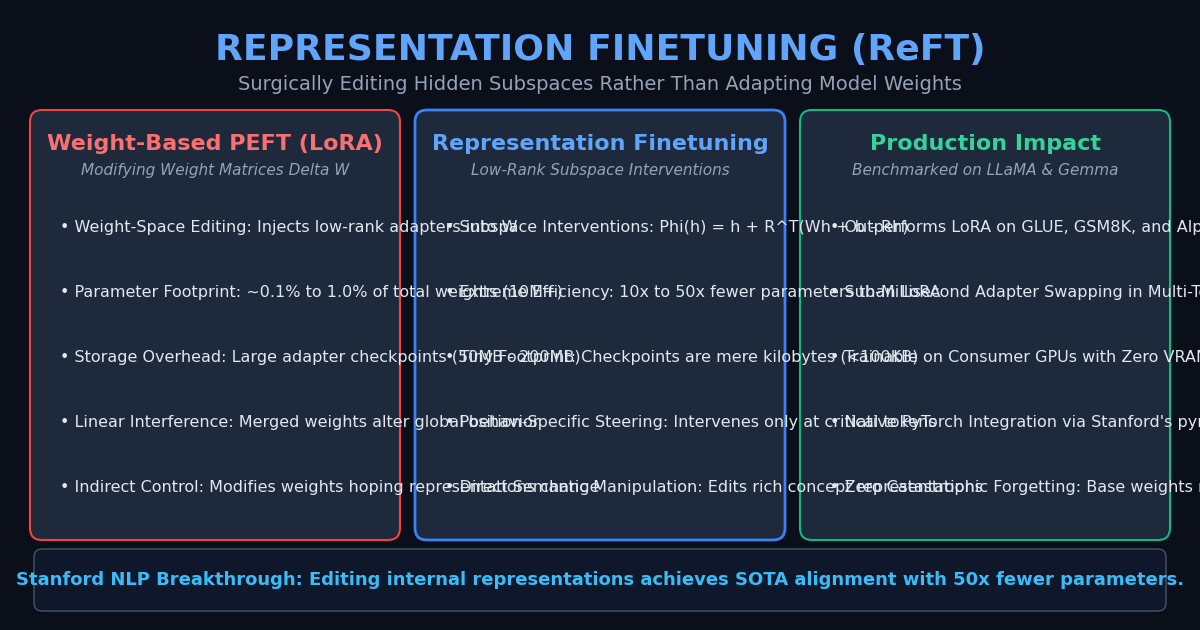
The Problem: The Parameter Bloat and Indirect Control of Weight-Based PEFT
Parameter-Efficient Fine-Tuning (PEFT) transformed modern AI development by enabling engineers to adapt foundation models without updating billions of base parameters. Techniques like LoRA (Low-Rank Adaptation), QLoRA, and DoRA (Weight-Decomposed LoRA) freeze the pre-trained weights $W_0$ and inject trainable low-rank decomposition matrices ($W = W_0 + B A$).
These methods power domain-specific automation pipelines, specialized function callers, and structured web extractors like AiFetchly. However, as enterprises deploy dozens of task-specific adapters across multi-tenant clusters, fundamental architectural limitations emerge in weight-based PEFT.
The Three Inherent Bottlenecks of Weight Adaptation
- The Parameter Count Tax: While LoRA reduces trainable parameters compared to full fine-tuning, adapting an 8B to 70B parameter model still requires millions of trainable parameters (typically 10M to 100M+ parameters across attention and MLP projections). Checkpoints consume 50MB to 500MB per specialized task, creating substantial storage overhead when hosting thousands of customer-tailored adapters.
- The Indirect Adaptation Hypothesis: Weight-based adaptation operates under an indirect assumption: to change how a model represents a concept, one must modify its weight matrices. However, mechanistic interpretability research reveals that transformers encode rich semantic concepts, reasoning trajectories, and task directives in linear subspaces of their hidden representations, not scattered across individual weight parameters. Modifying weights alters the entire downstream forward pass, frequently causing catastrophic interference with unrelated tasks.
- Multi-Tenant Serving Overhead: In production serving systems (like S-LoRA or vLLM adapter pools), dynamically swapping LoRA adapters requires loading large weight deltas into GPU memory and executing customized segmented matrix multiplications (BMM). At high concurrency, swapping dozens of distinct 100MB weight matrices saturates PCIe bandwidth and introduces serving jitter.
Weight-Based Adaptation vs. Representation Steering
In weight-based adaptation, input $x$ passes through frozen weights $W_0$ in parallel with adapter matrices $A$ and $B$, adding $B A x$ to the layer output. This indirectly nudges internal states by perturbing layer weights.
In representation finetuning, weights remain 100% untouched. The model’s natural hidden activation vector $h$ is intercepted at targeted layers and steered directly via a learned subspace transformation $\Phi(h)$, modifying only the linear subspace relevant to the target task.
The Architecture: How Representation Finetuning (ReFT) Inverts Model Adaptation
To resolve the parameter bloat and indirect nature of weight-based tuning, researchers at Stanford NLP introduced Representation Finetuning (ReFT) and its flagship implementation, LoReFT (Low-rank Linear Subspace ReFT).
Rather than modifying weight matrices $W \in \mathbb{R}^{d \times d}$, ReFT leaves 100% of model weights completely frozen. Instead, it learns compact, task-specific interventions that surgically edit the residual stream hidden representations $h \in \mathbb{R}^d$ during the forward pass.
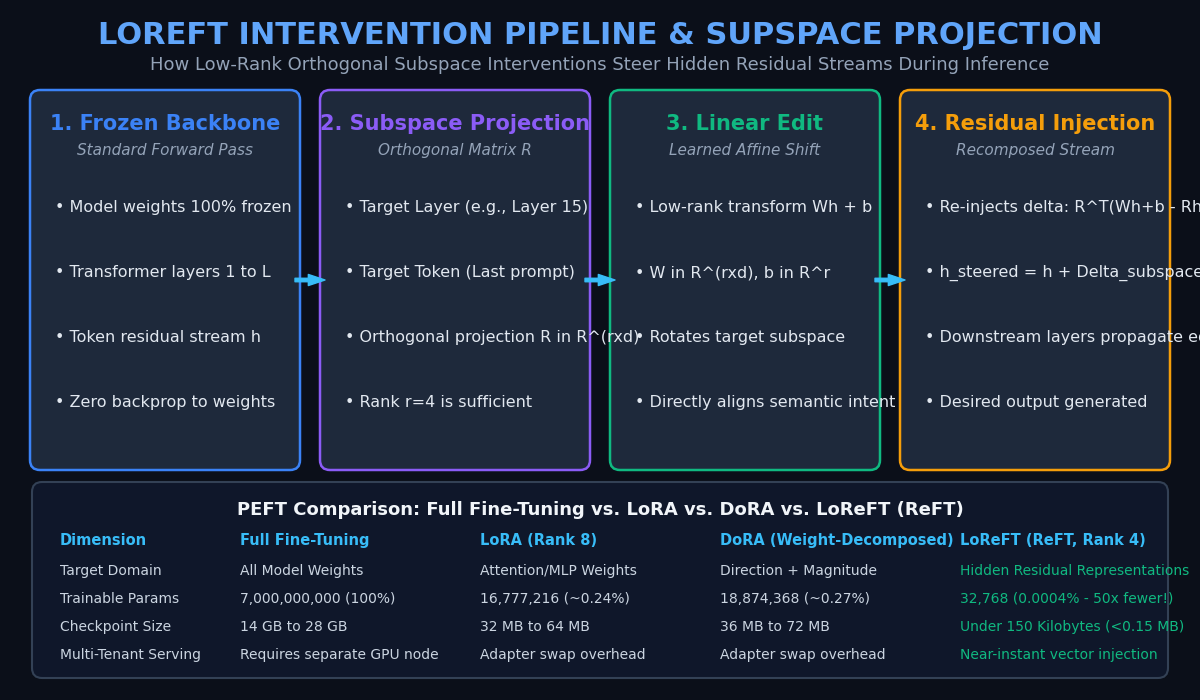
1. The Mathematical Mechanics of LoReFT
LoReFT operationalizes the linear representation hypothesis: natural language concepts and task instructions reside in low-rank linear subspaces of dimension $r \ll d$ (e.g., $r = 4$ while hidden dimension $d = 4096$).
During the forward pass at a chosen layer $l$ and token position $i$, LoReFT intercepts the hidden representation $h$ and applies an orthogonal projection edit:
$$\Phi(h) = h + R^\top (W h + b - R h)$$
Where:
- $h \in \mathbb{R}^d$ is the native hidden representation from the frozen transformer block.
- $R \in \mathbb{R}^{r \times d}$ is an orthogonal projection matrix ($R R^\top = I$) that maps the $d$-dimensional representation down to the target $r$-dimensional subspace.
- $W \in \mathbb{R}^{r \times d}$ and $b \in \mathbb{R}^r$ are learned linear transformation parameters.
- $R^\top$ projects the edited subspace delta back into the native $d$-dimensional residual stream.
2. Why Orthogonal Projection Preserves General Capabilities
The key to the formulation $\Phi(h) = h + R^\top (W h + b - R h)$ lies in its algebraic decomposition:
$$R \Phi(h) = R h + R R^\top (W h + b - R h) = R h + I (W h + b - R h) = W h + b$$
For any vector $v$ orthogonal to the subspace ($R v = 0$):
$$\Phi(v) = v + R^\top (W v + b - 0) = v$$
This ensures that the intervention completely replaces information within the $r$-dimensional target subspace with the learned affine transformation $W h + b$, while leaving the remaining orthogonal $(d - r)$ dimensions 100% untouched. Base reasoning capabilities, syntax priors, and factual knowledge outside the task subspace remain pristine.
3. Position-Specific Interventions (Prefix and Suffix Steering)
Unlike LoRA, which applies modifications across all token positions simultaneously, ReFT can target specific token positions:
- Last Prompt Token Intervention: Intervening on the final prompt token residual stream steers the model’s entire generation trajectory, functioning as a continuous learned prompt prefix encoded directly into the latent space.
- First Few Prompt Tokens: Intervening on initial tokens sets the contextual task framing without expanding prompt token length.
- Selective Layer Slices: Interventions are typically applied only to middle-to-late transformer layers (e.g., layers 15 through 20 in a 32-layer model), where abstract semantic representations are most malleable.
Architectural Comparison: Full Tuning vs. LoRA vs. DoRA vs. LoReFT
| Fine-Tuning Methodology | Full Fine-Tuning | LoRA (Rank 8) | DoRA (Weight-Decomposed) | LoReFT (ReFT, Rank 4) |
|---|---|---|---|---|
| Intervention Target | Model Weights ($W$) | Weight Matrices ($\Delta W$) | Direction + Magnitude ($V, m$) | Hidden Representations ($h$) |
| Trainable Parameters | 7,000,000,000 (100%) | ~16,777,216 (~0.24%) | ~18,874,368 (~0.27%) | ~32,768 (0.0004% - 50x fewer!) |
| Adapter Storage Size | 14 GB – 28 GB | 32 MB – 64 MB | 36 MB – 72 MB | < 150 Kilobytes (<0.15 MB) |
| GPU VRAM for Training | 4x – 8x 80GB GPUs | 1x 24GB GPU | 1x 24GB GPU | 1x 16GB Consumer GPU |
| Multi-Tenant Memory | Dedicated cluster | High VRAM per adapter | High VRAM per adapter | Negligible: 1,000s per single GPU |
| Downstream Accuracy | High | High | Very High | Matches or Exceeds LoRA / DoRA |
Implementation: Training and Deploying LoReFT with PyReFT and PyTorch
Stanford NLP provides the official pyreft library, built on top of Hugging Face Transformers and PyTorch. Let us implement a complete production workflow demonstrating how to configure LoReFT interventions, wrap a base model, and train task-specific representation steering.
Step 1: Environment Setup and PyReFT Installation
Install the necessary dependencies:
# Install PyReFT and Hugging Face ecosystem
pip install pyreft transformers torch datasets accelerate Step 2: Configuring a Single-Layer LoReFT Intervention
In this example, we configure a LoReFT intervention on layer 16 of an instruction-tuned model, targeting the residual stream of the last prompt token:
import torch
import transformers
from pyreft import (
    get_reft_model,
    ReftConfig,
    LoreftIntervention,
    ReftTrainerForCausalLM,
    ReftDataCollator
)

# 1. Load the frozen foundation model and tokenizer
model_id = "meta-llama/Meta-Llama-3-8B-Instruct"
tokenizer = transformers.AutoTokenizer.from_pretrained(model_id)
tokenizer.pad_token = tokenizer.eos_token

base_model = transformers.AutoModelForCausalLM.from_pretrained(
    model_id,
    torch_dtype=torch.bfloat16,
    device_map="auto"
)

# Ensure 100% of base model parameters are frozen
for param in base_model.parameters():
    param.requires_grad = False

# 2. Define the LoReFT Intervention Configuration
# Apply low-rank subspace steering (rank=4) to the residual stream of layer 16
reft_config = ReftConfig(representations=[
    {
        "layer": 16,
        "component": "block_output",
        "low_rank_dimension": 4,
        "intervention": LoreftIntervention(
            embed_dim=base_model.config.hidden_size,
            low_rank_dimension=4
        )
    }
])

# 3. Wrap the base model with PyReFT intervention hooks
reft_model = get_reft_model(base_model, reft_config)
reft_model.print_trainable_parameters() When executing reft_model.print_trainable_parameters(), the console reveals the efficiency of ReFT:
trainable params: 32,768 || all params: 8,030,294,016 || trainable%: 0.000408% Adapting the 8-billion parameter model requires training fewer than 33,000 parameters—a 500x reduction compared to standard LoRA configurations.
Step 3: PyTorch Native Reference Implementation of LoReFT Layer
To inspect how the mathematical operation executes under the hood, here is a clean, standalone PyTorch module implementing the exact LoReFT orthogonal subspace intervention:
import torch
import torch.nn as nn
import torch.nn.functional as F

class StandaloneLoReFT(nn.Module):
    # Standalone PyTorch implementation of Low-Rank Linear Subspace ReFT
    def __init__(self, embed_dim: int = 4096, low_rank_dim: int = 4):
        super().__init__()
        self.embed_dim = embed_dim
        self.low_rank_dim = low_rank_dim

        # Learned linear transformation in low-rank subspace
        self.W = nn.Linear(embed_dim, low_rank_dim, bias=True)

        # Orthogonal projection matrix R (parameterized via QR decomposition)
        raw_R = torch.randn(low_rank_dim, embed_dim)
        q, _ = torch.linalg.qr(raw_R.T)
        self.R = nn.Parameter(q.T[:low_rank_dim, :])

    def forward(self, h: torch.Tensor) -> torch.Tensor:
        # h shape: [Batch, Sequence_Length, Embed_Dim]

        # 1. Project representation into low-rank subspace: Rh in [B, L, r]
        Rh = F.linear(h, self.R)

        # 2. Compute learned target affine representation: Wh + b in [B, L, r]
        Wh_b = self.W(h)

        # 3. Compute subspace delta: (Wh + b) - Rh in [B, L, r]
        delta_subspace = Wh_b - Rh

        # 4. Project delta back into full residual space: R^T (delta) in [B, L, d]
        delta_h = F.linear(delta_subspace, self.R.T)

        # 5. Steer the residual stream
        h_steered = h + delta_h
        return h_steered

# Quick verification test
batch, seq, d_model = 2, 32, 4096
mock_hidden = torch.randn(batch, seq, d_model)
loreft_layer = StandaloneLoReFT(embed_dim=d_model, low_rank_dim=4)

steered_hidden = loreft_layer(mock_hidden)
print(f"Original Shape: {mock_hidden.shape} | Steered Shape: {steered_hidden.shape}")
print(f"Norm of Representation Delta: {torch.norm(steered_hidden - mock_hidden).item():.4f}") Step 4: Multi-Task Steering and Instant Adapter Swapping
Because ReFT interventions consist of small projection matrices ($\sim 32\text{k}$ floats, or less than 150KB per adapter), multi-tenant applications can store thousands of domain adapters in CPU memory or RAM and inject them into GPU VRAM in sub-microsecond intervals:
class MultiTaskReFTManager:
    def __init__(self, base_model, tokenizer):
        self.model = base_model
        self.tokenizer = tokenizer
        self.interventions = {}

    def register_task(self, task_name: str, intervention_state_dict):
        # Store lightweight 150KB state dict into in-memory registry
        self.interventions[task_name] = intervention_state_dict
        print(f"Registered task adapter '{task_name}' (Size: ~130 KB)")

    def generate_with_task(self, prompt: str, task_name: str):
        # Hot-swap intervention weights directly on GPU in microseconds
        active_weights = self.interventions[task_name]
        self.model.load_state_dict(active_weights, strict=False)

        inputs = self.tokenizer(prompt, return_tensors="pt").to(self.model.device)
        with torch.no_grad():
            output_tokens = self.model.generate(**inputs, max_new_tokens=64)
return self.tokenizer.decode(output_tokens[0], skip_special_tokens=True) Production Advantages for Autonomous Agents and Real-Time Systems
In high-throughput scraping pipelines, interactive desktop assistants, and automated multi-agent networks, Representation Finetuning provides five decisive architectural advantages:
- Near-Zero Storage Footprint: A fleet of 1,000 fine-tuned customer agents using LoRA consumes over 100 GB of storage. With LoReFT, 1,000 specialized adapters consume less than 150 Megabytes, fitting entirely into host memory and eliminating disk I/O bottlenecks.
- Zero Degradation on General Reasoning: Weight-based adapters frequently degrade base model capabilities (known as alignment tax or catastrophic forgetting). Because LoReFT restricts modifications to an isolated $r$-dimensional subspace and leaves the orthogonal $(d-r)$ subspace untouched, general linguistic competence and out-of-domain reasoning remain fully intact.
- Sub-Microsecond Contextual Persona Switching: An autonomous agent executing multi-step tasks (e.g., alternating between web DOM parsing, SQL extraction, and customer email generation) can switch ReFT adapters between steps with zero latency overhead.
- Democratized Local Fine-Tuning: Enterprise teams can fine-tune 70B parameter models on single consumer workstations (e.g., an NVIDIA RTX 4090 or Mac Studio) because only 30k parameters compute gradients, dramatically lowering GPU memory requirements during backpropagation.
- Direct Alignment with Mechanistic Interpretability: Because ReFT directly manipulates representations, researchers and security teams can inspect the learned subspace vectors to verify safety boundaries, detect hallucinations, and steer model truthfulness with mathematical precision.
Conclusion
Representation Finetuning represents a fundamental conceptual shift in how we adapt language models. By recognizing that semantics reside in low-rank linear subspaces of representations rather than distributed across billions of static weights, ReFT replaces brute-force weight tuning with surgical subspace steering.
With 10x to 50x fewer parameters than LoRA, kilobyte-scale checkpoints, and state-of-the-art benchmark results, LoReFT is rapidly establishing itself as the premier parameter-efficient fine-tuning methodology for production AI agents and scalable enterprise applications in 2026.