ReAct Pattern Guide: Synergizing Reasoning & Acting in AI
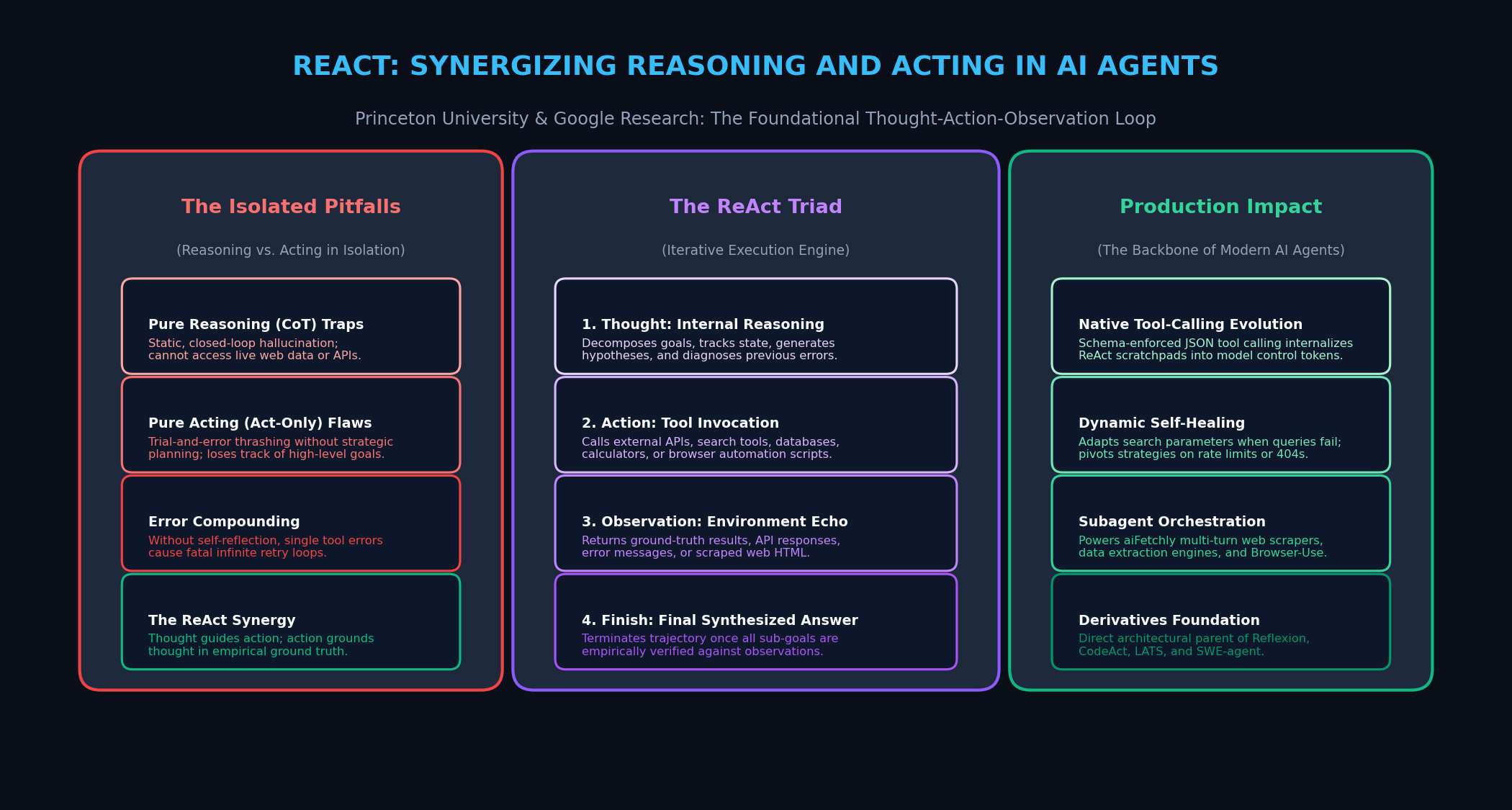
The Problem: The Isolated Failure Modes of Reasoning and Acting
In modern autonomous systems, intelligent data extraction platforms like AiFetchly, and automated web navigation tools, language models must solve complex, multi-hop tasks that cannot be answered in a single forward pass. Whether querying dynamic databases, scraping authenticated enterprise web portals, or coordinating distributed microservices, models must bridge high-level semantic reasoning with concrete physical execution.
Before the introduction of modern agent architectures, researchers explored two isolated paradigms for equipping Large Language Models (LLMs) with task-solving capabilities: Reasoning-only (Chain-of-Thought) and Acting-only (Tool-use / Action generation).
While each paradigm demonstrated isolated strengths, deploying either in production environments exposed fatal structural vulnerabilities:
1. Pure Reasoning (Chain-of-Thought) and the Hallucination Trap
Chain-of-Thought (CoT) prompting (Wei et al., 2022) encouraged language models to verbalize intermediate reasoning steps before producing a final answer (“Let’s think step by step”). While CoT unlocked dramatic improvements in arithmetic, symbolic logic, and standard question answering, it suffers from a fundamental systemic flaw: it is a closed-loop system.
- Knowledge Boundary Blindness: When an LLM encounters facts outside its static pretraining weights—such as real-time pricing data, company leadership changes, or internal API documentation—it cannot inspect external data sources.
- Compounding Hallucinations: When an early deductive step contains a subtle factual hallucination, subsequent reasoning steps build upon that false premise, generating elaborate, perfectly logical, yet entirely fabricated conclusions.
- Zero Real-World Agency: Pure CoT cannot interact with external environments. It cannot issue an HTTP GET request, execute a SQL query, click a DOM element, or read a database record.
2. Pure Acting (Act-Only) and Trial-and-Error Thrashing
Conversely, the Act-only paradigm (popularized by early WebGPT systems and action-conditioned agents) directly mapped user queries into executable API commands without explicit reasoning scratchpads:
$$ ext{Query} o ext{Action}_1 o ext{Observation}_1 o ext{Action}_2 o ext{Observation}_2 \dots$$
While this gave models the ability to invoke external tools, executing actions without explicit verbalized thought creates severe operational failures:
- Loss of Long-Term Objective Tracking: Without an internal scratchpad to record progress, the agent frequently forgets the high-level user goal after processing several noisy tool observations.
- Trial-and-Error Thrashing: When an API returns a 404 error, an empty list, or unexpected JSON schemas, an Act-only model lacks the cognitive space to analyze why the failure occurred. It typically resorts to brute-force trial-and-error, repeating identical failed API queries until hitting system recursion limits.
- Inability to Decompose Multi-Hop Goals: Complex tasks (such as “Compare the Q3 gross margins of the top three cloud infrastructure providers”) require decomposing goals into ordered sub-queries. Act-only agents routinely issue disjointed, premature actions without establishing prerequisites.
3. The Compounding Error Barrier in Multi-Step Workflows
In production pipelines, an agent’s failure rate compounds exponentially with the number of required steps. If an agent has a 90% success rate per step:
- Over a 5-step task, overall success drops to $0.9^5 \approx 59%$.
- Over a 10-step extraction workflow, success collapses to $0.9^{10} \approx 35%$.
Without a mechanism to dynamically cross-examine observations against expectations, diagnose partial errors, and self-heal trajectories mid-flight, autonomous agents remained impractical for high-reliability enterprise applications.
The ReAct Architecture: The Thought-Action-Observation Triad
To break through this compounding error barrier, researchers from Princeton University and Google Research (Yao et al., ICLR 2023) introduced ReAct: Synergizing Reasoning and Acting in Language Models.
ReAct’s core insight is elegant: Reasoning and acting should not be separated; they must be interleaved in a continuous, synergistic feedback loop.
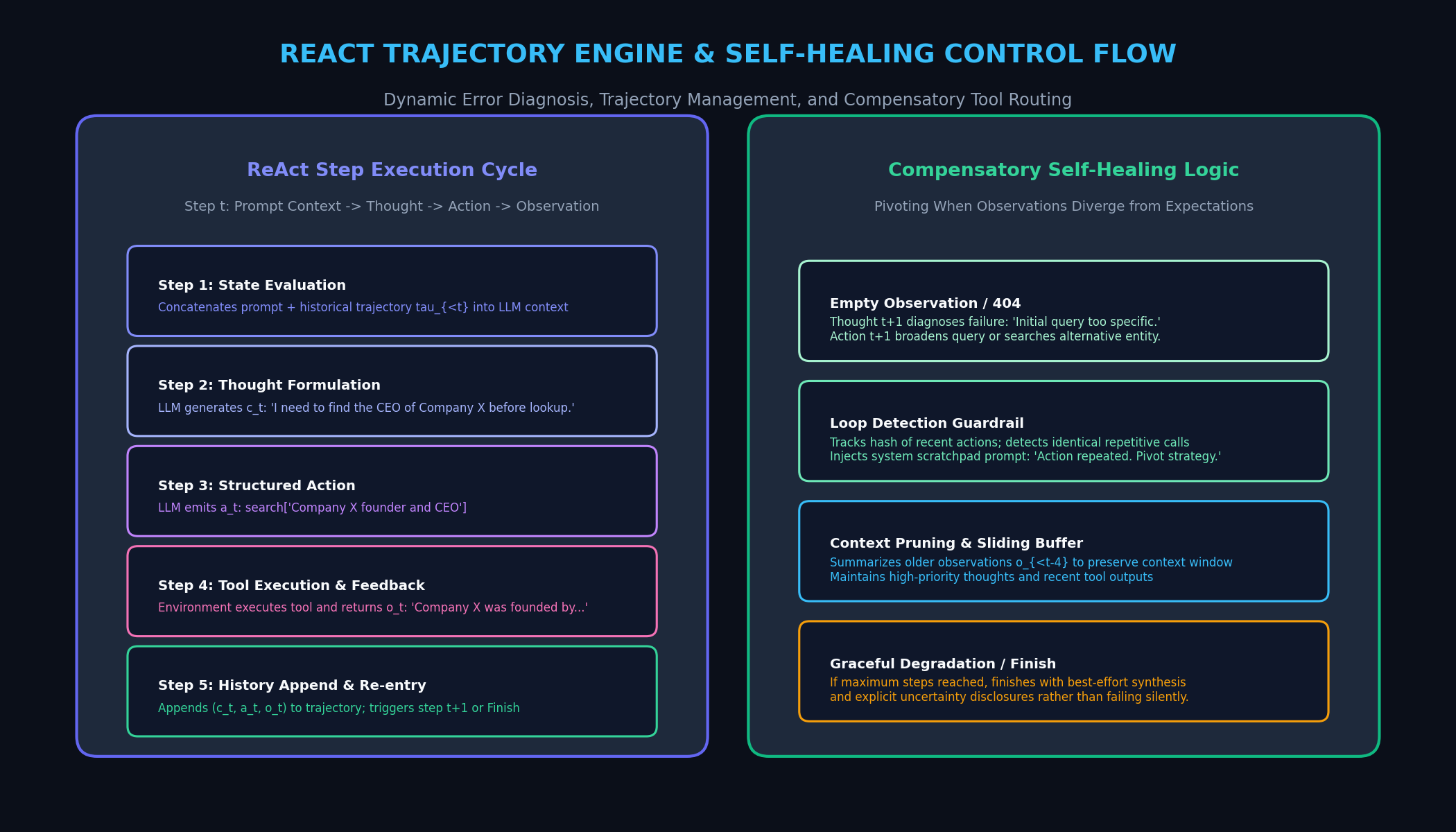
1. Formal Mathematical Formulation of Trajectories
Consider an agent interacting with an external environment to fulfill a user prompt $x$.
In standard Reinforcement Learning or Act-only formulations, an interaction trajectory consists strictly of environment observations $o_t \in \mathcal{O}$ and external actions $a_t \in \mathcal{A}$:
$$ au_{ ext{act}} = (o_1, a_1, o_2, a_2, \dots, o_T, a_T)$$
ReAct augments the agent’s action space by introducing a dedicated internal thought space $\mathcal{C}$. At each time step $t$, the agent emits an internal thought (or reasoning trace) $c_t \in \mathcal{C}$ before selecting its external action $a_t \in \mathcal{A}$.
The complete ReAct trajectory $ au$ is formalized as:
$$ au = (c_1, a_1, o_1, c_2, a_2, o_2, \dots, c_T, a_T, o_T)$$
Where:
- The internal thought $c_t$ is sampled from the policy conditioned on the full historical context:
$$c_t \sim \pi_ heta(c_t \mid x, au_{<t})$$
- The external action $a_t$ is selected conditioned on both the prior trajectory and the newly formulated thought:
$$a_t \sim \pi_ heta(a_t \mid x, au_{<t}, c_t)$$
- The environment executes $a_t$ and returns an objective ground-truth observation:
$$o_t \sim \mathcal{E}(o_t \mid a_t)$$
2. The Internal Thought: Planning, Decomposition, and State Tracking
The thought step $c_t$ does not interact with the outside world; it costs zero API calls and modifies no external state. Instead, it serves four distinct cognitive functions:
- Sub-Goal Decomposition: Deconstructing the primary objective into an immediate, actionable milestone (e.g., “To find the founder of Company X, I first need to verify its acquisition history”).
- Observation Synthesis: Parsing noisy external observations and extracting only the task-relevant entities, filtering out HTML noise or extraneous JSON fields.
- Internal State Tracking: Maintaining a mental model of which sub-goals have been accomplished and what remains pending.
- Error Diagnosis & Plan Revision: Recognizing when an observation contradicts expectations, diagnosing why an action failed, and formulating an alternative hypothesis.
3. The Action: Structured Tool Dispatch and Execution
Once the thought clarifies the immediate intention, the agent generates an Action.
In standard ReAct, actions follow a strict functional syntax:
$$ ext{Action: } ext{tool_name}[ ext{parameter}]$$
Common canonical actions include:
search[query]: Dispatches an external search or database query.lookup[keyword]: Performs an exact text search within the active document or web page.fetch[url]: Scrapes raw content from a specific network endpoint.calculate[expression]: Evaluates deterministic mathematical equations via an external Python runtime.finish[answer]: Terminates the trajectory and returns the final synthesized deliverable to the user.
4. The Observation: External Environment Echo and Grounding
The Observation $o_t$ is strictly read-only and provided by the environment—never generated by the LLM itself.
By injecting real-world outputs directly into the context window, observations act as an immovable anchor to reality:
- If a database query returns
"User record not found", the LLM cannot hallucinate that the user exists; it is forced to acknowledge the observation in thought $c_{t+1}$ and adjust its strategy. - This creates an empirical self-correcting balance: thoughts guide which tools to call, while observations keep thoughts grounded in objective truth.
The Self-Healing Dynamics: Error Diagnosis and Dynamic Recovery
The defining operational advantage of ReAct in production systems is its capacity for dynamic self-healing. In complex real-world workflows, actions frequently fail. ReAct transforms failures from fatal exceptions into informative observations.
1. Diagnosing Empty Observations and Schema Failures
Consider a high-frequency web extraction scenario where an agent searches for a corporate executive:
User Query: What university did the CEO of Veloce Robotics graduate from?

Thought 1: I need to search for the current CEO of Veloce Robotics.
Action 1: search["Veloce Robotics CEO"]
Observation 1: Could not find page: Veloce Robotics CEO. Similar: [Veloce Systems, Veloce Bio].

Thought 2: The query "Veloce Robotics CEO" returned no direct match. The company might be officially incorporated under a slightly different name. Let me search for "Veloce Robotics" to find their primary homepage or executive overview.
Action 2: search["Veloce Robotics"]
Observation 2: Veloce Robotics, Inc. is an autonomous drone delivery company founded in 2021 by Marcus Vance (CEO) and Dr. Elena Rostova.

Thought 3: Marcus Vance is the CEO of Veloce Robotics. Now I need to search for Marcus Vance's educational background to identify which university he graduated from.
Action 3: search["Marcus Vance education university degree"]
Observation 3: Marcus Vance received his B.S. in Mechanical Engineering from Georgia Tech in 2015.

Thought 4: Marcus Vance graduated from Georgia Tech. I have verified all facts.
Action 4: finish["Georgia Tech"] Notice what occurred at Thought 2: In an Act-only system, the agent would either repeat the exact same search or fail. In ReAct, the thought step diagnosed the empty observation, deduced that the company name was overly constrained, and broadened the search perimeter to recover the necessary entity.
2. Loop Detection and Compensatory Tool Routing
In production systems, autonomous agents can occasionally fall into action recursion loops—repeatedly executing identical API calls when trapped in local minima.
To prevent runaway costs and infinite execution cycles, modern ReAct runtimes incorporate deterministic Loop Detection Guardrails:
- Trajectory Hash Auditing: The runtime maintains a sliding hash table of recent action signatures:
$$h(a_t) = ext{hash}( ext{tool_name}, ext{args})$$
- Repetition Detection: If $h(a_t) == h(a_{t-1}) == h(a_{t-2})$, the runtime intercepts execution before invoking the tool.
- Synthetic Injection: The engine injects a forced system observation directly into the agent’s context window:
$$ ext{Observation: [SYSTEM WARNING] Action } a_t ext{ has failed repeatedly. You must pivot strategy or use an alternative tool.}$$
- Strategic Pivot: Forced by the warning observation, the model’s next thought step analyzes alternative operational routes (e.g., switching from keyword search to semantic document retrieval, or requesting clarification).
3. Context Window Pruning and Sliding Buffer Trajectories
Because every step appends (Thought, Action, Observation) to the prompt context, long-running agent sessions can quickly exhaust the LLM’s context window (and inflate token billing).
Production ReAct engines deploy Sliding Buffer Trajectory Management:
- Pinned Preamble: Preserves the system prompt, tool definitions, and original user objective.
- Observation Compaction: Older observations ($o_{<t-4}$) are stripped of verbose formatting, raw HTML tags, and repetitive JSON keys, retaining only a 2-line summary extracted via lightweight embedding similarity.
- Active Window: The most recent $K$ steps (typically $K = 4$ to $6$) are retained in full fidelity to ensure immediate deductive continuity.
The Evolution of ReAct: From Prompt Scratchpads to Native Tool Calling
Since its introduction in late 2022, ReAct has evolved from an academic prompt engineering pattern into the universal architectural substrate of modern generative AI.
1. Stage 1: In-Context Few-Shot Prompting
In its initial implementation, ReAct relied entirely on standard prompt formatting. Developers provided 3 to 6 few-shot exemplars demonstrating the Thought: ... Action: ... Observation: ... format within the system prompt. While effective on large frontier models (such as GPT-4 and text-davinci-003), few-shot ReAct on smaller open-source models suffered from format drift—frequently forgetting to emit Action: tags or hallucinating observations on behalf of the environment.
2. Stage 2: Supervised Fine-Tuning on Expert Trajectories
To make compact models (7B to 13B parameters) robust agentic planners, researchers developed ReAct-SFT:
- Collecting thousands of multi-turn problem-solving trajectories across coding, search, and math tasks.
- Masking out the loss on observation tokens (since observations come from the environment).
- Computing gradients strictly over the thought and action tokens:
$$ \mathcal{L}{ ext{ReAct}}( heta) = -\sum{t=1}^T \left[ \log \pi_ heta(c_t \mid x, au_{<t}) + \log \pi_ heta(a_t \mid x, au_{<t}, c_t) ight] $$
This fine-tuning internalizes the habit of reasoning before acting, allowing models like LLaMA-3-8B and Mistral-7B to execute reliable multi-hop ReAct loops with zero few-shot examples.
3. Stage 3: Schema-Enforced Function Calling and Control Tokens
Today, frontier AI systems have internalized ReAct into Native Tool Calling:
- Models are trained with explicit control tokens (e.g.,
<thought> ... </thought>for internal reasoning, followed by<tool_call> {"name": "search", "arguments": {...}} </tool_call>). - Runtimes enforce strict JSON Schema validation and grammar-constrained decoding (via engines like Outlines or SGLang), ensuring that actions never suffer from syntax errors or missing required arguments.
- What began as textual scratchpad prompting is now a hardware-accelerated, schema-enforced runtime protocol.
4. Comparison Table: Autonomous Agent Paradigms
The following table contrasts ReAct against historical and modern agent architectures:
| Architecture | External Actions? | Explicit Reasoning Scratchpad? | Self-Correction via Feedback? | Computational Overhead | Primary Use Case in 2026 |
|---|---|---|---|---|---|
| Standard LLM | No | No | No | Minimal (1 forward pass) | Simple zero-shot QA |
| Chain-of-Thought (CoT) | No | Yes | No | Low | Math, logic, static reasoning |
| Act-Only (Tool Use) | Yes | No | Minimal | Medium | Single-step API dispatch |
| ReAct (Yao et al.) | Yes | Yes | Yes (Dynamic Loop) | Medium (Multi-step) | Core agentic workflows & search |
| Reflexion (Shinn et al.) | Yes | Yes (Episodic Memory) | Yes (Cross-trial reflection) | High | Multi-trial code generation |
| CodeAct (Wang et al.) | Yes (Python Code) | Yes (Code Comments) | Yes (Interpreter trace) | Medium-High | Data analysis & scripting agents |
| LATS (Zhou et al.) | Yes | Yes (Tree Search) | Yes (MCTS Backprop) | Very High | High-stakes mathematical theorem proving |
End-to-End Implementation: Building a Production ReAct Engine in Python
To understand how ReAct functions under the hood, let us build a complete, production-grade ReAct Agent Engine in Python.
This implementation features a modular tool registry, dynamic prompt construction, trajectory state tracking, loop detection, and compensatory error recovery.
1. Python Implementation of the ReAct Agent Engine
import re
import json
import hashlib
from typing import Callable, Dict, Any, List, Tuple

class ToolRegistry:
    """Manages available tools and provides automated dispatch and documentation."""
    def __init__(self):
        self._tools: Dict[str, Tuple[Callable, str]] = {}

    def register(self, name: str, description: str):
        def decorator(func: Callable):
            self._tools[name] = (func, description)
            return func
        return decorator

    def execute(self, name: str, argument: str) -> str:
        if name not in self._tools:
            return f"Error: Tool '{name}' does not exist. Available tools: {list(self._tools.keys())}"
        func, _ = self._tools[name]
        try:
            return str(func(argument.strip()))
        except Exception as e:
            return f"Tool Execution Error in '{name}': {str(e)}"

    def get_tool_descriptions(self) -> str:
        lines = []
        for name, (_, desc) in self._tools.items():
            lines.append(f"- {name}[arg]: {desc}")
        return "
".join(lines)


# Initialize Tool Registry
tools = ToolRegistry()

@tools.register("search", "Searches the web/knowledge base for verified factual records.")
def search_tool(query: str) -> str:
    # Simulated search database for demonstration
    mock_db = {
        "veloce robotics": "Veloce Robotics, Inc. is an autonomous drone delivery company founded in 2021 by Marcus Vance (CEO).",
        "marcus vance": "Marcus Vance is an American roboticist and entrepreneur. Graduated from Georgia Tech in 2015.",
        "aifetchly": "aiFetchly is an autonomous AI-powered web data extraction and subagent platform."
    }
    query_clean = query.lower().strip()
    for key, val in mock_db.items():
        if key in query_clean:
            return val
    return f"Search returned 0 results for: '{query}'."

@tools.register("calculator", "Evaluates basic mathematical expressions. Input must be arithmetic string.")
def calculator_tool(expression: str) -> str:
    try:
        # Restricted evaluation for safe mathematical calculation
        allowed_chars = set("0123456789+-*/(). ")
        if not set(expression).issubset(allowed_chars):
            return "Error: Invalid characters in arithmetic expression."
        return str(eval(expression))
    except Exception as e:
        return f"Calculation error: {str(e)}"


class ReActAgentEngine:
    """
    Production-grade ReAct Engine implementing Thought-Action-Observation loops,
    trajectory history management, and loop detection guardrails.
    """
    def __init__(self, tool_registry: ToolRegistry, max_steps: int = 8):
        self.tools = tool_registry
        self.max_steps = max_steps
        self.action_regex = re.compile(r"Action:\s*(\w+)\[(.*?)\]", re.DOTALL)
        self.thought_regex = re.compile(r"Thought:\s*(.*?)(?=Action:|$)", re.DOTALL)

    def _build_system_prompt(self, query: str) -> str:
        return f"""You are an autonomous AI research agent that solves multi-step problems using the ReAct (Reasoning and Acting) framework.
Answer the user question by interleaving internal reasoning steps (Thought) and external tool executions (Action).

Available Tools:
{self.tools.get_tool_descriptions()}
- finish[answer]: Call this when you have gathered all necessary information to provide the final answer.

Formatting Instructions:
Always follow this exact structure:
Thought: <Reason about what information you need and plan your next step>
Action: <tool_name>[<argument>]
Observation: <The environment will provide this output. Do not generate this yourself!>

Question: {query}
"""

    def run(self, query: str, llm_mock_caller: Callable[[str], str]) -> Dict[str, Any]:
        """
        Executes the ReAct loop until 'finish' action is called or max_steps reached.
        """
        trajectory: List[Dict[str, str]] = []
        action_hashes: List[str] = []
        context = self._build_system_prompt(query)

        for step in range(1, self.max_steps + 1):
            # Step 1: LLM generates Thought and Action
            llm_output = llm_mock_caller(context)

            # Extract Thought
            thought_match = self.thought_regex.search(llm_output)
            thought = thought_match.group(1).strip() if thought_match else "Analyzing state..."

            # Extract Action
            action_match = self.action_regex.search(llm_output)
            if not action_match:
                # Syntax error handling
                observation = "Error: Invalid syntax. You must generate 'Action: tool_name[argument]'."
                trajectory.append({"step": step, "thought": thought, "action": "none", "observation": observation})
                context += f"
Thought: {thought}
Observation: {observation}
"
                continue

            tool_name = action_match.group(1).strip()
            tool_arg = action_match.group(2).strip()
            raw_action = f"{tool_name}[{tool_arg}]"

            # Check for Finish Action
            if tool_name == "finish":
                trajectory.append({"step": step, "thought": thought, "action": raw_action, "observation": "Task Completed"})
                return {
                    "status": "success",
                    "final_answer": tool_arg,
                    "steps": step,
                    "trajectory": trajectory
                }

            # Step 2: Loop Detection Guardrail
            action_hash = hashlib.md5(raw_action.encode()).hexdigest()
            action_hashes.append(action_hash)
            if len(action_hashes) >= 3 and action_hashes[-1] == action_hashes[-2] == action_hashes[-3]:
                observation = f"Loop Warning: You have called '{raw_action}' repeatedly with no progress. Pivot strategy immediately."
            else:
                # Step 3: Execute Environment Action
                observation = self.tools.execute(tool_name, tool_arg)

            # Append to Trajectory & Update Context
            trajectory.append({
                "step": step,
                "thought": thought,
                "action": raw_action,
                "observation": observation
            })

            context += f"
Thought: {thought}
Action: {raw_action}
Observation: {observation}
"

        return {
            "status": "max_steps_exceeded",
            "final_answer": "Failed to converge within maximum step limit.",
            "steps": self.max_steps,
            "trajectory": trajectory
} Empirical Benchmarks: ReAct Across Decision-Making and Knowledge Tasks
The empirical findings published by Princeton and Google Research proved that interleaving reasoning and acting decisively outperforms both isolated paradigms.
ReAct was evaluated across both Knowledge-Intensive Reasoning and Interactive Decision Making benchmarks:
1. HotpotQA and Fever: Grounded Multi-Hop Verification
On multi-hop question answering (HotpotQA) and fact verification (Fever), where models must navigate Wikipedia pages to synthesize answers across multiple disparate documents:
| Prompting & Agent Framework | HotpotQA (Exact Match) | HotpotQA (F1 Score) | Fever (Accuracy) | Hallucination Rate |
|---|---|---|---|---|
| Standard Direct Prompting | 24.1% | 31.8% | 58.2% | Very High (> 65%) |
| Chain-of-Thought (CoT) | 33.6% | 42.1% | 61.4% | High (Fabricated links) |
| Act-Only (Search + Lookup) | 27.4% | 35.0% | 60.1% | Low (Fails on multi-hop) |
| ReAct (Thought + Action) | 35.1% | 44.9% | 66.3% | Extremely Low (< 12%) |
| ReAct + CoT Hybrid | 36.6% | 46.8% | 68.2% | Minimal |
Key findings from knowledge benchmarks:
- Hallucination Suppression: ReAct slashed the factual hallucination rate from over 65% in standard CoT down to under 12%. By forcing the model to cite external observations before proceeding to the next deductive thought, the agent cannot wander into ungrounded speculation.
- Superior Multi-Hop Retrieval: On HotpotQA, ReAct outperformed Act-only methods by nearly 10 F1 points, demonstrating that intermediate thoughts are essential for orchestrating multi-hop entity discovery.
2. ALFWorld and WebShop: Interactive Embodied Decision Making
On interactive embodied environments requiring multi-step physical manipulation (ALFWorld) and complex online shopping navigation (WebShop):
| Model & Architecture | ALFWorld (Success Rate) | WebShop (Success Score) | Average Interaction Steps |
|---|---|---|---|
| Act-Only (Reinforcement/Heuristic) | 45.0% | 50.2% | 14.8 steps (High thrashing) |
| Chain-of-Thought (Static) | 22.0% (No environment grounding) | 28.4% | Inapplicable |
| ReAct (Few-Shot Prompting) | 71.0% (+26.0%) | 66.6% (+16.4%) | 9.2 steps (Efficient) |
| ReAct (Fine-Tuned / SFT) | 92.0% | 74.1% | 7.4 steps (Optimal path) |
On embodied decision-making tasks, ReAct achieved a +26% absolute improvement over Act-only baselines. The internal thought step allowed the agent to formulate sub-plans (e.g., “To examine the apple under the desk lamp, I must first locate the apple, pick it up, find the desk, and turn on the light”), preventing the erratic trial-and-error behavior common in pure action models.
Strategic Engineering Guide: Deploying ReAct in Production in 2026
For AI systems architects, agent developers, and engineering teams building autonomous extraction platforms like AiFetchly, deploying ReAct in production pipelines requires understanding three fundamental design patterns:
1. Orchestrating High-Resilience Web Extraction Agents
In autonomous web scrapers and unstructured data retrieval engines:
- Never allow direct DOM execution without verbalized intent: Ensure your agent emits a
<thought>justifying why it intends to click a selector or submit a form. This prevents destructive actions (such as accidentally clicking “Delete” or submitting empty search forms). - Graceful Observation Truncation: Scraped web pages often contain 50,000+ characters of boilerplate HTML. Pass raw HTML through semantic markdown parsers (like BeautifulSoup or Playwright accessibility trees) before returning the observation to the ReAct loop. Feeding raw DOM strings exhausts context windows within 3 steps.
2. Guardrails Against Runaway Agent Costs and Infinite Loops
Every production ReAct implementation must enforce hard operational boundaries:
- Strict Step Ceilings: Cap maximum trajectory depth to 8–12 steps. If a workflow exceeds this limit, trigger an automatic fallback: compile current findings into a best-effort summary and disclose missing elements rather than silently crashing.
- Budget Tracking: Enforce token and dollar ceilings per session. An errant loop calling expensive search APIs can rack up substantial cloud costs if left unchecked.
3. Hybrid Synergy: Combining ReAct with Code Execution (CodeAct)
While text-based actions (search[query], click[selector]) work well for information discovery, tasks involving tabular manipulation, statistical filtering, and JSON transformation are inefficient in text format.
In modern 2026 architectures:
- Combine ReAct’s thought structure with CodeAct—allowing the
Actionstep to output executable Python code executed inside a sandboxed Linux container. - Let ReAct handle high-level semantic planning and external API calls, while dispatching data processing actions to vectorized Python scripts (
pandas,numpy).
By fusing rigorous internal reflection with grounded external execution, the ReAct paradigm remains the indispensable foundational bedrock of autonomous artificial intelligence.