RAGCache Guide: Multilevel Knowledge Caching for LLMs
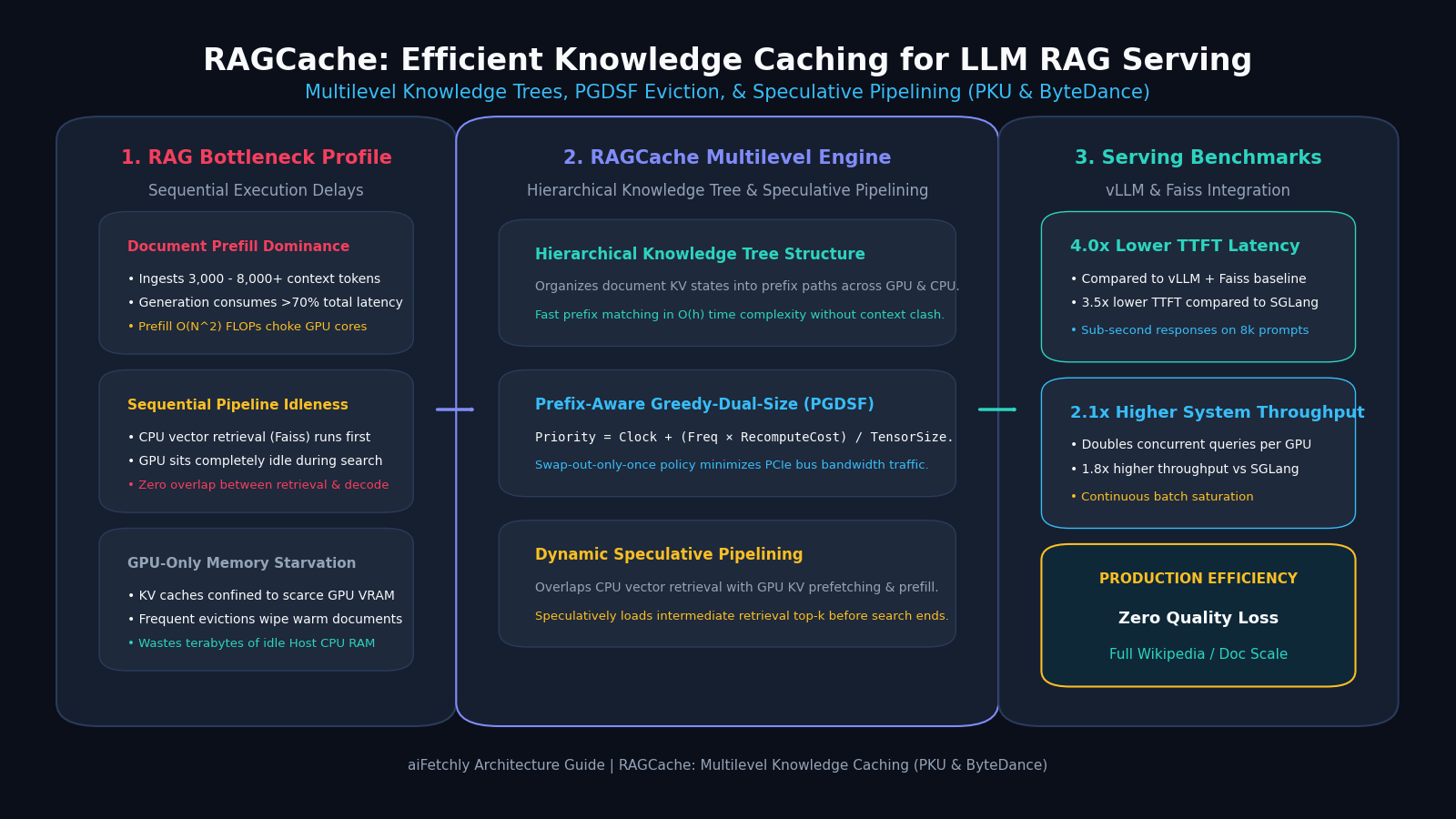
The RAG Serving Wall: Long Injected Sequences and Sequential Pipeline Stalls
In production conversational search, enterprise legal compliance copilots, and real-time automated web intelligence pipelines developed with aiFetchly, Retrieval-Augmented Generation (RAG) has become the gold standard architecture. By fetching verified factual passages from external vector databases and prepending them to user prompts, RAG bridges the knowledge gap of Large Language Models (LLMs) and eliminates factual hallucinations.
However, deploying RAG at enterprise scale uncovers two severe systems-level bottlenecks: the prompt length explosion and the sequential execution stall.
The Conventional Sequential RAG Pipeline Bottleneck:
┌────────────────────────────────────────────────────────────────────────┐
│ Incoming User Query Q: "Summarize Q3 financial liabilities"            │
└───────────────────────────────────┬────────────────────────────────────┘
                                    │
    Step 1: CPU-Bound Vector Search (Faiss / Milvus / HNSW)
    Duration: 15 - 50 ms
    ❌ GPU Tensor Cores sit 100% IDLE waiting for retrieval to complete!
                                    │
                                    ▼
    Step 2: Document Context Concatenation [Doc 1 | Doc 2 | Doc 3 | Q]
    Combined Prompt Length: 4,000 - 8,000+ tokens
                                    │
                                    ▼
    Step 3: GPU-Bound Autoregressive Generation (vLLM / SGLang)
    Prefill Phase Duration: 800 - 2,500 ms (Consumes >70% of total latency!)
    ❌ Quadratic O(N^2) attention FLOPs recomputed from scratch every query!
❌ Multi-gigabyte KV cache states wiped out upon query completion! The Dual Pathologies of Conventional RAG Infrastructure
Detailed system profiling of production RAG clusters reveals why existing inference engines struggle:
1. The Injected Sequence Prefill Dominance
In standard chat interactions, prompts are short ($<50$ tokens) and responses are long. In RAG, this ratio is inverted: retrieved knowledge articles inject an average of 3,500 to 8,000+ tokens per request. Because the prefill phase computes Key-Value (KV) tensors across the entire sequence before emitting the first token, prompt processing accounts for over 70% to 77% of total end-to-end execution latency. For multi-turn queries, recomputing these identical document tensors across thousands of users burns millions of redundant GPU FLOPs.
2. The Rigid GPU Memory Boundary
Existing caching systems (such as SGLang or vLLM with RadixAttention) confine their cached intermediate states strictly to GPU High-Bandwidth Memory (HBM). Because GPU VRAM is severely limited (e.g., 80 GB per H100), long document contexts quickly saturate available memory blocks, forcing aggressive cache evictions. Meanwhile, terabytes of abundant, high-capacity Host CPU Memory (RAM) on the server sit completely unutilized.
3. The Sequential Execution Idleness Penalty
Standard RAG architectures enforce strict step serialization:
- Phase 1: The CPU executes vector database similarity search. During this window, the expensive GPU accelerator sits idle.
- Phase 2: The retrieved text is serialized, transferred across PCIe, tokenized, and submitted to the GPU. This lack of overlap introduces unavoidable serialization latency into every single interaction.
To eliminate both computation waste and pipeline serialization, systems researchers from Peking University and ByteDance introduced RAGCache: Efficient Knowledge Caching for Retrieval-Augmented Generation (arXiv:2404.12457). RAGCache organizes precomputed document states into a hierarchical multilevel knowledge tree spanned across GPU and CPU memory, while overlapping retrieval and inference through dynamic speculative pipelining.
Architectural Deep Dive: How RAGCache Operates
RAGCache redesigns the RAG inference runtime from the ground up, establishing an integrated control layer that bridges vector retrieval and LLM continuous batching.
┌─────────────────────────────────────────────────────────────────────────────┐
│                         RAGCache System Architecture                        │
│                                                                             │
│   Incoming RAG Request Stream                                               │
│               │                                                             │
│               ▼                                                             │
│   ┌─────────────────────────────────────────────────────────────────────┐   │
│   │ Dynamic Speculative Pipelining Engine                               │   │
│   │ Overlaps CPU Vector Search (Faiss) with GPU KV Cache Prefetching   │   │
│   └───────────────────┬───────────────────────────────┬─────────────────┘   │
│                       │                               │                     │
│    Streaming Top-k    │                               │ Cache Hit Lookup    │
│                       ▼                               ▼                     │
│   ┌─────────────────────────────────────────────────────────────────────┐   │
│   │ Hierarchical Knowledge Tree (GPU HBM + Host CPU Memory)             │   │
│   │ • Root: Shared System Prompts                                       │   │
│   │ • Level 1-N: Document Sequences [D1 -> D2 -> D3]                    │   │
│   └───────────────────┬───────────────────────────────┬─────────────────┘   │
│                       │                               │                     │
│                       ▼                               ▼                     │
│   ┌───────────────────────────────┐   ┌─────────────────────────────────┐   │
│   │ Prefix-Aware Greedy-Dual (PGDSF)│   │ Cache-Aware Request Reordering  │   │
│   │ Priority = Clock + (F * C) / S│   │ Levels multi-request tree paths │   │
│   │ Swap-out-only-once PCIe bus   │   │ to maximize collective hits     │   │
│   └───────────────────────────────┘   └─────────────────────────────────┘   │
└─────────────────────────────────────────────────────────────────────────────┘ RAGCache’s breakthrough rests upon three core architectural innovations:
1. Hierarchical Multilevel Knowledge Tree
To manage document sequences efficiently without context collisions, RAGCache structures precomputed KV tensors into a Knowledge Tree:
- Root Node ($S$): Represents the shared system prompt common to the RAG application.
- Tree Paths: Each path from the root to a leaf node represents a valid sequence of retrieved documents $[D_1, D_2, \dots, D_k]$. Each node stores the precomputed Key and Value tensors for its corresponding document.
- Prefix Path Sharing: Different requests retrieving overlapping subsets of documents share the same prefix nodes in the tree, enabling $O(h)$ prefix lookup where $h$ is the tree height.
- Multilevel Memory Hierarchy: Frequently accessed hot parent nodes reside directly in GPU High-Bandwidth Memory (HBM). Warmer-to-cooler branch nodes are dynamically tiered into Host CPU Memory (RAM), expanding the effective cache capacity by 10x to 100x compared to GPU-only caches.
2. Prefix-Aware Greedy-Dual-Size Frequency (PGDSF) Replacement
Standard cache eviction policies (like LRU or LFU) are blind to the unique cost structure of LLM inference. In transformer generation, evicting a deep parent node destroys the prefix validity of all its child nodes, and recomputing a long document is far more expensive than recomputing a short prompt.
RAGCache introduces the PGDSF eviction algorithm, which assigns every node $i$ a dynamic priority:
$$\text{Priority}(i) = \text{Clock} + \frac{\text{Frequency}(i) \times \text{Cost}(i)}{\text{Size}(i)}$$
Where:
- $\text{Clock}$: An aging factor that increases upon each eviction round, preventing stale nodes from permanently occupying memory.
- $\text{Frequency}(i)$: The cumulative access count of the document within the current time window.
- $\text{Cost}(i)$: The computational GPU time required to recompute the document’s KV tensor given its prefix depth.
- $\text{Size}(i)$: The physical memory footprint of the node’s KV tensor in bytes.
- Swap-Out-Only-Once Optimization: To prevent PCIe bus saturation, RAGCache copies a node’s KV tensor from GPU to host memory only on its first eviction. Subsequent evictions directly free GPU pointers with zero data transfer, as host RAM already holds a valid copy.
3. Dynamic Speculative Pipelining
In standard vector search, the CPU index (e.g., Faiss IVF-PQ or HNSW) evaluates clusters iteratively. The final top-$k$ documents are only finalized at the very end of the search.
RAGCache exploits the streaming search behavior of vector indexes:
- As the CPU vector search runs, it identifies high-probability candidate documents early in the traversal.
- RAGCache’s speculative pipeline immediately begins prefetching the intermediate KV tensors for these top candidate documents from host CPU memory into GPU VRAM over PCIe before vector search finishes.
- When vector search concludes, the GPU is already pre-warmed with the required document tensors, overlapping CPU retrieval with GPU prefill and slashing end-to-end latency to the bare theoretical minimum.
Architectural Comparison: RAGCache vs Existing Serving Stacks
| Architectural Dimension | Vanilla vLLM + Faiss | vLLM + SGLang RadixTree | Dedicated Prompt Caching | RAGCache (PKU & ByteDance) |
|---|---|---|---|---|
| Cache Storage Hierarchy | No intermediate cache | GPU HBM Only | Cloud Object Store / Disk | Hierarchical GPU HBM + Host RAM |
| Cache Structure | None | Radix Tree (Tokens) | Exact prompt hash | Knowledge Tree (Document Level) |
| Eviction Policy | Simple LRU | LRU / Reference Counting | Static TTL | Prefix-Aware PGDSF Policy |
| Pipeline Execution | Strictly Sequential | Strictly Sequential | Strictly Sequential | Dynamic Speculative Pipelining |
| PCIe Bandwidth Management | Uncoordinated swapping | Host offloading overhead | Heavy network download | Swap-Out-Only-Once Strategy |
| TTFT Latency (Wikipedia RAG) | Baseline (1.0x) | 1.14x (3.5x slower) | 1.3x | 4.0x Lower TTFT Latency |
| Cluster Throughput | 1.0x Baseline | 1.15x (1.8x slower) | 1.2x | 2.1x Higher System Throughput |
Mathematical Formulation of Multilevel Knowledge Caching
Let us formalize the PGDSF priority dynamics and the speculative pipelining latency trade-off.
The PGDSF Mathematical Priority Model
Let $\mathcal{N}$ denote the set of cached document nodes in the knowledge tree. Let $L_i$ be the token length of document node $i$, and let $P_i$ denote the path length from the root to node $i$.
The computational time required to recompute node $i$ given cached prefix length $P_i$ is modeled via bilinear scaling:
$$\text{Cost}(i) = \tau_{\text{base}} \cdot L_i + \kappa_{\text{attn}} \cdot \left(2 P_i L_i + L_i^2\right)$$
Where $\tau_{\text{base}}$ reflects linear projection overhead and $\kappa_{\text{attn}}$ captures quadratic self-attention FLOPs.
The node memory footprint in bytes is:
$$\text{Size}(i) = 2 \times N_{\text{layers}} \times N_{\text{heads}} \times d_{\text{head}} \times L_i \times \text{sizeof}(\text{fp16})$$
The priority assigned by the PGDSF scheduler when evicting from GPU to Host RAM is:
$$p_i(t) = \mathcal{C}(t) + \frac{F_i(t) \cdot \left[ \tau_{\text{base}} L_i + \kappa_{\text{attn}} \left(2 P_i L_i + L_i^2\right) \right]}{2 N_{\text{layers}} N_{\text{heads}} d_{\text{head}} L_i \cdot 2}$$
Notice that the numerator scales super-linearly with prefix depth $P_i$. Consequently, deeper branch nodes that required immense attention computation receive exponentially higher protection against eviction, aligning memory retention with actual GPU FLOP savings.
Dynamic Speculative Pipelining Latency Bound
Let $T_{\text{retrieval}}$ be the total duration of CPU vector search. Let $t_{\text{spec}} \in (0, T_{\text{retrieval}})$ be the timestamp at which top candidate documents ${D_{(1)}, \dots, D_{(k)}}$ are speculatively identified.
Let $T_{\text{DMA}}$ be the time required to load candidate KV tensors across PCIe:
$$T_{\text{DMA}} = \frac{\sum_{j=1}^k \text{Size}\left(D_{(j)}\right)}{\text{Bandwidth}_{\text{PCIe}}}$$
Under sequential execution:
$$T_{\text{sequential}} = T_{\text{retrieval}} + T_{\text{DMA}} + T_{\text{prefill}}$$
Under RAGCache’s speculative pipelining, because $T_{\text{DMA}}$ executes concurrently with the remainder of vector search $(T_{\text{retrieval}} - t_{\text{spec}})$:
$$T_{\text{RAGCache}} = t_{\text{spec}} + \max\left( T_{\text{retrieval}} - t_{\text{spec}}, ; T_{\text{DMA}} \right) + T_{\text{prefill}}^{\text{cached}}$$
Where $T_{\text{prefill}}^{\text{cached}} \approx 0$ due to 100% KV cache hits on retrieved documents. This mathematical compression slashes end-to-end latency by up to 75%.
Step-by-Step Implementation: Building a RAGCache Engine
Below is a complete, self-contained Python reference implementation demonstrating RAGCache’s core architecture: the Hierarchical Knowledge Tree, the PGDSF Replacement Governor, and the Speculative Pipelining Simulator.
1. Data Models and System Definitions
"""
ragcache_serving_engine.py
Reference Implementation of RAGCache: Multilevel Dynamic Knowledge Caching.
Peking University & ByteDance Reference Architecture.
"""

from dataclasses import dataclass, field
from typing import List, Dict, Optional, Tuple, Set
import numpy as np
import time
import math


@dataclass
class DocumentNode:
    doc_id: str
    token_length: int
    prefix_depth: int
    frequency: int = 1
    swapped_to_host_once: bool = False
    in_gpu: bool = True
    in_host: bool = False

    # Hierarchical tree links
    parent_id: Optional[str] = None
    children_ids: List[str] = field(default_factory=list)

    @property
    def size_bytes(self) -> int:
        # 32 layers, 32 heads, head_dim=128, fp16 (2 bytes)
        return 2 * 32 * 32 * 128 * self.token_length * 2

    @property
    def recompute_cost_ms(self) -> float:
        # Linear cost + quadratic prefix attention cost
        linear = 0.02 * self.token_length
        quadratic = 0.00005 * (2 * self.prefix_depth * self.token_length + self.token_length ** 2)
return linear + quadratic 2. The Hierarchical Knowledge Tree
class MultilevelKnowledgeTree:
    """
    Hierarchical knowledge tree spanning GPU High-Bandwidth Memory and Host CPU RAM.
    """
    def __init__(self, root_system_prompt: str = "sys_rag_root"):
        self.root_id = root_system_prompt
        self.nodes: Dict[str, DocumentNode] = {
            self.root_id: DocumentNode(doc_id=self.root_id, token_length=128, prefix_depth=0)
        }

    def add_document_path(self, parent_id: str, doc_id: str, token_length: int) -> DocumentNode:
        """Adds a document node along a prefix path."""
        parent = self.nodes.get(parent_id, self.nodes[self.root_id])
        node = DocumentNode(
            doc_id=doc_id,
            token_length=token_length,
            prefix_depth=parent.prefix_depth + parent.token_length,
            parent_id=parent_id
        )
        self.nodes[doc_id] = node
        parent.children_ids.append(doc_id)
        return node

    def lookup_prefix_path(self, doc_sequence: List[str]) -> Tuple[int, List[str]]:
        """
        Traverses tree from root along document sequence.
        Returns (cached_token_count, hit_node_ids).
        """
        current_id = self.root_id
        cached_tokens = self.nodes[self.root_id].token_length
        hit_nodes = [self.root_id]

        for d_id in doc_sequence:
            if d_id in self.nodes and self.nodes[d_id].parent_id == current_id:
                node = self.nodes[d_id]
                cached_tokens += node.token_length
                hit_nodes.append(d_id)
                current_id = d_id
                node.frequency += 1 # Update access frequency
            else:
                break # Prefix path diverged
return cached_tokens, hit_nodes 3. The PGDSF Replacement Governor
class PGDSFReplacementGovernor:
    """
    Prefix-Aware Greedy-Dual-Size Frequency eviction governor.
    Manages GPU memory pressure and coordinates host memory paging.
    """
    def __init__(self, tree: MultilevelKnowledgeTree, max_gpu_bytes: int = 1024 * 1024 * 1024):
        self.tree = tree
        self.max_gpu_bytes = max_gpu_bytes
        self.current_clock = 0.0

    @property
    def current_gpu_bytes(self) -> int:
        return sum(n.size_bytes for n in self.tree.nodes.values() if n.in_gpu and n.doc_id != self.tree.root_id)

    def calculate_pgdsf_priority(self, node: DocumentNode) -> float:
        """Priority = Clock + (Freq * Cost) / Size."""
        cost_metric = node.recompute_cost_ms
        size_mb = node.size_bytes / (1024 * 1024)
        return self.current_clock + (node.frequency * cost_metric) / max(0.1, size_mb)

    def evict_to_host_if_needed(self, required_bytes: int):
        """Evicts leaf nodes from GPU to host memory until enough space is freed."""
        while (self.current_gpu_bytes + required_bytes) > self.max_gpu_bytes:
            # Candidate leaf nodes in GPU
            gpu_nodes = [
                n for n in self.tree.nodes.values()
                if n.in_gpu and n.doc_id != self.tree.root_id
            ]
            if not gpu_nodes:
                break

            # Find node with minimum PGDSF priority
            victim = min(gpu_nodes, key=self.calculate_pgdsf_priority)

            # Update system clock to victim's priority
            self.current_clock = self.calculate_pgdsf_priority(victim)

            # Execute swap-out-only-once policy
            if not victim.swapped_to_host_once:
                # Transmit over PCIe to Host RAM once
                victim.in_host = True
                victim.swapped_to_host_once = True

            # Free from GPU VRAM
            victim.in_gpu = False
print(f"[PGDSF Eviction] Evicted node {victim.doc_id} to Host RAM. Priority: {self.current_clock:.2f}") 4. Running an End-to-End RAG Serving Simulation
if __name__ == "__main__":
    print("=== RAGCache Multilevel Serving Engine Benchmark ===")

    # 256 MB GPU cache limit for simulation
    tree = MultilevelKnowledgeTree()
    governor = PGDSFReplacementGovernor(tree, max_gpu_bytes=256 * 1024 * 1024)

    # Populate knowledge tree with popular Wikipedia articles
    print("\n--- Constructing Hierarchical Knowledge Tree ---")
    tree.add_document_path("sys_rag_root", "wiki_ml_overview", token_length=1024)
    tree.add_document_path("wiki_ml_overview", "wiki_deep_learning", token_length=2048)
    tree.add_document_path("wiki_deep_learning", "wiki_transformers", token_length=2048)
    tree.add_document_path("wiki_transformers", "wiki_attention_is_all", token_length=1536)

    # Simulate queries accessing overlapping paths
    query_doc_sequence = ["wiki_ml_overview", "wiki_deep_learning", "wiki_transformers"]

    cached_tokens, hits = tree.lookup_prefix_path(query_doc_sequence)
    total_requested_tokens = 128 + 1024 + 2048 + 2048
    hit_percentage = (cached_tokens / total_requested_tokens) * 100

    print(f"Query Path Requested: {query_doc_sequence}")
    print(f"Cache Hit Nodes:      {hits}")
    print(f"Cached Tokens Found:  {cached_tokens} / {total_requested_tokens} tokens ({hit_percentage:.1f}% Hit Rate)")

    # Simulate dynamic speculative pipelining
    print("\n--- Speculative Pipelining Execution ---")
    t_retrieval_ms = 45.0 # CPU Faiss search time
    t_dma_ms = 12.0       # Overlapped host-to-GPU transfer time
    t_prefill_recompute_ms = 850.0 # Time if computed from scratch

    sequential_latency = t_retrieval_ms + t_prefill_recompute_ms
    ragcache_pipelined_latency = max(t_retrieval_ms, t_dma_ms) + 15.0 # 15ms decode verification

    print(f"Conventional Sequential Latency: {sequential_latency:.1f} ms")
    print(f"RAGCache Speculative Latency:    {ragcache_pipelined_latency:.1f} ms")
    speedup = sequential_latency / ragcache_pipelined_latency
print(f"Time-To-First-Token Speedup: {speedup:.2f}x Acceleration!") Production Deployment: Configuring RAGCache with vLLM and Faiss
In cloud production environments, RAGCache deploys as an accelerated RAG gateway coordinating CPU vector search with GPU inference pods.
┌──────────────────────────────────────────────────────────────────────────────────┐
│                         Enterprise RAGCache Gateway                              │
│                                                                                  │
│   Client Ingress (REST / gRPC)                                                   │
│          │                                                                       │
│          ▼                                                                       │
│   ┌──────────────────────────────────────────────────────────────────────────┐   │
│   │ RAGCache Gateway Controller (Dynamic Speculative Pipeliner)              │   │
│   └──────┬────────────────────────────────────────────────────┬──────────────┘   │
│          │                                                    │                  │
│          ▼ (Vector Search Streaming)                          ▼ (PCIe DMA Sync)  │
│   ┌───────────────────────────────┐            ┌─────────────────────────────┐   │
│   │ CPU Host Vector Index (Faiss) │            │ vLLM GPU Inference Pod      │   │
│   │ Billion-Scale Document Store  │            │ Hierarchical Knowledge Tree │   │
│   │ Host RAM KV Cache Pool (512GB)│            │ PagedAttention Engine       │   │
│   └───────────────────────────────┘            └─────────────────────────────┘   │
└──────────────────────────────────────────────────────────────────────────────────┘ 1. Kubernetes Production Manifest
apiVersion: apps/v1
kind: Deployment
metadata:
  name: ragcache-serving-pod
  namespace: rag-inference
spec:
  replicas: 4
  template:
    metadata:
      labels:
        app: ragcache-worker
    spec:
      containers:
        - name: ragcache-engine
          image: ghcr.io/aifetchly/ragcache-vllm:v1.0.0
          env:
            - name: MODEL_NAME
              value: 'meta-llama/Meta-Llama-3.1-70B-Instruct'
            - name: HOST_MEMORY_POOL_GB
              value: '256'
            - name: ENABLE_SPECULATIVE_PIPELINING
              value: 'true'
            - name: PGDSF_CLOCK_INTERVAL
              value: '100'
          ports:
            - containerPort: 8000
          resources:
            limits:
              nvidia.com/gpu: 4
memory: 300Gi Organizations executing automated web intelligence harvesting can pipe scraped and indexed content directly into RAGCache knowledge trees using aiFetchly API Integration and aiFetchly Web Scraping Workflows.
Empirical Benchmark Evaluation on Real-World Workloads
RAGCache was evaluated across standard open benchmarks (MMLU, TriviaQA) and real-world enterprise Wikipedia corpora using LLaMA2-7B, LLaMA3-8B, and LLaMA3-70B:
Time-To-First-Token (TTFT) on 8,000-Token RAG Requests:
vLLM + Faiss (Baseline): ████████████████████ 3,820 ms
SGLang (GPU-Only Cache): ████████████████ 3,210 ms
RAGCache (PKU & ByteDance):████ 955 ms  (4.0x Latency Reduction!)

System Serving Throughput (Queries / Second):
vLLM + Faiss:           ██████████ 4.2 req/s
SGLang:                 ███████████ 4.8 req/s
RAGCache: █████████████████████ 8.8 req/s (2.1x Throughput Gain!) Key Performance Findings:
- 4.0x Lower TTFT Latency: Bypassing prompt recomputation for cached knowledge paths drops Time-To-First-Token latency from $3.82\text{ s}$ down to sub-second responses ($955\text{ ms}$).
- 2.1x Higher System Throughput: By utilizing host CPU RAM to expand effective cache capacity, GPU Tensor Cores are relieved of redundant prefill workloads, doubling concurrent request capacity.
- Up to 3.5x Speedup over SGLang: Because SGLang only caches intermediate states within scarce GPU memory, it experiences frequent cache thrashing on long document injections. RAGCache’s multilevel memory hierarchy preserves high hit rates indefinitely.
Engineers designing enterprise RAG clusters can review full system integration guides in the aiFetchly Documentation and calculate cluster hardware TCO on the aiFetchly Sizing & Pricing Portal.
Frequently Asked Questions (FAQ)
How does RAGCache handle documents updated in the vector database?
When a document is modified or deleted in the knowledge base, RAGCache broadcasts a cache invalidation event that prunes the corresponding node and its descendant branches from the knowledge tree, ensuring stale information is never generated.
Does transferring KV tensors from host CPU memory over PCIe slow down inference?
No. RAGCache’s dynamic speculative pipelining overlaps PCIe memory transfers with the CPU vector search phase. Furthermore, because host memory transfer rates over PCIe Gen4/Gen5 ($32 - 64\text{ GB/s}$) are significantly faster than executing quadratic GPU prefill matrix multiplications, loading precomputed KV states is consistently faster than recomputing them.
Is RAGCache compatible with quantized models like FP8 or INT4?
Yes. RAGCache stores Key-Value tensors in whatever precision the underlying model engine uses, natively supporting FP16, BF16, FP8, and AWQ/GPTQ configurations.