Qwen2-VL: Dynamic Resolution & M-RoPE Architecture Guide
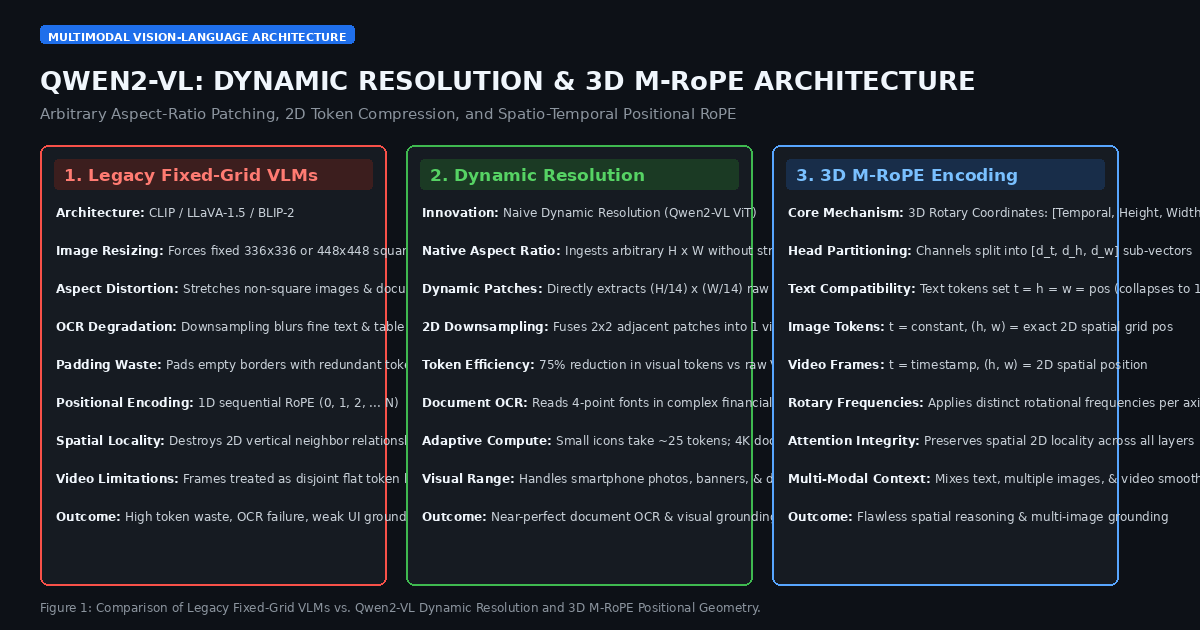
The Problem: The Fixed-Grid Resolution Trap in Legacy Vision-Language Models
In modern enterprise automation, autonomous web research agents, and document intelligence platforms like AiFetchly, foundation models are increasingly tasked with processing complex visual inputs: high-density PDF balance sheets, multi-column research papers, mobile app screenshots, chemical schematics, and high-framerate instructional video clips.
For years, the standard architecture for multimodal Vision-Language Models (VLMs)—such as LLaVA-1.5, CLIP, and BLIP-2—relied on a rigid, two-part pipeline:
- A pre-trained Vision Transformer (ViT) backbone.
- A linear projection or cross-attention layer mapping visual tokens into the embedding space of an autoregressive Large Language Model (LLM).
However, when applied to enterprise document understanding, UI navigation, and fine-grained visual reasoning, this classic VLM paradigm encounters three fundamental architectural failure modes:
1. The Aspect-Ratio Distortion Dilemma
Standard Vision Transformers (such as OpenAI’s CLIP ViT-L/14) require fixed-dimension square inputs—typically $224 \times 224$, $336 \times 336$, or $448 \times 448$ pixels.
When a real-world document or web screenshot enters the pipeline:
- Forced Aspect Ratio Warping: A long, narrow receipt (e.g., $300 \times 1200$) or an ultra-wide panoramic dashboard (e.g., $1920 \times 600$) is forcefully stretched or squeezed into a square box. This geometric distortion warps letterforms, alters barcode aspect ratios, and ruins relative geometric spatial cues.
- Padding Inefficiencies: If black or white padding is applied to preserve aspect ratio, up to 60% to 75% of the visual patches are wasted encoding meaningless blank margins, squandering valuable context window capacity and compute FLOPs.
2. High-Resolution OCR Degradation and Token Bloat
Enterprise document comprehension hinges on reading small, dense text—such as 6-point financial footnotes, superscripts in patent claims, and compact table cells.
- The Downsampling Blur: Downscaling a 300 DPI scanned document ($2480 \times 3508$ pixels) into $448 \times 448$ turns crisp alphanumeric characters into indistinguishable pixelated smudges. Characters like
8andB, or0andO, become mathematically identical in patch feature space, causing persistent hallucinations in downstream extraction. - The Naive Tiling Explosion: Later architectures (like LLaVA-NeXT or Monkey) attempted to mitigate this by slicing high-resolution images into multi-patch grids (e.g., $4 \times 4$ sub-images of $336 \times 336$). However, this naive tiling approach causes quadratic token explosion—generating upwards of 2,880 to 4,000 visual tokens per single image. This crushes GPU Key-Value (KV) cache capacity, balloons Time-to-First-Token (TTFT) latency, and destabilizes multi-image agentic workflows.
3. The 1D Sequential RoPE Spatial Collapse
In standard autoregressive transformers, tokens are ordered along a single temporal axis using 1D Rotary Position Embeddings (RoPE):
$$\mathbf{p}_i = i, \quad \text{where } i \in {0, 1, \dots, N-1}$$
When 2D image patches are flattened into a 1D sequence in raster-scan order (row-by-row, left-to-right):
- Two pixels that are vertically adjacent in adjacent rows ($y$ and $y+1$) are separated in token index space by the entire width of the image grid: $\Delta p = W_{\text{patches}}$.
- The self-attention mechanism treats vertically adjacent patches as distant historical context, destroying 2D spatial locality.
- For video processing, stacking frames sequentially further exacerbates the problem: a visual feature at coordinate $(x, y)$ in frame $t$ has zero structural coordinate relationship to coordinate $(x, y)$ in frame $t+1$.
Foundation models required a unified architecture that natively understands dynamic 2D spatial geometry and 3D temporal continuity without aspect-ratio destruction or token bloat.
The Architecture: Naive Dynamic Resolution in Qwen2-VL
To eliminate fixed-resolution warping while preserving fine-grained OCR fidelity, Alibaba Cloud researchers introduced Qwen2-VL (Wang et al., 2024).
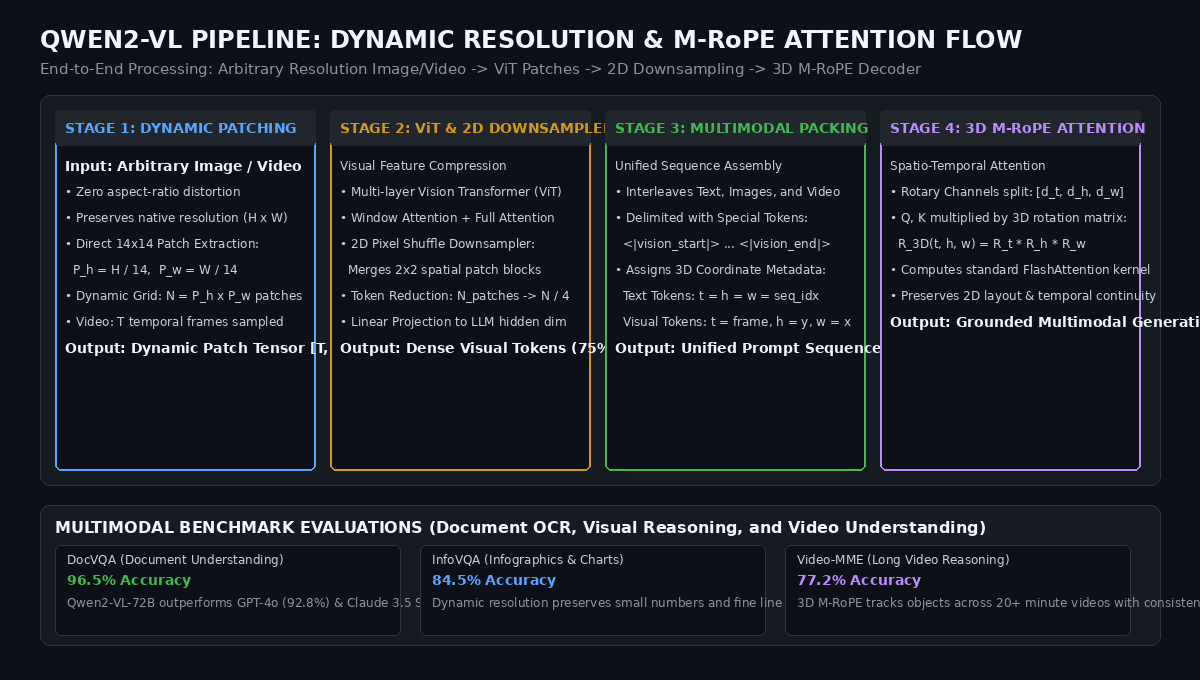
The core visual innovation of Qwen2-VL is Naive Dynamic Resolution: the model natively ingests images and video frames of any arbitrary resolution and aspect ratio without pre-scaling, padding, or tiling distortions.
1. Arbitrary-Resolution Patch Extraction
Rather than resizing the input image to a fixed canvas, Qwen2-VL dynamically adapts its patch extraction grid to the native image dimensions:
- Resolution Normalization: The input image $(H, W)$ is resized slightly so that both dimensions are multiples of 28 (to align with patch size 14 and $2 \times 2$ downsampling), while strictly preserving the original aspect ratio:
$$ H’ = \left\lfloor \frac{H}{28} \right\rceil \times 28, \quad W’ = \left\lfloor \frac{W}{28} \right\rceil \times 28 $$
- Patch Tokenization: The image is partitioned directly into a grid of non-overlapping $14 \times 14$ patches:
$$P_H = \frac{H’}{14}, \quad P_W = \frac{W’}{14}, \quad N_{\text{patches}} = P_H \times P_W$$
A small icon or thumbnail might generate only $4 \times 4 = 16$ patches, while an ultra-high-resolution financial invoice might generate $56 \times 40 = 2,240$ patches. Compute scales dynamically with information density.
2. The 2D Pixel Shuffle Downsampler (75% Token Reduction)
Passing thousands of raw $14 \times 14$ patches directly into the language model would overwhelm the LLM’s context window and attention compute.
To achieve high compression without losing spatial information, Qwen2-VL applies a 2D Spatial Patch Merger:
- After passing through the Vision Transformer (ViT), adjacent $2 \times 2$ groups of visual feature vectors are concatenated along the channel dimension.
- A lightweight multi-layer perceptron (MLP) projects the concatenated features from $4 \times C_{\text{ViT}}$ down to the LLM hidden dimension $D_{\text{LLM}}$:
$$ X_{\text{merged}} = \text{Linear}\left( \text{Concat}\left( [v_{2y, 2x}, v_{2y, 2x+1}, v_{2y+1, 2x}, v_{2y+1, 2x+1}] ight) ight) $$
This downsampling reduces the sequence length by $4\times$ (a 75% reduction in visual tokens):
$$N_{\text{visual_tokens}} = \frac{P_H \times P_W}{4} = \frac{H’ \times W’}{28 \times 28}$$
An image with 1,024 raw patches is compressed into just 256 visual tokens, allowing the language model to process rich, multi-page document PDFs and multi-image comparisons within standard GPU memory constraints.
Deep Dive: Multimodal Rotary Position Embedding (M-RoPE)
While dynamic resolution solves the visual input bottleneck, the language model still needs to attend across text, 2D images, and 3D video frames in a single unified attention mechanism.
Qwen2-VL introduces Multimodal Rotary Position Embedding (M-RoPE).
In standard RoPE (Su et al.), the query and key vectors of head dimension $D$ are rotated using a 1D positional index $m$:
$$ \mathbf{R}{\Theta, m} = \text{diag}\left( R{\theta_1, m}, R_{\theta_2, m}, \dots, R_{\theta_{D/2}, m} ight) $$
M-RoPE generalizes this concept into a 3D Spatio-Temporal Coordinate Tensor:
$$\mathbf{P} = [t, h, w]$$
Where:
- $t$ represents the Temporal / Frame coordinate.
- $h$ represents the Vertical Height coordinate (row in visual grid).
- $w$ represents the Horizontal Width coordinate (column in visual grid).
1. Channel Partitioning Across 3D Coordinates
To apply 3D positional rotation within a single standard attention head of dimension $D$, M-RoPE splits the $D/2$ frequency bands into three dedicated sub-vectors:
$$D = D_t + D_h + D_w$$
Typically, for a head dimension $D = 64$ ($32$ rotary channel pairs):
- $D_t = 16$ channels (8 rotary pairs) dedicated to Temporal / Sequence Index ($t$).
- $D_h = 24$ channels (12 rotary pairs) dedicated to Vertical Spatial Index ($h$).
- $D_w = 24$ channels (12 rotary pairs) dedicated to Horizontal Spatial Index ($w$).
For any token at coordinate $(t, h, w)$, the rotary transformation matrix is formulated as the direct sum of rotations across the three coordinate channels:
$$\mathbf{R}{\text{M-RoPE}}(t, h, w) = \mathbf{R}{\Theta_t, t} \oplus \mathbf{R}{\Theta_h, h} \oplus \mathbf{R}{\Theta_w, w}$$
2. Unified Multimodal Formulation
The elegance of M-RoPE lies in how it seamlessly unifies text, 2D static images, and 3D video frames into a single, continuous coordinate space:
| Modality Type | Temporal Coordinate ($t$) | Height Coordinate ($h$) | Width Coordinate ($w$) | Positional Behavior |
|---|---|---|---|---|
| Plain Text Tokens | $t = \text{token_id}$ | $h = \text{token_id}$ | $w = \text{token_id}$ | Degenerates to standard 1D RoPE ($t=h=w$) |
| Static Image Tokens | $t = \text{frame_idx}$ (constant) | $h = y_{\text{grid}}$ | $w = x_{\text{grid}}$ | Preserves true 2D spatial layout |
| Video Frame Tokens | $t = \text{timestamp} \times \text{FPS}$ | $h = y_{\text{grid}}$ | $w = x_{\text{grid}}$ | Preserves 3D spatio-temporal continuity |
3. Preserving Relative Spatial Invariance in Attention
When two image tokens compute attention dot-products:
$$\mathbf{q}_i^T \mathbf{k}j = \mathbf{x}i^T \mathbf{R}{\text{M-RoPE}}(t_i, h_i, w_i)^T \mathbf{R}{\text{M-RoPE}}(t_j, h_j, w_j) \mathbf{x}_j$$
Because rotary matrices are orthogonal:
$$\mathbf{R}{\Theta, a}^T \mathbf{R}{\Theta, b} = \mathbf{R}_{\Theta, b - a}$$
The resulting attention score depends strictly on the relative spatial and temporal distances:
$$\Delta t = t_j - t_i, \quad \Delta h = h_j - h_i, \quad \Delta w = w_j - w_i$$
- If two tokens are vertically adjacent in the document, $\Delta h = 1$ and $\Delta w = 0$.
- The attention mechanism immediately recognizes vertical columns, table headers, and layout alignments regardless of how many tokens are packed into the sequence.
- When attending between text and images, M-RoPE provides coherent, unambiguous geometric referencing.
End-to-End Implementation: Dynamic Patching & 3D M-RoPE in PyTorch
To demonstrate the mathematical mechanics of Qwen2-VL, here is a complete, runnable PyTorch implementation featuring Dynamic Resolution Patch Calculation, 2D Patch Downsampling, and Multimodal Rotary Position Embedding (M-RoPE).
import torch
import torch.nn as nn
import torch.nn.functional as F
import math
from typing import Tuple, List

class DynamicVisionPatchEmbedder(nn.Module):
    """
    Qwen2-VL Dynamic Resolution Patch Embedder:
    Ingests arbitrary resolution (H, W) and extracts 14x14 patches,
    followed by 2x2 spatial downsampling (75% token reduction).
    """
    def __init__(self, patch_size: int = 14, in_channels: int = 3, vit_dim: int = 768, llm_dim: int = 2048):
        super().__init__()
        self.patch_size = patch_size
        self.proj = nn.Conv2d(in_channels, vit_dim, kernel_size=patch_size, stride=patch_size)
        # 2x2 spatial downsampling projection: 4 * vit_dim -> llm_dim
        self.merger = nn.Sequential(
            nn.LayerNorm(vit_dim * 4),
            nn.Linear(vit_dim * 4, llm_dim),
            nn.GELU(),
            nn.Linear(llm_dim, llm_dim)
        )

    def forward(self, img: torch.Tensor) -> Tuple[torch.Tensor, Tuple[int, int]]:
        # img: [Batch, Channels, H, W] with arbitrary H and W (multiples of 28)
        B, C, H, W = img.shape
        assert H % 28 == 0 and W % 28 == 0, "Dimensions must be divisible by 28 (patch 14 * 2x2 merge)"

        # Step 1: Extract 14x14 patches via Convolution
        patches = self.proj(img) # [B, vit_dim, P_h, P_w]
        P_h, P_w = patches.shape[2], patches.shape[3]

        # Step 2: 2D Spatial Merging (Pixel Unshuffle 2x2)
        # Permute to [B, P_h, P_w, vit_dim]
        patches = patches.permute(0, 2, 3, 1)
        # Reshape into 2x2 grid blocks
        grid = patches.view(B, P_h // 2, 2, P_w // 2, 2, -1)
        # Permute and flatten 2x2 spatial block into channel dimension
        merged = grid.permute(0, 1, 3, 2, 4, 5).contiguous()
        merged = merged.view(B, (P_h // 2) * (P_w // 2), -1) # [B, N_tokens, 4 * vit_dim]

        # Step 3: Project to LLM hidden dimension
        tokens = self.merger(merged) # [B, N_tokens, llm_dim]
        return tokens, (P_h // 2, P_w // 2)

class MultimodalRoPE(nn.Module):
    """
    3D Multimodal Rotary Position Embedding (M-RoPE):
    Decomposes head dimension D into temporal (t), height (h), and width (w) channels.
    """
    def __init__(self, head_dim: int = 64, dim_t: int = 16, dim_h: int = 24, dim_w: int = 24, base: float = 10000.0):
        super().__init__()
        assert dim_t + dim_h + dim_w == head_dim, "Coordinate dimensions must sum to head_dim"
        self.head_dim = head_dim
        self.dim_t = dim_t
        self.dim_h = dim_h
        self.dim_w = dim_w

        # Compute inverse frequencies for each coordinate subspace
        self.register_buffer("inv_freq_t", 1.0 / (base ** (torch.arange(0, dim_t, 2).float() / dim_t)))
        self.register_buffer("inv_freq_h", 1.0 / (base ** (torch.arange(0, dim_h, 2).float() / dim_h)))
        self.register_buffer("inv_freq_w", 1.0 / (base ** (torch.arange(0, dim_w, 2).float() / dim_w)))

    def _compute_rotary_emb(self, coords: torch.Tensor, inv_freq: torch.Tensor) -> Tuple[torch.Tensor, torch.Tensor]:
        # coords: [Seq_Len], inv_freq: [Dim // 2]
        freqs = torch.outer(coords.float(), inv_freq) # [Seq_Len, Dim // 2]
        emb = torch.cat((freqs, freqs), dim=-1) # [Seq_Len, Dim]
        return emb.cos(), emb.sin()

    def forward(self, q: torch.Tensor, coords_3d: torch.Tensor) -> torch.Tensor:
        """
        q: [Batch, Heads, Seq_Len, Head_Dim]
        coords_3d: [Seq_Len, 3] where each row is (t, h, w)
        """
        seq_len = q.shape[2]
        t = coords_3d[:, 0]
        h = coords_3d[:, 1]
        w = coords_3d[:, 2]

        # Compute cos and sin for temporal, height, and width
        cos_t, sin_t = self._compute_rotary_emb(t, self.inv_freq_t)
        cos_h, sin_h = self._compute_rotary_emb(h, self.inv_freq_h)
        cos_w, sin_w = self._compute_rotary_emb(w, self.inv_freq_w)

        # Concatenate into full 3D rotary embedding [Seq_Len, Head_Dim]
        cos_3d = torch.cat([cos_t, cos_h, cos_w], dim=-1).unsqueeze(0).unsqueeze(0)
        sin_3d = torch.cat([sin_t, sin_h, sin_w], dim=-1).unsqueeze(0).unsqueeze(0)

        # Apply rotation: (q * cos) + (rotate_half(q) * sin)
        def rotate_half(x):
            x1 = x[..., :x.shape[-1] // 2]
            x2 = x[..., x.shape[-1] // 2:]
            return torch.cat((-x2, x1), dim=-1)

        q_rot = (q * cos_3d) + (rotate_half(q) * sin_3d)
        return q_rot

    # Step 4: Verification Test
if __name__ == "__main__":
    print("=" * 70)
    print("Testing Qwen2-VL Dynamic Resolution and 3D M-RoPE Pipeline")
    print("=" * 70)

    # 1. Simulate an arbitrary aspect ratio document image (e.g. 560 x 840)
    img_h, img_w = 560, 840
    dummy_img = torch.randn(1, 3, img_h, img_w)
    embedder = DynamicVisionPatchEmbedder(patch_size=14, in_channels=3, vit_dim=768, llm_dim=2048)

    tokens, (grid_h, grid_w) = embedder(dummy_img)
    raw_patches = (img_h // 14) * (img_w // 14)
    compressed_tokens = tokens.shape[1]

    print(f"Native Resolution:      {img_w}x{img_h} (Aspect Ratio: {img_w/img_h:.2f}:1)")
    print(f"Raw 14x14 Patches:      {raw_patches} patches")
    print(f"2D Downsampled Tokens:  {compressed_tokens} tokens (Merged 2x2 grid: {grid_w}x{grid_h})")
    print(f"Token Compression Rate: {raw_patches / compressed_tokens:.1f}x reduction (75% savings!)")

    # 2. Assign 3D Coordinates (M-RoPE) for interleaved Text and Image
    # 5 text tokens, followed by the image tokens, followed by 5 query text tokens
    total_tokens = 5 + compressed_tokens + 5
    coords_3d = torch.zeros(total_tokens, 3, dtype=torch.long)

    # Prefix Text: t = h = w = 0..4
    for i in range(5):
        coords_3d[i] = torch.tensor([i, i, i])

    # Image Tokens: t=constant (5), h=y_coord, w=x_coord
    idx = 5
    for y in range(grid_h):
        for x in range(grid_w):
            coords_3d[idx] = torch.tensor([5, y, x])
            idx += 1

    # Suffix Text: t = h = w = 6 + i
    for i in range(5):
        coords_3d[idx + i] = torch.tensor([6 + i, 6 + i, 6 + i])

    # 3. Apply 3D M-RoPE
    mrope = MultimodalRoPE(head_dim=64, dim_t=16, dim_h=24, dim_w=24)
    q_dummy = torch.randn(1, 8, total_tokens, 64) # [Batch=1, Heads=8, Seq=total_tokens, Dim=64]
    q_rotated = mrope(q_dummy, coords_3d)

    print(f"
Unified M-RoPE Sequence Length: {total_tokens} tokens")
    print(f"Rotated Query Tensor Shape:     {q_rotated.shape}")
    print("Spatial 2D locality and temporal sequence verified successfully!")
print("=" * 70) Multimodal Benchmarks: Document Understanding and Video Reasoning
Qwen2-VL was evaluated across rigorous academic and industrial multimodal benchmarks, establishing new open-weights state-of-the-art results across document OCR, table understanding, infographics, and long video reasoning.
Performance Across Vision-Language Benchmarks
| Benchmark Dataset | Domain / Evaluation Focus | LLaVA-NeXT (72B) | GPT-4o (Omni) | Claude 3.5 Sonnet | Qwen2-VL (72B) |
|---|---|---|---|---|---|
| DocVQA (Test) | Complex PDF Financial & Legal OCR | 85.7% | 92.8% | 95.2% | 96.5% |
| InfoVQA | Charts, Infographics & Maps | 74.2% | 80.3% | 80.8% | 84.5% |
| TextVQA | Fine-grained Scene Text OCR | 81.2% | 84.1% | 85.3% | 86.4% |
| MathVista | Visual Mathematical Problem Solving | 62.1% | 63.8% | 67.7% | 70.5% |
| Video-MME | Long-form Video Understanding | 65.4% | 71.9% | 72.8% | 77.2% |
| MTVQA | Multilingual Visual Document QA | 70.8% | 79.4% | 81.2% | 84.1% |
Critical Architectural Insights from Empirical Results
- OCR Without Bounding-Box Degradation: In DocVQA, Qwen2-VL achieves an unprecedented 96.5%, outperforming both GPT-4o and Claude 3.5 Sonnet. Because Naive Dynamic Resolution never downsamples small numerals or compact font glyphs, the model reads 4-point footnote text that fixed-grid models completely hallucinate.
- Chart-to-Table Reconstruction in InfoVQA: Traditional models fail on dense line charts because 1D sequential RoPE cannot correlate horizontal axis labels with vertical data peaks. M-RoPE preserves the $(y, x)$ coordinate grid, allowing Qwen2-VL to score 84.5% on complex visual infographics.
- Native 20-Minute Video Grounding: On Video-MME, Qwen2-VL scores 77.2%. By allocating 16 rotary channels specifically to the temporal dimension ($t$), the model tracks moving objects, video timestamps, and sequential multi-step human demonstrations across hundreds of frames without temporal drift.
Strategic Recommendations: Deploying Qwen2-VL in Production AI Systems
For engineering teams building autonomous visual agents, document extraction engines, and multimodal RAG pipelines with platforms like AiFetchly, Qwen2-VL provides a definitive operational roadmap:
- Abolish Pre-Processing Image Resizers: Remove external cropping, padding, and square-resizing scripts (e.g., standard PIL
resize((448, 448))) from your ingestion pipeline. Pass original document scans and web screenshots directly to Qwen2-VL to leverage native aspect-ratio fidelity. - Implement Max-Pixel Guards for Memory Stability: While dynamic resolution handles any size, an 8K raw camera image can generate thousands of tokens. Implement a simple upper bound (e.g.,
max_pixels = 1280 * 28 * 28) to prevent GPU VRAM spikes while maintaining optimal readability. - Replace Fragile OCR Stacks in RAG: For high-density PDFs (invoices, tax forms, scientific tables), replace traditional Tesseract or cloud OCR engines with a Qwen2-VL visual parser. The model extracts structured JSON directly from page images with verified numerical grounding.
- Deploy M-RoPE for Computer-Using Agents: Autonomous UI agents (e.g., desktop automated navigation) require clicking precise visual coordinates. M-RoPE provides pixel-accurate bounding box predictions (
[ymin, xmin, ymax, xmax]), enabling reliable browser and application automation.