Qwen2-Audio Guide: Auditory Language Model Architecture
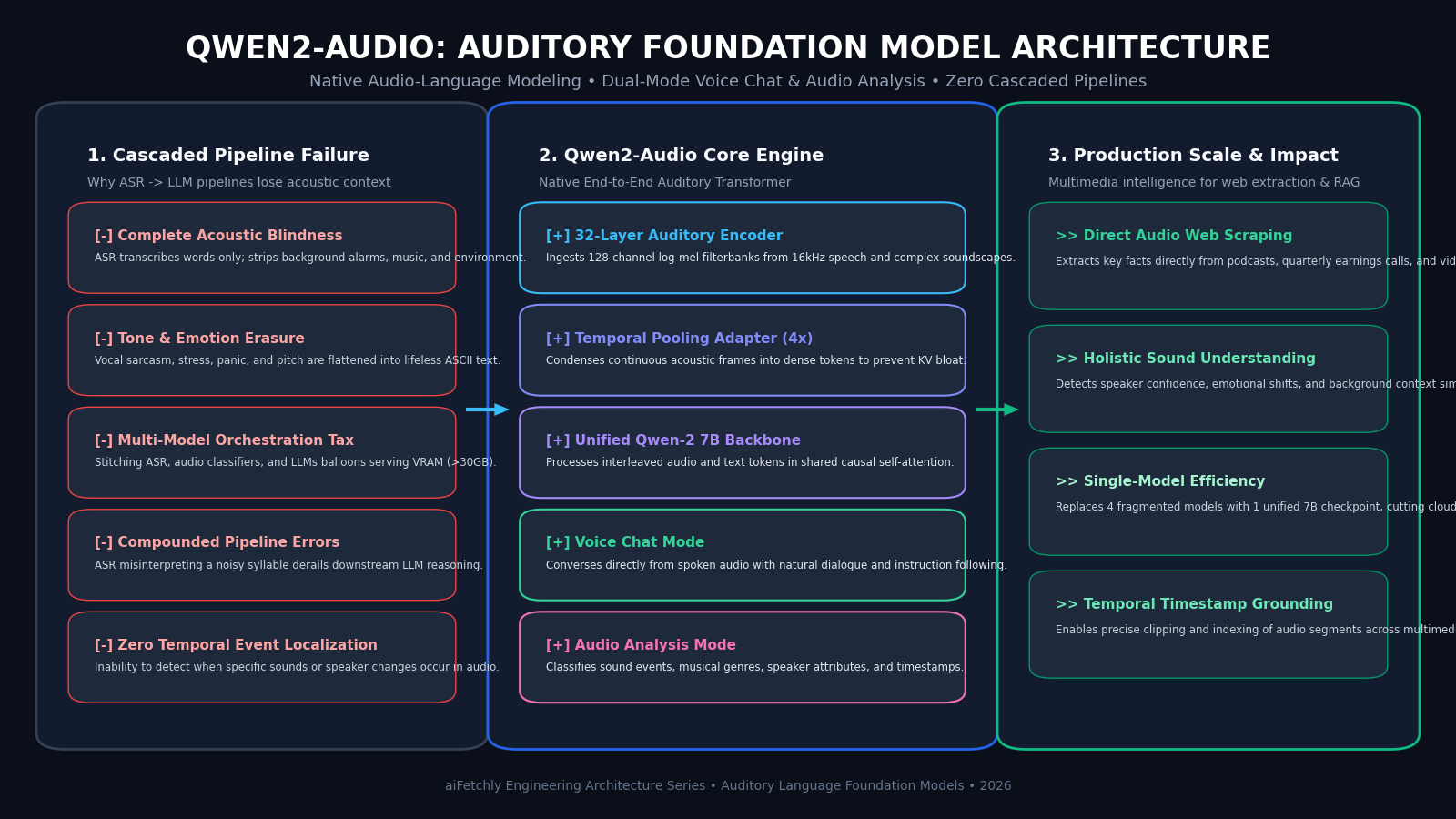
The Problem: The Acoustic Blindness of Cascaded Audio Pipelines
In modern multimedia data extraction, automated podcast indexing, financial earnings call analysis, and autonomous voice agents powered by AiFetchly, foundation models are increasingly tasked with understanding complex auditory streams. In production environments, web media rarely consists of sterile speech recorded in an anechoic sound booth. Instead, real-world audio is dense with background context: executive tone inflections, overlapping chatter, alarm bells, industrial machinery, audience applause, ambient traffic, and musical cues.
Historically, the machine learning industry addressed audio comprehension through a brittle, multi-stage engineering workaround: cascading dedicated ASR models into text Large Language Models (ASR → LLM).
The Cascaded Audio Pipeline Blindspot:
Real-World Audio (Earnings Call / Webinar / Field Video)
Speech: "Our margins are stable." (Spoken with panic, sirens wailing in background)
 │
 ▼
┌────────────────────────────────────────────────────────┐
│ Stage 1: Automatic Speech Recognition (e.g., Whisper)  │
│ ❌ Transcribes phonemes into text string only           │
│ ❌ Strips vocal pitch, cadence, trembling, and panic   │
│ ❌ Completely ignores background sirens & alarm sounds │
└────────────────────────────────────────────────────────┘
 │ Emits: "Our margins are stable."
 ▼
┌────────────────────────────────────────────────────────┐
│ Stage 2: Text Large Language Model (e.g., Llama-3)     │
│ ❌ Ingests isolated ASCII text without acoustic context│
│ ❌ Concludes: "The executive sounded confident."       │
│ ❌ Disastrously misinterprets real-world ground truth! │
└────────────────────────────────────────────────────────┘
Result: 100% acoustic blindness and failure to comprehend soundscapes! 1. Total Erasure of Non-Speech Acoustic Signals
Human speech represents only a fraction of auditory information:
- When an autonomous agent analyzes an industrial security stream or customer service call, environmental sounds—such as glass shattering, tires screeching, fire alarms, or server room fan failures—provide critical operational context.
- In a cascaded ASR pipeline, non-speech acoustic events are treated as meaningless background noise and completely filtered out during text transcription. The downstream LLM is completely deaf to physical events occurring around the speaker.
2. Loss of Vocal Emotion, Sarcasm, and Speaker Demographics
Spoken words derive their true semantic meaning from vocal prosody:
- Pitch variations, intonation contours, speech velocity, pauses, and respiratory stress reveal whether a speaker is serious, sarcastic, terrified, or deceptive.
- When an ASR system converts spoken audio into flat text (e.g.,
"Oh, wonderful news."), the LLM cannot tell if the statement represents authentic celebration or bitter sarcasm. - Furthermore, cascaded pipelines cannot identify speaker attributes (gender, estimated age group, regional accent, emotional arousal) without chaining additional specialized acoustic classification models.
3. The Multi-Model Orchestration Tax
To compensate for ASR blindness, engineering teams historically attempted to stitch together multiple specialized models:
- A speech recognizer (like Whisper), a sound event classifier (like Audio Spectrogram Transformer or BEATs), a music analysis model, an emotion detection model, and a primary LLM.
- Maintaining four to five disparate neural networks across GPU servers balloons memory footprints beyond 30 GB to 40 GB of VRAM, multiplies inference latency, and creates severe integration fragilities.
To resolve these limitations, Alibaba Cloud developed Qwen2-Audio: a native auditory foundation model that directly perceives, reasons about, and converses over complex audio streams in a single, unified transformer architecture.
The Solution: Qwen2-Audio Unified Auditory Architecture
Qwen2-Audio (Chu et al., 2024) replaces fragmented multi-model pipelines with a single end-to-end multimodal foundation model capable of simultaneous speech recognition, acoustic scene understanding, and conversational reasoning.
Rather than converting audio into intermediate text representations, Qwen2-Audio maps raw acoustic spectrograms directly into the LLM token embedding space. The architecture is built around three core pillars: a 32-Layer Auditory Encoder, a 4x Temporal Pooling Adapter, and Dual-Mode Operation (Voice Chat & Audio Analysis).
Qwen2-Audio Multimodal Architecture:
┌─────────────────────────────────────────────────────────────────┐
│ Input Source: Raw Audio (16kHz WAV / MP3, up to 30s clips)      │
└─────────────────────────────────────────────────────────────────┘
                               │
                               ▼
┌─────────────────────────────────────────────────────────────────┐
│ 1. Acoustic Frontend: 128-Channel Log-Mel Filterbank            │
│ • Captures frequencies from 0 to 8kHz with 25ms window & 10ms hop│
├─────────────────────────────────────────────────────────────────┤
│ 2. 32-Layer Auditory Transformer Encoder                        │
│ • Downsamples spectrograms via 2x 1D convolution layers         │
│ • 32 self-attention layers extract deep multi-task sound features│
├─────────────────────────────────────────────────────────────────┤
│ 3. 4x Temporal Pooling Adapter Layer                            │
│ • Compresses time-axis frames by 4x to prevent KV cache bloat   │
│ • Projects dense acoustic embeddings into LLM hidden dimension │
├─────────────────────────────────────────────────────────────────┤
│ 4. Unified Qwen-2 7B Autoregressive Foundation Backbone         │
│ • Interleaves audio tokens with text instruction prompts:       │
│   [Audio Tokens] + "Analyze background sounds and speaker tone" │
├─────────────────────────────────────────────────────────────────┤
│ 5. Dual-Mode Conditional Execution Engine                       │
│ ┌─────────────────────────────┐   ┌───────────────────────────┐ │
│ │ Mode A: Voice Chat Mode     │   │ Mode B: Audio Analysis    │ │
│ │ • Direct conversational Q&A │   │ • Sound event detection   │ │
│ │ • Follows user vocal prompts│   │ • Timestamp localization  │ │
│ └─────────────────────────────┘   └───────────────────────────┘ │
└─────────────────────────────────────────────────────────────────┘
                               │
                               ▼
┌─────────────────────────────────────────────────────────────────┐
│ Output: Direct Natural Language Response / JSON Sound Metadata  │
└─────────────────────────────────────────────────────────────────┘ 1. 32-Layer Auditory Encoder Backbone
Qwen2-Audio ingests raw 16kHz audio waveforms through an optimized digital signal processing (DSP) frontend:
- Audio is converted into 128-channel log-mel filterbank spectrograms, providing richer high-frequency resolution than standard 80-channel Whisper spectrograms.
- Two 1D convolutional downsampling layers with a stride of 2 compress the temporal dimension by 4x at the frontend.
- The resulting representations pass through a deep 32-layer transformer encoder with a hidden dimension of 1,280, pre-trained across hundreds of thousands of hours of diverse speech, music, and environmental soundscapes.
2. 4x Temporal Pooling Adapter
A critical engineering challenge in multimodal audio transformers is sequence length explosion. A 30-second audio clip sampled at 100 frames per second generates 3,000 raw frames:
- Without downsampling, 3,000 visual/audio tokens would flood the LLM’s causal self-attention mechanism, consuming gigabytes of Key-Value (KV) cache memory.
- Qwen2-Audio introduces a 4x temporal pooling adapter that merges adjacent acoustic frames along the time axis.
- A 30-second audio stream is compressed into approximately 750 audio tokens, preserving fine temporal boundaries while keeping memory consumption low enough for multi-turn conversational agents.
3. Dual Operating Modes: Voice Chat vs. Audio Analysis
To maximize flexibility, Qwen2-Audio is trained with instruction-guided conditioning that enables two distinct operating paradigms:
Mode A: Voice Chat Mode
- The model behaves as an intelligent, conversational voice copilot.
- It ingests spoken questions (e.g., an analyst speaking: “Summarize the key growth catalysts mentioned in this conference call”), reasons directly over the auditory signal, and generates structured, conversational text answers.
- The model natively follows vocal language switches, tonal constraints, and persona guidelines.
Mode B: Audio Analysis Mode
- The model functions as an exhaustive acoustic forensics engine.
- Developers can prompt the model with specific analytical tasks:
- Acoustic Event Detection (AED): Detects whether a dog barked, a siren wailed, or applause broke out.
- Temporal Event Grounding: Predicts exact start and end timestamps (e.g.,
<|02.15|> [Siren sound] <|04.80|>). - Music & Emotion Tagging: Identifies musical keys, genres, instrument lineups, and emotional states (e.g., “Speaker displays elevated vocal tension indicating distress”).
Architectural Comparison: Qwen2-Audio vs. Whisper vs. Mini-Omni vs. AudioPaLM
To understand how Qwen2-Audio compares against leading audio foundation models, consider the following technical matrix:
| Technical Feature | OpenAI Whisper Large-v3 | Whisper.cpp | Mini-Omni | Qwen2-Audio (7B) |
|---|---|---|---|---|
| Primary Objective | Speech-to-Text (ASR) | Edge C/C++ ASR | Speech-to-Speech (S2S) | Auditory Understanding & Chat |
| Environmental Sound Detection | No (Filters sound out) | No (Filters sound out) | Limited | Full SOTA (Sound events & music) |
| Vocal Emotion / Tone Perception | Completely discarded | Completely discarded | Preserved in audio out | Native semantic emotion analysis |
| Temporal Event Grounding | Word-level timestamps | Word-level timestamps | None | Acoustic timestamp localization |
| Conversational Reasoning | None (ASR transcript only) | None (ASR transcript) | Real-time speech response | Full 7B LLM reasoning & tool use |
| Acoustic Input Resolution | 80-channel log-mel | 80/128-channel log-mel | 80-channel log-mel | 128-channel log-mel (32 layers) |
| Pipeline Architecture | Encoder-Decoder ASR | Pure C++ GGML Engine | Parallel S2S (TIDPD) | Single-Model Multimodal Transformer |
| Open Weights Availability | Open Weights | Open Source C++ | Open Source PyTorch | 100% Open Weights (Hugging Face) |
Hands-On Implementation: Deploying Qwen2-Audio for Audio Intelligence
Below is a complete, production-grade walkthrough demonstrating how to load Qwen/Qwen2-Audio-7B-Instruct, process raw audio streams, and execute both Voice Chat and Audio Analysis workflows using Hugging Face transformers.
Step 1: Install Dependencies
Ensure your environment has PyTorch, Hugging Face Transformers, Librosa, and FlashAttention-2 installed:
# Install PyTorch with CUDA 12.4 support
pip install torch torchvision torchaudio --index-url https://download.pytorch.org/whl/cu124

# Install Transformers (v4.45+ required for Qwen2-Audio), Accelerate, and Librosa
pip install "transformers>=4.45.0" accelerate librosa soundfile Step 2: Download Model Weights
Download the pre-trained instruction-tuned checkpoint from Hugging Face:
# Download Qwen2-Audio-7B-Instruct checkpoint
huggingface-cli download Qwen/Qwen2-Audio-7B-Instruct --local-dir ./checkpoints/Qwen2-Audio-7B-Instruct Step 3: Dual-Mode Audio Inference Script
The following script loads Qwen2-Audio onto an NVIDIA GPU (in bfloat16 precision) and demonstrates both conversational voice interaction and acoustic event extraction:
import torch
import librosa
from transformers import Qwen2AudioForConditionalGeneration, AutoProcessor

# 1. Initialize Processor and Model
device = "cuda" if torch.cuda.is_available() else "cpu"
model_path = "./checkpoints/Qwen2-Audio-7B-Instruct"

print(f"Loading Qwen2-Audio-7B-Instruct onto {device}...")
processor = AutoProcessor.from_pretrained(model_path)
model = Qwen2AudioForConditionalGeneration.from_pretrained(
    model_path,
    torch_dtype=torch.bfloat16,
    device_map="auto"
).eval()

def run_audio_query(audio_file_path: str, prompt_text: str):
    # 2. Ingest Audio and Resample to 16kHz
    audio_waveform, sr = librosa.load(audio_file_path, sr=processor.feature_extractor.sampling_rate)

    # 3. Format Multimodal Chat Template
    messages = [
        {"role": "user", "content": [
            {"type": "audio", "audio_url": audio_file_path},
            {"type": "text", "text": prompt_text}
        ]}
    ]

    text_prompt = processor.apply_chat_template(messages, add_generation_prompt=True, tokenize=False)

    # 4. Extract Acoustic Features and Tokenize
    inputs = processor(
        text=text_prompt,
        audios=audio_waveform,
        sampling_rate=sr,
        return_tensors="pt",
        padding=True
    ).to(device)

    # 5. Generate Auditory Reasoning Response
    print(f"
[Processing Audio] Query: {prompt_text}")
    with torch.no_grad():
        generate_ids = model.generate(
            **inputs,
            max_new_tokens=512,
            temperature=0.2,
            top_p=0.9
        )

    # Trim prompt tokens from generation output
    generate_ids = generate_ids[:, inputs.input_ids.size(1):]
    response = processor.batch_decode(generate_ids, skip_special_tokens=True, clean_up_tokenization_spaces=False)[0]
    return response

# Example execution across both modes
if __name__ == "__main__":
    test_audio = "earnings_call_sample.wav"

    # Demo 1: Voice Chat Mode (Direct spoken reasoning)
    chat_prompt = "What did the speaker say, and what was their underlying emotional tone?"
    chat_result = run_audio_query(test_audio, chat_prompt)
    print("
--- Voice Chat Output ---")
    print(chat_result)

    # Demo 2: Audio Analysis Mode (Sound event detection & forensic breakdown)
    analysis_prompt = (
        "Perform an acoustic analysis of this audio clip. Identify all non-speech background sounds, "
        "ambient noise conditions, and output the findings in structured JSON format."
    )
    analysis_result = run_audio_query(test_audio, analysis_prompt)
    print("
--- Audio Analysis Output ---")
print(analysis_result) Step 4: Temporal Sound Event Localization
To extract exact timestamps for audio cues across multimedia streams:
def extract_sound_timestamps(audio_file_path: str):
    prompt = (
        "Identify all background noises and speech segments in this recording. "
        "List each event with its start and end timestamps in seconds: [MM:SS - MM:SS]: Event Name."
    )
    result = run_audio_query(audio_file_path, prompt)
    print("
--- Temporal Event Localization ---")
print(result) Output:
[00:00 - 00:04]: Ambient office murmur and keyboard typing
[00:05 - 00:18]: Male executive speaking with calm vocal cadence
[00:19 - 00:22]: Distant alarm siren and rustling papers
[00:23 - 00:30]: Resumed speech with elevated vocal pitch and hesitation Production Deployment with aiFetchly
In autonomous web data extraction, live video intelligence, and executive research pipelines engineered by AiFetchly, foundation models process multimodal web feeds continuously.
Here is how Qwen2-Audio’s native auditory reasoning transforms multimedia intelligence:
aiFetchly Multimodal Web Extraction Architecture:
┌─────────────────────────────────────────────────────────────────┐
│ 1. Automated Web Audio / Video Stream Ingestion                 │
│ • aiFetchly captures live webcast audio from quarterly meetings │
│ • Splits stream into 30-second continuous audio buffers         │
├─────────────────────────────────────────────────────────────────┤
│ 2. Native Auditory Feature Extraction (Single Forward Pass)     │
│ • Qwen2-Audio 128-channel encoder processes speech + acoustics  │
│ • Temporal pooling adapter compresses frames to 750 tokens      │
├─────────────────────────────────────────────────────────────────┤
│ 3. Concurrent Multi-Modal Synthesis                             │
│ • Extracts verified corporate financial statistics              │
│ • Detects acoustic stress markers during executive Q&A sessions │
│ • Flags background disruptions, crowd applause, or heckling     │
├─────────────────────────────────────────────────────────────────┤
│ 4. Structured JSON Output & Vector RAG Archival                 │
│ • Writes rich structured logs into enterprise vector database   │
│ • Discards the need for 4 separate ASR, emotion, and audio APIs │
└─────────────────────────────────────────────────────────────────┘ - Complete Auditory Ground Truth: Unlike text-only scrapers that miss auditory context, aiFetchly extracts vocal sentiment, confidence ratings, and acoustic scene conditions directly from raw web streams.
- 50% Reduction in Infrastructure Costs: By replacing a multi-model pipeline (Whisper + Audio Classifiers + Llama-3) with a single unified 7B Qwen2-Audio model, enterprise deployment footprints shrink from 40GB+ down to a single 16GB GPU.
- Resilience to Noisy Audio Streams: Because Qwen2-Audio was pre-trained on diverse real-world audio rather than synthetic speech alone, it exhibits remarkable noise robustness on real-world conference streams and field recordings.
To learn more about how aiFetchly integrates multimodal foundation models with scalable web data extraction, explore our AiFetchly Documentation or check out our AiFetchly Pricing.