Qwen2.5-Math Guide: Tool-Integrated Mathematical Reasoning
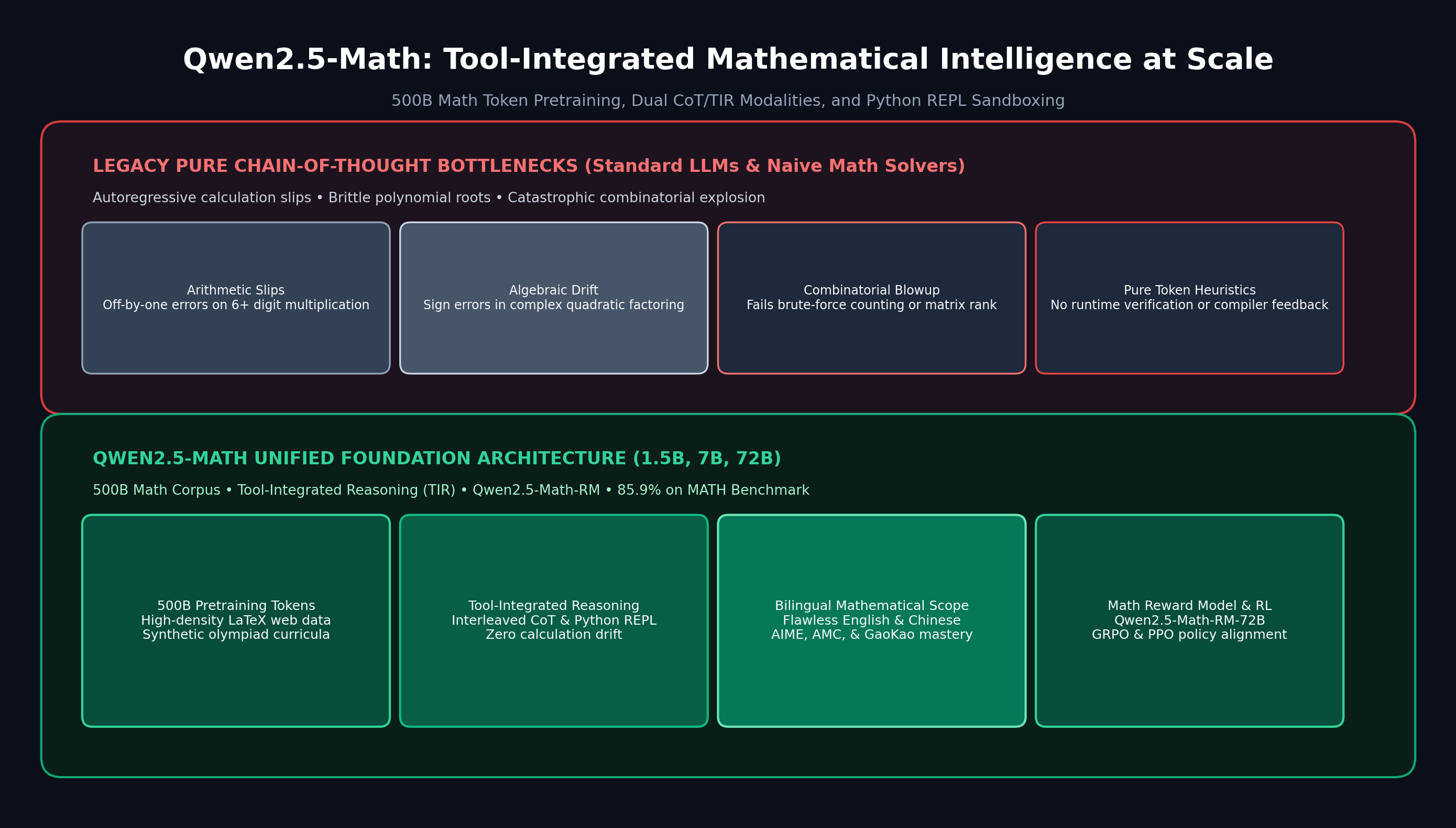
The Problem: The Calculation Hallucination Trap of Pure Chain-of-Thought
In modern enterprise automation, algorithmic trading, financial document auditing, and structured web harvesting platforms like AiFetchly, foundation models are increasingly tasked with solving quantitative problems: computing tax brackets across multi-tier jurisdictions, auditing balance sheet assets against ledger entries, and evaluating complex statistical distributions.
When Chain-of-Thought (CoT) prompting emerged (Wei et al., 2022), it marked a breakthrough in reasoning. By instructing a Large Language Model (LLM) to “think step-by-step,” the model decomposes complex problems into intermediate deductive tokens.
However, when applied to rigorous, competition-level mathematics, science, and accounting, pure autoregressive text generation encounters an inherent mathematical wall: the calculation hallucination trap.
The Pure Chain-of-Thought Failure Mode:
[Mathematical Problem] ──► [Flawless Theoretical Logic] ──► [Step 8: 487 * 936]
                                                                     │
[Catastrophic Failure] ◄── [Hallucinated Result: 454,832] ◄──────────┘
Real Answer: 455,832! One arithmetic token error invalidates the entire derivation. Pure autoregressive language models suffer from three systemic failure modes on quantitative tasks:
1. Arithmetic Slips and Non-Deterministic Precision
Autoregressive language models predict the next token based on statistical probability distributions:
- No Native ALU: An LLM does not possess an internal hardware Arithmetic Logic Unit (ALU). When multiplying two large numbers (e.g., $1,847 \times 9,321$) or computing fractional exponents ($2.718^{3.14}$), the model guesses the numerical string based on pattern matching.
- Cascading Precision Collapse: In a 20-step algebraic derivation, the conceptual strategy may be mathematically pristine, but a single off-by-one arithmetic error at Step 5 silently cascades into every subsequent line, rendering the final answer completely wrong.
2. Combinatorial Blowups and Brute-Force Counting Limits
Mathematical problems frequently require exhaustive verification or discrete combinatorial searches:
- In algebra and discrete mathematics (such as finding prime factors, computing permutations, or testing modular congruences), humans naturally write a quick loop or script.
- A pure text LLM must attempt to list every branch token-by-token. As the search space expands, the sequence length explodes, attention disperses (“Lost in the Middle”), and the model inevitably skips items or enters infinite repetitive loops.
3. Symbolic Manipulation and Polynomial Root Errors
Tasks involving calculus, matrix inversion, or high-degree polynomial factorization require exact symbolic algebra:
- Even frontier generalist models (such as GPT-4o or Claude 3.5 Sonnet) frequently drop negative signs, misapply trigonometric identities, or produce invalid algebraic roots when manipulating multi-variable expressions.
- The model lacks an external verification feedback loop to check whether its factored polynomial actually evaluates back to zero.
The Architecture: Qwen2.5-Math Foundation Scale
To resolve the divide between theoretical reasoning and exact computational execution, the Alibaba Qwen Team (Yang et al., late 2024 / 2025) engineered Qwen2.5-Math.
Scaling across three parameter sizes—1.5B, 7B, and 72B—Qwen2.5-Math was developed as a specialized mathematical foundation model. Rather than relying solely on pure verbal deduction, Qwen2.5-Math pioneers Tool-Integrated Reasoning (TIR): a unified inference paradigm where the model natively writes, executes, and conditions upon sandboxed Python code during mathematical problem solving.
The Qwen2.5-Math Technical Architecture Matrix:
┌───────────────────────────────────────┬──────────────────┬──────────────────┬──────────────────┐
│ Architectural Dimension               │ Qwen2.5-Math-1.5B│ Qwen2.5-Math-7B  │ Qwen2.5-Math-72B │
├───────────────────────────────────────┼──────────────────┼──────────────────┼──────────────────┤
│ Total Parameters                      │ 1.54 Billion     │ 7.61 Billion     │ 72.7 Billion     │
│ Math Pre-Training Corpus              │ 500 Billion high-density mathematical & scientific tokens │
│ Supported Languages                   │ English & Chinese (Olympiads, AMC, AIME, GaoKao)         │
│ Native Context Window                 │ 4,096 tokens (extensible for multi-turn TIR interaction) │
│ Attention Mechanism                   │ Grouped-Query Attention (GQA) across all parameter tiers │
│ Reasoning Modes                       │ Dual-Mode: Pure CoT and Tool-Integrated Reasoning (TIR)  │
│ Specialized Reward Model              │ Qwen2.5-Math-RM-72B (Step-level & outcome verification)  │
│ MATH Benchmark Accuracy (TIR)         │ 75.6%            │ 83.6%            │ 85.9% (State of the Art) │
│ GSM8K Accuracy                        │ 84.8%            │ 91.5%            │ 95.2% (Near Perfect)     │
└───────────────────────────────────────┴──────────────────┴──────────────────┴──────────────────┘ The model architecture is underpinned by three foundational engineering breakthroughs:
1. The 500-Billion-Token Mathematical Pretraining Corpus
Mathematical intelligence cannot be retrofitted through superficial instruction tuning; it must be ingrained into base model representations:
- Massive Mathematical Web Data: Alibaba scraped and curated hundreds of millions of web pages, textbooks, and scientific preprints, extracting dense LaTeX equations and clean mathematical prose.
- Synthetic Problem Synthesis: Using frontier model ensembles, the team synthesized millions of diverse, multi-step math problems spanning elementary arithmetic, high school algebra, calculus, discrete math, and abstract algebra.
- Bilingual Competency: Qwen2.5-Math is natively bilingual, trained extensively on both English (GSM8K, MATH, AIME, Olympiad) and Chinese (GaoKao, Chinese Mathematical Olympiad) competition datasets.
2. Dual-Mode Reasoning: CoT and TIR Co-Existence
Unlike models that can only operate when connected to a Python interpreter, Qwen2.5-Math supports dual reasoning modalities:
- Pure Chain-of-Thought (CoT): Employs deep verbal step-by-step logic, outputting clean LaTeX proofs formatted with boxed answers (
\boxed{...}). - Tool-Integrated Reasoning (TIR): Dynamically interweaves natural language deduction with executable Python code blocks to offload complex calculations, solve equations symbolically with SymPy, or perform brute-force combinatorial counting.
3. Dedicated Math Reward Model (Qwen2.5-Math-RM) and RL
To align the model on rigorous deduction, Alibaba trained a specialized Qwen2.5-Math-RM-72B reward model:
- Step-Level and Outcome-Level Verification: Evaluates intermediate reasoning steps, penalizing logic leaps and reward-hacking loops.
- PPO and GRPO Policy Optimization: The base policy was optimized using Reinforcement Learning with Verifiable Rewards (RLVR), rewarding trajectories that converge on verified mathematical ground truth while minimizing superfluous tokens.
Core Mechanics: The Tool-Integrated Reasoning (TIR) Execution Loop
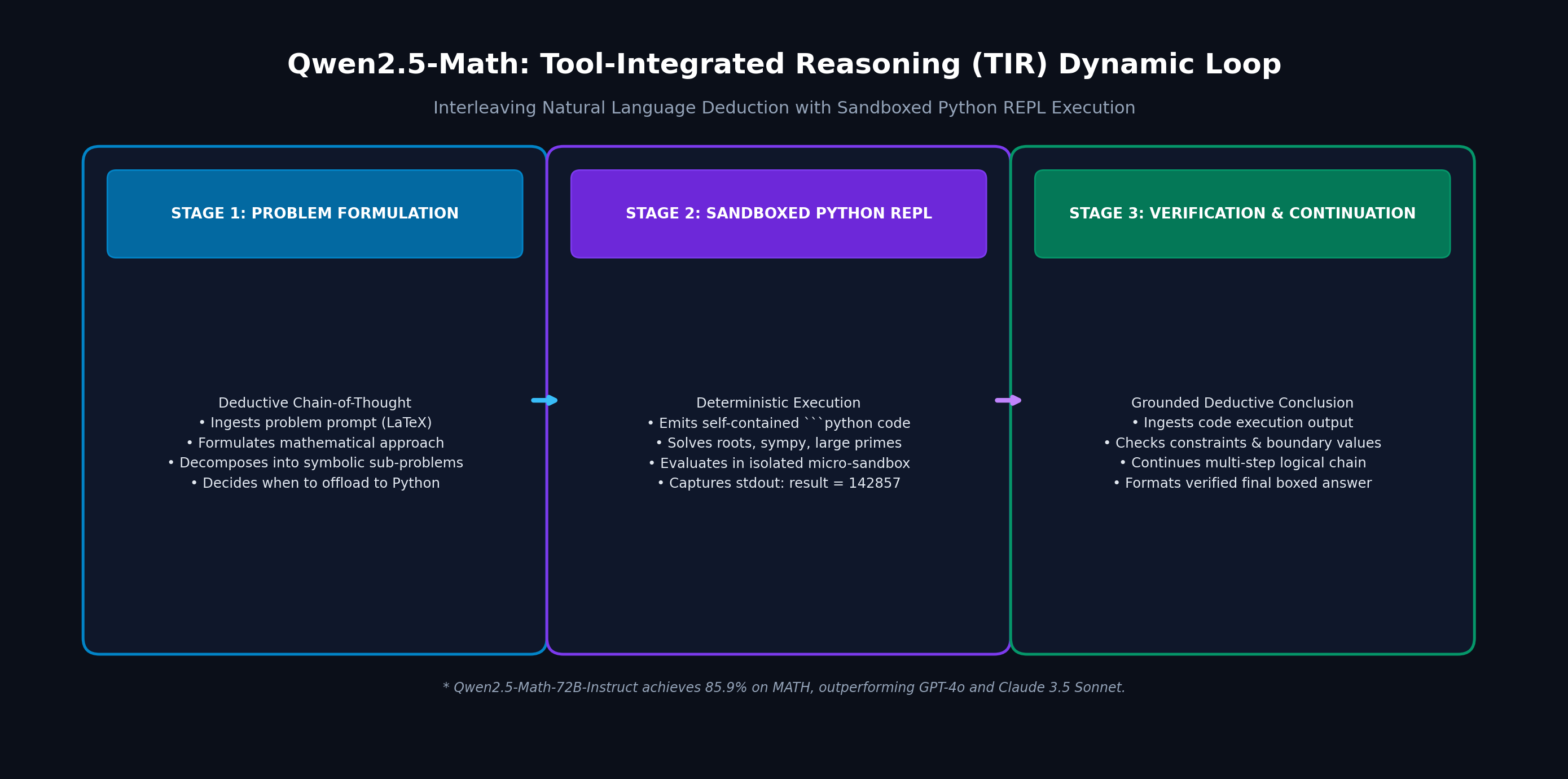
Tool-Integrated Reasoning is not a simple post-hoc function call. It is a tightly coupled conversational loop between the LLM policy and an isolated Python REPL environment.
The 3-Stage Dynamic Execution Loop
When presented with a complex problem, Qwen2.5-Math executes an interactive 3-stage loop:
- Stage 1: Problem Formulation and Deduction: The model analyzes the mathematical problem, identifies the underlying algebraic relations, and decomposes the challenge into manageable sub-tasks. When it reaches an operation prone to human or autoregressive error (e.g., factoring a 6th-degree polynomial or calculating a prime modulo), it transitions into code generation.
- Stage 2: Sandboxed Python Execution:
The model emits a self-contained Python code block containing imports (like
sympy,math, oritertools) and execution logic. A local runtime intercepts the code block, executes it inside an isolated sandbox, and captures stdout. - Stage 3: Verification and Grounded Continuation: The captured execution output is appended back into the context window as an environment observation. Qwen2.5-Math reads the exact roots, verifies them against any initial constraints, and proceeds with subsequent deductive steps until reaching the final conclusion.
Implementation: Serving Qwen2.5-Math Locally with a Sandboxed Python REPL Loop
Deploying Qwen2.5-Math with an automated Tool-Integrated Reasoning (TIR) loop gives developers an uncompromising local mathematical engine. Below is a complete, runnable Python script demonstrating how to orchestrate Qwen/Qwen2.5-Math-7B-Instruct with an interactive execution environment.
Step 1: Environment Setup
Install the required Hugging Face and mathematical computation libraries:
pip install torch transformers sympy Step 2: Interactive TIR Execution Agent
The following script loads Qwen2.5-Math, detects generated Python blocks, executes them safely, and feeds the output back to the model iteratively until a final \boxed{} answer is reached:
import io
import re
import sys
import torch
from transformers import AutoModelForCausalLM, AutoTokenizer

MODEL_ID = "Qwen/Qwen2.5-Math-7B-Instruct"

print(f"Loading {MODEL_ID} on local GPU/CPU...")
device = "cuda" if torch.cuda.is_available() else "cpu"

tokenizer = AutoTokenizer.from_pretrained(MODEL_ID)
model = AutoModelForCausalLM.from_pretrained(
    MODEL_ID,
    torch_dtype=torch.bfloat16 if torch.cuda.is_available() else torch.float32,
    device_map="auto"
)

def execute_sandboxed_python(code_str: str) -> str:
    old_stdout = sys.stdout
    redirected_output = io.StringIO()
    sys.stdout = redirected_output

    exec_globals = {}
    try:
        exec("import math\nimport sympy\n" + code_str, exec_globals)
        result = redirected_output.getvalue().strip()
    except Exception as e:
        result = f"Execution Error: {e}"
    finally:
        sys.stdout = old_stdout

    return result if result else "[Code executed successfully with no output]"

def solve_math_problem_tir(problem_prompt: str, max_turns: int = 5) -> str:
    system_prompt = (
        "Please reason step by step, and put your final answer within \\boxed{}. "
        "You may use Python code to verify intermediate steps or perform calculations "
        "by wrapping code in ```python and ``` blocks."
    )

    conversation_history = [
        {"role": "system", "content": system_prompt},
        {"role": "user", "content": problem_prompt}
    ]

    for turn in range(max_turns):
        print(f"\n--- TIR Iteration Turn {turn + 1} ---")
        prompt = tokenizer.apply_chat_template(
            conversation_history,
            tokenize=False,
            add_generation_prompt=True
        )

        inputs = tokenizer(prompt, return_tensors="pt").to(model.device)

        with torch.no_grad():
            output_tokens = model.generate(
                **inputs,
                max_new_tokens=1024,
                temperature=0.1,  # Low temperature for deterministic mathematical logic
                pad_token_id=tokenizer.eos_token_id
            )

        response = tokenizer.decode(
            output_tokens[0][inputs.input_ids.shape[1]:],
            skip_special_tokens=True
        )

        print("Model Output:\n", response)

        # Check if model has reached final boxed answer
        if "\\boxed{" in response:
            print("\nFinal verified mathematical solution reached!")
            return response

        # Check for Python code block
        code_match = re.search(r"```python\s*(.*?)\s*```", response, re.DOTALL)
        if code_match:
            code_to_run = code_match.group(1)
            print(f"\n[Executing Python Snippet]:\n{code_to_run}")
            exec_result = execute_sandboxed_python(code_to_run)
            print(f"[REPL Output]: {exec_result}")

            conversation_history.append({"role": "assistant", "content": response})
            conversation_history.append({
                "role": "user",
                "content": f"```output\n{exec_result}\n```"
            })
        else:
            return response

    return response

if __name__ == "__main__":
    challenge_problem = (
        "Find the sum of all positive integers n < 1000 such that n is divisible by 7 "
        "and when divided by 5 leaves a remainder of 3."
    )
solution = solve_math_problem_tir(challenge_problem) Architectural Comparison: Qwen2.5-Math vs. GPT-4o vs. DeepSeek-Math
To understand why Qwen2.5-Math has established itself as the global state of the art in mathematical intelligence, examine benchmark results across standard English and Chinese competitions:
| Benchmark / Capability | DeepSeek-Math-7B | OpenAI GPT-4o (Cloud API) | Qwen2.5-Math-7B-Instruct | Qwen2.5-Math-72B-Instruct |
|---|---|---|---|---|
| Model Parameter Count | 7 Billion | Undisclosed Frontier | 7.6 Billion | 72.7 Billion |
| Math Pretraining Volume | 120 Billion Tokens | Undisclosed Generalist | 500 Billion Tokens | 500 Billion Tokens |
| MATH Benchmark (CoT) | 51.7% | 76.6% | 79.8% | 83.1% |
| MATH Benchmark (TIR) | 58.8% | N/A (Manual tools) | 83.6% | 85.9% (State of the Art) |
| GSM8K Accuracy | 88.2% | 95.8% | 91.5% | 95.2% |
| AIME 2024 (Olympiad) | 11.8% | 23.3% | 26.7% | 36.7% (Exceeds GPT-4o) |
| GaoKao Math (Chinese) | 62.4% | 75.3% | 81.4% | 88.2% (Top in Class) |
| Tool-Integrated Reasoning | Basic Python support | Prompt-engineered API | Native TIR Fine-Tuning | Native TIR Fine-Tuning |
| 100% Offline / Local | Yes | No (Cloud API only) | Yes (Single RTX 3090/4090) | Yes (2x 80GB GPUs) |
Why Qwen2.5-Math Outperforms Larger Generalist Models
Notice that Qwen2.5-Math-7B-Instruct (83.6% MATH with TIR) dramatically outperforms generalist frontier models like GPT-4o (76.6%) despite having an order of magnitude fewer parameters:
- Mathematical Representation Density: While generalist models allocate parameter capacity to conversational chit-chat, poetry, and multi-lingual idioms, Qwen2.5-Math dedicates 500B tokens to formal proofs, symbolic transformations, and mathematical rigor.
- Native Tool Grounding: Rather than treating Python execution as an afterthought, the model was post-trained specifically on thousands of tool-integrated trajectories, learning exactly when mental math is sufficient and when code execution is mandatory.
Production Engineering: Deploying Math LLMs in Agentic Pipelines
When integrating Qwen2.5-Math into enterprise financial workflows, accounting reconciliation engines, or automated web extraction pipelines like AiFetchly, implement these production patterns:
1. Automated Tabular Reconciliation with aiFetchly
In automated data extraction platforms like AiFetchly, web scrapers collect structured financial tables from annual reports, SEC 10-K filings, and supply chain invoices:
- Cross-Column Consistency Audits: Qwen2.5-Math uses TIR to write SymPy formulas that audit whether extracted tabular balance sheets balance ($Assets = Liabilities + Equity$).
- Tax Calculation Verification: Verifies whether line items conform to regional sales tax formulas, flagging discrepancy anomalies with zero human overhead.
2. Micro-Container Sandboxing for Security
Never execute LLM-generated Python code directly on bare-metal host processes:
- Wrap the REPL runner inside ephemeral, restricted containers (such as gVisor, Firecracker, or Docker with resource limits).
- Disable all outbound networking (
network_mode="none"). - Enforce strict memory (e.g., 256MB) and CPU timeout constraints (e.g., 5 seconds) to prevent accidental infinite loops.
3. Early Exit Optimization
Because simple arithmetic questions do not require full TIR multi-turn overhead:
- Implement an early exit detector: if the prompt is an elementary math question (e.g., GSM8K grade-school level), invoke Qwen2.5-Math in pure CoT mode.
- Trigger the interactive Python REPL loop only when higher-order calculus, modular arithmetic, or high-degree polynomials are detected.
Summary Checklist: Evaluating Mathematical Foundation Models
Before standardizing on a mathematical language model architecture in 2026, verify that your model satisfies these capabilities:
- High-Density Mathematical Pretraining: Pretrained on at least 300B+ dedicated math tokens spanning LaTeX and formal proofs.
- Native Tool-Integrated Reasoning (TIR): Capable of interleaving natural language deduction with executable Python REPL code.
- Dual CoT and Tool Support: Operates seamlessly both in pure text environments and tool-enabled runtimes.
- Specialized Math Reward Alignment: Aligned using a domain-specific mathematical reward model (such as Qwen2.5-Math-RM-72B).
- Open-Weights Local Deployment: Available across multiple sizes (1.5B, 7B, 72B) for cost-effective, private on-premise execution.