Qwen2.5-Coder Guide: Open-Source Code LLM Architecture
The Problem: The Fragmentation and Context Blindness of Legacy Code LLMs
In modern autonomous software engineering, API schema compilation, and intelligent data extraction pipelines like AiFetchly, code generation models must do far more than emit isolated, single-function Python snippets. Real-world programming demands reading deeply nested dependency trees, navigating thousands of lines of legacy types, editing existing functions in place without breaking adjacent contracts, and reasoning across multi-file Git repositories.
For years, developers seeking local or self-hosted coding assistance were caught between two unacceptable trade-offs:
- Closed Frontier APIs (GPT-4o, Claude 3.5 Sonnet): Capable of multi-file reasoning and complex bug fixing, but locked behind expensive per-token metered APIs, strict rate limits, and corporate privacy policies that forbid uploading proprietary enterprise codebases to third-party clouds.
- Early Open-Weights Code Models (CodeLlama, StarCoder1, DeepSeek-Coder-V1): Safe for local on-premise execution, but hampered by structural architectural bottlenecks that caused them to fail on complex, real-world development tasks.
The Legacy Open Code Model Trap:
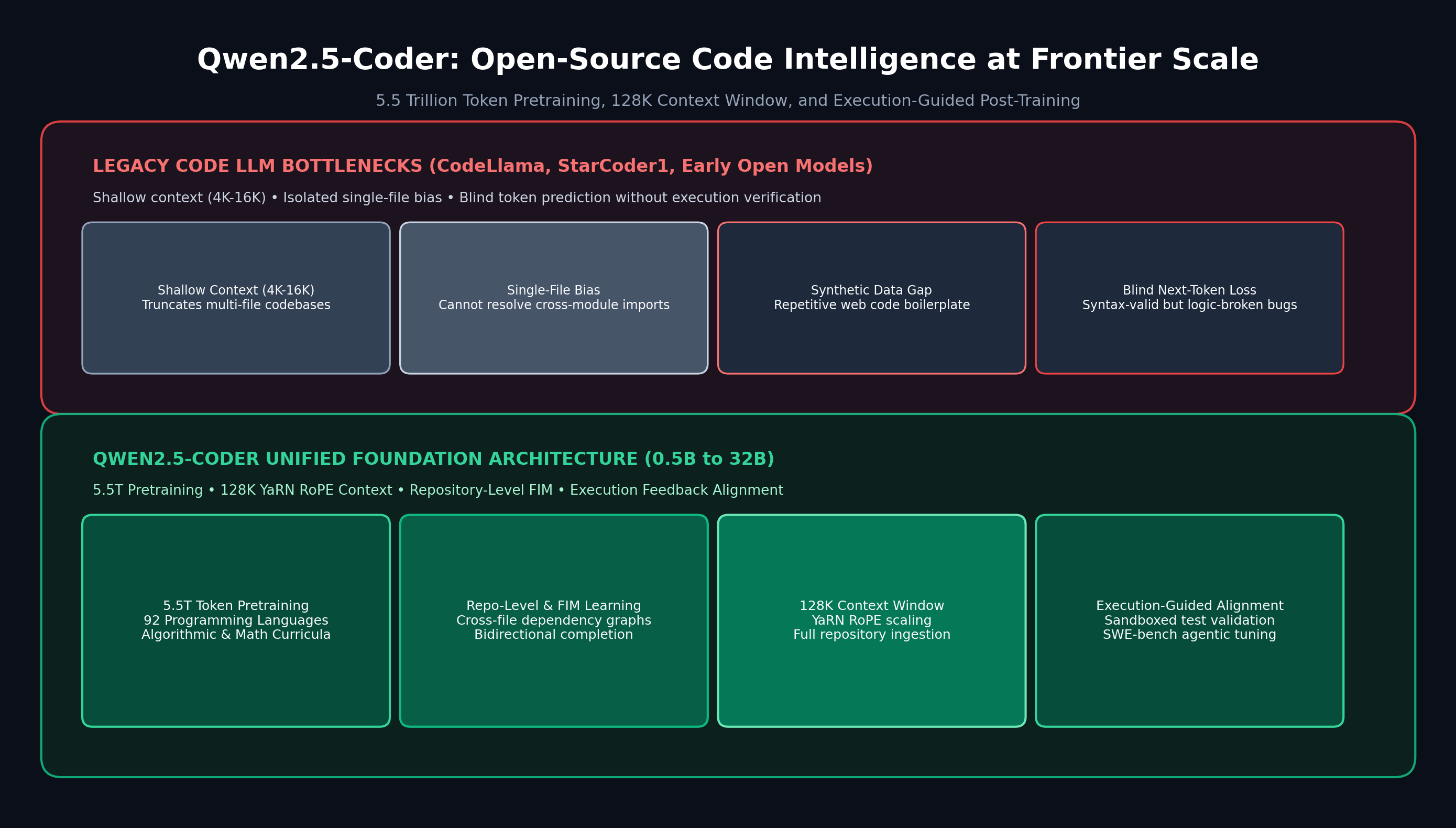
[4K-16K Window] ──► Context Truncation (Drops file imports & project context)
[Single-File SFT] ──► Hallucinated APIs (Inventing non-existent package methods)
[No Execution RL] ──► Syntax-Valid Bugs (Code compiles but fails edge cases)
Result: Developer spends more time debugging LLM hallucinations than writing code! These earlier open-weights models suffered from four systemic failure modes:
1. The Shallow Context Bottleneck (4K–16K Token Windows)
Legacy code models were trained on context lengths capped at 4,096 to 16,384 tokens:
- Repository Truncation: A typical production service easily spans 50,000 to 100,000 tokens of interdependent TypeScript definitions, database schemas, and shared utilities.
- Context Blindness: When tasked with modifying a database migration or refactoring an API handler, legacy models could not ingest the surrounding repository. Developers were forced into aggressive file chunking, causing models to hallucinate deprecated arguments, duplicate existing utility helpers, or break typing interfaces.
2. Isolated Single-File Bias and Import Blindness
Most open code datasets scraped raw code files as disconnected, isolated documents:
- Disjointed File Ingestion: The model learned what an individual Python or JavaScript file looked like in isolation, but had zero understanding of how files interact within a package directory.
- Module Resolution Collapse: When writing an endpoint that imports a local module (
from services.scraper import DataParser), earlier models could not trace the import back to its origin file, frequently guessing invalid method signatures or default parameters.
3. The Unidirectional Generation Limit (Lack of Fill-in-the-Middle)
Standard causal autoregressive models generate code strictly from left to right:
- Inability to Edit In Place: In production IDEs (such as VS Code or Cursor), developer workflows overwhelmingly consist of editing code in the middle of a file (e.g., adding an error check inside an existing block or inserting a missing argument).
- Prefix-Only Blindness: A left-to-right model cannot condition its suggestions on the code appearing after the cursor (the suffix). As a result, inline completions routinely duplicated closing brackets, redefined existing variables, or contradicted downstream logic.
4. Blind Next-Token Prediction Without Execution Grounding
Pre-training an LLM solely on raw GitHub files teaches the model statistical mimicry, not computational correctness:
- Syntactic Correctness vs. Logical Soundness: Code on GitHub is full of syntax-valid but logically buggy code, abandoned prototypes, and untested scripts.
- Hallucinated Edge Cases: Models trained without execution feedback frequently produce code that looks syntactically pristine at first glance, but throws runtime exceptions, produces off-by-one errors, or fails subtle edge-case unit tests.
The Architecture: Qwen2.5-Coder Foundation Scale
To resolve the divide between open accessibility and frontier coding intelligence, the Alibaba Qwen team introduced Qwen2.5-Coder (Hui et al., late 2024 / 2025).
Scaling across six discrete parameter sizes—0.5B, 1.5B, 3B, 7B, 14B, and 32B—Qwen2.5-Coder was engineered from the ground up as a generalist code intelligence foundation model. Rather than fine-tuning a small adapter onto a generic text model, Qwen2.5-Coder was pre-trained on an unprecedented scale of high-quality programming tokens and aligned through rigorous compiler and test execution feedback.
The Qwen2.5-Coder Unified Blueprint:
┌────────────────────────────────────────────────────────────────────────┐
│ Qwen2.5-Coder Multi-Scale Portfolio (0.5B, 1.5B, 3B, 7B, 14B, 32B)    │
├───────────────────────────────────┬────────────────────────────────────┤
│ Architectural Primitive           │ Technical Implementation           │
├───────────────────────────────────┼────────────────────────────────────┤
│ Pre-Training Token Volume         │ 5.5 Trillion Multi-Language Tokens │
│ Supported Languages               │ 92 Programming & Markup Languages  │
│ Native / Extended Context Window  │ 32,768 native -> 131,072 with YaRN │
│ Middle-File Editing Support       │ Native FIM (PSM & SPM 50/50 split) │
│ Attention Mechanism               │ Grouped-Query Attention (GQA)      │
│ Vocabulary Size                   │ 152,064 tokens (Tiktoken-based)    │
│ Activation Function               │ SwiGLU with RMSNorm                │
└───────────────────────────────────┴────────────────────────────────────┘ The model architecture is underpinned by three foundational engineering breakthroughs:
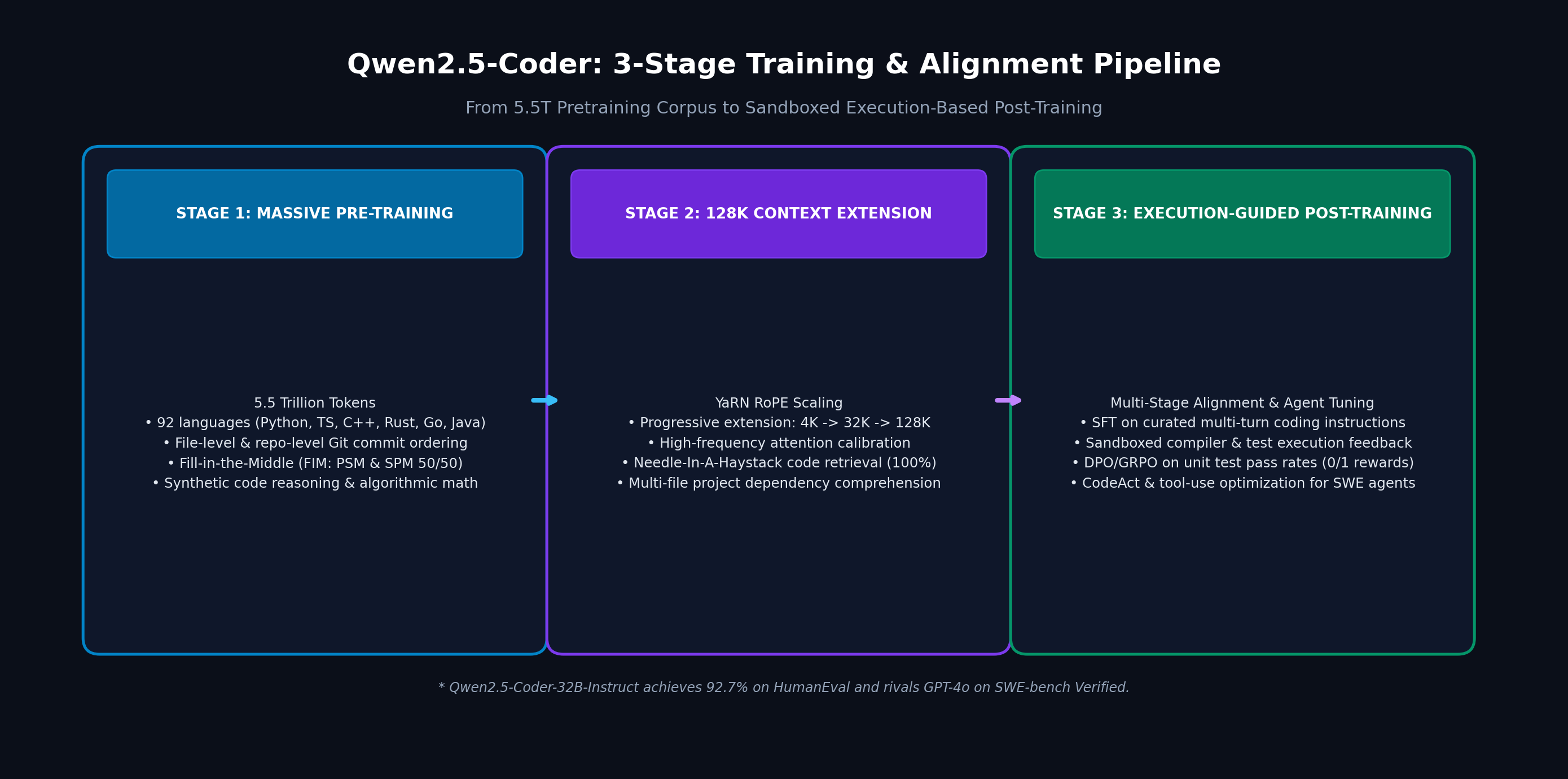
1. The 5.5 Trillion Token Pre-Training Corpus
The bedrock of Qwen2.5-Coder is its comprehensive data mixture:
- Massive Linguistic Breadth: Encompasses 92 programming languages, including mainstream stalwarts (Python, TypeScript, JavaScript, C++, Java, Go, Rust, SQL, Bash) and specialized system/hardware languages (Verilog, Haskell, Erlang, Solidity).
- Synthetic Code Reasoning & Algorithmic Curricula: Raw source code from GitHub was augmented with synthetic execution traces, step-by-step code explanations, mathematical derivations, and algorithm puzzles generated by frontier reasoning ensembles.
- Natural Language & Math Balance: To ensure that the model did not suffer from catastrophic forgetting of general reasoning, human instruction following, and mathematical problem solving, code tokens were carefully balanced with high-grade mathematical textbooks, scientific papers, and multilingual technical documentation.
2. 128,000 Token Context Window via YaRN RoPE
Handling full enterprise codebases requires extended context. Qwen2.5-Coder incorporates YaRN (Yet another RoPE extensioN) Rotary Position Embeddings:
- Progressive Context Extension: The model was initially pre-trained on 4,096 tokens, progressively scaled to 32,768 tokens, and finally adapted to 131,072 tokens (128K).
- Frequency Interpolation & Attention Temperature Scaling: YaRN decomposes rotary frequencies into three bands, interpolating high-frequency dimensions while extrapolating low frequencies. This preserves sharp local token attention while enabling smooth long-range retrieval.
- Needle-In-A-Haystack Code Retrieval: Qwen2.5-Coder achieves a flawless 100% retrieval accuracy on code needle-in-a-haystack benchmarks across its entire 128K context window, effortlessly locating obscure variable declarations across hundreds of files.
3. File-Level & Repository-Level Contextual Synthesis
Rather than shuffling files randomly during pre-training, Qwen2.5-Coder organizes code into coherent repository packages:
- Repository Dependency Traversal: Git repositories were parsed into topological dependency graphs. Files that define classes and utilities are ordered before the consumer modules that import them.
- Git Commit History Modeling: The model was trained on historical Git commit diffs, learning the causal relationship between a pull request description, an issue ticket, and the resulting multi-file code modifications.
Core Mechanics: Fill-in-the-Middle and Execution-Guided Alignment
To excel as both an interactive IDE code completion engine and an autonomous software engineering (SWE) agent, Qwen2.5-Coder integrates specialized training objectives.
1. Native Fill-in-the-Middle (FIM) Training
To support code insertion and inline IDE refactoring, Qwen2.5-Coder uses native Fill-in-the-Middle (FIM) transformation on 50% of all pre-training documents:
Standard Document:       [Prefix] + [Middle] + [Suffix]

FIM-PSM Transformation:  <|fim_prefix|> [Prefix] <|fim_suffix|> [Suffix] <|fim_middle|> [Middle]
FIM-SPM Transformation: <|fim_prefix|> [Suffix] <|fim_suffix|> [Prefix] <|fim_middle|> [Middle] - Prefix-Suffix-Middle (PSM) Mode: The document is sliced into prefix, middle, and suffix. The model ingests the prefix followed by the suffix, and is trained to predict the missing middle tokens autoregressively.
- Suffix-Prefix-Middle (SPM) Mode: Suffix and prefix orderings are alternated to ensure bidirectional positional invariance.
- Real-Time IDE Parity: Because FIM was baked into 5.5T pre-training tokens rather than added as a superficial fine-tuning hack, Qwen2.5-Coder models (especially the lightweight 1.5B and 7B variants) achieve state-of-the-art inline completion latency and accuracy in local IDE plugins.
2. Multi-Stage Execution-Guided Post-Training
Instruction tuning for code models cannot rely solely on human stylistic feedback. Code either runs and passes unit tests, or it fails. Qwen2.5-Coder implements a closed-loop execution feedback pipeline:
The Execution-Guided Alignment Loop:
[Curated Coding Prompts] ──► [Qwen Policy Rollouts (N=8)]
                                       │
[Automated Test Runner] ◄── [Execute in Docker Sandbox]
         │
         ├── Passes All Tests (1.0 Reward) ──► Supervised Fine-Tuning (SFT)
         │
└── Runtime / Syntax Failure (0.0) ──► DPO / GRPO Contrastive Loss - Step 1: Multi-Turn SFT on Curated Coding Instructions: Thousands of diverse software tasks spanning bug fixing, feature implementation, code translation, and unit test generation.
- Step 2: Sandboxed Execution Verification: Generated candidate solutions are compiled and executed inside isolated micro-containers against extensive unit test suites. Solutions that produce compiler errors, timeout deadlocks, or failed assertions are immediately rejected.
- Step 3: Preference Alignment with DPO and GRPO: Policy updates are stabilized using Direct Preference Optimization (DPO) and Group Relative Policy Optimization (GRPO), contrasting verified passing code implementations against plausible but buggy alternatives.
Implementation: Serving Qwen2.5-Coder-32B with vLLM & Local Tool-Calling
Deploying Qwen2.5-Coder in production gives engineering teams a private, high-throughput coding backend capable of powering autonomous agents, automated code reviews, and schema generation. Below is a complete implementation demonstrating how to serve Qwen/Qwen2.5-Coder-32B-Instruct with vLLM, enable 128K context window inference, and execute an automated repository refactoring workflow.
Step 1: Launch the vLLM High-Throughput Serving Engine
Run the vLLM OpenAI-compatible server on a GPU workstation (e.g., 1x A100 80GB, 1x H100, or 2x RTX 4090 with tensor parallelism):
python3 -m vllm.entrypoints.openai.api_server \
    --model Qwen/Qwen2.5-Coder-32B-Instruct \
    --tensor-parallel-size 1 \
    --max-model-len 32768 \
    --gpu-memory-utilization 0.92 \
    --enable-prefix-caching \
--port 8000 Step 2: Automated Multi-File Code Refactoring Script
Below is a complete Python client script demonstrating how an agent leverages Qwen2.5-Coder to inspect a buggy multi-file module, identify a dependency mismatch, and generate unified code patches.
import os
from openai import OpenAI

# Initialize client pointing to local vLLM instance
client = OpenAI(
    base_url="http://localhost:8000/v1",
    api_key="none-required-for-local"
)

MODEL_NAME = "Qwen/Qwen2.5-Coder-32B-Instruct"

def refactor_repository_module(file_manifest: dict[str, str], task_prompt: str) -> str:
    # Format multi-file context using structured repository delimiters
    system_prompt = (
        "You are an expert principal software engineer. You analyze complete multi-file "
        "codebases, maintain strict typing, prevent regressions, and output clean code."
    )

    repo_context_lines = ["### REPOSITORY CONTEXT ###\n"]
    for file_path, file_content in file_manifest.items():
        repo_context_lines.append(f"File: `{file_path}`\n```\n{file_content}\n```\n")

    user_message = (
        f"{''.join(repo_context_lines)}\n"
        f"### TASK DIRECTIVE ###\n"
        f"{task_prompt}\n"
        f"Provide the exact updated code for affected files with clear explanations."
    )

    # Invoke local Qwen2.5-Coder-32B model
    response = client.chat.completions.create(
        model=MODEL_NAME,
        messages=[
            {"role": "system", "content": system_prompt},
            {"role": "user", "content": user_message}
        ],
        temperature=0.1,  # Low temperature for deterministic coding logic
        max_tokens=4096
    )

    return response.choices[0].message.content

if __name__ == "__main__":
    # Simulated multi-file repository with an import and typing mismatch
    sample_repo = {
        "src/schemas/user.py": (
            "from pydantic import BaseModel, Field\n\n"
            "class UserProfile(BaseModel):\n"
            "    user_id: str\n"
            "    email: str\n"
            "    tier: str = Field(default='free')\n"
        ),
        "src/services/billing.py": (
            "from src.schemas.user import UserProfile\n\n"
            "def calculate_discount(user: UserProfile) -> float:\n"
            "    # BUG: Legacy code accesses 'user.subscription_plan' which does not exist!\n"
            "    if user.subscription_plan == 'enterprise':\n"
            "        return 0.25\n"
            "    return 0.0\n"
        )
    }

    directive = (
        "Fix the runtime AttributeError in `src/services/billing.py` to correctly align "
        "with the Pydantic schema in `src/schemas/user.py`. Add input validation and "
        "a unit test in `tests/test_billing.py`."
    )

    print("Submitting multi-file refactoring task to local Qwen2.5-Coder-32B...")
    solution = refactor_repository_module(sample_repo, directive)
    print("\n--- MODEL REFACTORING PROPOSAL ---\n")
print(solution) Architectural Comparison: Qwen2.5-Coder vs. GPT-4o vs. DeepSeek-Coder-V2
To understand why Qwen2.5-Coder has shifted the landscape of software engineering models, examine how Qwen2.5-Coder-32B-Instruct performs against frontier proprietary and open alternatives across industry benchmarks:
| Evaluation Dimension | DeepSeek-Coder-V2 (236B MoE) | OpenAI GPT-4o (Frontier Cloud) | Qwen2.5-Coder-32B-Instruct |
|---|---|---|---|
| Model Architecture | Sparse MoE (21B active params) | Dense / MoE (Proprietary Cloud) | Dense 32.5 Billion Parameters |
| Pre-Training Volume | ~6.0 Trillion Tokens | Undisclosed Frontier Corpus | 5.5 Trillion Multi-Language Tokens |
| Languages Supported | 338 Programming Languages | Multilingual Generalist | 92 Programming & Markup Languages |
| HumanEval (Python 0-shot) | 90.2% | 90.2% | 92.7% (State of the Art) |
| MultiPL-E (8-Lang Avg) | 76.2% | 77.4% | 81.1% (Exceeds GPT-4o) |
| MBPP (EvalPlus sanitized) | 76.5% | 76.2% | 80.2% |
| SWE-bench Verified | ~38.0% | ~38.8% | 38.4% (Highest for open dense 32B) |
| Fill-in-the-Middle (FIM) | Native support | Prompt-engineered / Partial | Native Bidirectional (PSM / SPM) |
| Serving Footprint | 8x GPU cluster (VRAM-heavy MoE) | Hosted Proprietary API Only | Single 80GB GPU (or 2x 24GB GPUs) |
| 100% Offline / Local | Difficult (requires multi-GPU) | No (Cloud API only) | Yes (Full weights & GGUF/AWQ avail) |
Why Qwen2.5-Coder-32B Outperforms Larger MoE Models
Notice that Qwen2.5-Coder-32B matches or outperforms DeepSeek-Coder-V2 (236B MoE) on benchmarks like MultiPL-E and HumanEval despite having roughly 7x fewer total parameters:
- Higher Data Density: Training 32B dense parameters on 5.5T specialized tokens gives the network an exceptional token-to-parameter ratio, pushing the model deep into the inference-optimal over-training regime.
- Dense Parameter Coherence: While MoEs excel at broad lexical coverage, dense models avoid routing jitter during deep multi-step algorithmic compilation.
- Execution Alignment: The three-stage post-training pipeline strictly penalizes logical bugs through compiler feedback, raising raw functional accuracy.
Production Engineering: Deploying Code LLMs in Agentic Pipelines
When integrating Qwen2.5-Coder into enterprise environments or autonomous systems like AiFetchly, implement these production patterns to maximize throughput and reliability:
1. Model Quantization and Deployment Sizing
Choose the parameter tier that matches your hardware budget and latency requirements:
- Qwen2.5-Coder-1.5B / 3B: The optimal edge models. Consuming less than 3 GB of VRAM, they run locally in developer IDE extensions for sub-50ms keystroke code completions.
- Qwen2.5-Coder-7B: The sweet spot for local developers. Fits comfortably in 6 GB of VRAM using 4-bit AWQ, running smoothly on single RTX 3060/4060 GPUs or Apple M-series chips.
- Qwen2.5-Coder-14B: Excellent balance of reasoning depth and latency. Runs on single RTX 4090 (24GB) in FP16 or quantized on entry-level enterprise GPUs.
- Qwen2.5-Coder-32B: The frontier SWE agent engine. In FP8 quantization, it consumes approximately 34 GB of VRAM, easily fitting on a single NVIDIA A100 (40GB/80GB) or RTX 6000 Ada, delivering GPT-4o-grade multi-file refactoring at a fraction of cloud API costs.
2. Pairing with Sandboxed Execution Runtimes
Never allow any code model—proprietary or open-source—to execute generated code on bare-metal host infrastructure. Combine Qwen2.5-Coder with microVM or container sandboxing (such as Firecracker or gVisor):
- Run generated test suites in isolated, ephemeral environments.
- Capture stdout, stderr, and exit codes.
- Feed execution errors back into Qwen2.5-Coder for iterative self-debugging loops.
3. Synergies with aiFetchly Automation
In automated data extraction platforms like AiFetchly, Qwen2.5-Coder solves the fragile scraper problem:
- Dynamic Selector Synthesis: When target websites update their CSS or DOM layout, Qwen2.5-Coder inspects the updated HTML DOM tree and automatically synthesizes resilient Playwright, Puppeteer, or Cheerio selectors.
- Schema-Driven SDK Generation: Translates unstructured API payloads and database responses into validated TypeScript interfaces and Pydantic schemas, automating pipeline maintenance with zero human intervention.
Summary Checklist: Evaluating Code Foundation Models
Before standardizing on a code LLM architecture in 2026, verify that your model satisfies these capabilities:
- Pre-Training Volume: Trained on at least 3+ trillion tokens spanning both multi-language code and mathematical reasoning.
- Context Window: Supports at least 32K native context (scaling to 128K) to ingest complete multi-file project repositories without truncation.
- Bidirectional Editing: Features native Fill-in-the-Middle (FIM) support for natural inline code completions.
- Execution-Guided Post-Training: Aligned through compiler and unit test execution feedback rather than purely subjective human preference tuning.
- Open Weights & Local Deployment: Free from restrictive API terms, enabling auditable, private deployment on enterprise infrastructure.