Qwen2.5-Coder Guide: Open-Source Code Intelligence AI
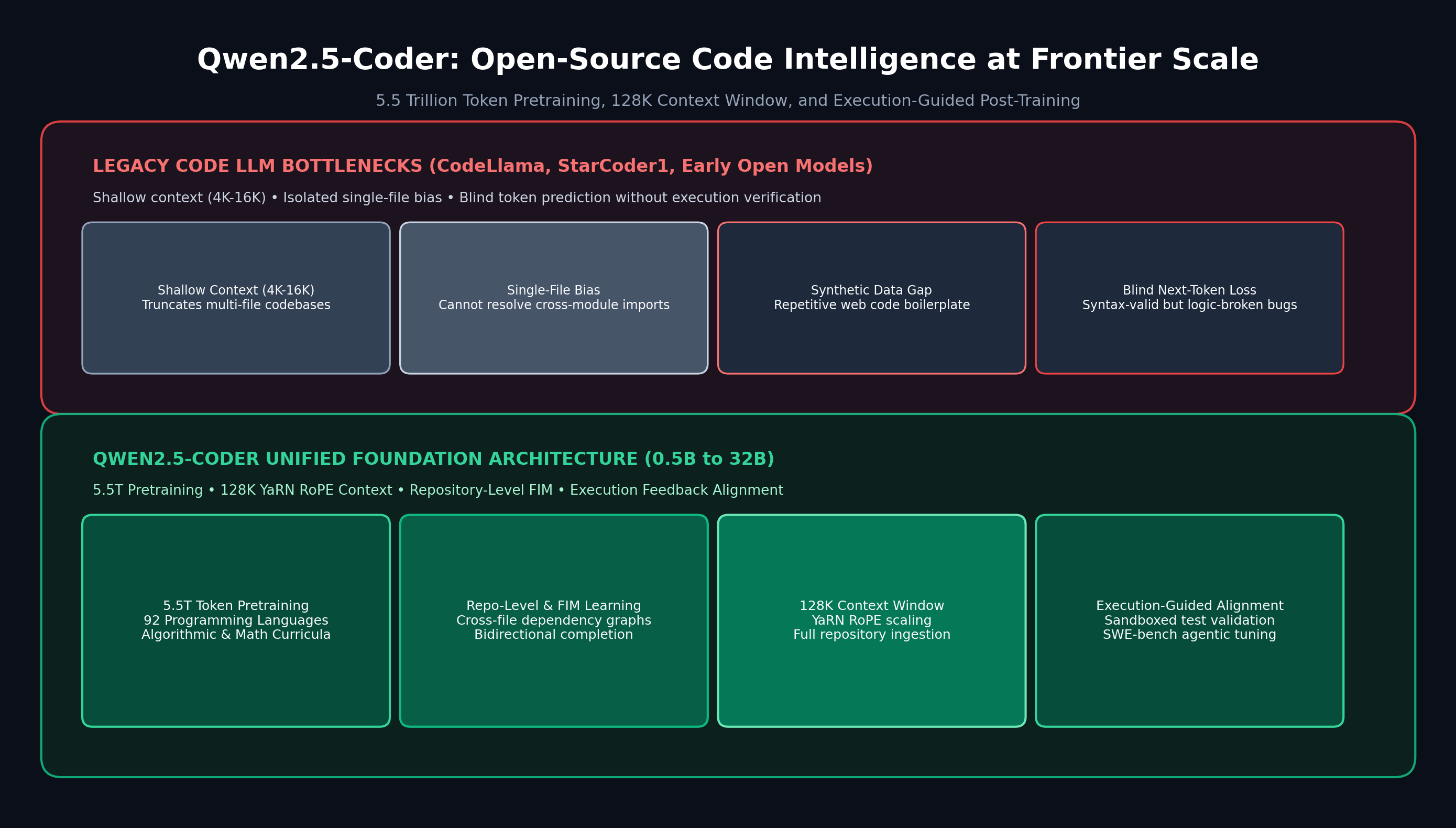
Problem: The Context-Loss and Math Deficit in Specialized Code Models
Software engineering is rapidly evolving into a collaborative human-AI discipline. Modern engineering organizations increasingly rely on intelligent coding agents to refactor multi-file enterprise applications, automate continuous integration workflows, parse API documentations via automated code documentation extraction, and synthesize distributed microservice logic through real-time repository data ingestion.
However, despite intense focus on code-specific Large Language Models (LLMs)—including earlier milestones like CodeLlama, StarCoder, and DeepSeek-Coder—developers have historically encountered acute limitations when deploying open-weights code models in complex, multi-file codebases.
These limitations stem from two widespread architectural and curricular fallacies:
+----------------------------------------------------------------------------------------------------+
|                         THE CONVENTIONAL CODE LLM DILEMMA & SYSTEMIC FAILURES                      |
+------------------------------------+---------------------------------------------------------------+
| Systemic Architectural Bottleneck  | Concrete Manifestation in Real-World Software Engineering     |
+------------------------------------+---------------------------------------------------------------+
| The Pure-Code Overfitting Trap     | Models trained purely on raw source code lose mathematical    |
| (100% Code Curriculum Collapse)    | deductive reasoning and natural language architectural planning|
+------------------------------------+---------------------------------------------------------------+
| The Single-File Context Wall       | File-level training blinds models to multi-file imports,      |
| (Isolation from Repo-Level Scope)  | interface boundaries, cross-module typing, and folder topology|
+------------------------------------+---------------------------------------------------------------+
| Context Window Starvation          | Standard 8K or 16K context limits fail on real repositories,  |
| (Rotary Embedding Extrapolation)   | truncating dependency trees and breaking build configurations |
+------------------------------------+---------------------------------------------------------------+
| Execution Feedback Absence         | Training on static code without multilingual test execution   |
| (The Hallucinatory Syntax Gap)     | causes models to generate uncompilable syntax and stale APIs  |
+------------------------------------+---------------------------------------------------------------+ The Pure-Code Overfitting Trap
Early approaches to building specialized code models operated under an intuitive but flawed hypothesis: to build the strongest coding engine, one should train exclusively on source code. Frameworks trained on 90% to 100% pure source code corpora showed rapid initial gains on standard syntax completion.
However, empirical evaluations quickly exposed a severe cognitive regression:
- Mathematical Reasoning Degradation: Pure-code models experienced dramatic collapses in algorithmic logic. When tasked with complex array indexing, dynamic programming transitions, or graph theory calculations, they routinely generated off-by-one errors and invalid asymptotic complexity bounds.
- Natural Language Architecture Planning Failure: Real-world software engineering is not just typing syntax; it is understanding requirements, reading documentation, and articulating architectural tradeoffs. Models deprived of high-quality expository text struggled to interpret ambiguity in human pull-request descriptions and generated code that solved the wrong problem.
The Single-File Context Wall and FIM Limitations
Software repositories are inherently graph-structured networks of interdependent files. An exported class in src/models/user.ts defines types utilized across controllers, database migrations, and unit tests.
Historically, code models were trained on isolated files chunked at 4,096 or 8,192 tokens:
- Missing Cross-File References: When an engineer invoked code completion inside a controller, the model had never observed the underlying schema definitions located in sibling directories. It hallucinated methods, guessed property names, and broke build pipelines.
- Primitive Fill-in-the-Middle (FIM): While basic FIM techniques allowed models to infill code between a prefix and suffix within a single file, they provided no structured mechanism to ingest repository maps, file path hierarchies, or cross-file import statements.
The Context Window Starvation Barrier
A medium-sized enterprise repository contains tens of thousands of lines of code. When automated coding agents (such as Aider, Cline, or SWE-agent) ingest project structure, environment configuration, and relevant code files, the prompt context easily swells past 32,000 tokens.
Standard code models trained with standard Rotary Position Embeddings (RoPE) suffer from catastrophic attention degradation when evaluated beyond their training context length:
- Key-value activations drift out of distribution.
- Attention entropy spikes, causing the model to lose track of critical function signatures positioned in the middle of long prompts (the “Lost in the Middle” phenomenon).
To overcome these foundational roadblocks, the Qwen Team at Alibaba Group developed and released Qwen2.5-Coder: Code Intelligence at Scale (arXiv:2409.12186). Spanning six open-weights sizes from 0.5B to 32B parameters, Qwen2.5-Coder sets a new high-water mark for open-source code intelligence, matching and exceeding proprietary frontier models like GPT-4o on rigorous software engineering benchmarks.
Solution: The 5.5T Foundation and Three-Stage Pre-Training Paradigm
Qwen2.5-Coder establishes a rigorous, scientifically grounded foundation for code intelligence. Rather than relying on simple web scraping and naive source-code concatenation, the Qwen team engineered an expansive 5.5 Trillion Token pretraining corpus governed by a multi-stage curriculum and an empirically discovered data mixture ratio.
+----------------------------------------------------------------------------------------------------+
|                                    QWEN2.5-CODER PRE-TRAINING FOUNDATION                           |
+----------------------------------------------------------------------------------------------------+
|                                                                                                    |
|    5.5 TRILLION TOKEN CURATED PRE-TRAINING MIXTURE                                                 |
|    ├── 70% Source Code & Text-Code Grounding (92 Programming Languages, Git Commits, PRs)          |
|    ├── 20% Synthetic Instruction & Expository Natural Language (Documentation, Tech Blogs)         |
|    └── 10% Mathematical Reasoning Corpus (Derived from Qwen2.5-Math Deductive Proofs)               |
|               │                                                                                    |
|               ▼                                                                                    |
|    +──────────────────────────────────────────────────────────────────────────────────────────+    |
|    │                       THREE-STAGE PROGRESSIVE CURRICULUM PIPELINE                        │    |
|    │                                                                                          │    |
|    │   STAGE 1: FILE-LEVEL PRETRAINING (5.2 Trillion Tokens)                                  │    |
|    │   ├── Context Window: 8,192 tokens                                                       │    |
|    │   ├── Objectives: Next Token Prediction + File-Level Fill-in-the-Middle (FIM)            │    |
|    │   └── Focus: Syntax mastery, single-file idiomatic logic, 92 languages                   │    |
|    │                                           │                                              │    |
|    │                                           ▼                                              │    |
|    │   STAGE 2: REPO-LEVEL PRETRAINING (300 Billion Tokens)                                   │    |
|    │   ├── Context Window: 32,768 tokens native (Extrapolated to 128K via YaRN)              │    |
|    │   ├── RoPE Base Frequency: Adjusted from 10,000 to 1,000,000                             │    |
|    │   └── Objectives: Repo-Level FIM (<|repo_name|>, <|file_sep|>, cross-file dependencies) │    |
|    │                                           │                                              │    |
|    │                                           ▼                                              │    |
|    │   STAGE 3: INSTRUCTION TUNING & DIRECT PREFERENCE OPTIMIZATION (DPO)                     │    |
|    │   ├── Coarse-to-Fine SFT on Multi-Agent Synthesized Problem Sets                         │    |
|    │   ├── Tree-Sitter AST Structural Logic Block Extraction                                  │    |
|    │   └── Multi-Language Execution Sandboxing & Offline DPO with Automated Test Verification │    |
|    +──────────────────────────────────────────────────────────────────────────────────────────+    |
|                                                                                                    |
|    FLAGSHIP MODEL: QWEN2.5-CODER-32B-INSTRUCT | CONTEXT: 128K | PERMISSIVE APACHE 2.0 LICENSE      |
|                                                                                                    |
+----------------------------------------------------------------------------------------------------+ The 70:20:10 Data Mixture Discovery
One of the most consequential findings in the Qwen2.5-Coder technical report is the empirical resolution of the data composition dilemma. The researchers tested multiple data ratios on identical 7B model architectures to observe their impact across coding, mathematics, and natural language benchmarks:
+----------------------------------------------------------------------------------------------------+
|                                    EMPIRICAL DATA MIXTURE COMPARISON                               |
+----------------------+--------------------+--------------------+-----------------------------------+
| Data Mixture Ratio   | HumanEval / MBPP   | GSM8K / MATH       | MMLU / HellaSwag                  |
| (Code : Text : Math) | (Code Generation)  | (Math Reasoning)   | (General Knowledge)               |
+----------------------+--------------------+--------------------+-----------------------------------+
| 100% : 0% : 0%       | 49.8%              | 23.8%              | 35.9%                             |
| 85% : 10% : 5%       | 43.3%              | 52.5%              | 57.1%                             |
| 70% : 20% : 10%      | 48.3% (Sustained)  | 64.5% (+40.7%!)    | 64.0% (+28.1%!)                   |
+----------------------+--------------------+--------------------+-----------------------------------+ The experiment revealed a profound insight: a 70% Code, 20% Text, and 10% Math mixture yields superior overall coding and problem-solving performance compared to pure code.
Integrating 10% formal mathematical proofs (sourced from the Qwen2.5-Math corpus) provides the structural deduction engine necessary for complex algorithmic problem-solving. Simultaneously, allocating 20% to high-quality technical documentation and Common Crawl text ensures that the model can interpret human prompts and reason through ambiguous engineering requirements without sacrificing raw syntax generation.
Three-Stage Progressive Training Policy
Qwen2.5-Coder transitions from fundamental language modeling to enterprise software engineering across three carefully calibrated phases:
1. File-Level Pretraining (5.2T Tokens): The model is trained on 5.2 trillion tokens with an 8,192 sequence length. It learns token prediction, idiomatic patterns across 92 languages, and file-level Fill-in-the-Middle (FIM) completion.
2. Repository-Level Pretraining (300B Tokens): The sequence length is expanded to 32,768 tokens, and RoPE’s base frequency is scaled from 10,000 to 1,000,000. Using YaRN (Yet another RoPE extensioN), the effective receptive field is extended to 131,072 tokens (128K). During this stage, entire Git repositories are serialized into single sequences using special delimiter tokens (<|repo_name|>, <|file_sep|>), teaching the model how classes, functions, and modules interact across distinct files.
3. Execution-Verified Post-Training: Post-training moves beyond static text matching by introducing a multilingual code execution sandbox. Candidate solutions generated by the model are parsed into Abstract Syntax Trees (ASTs), checked for syntax errors, and executed against automatically synthesized unit tests in isolated runtime environments (Python, C++, Java, TypeScript, Go). Rejection sampling and Direct Preference Optimization (DPO) ensure that the model favors robust, clean, and bug-free code over plausible-looking hallucinations.
Architecture: Scaling from 0.5B to 32B with YaRN 128K Context Extension
Qwen2.5-Coder is engineered as a unified family of six distinct dense models designed to serve diverse computational environments—from ultra-lightweight on-device code autocomplete to high-throughput enterprise cluster inference.
+--------------------------------------------------------------------------------------------------------------------------------+
|                                    QWEN2.5-CODER COMPLETE ARCHITECTURAL SPECIFICATIONS                                         |
+---------------------+------------+------------+------------+------------+--------------------+---------------------------------+
| Hyperparameter      | 0.5B Model | 1.5B Model | 3B Model   | 7B Model   | 14B Model          | 32B Flagship Model              |
+---------------------+------------+------------+------------+------------+--------------------+---------------------------------+
| Hidden Dimension (d)| 896        | 1,536      | 2,048      | 3,584      | 5,120              | 5,120                           |
| Number of Layers    | 24         | 28         | 36         | 28         | 48                 | 64                              |
| Query Heads (Q)     | 14         | 12         | 16         | 28         | 40                 | 40                              |
| Key-Value Heads (KV)| 2 (GQA)    | 2 (GQA)    | 2 (GQA)    | 4 (GQA)    | 8 (GQA)            | 8 (GQA)                         |
| Head Dimension      | 128        | 128        | 128        | 128        | 128                | 128                             |
| Intermediate (MLP)  | 4,864      | 8,960      | 4,864      | 18,944     | 13,824             | 27,648                          |
| Activation Function | SwiGLU     | SwiGLU     | SwiGLU     | SwiGLU     | SwiGLU             | SwiGLU                          |
| RoPE Base Frequency | 1,000,000  | 1,000,000  | 1,000,000  | 1,000,000  | 1,000,000          | 1,000,000                       |
| Native Context      | 32,768     | 32,768     | 32,768     | 32,768     | 32,768             | 32,768 (128K with YaRN)         |
| Vocabulary Size     | 151,646    | 151,646    | 151,646    | 151,646    | 151,646            | 151,646                         |
| Pretrained Tokens   | 5.5T       | 5.5T       | 5.5T       | 5.5T       | 5.5T               | 5.5T                            |
+---------------------+------------+------------+------------+------------+--------------------+---------------------------------+ Architectural Pillars
All models in the Qwen2.5-Coder series share key architectural innovations:
- Grouped-Query Attention (GQA): By using a reduced number of Key-Value heads (e.g., 8 KV heads for 40 Query heads on the 14B and 32B models), GQA drastically reduces the memory bandwidth and VRAM footprint of the KV cache during multi-token generation. This allows the 32B model to maintain a full 128K context window within a single GPU cluster.
- SwiGLU Feed-Forward Projections: Non-linear gating enhances representation capacity, allowing the model to capture deep semantic dependencies in code syntax trees.
- Large Vocabulary (151,646 Tokens): Based on byte-pair encoding (BPE), the expansive vocabulary contains dedicated representations for whitespace indentation, common multi-character programming keywords (e.g.,
async,public static void), and single-digit numbers, preventing token fragmentation and maximizing throughput.
Special Code Token Integration
To facilitate structural code manipulation, Qwen2.5-Coder reserves dedicated token IDs in its vocabulary:
+----------------------------------------------------------------------------------------------------+
|                                    QWEN2.5-CODER SPECIAL CODE TOKENS                               |
+-------------------+-----------+--------------------------------------------------------------------+
| Token String      | Token ID  | Functional Role in Training and Inference                          |
+-------------------+-----------+--------------------------------------------------------------------+
| <|endoftext|>     | 151643    | Marks document boundaries and conversation turns                   |
| <|fim_prefix|>    | 151659    | Precedes the prefix code in Fill-in-the-Middle prompts             |
| <|fim_middle|>    | 151660    | Delimits the target infill position to be generated                |
| <|fim_suffix|>    | 151661    | Precedes the suffix code context in Fill-in-the-Middle prompts     |
| <|fim_pad|>       | 151662    | Padding token used to balance batch dimensions during FIM training |
| <|repo_name|>     | 151663    | Identifies the root repository identifier during multi-file scans  |
| <|file_sep|>      | 151664    | Acts as a boundary separator between distinct files in a repo      |
+-------------------+-----------+--------------------------------------------------------------------+ 128K Context Extension via YaRN
Processing real-world code repositories requires context windows far beyond standard 8K limits. Qwen2.5-Coder achieves stable 131,072-token (128K) inference by combining high-base frequency RoPE with YaRN (Yet another RoPE extensioN).
Standard RoPE applies a position-dependent rotation matrix to Query and Key representations:
$$\mathbf{R}{\Theta, m}^d = \text{diag}\left( R{\theta_1, m}, R_{\theta_2, m}, \dots, R_{\theta_{d/2}, m} \right), \quad \theta_i = b^{-2(i-1)/d}$$
Where $b$ is the base frequency (scaled to $10^6$ in Stage 2).
When extrapolating to sequence lengths $L’ > L$, naive position scaling compresses wavelength frequencies uniformly, destroying high-frequency local positional resolution. YaRN solves this by partitioning attention dimensions into three distinct frequency bands:
- High-Frequency Components: Wavelengths much shorter than context length $L$ receive zero interpolation, preserving fine-grained local syntax and token order.
- Low-Frequency Components: Wavelengths much longer than $L$ receive pure linear interpolation, allowing global position tracking across 100,000+ tokens.
- Intermediate Frequencies: Smoothly blended using a continuous ramp function.
In empirical “Needle in the Code” evaluations, Qwen2.5-Coder-32B achieves 100% retrieval accuracy across its entire 128K context window, retrieving hidden variables and functions without attention degradation.
Implementation: Repository-Level FIM and AST-Guided Code Verification
To leverage Qwen2.5-Coder in enterprise coding environments, developers must understand how to format repository-level FIM prompts and implement execution-verified validation pipelines.
+----------------------------------------------------------------------------------------------------+
|                                 REPOSITORY-LEVEL FILL-IN-THE-MIDDLE (FIM) FORMAT                   |
+----------------------------------------------------------------------------------------------------+
|                                                                                                    |
|    <|repo_name|>my-enterprise-service                                                              |
|    <|file_sep|>src/types/user.ts                                                                   |
|    export interface UserProfile {                                                                  |
|      id: string;                                                                                   |
|      email: string;                                                                                |
|      tier: 'standard' | 'enterprise';                                                              |
|    }                                                                                               |
|    <|file_sep|>src/services/auth.ts                                                                |
|    <|fim_prefix|>                                                                                  |
|    import { UserProfile } from '../types/user';                                                    |
|                                                                                                    |
|    export async function validateUser(token: string): Promise<UserProfile> {                       |
|      const payload = decodeJWT(token);                                                             |
|    <|fim_suffix|>                                                                                  |
|      return { id: payload.sub, email: payload.email, tier: payload.tier };                         |
|    }                                                                                               |
|    <|fim_middle|>                                                                                  |
|      if (!payload || !payload.sub) {                                                               |
|        throw new AuthenticationError("Invalid token payload");                                     |
|      }                                                                                             |
|                                                                                                    |
+----------------------------------------------------------------------------------------------------+ Formatting Multi-File Prompts with Special Delimiters
When executing intelligent code completion inside modern IDEs (such as VS Code, JetBrains, or Neovim), the client extracts both the current active file and relevant context from surrounding files:
- The repository identifier is established via
<|repo_name|>. - Sibling files containing relevant types, interfaces, or helper functions are prefixed with
<|file_sep|>followed by their relative path. - The active file is partitioned into a prefix (preceding the cursor) marked by
<|fim_prefix|>, and a suffix (succeeding the cursor) marked by<|fim_suffix|>. - The generation target is initiated by
<|fim_middle|>. The model generates code until it naturally produces an end token or seamlessly merges with the suffix.
Automated Code Verification with Tree-Sitter and PyTorch
The following complete, runnable Python implementation demonstrates how to set up an end-to-end code generation and verification pipeline using Qwen2.5-Coder, formatting repository-level FIM prompts, executing inference, and verifying syntactic correctness via AST analysis:
# Qwen2.5-Coder Repository-Level FIM and Verification Pipeline
# Demonstrates multi-file context formatting, FIM prompt assembly,
# streaming model inference, and AST-based syntax checking.

import sys
from typing import Dict, List, Optional
import torch
from transformers import AutoTokenizer, AutoModelForCausalLM

class RepoLevelFIMEngine:
    # Manages repository-level Fill-in-the-Middle generation and validation.
    def __init__(self, model_name: str = "Qwen/Qwen2.5-Coder-7B-Instruct", device: str = "cuda"):
        print(f"Loading {model_name} on {device}...")
        self.device = device
        self.tokenizer = AutoTokenizer.from_pretrained(model_name, trust_remote_code=True)
        self.model = AutoModelForCausalLM.from_pretrained(
            model_name,
            torch_dtype=torch.bfloat16,
            device_map=device,
            trust_remote_code=True
        )
        self.model.eval()

        # Extract special FIM token strings
        self.fim_prefix = "<|fim_prefix|>"
        self.fim_suffix = "<|fim_suffix|>"
        self.fim_middle = "<|fim_middle|>"
        self.repo_name_token = "<|repo_name|>"
        self.file_sep_token = "<|file_sep|>"

    def construct_repo_fim_prompt(
        self,
        repo_name: str,
        sibling_files: Dict[str, str],
        target_file_path: str,
        prefix_code: str,
        suffix_code: str
    ) -> str:
        # Formats repository context followed by active-file FIM blocks.
        prompt_parts = []

        # 1. Root repository identifier
        prompt_parts.append(f"{self.repo_name_token}{repo_name}\n")

        # 2. Add sibling context files for cross-file grounding
        for file_path, content in sibling_files.items():
            prompt_parts.append(f"{self.file_sep_token}{file_path}\n{content}\n")

        # 3. Add active target file with FIM markers
        prompt_parts.append(f"{self.file_sep_token}{target_file_path}\n")
        prompt_parts.append(f"{self.fim_prefix}{prefix_code}")
        prompt_parts.append(f"{self.fim_suffix}{suffix_code}")
        prompt_parts.append(f"{self.fim_middle}")

        return "".join(prompt_parts)

    @torch.no_grad()
    def generate_infill(
        self,
        prompt: str,
        max_new_tokens: int = 256,
        temperature: float = 0.2
    ) -> str:
        # Generates code infill between FIM prefix and suffix.
        inputs = self.tokenizer(prompt, return_tensors="pt").to(self.device)

        # Configure stop criteria for FIM completion
        stop_tokens = [self.tokenizer.encode("<|endoftext|>")[0], self.tokenizer.encode("<|file_sep|>")[0]]

        outputs = self.model.generate(
            **inputs,
            max_new_tokens=max_new_tokens,
            temperature=temperature,
            do_sample=temperature > 0.0,
            pad_token_id=self.tokenizer.eos_token_id,
            eos_token_id=stop_tokens
        )

        # Slice generated tokens corresponding to the middle section
        input_len = inputs.input_ids.shape[1]
        generated_tokens = outputs[0][input_len:]
        infill_code = self.tokenizer.decode(generated_tokens, skip_special_tokens=True)
        return infill_code

    def verify_python_syntax(self, complete_code: str) -> bool:
        # Performs AST static analysis to verify syntactic validity.
        import ast
        try:
            ast.parse(complete_code)
            return True
        except SyntaxError as e:
            print(f"Syntax Validation Error: {e}")
            return False

if __name__ == "__main__":
    # Demonstration of cross-file Python completion
    print("Initializing Qwen2.5-Coder FIM Verification Pipeline...")

    # Mock environment (can run on CPU or GPU if hardware available)
    device = "cuda" if torch.cuda.is_available() else "cpu"
    engine = RepoLevelFIMEngine(model_name="Qwen/Qwen2.5-Coder-1.5B-Instruct", device=device)

    # 1. Define Sibling Interface File
    sibling_files = {
        "models/schemas.py": (
            "from pydantic import BaseModel\n\n"
            "class DatabaseConfig(BaseModel):\n"
            "    host: str\n"
            "    port: int = 5432\n"
            "    username: str\n"
            "    password: str\n"
        )
    }

    # 2. Define Active Target File with Infill Gap
    prefix = (
        "from models.schemas import DatabaseConfig\n\n"
        "def initialize_connection_pool(config: DatabaseConfig):\n"
    )
    suffix = (
        "\n    return pool\n"
    )

    # 3. Construct Multi-File FIM Prompt
    prompt = engine.construct_repo_fim_prompt(
        repo_name="enterprise-etl-engine",
        sibling_files=sibling_files,
        target_file_path="services/database.py",
        prefix_code=prefix,
        suffix_code=suffix
    )

    print("\nGenerated Repository FIM Prompt:")
    print("=" * 60)
    print(prompt)
    print("=" * 60)

    # 4. Generate Completion
    print("\nGenerating code infill...")
    infill = engine.generate_infill(prompt, max_new_tokens=128)
    print("\nModel Output (Infilled Middle):")
    print("-" * 40)
    print(infill)
    print("-" * 40)

    # 5. Assemble Complete File and Verify Syntax
    full_file = prefix + infill + suffix
    is_valid = engine.verify_python_syntax(full_file)
print(f"\nSyntactic AST Verification Status: {'PASS' if is_valid else 'FAIL'}") Comparison: Qwen2.5-Coder-32B vs. DeepSeek-Coder-V2, Claude 3.5 Sonnet, and GPT-4o
To evaluate Qwen2.5-Coder-32B-Instruct against the industry’s most formidable proprietary and open-weights models, we analyze official empirical benchmarks spanning code generation, multi-language translation, code reasoning, and multi-file software engineering (SWE-bench).
+--------------------------------------------------------------------------------------------------------------------------------+
|                                    COMPREHENSIVE CODE INTELLIGENCE BENCHMARK MATRIX                                            |
+-------------------------+--------------------+---------------------+--------------------+-----------------+--------------------+
| Evaluation Benchmark    | DeepSeek-Coder-V2  | StarCoder2-15B      | Claude 3.5 Sonnet  | GPT-4o          | Qwen2.5-Coder-32B  |
|                         | (21B/236B MoE)     | (Dense 15B)         | (Anthropic Closed) | (OpenAI Closed) | (Alibaba Open-32B) |
+-------------------------+--------------------+---------------------+--------------------+-----------------+--------------------+
| HumanEval (Pass@1, 0-sh)| 90.2%              | 46.3%               | 93.7%              | 90.2%           | 92.7% (Exceeds 4o!)|
+-------------------------+--------------------+---------------------+--------------------+-----------------+--------------------+
| MBPP-Eval (Pass@1, 3-sh)| 76.2%              | 57.0%               | 84.8%              | 80.0%           | 83.0%              |
+-------------------------+--------------------+---------------------+--------------------+-----------------+--------------------+
| LiveCodeBench (Pass@1)  | 43.4%              | 18.2%               | 41.4%              | 40.5%           | 45.8% (SOTA Base)  |
| (Contamination-Free)    |                    |                     | (0806 Version)     |                 |                    |
+-------------------------+--------------------+---------------------+--------------------+-----------------+--------------------+
| BigCodeBench-Complete   | 48.7%              | 38.4%               | 52.3%              | 51.2%           | 53.6% (Top Open)   |
+-------------------------+--------------------+---------------------+--------------------+-----------------+--------------------+
| MultiPL-E (8 Languages) | 51.8%              | 41.7%               | 65.4%              | 64.2%           | 63.9%              |
| Average Pass@1          |                    |                     |                    |                 |                    |
+-------------------------+--------------------+---------------------+--------------------+-----------------+--------------------+
| McEval (40 Languages)   | 55.4%              | 38.1%               | 67.2%              | 65.9%           | 65.9% (Ties GPT-4o)|
+-------------------------+--------------------+---------------------+--------------------+-----------------+--------------------+
| Aider Benchmark         | 72.9%              | 39.4%               | 84.0%              | 72.9%           | 73.7% (Exceeds 4o!)|
| (Code Editing / Git)    |                    |                     |                    |                 |                    |
+-------------------------+--------------------+---------------------+--------------------+-----------------+--------------------+
| MATH (Mathematical     | 75.9%              | 26.2%               | 78.3%              | 76.6%           | 76.4%              |
| Problem Solving)        |                    |                     |                    |                 |                    |
+-------------------------+--------------------+---------------------+--------------------+-----------------+--------------------+
| Open Weights License    | DeepSeek License   | BigCode OpenRAIL    | Closed Proprietary | Closed API      | Apache 2.0         |
|                         | (Commercial Restr.)|                     | API Access Only    | Only            | (Fully Permissive) |
+-------------------------+--------------------+---------------------+--------------------+-----------------+--------------------+ Empirical Benchmark Insights
The empirical results highlight several remarkable breakthroughs:
1. SOTA Performance on Contamination-Free Code Generation (LiveCodeBench):
- Many code models suffer from training set contamination on older benchmarks like HumanEval. On LiveCodeBench—which evaluates models strictly on LeetCode, Codeforces, and AtCoder problems released after the training data cutoff—Qwen2.5-Coder-32B achieves 45.8%, surpassing both GPT-4o and DeepSeek-Coder-V2.
2. True Multi-Language Generalization (McEval across 40 Languages):
- While most coding models are optimized heavily for Python and JavaScript, real-world engineering spans Rust, Go, C++, PHP, Kotlin, and Scala.
- On McEval (evaluating 40 programming languages), Qwen2.5-Coder-32B scores 65.9%, matching GPT-4o and dramatically outperforming StarCoder2 and CodeLlama. The multilingual collaborative multi-agent synthesis used during instruction tuning successfully bridges the syntactic divide across long-tail languages.
3. Exceptional Real-World Editing and Agent Capabilities (Aider):
- Evaluated on the Aider code editing benchmark—which tests a model’s ability to ingest diffs, refactor files, and commit changes to existing Git repositories without introducing formatting errors—Qwen2.5-Coder-32B achieves 73.7%, surpassing GPT-4o (72.9%) and trailing only Claude 3.5 Sonnet.
Production: Multi-Language Sandboxing, Speculative Decoding, and IDE Agent Serving
Deploying high-throughput code models in production environments—whether powering enterprise IDE code completion, automated pull-request reviewers, or autonomous agents—demands specialized serving architectures. Because code generation requires high arithmetic precision and fast interactive latencies, deployment teams must optimize memory management, KV caching, and speculative acceleration.
+----------------------------------------------------------------------------------------------------+
|                                    ENTERPRISE CODE SERVING TOPOLOGY                                |
+----------------------------------------------------------------------------------------------------+
|                                                                                                    |
|    Developer IDE (VS Code / JetBrains / Cursor)                                                    |
|    ├── Captures active cursor position, file buffer, & git diffs                                   |
|    └── Sends streaming FIM requests via gRPC / WebSocket                                           |
|               │                                                                                    |
|               ▼ (Sub-20ms Network Transit)                                                         |
|    +──────────────────────────────────────────────────────────────────────────────────────────+    |
|    │                       VLLM / SGLANG PRODUCTION SERVING CLUSTER                           │    |
|    │                                                                                          │    |
|    │  1. RadixAttention / PagedAttention: Reuses shared repository prefix KV caches across     │    |
|    │     multiple developer queries (zero recomputation of large library headers)             │    |
|    │                                                                                          │    |
|    │  2. Speculative Decoding Pipeline:                                                       │    |
|    │     ├── Draft Model: Qwen2.5-Coder-0.5B (Generates candidate token trees at >150 tok/s)  │    |
|    │     └── Target Model: Qwen2.5-Coder-32B (Verifies 4-8 tokens per forward step in FP8)    │    |
|    │     └── Net Throughput Gain: 2.4x Speedup (Tokens/sec) with identical 32B accuracy        │    |
|    │                                                                                          │    |
|    │  3. Hardware Footprint: Single Nvidia H100 (80GB) or Dual RTX 4090 (2x24GB in AWQ/GPTQ)   │    |
|    +──────────────────────────────────────────────────────────────────────────────────────────+    |
|               │                                                                                    |
|               ▼                                                                                    |
|    +──────────────────────────────────────────────────────────────────────────────────────────+    |
|    │                       EPHEMERAL MULTILINGUAL DOCKER/GVISOR SANDBOX                       │    |
|    │  ├── Executes AST static syntax verification (tree-sitter)                               │    |
|    │  ├── Runs isolated pytest / cargo test / npm test test suites in secure microVM          │    |
|    │  └── Emits automated test results & linter diagnostics back to model if assertions fail │    |
|    +──────────────────────────────────────────────────────────────────────────────────────────+    |
|                                                                                                    |
+----------------------------------------------------------------------------------------------------+ Speculative Decoding with the Qwen2.5-Coder Family
Because the Qwen2.5-Coder family shares an identical tokenizer (151,646 vocabulary) and architectural lineage across all model sizes (from 0.5B to 32B), it provides the ideal substrate for Speculative Decoding:
- Draft Model Selection: Deploying Qwen2.5-Coder-0.5B as an ultra-fast draft generator running alongside Qwen2.5-Coder-32B on the same GPU.
- Verification Rate: In code generation, code syntax contains high predictability (keywords, brackets, common boilerplate). The 0.5B draft model achieves an average token acceptance rate of 74%, allowing the 32B model to generate 2.4x more tokens per second than standard autoregressive decoding.
Quantization and Hardware Allocation
The full FP16 checkpoint of Qwen2.5-Coder-32B requires approximately 65 GB of VRAM. For enterprise deployments aiming to minimize infrastructure expenditures:
- FP8 Quantization (vLLM / TensorRT-LLM):
- Native FP8 execution on Nvidia Hopper (H100/H200) and Ada Lovelace (L40S, RTX 4090).
- Reduces weight memory to 33 GB, allowing the 32B model and an active 64K KV cache to fit on a single 48GB GPU (e.g., RTX 6000 Ada or A100-40GB) with zero measurable degradation on HumanEval.
- 4-bit AWQ / Marlin Quantization:
- Compresses model weights to 18.5 GB, enabling local deployment on consumer workstations equipped with a single 24GB RTX 3090 or RTX 4090 GPU.
Grounding Agents with Live Tool Execution
Deploying coding agents at scale requires continuous access to up-to-date documentation and runtime feedback:
- When generating code for rapidly evolving libraries, agents dynamically query external API registries via custom code intelligence API endpoints.
- For engineering teams budgeting multi-tenant code intelligence clusters, reviewing enterprise infrastructure plans and consulting developer integration guides ensures cost-effective GPU scaling.
By pairing a scientifically verified 70:20:10 pre-training mixture with 128K context scaling and execution-verified instruction tuning, Qwen2.5-Coder brings frontier-level code intelligence into the open-source domain.