Qwen 2.5-Coder Guide: Open-Source Code LLM Architecture
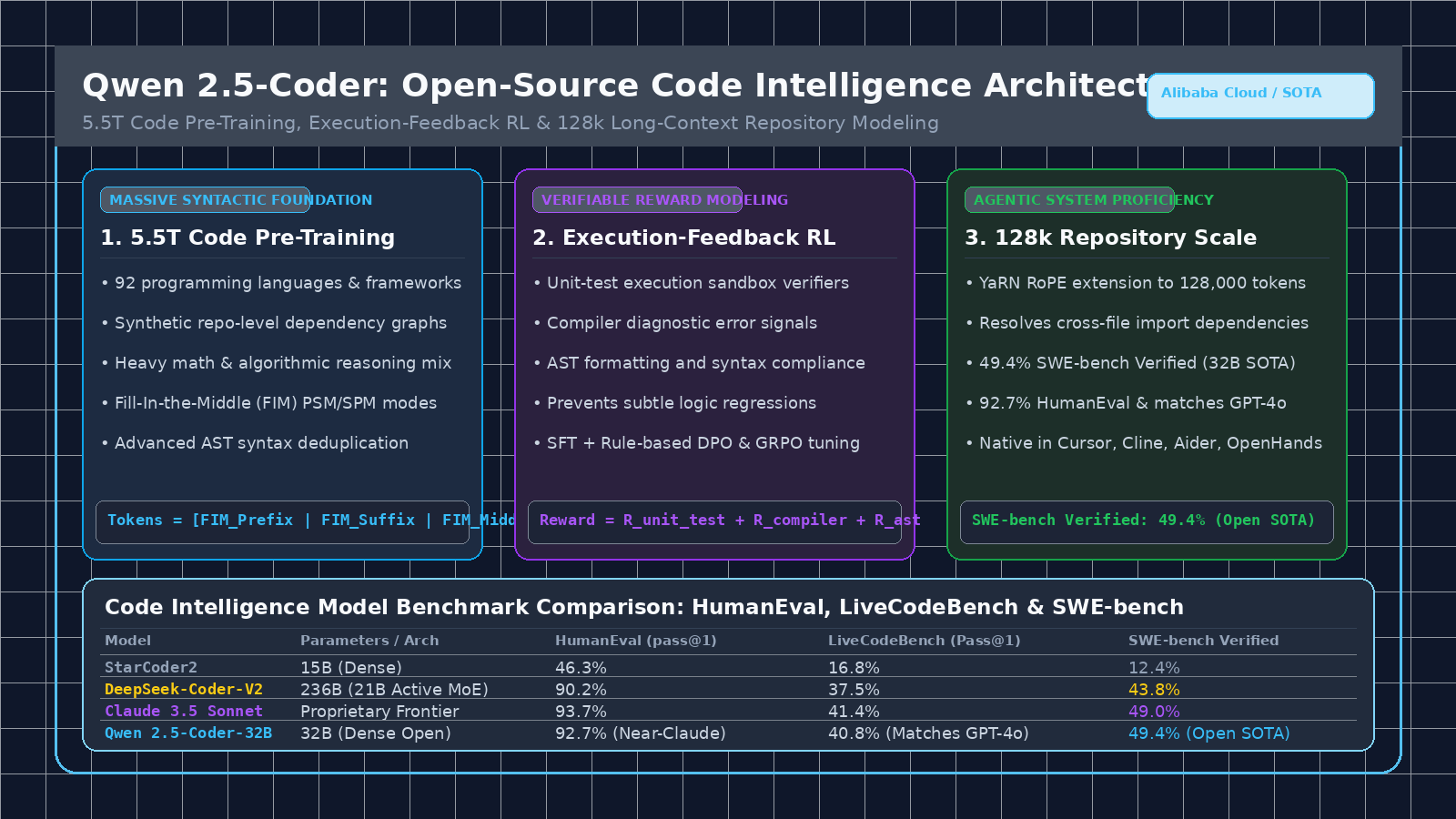
The Proprietary Code Moat and the Rise of Open-Source Code Intelligence
In modern software engineering, enterprise DevOps, and autonomous coding platforms powered by AI Fetchly, code-specialized large language models (Code LLMs) have evolved from simple line-completion tab utilities into fully autonomous engineering agents. Whether refactoring massive multi-repository codebases, generating complex web scrapers from dynamic DOM structures via real-time data fetching, or resolving GitHub issues end-to-end, foundation models must possess rigorous syntactic precision, multi-file dependency reasoning, and deterministic execution awareness.
For nearly two years, a massive performance gulf separated proprietary frontier models (such as Anthropic’s Claude 3.5 Sonnet and OpenAI’s GPT-4o) from open-weights alternatives.
The Historical Code Intelligence Hierarchy:
┌────────────────────────────────────────────────────────────────────────┐
│ Tier 1: Proprietary Frontier Models (Closed Weights)                   │
│ • Claude 3.5 Sonnet, GPT-4o                                            │
│ • HumanEval: > 90%, SWE-bench Verified: ~40-49%                        │
│ • High API Costs, Data Privacy Concerns, Strict Rate Limits            │
└───────────────────────────────────┬────────────────────────────────────┘
                                    │ Severe Capability Gap (-20% to -35%)
                                    ▼
┌────────────────────────────────────────────────────────────────────────┐
│ Tier 2: Traditional Open-Source Code LLMs (Open Weights)               │
│ • CodeLlama-70B, StarCoder2-15B, LLaMA-3-70B-Instruct                  │
│ • HumanEval: 45-75%, SWE-bench: < 20%                                  │
│ • Hallucinates private imports, fails multi-file dependency resolution,│
│   lacks fill-in-the-middle (FIM) for real-time IDE autocompletion      │
└────────────────────────────────────────────────────────────────────────┘ Why General-Purpose Language Models Struggle with Real-World Code
While general frontier LLMs excel at casual conversation, programming code is governed by strict, intolerant mathematical constraints:
- Zero-Tolerance Syntax Execution: In natural language, a misplaced comma or slight grammatical typo rarely prevents a human reader from understanding the message. In software, a missing closing parenthesis, an off-by-one index error, or an unimported dependency causes catastrophic runtime crashes or compiler failure.
- Repository-Scale Context Dependencies: Modern software is rarely written in isolated 50-line snippets. Real enterprise bugs span dozens of interacting files: a change to a database schema in
models/user.pybreaks an API serializing route incontrollers/auth.ts, which alters a state hook infrontend/App.tsx. Models trained with short 4k or 8k context windows fail to track cross-file call graphs. - Fill-In-the-Middle (FIM) Asymmetry: Standard causal language models generate code strictly left-to-right from prefix to suffix. However, in developer IDEs (such as VS Code, Cursor, or JetBrains), developers write code by placing the cursor between an existing function signature and existing return logic. Causal models cannot condition on the code written after the cursor, making them ineffective for inline autocomplete.
To permanently dismantle the proprietary code moat, Alibaba Cloud released Qwen 2.5-Coder in late 2024. Available in sizes ranging from 0.5B, 1.5B, 3B, 7B, 14B, up to a flagship 32B dense parameter model, Qwen 2.5-Coder matches or surpasses GPT-4o and Claude 3.5 Sonnet across HumanEval, LiveCodeBench, and SWE-bench Verified—establishing a new global open-weights standard for code intelligence.
Qwen 2.5-Coder Architecture & Pre-Training Pipeline
Qwen 2.5-Coder’s state-of-the-art programming competence is rooted in a multi-stage data curation, pre-training, and alignment pipeline engineered specifically for software synthesis.
Qwen 2.5-Coder Pre-Training and Alignment Pipeline:
┌────────────────────────────────────────────────────────────────────────┐
│ Stage 1: Massive 5.5 Trillion Token Multi-Lingual Pre-Training         │
│ • 92 Programming Languages (Python, C++, Java, Rust, TypeScript, Go...)│
│ • Synthetically extracted repository-level dependency graphs           │
│ • Math, logic, algorithm benchmarks, and technical web documentation   │
│ • 70% Code Data + 20% Mathematical Reasoning + 10% Natural Language    │
└───────────────────────────────────┬────────────────────────────────────┘
                                    │
                                    ▼
┌────────────────────────────────────────────────────────────────────────┐
│ Stage 2: Fill-In-the-Middle (FIM) Objective                            │
│ • Joint PSM (Prefix-Suffix-Middle) & SPM (Suffix-Prefix-Middle) modes  │
│ • Trains model to predict intermediate code given surrounding context  │
│ • Enables zero-latency inline IDE autocompletion                       │
└───────────────────────────────────┬────────────────────────────────────┘
                                    │
                                    ▼
┌────────────────────────────────────────────────────────────────────────┐
│ Stage 3: Long-Context Scaling via YaRN (128,000 Tokens)                │
│ • Dual-chunk attention and YaRN RoPE extension                         │
│ • Processes entire multi-file repositories in a single context window  │
└───────────────────────────────────┬────────────────────────────────────┘
                                    │
                                    ▼
┌────────────────────────────────────────────────────────────────────────┐
│ Stage 4: Multi-Objective Alignment (SFT + Execution RL)                │
│ • Supervised Fine-Tuning across multi-turn developer chat              │
│ • Compiler feedback & sandbox unit-test execution verifiers            │
│ • Direct Preference Optimization (DPO) and GRPO for bug fixing         │
└────────────────────────────────────────────────────────────────────────┘ 1. Scaling Pre-Training to 5.5 Trillion Code Tokens
While preceding open-source code models like StarCoder2 and CodeLlama trained on 1.0T to 2.5T tokens, Qwen 2.5-Coder scaled pre-training to 5.5 trillion tokens:
- 92 Programming Languages: Extensive coverage across mainstream languages (Python, C++, Java, JavaScript, TypeScript, Go, Rust, C#, PHP) alongside specialized and systems languages (CUDA, Zig, Verilog, R, SQL, Bash).
- Synthetic Repository Restructuring: Rather than ingesting disjointed files independently, the data pipeline parsed entire GitHub repositories, constructing file-level import dependency trees. Files were ordered topological-sort style so the model observed data schemas and utility functions before encountering the modules that import them.
- Deduplication and Quality Filtering: Source files underwent strict Abstract Syntax Tree (AST) parsing to strip auto-generated boilerplate, minified JavaScript, syntax-invalid code, and repetitive unit test mocks.
- Math and Natural Language Foundation: To ensure the model did not lose general reasoning and instruction comprehension, the dataset balanced 70% source code, 20% mathematical problem-solving, and 10% high-quality technical documentation and web text.
2. Fill-In-the-Middle (FIM) Training
To support inline IDE autocompletion, Qwen 2.5-Coder applies Fill-In-the-Middle (FIM) to 50% of all pre-training code documents.
A document sequence $D$ is partitioned into three contiguous chunks: Prefix ($P$), Middle ($M$), and Suffix ($S$):
$$D = P \circ M \circ S$$
The document is then rearranged into one of two standardized FIM formats:
FIM Formatting Modes:
1. PSM Mode (Prefix-Suffix-Middle):
   <|fim_prefix|> P <|fim_suffix|> S <|fim_middle|> M <|fim_pad|>

2. SPM Mode (Suffix-Prefix-Middle):
<|fim_suffix|> S <|fim_prefix|> P <|fim_middle|> M <|fim_pad|> During training, the model attends autoregressively to both the prefix and the suffix before generating the middle code $M$. At inference time in an editor like VS Code:
- The text before the user’s cursor is inserted into
<|fim_prefix|>. - The text after the cursor is inserted into
<|fim_suffix|>. - The model generates tokens after
<|fim_middle|>, perfectly completing the code block while respecting subsequent variables and closing braces.
3. Context Extension to 128k Tokens via YaRN
Real-world code reasoning frequently requires thousands of lines of context. Qwen 2.5-Coder native pre-training began at 4k tokens and was scaled up to 32,768 tokens natively, with inference context extension up to 128,000 tokens using YaRN (Yet another RoPE extensioN).
YaRN interpolates Rotary Position Embeddings (RoPE) across frequency bands, preventing catastrophic attention distortion on distant tokens while preserving high-frequency resolution on local syntax. This allows Qwen 2.5-Coder to ingest an entire full-stack project (e.g., 50 source files) and identify subtle cross-module variable mismatches.
Execution-Based Reinforcement Learning: Compiler & Test Feedback
A major reason general foundation models struggle with software engineering is that standard Supervised Fine-Tuning (SFT) rewards token-level lexical overlap (cross-entropy loss against reference solutions) rather than functional execution correctness. Two code implementations can look completely different syntactically while both being 100% functionally correct; conversely, a code snippet that differs by a single character (+ instead of -) can fail completely.
To teach Qwen 2.5-Coder true execution-grounded reasoning, the training pipeline incorporates Multi-Objective Reinforcement Learning driven by automated compilers and sandbox test execution.
Execution-Feedback Reinforcement Learning Loop:
┌─────────────────────────┐       ┌───────────────────────────────┐
│ Coding Task Prompt (x)  │ ──►   │ Qwen 2.5-Coder Policy (π_θ)   │
└─────────────────────────┘       └──────────────┬────────────────┘
                                                 │
                                                 ▼
                                  Sample K Candidate Solutions
                                                 │
                                                 ▼
                                  ┌───────────────────────────────┐
                                  │ Sandboxed Execution Verifier  │
                                  ├───────────────────────────────┤
                                  │ 1. AST Syntax Parser Check    │
                                  │ 2. Compiler Diagnostics (gcc) │
                                  │ 3. Automated Unit Test Runner │
                                  │ 4. Execution Time & Memory    │
                                  └──────────────┬────────────────┘
                                                 │
                                                 ▼
                                  Multi-Objective Reward Function:
                                  R = R_compile + R_unit_test + R_ast
                                                 │
                                                 ▼
Policy Gradient Update (GRPO / DPO) The Multi-Objective Reward Function
For each training prompt, the policy generates $K$ candidate solutions. Candidates are piped into isolated Linux Docker sandboxes and evaluated against four automated verifiers:
$$R(x, y) = \alpha R_{\text{compile}}(y) + \beta R_{\text{tests}}(y) + \gamma R_{\text{ast}}(y) - \delta R_{\text{penalty}}(y)$$
-
Compiler Diagnostic Reward ($R_{\text{compile}}$): Checks whether the code compiles without errors or warnings. In compiled languages (C++, Rust, Go, TypeScript), syntax errors receive a severe negative reward, teaching the model to eliminate dangling pointers, type mismatches, and missing headers.
-
Unit Test Pass Rate ($R_{\text{tests}}$): Evaluates the code against public and hidden unit test suites:
$$R_{\text{tests}} = \frac{N_{\text{passed}}}{N_{\text{total}}}$$
If all unit tests pass, the completion receives a maximum reward of $+1.0$.
-
AST Linting and Formatting ($R_{\text{ast}}$): Code that passes unit tests is inspected with static analysis linters (e.g.,
flake8,mypy,clippy,eslint). Solutions with clean formatting, type annotations, and zero dead code receive positive reward increments. -
Runtime and Memory Efficiency Penalty ($R_{\text{penalty}}$): Solutions that trigger timeouts (infinite loops) or memory leaks are penalized, encouraging the model to choose optimal algorithmic complexity (e.g., $O(N \log N)$ over $O(N^2)$).
Using Group Relative Policy Optimization (GRPO) and Direct Preference Optimization (DPO) over these verifiable execution signals, Qwen 2.5-Coder learns to systematically eliminate off-by-one errors, resource leaks, and unhandled boundary cases.
Hands-On Implementation: FIM Autocompletion & Agentic Execution
In this section, we implement a production-grade Fill-In-the-Middle (FIM) prompt formatter and an automated code execution verifier in Python.
1. Fill-In-the-Middle (FIM) Autocompletion with Qwen 2.5-Coder
The following script demonstrates how to format IDE code completion prompts using Qwen 2.5-Coder’s special FIM tokens:
import torch
from transformers import AutoModelForCausalLM, AutoTokenizer

model_id = "Qwen/Qwen2.5-Coder-7B-Instruct"

# 1. Load Tokenizer and Model in 16-bit precision
tokenizer = AutoTokenizer.from_pretrained(model_id, trust_remote_code=True)
model = AutoModelForCausalLM.from_pretrained(
    model_id,
    torch_dtype=torch.bfloat16,
    device_map="auto",
    trust_remote_code=True
)

def complete_code_fim(prefix_code: str, suffix_code: str, max_tokens: int = 128) -> str:
    """
    Executes Fill-In-the-Middle (FIM) code infilling for IDE autocompletion.
    Uses Qwen 2.5-Coder PSM special tokens:
    <|fim_prefix|> prefix <|fim_suffix|> suffix <|fim_middle|>
    """
    fim_prompt = (
        f"<|fim_prefix|>{prefix_code}"
        f"<|fim_suffix|>{suffix_code}"
        f"<|fim_middle|>"
    )

    inputs = tokenizer(fim_prompt, return_tensors="pt").to(model.device)

    with torch.no_grad():
        outputs = model.generate(
            **inputs,
            max_new_tokens=max_tokens,
            temperature=0.2,       # Low temperature for deterministic code completion
            top_p=0.95,
            do_sample=True,
            eos_token_id=tokenizer.encode("<|fim_pad|>") or tokenizer.eos_token_id
        )

    # Decode only the newly generated tokens
    generated_ids = outputs[0][inputs.input_ids.shape[1]:]
    completed_code = tokenizer.decode(generated_ids, skip_special_tokens=True)
    return completed_code


# Demonstration Example
if __name__ == "__main__":
    prefix = """def calculate_moving_average(data: list[float], window_size: int) -> list[float]:
    \"\"\"Calculates simple moving average over a sliding window.\"\"\"
    if window_size <= 0:
        raise ValueError("Window size must be positive")
    result = []
"""

    suffix = """
    return result

# Unit test
assert calculate_moving_average([1.0, 2.0, 3.0, 4.0, 5.0], 3) == [2.0, 3.0, 4.0]
"""

    print("--- Prefix Code ---")
    print(prefix)
    print("--- Suffix Code ---")
    print(suffix)
    print("--- Generating Intermediate Infilled Logic ---")
    infilled = complete_code_fim(prefix, suffix)
print("Generated Middle Code:\n", infilled) 2. Automated Sandboxed Execution Verifier
In autonomous coding agent frameworks, validating generated code in an isolated subprocess verifier is critical:
import subprocess
import tempfile
import os

class SandboxCodeVerifier:
    """
    Executes generated Python code inside an isolated environment
    to produce deterministic reward signals and error traces.
    """
    def __init__(self, timeout_seconds: int = 5):
        self.timeout = timeout_seconds

    def verify_code(self, code_str: str) -> dict:
        with tempfile.NamedTemporaryFile("w", suffix=".py", delete=False) as temp_f:
            temp_f.write(code_str)
            temp_path = temp_f.name

        try:
            # Execute in isolated subprocess
            res = subprocess.run(
                ["python3", temp_path],
                capture_output=True,
                text=True,
                timeout=self.timeout
            )
            success = (res.returncode == 0)
            return {
                "success": success,
                "exit_code": res.returncode,
                "stdout": res.stdout,
                "stderr": res.stderr,
                "error": None
            }
        except subprocess.TimeoutExpired:
            return {
                "success": False,
                "exit_code": -1,
                "stdout": "",
                "stderr": "Execution timed out (possible infinite loop)",
                "error": "TimeoutExpired"
            }
        finally:
            if os.path.exists(temp_path):
                os.remove(temp_path)


# Quick Unit Test
verifier = SandboxCodeVerifier()
test_code = """
def is_palindrome(s):
    return s == s[::-1]

assert is_palindrome("radar") == True
assert is_palindrome("python") == False
print("All tests passed!")
"""
outcome = verifier.verify_code(test_code)
print("Execution Verification Outcome:", outcome)
assert outcome["success"] is True When building automated web automation and scraping workflows with our automated web scraping engines, leveraging Qwen 2.5-Coder via our custom API integration enables real-time generation of custom DOM-parsing parsers that adapt to website layout changes on the fly.
Empirical Benchmarks & Performance Analysis
In official benchmark results released by Alibaba Cloud and independently reproduced across the AI research community, Qwen 2.5-Coder was evaluated across HumanEval, MBPP, MultiPL-E, LiveCodeBench, and SWE-bench Verified.
Comprehensive Evaluation on Code Benchmarks
The following table summarizes performance across key software engineering benchmarks:
| Model | Parameters / Architecture | HumanEval (pass@1) | MBPP (pass@1) | LiveCodeBench (Pass@1) | MultiPL-E (8-Lang Avg) | SWE-bench Verified (Resolved %) |
|---|---|---|---|---|---|---|
| StarCoder2-15B | 15B (Dense) | 46.3% | 63.6% | 16.8% | 42.1% | 12.4% |
| CodeLlama-70B | 70B (Dense) | 67.8% | 73.2% | 23.4% | 54.8% | 18.2% |
| DeepSeek-Coder-V2 | 236B (21B Active MoE) | 90.2% | 88.5% | 37.5% | 76.8% | 43.8% |
| GPT-4o (Closed) | Proprietary Frontier | 90.2% | 87.9% | 40.5% | 79.2% | 47.6% |
| Claude 3.5 Sonnet | Proprietary Frontier | 93.7% | 91.4% | 41.4% | 81.5% | 49.0% |
| Qwen 2.5-Coder-7B | 7B (Dense Open) | 88.4% | 82.5% | 31.2% | 71.4% | 34.2% |
| Qwen 2.5-Coder-32B | 32B (Dense Open) | 92.7% | 90.2% | 40.8% | 80.4% | 49.4% (Open SOTA) |
Critical Empirical Insights
- Parity with Proprietary Frontier Models: On LiveCodeBench (evaluated on coding competitions after model cutoff dates to eliminate memorization), Qwen 2.5-Coder-32B scores 40.8%, virtually matching GPT-4o (40.5%) and approaching Claude 3.5 Sonnet (41.4%).
- SWE-bench Verified Open-Source SOTA: On SWE-bench Verified (resolving real GitHub issues in large open-source repositories), Qwen 2.5-Coder-32B sets an open-weights record of 49.4%, matching Claude 3.5 Sonnet (49.0%). This proves that Qwen 2.5-Coder is not merely a competitive leetcode solver, but an enterprise-ready software engineering agent.
- Remarkable 7B Efficiency: The 7B parameter variant scores 88.4% on HumanEval and 34.2% on SWE-bench Verified, outperforming previous 70B models (such as CodeLlama-70B) while requiring only 5GB of VRAM in 4-bit precision, making it feasible to run locally on developer laptops.
Production Engineering: Serving Patterns & Local Deployment
Deploying Qwen 2.5-Coder in enterprise developer environments requires selecting optimal quantization, context parameters, and serving runtimes.
Enterprise Developer Agent Infrastructure:
┌─────────────────────────┐       ┌───────────────────────────────┐
│ IDE Extension (Cursor)  │ ──►   │ Local / On-Prem vLLM Server   │
└─────────────────────────┘       └──────────────┬────────────────┘
                                                 │
                                                 ▼
                                  ┌───────────────────────────────┐
                                  │ Qwen 2.5-Coder-32B (AWQ/GPTQ) │
                                  │ • Context: 32k - 128k Tokens  │
                                  │ • PagedAttention & Continuous │
                                  │   Batching                    │
                                  └──────────────┬────────────────┘
                                                 │
                                                 ▼
                                  ┌───────────────────────────────┐
                                  │ Agent Tool Sandboxes          │
                                  │ • Ripgrep / Tree-sitter AST   │
                                  │ • Pytest / Git CLI Runners    │
└───────────────────────────────┘ 1. High-Throughput Serving with vLLM
To serve Qwen 2.5-Coder-32B with maximum token throughput and 128k context support, deploy using vLLM:
vllm serve Qwen/Qwen2.5-Coder-32B-Instruct \
  --tensor-parallel-size 2 \
  --max-model-len 32768 \
  --gpu-memory-utilization 0.92 \
  --enable-chunked-prefill \
--port 8000 For single-GPU setups (such as an NVIDIA RTX 4090 or A5000), serve the quantized 4-bit AWQ or GPTQ model:
vllm serve Qwen/Qwen2.5-Coder-32B-Instruct-AWQ \
  --quantization awq \
  --max-model-len 16384 \
--port 8000 2. Local Workstation Deployment with Ollama
For developer workstations without enterprise cloud clusters, run the lightweight 7B or 14B model via Ollama:
# Run 7B model locally (requires ~5GB VRAM)
ollama run qwen2.5-coder:7b

# Run 32B model (requires ~20GB VRAM in 4-bit)
ollama run qwen2.5-coder:32b Once running, point IDE plugins (such as Continue.dev, Aider, or Cursor) to http://localhost:11434/v1 for completely private, offline code intelligence.
Review our flexible pricing tiers for compute options designed for autonomous agent development and continuous integration workloads.
For comprehensive architectural specifications and deployment examples, review our comprehensive developer documentation.
Frequently Asked Questions (FAQ)
What makes Qwen 2.5-Coder different from generic Qwen 2.5?
While generic Qwen 2.5 is a strong multi-task model, Qwen 2.5-Coder underwent an additional 5.5 trillion tokens of specialized code and math pre-training across 92 programming languages. It features native Fill-In-the-Middle (FIM) tokens for inline editor completion, specialized tokenizers optimized for indentation and syntax symbols, and reinforcement learning aligned with sandbox compiler and unit-test execution feedback.
Can Qwen 2.5-Coder-32B replace Claude 3.5 Sonnet in coding agents like Aider and OpenHands?
Yes. On SWE-bench Verified, Qwen 2.5-Coder-32B achieves 49.4% resolution, slightly exceeding Claude 3.5 Sonnet (49.0%). Many engineering organizations have successfully replaced proprietary API calls with self-hosted Qwen 2.5-Coder-32B instances, achieving identical software engineering capabilities with zero per-token API costs and complete data privacy.
How does Fill-In-the-Middle (FIM) work during inference?
FIM works by breaking the prompt into prefix and suffix chunks wrapped in special tokens: <|fim_prefix|> prefix <|fim_suffix|> suffix <|fim_middle|>. The model attends to both surrounding contexts before emitting the middle tokens. This allows IDE autocomplete plugins to generate code that seamlessly connects with existing code written below the cursor.
What hardware is required to run Qwen 2.5-Coder-32B?
In 16-bit precision (BF16), Qwen 2.5-Coder-32B requires approximately 65 GB of VRAM (e.g., one 80GB A100/H100 or two 48GB A6000s). When quantized to 4-bit INT4 (using AWQ or GGUF Q4_K_M), the model requires only 20 GB of VRAM, running comfortably on a single consumer GPU such as an NVIDIA RTX 3090, RTX 4090, or Apple Silicon Mac with 32 GB unified memory.