Quiet-STaR: Teaching LLMs to Think Before Speaking Guide
The Problem: The Curated Question-Answering Bottleneck in LLM Reasoning
In enterprise generative AI deployments—such as multi-step research agents and automated document parsers in AiFetchly—reinforcing complex logical reasoning is a central technical goal.
Over recent years, the AI ecosystem made substantial strides in model reasoning through Chain-of-Thought (CoT) prompting, test-time search, and reinforcement learning frameworks like STaR (Self-Taught Reasoner) and DeepSeek-R1.
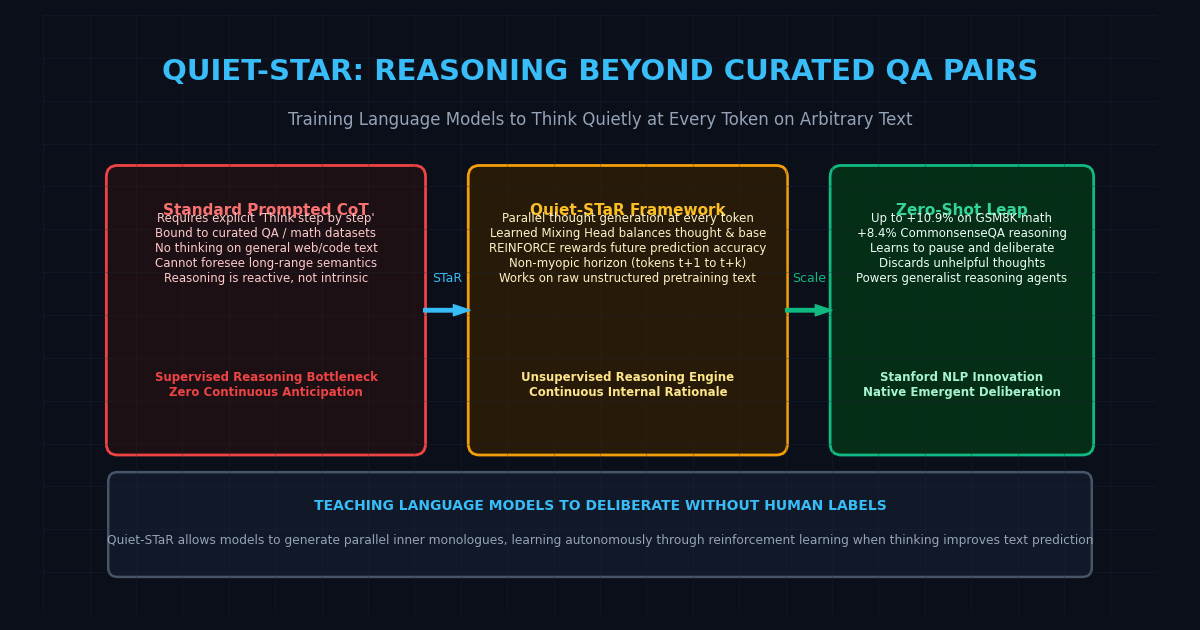
However, existing reasoning paradigms suffer from an acute structural bottleneck: they rely entirely on curated Question-Answering (QA) datasets.
Why Supervised Reasoning Paradigms Hit a Data Wall
- The Scarcity of Curated Reasoning Datasets: High-quality reasoning datasets (like GSM8K, MATH, or HumanEval) represent less than 0.01% of the total tokens available on the internet. Fine-tuning models solely on math problems and code benchmarks creates brittle domain specialists that struggle when analyzing unstructured corporate reports or noisy web data.
- The Reactive Nature of Prompted CoT: Models trained on standard CoT only generate reasoning rationales when explicitly commanded (e.g., “Think step by step”). During everyday text generation, document extraction, and dialogue, the model reverts to standard autoregressive next-token prediction without deliberating.
- The Myopic Horizon of Standard Pretraining: Standard autoregressive pretraining evaluates only the immediate next token $x_{t+1}$. The model is not incentivized to form forward-looking hypotheses, anticipate downstream syntax, or consider non-obvious inferences across future paragraphs.
Humans do not only think when presented with a formal test question. While reading an article or listening to a discussion, humans constantly run quiet, parallel internal monologues—anticipating what the speaker will say, resolving ambiguities, and connecting background knowledge.
To scale reasoning to the entire corpus of human text, language models need an architecture that teaches them to think quietly and continuously on arbitrary, unstructured text.
The Architecture: How Quiet-STaR Learns to Think on Raw Text
Introduced by researchers from Stanford University (Eric Zelikman et al., 2024 / 2025), Quiet-STaR (Quiet Self-Taught Reasoner) is an unsupervised reasoning framework that generalizes reasoning beyond curated QA pairs.
Instead of requiring questions and verified answers, Quiet-STaR trains the model to generate hidden reasoning thoughts at every token position on raw pretraining corpora, using future tokens as the ground-truth supervision signal.
The Three Operational Pillars of Quiet-STaR
Quiet-STaR decomposes continuous deliberation into three coordinated components:
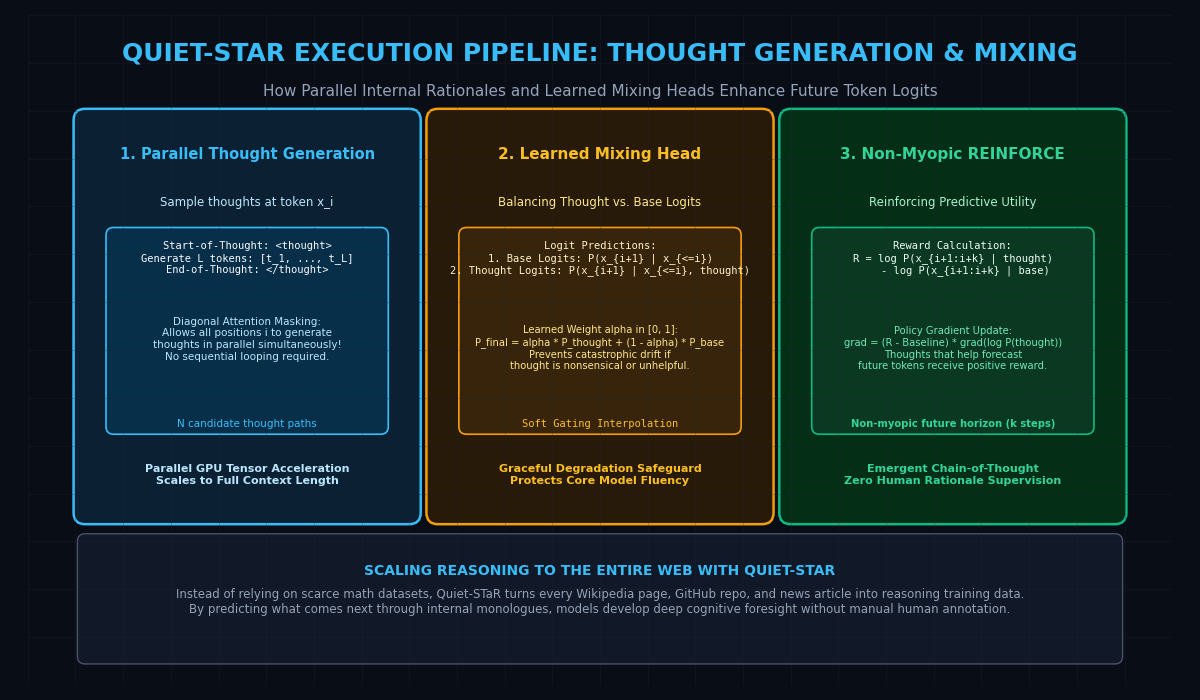
1. Parallel Thought Generation via Diagonal Masking
At every token position $i$ in an input sequence, the model samples $N$ candidate reasoning thoughts of length $L$ (typically $L = 8$ to $16$ tokens):
$$\text{Thought}_i = [\langle\text{thought}\rangle, t_1, t_2, \dots, t_L, \langle/\text{thought}\rangle]$$
Generating thoughts sequentially across a 2,048-token sequence would be prohibitively slow. Quiet-STaR solves this using a custom 4D attention mask (diagonal tree masking).
The attention mask allows the model to generate thoughts for all token positions in parallel within a single batched GPU forward pass, while ensuring that thoughts at position $i$ can attend to historical context ($x_{\le i}$) but cannot leak into other positions.
2. The Learned Mixing Head
A critical vulnerability in generative reasoning is that an internal thought might be nonsensical, irrelevant, or distracting. Forcing the model to condition unconditionally on bad thoughts would destroy core language fluency.
Quiet-STaR introduces a learned mixing head that computes an adaptive interpolation weight $\alpha \in [0, 1]$:
$$P_{\text{final}}(x_{i+1}) = \alpha \cdot P_{\text{thought}}(x_{i+1} \mid x_{\le i}, \text{Thought}i) + (1 - \alpha) \cdot P{\text{base}}(x_{i+1} \mid x_{\le i})$$
If a thought is unhelpful or adds noise, the mixing head sets $\alpha \to 0$, falling back to the base model’s prediction and preventing performance regressions.
3. Non-Myopic REINFORCE with Teacher Forcing
To optimize the thought generation policy, Quiet-STaR uses policy gradient reinforcement learning (REINFORCE).
Because the model is processing arbitrary text (e.g., a Wikipedia article), the true future tokens of the text serve as the reward benchmark. Furthermore, to encourage deep, conceptual planning rather than trivial grammatical guesses, Quiet-STaR evaluates a non-myopic prediction horizon spanning $k$ future tokens ($x_{i+1}, \dots, x_{i+k}$):
$$R_i = \sum_{j=1}^k \left[ \log P_{\text{thought}}(x_{i+j}) - \log P_{\text{base}}(x_{i+j}) \right]$$
If generating the thought improved the model’s likelihood of correctly predicting the next $k$ tokens compared to the base model, the policy gradient applies a positive update to the thought tokens. If the thought degraded prediction accuracy, it is penalized.
Key Mechanics: Training Dynamics and Zero-Shot Transfer
Quiet-STaR demonstrates that genuine reasoning capabilities emerge naturally as an optimal strategy for language modeling:
1. Teacher Forcing Without Human Labels
In traditional reinforcement learning, reward models or automated code sandboxes must verify whether an answer is correct.
Quiet-STaR requires zero reward models. By measuring whether internal thoughts help predict the actual ground-truth continuation of web text, the model learns to reason about physics, biology, history, and law directly from the structure of written human language.
2. Zero-Shot Reasoning Transfer
Despite never being trained on math or reasoning benchmarks, models trained with Quiet-STaR exhibit massive out-of-domain improvements:
- GSM8K Grade-School Math: Achieves an absolute gain of +10.9% in zero-shot accuracy over the base pre-trained model.
- CommonsenseQA: Demonstrates an absolute gain of +8.4% in zero-shot multi-hop reasoning.
These results confirm that chain-of-thought is not an artificial prompting gimmick, but an intrinsic cognitive mechanism for resolving statistical uncertainty in complex data.
Reasoning Frameworks Comparison: CoT vs. STaR vs. Quiet-STaR
| Dimension | Prompted CoT (Few-Shot) | STaR (Self-Taught Reasoner) | DeepSeek-R1 (Rule-Based RL) | Quiet-STaR (Unsupervised) |
|---|---|---|---|---|
| Training Data Requirement | None (Prompting only) | Curated QA pairs with answers | Verifiable math & code tasks | Raw, arbitrary unstructured text |
| Reward Mechanism | None | Exact match on final answer | Rule-based verifier & format | Future token log-likelihood delta |
| Thinking Scope | When explicitly prompted | Problem-level answers | Multi-turn reasoning rollouts | Token-by-token continuous thoughts |
| Supervision Level | Prompt engineering | Supervised QA dataset | Verified unit tests & rules | 100% Unsupervised Self-Supervision |
| Catastrophic Drift Risk | High on standard tasks | Moderate | Requires formatting constraints | Protected by Learned Mixing Head |
| Downstream Transfer | Moderate | Narrow (Domain-specific) | Strong on math and coding | Broad (Generalist reasoning) |
Reference Implementation: Quiet-STaR Mixing Head and Reward in PyTorch
Below is a self-contained PyTorch module illustrating the learned mixing head and non-myopic reward calculation of Quiet-STaR:
import torch
import torch.nn as nn
import torch.nn.functional as F

class QuietSTaRMixingHead(nn.Module):
    """
    Quiet-STaR Learned Mixing Head.
    Interpolates between base model logits and thought-augmented logits,
    safeguarding core language modeling capabilities.
    """
    def __init__(self, hidden_dim: int, vocab_size: int):
        super().__init__()
        self.mixing_gate = nn.Linear(hidden_dim, 1) # Outputs alpha logit
        self.lm_head = nn.Linear(hidden_dim, vocab_size, bias=False)

    def forward(
        self,
        base_hidden: torch.Tensor,
        thought_hidden: torch.Tensor
    ) -> tuple[torch.Tensor, torch.Tensor]:
        """
        base_hidden: [B, hidden_dim]
        thought_hidden: [B, hidden_dim]
        """
        # 1. Compute separate logit distributions
        base_logits = self.lm_head(base_hidden)
        thought_logits = self.lm_head(thought_hidden)

        base_probs = F.softmax(base_logits, dim=-1)
        thought_probs = F.softmax(thought_logits, dim=-1)

        # 2. Compute dynamic mixing weight alpha in [0, 1]
        alpha = torch.sigmoid(self.mixing_gate(thought_hidden))

        # 3. Interpolate probability distributions
        final_probs = alpha * thought_probs + (1.0 - alpha) * base_probs
        final_log_probs = torch.log(final_probs + 1e-9)

        return final_log_probs, alpha

def compute_non_myopic_reward(
    thought_log_probs: torch.Tensor,
    base_log_probs: torch.Tensor,
    future_target_ids: torch.Tensor
) -> torch.Tensor:
    """
    Computes Quiet-STaR non-myopic reward across k future tokens.
    future_target_ids: [B, k]
    thought_log_probs, base_log_probs: [B, k, vocab_size]
    """
    # Gather log-probabilities for true target tokens
    thought_targets = thought_log_probs.gather(2, future_target_ids.unsqueeze(-1)).squeeze(-1)
    base_targets = base_log_probs.gather(2, future_target_ids.unsqueeze(-1)).squeeze(-1)

    # Reward is cumulative log-likelihood improvement across future window k
    reward = (thought_targets - base_targets).sum(dim=-1)
    return reward

if __name__ == "__main__":
    torch.manual_seed(42)
    B, hidden_dim, vocab_size, k = 2, 512, 1000, 4

    mixing_module = QuietSTaRMixingHead(hidden_dim=hidden_dim, vocab_size=vocab_size)

    h_base = torch.randn(B, hidden_dim)
    h_thought = torch.randn(B, hidden_dim)
    future_tokens = torch.randint(0, vocab_size, (B, k))

    log_probs, alpha = mixing_module(h_base, h_thought)

    print("--- Quiet-STaR Mixing & Deliberation Verified ---")
    print(f"Output Log-Probabilities Shape: {list(log_probs.shape)}")
    print(f"Learned Mixing Weight Alpha:    {alpha.squeeze().tolist()}")
print("Verification passed: Model dynamically balances base fluency and internal rationales.") Production Scaling: Continuous Deliberation in aiFetchly
In automated data extraction platforms like AiFetchly, foundation models process highly heterogeneous, semi-structured web documents, tables, and API outputs:
1. Anticipating Parsing Challenges on Noisy Web Data
When parsing deeply nested tables or irregular HTML structures, traditional models make premature extraction decisions, hallucinating missing columns or truncating text.
Models enhanced with Quiet-STaR generate internal thoughts before committing to output tokens. When encountering an ambiguous tag or broken syntax, the model pauses, considers alternative schema interpretations quietly, and emits the verified, valid JSON record on its first attempt.
2. Unsupervised Adaptation to Private Enterprise Schemas
Enterprise teams do not need to create thousands of synthetic reasoning traces to teach an agent how to extract domain-specific contracts.
By pretraining on raw internal PDF archives and technical manuals with Quiet-STaR, the model autonomously teaches itself how to navigate domain jargon and regulatory clauses, transforming passive reading into active, robust intelligence in 2026.