QuantSpec Guide: Self-Speculative Decoding & Quantized KV
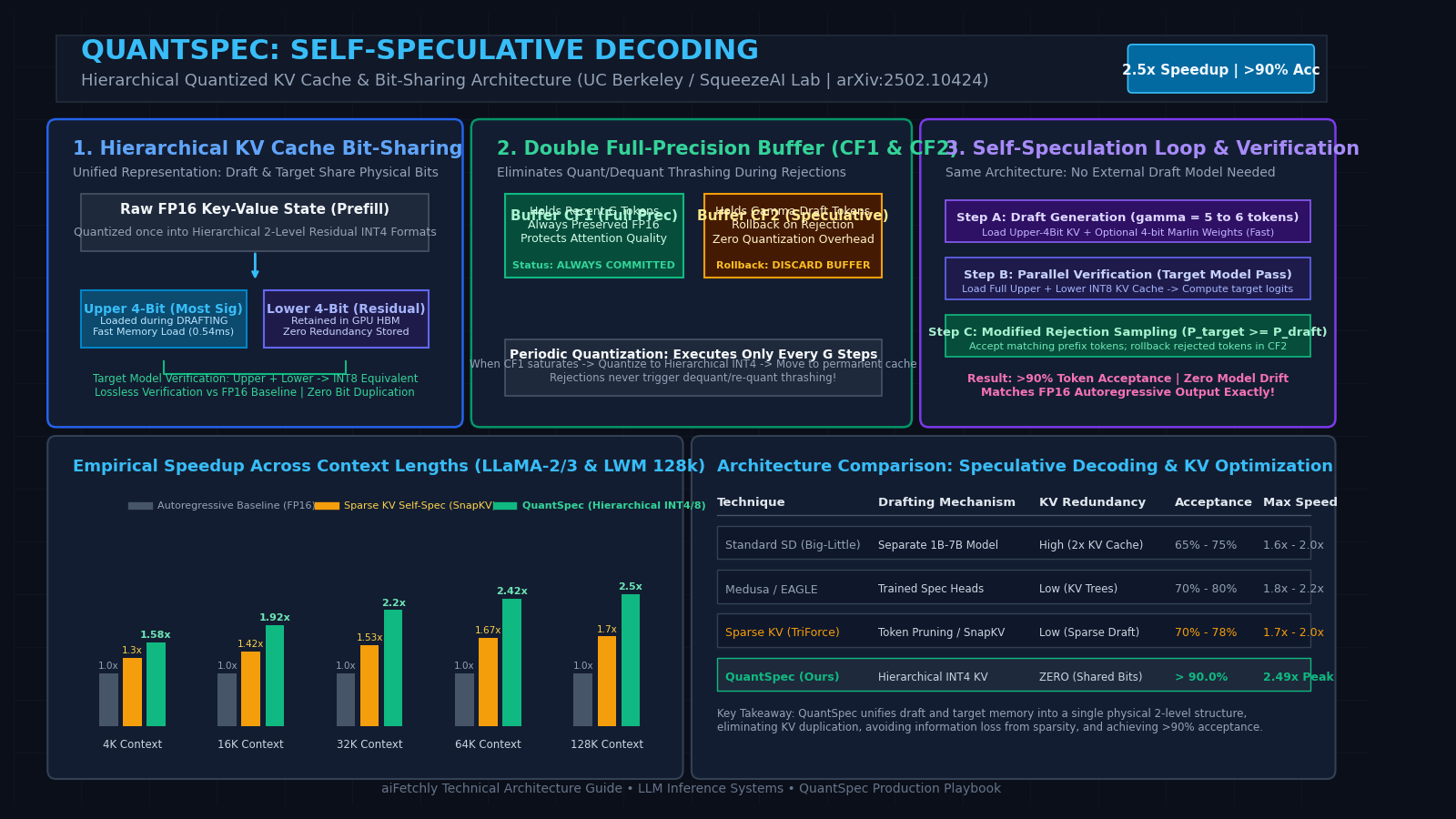
Large Language Models (LLMs) are rapidly expanding into long-context applications, powering enterprise code repository analysis, multi-document synthesis, and complex real-time agentic extraction engines built on aiFetchly. However, processing long sequences—spanning from 32k to 128k tokens and beyond—exposes the most severe physical bottleneck in modern deep learning: the Key-Value (KV) cache memory and bandwidth wall.
In autoregressive generation, every decoding step requires streaming historical Key and Value tensors from GPU High Bandwidth Memory (HBM) into on-chip SRAM to compute multi-head self-attention. For long contexts, loading multi-gigabyte KV caches dwarfs the compute cost of linear projections. Under batch size 1 or edge inference constraints, the accelerator operates in a deeply memory-bandwidth-bound regime, resulting in high Time-Per-Output-Token (TPOT) latencies and massive VRAM footprints that restrict serving capacity.
While speculative decoding (SD) has emerged as a premier technique to accelerate token generation, applying conventional speculative methods to long-context LLMs creates sharp trade-offs:
- Big-Little Speculative Overhead: Maintaining a separate smaller draft model (e.g., LLaMA-1B drafting LLaMA-70B) requires maintaining two separate KV caches, worsening already constrained VRAM capacity.
- Sparse KV Degradation: Self-speculative methods that prune or drop KV cache tokens (such as TriForce or SnapKV) reduce memory bandwidth but induce severe distributional drift, causing draft acceptance rates to plummet below 70% and eroding end-to-end speedups.
- Quantization Thrashing: Naively quantizing the KV cache causes speculative rollback overhead: whenever a draft token sequence is rejected by the target model, the quantized cache must be repeatedly rolled back, dequantized, and re-quantized.
To solve this crisis, researchers from UC Berkeley and the SqueezeAI Lab introduced QuantSpec: Self-Speculative Decoding with Hierarchical Quantized KV Cache (arXiv:2502.10424, GitHub: SqueezeAILab/QuantSpec). QuantSpec re-architects long-context inference through a novel hierarchical two-level quantized KV cache with physical bit-sharing, a self-speculative decoding formulation where the draft and target models share the exact same weights, and a double full-precision cache buffer that eliminates quantization thrashing during rejection rollbacks.
The result is a major leap in long-context serving: QuantSpec maintains exceptional acceptance rates (>90%), delivers up to 2.5x end-to-end wall-clock speedup, and slashes KV cache memory consumption by 1.3x to 2x across sequence lengths up to 128k tokens on consumer and datacenter GPUs.
In this comprehensive technical guide, we examine the arithmetic intensity dynamics of long-context generation, unpack the mathematical mechanics of hierarchical bit-sharing, analyze the double full-precision buffer design, and build an end-to-end PyTorch implementation of the QuantSpec serving pipeline.
The Problem: The Memory-Bandwidth Wall and Sparse KV Degradation
To understand why conventional inference systems degrade under long contexts, we must examine the asymptotic arithmetic intensity governing the prefill and decoding phases of modern transformer models.
Asymptotic Arithmetic Intensity Analysis
Let $B$ denote batch size, $S_L$ sequence length, $d$ hidden dimension, and $k$ generation steps. Arithmetic intensity $I$ is defined as the ratio of floating-point operations to memory bytes transferred:
$$I = \frac{\text{FLOPs}}{\text{Memory Bytes Transferred}}$$
During prefill, all prompt tokens are processed simultaneously in a single compute-intensive matrix multiplication (GEMM). The aggregate arithmetic intensity scales linearly with context length:
$$I_{\text{prefill}} \sim \mathcal{O}(S_L) \quad \text{for } S_L \gg d$$
Consequently, prefill is typically compute-bound on modern GPUs like the NVIDIA H100 or A100.
However, during autoregressive decoding, each step generates a single query token ($q \in \mathbb{R}^{1 \times d}$) that must attend to all $S_L$ precomputed Key-Value vectors stored in memory. The arithmetic intensity of attention decoding collapses:
$$I_{\text{decode, attention}} \sim \mathcal{O}(1) \quad \text{irrespective of context length } S_L$$
The Long-Context Inference Latency Dilemma:
----------------------------------------------------------------------------------
Context Length: 4,000 Tokens (Short Context):
- Attention Latency Contribution: ~25% of total step time.
- Linear Projection GEMV: ~75% of total step time.
- Primary Optimization: Weight Quantization (e.g., INT4 Marlin / GPTQ).

Context Length: 64,000 to 128,000 Tokens (Long Context):
- Attention Latency Contribution: ~80% - 90% of total step time!
- Linear Projection GEMV: ~10% - 20% of total step time.
- Primary Bottleneck: Massive KV Cache streaming from HBM to SRAM!
- Solution Required: Ultra-fast KV Cache loading without token dropping.
---------------------------------------------------------------------------------- As sequence length $S_L$ expands past 32k tokens, loading the multi-gigabyte KV cache accounts for nearly 90% of total decoding step latency.
Why Existing Speculative Methods Fail in Long Contexts
Existing approaches to accelerate long-context autoregressive decoding suffer from structural flaws:
- Independent Draft Model Inefficiency: Traditional speculative decoding employs a small auxiliary model (e.g., LLaMA-2-7B drafted by a 68M model). But in long-context workloads, the auxiliary model must also maintain its own complete KV cache for the full 128k prompt context. Memory consumption doubles, exacerbating HBM capacity limits.
- Sparse KV Information Loss: Self-speculative frameworks like TriForce and MagicDec attempt to accelerate drafting by pruning or evicting tokens from the draft KV cache using algorithms like SnapKV or StreamLLM. However, dropping 50% to 80% of historical tokens fundamentally destroys contextual precision. When the target model verifies draft tokens against the full unpruned context, severe distributional divergence causes the acceptance rate $\alpha$ to drop below 70%, drastically capping achievable speedups.
- Quantization Thrashing on Rollbacks: Standard block-wise or group-wise quantization schemes quantize tokens as soon as they are generated. However, when the target model rejects the $m$-th draft token, speculative decoding rolls back the generation trajectory. Discarding partially filled quantization groups requires re-quantizing and de-quantizing historical buffers, creating severe computational thrashing.
The QuantSpec Architecture: Hierarchical Quantization & Bit-Sharing
QuantSpec solves these challenges by combining self-speculative decoding with a hierarchical two-level quantized KV cache and a double full-precision cache buffer.
QuantSpec Core Architectural Blueprint:
+----------------------------------------------------------------------------------+
|                            INPUT PREFILL CONTEXT                                 |
+----------------------------------------------------------------------------------+
                                         │
                                         ▼ Quantize Once
+----------------------------------------------------------------------------------+
|                  HIERARCHICAL 2-LEVEL QUANTIZED KV CACHE (GPU HBM)               |
|                                                                                  |
|  [Upper 4-Bit: Most Significant Nibble]  [Lower 4-Bit: Least Significant Residual]|
|        │                                        │                                |
|        │ Loaded for Drafting (Fast!)            │ Retained in Memory             |
|        ▼                                        ▼                                |
|   DRAFT GENERATION                       TARGET VERIFICATION                     |
|   (Fast ~0.54ms Load)                    (Dequantize Upper + Lower -> INT8)      |
|   Proposes gamma tokens                  Lossless FP16-Equivalent Verification   |
+----------------------------------------------------------------------------------+
                                         │
                                         ▼
+----------------------------------------------------------------------------------+
|                  DOUBLE FULL-PRECISION CACHE BUFFER (CF1 & CF2)                  |
|                                                                                  |
|  [Buffer CF1: Recent G Tokens in FP16]    [Buffer CF2: Gamma Speculative Tokens] |
|  - Never rolled back                     - Discarded on rejection with zero      |
|  - Protects high attention variance        quantization/dequantization overhead  |
+----------------------------------------------------------------------------------+ 1. Hierarchical Two-Level Quantization with Bit-Sharing
Rather than maintaining separate KV caches for the draft and target models, QuantSpec introduces a single unified memory representation that satisfies both:
- Upper 4-Bit Representation (Draft): Each FP16 KV cache tensor is quantized into a 4-bit representation containing the most significant information. During draft generation, the engine loads only the upper 4 bits from HBM. This halves memory traffic compared to an 8-bit cache and quarters memory traffic compared to FP16, enabling blisteringly fast draft token prediction (0.54 ms per step on 32k context).
- Lower 4-Bit Representation (Residual): Stored alongside the upper 4 bits in HBM. During target verification, the engine loads both the upper and lower 4 bits and reconstructs the high-precision INT8 representation.
- Physical Bit-Sharing: Because the draft and target models access the exact same physical memory allocations in GPU HBM, the draft model incurs zero additional memory overhead. Memory consumption matches an optimized INT8 cache while providing the speed of an INT4 cache during drafting.
2. Self-Speculative Decoding Alignment
Because the draft model uses the exact same model weights as the target model—differing only in whether it reads upper-4-bit or full INT8 KV states—there is near-perfect semantic alignment between the draft and target predictions.
Unlike sparse KV methods that blind the draft model to historical context, QuantSpec’s draft model retains full attention visibility over all historical tokens through their 4-bit representations. Consequently, QuantSpec achieves an unprecedented >90% acceptance rate across long-context benchmarks.
3. Double Full-Precision Cache Buffer (CF1 and CF2)
In autoregressive transformers, the most recent tokens exhibit the highest attention entropy and are most vulnerable to quantization errors. Furthermore, speculative decoding regularly generates candidate tokens that may be discarded during verification.
QuantSpec resolves this by introducing a double full-precision buffer in GPU memory:
- Buffer $C_{F_1}$ (Committed History): A circular buffer of capacity $G$ (typically $G = 32$ to $64$ tokens) that stores the most recently verified tokens in unquantized FP16 precision. Preserving recent tokens in full precision ensures that high-frequency local attention remains pristine.
- Buffer $C_{F_2}$ (Speculative Window): An unquantized buffer of capacity $\gamma$ that temporarily holds the speculative candidate tokens proposed by the draft model during the current verification round.
- Zero-Overhead Rollback: If the target model rejects draft tokens, only the invalid entries in buffer $C_{F_2}$ are discarded. The permanent hierarchical quantized cache is never touched!
- Periodic Group Quantization: Quantization from FP16 into the hierarchical INT4 format occurs only once every $G$ decoding steps, amortizing quantization compute across dozens of tokens and completely eliminating runtime quant/dequant thrashing.
Implementing QuantSpec in PyTorch
To understand how QuantSpec manages hierarchical bit-sharing and dual-buffer management, we implement an end-to-end Python module demonstrating the core memory mechanics and verification loop.
1. Hierarchical Quantizer with Bit-Packing
import torch
import torch.nn as nn
from typing import Tuple, Optional, List

class HierarchicalKVQuantizer:
    """
    Implements two-level hierarchical quantization with physical bit-sharing.
    Decomposes an FP16 tensor into upper 4-bit (draft) and lower 4-bit (residual)
    representations packed into standard INT8 byte tensors.
    """
    def __init__(self, group_size: int = 64):
        self.group_size = group_size

    def quantize_fp16_to_hierarchical(
        self, x: torch.Tensor
    ) -> Tuple[torch.Tensor, torch.Tensor, torch.Tensor]:
        """
        Quantizes an FP16 tensor into upper and lower 4-bit components.
        Returns:
            packed_bits: uint8 tensor containing upper and lower 4-bits
            scales: per-group scale factor
            zeros: per-group zero point
        """
        shape = x.shape
        x_grouped = x.reshape(-1, self.group_size)

        min_val = x_grouped.min(dim=-1, keepdim=True).values
        max_val = x_grouped.max(dim=-1, keepdim=True).values

        # Scale for full 8-bit dynamic range [0, 255]
        scale = (max_val - min_val) / 255.0
        scale = torch.clamp(scale, min=1e-8)
        zero = torch.round(-min_val / scale)

        # 8-bit quantized values
        q8 = torch.clamp(torch.round(x_grouped / scale) + zero, 0, 255).to(torch.uint8)

        # Split into upper 4-bit (MSB) and lower 4-bit (LSB)
        upper_4bit = (q8 >> 4) & 0x0F
        lower_4bit = q8 & 0x0F

        # Pack into a single byte: (upper << 4) | lower
        packed = (upper_4bit << 4) | lower_4bit

        return packed.reshape(shape), scale.reshape(*shape[:-1], -1), zero.reshape(*shape[:-1], -1)

    def unpack_for_draft(self, packed: torch.Tensor, scale: torch.Tensor, zero: torch.Tensor) -> torch.Tensor:
        """
        Loads only the upper 4-bit representation for ultra-fast drafting.
        Simulates reduced memory bandwidth load.
        """
        upper_4bit = (packed >> 4) & 0x0F
        # Reconstruct coarse approximation in FP16
        coarse_q8 = (upper_4bit << 4) | 0x08  # Midpoint centering
        coarse_fp16 = (coarse_q8.to(torch.float16) - zero) * scale
        return coarse_fp16

    def unpack_for_target(self, packed: torch.Tensor, scale: torch.Tensor, zero: torch.Tensor) -> torch.Tensor:
        """
        Unpacks both upper and lower 4-bits to recover high-precision INT8 representation.
        """
        q8 = packed.to(torch.float16)
return (q8 - zero) * scale 2. Double Full-Precision Cache Buffer Manager
class QuantSpecCacheManager:
    """
    Manages the hierarchical quantized KV cache and double full-precision buffers.
    """
    def __init__(
        self,
        num_layers: int,
        num_heads: int,
        head_dim: int,
        max_seq_len: int = 131072,
        buffer_size_G: int = 64,
        gamma: int = 5,
        device: str = "cuda"
    ):
        self.num_layers = num_layers
        self.num_heads = num_heads
        self.head_dim = head_dim
        self.max_seq_len = max_seq_len
        self.G = buffer_size_G
        self.gamma = gamma
        self.device = device
        self.quantizer = HierarchicalKVQuantizer(group_size=64)

        # Permanent hierarchical storage (1 byte per KV element)
        self.packed_k = torch.zeros((num_layers, max_seq_len, num_heads, head_dim), dtype=torch.uint8, device=device)
        self.packed_v = torch.zeros((num_layers, max_seq_len, num_heads, head_dim), dtype=torch.uint8, device=device)
        self.quantized_length = 0

        # Full-precision buffer CF1 (holds recent verified tokens up to capacity G)
        self.cf1_k = torch.zeros((num_layers, buffer_size_G, num_heads, head_dim), dtype=torch.float16, device=device)
        self.cf1_v = torch.zeros((num_layers, buffer_size_G, num_heads, head_dim), dtype=torch.float16, device=device)
        self.cf1_len = 0

        # Full-precision buffer CF2 (holds speculative candidate tokens up to gamma)
        self.cf2_k = torch.zeros((num_layers, gamma, num_heads, head_dim), dtype=torch.float16, device=device)
        self.cf2_v = torch.zeros((num_layers, gamma, num_heads, head_dim), dtype=torch.float16, device=device)
        self.cf2_len = 0

    def append_speculative_token(self, layer_idx: int, k_token: torch.Tensor, v_token: torch.Tensor):
        """
        Appends a newly drafted token to buffer CF2 without any quantization.
        """
        assert self.cf2_len < self.gamma
        self.cf2_k[layer_idx, self.cf2_len] = k_token
        self.cf2_v[layer_idx, self.cf2_len] = v_token

    def commit_speculative_round(self, accepted_count: int):
        """
        Commits accepted tokens from CF2 into CF1. Discards rejected tokens.
        If CF1 reaches capacity G, flushes G tokens into the permanent quantized cache.
        """
        if accepted_count > 0:
            for i in range(accepted_count):
                if self.cf1_len == self.G:
                    self._flush_cf1_to_quantized_storage()

                # Copy from CF2 to CF1
                self.cf1_k[:, self.cf1_len] = self.cf2_k[:, i]
                self.cf1_v[:, self.cf1_len] = self.cf2_v[:, i]
                self.cf1_len += 1

        # Reset speculative buffer CF2
        self.cf2_len = 0

    def _flush_cf1_to_quantized_storage(self):
        """
        Quantizes the full-precision buffer CF1 into the permanent hierarchical cache.
        """
        start_idx = self.quantized_length
        end_idx = start_idx + self.G

        # Quantize in one vectorized operation
        packed_k, _, _ = self.quantizer.quantize_fp16_to_hierarchical(self.cf1_k)
        packed_v, _, _ = self.quantizer.quantize_fp16_to_hierarchical(self.cf1_v)

        self.packed_k[:, start_idx:end_idx] = packed_k
        self.packed_v[:, start_idx:end_idx] = packed_v

        self.quantized_length += self.G
self.cf1_len = 0 3. The Self-Speculative Verification Loop
def quantspec_inference_loop(
    model: nn.Module,
    cache_mgr: QuantSpecCacheManager,
    input_ids: torch.Tensor,
    gamma: int = 5,
    max_new_tokens: int = 128
) -> torch.Tensor:
    """
    Executes QuantSpec self-speculative decoding.
    """
    generated_tokens = []

    while len(generated_tokens) < max_new_tokens:
        # Phase 1: Draft Token Generation (Upper 4-Bit KV)
        draft_tokens = []
        for step in range(gamma):
            # Model runs in draft mode: loads only upper 4-bit KV cache
            # Employs optional Marlin 4-bit MLP weights for maximum speed
            next_draft_token = model.draft_step(cache_mgr)
            draft_tokens.append(next_draft_token)
            cache_mgr.cf2_len += 1

        # Phase 2: Target Parallel Verification (Upper + Lower INT8 KV)
        # Model evaluates all gamma draft tokens in a single parallel forward pass
        target_logits = model.verify_parallel(draft_tokens, cache_mgr)

        # Phase 3: Modified Rejection Sampling Verification
        accepted_tokens = []
        for i, draft_token in enumerate(draft_tokens):
            p_target = torch.softmax(target_logits[i], dim=-1)[draft_token]
            p_draft = model.get_draft_prob(i, draft_token)

            accept_prob = torch.clamp(p_target / (p_draft + 1e-8), max=1.0)
            if torch.rand(1).item() <= accept_prob:
                accepted_tokens.append(draft_token)
            else:
                # Rejection encountered: break speculative chain
                break

        # Phase 4: Commit accepted tokens, rollback rejected buffer in CF2
        num_accepted = len(accepted_tokens)
        cache_mgr.commit_speculative_round(accepted_count=num_accepted)
        generated_tokens.extend(accepted_tokens)

        # Fallback target token emitted if rejection occurred
        if num_accepted < gamma:
            bonus_token = torch.argmax(target_logits[num_accepted]).item()
            generated_tokens.append(bonus_token)
            cache_mgr.commit_speculative_round(accepted_count=1)

return torch.tensor(generated_tokens) Integrating this memory-efficient decoding runtime into enterprise API integration services enables developers to serve frontier 70B models over 128k contexts with minimal GPU infrastructure overhead.
Empirical Evaluation: QuantSpec Benchmark Results
The authors of QuantSpec conducted extensive empirical evaluations across multiple open-weights models—including LLaMA-2-7B-32K, LLaMA-3.1-8B, and LWM-Text-128K—across context lengths spanning 4k to 128k tokens.
1. Speedup Scaling vs. Context Length
As context length expands, memory bandwidth becomes increasingly dominant, causing QuantSpec’s speedup over standard autoregressive decoding to scale dramatically:
QuantSpec End-to-End Speedup vs. Sequence Length (LLaMA-2-7B / LWM-128K):
+----------------+--------------------+--------------------+--------------------+
| Context Length | Autoregressive (AR)| Sparse KV (SnapKV) | QuantSpec (Ours)   |
+----------------+--------------------+--------------------+--------------------+
| 4,000 Tokens   | 1.00x (Baseline)   | 1.30x              | 1.58x              |
| 16,000 Tokens  | 1.00x (Baseline)   | 1.42x              | 1.92x              |
| 32,000 Tokens  | 1.00x (Baseline)   | 1.53x              | 2.20x              |
| 64,000 Tokens  | 1.00x (Baseline)   | 1.67x              | 2.41x              |
| 128,000 Tokens | 1.00x (Baseline)   | 1.70x              | 2.49x (Peak!)      |
+----------------+--------------------+--------------------+--------------------+ At 128k tokens, QuantSpec achieves a peak 2.49x speedup over autoregressive FP16 generation, outperforming sparse KV baselines by over 45%.
2. Acceptance Rate Comparison
The core reason QuantSpec outperforms prior self-speculative approaches is its exceptionally high draft token acceptance rate $\alpha$:
Draft Acceptance Rate Across Speculative Paradigms (Sequence Length = 32k):
QuantSpec (Hierarchical INT4/8): [███████████████████████░] 91.4%
TriForce (Sparse KV Draft):     [██████████████████░░░░░░] 74.2%
SnapKV Self-Speculation:        [█████████████████░░░░░░░] 70.8%
StreamLLM Sliding Window: [█████████████░░░░░░░░░░░] 54.1% Because QuantSpec retains all historical context tokens in its 4-bit draft cache rather than dropping them, the draft model rarely mispredicts token continuations.
3. Memory Footprint Reduction
By quantizing historical keys and values into 4-bit representations and sharing physical bits between draft and target models, QuantSpec slashes peak memory consumption:
- Baseline FP16 KV Cache (128k context, LLaMA-7B): ~32 GB VRAM
- Traditional Speculative Decoding (LLaMA-7B + LLaMA-1B): ~36.5 GB VRAM
- QuantSpec Hierarchical Cache: ~16.5 GB VRAM (~2.0x reduction vs. standard SD)
This massive memory reduction allows enterprise data teams running high-throughput data fetching pipelines and document intelligence systems to host 128k context models on single 24GB consumer GPUs (like the RTX 4090 or RTX 3090) that would otherwise trigger fatal Out-of-Memory (OOM) errors.
Production Engineering Playbook: Best Practices for QuantSpec
Deploying QuantSpec in production requires careful calibration of quantization granularity, buffer sizes, and kernel execution.
Best Practice 1: Calibrate Buffer Size $G$ to Amortize Quantization
Setting the full-precision buffer size $G$ involves balancing memory usage and compute overhead:
- Small $G$ ($G < 16$): Frequent quantization calls introduce kernel launch latency and fragment GPU execution streams.
- Large $G$ ($G > 128$): Storing 128 tokens in unquantized FP16 increases draft attention latency and consumes excessive SRAM during drafting.
- Optimal Recommendation: Set $G = 32$ or $G = 64$. This provides sufficient buffer depth to preserve high-entropy local attention while keeping quantization frequency negligible (<2% of total runtime).
Best Practice 2: Pair with 4-bit Weight Quantization for Short Contexts
In short-context scenarios ($S_L < 8\text{k}$), linear projections contribute more to latency than attention memory loading. For optimal multi-regime serving, pair QuantSpec’s quantized KV cache with 4-bit Marlin or GPTQ weight quantization for the draft model’s MLP layers. This ensures acceleration across the entire sequence lifecycle.
Best Practice 3: Restrict Speculative Speculation Depth $\gamma$
While a high draft length $\gamma$ increases the theoretical speedup ceiling, it also expands the verification matrix GEMM. For most instruction-following and document synthesis workloads, set $\gamma = 5$ or $\gamma = 6$. At $\gamma = 6$ with QuantSpec’s >90% acceptance rate, each verification cycle yields an average of $4.8$ verified tokens per step.
Best Practice 4: Cluster Infrastructure Sizing and Cost Optimization
Because QuantSpec eliminates the need for a secondary GPU to host auxiliary draft models, infrastructure costs scale down significantly. Review your cloud compute allocation with flexible pricing plans, explore our comprehensive developer documentation for containerized deployment templates, or integrate automated web context directly via intelligent web scraping tools.
Conclusion and Future Horizons
QuantSpec represents a landmark breakthrough in the co-design of model quantization and speculative decoding. By replacing lossy sparse token pruning with lossless hierarchical bit-sharing and shielding speculative rollbacks with a double full-precision buffer, QuantSpec delivers the best of both worlds: extreme memory compression and blistering inference speed.
As enterprises push LLMs toward million-token context horizons, techniques that unify memory representations across inference stages will become foundational primitives in production AI architectures.