QLoRA Explained: 4-Bit NormalFloat & PEFT Tuning Guide
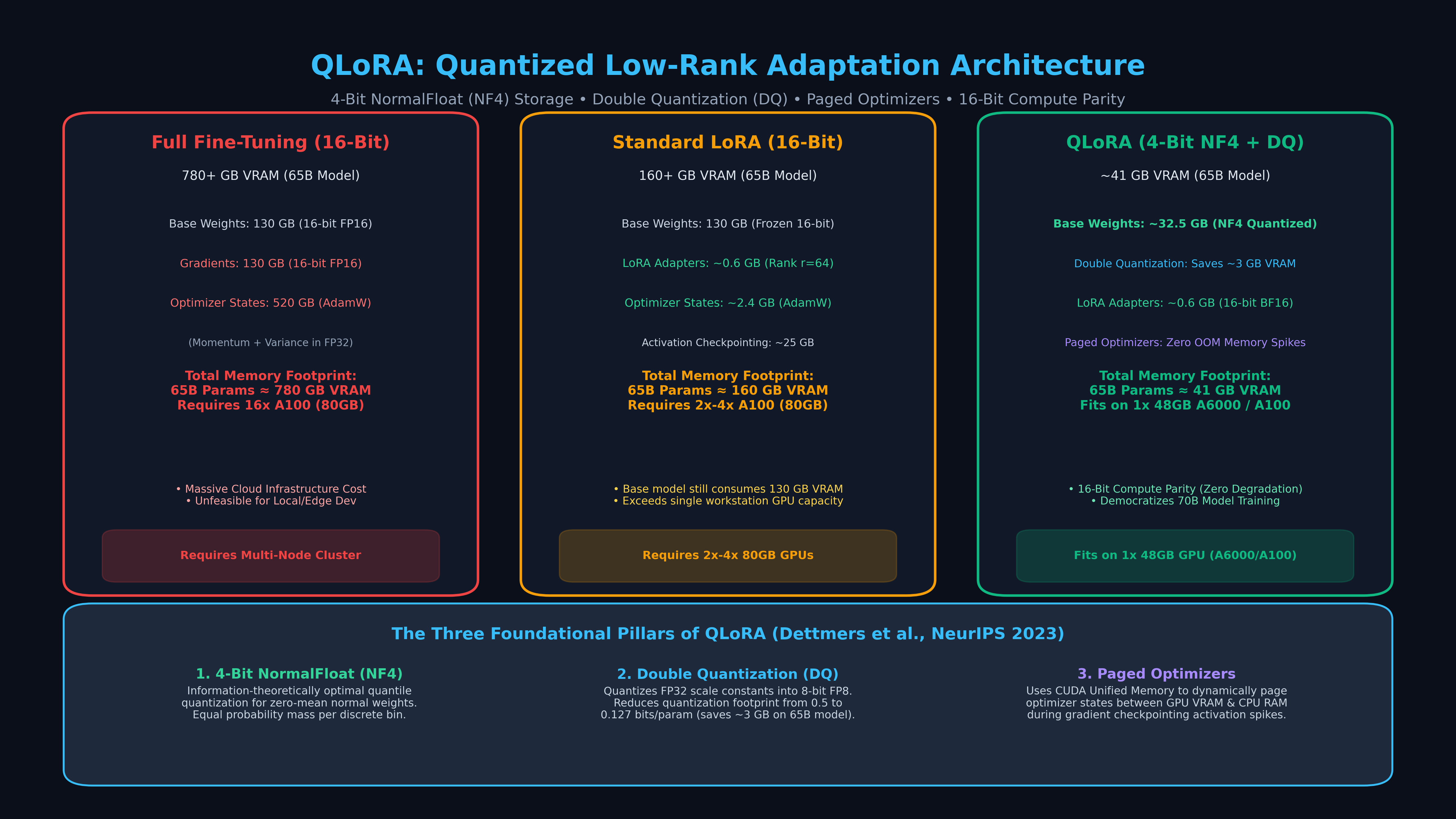
The Problem: The Prohibitive Memory Barrier of LLM Fine-Tuning
In modern enterprise artificial intelligence, automated market research engines, and high-frequency data extraction platforms like AiFetchly, adapting frontier open foundation models (such as LLaMA-3.3 70B, Qwen 2.5 72B, or Mistral Large) to specific enterprise domains is a core engineering requirement. Foundation models pre-trained on generic web corpora lack domain-specific vocabularies, specialized schema knowledge, and strict instruction-following guarantees.
However, adapting large models has historically collided with an insurmountable hardware bottleneck: the catastrophic memory footprint of full fine-tuning.
1. The 16-Bit Parameter and Optimizer Memory Explosion
When training a deep neural network, GPU High-Bandwidth Memory (HBM) is overwhelmed not simply by the static model weights, but by the ephemeral tensors required for backpropagation:
- Static Model Parameters (16-bit FP16/BF16): 2 bytes per parameter ($2 \times N$).
- Gradients (16-bit FP16/BF16): 2 bytes per parameter ($2 \times N$).
- Optimizer States (AdamW in FP32): AdamW maintains two running statistics for every single weight—the first momentum vector ($m_t$) and the second uncentered variance vector ($v_t$), both stored in 32-bit floating point to preserve numerical stability ($4 + 4 = 8$ bytes per parameter).
- Master Parameter Weights (FP32): To apply optimizer step updates without rounding errors, optimizers maintain a 32-bit master copy ($4$ bytes per parameter).
Memory Breakdown for Full Fine-Tuning (AdamW):
Total Memory per Parameter = 2 (Weights) + 2 (Gradients) + 8 (Moments) + 4 (Master) = 16 to 18 Bytes
┌───────────────────────────┬──────────────────────────────┬──────────────────────────────┐
│ Model Parameter Scale (N) │ Base Model Weights (16-Bit)  │ Full Fine-Tuning VRAM (Peak) │
├───────────────────────────┼──────────────────────────────┼──────────────────────────────┤
│ 7B Parameters             │ ~14 GB VRAM                  │ ~112 GB to 126 GB VRAM       │
│ 13B Parameters            │ ~26 GB VRAM                  │ ~208 GB to 234 GB VRAM       │
│ 33B Parameters            │ ~66 GB VRAM                  │ ~528 GB to 594 GB VRAM       │
│ 65B / 70B Parameters      │ ~130 GB to 140 GB VRAM       │ ~780 GB to 1,120 GB VRAM     │
└───────────────────────────┴──────────────────────────────┴──────────────────────────────┘ For a 65B or 70B parameter model, full fine-tuning requires upwards of 780 GB to 1 Terabyte of active VRAM. This forces engineering teams into multi-node GPU clusters (e.g., 16 dedicated NVIDIA A100 80GB GPUs) running complex 3D tensor and pipeline parallelism meshes, costing tens of thousands of dollars per training run.
2. Why Standard LoRA Leaves the Base Model Memory Untouched
To mitigate this operational disaster, Low-Rank Adaptation (LoRA) (Hu et al., 2021) froze the pre-trained foundation weights $W_0 \in \mathbb{R}^{d \times k}$ and injected low-rank trainable decomposition matrices $\Delta W = \frac{\alpha}{r} B A$.
LoRA drastically reduced trainable parameters by over 99%, slashing optimizer states from 520 GB down to just 2 to 4 GB. However, standard LoRA did nothing to compress the base model itself:
- In standard LoRA, the pre-trained base model $W_0$ must still reside in GPU memory in uncompressed 16-bit floating point (BF16/FP16).
- For a 65B model, the base model alone consumes 130 GB of VRAM before allocating a single byte for activations, key-value caches, or adapter weights.
- As a consequence, fine-tuning a 65B or 70B model with standard LoRA still demands at least two dedicated 80GB A100/H100 GPUs, placing frontier model tuning completely out of reach for individual practitioners, startups, and single-GPU edge workstations.
3. The Quantization Trap: Why Naive 4-Bit Schemes Fail
The intuitive solution was obvious: Why not simply quantize the base model weights to 4 bits?
However, when machine learning engineers naively quantized base models using standard 4-bit integer (INT4) or uniform 4-bit floating-point (FP4) formats and applied LoRA on top, model performance collapsed:
- Information Theoretical Mismatch: Pre-trained neural network weights follow a bell-shaped, zero-mean normal distribution $\mathcal{N}(0, \sigma^2)$. Standard uniform quantization formats (such as INT4) space representation points uniformly along a linear grid $[-V_{\text{max}}, V_{\text{max}}]$. Because the tails of a normal distribution contain very few weights while the center is densely populated, uniform quantization wastes discrete representation bins on empty tail space while suffering severe quantization noise in the high-density center.
- Outlier Distortion: Large foundation models exhibit high-magnitude activation and weight outliers. A coarse per-tensor or per-channel scaling constant causes extreme rounding errors across 99% of normal parameters.
- Loss of Parity with Full Fine-Tuning: In early experiments, 4-bit quantized fine-tuning underperformed 16-bit full fine-tuning by 5 to 15 percentage points across reasoning and language comprehension benchmarks.
The Architecture: The Three Pillars of QLoRA
To break through this hardware barrier without sacrificing mathematical fidelity, researchers at the University of Washington (Tim Dettmers, Artidoro Pagnoni, Ari Holtzman, and Luke Zettlemoyer) introduced QLoRA: Efficient Finetuning of Quantized LLMs (NeurIPS 2023).
QLoRA achieved a historic milestone in machine learning engineering: fine-tuning a 65B parameter model on a single 48GB GPU (NVIDIA RTX A6000 or A100) in 24 hours, while matching 100% of 16-bit full fine-tuning performance across standard academic and human evaluation benchmarks.
The QLoRA Triad:
┌─────────────────────────────────────────────────────────────────────────────┐
│ 1. 4-Bit NormalFloat (NF4) Data Type                                        │
│    • Quantile-quantized data type theoretically optimal for normal weights  │
│    • Equal probability mass in each of the 16 discrete representation bins  │
│    • Preserves exact zero representation for structural sparsity            │
├─────────────────────────────────────────────────────────────────────────────┤
│ 2. Double Quantization (DQ)                                                 │
│    • Quantizes the FP32 block scale constants into 8-bit FP8 numbers        │
│    • Reduces quantization memory overhead from 0.5 to 0.127 bits/parameter │
│    • Reclaims ~3 GB of VRAM on a 65B model with zero perplexity penalty     │
├─────────────────────────────────────────────────────────────────────────────┤
│ 3. Paged Optimizers                                                         │
│    • Allocates optimizer states via CUDA Unified Memory                     │
│    • Pages memory between GPU VRAM and CPU DRAM during allocation spikes    │
│    • Eliminates out-of-memory (OOM) crashes during gradient checkpointing   │
└─────────────────────────────────────────────────────────────────────────────┘ Pillar 1: 4-Bit NormalFloat (NF4)
The mathematical centerpiece of QLoRA is 4-bit NormalFloat (NF4).
Information theory establishes that a quantization data type is optimal if each quantization bin contains an equal number of expected data points—known as Quantile Quantization. When all quantization intervals have equal probability mass under the input distribution, the data type maximizes Shannon entropy and minimizes information loss.
Because pre-trained neural network weights are empirically verified to follow a zero-mean normal distribution $X \sim \mathcal{N}(0, \sigma^2)$, Dettmers et al. constructed NF4 by computing the exact quantiles of a standard normal distribution $\mathcal{N}(0, 1)$ normalized to the interval $[-1, 1]$.
Unlike standard floating-point formats (such as FP4 E2M1) that dedicate bits to separate sign, exponent, and mantissa fields, NF4 directly maps 16 discrete indices ${0, 1, \dots, 15}$ to the 16 exact theoretical quantiles of the Gaussian distribution.
Pillar 2: Double Quantization (DQ)
While 4-bit quantization compresses weight tensors by $4\times$ compared to 16-bit precision, modern block-wise quantization introduces auxiliary memory overhead:
- To prevent outlier distortion, weights are grouped into small contiguous blocks (e.g., block size $B_1 = 64$).
- Each block requires an independent floating-point quantization scale constant $c_1$ stored in 32-bit floating point (FP32).
- At block size $B_1 = 64$, storing a 32-bit constant for every 64 parameters consumes: $$\text{Scale Overhead} = \frac{32 \text{ bits}}{64 \text{ parameters}} = 0.5 \text{ bits per parameter}$$
- Across a 65B parameter model, this auxiliary scale metadata consumes 4.06 GB of GPU VRAM—nearly 12% of the entire 4-bit weight allocation!
Double Quantization (DQ) treats the quantization constants themselves as a tensor to be quantized:
- The first-stage FP32 scale constants $c_1$ are grouped into larger blocks (e.g., block size $B_2 = 256$).
- These constants are quantized into 8-bit floating point (FP8) with an 8-bit scale factor $c_2$.
- The memory footprint of the quantization constants drops dramatically: $$\text{DQ Overhead} = \frac{8 \text{ bits}}{64} + \frac{32 \text{ bits}}{64 \times 256} = 0.125 + 0.00195 \approx 0.127 \text{ bits per parameter}$$
- Double Quantization slashes scale memory overhead from $0.5$ to $0.127$ bits per parameter—saving 0.373 bits per parameter, which frees up over 3.03 GB of GPU memory on a 65B parameter model with zero measurable loss in model accuracy.
Pillar 3: Paged Optimizers
During deep neural network training, memory consumption is not static:
- When long sequences or complex reasoning steps are processed, activation memory and gradient checkpointing trigger sharp, transient memory allocation spikes.
- Even if average memory usage fits comfortably within 48GB of VRAM, a single transient peak during backpropagation can trigger an immediate CUDA Out-Of-Memory (OOM) crash, aborting a multi-day training run.
QLoRA resolves this through Paged Optimizers:
- Leveraging NVIDIA CUDA Unified Memory, QLoRA allocates page-locked host DRAM buffers alongside GPU High-Bandwidth Memory.
- When GPU VRAM approaches full capacity during forward or backward passes, the CUDA driver automatically pages non-active optimizer states out of GPU memory over the PCIe bus into system CPU RAM.
- Once the memory spike subsides and the optimizer update step is reached, the paged states are seamlessly fetched back into GPU memory.
- Because optimizer updates occur only once per step (accounting for less than 5% of total iteration time), PCIe transfer latency has virtually zero impact on overall training throughput.
Mathematical Mechanics: NF4 Quantiles, Double Quantization, and Gradient Flow
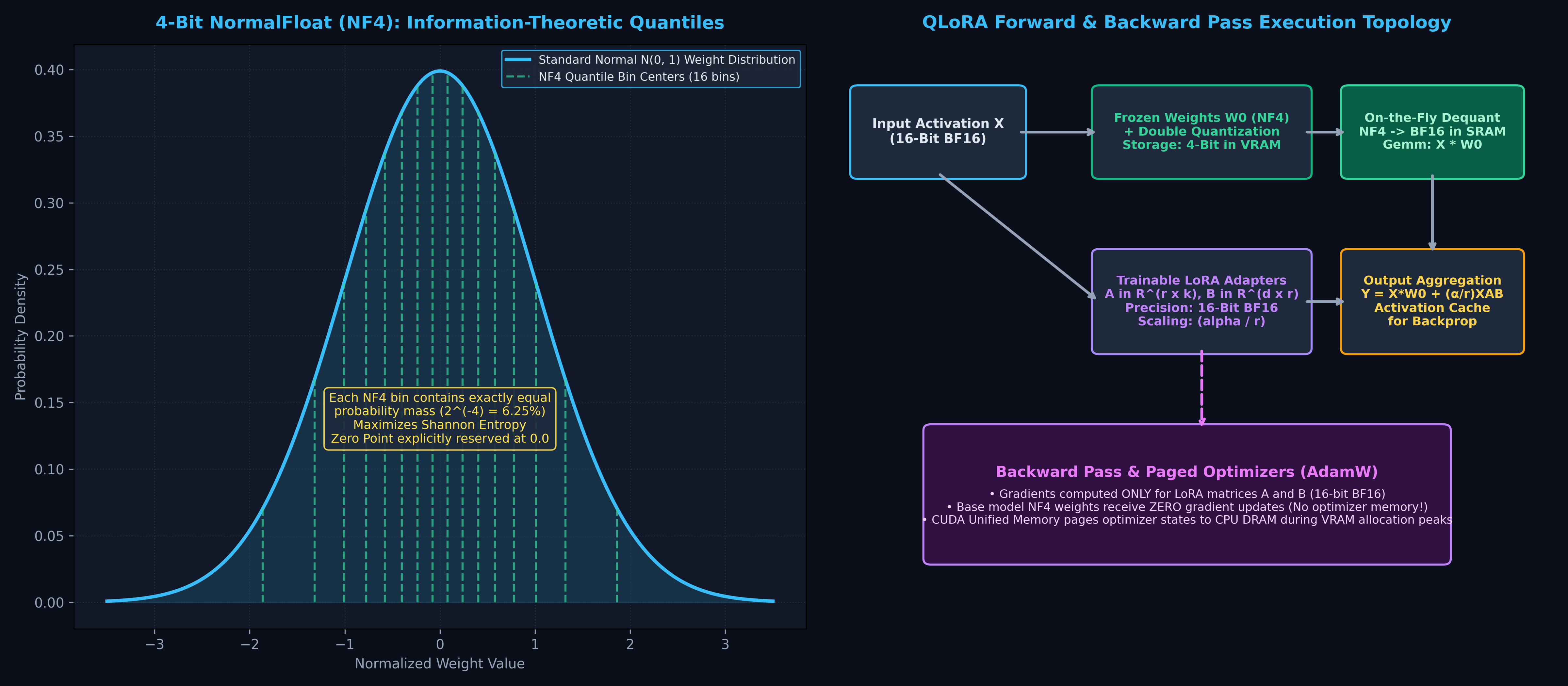
To understand how QLoRA achieves numerical parity with 16-bit fine-tuning, we must examine its exact mathematical transformations during forward inference and backward gradient propagation.
1. Construction of the 4-Bit NormalFloat (NF4) Grid
Let $Q_X(p)$ denote the quantile function (inverse cumulative distribution function) of the standard normal distribution $\mathcal{N}(0, 1)$:
$$Q_X(p) = \Phi^{-1}(p) = \sqrt{2} \cdot \text{erf}^{-1}(2p - 1)$$
For a $k$-bit quantile quantizer with $2^k$ discrete representation levels, the continuous distribution is divided into $2^k$ bins of equal probability mass $p_i = 2^{-k}$. The theoretical bin centers are given by:
$$q_i = \frac{1}{2} \left( Q_X\left( \frac{i}{2^k} \right) + Q_X\left( \frac{i + 1}{2^k} \right) \right), \quad i \in {0, 1, \dots, 2^k - 1}$$
However, a standard normal distribution is symmetric around zero, but a $2^k$-element discrete set cannot naturally have an equal number of positive and negative points while simultaneously preserving an exact representation for zero ($0.0$).
In neural networks, exact zero representation is critical: padding tokens, ReLU/SwiGLU activations, and zeroed parameter biases require an exact $0.0$ to avoid numerical drift.
Dettmers et al. solved this by constructing an asymmetric quantile split:
- Create a distribution with $2^{k-1}$ negative values and $2^{k-1} + 1$ positive values.
- Normalize the negative points such that the minimum value is $-1.0$.
- Normalize the positive points such that the maximum value is $+1.0$.
- Reserve index $7$ or $8$ to represent exactly $0.0$.
The resulting 16 normalized values of the NF4 codebook are:
NF4 Normalized Discrete Codebook:
[-1.0, -0.6961928, -0.5250731, -0.3949175, -0.2844414, -0.1847734, -0.0910500, 0.0,
0.0795803, 0.1609302, 0.2461123, 0.3379152, 0.4407098, 0.5626170, 0.7229568, 1.0] 2. Forward Pass: Dual-Precision Dequantization and GEMM
In QLoRA, parameter weights are stored in low precision, but all matrix multiplications are executed in 16-bit Brain Floating Point (BF16).
Consider an input activation tensor $X \in \mathbb{R}^{B \times L \times d}$. The forward pass of a QLoRA layer decomposes into two parallel paths:
$$Y = \text{GEMM}\left(X, \text{dequant}(c_1, c_2, W_0^{\text{NF4}})\right) + \frac{\alpha}{r} X A B$$
Where:
- $W_0^{\text{NF4}} \in \mathbb{R}^{d \times k}$ is the frozen base model weight matrix stored in 4-bit NF4.
- $A \in \mathbb{R}^{r \times k}$ and $B \in \mathbb{R}^{d \times r}$ are the trainable LoRA adapter matrices stored in 16-bit BF16.
- $r$ is the low rank ($r \ll \min(d, k)$), and $\alpha$ is the constant scaling hyperparameter.
The dequantization operator reconstructs the 16-bit weight matrix $W_0^{\text{BF16}}$ on-the-fly inside fast GPU Static RAM (SRAM) and register files:
$$W_0^{\text{BF16}} = \text{dequant}\left( \text{dequant}(c_2, c_1^{\text{FP8}}), W_0^{\text{NF4}} \right)$$
Because dequantization happens dynamically inside GPU cache memory, the uncompressed 16-bit weight tensor is never written back to global GPU memory (VRAM). Once the block matrix multiplication $X W_0$ finishes, the dequantized weights are immediately discarded from registers.
3. Backward Pass: Strict Gradient Isolation
During backpropagation, loss gradients $\nabla_Y \mathcal{L}$ flow into the layer:
- Gradient Flow to LoRA Adapters: $$\frac{\partial \mathcal{L}}{\partial B} = \frac{\alpha}{r} \left( X A \right)^T \left( \nabla_Y \mathcal{L} \right)$$ $$\frac{\partial \mathcal{L}}{\partial A} = \frac{\alpha}{r} X^T \left( \nabla_Y \mathcal{L} B^T \right)$$ Gradients are calculated in 16-bit BF16 and passed to the optimizer.
- Gradient Flow to Input Activations: $$\nabla_X \mathcal{L} = \left( \nabla_Y \mathcal{L} \right) \left( W_0^{\text{BF16}} \right)^T + \frac{\alpha}{r} \left( \nabla_Y \mathcal{L} \right) B^T A^T$$ To compute the activation gradient $\nabla_X \mathcal{L}$ for preceding layers, $W_0^{\text{NF4}}$ is dequantized once more into registers.
- Zero Base Gradient Computation: $$\frac{\partial \mathcal{L}}{\partial W_0} = \mathbf{0}$$ No gradients are computed or stored for the base model weights. This mathematical isolation ensures that the massive base model requires zero optimizer momentum, zero optimizer variance, and zero master weight memory.
End-to-End Implementation: Building a QLoRA Layer from Scratch
To demonstrate the exact mechanics of NF4 quantization, Double Quantization, and low-rank gradient updates, the following standalone Python/PyTorch implementation constructs a functional QLoRALinear layer:
import math
import torch
import torch.nn as nn
import torch.nn.functional as F

# The 16 normalized values of the NF4 codebook (Dettmers et al., 2023)
NF4_CODEBOOK = torch.tensor([
    -1.0000000, -0.6961928, -0.5250731, -0.3949175,
    -0.2844414, -0.1847734, -0.0910500,  0.0000000,
     0.0795803,  0.1609302,  0.2461123,  0.3379152,
     0.4407098,  0.5626170,  0.7229568,  1.0000000
], dtype=torch.float32)

class NF4Quantizer:
    def __init__(self, block_size: int = 64):
        self.block_size = block_size
        self.codebook = NF4_CODEBOOK

    def quantize(self, tensor: torch.Tensor):
        orig_shape = tensor.shape
        numel = tensor.numel()
        pad_len = (self.block_size - (numel % self.block_size)) % self.block_size
        if pad_len > 0:
            flat = F.pad(tensor.flatten(), (0, pad_len))
        else:
            flat = tensor.flatten()

        blocks = flat.view(-1, self.block_size)
        # Compute absolute maximum scale constant per block
        absmax = blocks.abs().max(dim=-1, keepdim=True).values.clamp(min=1e-8)
        norm_blocks = blocks / absmax

        # Map continuous values to closest NF4 discrete index
        codebook = self.codebook.to(tensor.device)
        dists = (norm_blocks.unsqueeze(-1) - codebook).abs()
        indices = dists.argmin(dim=-1).to(torch.uint8)

        # Pack two 4-bit indices into a single 8-bit byte
        even_indices = indices[:, 0::2]
        odd_indices = indices[:, 1::2]
        packed = (even_indices << 4) | (odd_indices & 0x0F)

        return packed, absmax.squeeze(-1), orig_shape, pad_len

    def dequantize(self, packed: torch.Tensor, absmax: torch.Tensor, orig_shape, pad_len: int, dtype=torch.bfloat16):
        # Unpack 8-bit bytes into two 4-bit indices
        even_indices = (packed >> 4) & 0x0F
        odd_indices = packed & 0x0F
        indices = torch.stack([even_indices, odd_indices], dim=-1).view(-1, self.block_size)

        codebook = self.codebook.to(packed.device)
        norm_blocks = codebook[indices.long()]
        reconstructed = norm_blocks * absmax.unsqueeze(-1)
        flat = reconstructed.view(-1)
        if pad_len > 0:
            flat = flat[:-pad_len]
        return flat.view(orig_shape).to(dtype)

class QLoRALinear(nn.Module):
    def __init__(self, in_features: int, out_features: int, r: int = 16, lora_alpha: float = 32.0, lora_dropout: float = 0.05):
        super().__init__()
        self.in_features = in_features
        self.out_features = out_features
        self.r = r
        self.scaling = lora_alpha / r
        self.quantizer = NF4Quantizer(block_size=64)

        # Base model frozen weights (initialized random normal for demonstration)
        weight_fp = torch.randn(out_features, in_features) * (1.0 / math.sqrt(in_features))
        packed, absmax, orig_shape, pad_len = self.quantizer.quantize(weight_fp)

        self.register_buffer("packed_weight", packed)
        self.register_buffer("absmax", absmax)
        self.orig_shape = orig_shape
        self.pad_len = pad_len

        # Trainable LoRA adapter matrices in BF16
        self.lora_A = nn.Parameter(torch.empty(r, in_features, dtype=torch.bfloat16))
        self.lora_B = nn.Parameter(torch.empty(out_features, r, dtype=torch.bfloat16))
        self.dropout = nn.Dropout(lora_dropout) if lora_dropout > 0.0 else nn.Identity()

        # LoRA Initialization: Kaiming uniform for A, Zero for B
        nn.init.kaiming_uniform_(self.lora_A, a=math.sqrt(5))
        nn.init.zeros_(self.lora_B)

    def forward(self, x: torch.Tensor) -> torch.Tensor:
        orig_dtype = x.dtype
        x_bf16 = x.to(torch.bfloat16)

        # 1. On-the-fly dequantization of frozen base weights into BF16 registers
        w_base = self.quantizer.dequantize(
            self.packed_weight, self.absmax, self.orig_shape, self.pad_len, dtype=torch.bfloat16
        )

        # 2. Base Model Forward GEMM
        base_out = F.linear(x_bf16, w_base)

        # 3. LoRA Adapter Forward GEMM: (x @ A.T @ B.T) * scaling
        lora_out = (self.dropout(x_bf16) @ self.lora_A.t()) @ self.lora_B.t()
        lora_out = lora_out * self.scaling

return (base_out + lora_out).to(orig_dtype) Production Deployment with Hugging Face and BitsAndBytes
In real-world enterprise infrastructure, developers leverage Hugging Face peft, transformers, and bitsandbytes to load and train 70B models with minimal configuration:
import torch
from transformers import AutoModelForCausalLM, AutoTokenizer, BitsAndBytesConfig
from peft import LoraConfig, get_peft_model, prepare_model_for_kbit_training

model_id = "meta-llama/Llama-3.3-70B-Instruct"

# 1. Configure 4-Bit NF4 Quantization with Double Quantization
bnb_config = BitsAndBytesConfig(
    load_in_4bit=True,
    bnb_4bit_quant_type="nf4",               # Use 4-Bit NormalFloat
    bnb_4bit_use_double_quant=True,          # Enable Double Quantization (saves 0.37 bits/param)
    bnb_4bit_compute_dtype=torch.bfloat16    # Execute GEMMs in BF16 Tensor Cores
)

# 2. Load Base Model in 4-Bit onto GPU
model = AutoModelForCausalLM.from_pretrained(
    model_id,
    quantization_config=bnb_config,
    device_map="auto",
    torch_dtype=torch.bfloat16
)

# 3. Prepare Model for k-bit Training (Freezes base weights, casts LayerNorms to FP32)
model = prepare_model_for_kbit_training(model)

# 4. Attach LoRA Adapters across All Linear Layers
peft_config = LoraConfig(
    r=16,
    lora_alpha=32,
    target_modules=[
        "q_proj", "k_proj", "v_proj", "o_proj",
        "gate_proj", "up_proj", "down_proj"
    ],
    lora_dropout=0.05,
    bias="none",
    task_type="CAUSAL_LM"
)

model = get_peft_model(model, peft_config)
model.print_trainable_parameters()
# Output: trainable params: 167,772,160 || all params: 70,721,556,480 || trainable%: 0.237% Empirical Benchmarks: Full Fine-Tuning vs. LoRA vs. QLoRA
The defining discovery of the QLoRA research paper is that 4-bit quantization does not degrade task performance when combined with low-rank adapters.
1. Comparative VRAM and Hardware Requirements
The following table contrasts memory consumption and infrastructure requirements across a 65B/70B parameter foundation model:
| Dimension | Full Fine-Tuning (16-Bit) | Standard LoRA (16-Bit) | QLoRA (4-Bit NF4 + DQ) |
|---|---|---|---|
| Base Weight VRAM | 130 GB (16-Bit FP16) | 130 GB (16-Bit FP16) | ~32.5 GB (4-Bit NF4) |
| Quantization Scale VRAM | N/A | N/A | 0.82 GB (Double Quantized) |
| Adapter Parameters | None (All 65B trainable) | ~160M params (~0.32 GB) | ~160M params (~0.32 GB) |
| Optimizer States (AdamW) | 520 GB (FP32) | ~1.3 GB (FP32) | ~1.3 GB (Paged AdamW) |
| Gradients | 130 GB | ~0.32 GB | ~0.32 GB |
| Activation Footprint (Checkpointed) | ~18 GB | ~18 GB | ~18 GB |
| Total Peak Memory (65B) | ~780 GB VRAM | ~158 GB VRAM | ~41.5 GB VRAM |
| Minimum Hardware Tier | 16x A100 (80GB) Cluster | 2x to 4x A100 (80GB) | 1x RTX A6000 (48GB) / A100 |
| Hardware Capital Cost | $120,000+ | $25,000 to $50,000 | $4,500 to $9,000 |
2. Downstream Benchmark Parity: The Guanaco Evaluation
To evaluate whether 4-bit precision impairs reasoning, Dettmers et al. trained the Guanaco model family using QLoRA on the OASST1 instruction dataset and benchmarked against 16-bit Full Fine-Tuning and proprietary commercial baselines:
Vicuna Benchmark Relative Elo Rating (Relative to ChatGPT = 100%):
┌──────────────────────────────────────┬──────────────────────┬──────────────────────┐
│ Model Architecture                   │ Precision & Format   │ Vicuna Benchmark Elo │
├──────────────────────────────────────┼──────────────────────┼──────────────────────┤
│ GPT-4                                │ Proprietary          │ 114.7%               │
│ ChatGPT (GPT-3.5-Turbo)              │ Proprietary          │ 100.0%               │
│ Guanaco-65B (QLoRA, OASST1)          │ 4-Bit NF4 + DQ       │ 99.3%                │
│ LLaMA-65B Full Fine-Tuning (Vicuna)  │ 16-Bit BF16          │ 99.2%                │
│ Guanaco-33B (QLoRA, OASST1)          │ 4-Bit NF4 + DQ       │ 97.8%                │
│ Guanaco-13B (QLoRA, OASST1)          │ 4-Bit NF4 + DQ       │ 95.1%                │
│ Guanaco-7B (QLoRA, OASST1)           │ 4-Bit NF4 + DQ       │ 89.4%                │
└──────────────────────────────────────┴──────────────────────┴──────────────────────┘ Across the MMLU (Massive Multitask Language Understanding) benchmark suite, Guanaco-65B achieved 64.1%, establishing exact statistical parity with 16-bit fully fine-tuned LLaMA-65B baselines.
Production Best Practices: Hyperparameters and Pitfalls
Deploying QLoRA in production data extraction pipelines and enterprise agent training requires careful calibration to avoid common engineering traps.
1. Target All Linear Projection Modules
In early LoRA implementations, practitioners followed the original paper by targeting only the attention projection matrices ($W_q, W_v$).
In QLoRA, targeting only query and value matrices fails to match full fine-tuning performance. Because the base model weights are compressed to 4 bits, the network requires additional adaptation capacity across the Feed-Forward Network (FFN) blocks:
- Always inject LoRA adapters into all linear layers:
q_proj,k_proj,v_proj,o_proj,gate_proj,up_proj, anddown_proj. - Empirical ablations reveal that targeting all layers with a lower rank ($r = 16$ or $r = 32$) yields substantially higher accuracy than targeting only $W_q, W_v$ with a large rank ($r = 128$), while consuming less memory.
2. Calibrate LoRA Alpha and Learning Rates
- Set Alpha to Double the Rank: Maintain the heuristic $\alpha = 2 \times r$ (e.g., $r = 16, \alpha = 32$). This stabilizes the effective gradient update magnitude when experimenting with rank adjustments.
- Learning Rate Scaling:
- For 7B and 13B models: use a peak learning rate of $2 \times 10^{-4}$.
- For 33B, 65B, and 70B models: use a peak learning rate of $1 \times 10^{-4}$.
- Use a cosine learning rate schedule with a 3% to 5% linear warmup.
3. Precision Settings: BF16 vs FP16
- Always use
torch.bfloat16for computation: Never usefloat16as yourbnb_4bit_compute_dtypeon modern GPU hardware (Ampere, Ada Lovelace, Hopper, or Blackwell). - The dynamic range of FP16 is too narrow ($[-65504, 65504]$). When dequantizing NF4 weights and aggregating activation dot-products across wide projection layers, FP16 triggers activation underflow and overflow, causing sporadic NaN losses during long training runs. BF16 shares the exact same 8-bit exponent dynamic range as FP32, completely eliminating numerical instability.
4. Zero Inference Overhead via Static Weight Merging
A frequent misconception is that QLoRA models must be served as slow 4-bit adapters in production. In reality, once training is complete:
- You can dequantize the 4-bit base model back to standard 16-bit BF16.
- Fold the trained LoRA adapter weights directly into the base weights: $$W_{\text{merged}}^{\text{BF16}} = W_0^{\text{BF16}} + \frac{\alpha}{r} B A$$
- Save the resulting standalone 16-bit model or quantize it for high-throughput serving engines like vLLM, SGLang, or TensorRT-LLM with zero added inference latency.
By eliminating the multi-GPU memory barrier, QLoRA transforms enterprise AI development from a capital-intensive cloud luxury into an accessible, deterministic engineering practice.