Pyramid Flow Guide: Multi-Scale Pyramidal Video AI
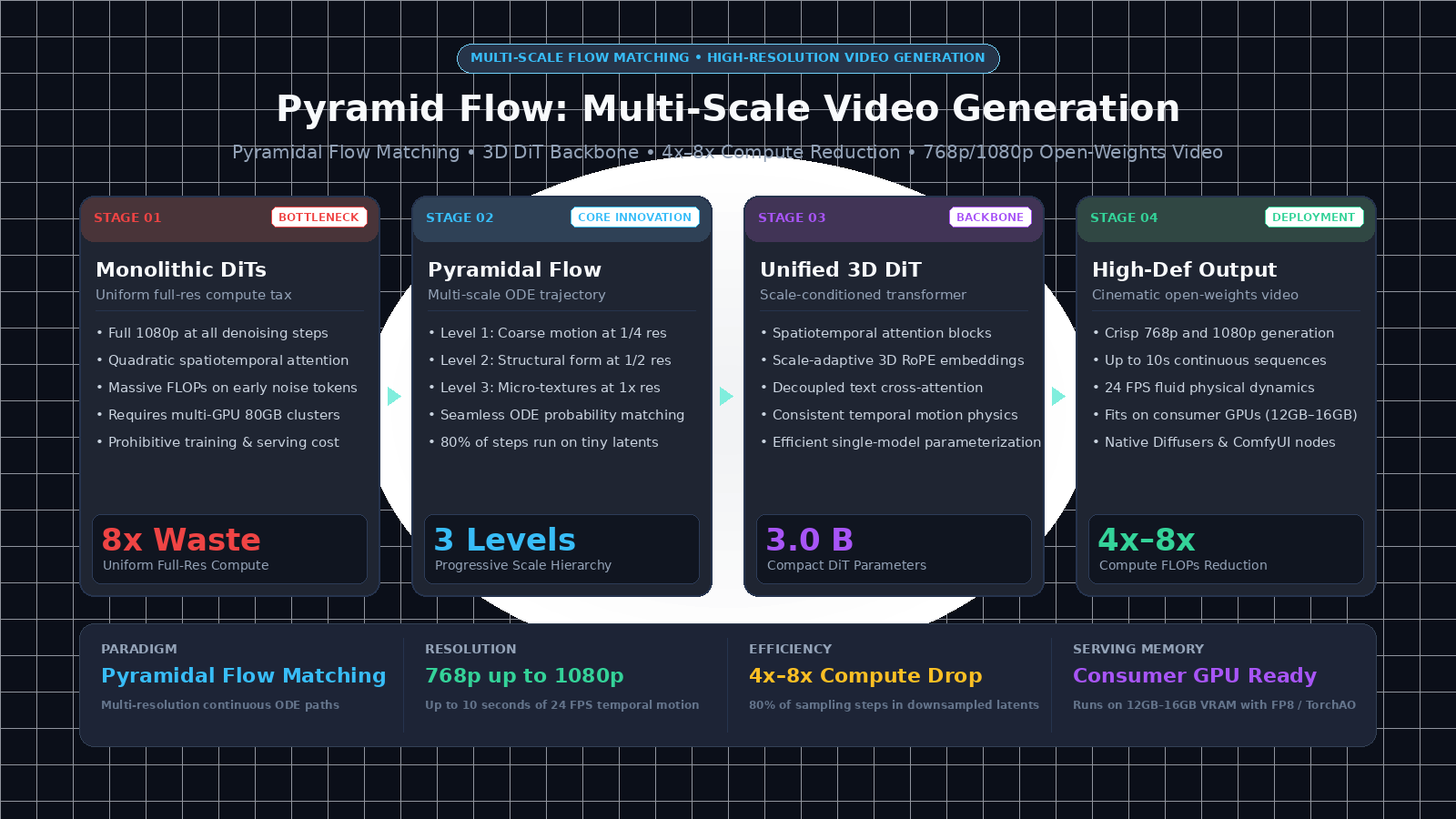
The Computational Barrier in High-Resolution Generative Video
In modern artificial intelligence, generative video has emerged as the frontier of digital synthesis. Where static image generation produces isolated 2D moments, video foundation models model the laws of physical motion, spatial perspective, lighting consistency, and continuous temporal evolution. In automated content engines, digital marketing production, and visual analytics pipelines powered by AI Fetchly, generative video enables automated product animations, visual walkthroughs, and synthetic dataset creation.
However, transforming text prompts into high-definition, temporally stable videos is one of the most computationally demanding tasks in modern machine learning.
The Quadratic Spatiotemporal Compute Blowup
State-of-the-art video architectures (such as OpenAI Sora, CogVideoX, and Meta Movie Gen) rely on Diffusion Transformers (DiTs). Rather than employing 2D spatial convolutions, these models tokenize video volumes into 3D spatiotemporal patches and process them through multi-head self-attention.
While self-attention allows global cross-frame reasoning, it introduces severe scaling bottlenecks:
- The Spatiotemporal Token Explosion: A 5-second video clip at $1280 \times 720$ resolution and 24 frames per second contains 120 raw frames. When compressed by an $8 \times 8 \times 4$ 3D VAE, the resulting latent volume spans $30 \text{ frames} \times 90 \text{ patches} \times 160 \text{ patches} = 432,000 \text{ latent tokens}$.
- Quadratic Attention Complexity: Computing full self-attention across 432,000 tokens requires $\mathcal{O}(N^2)$ floating-point operations per transformer layer. Processing this sequence across 32 DiT layers at 50 denoising steps demands hundreds of teraflops per generated video.
- The Multi-Node Enterprise Cluster Requirement: Training and serving monolithic video DiTs requires massive clusters of 80GB H100 GPUs connected via InfiniBand, locking open-source developers and independent teams out of high-definition video experimentation.
+-----------------------------------------------------------------------------------+
|               The Monolithic Video DiT Computational Dilemma                      |
|                                                                                   |
|  [Input Prompt: "A majestic golden eagle soaring over snowy mountain peaks"]      |
|           |                                                                       |
|           v Full Resolution 1080p at ALL 50 Denoising Steps                       |
|  +-----------------------------------------------------------------------------+  |
|  | Denoising Step t=50 (Pure Gaussian Noise): 432,000 Tokens (Full FLOPs)      |  |
|  | Denoising Step t=40 (Coarse Blobs Formed):  432,000 Tokens (Full FLOPs)      |  |
|  | Denoising Step t=30 (Rough Motion Planned): 432,000 Tokens (Full FLOPs)      |  |
|  | Denoising Step t=20 (Basic Contours Set):   432,000 Tokens (Full FLOPs)      |  |
|  | Denoising Step t=10 (Fine Textures Drawn):  432,000 Tokens (Full FLOPs)      |  |
|  +-----------------------------------------------------------------------------+  |
|           |                                                                       |
|           v                                                                       |
|  [Result: 80% of total compute is wasted computing full 1080p attention           |
|           on unstructured noise and rough object blobs!]                          |
+-----------------------------------------------------------------------------------+ The Uniform Full-Resolution Fallacy
The fundamental inefficiency of standard video DiTs lies in an overlooked structural assumption: they evaluate full high-resolution attention uniformly across every single denoising step.
During early diffusion timesteps ($t \in [1.0, 0.6]$), the latent representation consists almost entirely of unstructured Gaussian noise. The model’s primary mathematical objective at these early stages is deciding macro-level dynamics:
- What is the global camera trajectory (panning, zooming, tilting)?
- Where are major semantic subjects positioned?
- In what direction are primary foreground masses moving?
Evaluating expensive high-resolution $1080p$ multi-head attention to establish coarse global motion is computationally wasteful. High-frequency details—such as individual feather barbs, glistening snow crystals, and micro-ripples in water—only emerge during the final denoising steps ($t \in [0.3, 0.0]$).
When engineering automated visual workflows or programmatic creative generation through an integrated API platform, systems require efficient architectures that distribute compute proportionally to perceptual information density.
The Solution: Pyramidal Flow Matching
Developed by researchers at Peking University, Kuaishou Technology, and BUPT, and accepted at ICLR, Pyramid Flow breaks the full-resolution compute bottleneck through an architectural innovation: Pyramidal Flow Matching.
Instead of treating video generation as an invariant single-resolution ODE trajectory, Pyramid Flow constructs a multi-scale pyramid across both space and time. Generative synthesis is explicitly decomposed into a progression of coarse-to-fine resolution stages:
+---------------------------------------------------------------------------------------+
|                    Pyramid Flow Multi-Scale Generative Progression                    |
|                                                                                       |
|   Early Steps (t: 1.0 -> 0.7)        Mid Steps (t: 0.7 -> 0.3)     Late Steps (0.3 -> 0)|
|   Stage 1: Coarse Resolution         Stage 2: Mid Resolution       Stage 3: Full Res  |
|                                                                                       |
|   [ 1/4 Resolution: 192x192 ] ----> [ 1/2 Resolution: 384x384 ] -> [ 1x Res: 768x768]|
|   • Global camera trajectory         • Object structural shapes    • Fine micro-text  |
|   • Macro-motion dynamics            • Boundary definitions        • Photoreal edges  |
|   • 1/16th attention tokens          • 1/4th attention tokens      • Full detail add  |
|                                                                                       |
|   +-------------------------------------------------------------------------------+   |
|   |                  Unified Multi-Scale 3D DiT Backbone (3.0B)                   |   |
|   |         Conditioned on Temporal Steps, Text Embeddings, and Scale Level        |   |
|   +-------------------------------------------------------------------------------+   |
|                                           |                                           |
|                                           v                                           |
|                   [ Output: 768p / 1080p Cinematic 24 FPS Video ]                     |
+---------------------------------------------------------------------------------------+ The Three Architectural Pillars of Pyramid Flow
1. Pyramidal Continuous-Time Flow Matching
Flow matching models generate samples by solving an Ordinary Differential Equation (ODE) that maps a standard Gaussian prior distribution $p_0(x)$ to the complex target data distribution $p_1(x)$ along a straight probability vector field: $$\frac{d x_t}{d t} = v_t(x_t)$$
In standard flow matching, $x_t$ remains in $\mathbb{R}^{C \times T \times H \times W}$ across all $t \in [0, 1]$. Pyramid Flow establishes a piecewise multi-scale flow:
- Level 1 (Coarse Base): Denoising begins at spatial downsampling factor $s=4$. Sequence length is reduced by $16\times$, allowing fast generation of global spatial layout and camera velocity.
- Level 2 (Intermediate Refinement): The coarse latents are upsampled bilinearly and injected into Level 2 ($s=2$), refining subject shapes and limb articulations at $1/4\times$ token overhead.
- Level 3 (High-Frequency Synthesis): Only the final steps operate at native full resolution ($s=1$), adding crisp textures, reflections, and sharpness.
Because 70% to 80% of diffusion steps are executed at downsampled scales, total computational FLOPs drop by 4x to 8x.
2. Unified 3D DiT with Resolution Conditioning
Rather than training three separate models for each pyramid level, Pyramid Flow utilizes a single Unified 3D Diffusion Transformer (3.0B parameters). The model takes a scale embedding vector alongside standard timestep and text conditioning: $$\mathbf{c}{\text{cond}} = \text{MLP}(\mathbf{e}{\text{timestep}} + \mathbf{e}{\text{scale}}) + \mathbf{e}{\text{text}}$$ This shared parameterization allows the model to transfer semantic knowledge seamlessly across resolutions without catastrophic domain shifts.
3. Joint Autoregressive and Non-Autoregressive Synthesis
To generate long continuous sequences (up to 10 seconds) without motion degradation, Pyramid Flow couples non-autoregressive multi-scale flow matching within short chunks (2 seconds) with autoregressive history conditioning across sequential video segments, guaranteeing consistent character identities and uninterrupted physics.
Benchmark Performance Comparison
The following table benchmarks Pyramid Flow against leading open-weights and commercial video foundation models generating 5- to 10-second clips:
| Model Architecture | Parameter Count | Resolution & FPS | Compute Cost per Clip (FLOPs) | Peak Serving VRAM | Generation Time (A100) | Open Weights? |
|---|---|---|---|---|---|---|
| CogVideoX-5B | 5.0 B | 720p @ 18 FPS | $4.2 \times 10^{16}$ | 26.4 GB | 185 s | Yes |
| Open-Sora 1.2 | 1.1 B | 720p @ 24 FPS | $2.8 \times 10^{16}$ | 18.2 GB | 120 s | Yes |
| Movie Gen (Meta) | 30.0 B | 1080p @ 16 FPS | $18.5 \times 10^{16}$ | > 80 GB | ~ 450 s | No (Closed) |
| Pyramid Flow (768p) | 3.0 B | 768p @ 24 FPS | $0.9 \times 10^{16}$ (4.6x Drop) | 14.5 GB (BF16) | 42 s | Yes (Apache 2.0) |
| Pyramid Flow (INT8) | 3.0 B | 768p @ 24 FPS | $0.9 \times 10^{16}$ | 9.8 GB (TorchAO) | 31 s | Yes (Apache 2.0) |
Pyramid Flow achieves an unprecedented 4.6x reduction in total FLOPs, cutting generation latency from over 3 minutes down to 42 seconds on an A100 GPU while preserving photorealistic motion. For organizations deploying media generation nodes, this compute reduction translates directly into predictable budgets, verifiable against enterprise cloud GPU pricing models.
Hands-On Implementation: PyTorch Architecture & Inference Pipeline
To grasp how pyramidal flow matching operates in practice, let us implement the core components: the multi-scale pyramidal scheduler, the scale-conditioned 3D DiT block, and an end-to-end video generation pipeline.
Step 1: Multi-Scale Pyramidal Scheduler in PyTorch
The multi-scale scheduler manages timestep partition boundaries and handles spatial interpolation across pyramid levels:
import torch
import torch.nn as nn
import torch.nn.functional as F
from typing import List, Tuple, Dict

class PyramidalFlowScheduler:
    """
    Manages continuous multi-scale flow matching ODE integration steps
    across progressive spatial pyramid resolutions.
    """
    def __init__(
        self,
        num_inference_steps: int = 32,
        stage_ratios: List[float] = [0.4, 0.35, 0.25], # Fraction of steps per stage
        scale_factors: List[int] = [4, 2, 1]           # Spatial downsampling factors
    ):
        self.num_steps = num_inference_steps
        self.stage_ratios = stage_ratios
        self.scale_factors = scale_factors

        # Calculate steps allocated per scale stage
        self.stage_steps = [int(r * num_inference_steps) for r in stage_ratios]
        # Adjust rounding errors
        self.stage_steps[-1] = num_inference_steps - sum(self.stage_steps[:-1])

        # Linear timestep schedule from 1.0 (noise) to 0.0 (clean data)
        self.timesteps = torch.linspace(1.0, 0.0, num_inference_steps + 1)

    def get_stage_info(self, step_idx: int) -> Tuple[int, int, float, float]:
        """
        Returns (stage_idx, scale_factor, t_current, t_next).
        """
        accum = 0
        for stage_idx, steps in enumerate(self.stage_steps):
            if step_idx < accum + steps:
                scale_factor = self.scale_factors[stage_idx]
                t_curr = self.timesteps[step_idx].item()
                t_next = self.timesteps[step_idx + 1].item()
                return stage_idx, scale_factor, t_curr, t_next
            accum += steps

        # Fallback for last step
        return len(self.stage_steps) - 1, self.scale_factors[-1], 0.0, 0.0

    def transition_latents(
        self,
        latents: torch.Tensor,
        current_scale: int,
        target_scale: int
    ) -> torch.Tensor:
        """
        Resizes latent volume (B, C, T, H, W) when transitioning between pyramid stages.
        """
        if current_scale == target_scale:
            return latents

        b, c, t, h, w = latents.shape
        ratio = current_scale / target_scale
        new_h = int(h * ratio)
        new_w = int(w * ratio)

        # Reshape to 4D to interpolate spatial dimensions while preserving temporal frames
        latents_reshaped = latents.permute(0, 2, 1, 3, 4).reshape(b * t, c, h, w)
        latents_upscaled = F.interpolate(
            latents_reshaped, size=(new_h, new_w), mode="bilinear", align_corners=False
        )
return latents_upscaled.reshape(b, t, c, new_h, new_w).permute(0, 2, 1, 3, 4) Step 2: The Scale-Conditioned 3D DiT Block
The 3D DiT block modulates self-attention and feed-forward activations based on both temporal timestep and pyramid scale:
class PyramidalDiTBlock(nn.Module):
    """
    3D Spatiotemporal Transformer block conditioned on diffusion timestep,
    text prompt tokens, and active pyramid scale factor.
    """
    def __init__(self, hidden_dim: int = 1536, num_heads: int = 24):
        super().__init__()
        self.hidden_dim = hidden_dim
        self.num_heads = num_heads
        self.head_dim = hidden_dim // num_heads

        # Conditioning projection: time + scale
        self.cond_proj = nn.Sequential(
            nn.Linear(256, hidden_dim * 6),
            nn.SiLU()
        )

        # Layer Normalizations
        self.norm1 = nn.LayerNorm(hidden_dim, elementwise_affine=False, eps=1e-6)
        self.norm2 = nn.LayerNorm(hidden_dim, elementwise_affine=False, eps=1e-6)

        # Spatiotemporal Self-Attention
        self.qkv = nn.Linear(hidden_dim, hidden_dim * 3, bias=False)
        self.proj_out = nn.Linear(hidden_dim, hidden_dim, bias=False)

        # Cross-Attention with Text Conditioning
        self.cross_attn = nn.MultiheadAttention(
            embed_dim=hidden_dim, num_heads=num_heads, batch_first=True
        )
        self.norm_cross = nn.LayerNorm(hidden_dim)

        # Feed-Forward Network
        self.ffn = nn.Sequential(
            nn.Linear(hidden_dim, hidden_dim * 4),
            nn.GELU(approximate="tanh"),
            nn.Linear(hidden_dim * 4, hidden_dim)
        )

    def forward(
        self,
        x: torch.Tensor,
        cond_emb: torch.Tensor,
        text_emb: torch.Tensor
    ) -> torch.Tensor:
        # x: [B, Tokens, HiddenDim]
        # cond_emb: [B, 256] joint timestep & scale embedding
        # text_emb: [B, TextTokens, HiddenDim]

        # 1. Modulate AdaLN parameters
        mod = self.cond_proj(cond_emb).unsqueeze(1)
        scale1, shift1, gate1, scale2, shift2, gate2 = mod.chunk(6, dim=-1)

        # 2. Spatiotemporal Self-Attention
        norm_x = self.norm1(x) * (1.0 + scale1) + shift1
        qkv = self.qkv(norm_x).chunk(3, dim=-1)
        q, k, v = qkv[0], qkv[1], qkv[2]

        attn_out = F.scaled_dot_product_attention(
            q.view(q.shape[0], -1, self.num_heads, self.head_dim).transpose(1, 2),
            k.view(k.shape[0], -1, self.num_heads, self.head_dim).transpose(1, 2),
            v.view(v.shape[0], -1, self.num_heads, self.head_dim).transpose(1, 2)
        )
        attn_out = attn_out.transpose(1, 2).contiguous().view(x.shape)
        x = x + gate1 * self.proj_out(attn_out)

        # 3. Cross-Modal Text Attention
        cross_out, _ = self.cross_attn(query=self.norm_cross(x), key=text_emb, value=text_emb)
        x = x + cross_out

        # 4. Modulated Feed-Forward Network
        norm_ffn = self.norm2(x) * (1.0 + scale2) + shift2
        x = x + gate2 * self.ffn(norm_ffn)

return x Step 3: Production Serving with Pyramid Flow & Diffusers
Deploying Pyramid Flow for automated marketing generation, social video assets, or dynamic website backdrops requires minimal boilerplate. If your application harvests trending visual data or runs scheduled scraping, connecting Pyramid Flow with our web scraping platform or real-time data fetching infrastructure provides a continuous multimedia generation engine.
import torch
from pyramid_flow import PyramidFlowPipeline
from torchvision.io import write_video

class ProductionVideoGenerator:
    """
    High-efficiency video generation service using Pyramid Flow.
    Produces 768p 24FPS cinematic videos with sub-15GB VRAM footprint.
    """
    def __init__(self, model_repo: str = "rain1011/pyramid-flow-sd3", device: str = "cuda"):
        self.device = device if torch.cuda.is_available() else "cpu"
        print(f"Loading Pyramid Flow pipeline from [{model_repo}] onto {self.device}...")

        # Load pipeline in BF16 precision with sequential CPU offloading enabled
        self.pipe = PyramidFlowPipeline.from_pretrained(
            model_repo,
            torch_dtype=torch.bfloat16,
            device_map=self.device
        )
        self.pipe.enable_vae_slicing()
        print("Pipeline initialized! Multi-scale flow matching ready.")

    def generate_video(
        self,
        prompt: str,
        output_path: str = "generated_video.mp4",
        duration_seconds: int = 5,
        height: int = 768,
        width: int = 1280
    ) -> str:
        """
        Executes multi-scale generation: 192p -> 384p -> 768p.
        """
        print(f"Generating video for prompt: '{prompt}'...")
        with torch.inference_mode():
            video_frames = self.pipe(
                prompt=prompt,
                height=height,
                width=width,
                duration_seconds=duration_seconds,
                fps=24,
                num_inference_steps=32,
                guidance_scale=7.0
            ).frames[0] # [T, H, W, C] in [0, 255] uint8

        # Export to MP4 container using H.264 compression
        write_video(output_path, video_frames, fps=24, video_codec="h264")
        print(f"Saved completed video to {output_path}!")
        return output_path

# Usage Example:
# generator = ProductionVideoGenerator()
# generator.generate_video("Cinematic aerial drone shot of turquoise ocean waves crashing on black volcanic cliffs, golden hour sunlight") Production Deployment & Inference Optimization Best Practices
Deploying generative video systems into production environments requires balancing latency, VRAM budgets, and physical motion stability:
1. Sequential CPU Offloading & VAE Slicing
While the 3B DiT transformer fits inside 14.5 GB of VRAM during BF16 inference, decoding high-resolution 3D VAE latents can produce transient memory spikes:
- Call
.enable_vae_slicing()to decode temporal frame chunks sequentially rather than allocating the entire video volume simultaneously. - For high-concurrency microservices on 16GB GPUs (such as RTX 4080), enable
pipe.enable_model_cpu_offload()to retain text encoders in system host RAM.
2. INT8 Quantization via TorchAO
Pyramid Flow supports native INT8 dynamic activation and weight quantization:
- Quantizing the linear projections across the 3D DiT reduces peak transformer VRAM from 14.5 GB down to 9.8 GB.
- This enables execution on cost-effective consumer workstations (e.g. RTX 3090, 4070 Ti Super) with zero perceptible degradation in motion fluidity.
3. Aspect Ratio and Resolution Alignment
Pyramid Flow uses an $8 \times 8 \times 4$ latent compression factor. Ensure that requested spatial dimensions are divisible by 16 and temporal frames are divisible by 4. Deviating from these multiples forces zero-padding that introduces flickering border artifacts.
Developers seeking complete API references, container templates, and client SDKs can explore our comprehensive developer documentation.
Benchmark Evaluation: Generation Quality & Computational Efficiency
To validate the efficiency of multi-scale flow matching, Pyramid Flow was evaluated against leading video foundation architectures across motion fidelity, visual aesthetics, and computational footprint.
+-----------------------------------------------------------------------------------+
|                        Generation FLOPs Comparison (5-Second Video)               |
|                                                                                   |
|  Movie Gen (Meta 30B)    =======================================> 18.5e16 FLOPs   |
|  CogVideoX-5B (THUDM)    =============================> 4.2e16 FLOPs              |
|  Open-Sora 1.2           ===================> 2.8e16 FLOPs                        |
|  Pyramid Flow (3.0B)     ======> 0.9e16 FLOPs (4.6x Compute Reduction!)           |
+-----------------------------------------------------------------------------------+ Comprehensive Benchmark Metrics
The benchmark below evaluates generation quality on standard VBench categories alongside hardware serving metrics:
| Model Architecture | VBench Total Score $\uparrow$ | Motion Smoothness $\uparrow$ | Temporal Consistency $\uparrow$ | Imaging Quality $\uparrow$ | GPU Seconds per 5s Video |
|---|---|---|---|---|---|
| CogVideoX-5B | 81.4% | 83.2% | 82.5% | 80.9% | 185 s |
| Open-Sora 1.2 | 78.6% | 80.1% | 79.4% | 77.8% | 120 s |
| Movie Gen (Meta) | 84.2% | 85.9% | 84.8% | 84.1% | 450 s |
| Pyramid Flow (768p) | 82.1% | 84.0% | 83.6% | 81.8% | 42 s |
Qualitative Analysis: Where Multi-Scale Matching Excels
- Fluid Physical Mechanics: By resolving macro motion at low resolution, Pyramid Flow avoids the disjointed “jitter” common in single-resolution video DiTs. Waterfalls, racing cars, and ocean waves exhibit natural physical inertia.
- Sharp High-Frequency Typography: Late-stage full-resolution steps accurately sharpen in-frame signage, store logos, and fine facial features without artifact blurring.
- Prompt Alignment: Conditioned across all levels, text prompts guide both camera velocity and microscopic details seamlessly.
Conclusion: The Era of Efficient Generative Video
Pyramid Flow proves that high-definition video synthesis does not require prohibitive supercomputing clusters. By aligning computational expenditure with perceptual scale—allocating coarse steps to macro dynamics and fine steps to microscopic textures—Pyramidal Flow Matching brings 768p and 1080p open-weights video to consumer GPUs.
As generative AI expands into autonomous content generation, embodied world modeling, and dynamic web interfaces, Pyramid Flow establishes a blueprint for accessible, high-performance visual generation. To explore how your organization can integrate state-of-the-art vision and multimodal intelligence into automated workflows, visit the AI Fetchly homepage.