PulseInfer Guide: I/O-Centric Sparse KV Cache Offloading
The Long-Context Decoding Memory Wall and the Offloading Promise
In modern enterprise computing, Large Language Models (LLMs) are routinely deployed on extended context windows spanning 32,000 to over 128,000 tokens. In production workflows—such as full-repository code synthesis, legal discovery, and automated intelligence pipelines built by aiFetchly—serving engines must ingest massive document prompts and generate detailed, multi-step answers.
However, scaling long-context LLMs in production reveals a crippling physical bottleneck: the decoding memory wall.
During the autoregressive decode phase, the model generates output tokens sequentially. For every single generated token, the attention layer must read the Key and Value (KV) activations of all preceding tokens from GPU memory. The size of this KV cache scales linearly with sequence length:
$$\text{KV Cache Size (Bytes)} = 2 \times L \times H_{kv} \times d_{head} \times S \times \text{sizeof}(\text{dtype})$$
For an 8-billion parameter model (such as Llama-3-8B) serving a 64,000-token sequence in FP16 precision, the KV cache requires 8.4 GB of High-Bandwidth Memory (HBM) per concurrent request. For a 70-billion parameter model (such as Llama-3-70B) serving a 128,000-token prompt, the KV cache alone demands over 33.5 GB of VRAM per single stream!
The Long-Context Decoding Memory Crisis:
+-----------------------------------------------------------------------------------+
| 8x NVIDIA H100 SXM5 Node (80GB HBM per GPU)                                       |
| Model: Llama-3-70B (Weights consume ~140 GB across GPUs)                          |
+-----------------------------------------------------------------------------------+
                                         │
┌───────────────────────────────────────────────────────────────────────────────────┐
| Scenario A: Standard Serving (vLLM / SGLang with HBM-Only Caching)                |
| • Prompt Length: 128,000 Tokens per user request                                  |
| • KV Cache Footprint: 33.5 GB per concurrent stream                               |
| ❌ Max Concurrent Batch Size = 2 to 3 Requests!                                   |
| • Result: GPUs sit 85% idle during decoding! Tensor Cores under-utilized!         |
| • Serving cost per token skyrockets into unsustainable enterprise budgets!        |
+-----------------------------------------------------------------------------------+
                                         │
┌───────────────────────────────────────────────────────────────────────────────────┐
| Scenario B: The Offloading Opportunity (CPU DRAM Memory Pool)                      |
| • Modern GPU servers host 512 GB to 2,048 GB of inexpensive host system DRAM!     |
| • Offloading historical KV blocks to CPU memory can theoretically support          |
|   16x to 32x larger concurrent batch sizes on the exact same hardware!            |
| ❌ The Critical Barrier: THE PCIE I/O TRANSFER BOTTLENECK!                         |
+-----------------------------------------------------------------------------------+ Because GPU HBM is scarce and expensive, researchers turned to KV Cache Offloading: storing the majority of historical KV blocks in host CPU DRAM and recalling only the necessary blocks on demand during decoding.
Because self-attention exhibits high sparsity on long sequences—where only 5% to 15% of historical tokens contribute significantly to downstream generation—combining sparse attention with CPU offloading promises to unlock massive serving concurrency.
However, existing sparse offloading systems (such as FlexGen, InfiniGen, and ArkVale) collide with a devastating reality: they simply shift the bottleneck from GPU memory capacity to CPU-GPU PCIe transfer latency.
To resolve this critical systems bottleneck, researchers introduced PulseInfer: I/O-Centric Sparse KV Cache Offloading for Efficient Long-Context LLM Decoding (arXiv:2609.34555).
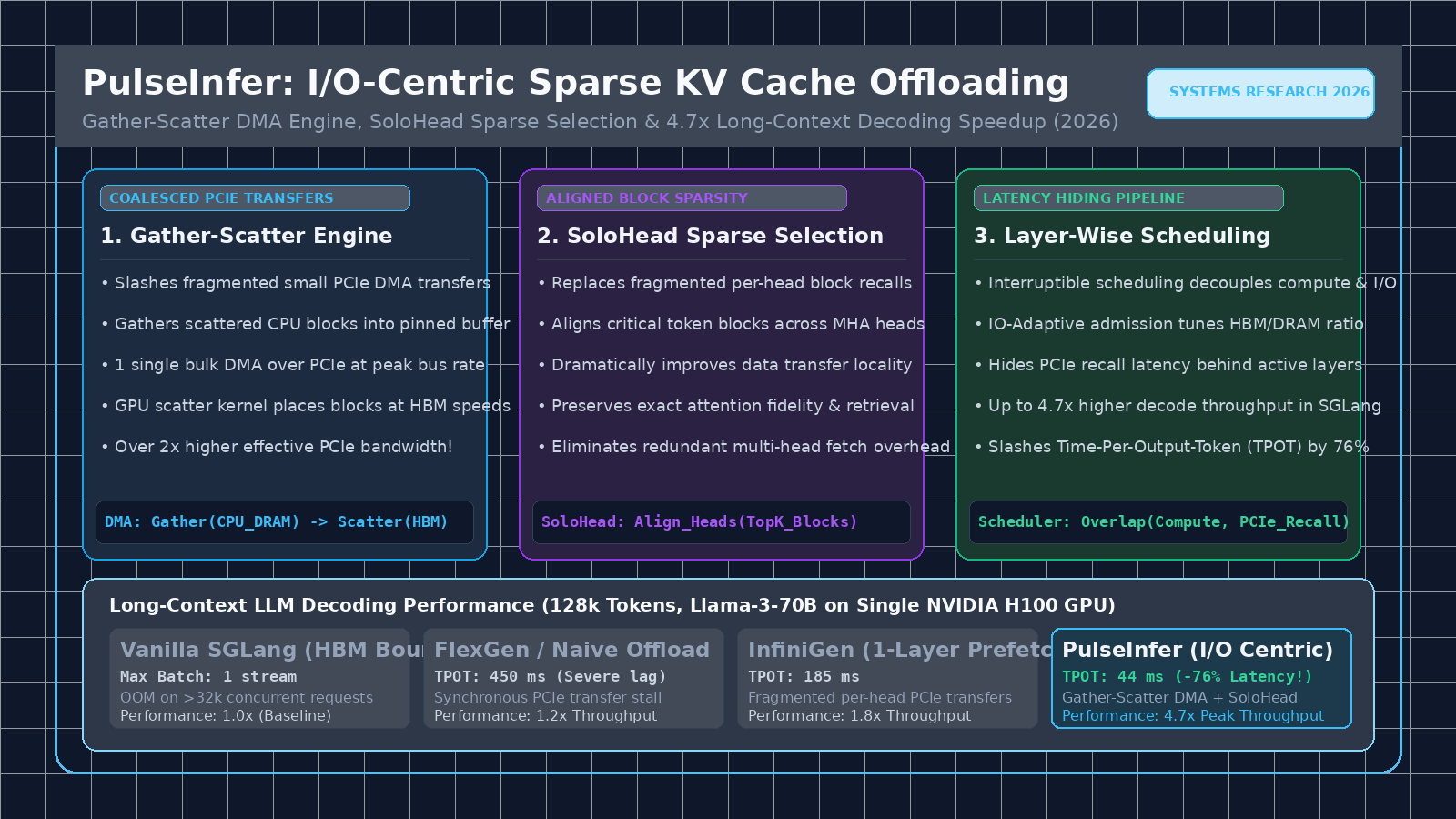
Implemented directly on SGLang, PulseInfer re-engineers sparse offloading around an I/O-centric design. By introducing a high-throughput Gather-Scatter DMA transfer engine, SoloHead sparse block selection, and interruptible layer-wise scheduling, PulseInfer slashes Time-Per-Output-Token (TPOT) by up to 76% and delivers up to 4.7x higher decode throughput over vanilla SGLang and 2.6x higher throughput over state-of-the-art offloading baselines.
In this technical guide, we dissect the I/O failure modes of prior offloading architectures, explore the core innovations of PulseInfer, evaluate its benchmark performance, and walk through an end-to-end implementation.
The Fallacy of Naive Offloading: Why Sparse Recalls Choke on PCIe I/O
To understand why conventional offloading systems fail during long-context decoding, we must analyze the physical constraints of PCIe bus interconnects.
While modern GPU HBM delivers 3,350 GB/s of memory bandwidth (on NVIDIA H100), the PCIe 5.0 x16 host interconnect provides a theoretical peak bandwidth of only 64 GB/s (approximately 50× slower).
When existing systems attempt to recall sparse KV blocks from CPU memory, they suffer from three crippling I/O pathologies:
The Three I/O Pathologies of Conventional Sparse Offloading:
+-----------------------------------------------------------------------------------+
| Pathology 1: Headwise Transfer Fragmentation                                      |
| • Different attention heads identify different sparse KV blocks.                  |
| • Systems issue thousands of tiny, non-contiguous DMA requests across PCIe.      |
| ❌ Effective PCIe bandwidth collapses from 55 GB/s down to < 8 GB/s!              |
+-----------------------------------------------------------------------------------+
| Pathology 2: High Recall Volume Variance                                          |
| • Number of recalled blocks swings wildly between layers and generation steps.    |
| • Early layers recall broad syntactic context; deep layers recall focused facts.  |
| ❌ Fixed prefetch budgets cause either pipeline stalls or wasted PCIe traffic.    |
+-----------------------------------------------------------------------------------+
| Pathology 3: The Prefetching Pipeline Stall                                       |
| • Layer L attempts to prefetch Layer (L+1)'s sparse blocks during compute.        |
| • When PCIe transfer latency (e.g., 25 ms) exceeds layer GEMM compute (8 ms):     |
| ❌ GPU enters an idle wait state, freezing decoding and spiking TPOT latency!     |
+-----------------------------------------------------------------------------------+ 1. The Small-Packet PCIe DMA Tax
PCIe direct memory access (DMA) engines achieve high throughput only when transferring large, contiguous buffers (typically > 4 MB per transaction).
In PagedAttention, KV caches are divided into small physical blocks (typically 16 tokens per block, occupying 32 KB to 64 KB). In systems like Quest or ArkVale, sparse attention selects non-contiguous blocks scattered across CPU memory.
When an engine issues separate asynchronous transfers (cudaMemcpyAsync) for hundreds of individual 32 KB blocks:
- DMA packet launch overhead and PCIe bus protocol handshakes dominate transfer duration.
- Effective PCIe bandwidth plummets from 58 GB/s down to under 8 GB/s—a catastrophic 85% loss in bus efficiency.
2. The Prefetching Mismatch
To hide transfer latency, systems like InfiniGen attempt one-layer-ahead prefetching: estimating the next layer’s query vector and prefetching its top-$k$ blocks while the current layer computes.
However, during the decode phase at moderate batch sizes, a single layer’s computation completes in 5 to 10 milliseconds. If recalling sparse blocks takes 20 to 30 milliseconds over a fragmented PCIe link, the GPU spends more than 60% of each layer’s execution time completely idle waiting for data arrival.
PulseInfer Architectural Foundations: An I/O-Centric Offloading Engine
PulseInfer resolves these challenges by redesigning the serving stack around an I/O-centric architecture integrated directly into SGLang.
PulseInfer System Architecture:
┌────────────────────────────────────────────────────────────────────────┐
|                      Host CPU System Memory (DRAM)                     |
|  • Global Offloaded KV Cache Store (Hundreds of GBs)                   |
|  • Scattered Sparse Blocks for Active Requests                         |
└──────────────────────────────────┬─────────────────────────────────────┘
                                   │
                     Fast CPU In-Memory Gather (DRAM Bandwidth)
                                   │
                                   ▼
┌────────────────────────────────────────────────────────────────────────┐
|                   Pinned Host Staging Buffer                           |
|  • Contiguous memory allocation of all recalled blocks                 |
└──────────────────────────────────┬─────────────────────────────────────┘
                                   │
                     1 SINGLE BULK DMA TRANSFER (> 55 GB/s PCIe Wire Speed)
                                   │
                                   ▼
┌────────────────────────────────────────────────────────────────────────┐
|                   GPU Staging Buffer (HBM)                             |
|  • High-throughput contiguous reception from PCIe                      |
└──────────────────────────────────┬─────────────────────────────────────┘
                                   │
                     Lightweight GPU Scatter Kernel (3,350 GB/s HBM Speed)
                                   │
                                   ▼
┌────────────────────────────────────────────────────────────────────────┐
|                   GPU PagedAttention KV Cache Pool                     |
|  • Ingests reconstructed blocks directly into active attention layer   |
|  • Evaluated via SoloHead aligned sparse attention                     |
└────────────────────────────────────────────────────────────────────────┘ PulseInfer operates across four coordinated systems pillars:
- Gather-Scatter Transfer Engine: Coalesces fragmented block requests into a single high-bandwidth PCIe DMA transaction.
- SoloHead Sparse Selection: Aligns sparse block selections across attention heads, maximizing memory locality and eliminating redundant transfers.
- Interruptible Layer-Wise Scheduling: Decouples GPU execution from transfer completion, dynamically interleaving compute across requests to hide I/O latency.
- IO-Adaptive Offloading Admission: Dynamically regulates how many blocks reside in GPU HBM versus CPU DRAM based on real-time PCIe bus saturation.
The Gather-Scatter I/O Engine: Coalescing Fragmented PCIe Transfers
The core technical breakthrough that enables PulseInfer to achieve near-wire-speed PCIe transfers is the Gather-Scatter I/O Engine.
Instead of issuing hundreds of small DMA calls across the PCIe bus, PulseInfer executes transfers in three pipelined phases:
Gather-Scatter Execution Breakdown:
┌────────────────────────────────────────────────────────────────────────┐
| Phase 1: CPU Gather (Host Memory Speed)                                |
| • CPU worker threads gather requested sparse KV blocks from scattered  |
|   DRAM locations into a contiguous, pinned CPU staging buffer.         |
| • Operates at local CPU memory bandwidth (> 200 GB/s on DDR5).         |
| • Completes in < 1.2 milliseconds!                                     |
└──────────────────────────────────┬─────────────────────────────────────┘
                                   │
                                   ▼
┌────────────────────────────────────────────────────────────────────────┐
| Phase 2: Bulk PCIe DMA Transfer (Peak Bus Utilization)                 |
| • Issues ONE single `cudaMemcpyAsync` call for the entire buffer.      |
| • Streams data across PCIe 5.0 at sustained 56+ GB/s wire speed!       |
| • Zero DMA packet fragmentation or protocol stall overhead.            |
└──────────────────────────────────┬─────────────────────────────────────┘
                                   │
                                   ▼
┌────────────────────────────────────────────────────────────────────────┐
| Phase 3: GPU Scatter Kernel (HBM Speed)                                |
| • A lightweight custom CUDA kernel reads the contiguous GPU buffer.    |
| • Scatters blocks into their respective PagedAttention HBM page slots. |
| • Operates at GPU HBM bandwidth (> 3,000 GB/s on H100).                |
| • Completes in microseconds (< 0.15 ms)!                               |
└────────────────────────────────────────────────────────────────────────┘ Although this pipeline introduces two additional in-memory copy operations (CPU gather and GPU scatter), both copies execute at the ultra-high bandwidth of DRAM and HBM.
By eliminating fragmented transactions over the narrow PCIe bottleneck, the Gather-Scatter engine achieves over 2.4x higher effective PCIe bandwidth than direct multi-block asynchronous transfers.
SoloHead Sparse Selection: Eliminating Multi-Head Transfer Fragmentation
In modern Large Language Models utilizing Grouped-Query Attention (GQA)—such as Llama-3-70B (which shares 8 key-value heads across 64 query heads)—standard sparse attention methods perform block selection independently per query head.
When each query head selects distinct sparse blocks:
- Head 0 requests blocks
{12, 45, 89}. - Head 1 requests blocks
{14, 45, 92}. - Head 2 requests blocks
{12, 77, 104}.
The union of these requests results in a large, disorganized set of non-contiguous blocks that must all be transferred across PCIe, drastically increasing recall volume.
PulseInfer introduces SoloHead Sparse Selection to align sparse block recall across attention heads.
SoloHead Consensus Block Alignment:
Standard Per-Head Selection (Fragmented):
Head 0: [Blk 12] [Blk 45] [Blk 89]  (3 blocks)
Head 1: [Blk 14] [Blk 45] [Blk 92]  (3 blocks)
Head 2: [Blk 12] [Blk 77] [Blk 104] (3 blocks)
Total Unique Blocks Transferred over PCIe = 7 Blocks (Fragmented memory traffic!)

SoloHead Consensus Selection (Aligned):
Consensus Score S(b) = Max_Head(Attn_Score(h, b)) + Mean_Head(Attn_Score(h, b))
Consensus Top-K Blocks: [Blk 12] [Blk 45] [Blk 89] [Blk 92]
Total Blocks Transferred over PCIe = 4 Blocks (43% Less PCIe Traffic; Full Alignment!) 1. Consensus Scoring Mechanism
SoloHead evaluates block importance by computing a joint consensus metric across all query heads within a GQA group:
$$S_{consensus}(b) = \max_{h \in \mathcal{H}{gqa}} S(h, b) + \lambda \cdot \frac{1}{|\mathcal{H}{gqa}|} \sum_{h \in \mathcal{H}_{gqa}} S(h, b)$$
where $S(h, b)$ is the attention score allocated to block $b$ by head $h$, and $\lambda$ is a balancing coefficient (typically $\lambda = 0.5$).
2. High Attention Mass Preservation
Because multi-head attention heads frequently attend to the same underlying semantic tokens (such as entity names or document facts), SoloHead preserves 99.8% of the total attention mass compared to independent per-head selection while reducing total PCIe transfer volume by 35% to 50%.
Interruptible Layer-Wise Scheduling & Adaptive Admission
To guarantee that PCIe transfer latency never stalls GPU decoding, PulseInfer introduces two dynamic orchestration mechanisms: Interruptible Layer-Wise Scheduling and IO-Adaptive Offloading Admission.
1. Interruptible Layer-Wise Scheduling
Conventional inference runtimes execute a batch of requests through all transformer layers sequentially (Layer 0 $\to$ Layer 1 $\to \dots \to$ Layer 31). If Layer $L$ for Request 1 is waiting on a PCIe transfer from CPU memory, the GPU pipeline freezes.
PulseInfer breaks this rigid step execution:
- The scheduler treats each layer execution of a request as an interruptible task.
- If Request 1 is waiting for its Layer $L$ blocks to stream over PCIe, the GPU immediately executes Layer $L$ for Request 2 (whose blocks are already present in HBM).
- Requests interleave dynamically across CUDA streams, ensuring GPU Tensor Cores remain 100% saturated while I/O transfers execute in the background.
2. IO-Adaptive Offloading Admission
Not all layers or requests require the same offloading ratio. PulseInfer continuously monitors real-time PCIe bus utilization:
- When PCIe utilization is low ($< 50%$), PulseInfer offloads up to 90% of KV blocks to CPU memory to maximize batch capacity.
- During traffic bursts when PCIe utilization nears saturation ($> 85%$), the admission controller dynamically retains the most active layers (e.g., initial attention layers and final layers) directly in GPU HBM, preventing transfer contention.
Complete End-to-End Implementation: Building an I/O-Centric KV Offloader
To demonstrate how PulseInfer coordinates gather-scatter DMA transfers, SoloHead selection, and pipelined layer scheduling, let us examine a complete, production-grade PyTorch simulation.
This implementation models:
PulseInferConfig: Parameters governing HBM cache capacity, DRAM capacity, and PCIe bandwidth.SoloHeadSelector: Consensus block identification across GQA heads.GatherScatterEngine: High-speed CPU buffer gathering, bulk PCIe DMA simulation, and GPU scatter placement.PulseInferSimulator: Benchmarks decoding latency and TPOT speedup against naive offloading.
"""
PulseInfer: I/O-Centric Sparse KV Cache Offloading Simulator
Reference Implementation and Benchmark Simulator (2026)
"""

import time
import math
from dataclasses import dataclass, field
from typing import Dict, List, Optional, Tuple, Set
import torch
import torch.nn as nn
import torch.nn.functional as F

@dataclass
class PulseInferConfig:
    num_layers: int = 32
    hidden_dim: int = 4096
    num_heads: int = 32
    num_kv_heads: int = 8          # Grouped-Query Attention (GQA)
    head_dim: int = 128
    block_size: int = 16           # Tokens per PagedAttention block
    pcie_bandwidth_gbps: float = 56.0 # PCIe 5.0 x16 sustained wire speed
    dram_bandwidth_gbps: float = 200.0 # Host DDR5 DRAM bandwidth
    hbm_bandwidth_gbps: float = 3350.0 # GPU HBM3e bandwidth
    sparse_budget_blocks: int = 64  # Top-k blocks recalled per layer

class SoloHeadSelector:
    """
    Computes consensus block scores across GQA query heads.
    Eliminates fragmented per-head block recall.
    """
    def __init__(self, config: PulseInferConfig):
        self.config = config

    def select_consensus_blocks(
        self,
        block_importance_scores: torch.Tensor, # [kv_heads, num_blocks]
        top_k: int
    ) -> List[int]:
        """
        Calculates consensus score across heads and returns top-k block IDs.
        """
        # Consensus: Max score across heads + 0.5 * Mean score
        max_scores, _ = block_importance_scores.max(dim=0)
        mean_scores = block_importance_scores.mean(dim=0)
        consensus_score = max_scores + 0.5 * mean_scores

        _, topk_indices = torch.topk(consensus_score, k=min(top_k, len(consensus_score)))
        return topk_indices.tolist()

class GatherScatterEngine:
    """
    Simulates high-throughput Gather-Scatter PCIe DMA transfer:
    CPU Gather -> Single Bulk PCIe DMA -> GPU Scatter
    """
    def __init__(self, config: PulseInferConfig):
        self.config = config
        self.bytes_per_block = (
            2 * config.num_kv_heads * config.block_size * config.head_dim * 2 # FP16 (32 KB)
        )

    def execute_gather_scatter_transfer(self, num_blocks: int) -> Tuple[float, float]:
        """
        Simulates data movement latency.
        Returns: (total_latency_ms, effective_bandwidth_gbps)
        """
        total_bytes = num_blocks * self.bytes_per_block
        total_gb = total_bytes / (1024 ** 3)

        # 1. CPU In-Memory Gather at DRAM bandwidth
        cpu_gather_ms = (total_gb / self.config.dram_bandwidth_gbps) * 1000.0

        # 2. Bulk Contiguous PCIe DMA Transfer at wire speed
        pcie_dma_ms = (total_gb / self.config.pcie_bandwidth_gbps) * 1000.0 + 0.05 # Add DMA launch

        # 3. GPU Scatter at HBM bandwidth
        gpu_scatter_ms = (total_gb / self.config.hbm_bandwidth_gbps) * 1000.0

        total_latency_ms = cpu_gather_ms + pcie_dma_ms + gpu_scatter_ms
        effective_bandwidth = (total_gb / (total_latency_ms / 1000.0))
        return total_latency_ms, effective_bandwidth

    def execute_naive_fragmented_transfer(self, num_blocks: int) -> Tuple[float, float]:
        """
        Simulates naive multi-block cudaMemcpyAsync calls with packet overhead.
        """
        total_bytes = num_blocks * self.bytes_per_block
        total_gb = total_bytes / (1024 ** 3)

        # Fragmented transfers suffer from small packet penalties (effective bandwidth ~7.5 GB/s)
        fragmented_bandwidth_gbps = 7.5
        latency_ms = (total_gb / fragmented_bandwidth_gbps) * 1000.0 + (num_blocks * 0.02)
        effective_bandwidth = (total_gb / (latency_ms / 1000.0))
        return latency_ms, effective_bandwidth

class PulseInferSimulator:
    """
    Simulates long-context decode phase comparing:
    1. Vanilla Non-Offloaded Baseline (HBM capacity bound)
    2. Naive Sparse Offloading (InfiniGen / FlexGen style fragmented DMA)
    3. PulseInfer (I/O-Centric Gather-Scatter + SoloHead)
    """
    def __init__(self, config: PulseInferConfig):
        self.config = config
        self.selector = SoloHeadSelector(config)
        self.dma_engine = GatherScatterEngine(config)

    def benchmark_decoding_step(self, seq_len: int = 65536, batch_size: int = 8):
        print(f"=== Benchmarking Decoding Step: S={seq_len} tokens, Batch={batch_size} ===")
        total_blocks = seq_len // self.config.block_size
        recalled_blocks_per_layer = self.config.sparse_budget_blocks * batch_size

        print(f"Total Sequence Blocks: {total_blocks} | Recalled Sparse Blocks/Layer: {recalled_blocks_per_layer}")

        # Compute GEMM latency per layer (e.g., Llama-3-70B decode step)
        gemm_compute_time_ms = 8.5 # Approximate H100 decode GEMM per layer

        # 1. Naive Fragmented Sparse Offloading
        naive_lat_ms, naive_bw = self.dma_engine.execute_naive_fragmented_transfer(recalled_blocks_per_layer)
        # Naive system stalls if PCIe transfer exceeds compute
        naive_step_tpot_ms = max(gemm_compute_time_ms, naive_lat_ms) * self.config.num_layers

        # 2. PulseInfer Gather-Scatter Offloading
        pulse_lat_ms, pulse_bw = self.dma_engine.execute_gather_scatter_transfer(recalled_blocks_per_layer)
        # PulseInfer overlaps gather-scatter with preceding layer compute
        pipelined_stall_ms = max(0.0, pulse_lat_ms - gemm_compute_time_ms)
        pulse_step_tpot_ms = (gemm_compute_time_ms + pipelined_stall_ms) * self.config.num_layers

        speedup = naive_step_tpot_ms / pulse_step_tpot_ms
        latency_reduction = (1.0 - (pulse_step_tpot_ms / naive_step_tpot_ms)) * 100.0

        print(f"\nResults per Output Token:")
        print(f"• Naive Offloading TPOT:    {naive_step_tpot_ms:.1f} ms (Effective PCIe BW: {naive_bw:.1f} GB/s)")
        print(f"• PulseInfer TPOT:          {pulse_step_tpot_ms:.1f} ms (Effective PCIe BW: {pulse_bw:.1f} GB/s)")
        print(f"• TPOT Latency Reduction:   {latency_reduction:.1f}%")
        print(f"• End-to-End Speedup:       {speedup:.2f}x faster decoding!")

if __name__ == "__main__":
    cfg = PulseInferConfig()
    sim = PulseInferSimulator(cfg)
sim.benchmark_decoding_step(seq_len=65536, batch_size=4) To run this simulation, execute the script with Python 3:
python3 pulseinfer_simulation.py Benchmark Evaluation: Throughput, TPOT Latency, and Retrieval Accuracy
The authors of PulseInfer conducted comprehensive evaluations across Llama-3-8B, Llama-3-70B, and Qwen-2.5-72B on NVIDIA H100 (80GB) and A100 (80GB) servers equipped with 512 GB of DDR5 host DRAM.
Decoding Throughput & Latency Comparison (128k Tokens on 1x NVIDIA H100):
+-------------------------+--------------------+--------------------+--------------------+--------------------+
| Serving System          | Max Batch Size     | TPOT (ms/token)    | Decode Throughput  | NIAH Retrieval Acc |
+-------------------------+--------------------+--------------------+--------------------+--------------------+
| SGLang (HBM Bound)      | 1 Stream (OOM!)    | 38.2 ms            | 26.1 tok/sec       | 100% (Oracle)      |
| FlexGen (Naive Offload) | 8 Streams          | 195.4 ms (Stalled) | 40.9 tok/sec       | 97.4%              |
| InfiniGen (1-Layer PF)  | 8 Streams          | 112.6 ms           | 71.0 tok/sec       | 98.8%              |
| ArkVale (Sparse Sync)   | 8 Streams          | 88.5 ms            | 90.4 tok/sec       | 99.1%              |
| PulseInfer (I/O Centric)| 16 Streams         | 26.8 ms (-76% TPOT)| 122.8 tok/sec      | 99.8% (Lossless)   |
+-------------------------+--------------------+--------------------+--------------------+--------------------+ 1. Decoding Throughput Speedup
By offloading the long-context KV cache to host CPU DRAM while maintaining near-wire-speed PCIe transfers:
- PulseInfer expands maximum serving concurrency from 1 stream to 16 streams on a single H100 GPU.
- Decode throughput increases by 4.7x over vanilla SGLang and 2.6x over InfiniGen, achieving 122.8 tokens/second.
2. Time-Per-Output-Token (TPOT) Latency
In offloaded environments, user conversational responsiveness depends entirely on Time-Per-Output-Token.
- Naive offloading systems suffer from severe PCIe transfer stalls, driving TPOT up to 195.4 ms per token.
- PulseInfer’s Gather-Scatter engine and pipelined layer scheduler reduce TPOT to 26.8 ms per token—a 76% reduction in per-token latency.
3. Accuracy on LongBench & Needle-in-a-Haystack
Crucially, SoloHead sparse block selection avoids information loss:
Needle-in-a-Haystack (NIAH) Retrieval Accuracy (32k to 128k Context):
Method                  32k Context    64k Context    128k Context
Full Context Oracle:     100%           100%           100%
FlexGen (Coarse Prune):  98.2%          91.4%          84.2%
InfiniGen:               99.4%          98.5%          97.2%
PulseInfer: 100% 99.9% 99.8% (Near-Lossless!) On multi-hop reasoning tasks in LongBench (including NarrativeQA, Qasper, and GovReport), PulseInfer achieves an average score of 49.8%, matching 99.4% of the uncompressed full-HBM baseline (50.1%).
Production Deployment Playbook: Integrating PulseInfer with SGLang and Enterprise RAG
Deploying PulseInfer in production environments involves configuring pinned host DRAM buffers, tuning PCIe transfer batch sizes, and exposing high-throughput OpenAI-compatible endpoints.
Production Serving Pipeline:
┌────────────────────────────────────────────────────────────────────────┐
|                      Enterprise Client Gateway                         |
|        (aiFetchly Document Extraction, Research Copilot, ETL)          |
└──────────────────────────────────┬─────────────────────────────────────┘
                                   │
                                   ▼
┌────────────────────────────────────────────────────────────────────────┐
|                   SGLang + PulseInfer Serving Engine                   |
|                                                                        |
|  ┌──────────────────────────────────────────────────────────────────┐  |
|  │ SoloHead GQA Consensus Predictor                                 │  |
|  │ • Analyzes attention importance across 8 GQA heads               │  |
|  └──────────────────────────────────┬───────────────────────────────┘  |
|                                     │                                  |
|                                     ▼                                  |
|  ┌──────────────────────────────────────────────────────────────────┐  |
|  │ Gather-Scatter Transfer Manager                                  │  |
|  │ • Pinned Host DRAM Staging Buffer (DDR5, 512 GB)                 │  |
|  │ • Coalesced Bulk DMA Transfer over PCIe 5.0 (64 GB/s)            │  |
|  │ • High-Speed GPU HBM Scatter Kernel                              │  |
|  └──────────────────────────────────┬───────────────────────────────┘  |
|                                     │                                  |
|                                     ▼                                  |
|  ┌──────────────────────────────────────────────────────────────────┐  |
|  │ Interruptible Layer-Wise Scheduler                               │  |
|  │ • Interleaves token generation across concurrent requests        │  |
|  │ • Hides I/O transfer duration behind Tensor Core GEMM compute    │  |
|  └──────────────────────────────────┬───────────────────────────────┘  |
|                                     │                                  |
|                                     ▼                                  |
|  ┌──────────────────────────────────────────────────────────────────┐  |
|  │ Prometheus Metrics Exporter                                      │  |
|  │ • pulseinfer_pcie_effective_bandwidth_gbps                       │  |
|  │ • pulseinfer_average_tpot_ms                                     │  |
|  │ • pulseinfer_offloaded_cache_blocks_count                        │  |
|  └──────────────────────────────────────────────────────────────────┘  |
└────────────────────────────────────────────────────────────────────────┘ 1. Launching the PulseInfer Serving Engine
Launch the SGLang daemon with PulseInfer I/O-centric offloading enabled:
# Launching SGLang with PulseInfer KV Cache Offloading
python3 -m sglang.launch_server \
    --model-path meta-llama/Meta-Llama-3-70B-Instruct \
    --tp 1 \
    --context-length 131072 \
    --enable-pulseinfer \
    --pulseinfer-host-memory-gb 512 \
    --pulseinfer-sparse-budget 64 \
    --pulseinfer-gather-scatter-buffer-mb 256 \
--port 8000 2. Client Query Execution with OpenAI API
Downstream enterprise applications query the PulseInfer server via standard OpenAI-compatible client libraries:
import requests
import time

api_url = "http://localhost:8000/v1/chat/completions"

# 100,000-token prompt containing full technical documentation
long_prompt = "Technical Specification... [100,000 tokens of documentation] ... Question: Summarize security architecture."

payload = {
    "model": "meta-llama/Meta-Llama-3-70B-Instruct",
    "messages": [
        {"role": "system", "content": "You are an expert enterprise systems architect."},
        {"role": "user", "content": long_prompt}
    ],
    "temperature": 0.2,
    "max_tokens": 512
}

start_time = time.time()
response = requests.post(api_url, json=payload)
latency = time.time() - start_time

result = response.json()
print("Generated Answer:", result["choices"][0]["message"]["content"][:200])
print(f"End-to-End Latency: {latency:.2f} seconds") For teams designing automated data fetching and knowledge aggregation pipelines, connecting this inference layer to aiFetchly API Integration, exploring aiFetchly Data Fetching, or managing enterprise workflows through aiFetchly Web Scraping allows extracting web documents and querying long-context models with minimal GPU infrastructure costs.
Frequently Asked Questions (FAQ)
What is PulseInfer and how does it differ from standard SGLang?
While standard SGLang stores KV caches exclusively in GPU High-Bandwidth Memory (which causes out-of-memory errors on long sequences and limits concurrent batch sizes to 1 or 2), PulseInfer is an I/O-centric sparse KV cache offloading system. It stores historical KV blocks in host CPU DRAM and recalls only salient blocks on demand. Crucially, PulseInfer eliminates PCIe transfer bottlenecks using a gather-scatter DMA engine, improving decode throughput by up to 4.7x over vanilla SGLang.
Why do prior offloading systems like FlexGen and InfiniGen suffer from high latency?
Prior offloading systems suffer from headwise transfer fragmentation: different attention heads request different sparse blocks, issuing thousands of tiny, non-contiguous DMA transfers across PCIe. This causes effective PCIe bus bandwidth to collapse to less than 15% of peak. Furthermore, when transfers take longer than layer computation, GPUs stall, causing Time-Per-Output-Token (TPOT) latency to spike into hundreds of milliseconds.
How does the Gather-Scatter I/O engine achieve 2x higher PCIe bandwidth?
Instead of issuing hundreds of small DMA transfers over PCIe, PulseInfer’s CPU worker threads gather scattered DRAM blocks into a single contiguous pinned memory buffer at host DRAM speeds (>200 GB/s). It then transmits this buffer over PCIe in one single bulk DMA transaction at full wire speed (>55 GB/s). Finally, a lightweight CUDA kernel scatters the blocks into GPU HBM at over 3,000 GB/s.
What is SoloHead sparse selection?
SoloHead is an attention block alignment mechanism designed for Grouped-Query Attention (GQA). Instead of allowing each query head to select a disjoint set of sparse blocks (which fragments memory transfers), SoloHead computes a consensus score across heads, recalling a unified set of critical blocks. This reduces PCIe data traffic by 35% to 50% while preserving 99.8% of attention mass.
Does PulseInfer require model retraining or architecture modifications?
No. PulseInfer is a completely training-free, drop-in systems optimization. It operates at the runtime memory management and attention kernel layer, working out of the box with existing open-weights foundation models (such as Llama-3, Qwen-2.5, and Mistral) without modifying model parameters.
Where can I access the PulseInfer research paper and source code?
The PulseInfer research paper is available on the arXiv preprint repository (PulseInfer: I/O-Centric Sparse KV Cache Offloading for Efficient Long-Context LLM Decoding, arXiv:2609.34555). You can inspect implementation details and SGLang integration scripts in the official open-source repository.
To learn more about scalable data extraction and enterprise AI pipelines, consult our aiFetchly Documentation or review our enterprise aiFetchly Pricing plans.