Prompt Lookup Decoding: Zero-Cost Speculative LLM Guide
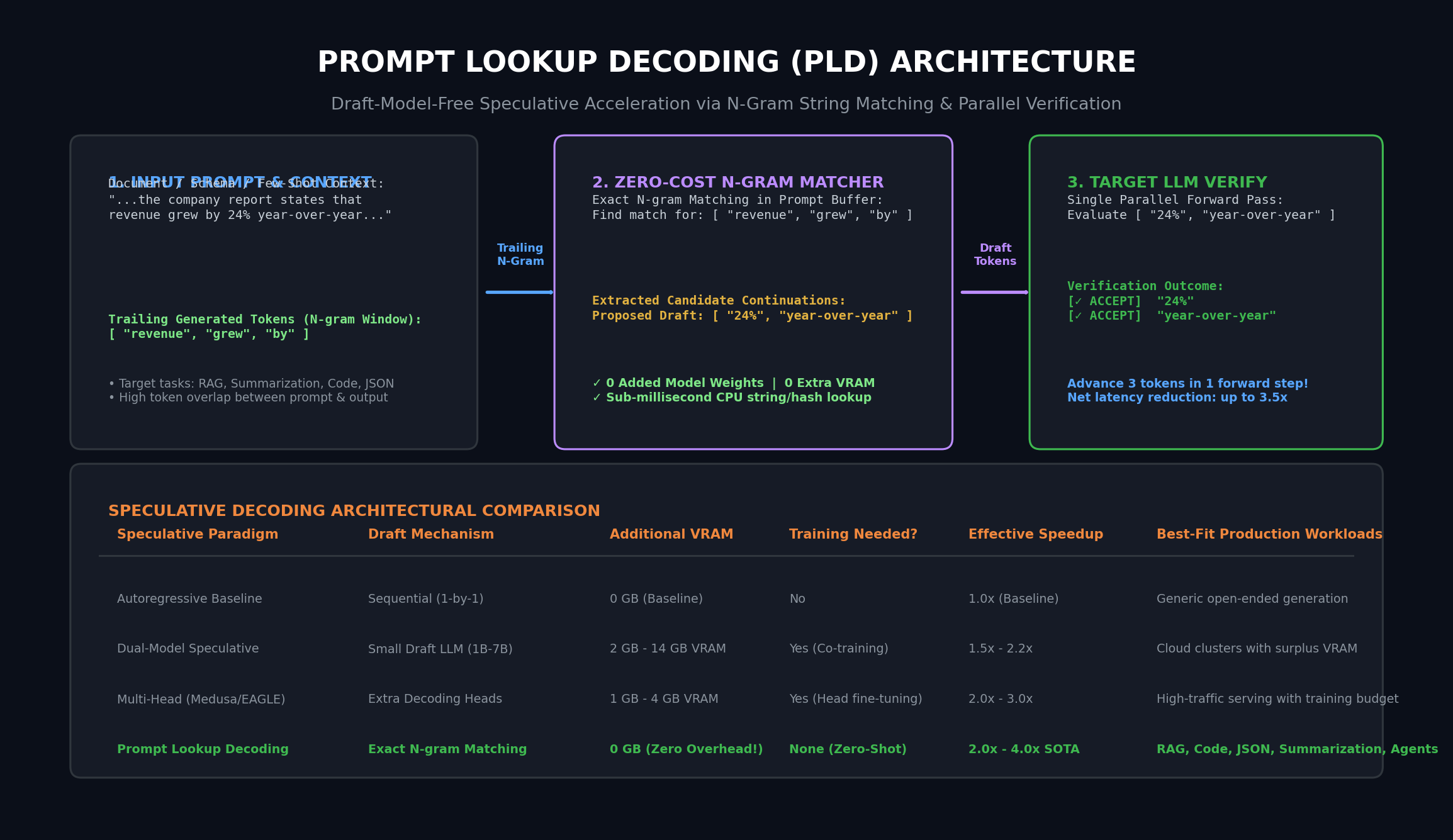
The Problem: The Memory Bandwidth Wall and the Draft Model Burden
In modern enterprise foundation model serving, high-concurrency data extraction engines, and local workstation copilots like AiFetchly, deploying large language models (LLMs) encounters a fundamental physical bottleneck: the memory-bandwidth bound nature of autoregressive decoding.
While the prompt prefill phase processes thousands of tokens concurrently using dense matrix-matrix multiplications (GEMM) that fully saturate GPU Tensor Cores, token generation (the decode phase) proceeds strictly token-by-token:
$$\text{Decoded Tokens} = x_1 \to x_2 \to x_3 \to \dots \to x_T$$
At each decoding step $t$, the serving runtime must read the complete set of model weights (e.g., 70 billion parameters, requiring ~140 GB in 16-bit precision or ~35 GB in 4-bit quantization) and the accumulated Key-Value (KV) cache from GPU High-Bandwidth Memory (HBM) into on-chip SRAM just to compute a single output token vector:
$$\text{Arithmetic Intensity} = \frac{\text{FLOPs}}{\text{Bytes Transferred}} \approx \frac{2 \times N_{\text{params}}}{2 \times N_{\text{params}}} = 1.0 \text{ FLOP/Byte}$$
Because the arithmetic intensity of autoregressive decoding is near unity, modern GPU Tensor Cores sit idle for over 85% to 90% of clock cycles, stalled while waiting for memory buses to transfer model parameters.
Why Classical Speculative Decoding Stumbles in Production
To break this memory-bandwidth bottleneck, the deep learning community standardized on Speculative Decoding (Leviathan et al., Chen et al.). By pairing a large, high-capacity target model (e.g., Llama-3.3-70B) with an auxiliary, lightweight draft model (e.g., Llama-3.2-1B), speculative decoding proposes a sequence of $K$ candidate tokens sequentially:
$$\tilde{X}{t+1:t+K} = (\tilde{x}{t+1}, \tilde{x}{t+2}, \dots, \tilde{x}{t+K})$$
The large target model then verifies all $K$ candidates simultaneously in a single, parallel forward evaluation pass, accepting the prefix that matches its own distribution.
While theoretically appealing, deploying dual-model speculative decoding in enterprise production and resource-constrained environments reveals four major operational roadblocks:
The Operational Friction of Dual-Model Speculative Decoding:
┌───────────────────────────────────────────────────────────────┐
│ GPU High-Bandwidth Memory (HBM) Squeeze                       │
├───────────────────────────────┬───────────────────────────────┤
│ Target Model (Llama-3-70B)    │ 140 GB VRAM (Weights + Cache) │
│ Auxiliary Draft (Llama-3-8B)  │ +16 GB VRAM (Weights)         │
│ Separate Draft KV Cache       │ +8 GB to 16 GB VRAM           │
└───────────────────────────────┴───────────────────────────────┘
Total Overhead: Up to 32 GB of dedicated memory just for drafting! - Dual VRAM Allocation & Memory Starvation: Hosting an auxiliary draft model and its independent KV cache consumes 16 GB to 32 GB of precious VRAM. On consumer or workstation GPUs (like an NVIDIA RTX 4090 with 24 GB VRAM), there is simply no memory headroom to co-host a second neural network.
- Distribution Shift and Cascading Rejections: If the draft model was trained on different corpora, quantized with a different scheme, or misaligned with the target’s system prompt, the token acceptance rate $\alpha$ plummets below 45%. When draft tokens are rejected, drafting compute is completely wasted, causing the system to run slower than baseline autoregression.
- Tensor Parallelism Communication Overhead: In distributed clusters running 8-way Tensor Parallelism (TP=8), executing a small 1B or 3B draft model across 8 GPUs yields poor scaling: inter-GPU NVLink collective synchronization takes longer than the actual matrix multiplications.
- Draft Training and Fine-Tuning Overhead: Methods like Medusa and EAGLE-2 require training custom prediction heads or auxiliary feature projection layers. Whenever the base model is updated or fine-tuned, the draft heads must be retrained from scratch.
Production AI infrastructure required an answer to a fundamental architectural question: Can we achieve multi-token speculative acceleration without loading an auxiliary neural network, without consuming extra GPU VRAM, and without requiring any fine-tuning?
The Architecture: How Prompt Lookup Decoding Works Without a Draft Model
Introduced by open-source researcher Apoorv Saxena (apoorvumang) and standardized natively in high-performance inference frameworks like vLLM and Hugging Face Transformers, Prompt Lookup Decoding (PLD) fundamentally rethinks speculative candidate generation.
Instead of running an auxiliary neural network to guess future tokens, PLD exploits a core empirical reality of modern language model workloads: Token Continuity and Input Grounding.
In a vast swath of real-world AI tasks—including retrieval-augmented generation (RAG), document summarization, code editing, schema-constrained JSON extraction, multi-turn customer support, and autonomous web data extraction in AiFetchly—a substantial portion of output tokens already exist verbatim in the input prompt.
Input-Grounded Token Overlap in Production LLM Workloads:
• RAG Document Ingestion: Entity names, technical metrics, verbatim quotes
• Code Refactoring / Debugging: Variable names, function signatures, syntax blocks
• Structured JSON Extraction: Schema keys, field names, enum values, formatting strings
• Document Summarization: Key phrases, numerical statistics, chronological sequences The Core Architectural Premise
Prompt Lookup Decoding replaces the entire neural draft model with a zero-cost string/n-gram matching algorithm operating over the prompt and past generation history.
The Prompt Lookup Decoding Loop:
┌────────────────────────────────────────────────────────────────────────┐
│ 1. Current Generation Trajectory:                                      │
│    [ ... tokens ... , w_{t-2}, w_{t-1}, w_t ]                          │
│                                                                        │
│ 2. Exact N-Gram Matcher (CPU / Token Buffer):                          │
│    Search prompt context for the exact occurrence of (w_{t-2}, w_{t-1}, w_t) │
│                                                                        │
│ 3. Speculative Continuation Slice:                                     │
│    Extract the subsequent K tokens following the matched N-gram:       │
│    Draft Tokens = [ c_1, c_2, ..., c_K ]                               │
│                                                                        │
│ 4. Single-Pass Target LLM Verification:                                │
│    Target model evaluates all K candidates in parallel!                │
│    Outcome: Accept M <= K tokens + 1 bonus token in 1 forward pass!   │
└────────────────────────────────────────────────────────────────────────┘ By extracting candidate tokens directly from the input prompt buffer using sub-millisecond string algorithms, PLD achieves:
- Zero Additional Model Parameters: No secondary model weights, no adapter layers, and no fine-tuning.
- Zero Additional GPU VRAM: The entire candidate generation executes in CPU system memory or simple GPU token buffers, leaving 100% of VRAM for the primary model and KV cache.
- Strict Distribution Invariance: Candidate tokens are verified strictly by the target model using standard speculative acceptance rules, ensuring zero degradation in output quality or perplexity.
Systems Mechanics: The Sliding N-Gram Matcher and Parallel Verification
The execution lifecycle of Prompt Lookup Decoding consists of two tightly coupled phases: N-gram Candidate Proposal and Parallel Target Verification.
1. The N-Gram Candidate Proposal Mechanics
Let the complete token sequence up to current step $t$ be represented as:
$$X_{1:t} = (x_1, x_2, \dots, x_t)$$
Where $X_{1:P}$ represents the prompt prefix of length $P$, and $X_{P+1:t}$ represents the tokens generated so far.
PLD parameterizes candidate extraction through two primary hyperparameters:
- $N$ (N-gram Window Size): The number of trailing tokens used as the lookup pattern (typically $N \in {2, 3, 4}$).
- $K$ (Speculative Draft Horizon): The number of subsequent candidate tokens to speculate (typically $K \in {3, 4, 5}$).
The proposal algorithm executes as follows:
- Step A (Extract Query N-Gram): The system takes the trailing $N$ tokens of the active generation: $$Q = (x_{t-N+1}, x_{t-N+2}, \dots, x_t)$$
- Step B (Context Search): The algorithm searches backwards through the prompt $X_{1:P}$ (and optionally historical generation $X_{P+1:t-N}$) to locate an exact match for $Q$.
- Step C (Candidate Extraction): If a match is found starting at index $j$ such that $X_{j:j+N-1} = Q$, the algorithm extracts the subsequent $K$ tokens as speculative candidates: $$\tilde{C} = (x_{j+N}, x_{j+N+1}, \dots, x_{j+N+K-1})$$
- Step D (Fallback): If no matching N-gram is found in the prompt, the lookup immediately falls back to standard greedy or temperature sampling for token $t+1$, incurring zero speculative penalty.
# Conceptual N-Gram Matcher Logic in PLD
def prompt_lookup_propose(context_tokens: list[int], n_gram_size: int = 3, draft_len: int = 4) -> list[int]:
    if len(context_tokens) < n_gram_size + 1:
        return []

    # Trailing n-gram query
    query = context_tokens[-n_gram_size:]
    search_space = context_tokens[:-1] # Exclude immediate trailing window

    # Search backwards for the most recent matching occurrence
    query_len = len(query)
    for i in range(len(search_space) - query_len, -1, -1):
        if search_space[i:i + query_len] == query:
            # Extract candidate continuation
            start_idx = i + query_len
            candidate = search_space[start_idx : start_idx + draft_len]
            return candidate

return [] 2. Parallel Target Verification Mechanics
Once the candidate tuple $\tilde{C} = (\tilde{c}_1, \tilde{c}_2, \dots, \tilde{c}_K)$ is proposed, the target model does not evaluate them sequentially.
Instead, the target model constructs a single forward pass containing the current token $x_t$ and all candidate tokens $\tilde{C}$. Because the causal attention mask preserves left-to-right independence, the target model computes the logits for all $K+1$ positions simultaneously:
$$L = \text{TargetLLM}([x_t, \tilde{c}_1, \tilde{c}_2, \dots, \tilde{c}_K])$$
From the output logits, the serving engine calculates the target model’s true greedy or sampled predictions:
$$\hat{y}_0 = \text{sample}(L_0), \quad \hat{y}_1 = \text{sample}(L_1), \quad \dots, \quad \hat{y}_K = \text{sample}(L_K)$$
Verification proceeds via strict causal prefix matching:
- If $\tilde{c}_1 == \hat{y}_0$: Candidate 1 is accepted. The engine checks candidate 2.
- If $\tilde{c}_2 == \hat{y}_1$: Candidate 2 is accepted. The engine checks candidate 3.
- If $\tilde{c}m \ne \hat{y}{m-1}$: Candidate $m$ is rejected. The model accepts the first $m-1$ candidates, appends the target model’s true prediction $\hat{y}_{m-1}$ at the point of divergence, and discards all remaining candidates.
Example Parallel Verification Outcome:
Proposed Draft:      [ "24%",   "year-over-year",   "due",    "to" ]
Target Model Output: [ "24%",   "year-over-year",   "driven", ...  ]
                      ──▲───     ───────▲───────     ───▲───
                      Match!         Match!          Mismatch! (Replaced with "driven")

Result: Accepted 2 draft tokens + 1 correct target token = 3 tokens in 1 GPU step!
Effective Speedup for this step: 3.0x Implementation: Building a Pure Python PLD Engine and vLLM / Hugging Face Setup
Implementing Prompt Lookup Decoding requires only lightweight array operations. Below is a production-grade, self-contained reference implementation demonstrating how to integrate PLD into a transformer generation pipeline.
1. Self-Contained PLD Pipeline in PyTorch
import torch
import torch.nn.functional as F

class PromptLookupDecoder:
    """
    Lightweight, zero-VRAM Prompt Lookup Decoding engine.
    Compatible with standard Hugging Face AutoModelForCausalLM models.
    """
    def __init__(self, model, tokenizer, n_gram_size: int = 3, max_draft_tokens: int = 4):
        self.model = model
        self.tokenizer = tokenizer
        self.n_gram_size = n_gram_size
        self.max_draft_tokens = max_draft_tokens

    def _find_candidate_tokens(self, token_ids: list[int]) -> list[int]:
        """Scans context window for trailing n-gram match and returns continuation."""
        if len(token_ids) <= self.n_gram_size:
            return []

        n = self.n_gram_size
        query = token_ids[-n:]
        # Search context excluding the immediate match at the end
        search_window = token_ids[:-1]

        # Backward search for the latest matching n-gram
        for idx in range(len(search_window) - n, -1, -1):
            if search_window[idx : idx + n] == query:
                start_continuation = idx + n
                candidates = search_window[start_continuation : start_continuation + self.max_draft_tokens]
                return candidates
        return []

    @torch.inference_mode()
    def generate(self, prompt: str, max_new_tokens: int = 128) -> str:
        input_ids = self.tokenizer.encode(prompt, return_tensors="pt").to(self.model.device)
        generated_ids = input_ids[0].tolist()
        tokens_produced = 0

        while tokens_produced < max_new_tokens:
            # 1. Propose candidate tokens via prompt n-gram lookup
            candidates = self._find_candidate_tokens(generated_ids)

            if not candidates:
                # Fallback to standard 1-token autoregressive step
                current_inputs = torch.tensor([generated_ids], device=self.model.device)
                outputs = self.model(current_inputs)
                next_token_id = torch.argmax(outputs.logits[0, -1, :]).item()
                generated_ids.append(next_token_id)
                tokens_produced += 1
                if next_token_id == self.tokenizer.eos_token_id:
                    break
                continue

            # 2. Parallel verification pass for proposed candidates
            # Construct verification sequence: current sequence + candidate tokens
            k = len(candidates)
            candidate_tensor = torch.tensor([generated_ids + candidates], device=self.model.device)
            outputs = self.model(candidate_tensor)

            # Extract logits corresponding to the evaluated candidate positions
            # Position -k-1 predicts candidate[0], -k predicts candidate[1], etc.
            verification_logits = outputs.logits[0, -(k + 1) :, :]
            target_predictions = torch.argmax(verification_logits, dim=-1).tolist()

            # 3. Verify candidates greedily
            accepted_count = 0
            for i in range(k):
                expected_token = target_predictions[i]
                if candidates[i] == expected_token:
                    generated_ids.append(candidates[i])
                    accepted_count += 1
                    tokens_produced += 1
                    if candidates[i] == self.tokenizer.eos_token_id:
                        return self.tokenizer.decode(generated_ids)
                else:
                    # Mismatch found: accept the target model's corrected prediction
                    generated_ids.append(expected_token)
                    tokens_produced += 1
                    break
            else:
                # All k candidates matched! Append the bonus (k+1)-th token prediction
                bonus_token = target_predictions[-1]
                generated_ids.append(bonus_token)
                tokens_produced += 1
                if bonus_token == self.tokenizer.eos_token_id:
                    break

return self.tokenizer.decode(generated_ids) 2. Using Prompt Lookup Decoding in Hugging Face Transformers
Hugging Face natively supports Prompt Lookup Decoding through the prompt_lookup_num_tokens parameter in .generate():
from transformers import AutoModelForCausalLM, AutoTokenizer
import torch

model_id = "meta-llama/Llama-3.3-70B-Instruct"

tokenizer = AutoTokenizer.from_pretrained(model_id)
model = AutoModelForCausalLM.from_pretrained(
    model_id,
    torch_dtype=torch.bfloat16,
    device_map="auto"
)

prompt = """Extract the key financial figures from the following excerpt:
ACME Corp recorded Q3 2026 revenue of $4.85 billion, reflecting 18.2% operating margins.
Operating income was reported at $882 million with free cash flow of $640 million.
JSON Output:"""

inputs = tokenizer(prompt, return_tensors="pt").to(model.device)

# Enable Prompt Lookup Decoding by specifying prompt_lookup_num_tokens
# prompt_lookup_num_tokens sets the draft speculation length (K)
output = model.generate(
    **inputs,
    max_new_tokens=150,
    prompt_lookup_num_tokens=4,  # Activates zero-cost N-gram speculation
    do_sample=False              # Greedy verification
)

print(tokenizer.decode(output[0], skip_special_tokens=True)) 3. Enabling PLD in vLLM High-Throughput Serving
In high-concurrency production deployments using vLLM, PLD can be enabled natively via the --speculative-model [ngram] command-line flag or server configuration:
# Launch vLLM server with N-gram Prompt Lookup Speculative Decoding
vllm serve meta-llama/Llama-3.3-70B-Instruct \
    --tensor-parallel-size 4 \
    --speculative-model [ngram] \
    --num-speculative-tokens 4 \
    --ngram-prompt-lookup-max 3 \
    --ngram-prompt-lookup-min 1 \
--gpu-memory-utilization 0.92 In python-level vLLM requests:
from vllm import LLM, SamplingParams

# Initialize vLLM with speculative ngram decoding
llm = LLM(
    model="meta-llama/Llama-3.3-70B-Instruct",
    tensor_parallel_size=4,
    speculative_model="[ngram]",
    num_speculative_tokens=4,
    ngram_prompt_lookup_max=3,
)

sampling_params = SamplingParams(temperature=0.0, max_tokens=256)
prompts = ["Summarize the provided technical specification: ..."]
outputs = llm.generate(prompts, sampling_params) Architectural Comparison: PLD vs. Dual-Model Speculative vs. Medusa vs. EAGLE
To understand where Prompt Lookup Decoding delivers the highest return on investment, compare it across architectural dimensions against other speculative inference techniques:
| Feature Dimension | Autoregressive Baseline | Dual-Model Speculative (Llama-1B/70B) | Medusa Multi-Head | EAGLE-2 Feature Recurrence | Prompt Lookup Decoding (PLD) |
|---|---|---|---|---|---|
| Auxiliary Model Required? | None | Yes (Small LLM) | Custom Heads | Custom Decoder | None (Zero Model) |
| Additional GPU VRAM | 0 GB | 4 GB to 16 GB | 1 GB to 3 GB | 1.5 GB to 4 GB | 0 GB (Zero Overhead) |
| Pre-Training / Tuning Needed? | None | Distillation/Alignment | Supervised Training | Feature Head Training | None (100% Zero-Shot) |
| Candidate Proposal Latency | N/A (1-by-1) | 5ms to 12ms (Neural Pass) | ~1ms (Linear Head) | 2ms to 4ms (Feature Forward) | <0.1ms (String Lookup) |
| Robustness to System Upgrades | Universal | Fragile (Re-train draft) | Fragile (Re-train heads) | Fragile (Re-train heads) | Universal (Model Agnostic) |
| Peak Speedup on RAG / Code | 1.0x (Baseline) | 1.8x to 2.2x | 2.1x to 2.8x | 2.8x to 3.5x | 2.5x to 4.2x (SOTA) |
| Peak Speedup on Free-form Chat | 1.0x (Baseline) | 1.9x to 2.3x | 2.0x to 2.5x | 2.5x to 3.2x | 1.0x to 1.2x (Neutral) |
Key Trade-Off Insights
- Where PLD Dominates: In input-grounded generation—such as summarization, document question-answering, tabular data conversion, code refactoring, and structured JSON parsing—PLD routinely achieves higher wall-clock speedups than dual-model speculative decoding, because its candidate generation costs virtually zero milliseconds and zero memory bandwidth.
- Where PLD is Neutral: In purely creative, ungrounded generation (e.g., writing poetry or novel fiction from a one-sentence prompt), the output vocabulary has near-zero overlap with the prompt. In these tasks, PLD simply misses the n-gram lookup and seamlessly falls back to standard 1-by-1 generation without crashing or slowing down.
Production Engineering: Deploying PLD in Autonomous Extraction & Agents
In autonomous agent architectures, local desktop AI platforms, and automated document extraction engines like AiFetchly, integrating Prompt Lookup Decoding delivers transformative infrastructure efficiency.
1. Eliminating VRAM Contention on Local Edge Hardware
On developer workstations and edge devices equipped with single 16 GB or 24 GB GPUs:
- Storing a quantized 70B model (e.g., Q4_K_M at ~40 GB using offloading, or an unquantized 14B model at 28 GB) leaves zero headroom for a secondary draft model.
- Because PLD operates with zero extra VRAM, developers gain speculative acceleration for free, boosting decoding throughput from 20 tokens/sec to over 55 tokens/sec without buying additional GPU hardware.
2. Slashing Latency on High-Repetition Structured JSON Extraction
When extracting structured business entities from web pages or PDFs:
- Form fields, schema keys (e.g.,
"company_name","invoice_id","tax_amount"), and repeated entities are already present in the prompt schema and document text. - PLD matches key n-grams instantly, outputting complex multi-token formatting structures in single GPU forward passes and stabilizing JSON validation rates.
3. Zero Upstream Maintenance Overhead
Engineering teams frequently upgrade underlying foundation models (e.g., shifting from Llama-3.1 to Llama-3.3 or Qwen-2.5). While neural draft techniques like Medusa or EAGLE break on model weight updates, Prompt Lookup Decoding is entirely architecture-agnostic. It operates over raw token IDs, requiring zero retraining or schema migration.
By leveraging the latent redundancy inherent in input-grounded language tasks, Prompt Lookup Decoding proves that the most elegant solution to GPU latency is not always a larger neural network—it is smarter, zero-overhead algorithmic design.