Process Reward Models: Step-Level LLM Reasoning Guide
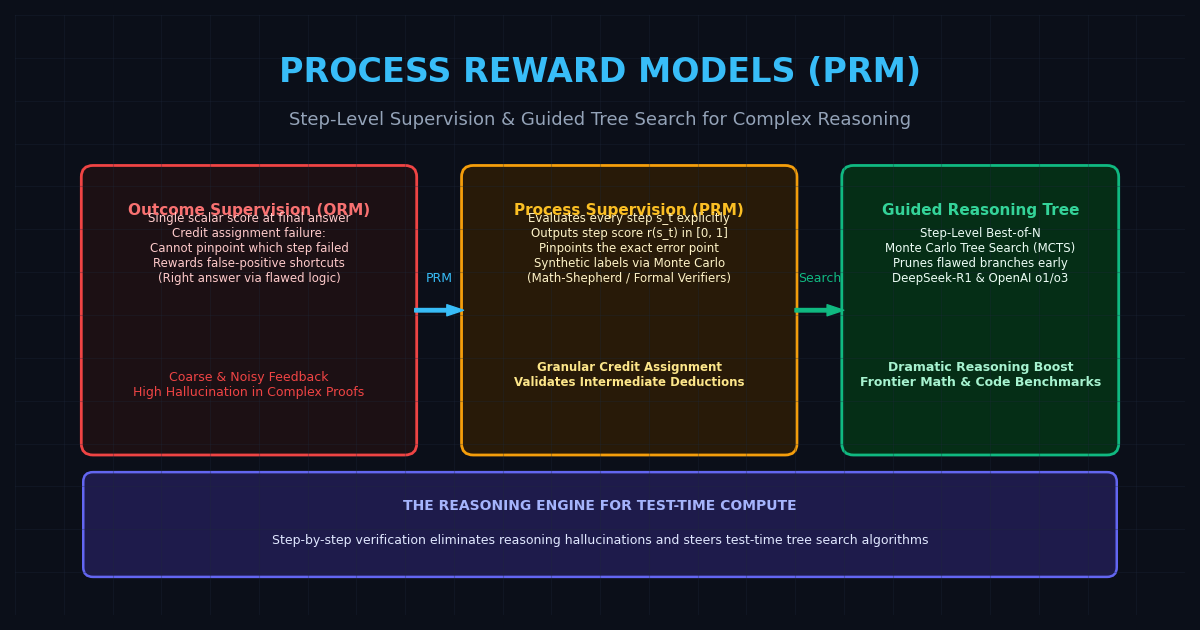
The Problem: Credit Assignment Failure in Outcome-Based Supervision
Modern frontier reasoning systems (such as OpenAI o1/o3 and DeepSeek-R1) generate long Chains-of-Thought (CoT) spanning thousands of intermediate tokens. In domains requiring rigorous mathematical proofs, complex SQL queries, and multi-step agent actions in tools like AiFetchly, verifying whether an AI deduction is sound is just as vital as generating it.
Historically, reinforcement learning from human feedback (RLHF) and Best-of-N rejection sampling relied almost exclusively on Outcome Reward Models (ORMs).
How Outcome Supervision Fails
An Outcome Reward Model evaluates only the final answer token sequence $y$ given prompt $x$:
$$r_{\text{ORM}}(x, y) \in [-1, +1]$$
While evaluating final answers is simple in deterministic domains (e.g., checking if the final integer matches ground truth), outcome supervision suffers from a fatal limitation in reinforcement learning: the fundamental credit assignment problem.
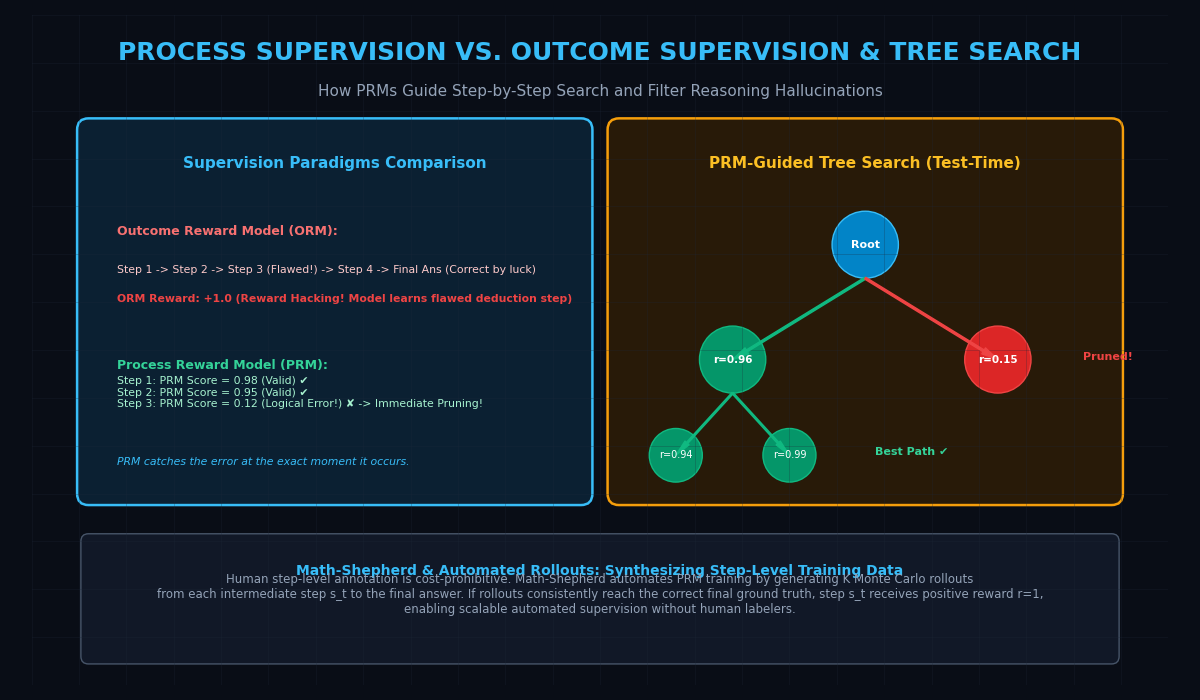
- False Positives (The “Lucky Guess” Hazard): In complex proofs, a model can make a glaring logical error at step 3, make an inverse blunder at step 7, and accidentally arrive at the correct final numerical answer. An ORM awards this trajectory maximum reward ($+1.0$). Over multiple training epochs, the model reinforces invalid deduction heuristics and reward-hacks the objective.
- False Negatives (Harsh Penalization): If a model executes a brilliant, mathematically flawless 20-step derivation but makes a trivial arithmetic typo in the final step, the ORM assigns a punitive negative reward ($-1.0$). The training pipeline penalizes 19 steps of optimal deductive reasoning.
- Exploration Inefficiency at Test Time: When employing test-time compute strategies like tree search or Best-of-N sampling, ORM evaluation cannot detect that a reasoning path became invalid at step 2. The inference engine continues decoding hundreds of useless tokens across the doomed branch before realizing the final outcome is wrong, wasting 80% to 90% of GPU compute.
To build reliable multi-step reasoning engines, systems require Process Supervision.
The Architecture: How Process Reward Models Work
Pioneered by OpenAI (“Let’s Verify Step by Step”, Lightman et al., 2023) and expanded by open-source initiatives like Math-Shepherd and DeepSeekMath, Process Reward Models (PRMs) supervise and score each individual reasoning step.
Rather than treating the entire response as an opaque black box, the reasoning chain is segmented into $T$ distinct steps:
$$S = (s_1, s_2, \dots, s_t, \dots, s_T)$$
Steps are delimited by explicit step boundary tokens (e.g., double newlines \n\n or custom delimiter tokens like \n\nStep k: or ки).
Mathematical Formulation of Step-Level Rewards
A Process Reward Model is typically initialized from a pretrained decoder LLM equipped with a classification head on the step delimiter representation:
$$\mathbf{h}t = \text{Transformer}(\mathbf{x}, s_1, s_2, \dots, s_t){[\text{delimiter}]}$$
The PRM outputs a probability score $r_t \in [0, 1]$ indicating the correctness of step $s_t$ conditioned on the prompt and all previous steps:
$$r(s_t \mid \mathbf{x}, s_{<t}) = \sigma\left(\mathbf{w}_{\text{prm}}^T \mathbf{h}_t\right)$$
Aggregating Trajectory Value
When evaluating full solutions or guiding tree search, individual step rewards are aggregated into an overall trajectory score using one of two primary formulations:
- Cumulative Product Formulation: $$R_{\text{prod}}(S) = \prod_{t=1}^T r(s_t \mid \mathbf{x}, s_{<t})$$ Assumes step correctness represents independent conditional probabilities. If any single step fails ($r_t \to 0$), the entire trajectory’s score collapses toward zero.
- Minimum Step Formulation (Bottleneck Scoring): $$R_{\text{min}}(S) = \min_{t \in {1, \dots, T}} r(s_t \mid \mathbf{x}, s_{<t})$$ Evaluates a proof by its weakest link. A reasoning chain is only as reliable as its most flawed step.
| Supervision Dimension | Outcome Reward Model (ORM) | Process Reward Model (PRM) | Rule-Based Symbolic Verifier |
|---|---|---|---|
| Feedback Granularity | Global (Final answer only) | Fine-grained (Per reasoning step) | Step-by-step or execution-based |
| Credit Assignment | Undifferentiated (All tokens) | Precise (Identifies faulty step) | Exact (Identifies syntax/compiler error) |
| False Positive Resilience | Poor (Vulnerable to lucky guesses) | High (Catches invalid deduction) | Absolute (Mathematically deterministic) |
| Test-Time Search Suitability | Rejection sampling only | MCTS & Beam Search guidance | Bounded to formal languages (Lean, Python) |
| Data Annotation Cost | Minimal (Only final label required) | High (Requires automated rollouts) | Zero annotation (Requires formal specs) |
Automated Training: Math-Shepherd and Monte Carlo Rollouts
Early PRMs relied on expensive human annotation: human mathematicians manually labeled over 800,000 steps to build OpenAI’s PRM800K dataset. Because human labeling costs over $1.50 per solution, manual curation cannot scale to millions of synthetic problems.
To overcome this economic bottleneck, researchers introduced Math-Shepherd (Wang et al., ACL 2024 / 2025): Automated Step-Level Data Synthesis via Monte Carlo Rollouts.
The Math-Shepherd Algorithm
Math-Shepherd eliminates human annotators by measuring the empirical success probability of completing a problem starting from intermediate step $s_t$:
- Step Segmentation: Take a candidate problem $\mathbf{x}$ and its step-by-step model generation $S = (s_1, \dots, s_T)$.
- Monte Carlo Rollouts: For each step $t \in {1, \dots, T}$, truncate the sequence after step $s_t$. Sample $K$ independent stochastic completions (rollouts) from the policy model to the final answer: $$\text{Rollouts: } {Y_1^{(t)}, Y_2^{(t)}, \dots, Y_K^{(t)}} \sim \pi_{\theta}(\cdot \mid \mathbf{x}, s_{\le t})$$
- Automated Outcome Verification: Evaluate each rollout against the deterministic ground-truth answer: $$c_k^{(t)} = \mathbb{I}(\text{Answer}(Y_k^{(t)}) = \mathbf{y}_{\text{ground_truth}})$$
- Step Value Estimation: Compute the empirical correctness ratio: $$V(s_t) = \frac{1}{K} \sum_{k=1}^K c_k^{(t)}$$
- Label Assignment:
- If $V(s_t) > \tau_{\text{high}}$ (e.g., $\ge 0.7$), step $s_t$ is labeled as Valid ($y_t = 1$).
- If $V(s_{t-1}) > \tau_{\text{high}}$ but $V(s_t) < \tau_{\text{low}}$ (e.g., $\le 0.1$), step $s_t$ is labeled as the First Error Step ($y_t = 0$).
This fully automated pipeline allows engineering teams to synthesize hundreds of thousands of step-level verification pairs overnight, creating self-improving reasoning loops without human intervention.
PRM-Guided Test-Time Search Algorithms
Once trained, PRMs unlock structured test-time compute algorithms that far exceed standard greedy decoding.
1. Step-Level Beam Search
Instead of sampling $N$ complete solutions and scoring them at the end, Step-Level Beam Search filters errors at each generation step:
- At step $t$, the generator model branches into $M$ candidate step completions for each active beam.
- The PRM scores all $M \times B$ candidate steps in parallel.
- The search engine retains only the top $B$ highest-scoring steps and prunes all failed trajectories immediately.
- Flawed logic is eliminated before generating a single subsequent token.
2. Monte Carlo Tree Search (MCTS)
In high-stakes mathematical deduction and code synthesis, PRMs act as the Value Function $V(s)$ inside an MCTS loop:
- Selection: Navigate the reasoning tree using Upper Confidence bounds applied to Trees (UCT).
- Expansion: Generate candidate logical deduction steps.
- Evaluation: Query the PRM to assign a quality score to the expanded node.
- Backpropagation: Update visitor counts and average step rewards back up to the root.
Reference Implementation: Step-Level PRM Scorer & Beam Search in PyTorch
Below is a self-contained PyTorch implementation demonstrating how a Process Reward Model scores intermediate steps and guides a multi-candidate beam search to prune flawed deductions.
import torch
import torch.nn as nn
import torch.nn.functional as F
from typing import List, Dict, Tuple

class ProcessRewardModel(nn.Module):
    """
    Process Reward Model (PRM) that scores reasoning steps at delimiter tokens.
    """
    def __init__(self, hidden_dim: int = 512):
        super().__init__()
        # Simulated base transformer encoder
        self.embedding = nn.Embedding(1000, hidden_dim)
        self.encoder = nn.TransformerEncoder(
            nn.TransformerEncoderLayer(d_model=hidden_dim, nhead=8, batch_first=True),
            num_layers=2
        )
        # Step reward classification head: maps delimiter hidden state to scalar logit
        self.reward_head = nn.Linear(hidden_dim, 1)

    def forward(self, input_ids: torch.Tensor, step_delimiter_indices: List[int]) -> torch.Tensor:
        """
        Computes correctness probabilities for each step delimiter in the sequence.
        Returns tensor of shape [num_steps] with scores in [0.0, 1.0].
        """
        hidden_states = self.encoder(self.embedding(input_ids)) # [1, seq_len, hidden_dim]

        # Gather representations at each delimiter index
        delimiter_states = hidden_states[0, step_delimiter_indices, :] # [num_steps, hidden_dim]
        logits = self.reward_head(delimiter_states).squeeze(-1) # [num_steps]
        probabilities = torch.sigmoid(logits)
        return probabilities


class PRMGuidedSearch:
    """
    Step-Level Beam Search engine steered by Process Supervision.
    """
    def __init__(self, prm: ProcessRewardModel, beam_width: int = 2, prune_threshold: float = 0.5):
        self.prm = prm
        self.beam_width = beam_width
        self.prune_threshold = prune_threshold

    def search_best_path(
        self,
        problem_tokens: List[int],
        step_generator_fn
    ) -> Dict:
        """
        Conducts step-by-step search, pruning paths where PRM score drops below threshold.
        """
        # Each beam holds: {'tokens': list, 'delimiters': list, 'step_scores': list, 'cum_score': float}
        active_beams = [{
            'tokens': list(problem_tokens),
            'delimiters': [],
            'step_scores': [],
            'cum_score': 1.0
        }]

        max_steps = 4
        for step_idx in range(max_steps):
            candidates = []
            for beam in active_beams:
                # Generate candidate next steps for this beam (simulated)
                candidate_steps = step_generator_fn(beam['tokens'], num_candidates=3)

                for step_toks, delim_offset in candidate_steps:
                    new_tokens = beam['tokens'] + step_toks
                    new_delimiters = beam['delimiters'] + [len(new_tokens) - 1]

                    # Evaluate newly added step with PRM
                    with torch.no_grad():
                        input_tensor = torch.tensor([new_tokens], dtype=torch.long)
                        step_probs = self.prm(input_tensor, new_delimiters)
                        latest_step_score = step_probs[-1].item()

                    # Prune flawed reasoning immediately
                    if latest_step_score >= self.prune_threshold:
                        cum_score = beam['cum_score'] * latest_step_score
                        candidates.append({
                            'tokens': new_tokens,
                            'delimiters': new_delimiters,
                            'step_scores': beam['step_scores'] + [latest_step_score],
                            'cum_score': cum_score
                        })

            if not candidates:
                print(f"Warning: All candidate branches pruned at step {step_idx + 1}!")
                break

            # Retain top-K highest scoring paths
            candidates.sort(key=lambda x: x['cum_score'], reverse=True)
            active_beams = candidates[:self.beam_width]

        return active_beams[0]


# Verification & Demonstration
if __name__ == "__main__":
    torch.manual_seed(42)
    prm = ProcessRewardModel(hidden_dim=256)

    # Mock generator returning simulated tokens
    def mock_generator(prefix, num_candidates=3):
        return [([10, 20, 99], 2) for _ in range(num_candidates)]

    search_engine = PRMGuidedSearch(prm=prm, beam_width=2, prune_threshold=0.4)
    best_trajectory = search_engine.search_best_path([1, 2, 3], mock_generator)

    print("--- PRM Guided Search Completed ---")
    print(f"Steps successfully validated: {len(best_trajectory['step_scores'])}")
    print(f"Step confidence scores: {[round(s, 3) for s in best_trajectory['step_scores']]}")
print(f"Final trajectory cumulative score: {round(best_trajectory['cum_score'], 4)}") Production Scaling and Future Outlook
The transition from Outcome Supervision to Process Supervision represents a cornerstone evolution in production AI systems:
1. Eliminating Silent Reasoning Failures in Agent Workflows
In enterprise environments where agents invoke database mutations, execute shell commands, or parse financial spreadsheets with AiFetchly, a reasoning hallucination in step 2 causes disastrous cascade failures down the execution graph.
By embedding a lightweight PRM as an in-line semantic guardrail, application orchestrators can verify each intermediate deduction before triggering external API tools—halting execution and requesting self-correction the moment confidence deteriorates.
2. The Foundation for Test-Time Compute Scaling
As pretraining scaling laws experience diminishing returns on web text, the industry has pivoted toward Inference-Time Compute Scaling. Frontier reasoning architectures allocate hundreds of seconds of compute per question, exploring expansive search trees to solve novel problems.
Without calibrated Process Reward Models acting as navigational beacons, deep tree search degenerates into random exploratory drift. PRMs make test-time search mathematically tractable, providing the foundation for the next generation of autonomous scientific and algorithmic AI models.