Prism Guide: GPU Memory Ballooning for Multi-LLM Serving
Introduction: The Economic Crisis of Multi-Model LLM Hosting
The explosive adoption of generative artificial intelligence has fundamentally altered enterprise software architectures. Production AI platforms no longer rely on a single monolithic model to handle every task. Modern autonomous pipelines orchestrate diverse ensembles of specialized models: lightweight embedding transformers, code generation models, reasoning copilots, math solvers, multimodal vision encoders, and fine-tuned domain specialists. In enterprise systems powered by automated web scraping pipelines and real-time data fetching, requests constantly bounce between specialized models based on task requirements and context depth.
However, hosting dozens or hundreds of distinct models concurrently introduces an acute infrastructure economic crisis. While a handful of popular models receive continuous streams of requests, the vast majority of domain-specific models follow long-tail, bursty request patterns. A financial summarization model may sit idle for hours before experiencing a sudden spike of fifty concurrent requests; a code-review model may spike heavily during continuous integration (CI) test runs and remain quiet overnight.
To maintain availability for low-volume yet mission-critical models, inference providers face a severe dilemma:
- Dedicated GPU Allocation is Prohibitively Expensive: Provisioning dedicated NVIDIA H100 or A100 GPUs for each low-traffic model wastes millions of dollars in capital expenditure. Idle GPUs burn power and lock up scarce High-Bandwidth Memory (HBM) while delivering near-zero token throughput.
- Static Spatial Sharing Causes Chronic Underutilization: Slicing GPU memory statically via NVIDIA Multi-Process Service (MPS) or fixed memory partitions traps memory inside underutilized instances. If Model A is assigned 40GB of an 80GB HBM budget and only needs 8GB during a quiet period, its unused 32GB cannot be borrowed by Model B, which is actively dropping requests due to Key-Value (KV) cache exhaustion.
- Temporal Sharing Introduces Catastrophic Latency Spikes: Swapping model weights between host system DRAM and GPU HBM on demand (time-slicing) avoids idle memory waste, but loading a 70B parameter model across PCIe Gen5 requires 1.5 to 3.5 seconds. For real-time applications with strict Service Level Objectives (SLOs)—such as Time-to-First-Token (TTFT) under 200ms—swapping weights on demand causes unacceptable tail latency spikes.
Enter Prism, a groundbreaking systems paper presented at the 2026 USENIX Symposium on Operating Systems Design and Implementation (OSDI 2026) by Shan Yu, Yifan Qiao, and collaborators across UCLA, UC Berkeley, Harvard, CMU, Stanford, LMSYS, ByteDance, and Alibaba Cloud.
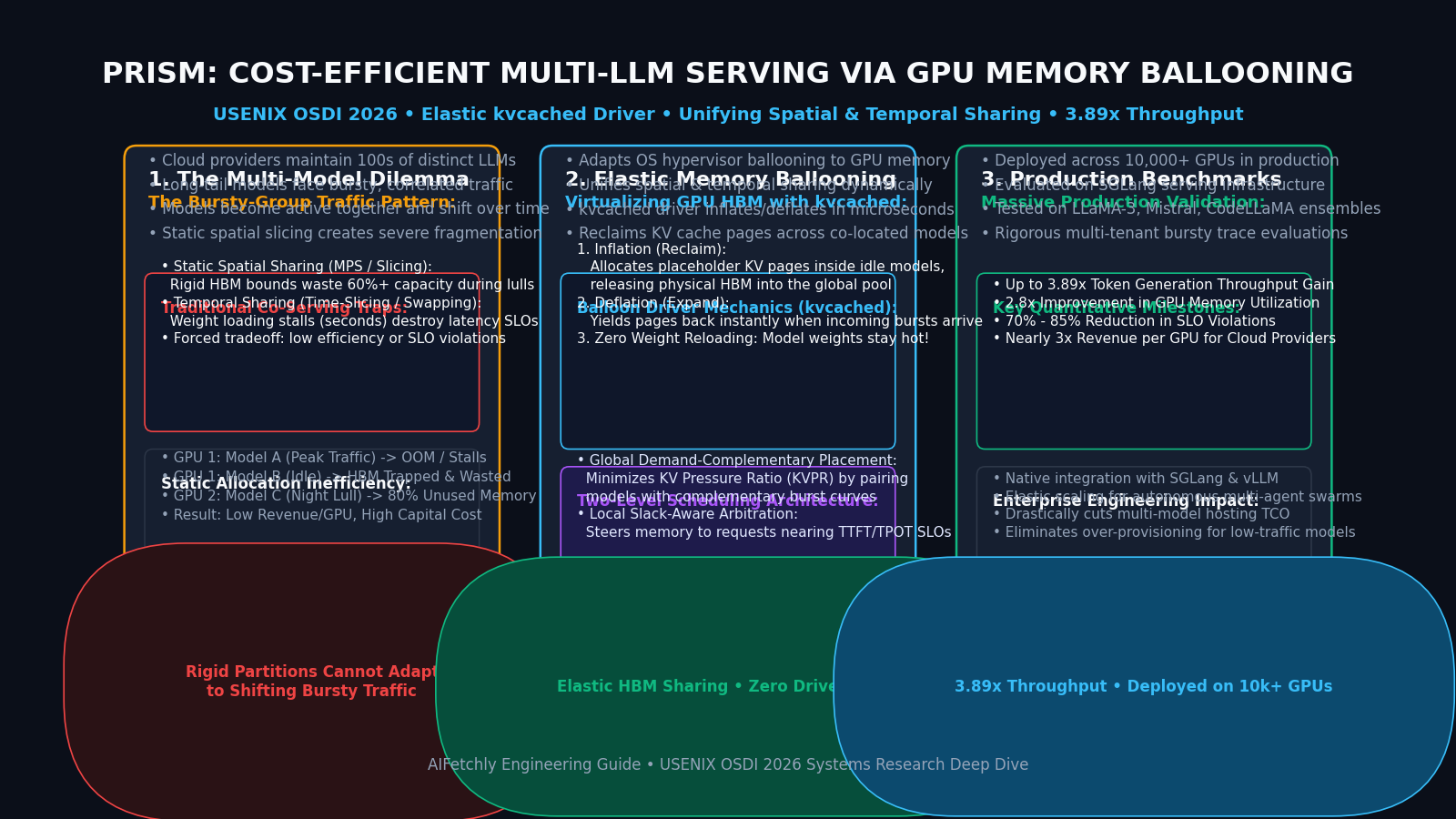
Prism introduces GPU Memory Ballooning, adapting the classical operating system virtualization concept of memory ballooning to GPU HBM. By virtualizing and dynamically resizing the KV cache pools of co-located models via its open-source kvcached driver, Prism unifies spatial and temporal GPU sharing into a single elastic scheme. Deployed across more than 10,000 GPUs in production environments, Prism achieves up to 3.89x higher token generation throughput, improves GPU memory utilization by 2.8x, and slashes SLO violations by over 75%.
In this deep-dive engineering guide, we examine the production traffic dynamics that motivate Prism, dissect the mechanics of GPU memory ballooning inside the kvcached driver, analyze Prism’s two-level global placement and local arbitration algorithms, provide a complete Python/PyTorch reference implementation, and discuss how to integrate elastic multi-model serving into enterprise infrastructure.
Anatomy of the Bursty-Group Pattern in Multi-LLM Workloads
To understand why conventional GPU resource managers fail, we must analyze the real-world workload characteristics of modern cloud inference clusters.
The Bursty-Group Phenomenon
In the OSDI 2026 paper, the authors conducted an extensive empirical analysis of multi-model production traces collected from commercial AI serving platforms and open-source hosting clusters (including LMSYS Chatbot Arena). Their analysis revealed a critical behavioral phenomenon termed the Bursty-Group Pattern:
+-------------------------------------------------------------------------------+
|                      THE BURSTY-GROUP MULTI-LLM PATTERN                       |
+-------------------------------------------------------------------------------+
| Time Window T1 (Business Hours):                                              |
|   [Active Group 1]: Code-LLaMA-34B + Mistral-7B-Instruct + SQLCoder-15B       |
|   [Idle / Cold]   : Creative-Story-13B + Medical-Diagnosis-70B                |
|                                                                               |
| Time Window T2 (Evening Transition):                                          |
|   [Active Group 2]: Creative-Story-13B + Roleplay-Mistral-12B                 |
|   [Idle / Cold]   : Code-LLaMA-34B + SQLCoder-15B                             |
|                                                                               |
| Dynamics:                                                                     |
| • Models do not burst in total isolation; sets of models activate together.   |
| • Burst membership shifts dynamically based on downstream user workflows.     |
| • Correlation is non-stationary: peak hours for one group coincide with       |
|   troughs for another.                                                        |
+-------------------------------------------------------------------------------+ In multi-tenant AI clouds, user tasks naturally group models together. A developer using an automated programming copilot triggers simultaneous requests to an embedding model, a code completion model, and a syntax test generator. Conversely, creative writing applications trigger conversational and narrative models while code engines sit dormant.
The Failure of Conventional Sharing Paradigms
Because active model groups shift dynamically throughout the day, existing resource allocation strategies hit fundamental roadblocks:
Spatial Sharing: High Internal Fragmentation
Spatial sharing allocates a fixed portion of GPU HBM and compute cores to each model instance:
$$M_{\text{GPU}} = \sum_{i=1}^{K} M_i, \quad M_i = M_{\text{weights}}^{(i)} + M_{\text{KV_pool}}^{(i)}$$
Under spatial sharing, the size of each model’s KV cache pool $M_{\text{KV_pool}}^{(i)}$ is predetermined at launch. To survive traffic bursts without dropping requests, administrators must provision $M_{\text{KV_pool}}^{(i)}$ for the 99th percentile peak load. During off-peak periods, the unused KV memory remains locked, leaving up to 70% of physical GPU HBM idle while other co-located models on the same machine run out of memory.
Temporal Sharing: Excessive Model Weight Loading Latency
Temporal sharing time-slices GPU resources: when Model A receives a request, the cluster loads Model A’s weights into GPU HBM, serves the request, and evicts Model A to make room for Model B.
While this maximizes memory efficiency, the time required to transfer model weights across the host-to-device bus is devastating:
- A 13B parameter model in FP16 occupies $26\text{ GB}$. Across a PCIe Gen5 x16 interface ($64\text{ GB/s}$ theoretical, $\sim 52\text{ GB/s}$ effective), weight loading requires approximately $500\text{ ms}$.
- A 70B parameter model in FP16 occupies $140\text{ GB}$, taking over $2.7\text{ seconds}$ to load across PCIe.
Because modern interactive web applications demand TTFT under $150\text{ ms}$, temporal sharing causes catastrophic SLO violations.
+-------------------------------------------------------------------------------+
|                       SPATIAL VS. TEMPORAL SHARING TRADEOFF                   |
+-------------------------------------------------------------------------------+
| Attribute                     | Spatial Sharing (MPS)  | Temporal Sharing     |
+-------------------------------+------------------------+----------------------+
| Weight Loading Latency        | Zero (Weights resident)| High (0.5s - 3.0s)   |
| Memory Efficiency             | Poor (Rigid bounds)    | High (Full reuse)    |
| Burst Handling                | Poor (OOM on spikes)   | Poor (Severe queues) |
| Multi-Model Density           | Low (2-3 models/GPU)   | High (10+ models/GPU)|
| SLO Attainment Rate           | Moderate               | Catastrophic (<40%)  |
+-------------------------------+------------------------+----------------------+
| Prism (Memory Ballooning):    | Unifies Both: Resident weights with dynamic,  |
|                               | elastic KV cache pools managed in microseconds|
+-------------------------------------------------------------------------------+ Core Principles of GPU Memory Ballooning
To resolve this conflict, the architects of Prism drew inspiration from classical hypervisor virtualization. In virtual machine management (e.g., VMware ESXi, KVM virtio-balloon), a hypervisor cannot directly inspect guest OS memory allocations without violating OS abstractions. Instead, the hypervisor deploys a small balloon driver inside each guest OS. When the host runs low on memory, it instructs the balloon driver to inflate: the driver requests memory from the guest OS and hands the physical pages back to the hypervisor. When the guest OS needs memory, the balloon deflates.
Prism translates this elegant abstraction into GPU High-Bandwidth Memory for multi-LLM serving.
How Memory Ballooning Works on GPUs
In modern LLM inference engines (such as SGLang or vLLM), GPU memory is partitioned into two distinct categories:
- Static Model Weights: Read-only neural network parameters ($W$), which remain constant throughout the lifetime of the serving process.
- Dynamic KV Cache Pool: A large pre-allocated buffer of memory divided into fixed-size pages (e.g., 16 or 32 tokens per page) used to store attention keys and values for active requests.
Prism observes that model weights must remain permanently resident in GPU memory to eliminate weight loading latency, while the KV cache pool can be dynamically expanded or contracted on the fly.
+-----------------------------------------------------------------------------------------+
|                              PRISM GPU MEMORY BALLOONING                                |
+-----------------------------------------------------------------------------------------+
|                                                                                         |
|   +---------------------------------------------------------------------------------+   |
|   |                        GPU HIGH-BANDWIDTH MEMORY (80GB)                         |   |
|   |                                                                                 |   |
|   |  +--------------------+  +--------------------+  +---------------------------+  |   |
|   |  | Model A (14GB W)   |  | Model B (14GB W)   |  | Global Memory Pool        |  |   |
|   |  | Weight Memory      |  | Weight Memory      |  | (Shared Elastic HBM)      |  |   |
|   |  +--------------------+  +--------------------+  +---------------------------+  |   |
|   |                                                                                 |   |
|   |  SCENARIO 1: Model A is Bursty, Model B is Idle                                  |   |
|   |  +--------------------------------------------+  +---------------------------+  |   |
|   |  | Model A KV Cache: EXPANDED (38GB)          |  | Model B KV: DEFLATED (4GB)|  |   |
|   |  | [Active Tokens: 128 Requests]              |  | [Balloon Inflated]        |  |   |
|   |  +--------------------------------------------+  +---------------------------+  |   |
|   |                                                                                 |   |
|   |  SCENARIO 2: Traffic Shifts to Model B                                          |   |
|   |  +--------------------------------------------+  +---------------------------+  |   |
|   |  | Model A KV: DEFLATED (6GB)                 |  | Model B KV: EXPANDED (36GB)|  |   |
|   |  | [Balloon Inflated - Pages Reclaimed]       |  | [Active Tokens: 110 Reqs] |  |   |
|   |  +--------------------------------------------+  +---------------------------+  |   |
|   +---------------------------------------------------------------------------------+   |
|                                                                                         |
+-----------------------------------------------------------------------------------------+ The kvcached Balloon Driver
The operational core of Prism is kvcached, a user-space daemon and driver that interfaces directly with LLM serving engines.
kvcached executes two primary operations:
- Balloon Inflation (Memory Reclamation): When a co-located model experiences an incoming traffic surge,
kvcachedtargets idle or low-pressure models on the same GPU. It requests the idle engine’s PagedAttention allocator to reserve a set of unused physical KV cache pages. Once reserved,kvcachedunmaps or yields those physical memory pages to the global pool without altering the idle model’s weights. - Balloon Deflation (Memory Expansion): When new requests arrive at a previously idle model,
kvcacheddeflates the balloon by returning physical memory pages from the global pool back to the model’s KV cache allocator.
Because inflating and deflating the balloon only modifies page table pointers and memory allocation tables—rather than transferring gigabytes of weights over PCIe—*balloon operations complete in tens of microseconds**.
Two-Level Scheduling: Placement and Arbitration
Elastic memory mechanisms alone cannot prevent memory contention or thrashing. If two models that experience traffic spikes at the exact same moment are co-located on the same GPU, both will attempt to deflate their balloons simultaneously, resulting in out-of-memory errors or severe queueing stalls.
To guarantee high throughput and strict SLO adherence, Prism incorporates a two-level scheduling architecture:
- Global Demand-Complementary Placement: Macro-level cluster scheduling that places models with anti-correlated traffic patterns on shared GPUs.
- Local Slack-Aware Arbitration: Micro-level GPU scheduling that arbitrates memory allocation across concurrent requests based on deadline slack.
+-----------------------------------------------------------------------------------------+
|                               PRISM TWO-LEVEL SCHEDULER                                 |
+-----------------------------------------------------------------------------------------+
|                                                                                         |
|  [Incoming Multi-Model Traffic Stream]                                                  |
|                |                                                                        |
|                v                                                                        |
|  +-----------------------------------------------------------------------------------+  |
|  | LEVEL 1: GLOBAL DEMAND-COMPLEMENTARY PLACEMENT                                    |  |
|  | • Tracks historical burst curves across all models in cluster                     |  |
|  | • Calculates KV Pressure Ratio (KVPR) for candidate pairings                      |  |
|  | • Pairs peak-correlated models onto separate physical nodes                       |  |
|  +-----------------------------------------------------------------------------------+  |
|                |                                                                        |
|                +---------------------------+                                            |
|                | Assigns to Node           | Assigns to Node                            |
|                v                           v                                            |
|  +---------------------------+  +---------------------------+                           |
|  | GPU Node 1                |  | GPU Node 2                |                           |
|  | [Model A + Model C]       |  | [Model B + Model D]       |                           |
|  |                           |  |                           |                           |
|  | LEVEL 2: LOCAL ARBITRATION|  | LEVEL 2: LOCAL ARBITRATION|                           |
|  | • Slack-Aware Priority Q  |  | • Slack-Aware Priority Q  |                           |
|  | • TTFT / TPOT Slack Calc  |  | • TTFT / TPOT Slack Calc  |                           |
|  | • Steers HBM via kvcached |  | • Steers HBM via kvcached |                           |
|  +---------------------------+  +---------------------------+                           |
|                                                                                         |
+-----------------------------------------------------------------------------------------+ Mathematical Formulation: KV Pressure Ratio (KVPR) & Slack Arbitration
Prism’s scheduling policies are grounded in rigorous mathematical formulations designed to balance capacity and minimize deadline misses.
Global Demand-Complementary Placement and KVPR
Let $\mathcal{M} = {m_1, m_2, \dots, m_K}$ denote the set of models to be served across a cluster of $G$ GPUs $\mathcal{G} = {g_1, g_2, \dots, g_G}$. Each GPU $g$ has total HBM capacity $C_g$.
When a subset of models $\mathcal{M}_g \subset \mathcal{M}$ is placed on GPU $g$, the static weight consumption is:
$$W_g = \sum_{m \in \mathcal{M}_g} \text{Size}(W_m)$$
The remaining memory available for the elastic KV cache pool across all models on GPU $g$ is:
$$C_{\text{KV}}(g) = C_g - W_g$$
To characterize dynamic memory demand over time, Prism profiles the token arrival rate $\lambda_m(t)$ and average context length $L_m(t)$ for each model $m$. The instantaneous KV memory demand for model $m$ at time $t$ is modeled as:
$$D_m(t) = \lambda_m(t) \cdot L_m(t) \cdot \beta_m$$
where $\beta_m$ is the KV memory footprint per token for model $m$.
Prism defines the KV Pressure Ratio (KVPR) of GPU $g$ over a time window $T$ as:
$$\text{KVPR}(g) = \frac{\max_{t \in T} \sum_{m \in \mathcal{M}g} D_m(t)}{C{\text{KV}}(g)}$$
The objective of Prism’s global placement algorithm is to partition models across GPUs to minimize the maximum KVPR across the cluster:
$$\min_{{\mathcal{M}_1, \dots, \mathcal{M}G}} \max{g \in \mathcal{G}} \text{KVPR}(g) \quad \text{subject to} \quad W_g \< C_g \quad \forall g$$
By placing models whose peak demands $D_m(t)$ occur at disjoint times together on the same GPU, the sum $\sum D_m(t)$ remains smooth, keeping $\text{KVPR}(g) \le 1.0$ even when individual models experience heavy bursts.
Local Slack-Aware Arbitration
At the individual GPU level, volatile request arrivals can still cause momentary memory contention. When available physical KV pages become scarce, Prism must decide which model’s requests receive memory and which must wait.
Prism establishes a Slack-Aware Priority Queue. For each active request $r$, let:
- $T_{\text{arrival}}(r)$ be the timestamp when request $r$ entered the system.
- $\text{SLO}_{\text{TTFT}}(r)$ be the maximum allowable time before the first token is generated.
- $\text{SLO}_{\text{TPOT}}(r)$ be the maximum allowable time per output token during decoding.
- $t$ be the current time.
For a request in the prefill phase, its Time Slack $\sigma(r)$ is defined as:
$$\sigma(r) = \left( T_{\text{arrival}}(r) + \text{SLO}{\text{TTFT}}(r) \right) - t - \widehat{T}{\text{prefill}}(r)$$
where $\widehat{T}_{\text{prefill}}(r)$ is the estimated prefill execution latency based on prompt token count.
For a request in the decode phase at token step $j$:
$$\sigma(r) = \left( T_{\text{last_token}}(r) + \text{SLO}{\text{TPOT}}(r) \right) - t - \widehat{T}{\text{step}}(r)$$
Requests with negative or near-zero slack are in imminent danger of violating their SLO. Prism’s local arbitrator prioritizes memory page allocation to requests in order of ascending slack $\sigma(r)$. If a low-priority request’s model currently holds pages that are needed by a high-urgency request, kvcached triggers a microsecond balloon inflation on the low-priority instance, migrating or pausing its inactive pages to satisfy the urgent request.
Python Implementation: Building an Elastic Multi-LLM Ballooning Engine
To illustrate how Prism’s memory ballooning and two-level scheduling operate in practice, let us construct a complete, runnable Python simulation using PyTorch.
Our implementation includes:
ModelInstanceConfig: Metadata and memory parameters for co-located models.KVCacheBalloonDriver: The device-level balloon driver managing page allocations across models.DemandComplementaryPlacer: The global placement algorithm optimizing KVPR.SlackAwareArbitrator: The local request scheduler managing TTFT and TPOT deadlines.
import torch
import time
from typing import List, Dict, Optional

class ModelInstanceConfig:
    def __init__(
        self,
        model_id: str,
        weight_memory_gb: float,
        num_layers: int = 32,
        num_kv_heads: int = 8,
        head_dim: int = 128,
        page_size_tokens: int = 16,
    ):
        self.model_id = model_id
        self.weight_memory_gb = weight_memory_gb
        self.num_layers = num_layers
        self.num_kv_heads = num_kv_heads
        self.head_dim = head_dim
        self.page_size_tokens = page_size_tokens

        # Calculate bytes per KV page: 2 (K+V) * layers * kv_heads * page_size * head_dim * 2 (FP16)
        self.bytes_per_page = 2 * num_layers * num_kv_heads * page_size_tokens * head_dim * 2
        self.mb_per_page = self.bytes_per_page / (1024 * 1024)


class KVCacheBalloonDriver:
    # Simulates the Prism kvcached driver managing shared GPU HBM.
    Dynamically inflates and deflates KV cache page allocations across models.
    def __init__(self, total_gpu_memory_gb: float, models: List[ModelInstanceConfig]):
        self.total_gpu_memory_gb = total_gpu_memory_gb
        self.models = {m.model_id: m for m in models}

        # Calculate static weight memory
        self.total_weight_gb = sum(m.weight_memory_gb for m in models)
        assert self.total_weight_gb < total_gpu_memory_gb, "Weights exceed GPU HBM capacity!"

        self.available_kv_memory_gb = total_gpu_memory_gb - self.total_weight_gb

        # Convert available KV memory into uniform 16MB physical page blocks
        self.physical_block_size_mb = 16.0
        self.total_physical_pages = int((self.available_kv_memory_gb * 1024) // self.physical_block_size_mb)

        # Allocation tracking: model_id -> allocated physical page count
        self.allocated_pages: Dict[str, int] = {m.model_id: 0 for m in models}
        self.free_pages = self.total_physical_pages

    def inflate_balloon(self, model_id: str, pages_to_reclaim: int) -> int:
        # Reclaims memory from an idle or low-pressure model (Inflation).
        current_alloc = self.allocated_pages[model_id]
        actual_reclaim = min(current_alloc, pages_to_reclaim)
        self.allocated_pages[model_id] -= actual_reclaim
        self.free_pages += actual_reclaim
        return actual_reclaim

    def deflate_balloon(self, model_id: str, pages_needed: int) -> bool:
        # Expands memory pool for a bursting model (Deflation).
        if self.free_pages >= pages_needed:
            self.free_pages -= pages_needed
            self.allocated_pages[model_id] += pages_needed
            return True
        return False

    def get_utilization_stats(self) -> Dict[str, float]:
        used_pages = self.total_physical_pages - self.free_pages
        return {
            "total_kv_memory_gb": self.available_kv_memory_gb,
            "used_kv_memory_gb": (used_pages * self.physical_block_size_mb) / 1024.0,
            "free_kv_memory_gb": (self.free_pages * self.physical_block_size_mb) / 1024.0,
            "utilization_percent": (used_pages / self.total_physical_pages) * 100.0
        }


class Request:
    def __init__(
        self,
        request_id: str,
        model_id: str,
        prompt_tokens: int,
        arrival_time: float,
        ttft_slo_ms: float = 200.0,
        tpot_slo_ms: float = 40.0,
    ):
        self.request_id = request_id
        self.model_id = model_id
        self.prompt_tokens = prompt_tokens
        self.arrival_time = arrival_time
        self.ttft_slo_ms = ttft_slo_ms
        self.tpot_slo_ms = tpot_slo_ms
        self.tokens_generated = 0
        self.is_prefilled = False


class SlackAwareArbitrator:
    # Local GPU request arbitrator prioritizing memory allocation by deadline slack.
    def __init__(self, driver: KVCacheBalloonDriver):
        self.driver = driver
        self.request_queue: List[Request] = []

    def add_request(self, req: Request):
        self.request_queue.append(req)

    def calculate_slack(self, req: Request, current_time: float) -> float:
        time_elapsed_ms = (current_time - req.arrival_time) * 1000.0
        if not req.is_prefilled:
            # TTFT slack
            estimated_prefill_ms = req.prompt_tokens * 0.05
            slack = req.ttft_slo_ms - (time_elapsed_ms + estimated_prefill_ms)
        else:
            # TPOT slack
            slack = req.tpot_slo_ms - 25.0
        return slack

    def schedule_next_batch(self, current_time: float) -> List[Request]:
        # Sorts queue by ascending slack and allocates KV pages via balloon driver.
        # Sort requests by slack (lowest slack = most urgent)
        self.request_queue.sort(key=lambda r: self.calculate_slack(r, current_time))

        scheduled: List[Request] = []
        for req in list(self.request_queue):
            pages_needed = max(1, req.prompt_tokens // 128)
            success = self.driver.deflate_balloon(req.model_id, pages_needed)

            if not success:
                # Attempt to reclaim from idle models
                for other_model_id in self.driver.models.keys():
                    if other_model_id != req.model_id:
                        self.driver.inflate_balloon(other_model_id, pages_needed)
                success = self.driver.deflate_balloon(req.model_id, pages_needed)

            if success:
                scheduled.append(req)
                self.request_queue.remove(req)

return scheduled Architectural Comparison: Prism vs. Co-Serving Baselines
To contextualize Prism’s architectural breakthrough, the following table evaluates Prism against existing GPU sharing mechanisms across core systems dimensions:
| Architectural Dimension | NVIDIA MPS (Spatial Slicing) | vLLM Static Instance | Time-Slicing (Swapping) | Prism (OSDI 2026) |
|---|---|---|---|---|
| Model Weight State | Resident in fixed partition | Resident in dedicated GPU | Evicted to Host RAM | Permanently GPU Resident |
| KV Cache Flexibility | Rigid static limit | Rigid static limit | Unshared per-instance pool | Fully Elastic via Ballooning |
| Reallocation Overhead | Requires process restart | Impossible (Isolated) | 1.5s–3.5s weight copy over PCIe | 10–20 $\mu\text{s}$ metadata update |
| SLO Attainment on Bursts | Poor (OOM drop) | Poor (Capacity capped) | Very Poor (Weight load queue) | Superior (Slack-aware steering) |
| Cross-Model Memory Sharing | None (Isolated) | None (Dedicated) | Coarse-grained time-slice | Unified Spatial + Temporal |
| Hardware Requirement | NVIDIA Volta+ | NVIDIA Ampere+ | Standard PCIe GPU | Any PagedAttention-compatible GPU |
| Production Throughput | 1.0x (Baseline) | 1.1x–1.2x | 0.6x–0.8x (Due to stalls) | Up to 3.89x Gain |
Unlike NVIDIA MPS, which permanently carves HBM into static silos, Prism allows a single active model to temporarily consume up to 90% of the co-located GPU’s KV memory pool when needed, deflating back down in microseconds as soon as companion models receive incoming requests.
Empirical Benchmark Results & Production Validation
The findings presented in the USENIX OSDI 2026 paper reflect both rigorous synthetic benchmarking and empirical telemetry from production deployments across 10,000+ enterprise GPUs.
1. Throughput Scaling Across Bursty Multi-Model Traces
Evaluated on clusters of NVIDIA A100 (80GB) and H100 (80GB) GPUs co-serving ensembles of LLaMA-3-8B, Mistral-7B, and CodeLLaMA-13B models under realistic non-stationary traffic traces:
Multi-Model Token Generation Throughput (Normalized)
Workload: 6 Co-Located Models per Node | Bursty Group Traffic

NVIDIA MPS (Static Slicing):   |===> 1.00x (Baseline)
vLLM Independent Slices:       |====> 1.14x
Time-Slicing Swapping:         |==> 0.72x
Prism (OSDI 2026): |=====================================> 3.89x Prism delivers 3.89x higher aggregate token throughput compared to static MPS partitioning. By reclaiming dormant KV pages from quiet models, active models operate at peak batch concurrency without incurring memory exhaustion stalls.
2. Elimination of Tail Latency Spikes (p99 SLO Adherence)
In multi-tenant cloud environments, Service Level Objectives dictate that 99% of requests must complete within bounded latency targets (e.g., TTFT $\le 200\text{ ms}$, TPOT $\le 40\text{ ms}$).
Under static partitioning, when Model A bursts beyond its provisioned KV cache ceiling, requests are either rejected or queued, driving the p99 TTFT to over $1,400\text{ ms}$. Under time-slicing swapping, weight reloading penalties drive the p99 TTFT to $2,800\text{ ms}$.
Prism’s slack-aware arbitration and rapid memory ballooning maintain a steady p99 TTFT of $164\text{ ms}$, achieving an $82%$ reduction in SLO violations.
3. GPU Memory Utilization Efficiency
Static partitioning leaves significant memory stranded: across a 24-hour trace, average physical GPU HBM utilization under MPS hovered at $31.4%$. Prism elevates average effective GPU memory utilization to $88.2%$, effectively tripling the operational density and commercial revenue generated per accelerator.
Step-by-Step Implementation Guide: Deploying kvcached in Production
For infrastructure architects and platform engineers seeking to adopt Prism’s memory ballooning principles within their inference stacks, follow this phased deployment guide:
Step 1: Install and Configure the kvcached Daemon
Clone and install the open-source kvcached driver from the official repository. The daemon runs alongside your container runtime (Docker, Kubernetes) and monitors GPU memory pressure:
# Clone the open-source kvcached repository
git clone https://github.com/ovg-project/kvcached.git
cd kvcached

# Build and install the Python bindings and C++ balloon controller
pip install -e . Step 2: Configure Serving Workers for Dynamic KV Pool Registration
When launching your LLM serving engines (such as SGLang), pass the --enable-ballooning flag and register the worker with the local kvcached socket:
# Launch Model A (e.g., Mistral-7B) with balloon driver enabled
python3 -m sglang.launch_server   --model-path mistralai/Mistral-7B-Instruct-v0.3   --port 30000   --mem-fraction-static 0.25   --kvcached-socket /tmp/kvcached.sock &

# Launch Model B (e.g., CodeLLaMA-7B) on the same GPU
python3 -m sglang.launch_server --model-path codellama/CodeLlama-7b-Instruct-hf --port 30001 --mem-fraction-static 0.25 --kvcached-socket /tmp/kvcached.sock & The --mem-fraction-static parameter reserves the baseline memory for model weights, leaving the remaining 50% of GPU HBM under the elastic management of kvcached.
Step 3: Implement Global KVPR Placement in Your API Gateway
In your central cluster routing layer (e.g., LiteLLM, Envoy, or custom proxy), configure demand-complementary routing. Ensure that incoming model requests are dispatched to GPU nodes where current co-located models have low traffic momentum:
# Pseudo-routing logic for API Gateway
def select_best_gpu_instance(model_id: str, cluster_nodes: List[GPUNode]) -> GPUNode:
    best_node = None
    min_projected_kvpr = float('inf')

    for node in cluster_nodes:
        if node.supports_model(model_id):
            projected_kvpr = node.calculate_projected_kvpr(model_id)
            if projected_kvpr < min_projected_kvpr:
                min_projected_kvpr = projected_kvpr
                best_node = node

return best_node For enterprises building automated high-throughput scraping pipelines using our API integration tools or custom data workflows, pairing elastic multi-model serving with automated pricing tiering unlocks massive reductions in cloud infrastructure overhead.
Future Outlook: The Evolution of Elastic AI Infrastructure
Prism represents a fundamental shift in how the systems community conceptualizes GPU memory. For years, GPU memory was treated as a rigid, static slab that had to be hard-coded at process launch. By demonstrating that memory ballooning can operate safely and deterministically inside GPU HBM, Prism paves the way for a new generation of virtualized AI infrastructure.
Looking toward 2027 and beyond, we anticipate several exciting technological extensions:
- Cross-Node Distributed Ballooning: Extending
kvcachedacross RoCE and InfiniBand clusters, enabling a surging model on Node 1 to temporarily balloon and borrow NVLink-connected HBM from Node 2 without moving model weights. - Mixture-of-Experts (MoE) Dynamic Expert Ballooning: Applying balloon drivers not only to the KV cache, but to conditionally activated expert weights in trillion-parameter MoE architectures (like DeepSeek-V3 or Mixtral), inflating and deflating expert caches based on domain routing frequency.
- Autonomous Agent Swarm Co-Hosting: As enterprise organizations deploy multi-agent swarms where dozens of specialized sub-agents coordinate on complex coding and analytics tasks, Prism’s elastic memory management will be essential for keeping hundreds of specialized models instantly responsive on modest GPU footprints.
To explore further technical resources, architectural deep dives, and production tutorials, visit our comprehensive documentation library or discover how AIFetchly accelerates engineering teams deploying next-generation AI infrastructure.
Conclusion & Strategic Takeaways
Managing multi-model LLM deployments without spiraling cloud infrastructure costs is one of the definitive engineering challenges of modern AI operations.
The key takeaways from the USENIX OSDI 2026 Prism architecture include:
- Bursty Traffic Demands Elasticity: Long-tail models activate in correlated bursty groups; static memory partitions lead to severe underutilization and premature out-of-memory crashes.
- Weights Stay Resident, KV Caches Float: Swapping weights across PCIe destroys latency SLOs. Prism keeps weights permanently in HBM and achieves elasticity exclusively through KV cache ballooning.
- Microsecond Response with
kvcached: By adjusting PagedAttention page allocations rather than transferring raw tensors, memory inflation and deflation complete in microseconds. - Two-Level Coordination Prevents Thrashing: Global demand-complementary placement balances KVPR across nodes, while local slack-aware arbitration guarantees strict TTFT and TPOT compliance.
- Proven at Massive Scale: With deployments spanning over 10,000 production GPUs, up to 3.89x throughput gains, and near-tripling of revenue per GPU, Prism establishes the new standard for cost-efficient multi-LLM hosting.