Polars Guide: High-Performance DataFrames for AI Pipelines
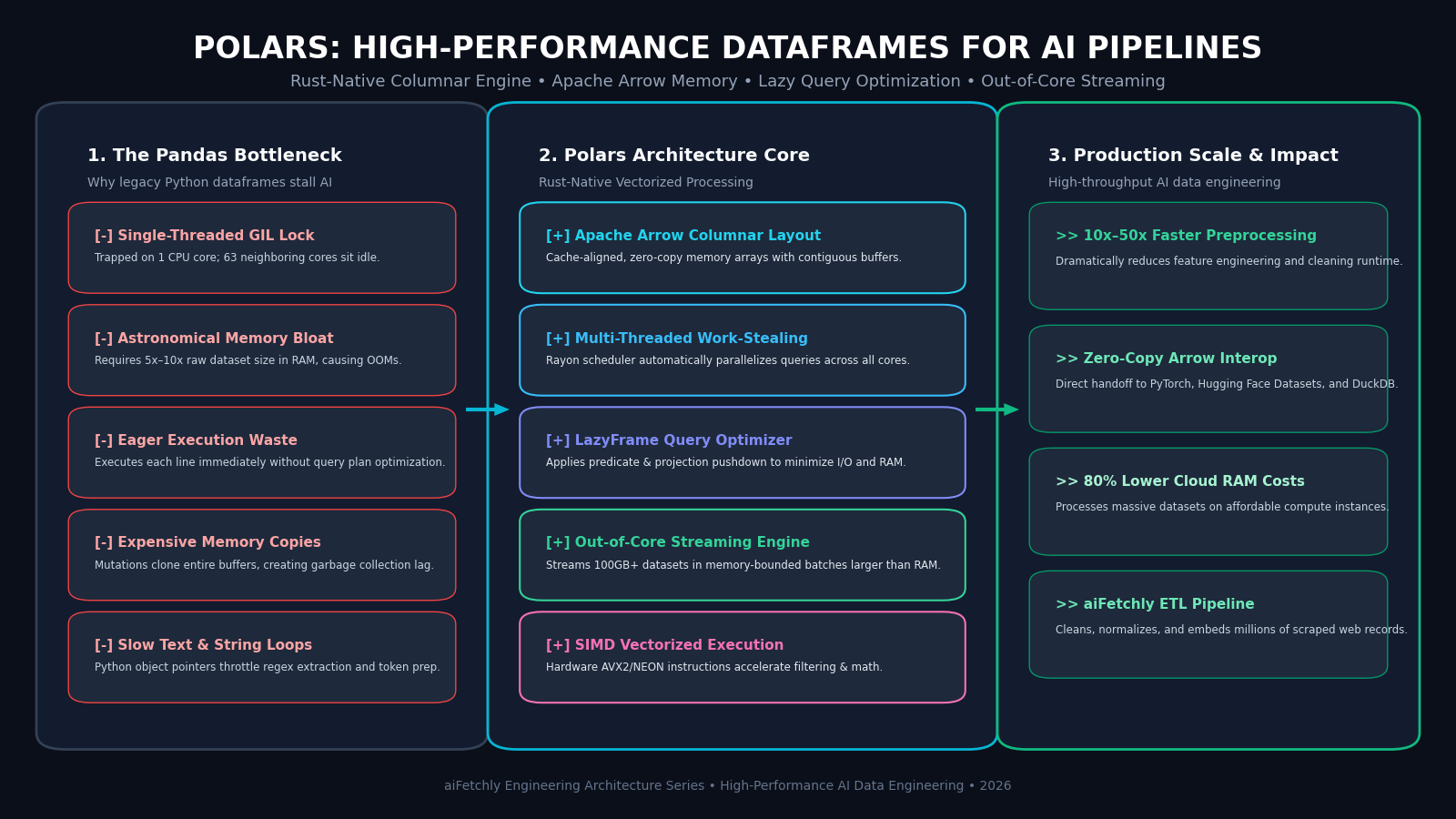
The Problem: The Memory Exhaustion and Single-Core Bottleneck of Legacy DataFrames
In modern enterprise machine learning, automated web scraping swarms, and massive foundation model pretraining pipelines like AiFetchly, data engineering represents up to 80% of total pipeline compute time. Before a Large Language Model (LLM) or embedding neural network can train, fine-tune, or perform Retrieval-Augmented Generation (RAG), billions of raw scraped text records, JSON logs, and tabular metadata entries must be ingested, deduplicated, cleaned, tokenized, and normalized.
For over a decade, Pandas served as the default Python library for tabular data manipulation. However, when software engineers attempt to deploy Pandas on modern gigabyte-to-terabyte scale AI datasets, the library encounters severe physical and architectural bottlenecks:
The Legacy Python DataFrame Crisis in AI Pipelines:
┌─────────────────────────────────────────────────────────────────┐
│ Server Hardware: 64-Core AMD EPYC / Intel Xeon + 256GB RAM      │
└────────────────────────────────┬────────────────────────────────┘
                                 │
                                 ▼ [Executing Pandas Preprocessing Script]
┌─────────────────────────────────────────────────────────────────┐
│ Pandas Runtime Bottlenecks:                                     │
│ • Core 0: 100% CPU Load (Pinned by Python Global Interpreter Lock)│
│ • Cores 1–63: 0% CPU Load (Completely Idle!)                     │
│ • Memory Usage: 10GB CSV consumes 60GB–100GB of uncompressed RAM │
│ • Python Object Overhead: Millions of heap pointers thrash L1/L2 │
│ • Copy-on-Write: Intermediate filters clone entire memory chunks │
└────────────────────────────────┬────────────────────────────────┘
                                 │
                                 ▼
┌─────────────────────────────────────────────────────────────────┐
│ Production Consequences:                                        │
│ ❌ Catastrophic Out-Of-Memory (OOM) Kernel Panics                │
│ ❌ Hours wasted running sequential single-threaded regex loops  │
│ ❌ Expensive cloud instances provisioned purely for RAM bloat   │
│ ❌ Slow tensor handoff requiring costly serialization copies    │
└─────────────────────────────────────────────────────────────────┘ 1. The Single-Threaded GIL Barrier in Modern Multi-Core Servers
Modern cloud servers and developer workstations feature 16, 32, 64, or even 128 physical CPU cores:
- The GIL Lock: Standard Python scripts run under the Global Interpreter Lock (GIL), restricting bytecode execution to a single thread.
- Wasted Silicon: When Pandas performs string manipulation, datetime parsing, or grouped aggregations, it executes on exactly one CPU core. The remaining 63 cores on a modern compute instance sit completely idle, artificially throttling data ingestion pipelines.
- Attempting to bypass this via Python’s
multiprocessinglibrary introduces immense inter-process communication (IPC) overhead, memory duplication, and complex pickling latency.
2. The 10x RAM Overhead and Catastrophic OOM Crashes
Pandas relies on NumPy’s memory model, which was architected for dense, numerical linear algebra rather than heterogeneous, semi-structured AI datasets:
- Memory Expansion Ratio: A 10 GB compressed Parquet or CSV dataset frequently expands into 50 GB to 100 GB of active memory once loaded into a Pandas DataFrame.
- Garbage Collection Pressure: Every intermediate transformation (e.g.,
df = df[df['status'] == 200]) creates uncoordinated memory copies, triggering sudden spikes that trigger Linux OOM (Out-of-Memory) killers and crash production worker pods.
3. Eager Execution Waste and Redundant Transformations
Pandas executes code eagerly: each line of code runs immediately upon evaluation:
- If a developer writes
df = df.sort_values('date')followed three lines later bydf = df.filter(df['country'] == 'US'), Pandas sorts the entire 50-million-row dataset first, only to discard 90% of the rows immediately afterward. - The runtime lacks a global query optimizer to reorder operations, prune unneeded columns, or push filtering down to the disk storage layer.
4. The Python Object Pointer Penalty in Text Cleaning & Tokenization
AI data engineering is predominantly text-heavy: cleaning raw HTML snippets, removing boilerplate headers, extracting regex patterns, and stripping emojis:
- In Pandas, string columns have historically been stored as arrays of pointers to individual Python
strobjects scattered randomly across the system heap. - Iterating across millions of string pointers destroys CPU L1/L2 cache locality, causing constant CPU cache misses that make text cleaning orders of magnitude slower than compiled code.
To dismantle these bottlenecks, the open-source engineering community created Polars: a blazingly fast, multi-threaded DataFrame library built from scratch in Rust on top of the Apache Arrow columnar format.
The Solution: Polars Architecture, Rust Multithreading & Apache Arrow Memory
Polars is designed to treat tabular and textual data with the same hardware efficiency that modern graphics cards bring to matrix multiplication. By leveraging compiled Rust, SIMD vectorization, cache-aligned Apache Arrow memory, and a sophisticated query optimization engine, Polars delivers orders-of-magnitude performance gains over legacy data tools.
Polars High-Performance Data Processing Architecture:
┌─────────────────────────────────────────────────────────────────┐
│ Developer Interface: Python / Rust / R API                     │
└────────────────────────────────┬────────────────────────────────┘
                                 │ (Declarative Expressions: pl.col())
                                 ▼
┌─────────────────────────────────────────────────────────────────┐
│ Polars Logical Plan & Query Optimizer                          │
│ • Predicate Pushdown: Filters pushed to disk reader             │
│ • Projection Pushdown: Only required columns loaded into RAM    │
│ • Common Subexpression Elimination & Type Coercion             │
└────────────────────────────────┬────────────────────────────────┘
                                 │ (Optimized Physical Plan)
                                 ▼
┌─────────────────────────────────────────────────────────────────┐
│ Multi-Threaded Rust Execution Engine (Rayon Work-Stealing)      │
│ • Automatic multi-core parallelization without Python GIL locks │
│ • SIMD-vectorized string and numeric kernels (AVX2 / AVX-512)   │
│ • Out-of-Core Streaming Engine for datasets larger than RAM     │
└────────────────────────────────┬────────────────────────────────┘
                                 │ (Zero-Copy Apache Arrow Layout)
                                 ▼
┌─────────────────────────────────────────────────────────────────┐
│ Downstream AI Ingestion: PyTorch / DuckDB / Hugging Face / RAG  │
└─────────────────────────────────────────────────────────────────┘ 1. Native Apache Arrow Columnar Memory Layout
Polars is built directly on the Apache Arrow specification:
- Contiguous Columnar Buffers: Data is arranged in contiguous, cache-aligned byte arrays. All values for a single column are stored adjacently in physical memory, maximizing CPU cache line utilization ($64$ bytes per cache line).
- Native Null Bitmaps: Missing or null values do not require special sentinel values (like
NaNorNone); they are tracked via efficient 1-bit boolean masks, preventing type casting issues and eliminating memory bloat. - Zero-Copy Slicing: Filtering or slicing DataFrames creates lightweight pointers to existing memory buffers rather than duplicating physical memory.
2. Multi-Threaded Work-Stealing with Rayon
Unlike Python-based tools, Polars bypasses the Python interpreter during data execution:
- Written in safe Rust, Polars uses the Rayon work-stealing thread pool to parallelize every query across all available CPU cores automatically.
- Tasks are decomposed into fine-grained chunks (morsels) that execute concurrently without thread contention or manual locking. A 64-core server achieves linear $60\times$ speedups on grouping, sorting, and text transformations.
3. LazyFrame Query Optimizer (Predicate and Projection Pushdown)
Polars introduces the Lazy API (LazyFrame), allowing developers to define complex transformations declaratively before executing:
- Predicate Pushdown: Polars evaluates filter expressions (
pl.col('status') == 200) and pushes them directly down into the file reader (e.g., Parquet row group statistics). If a Parquet file contains millions of rows, Polars skips reading entire data chunks from disk before they ever touch RAM. - Projection Pushdown: If a raw dataset contains 80 columns but your machine learning feature extractor only uses 4, Polars instructs the reader to deserialize only those 4 columns, slashing disk I/O and memory consumption by over 90%.
- Expression Optimization: Multiple sequential transformations are fused into single-pass SIMD vector loops.
4. Out-of-Core Streaming for Datasets Exceeding RAM
In traditional data engineering, processing a 150 GB dataset on a 32 GB RAM workstation was impossible without spinning up a distributed Spark cluster:
- Polars features an Out-of-Core Streaming Engine (
collect(streaming=True)). - It processes datasets in memory-bounded batches (morsels), pipelining disk I/O, transformation, and output sinks. Datasets that are 5x to 10x larger than available system RAM execute smoothly with bounded memory overhead.
5. Zero-Copy Arrow Interoperability with PyTorch and Hugging Face
In AI training pipelines, moving data between Python libraries has historically incurred high serialization penalties:
- Because Polars implements the Apache Arrow C Data Interface and PyCapsule protocol, a Polars DataFrame can be handed directly to PyTorch tensors, DuckDB tables, or Hugging Face Datasets with zero memory copying:
# Zero-copy memory handoff directly to PyTorch tensors arrow_table = df.to_arrow() tensor = torch.from_numpy(df["embedding_features"].to_numpy()) - This eliminates gigabytes of redundant memory allocations and cuts tensor preparation latency to microseconds.
Architectural Comparison: Polars vs. Pandas 2.x vs. Dask vs. DuckDB
The table below contrasts Polars with leading data manipulation and analytical tools:
| Architectural Metric | Pandas 2.x (PyArrow backend) | Dask DataFrame | DuckDB | Polars |
|---|---|---|---|---|
| Core Implementation | Python & C (NumPy/Arrow) | Python Task Graph | C++ Columnar Engine | Pure Rust & Rayon |
| Multi-Core Scaling | Single-Threaded (GIL) | Process / Thread Pool | Multi-Threaded Vectorized | Native Multi-Threaded Work-Stealing |
| Query Optimizer | None (Strictly Eager) | Basic Graph Optimization | Advanced Cost-Based SQL | Predicate & Projection Pushdown |
| Out-of-Core Streaming | No (Fails on OOM) | Yes (Chunked Graphs) | Yes (Streaming Spill) | Yes (streaming=True) |
| Memory Footprint | High (3x–8x raw data) | Moderate | Minimal (Columnar) | Minimal (Cache-Aligned Arrow) |
| Syntax & API Style | Index-Oriented Pandas | Pandas-Mimic API | Standard ANSI SQL | Composable Columnar Expressions |
| Zero-Copy Arrow | Partial | Partial | Full Arrow C Interface | Native Zero-Copy Arrow & PyCapsule |
| Ideal Production Fit | Small Scripts (< 1GB) | Distributed Clusters | Embedded SQL Analytics | High-Throughput ML/AI Data Prep |
Hands-On Implementation: Building a High-Throughput AI Preprocessing Pipeline
Below is a complete, production-grade guide demonstrating how to install Polars, build a multi-threaded LazyFrame preprocessing pipeline with text normalization and regex extraction, execute out-of-core streaming, and hand off memory zero-copy to PyTorch.
Step 1: Install Polars and Configure Threading
Install Polars with optional dependencies for Parquet and timezone support:
pip install "polars[all]" torch pyarrow In your Python script, inspect hardware detection and configure your compute environment:
import polars as pl
import os

# Inspect auto-detected CPU parallelism
thread_count = pl.thread_pool_size()
print(f"Polars initialized with {thread_count} worker threads via Rayon.")

# Optional: Set global configuration for rich terminal outputs
pl.Config.set_tbl_rows(10)
pl.Config.set_tbl_cols(8)
pl.Config.set_fmt_str_lengths(60) Step 2: Build a Lazy ETL Pipeline with Text Normalization and Regex Extraction
Construct an end-to-end data preparation workflow using Polars expressions. Notice how expressions run concurrently within each column:
import polars as pl

# 1. Initialize LazyFrame from raw data or Parquet lake
# Polars will NOT read the file immediately; it compiles an execution graph
raw_data = [
    {"doc_id": "doc_101", "url": "https://example.com/blog/ai-trends?ref=twitter", "raw_text": "  Breaking: DeepSeek launches R1 reasoning model!!   ", "http_status": 200, "word_count": 850},
    {"doc_id": "doc_102", "url": "https://example.com/careers/engineer", "raw_text": "We are hiring Rust and Python engineers for AI infrastructure.", "http_status": 200, "word_count": 420},
    {"doc_id": "doc_103", "url": "https://spam-tracker.net/bot-trap", "raw_text": "403 Forbidden Access - Bot Detected", "http_status": 403, "word_count": 12},
    {"doc_id": "doc_104", "url": "https://example.com/research/vector-search", "raw_text": "HNSW indexing accelerates high-dimensional vector search in RAG pipelines.", "http_status": 200, "word_count": 1240}
]

# Create LazyFrame
lazy_df = pl.LazyFrame(raw_data)

# 2. Define declarative transformation pipeline
optimized_pipeline = (
    lazy_df
    # Predicate Pushdown: Filter out non-200 responses and thin content immediately
    .filter(
        (pl.col("http_status") == 200) &
        (pl.col("word_count") >= 100)
    )
    # Projection Pushdown: Select and transform only relevant columns in a single pass
    .select([
        pl.col("doc_id"),
        # Extract clean domain name via regex expression
        pl.col("url")
            .str.extract(r"https?://([^/]+)", 1)
            .alias("domain"),
        # High-performance string normalization: strip whitespace, lowercase, remove punctuation
        pl.col("raw_text")
            .str.strip_chars()
            .str.to_lowercase()
            .str.replace_all(r"[!?:;\-]", "")
            .alias("clean_text"),
        # Feature engineering: compute character density and reading length
        (pl.col("word_count") / 250.0)
            .round(2)
            .alias("estimated_read_minutes")
    ])
    # Add token count estimation expression
    .with_columns(
        pl.col("clean_text")
            .str.split(" ")
            .list.len()
            .alias("approx_tokens")
    )
)

# Inspect the compiled query plan before execution
print("\n--- UNOPTIMIZED LOGICAL PLAN ---")
print(optimized_pipeline.explain(optimized=False))

print("\n--- OPTIMIZED PHYSICAL PLAN (WITH PUSHDOWNS) ---")
print(optimized_pipeline.explain(optimized=True)) Step 3: Stream Out-of-Core Data and Convert to PyTorch / Arrow Zero-Copy
Execute the query using the streaming engine to bound memory consumption, then hand off features zero-copy to PyTorch:
import torch

# Execute the pipeline with streaming enabled (out-of-core execution)
processed_df = optimized_pipeline.collect(streaming=True)
print("\n--- PROCESSED AI DATASET ---")
print(processed_df)

# Zero-copy memory handoff to PyTorch tensors
# Extract numerical features directly from Arrow memory buffers
read_times = processed_df["estimated_read_minutes"].to_numpy()
token_counts = processed_df["approx_tokens"].to_numpy()

# Combine into 2D tensor for model training
feature_matrix = torch.from_numpy(
    processed_df.select(["estimated_read_minutes", "approx_tokens"]).to_numpy()
)

print("\n--- ZERO-COPY PYTORCH TENSOR CREATED ---")
print(f"Tensor Shape: {feature_matrix.shape}")
print(f"Tensor Dtype: {feature_matrix.dtype}")
print(feature_matrix) By leveraging Polars’s expression engine, all string transformations, regex extractions, and arithmetic projections execute inside compiled Rust threads in parallel, leaving Python free to manage the high-level workflow.
Production Deployment with aiFetchly
In distributed web data collection, real-time market intelligence, and continuous web monitoring engines engineered by AiFetchly, Polars serves as the core high-throughput data processing engine.
aiFetchly Data Pipeline Integration with Polars:
┌─────────────────────────────────────────────────────────────────┐
│ 1. Autonomous Web Extraction Swarms                             │
│ • aiFetchly crawls millions of e-commerce and regulatory URLs   │
│ • Emits raw HTML tables, JSON blobs, and unstructured text      │
├─────────────────────────────────────────────────────────────────┤
│ 2. High-Throughput Polars Data Normalization                    │
│ • Cleans text, parses ISO timestamps, and validates schemas     │
│ • Multi-threaded Rayon execution processes 50k records/sec      │
├─────────────────────────────────────────────────────────────────┤
│ 3. Memory-Bounded Out-of-Core Streaming                         │
│ • Streams 100GB+ scraped corpora without memory exhaustion      │
│ • Predicate pushdowns filter invalid web pages at disk read     │
├─────────────────────────────────────────────────────────────────┤
│ 4. Zero-Copy Lakehouse & Model Ingestion                        │
│ • Directly exports clean Arrow tables to DuckDB, LanceDB, or S3 │
│ • 100% private, on-premise data sovereignty with zero SaaS fees │
└─────────────────────────────────────────────────────────────────┘ - Slashing Cloud Data Preprocessing Costs: By replacing legacy Pandas ETL containers with Polars, aiFetchly enterprise users process massive web crawl archives using 80% less RAM and one-fifth of the CPU time, slashing cloud compute invoices.
- Instant Feature Engineering on Scraped Catalogs: When tracking millions of competitor pricing records, Polars executes complex window functions, category groupings, and price volatility standard deviations in milliseconds.
- Seamless Multi-Modal RAG Ingestion: Polars cleans scraped web text, extracts metadata tags, and feeds normalized chunks zero-copy into downstream vector databases (such as DuckDB VSS, Qdrant, or Chroma) without memory fragmentation.
To discover how aiFetchly combines automated web extraction with high-performance data engineering architectures, explore our AiFetchly Documentation or review our AiFetchly Pricing.