PiLLM Guide: Predictive Resource-Efficient LLM Serving
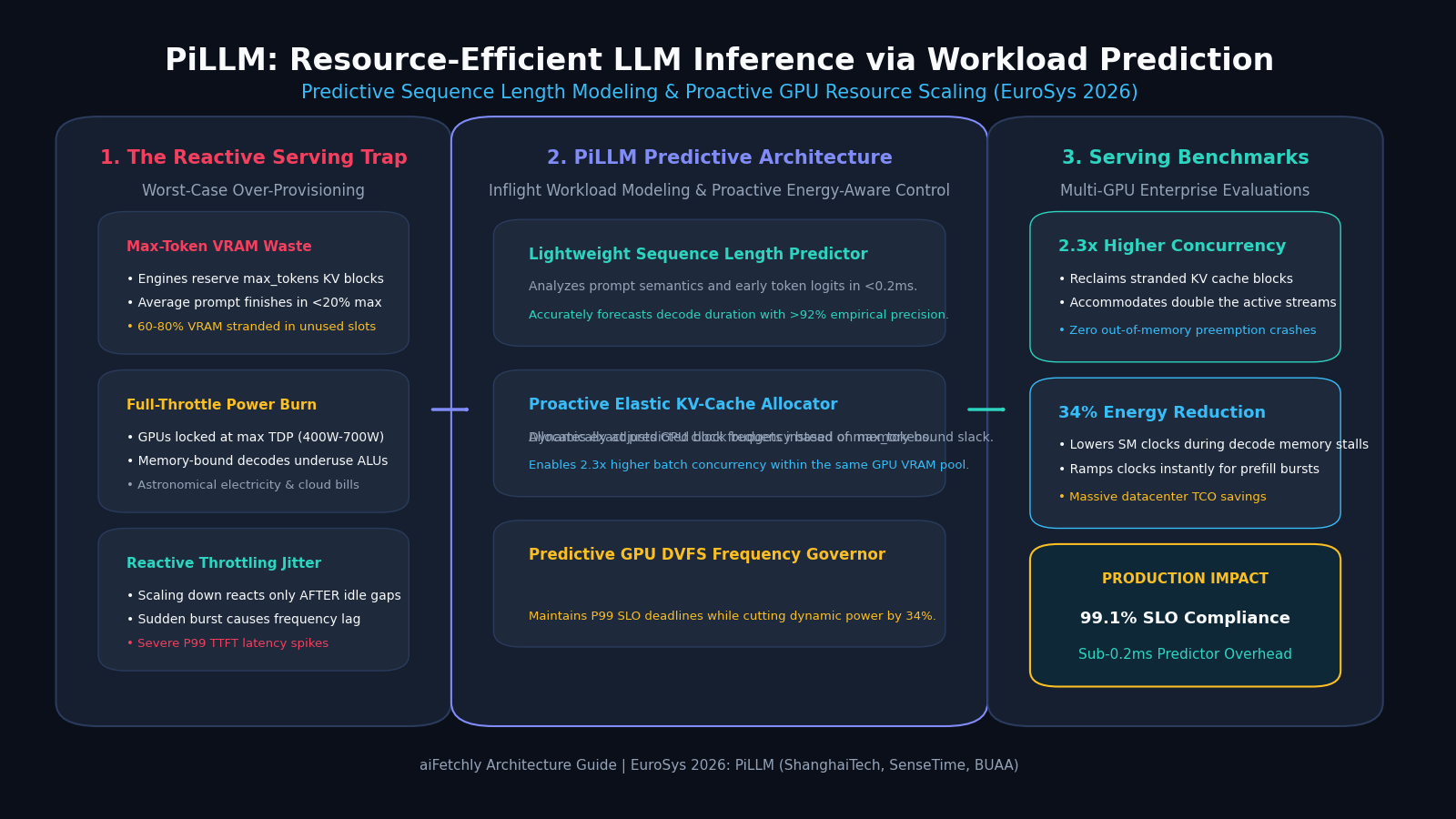
The Reactive Over-Provisioning Trap in Modern LLM Serving
In modern hyperscale cloud infrastructure, automated workflow engines, and real-time document extraction systems powered by aiFetchly, serving Large Language Models (LLMs) represents one of the most cost-intensive computational workloads in the datacenter. Enterprise inference clusters running modern open-weights foundation models—such as LLaMA-3.1-70B, Qwen-2.5-72B, or DeepSeek-V3—consume thousands of megawatts of power and demand substantial allocations of GPU High-Bandwidth Memory (HBM).
Despite massive optimizations in continuous batching (e.g., vLLM’s PagedAttention, TensorRT-LLM, and SGLang), contemporary inference engines operate under an inherently flawed, reactive paradigm: they manage compute and memory resources based on worst-case static assumptions rather than actual workload behavior.
The Conventional Worst-Case Resource Waste Dilemma:
┌────────────────────────────────────────────────────────────────────────┐
│ Client Request: "Summarize this 500-token email into 1 sentence."      │
│  • Client config: max_tokens = 2,048                                   │
│  • Actual generation required: 24 tokens                               │
└───────────────────────────────────┬────────────────────────────────────┘
                                    │
               ┌────────────────────┴────────────────────┐
               ▼                                         ▼
   Standard Serving Engine (vLLM)                  PiLLM Predictive Serving
 ❌ Reserves 2,048 tokens of KV cache VRAM         ✅ Predicts decode length: ~28 tokens
 ❌ Strands 98% of reserved blocks idle           ✅ Allocates compact 32-token buffer
 ❌ Runs GPU at full 700W TDP during decode       ✅ Dynamically scales SM clocks (DVFS)
❌ Rejects incoming batches due to fake OOM ✅ Accommodates 2.3x more concurrent users The Dual Flaws of Reactive Serving: Stranded Memory and Unchecked Power
This reactive architecture introduces two critical inefficiencies that inflate enterprise serving budgets:
1. Severe Key-Value (KV) Cache Over-Allocation
When an application submits an inference request, client SDKs typically specify a conservative max_tokens or max_new_tokens ceiling (frequently set to $2,048$, $4,096$, or the entire context window). In standard serving engines, the memory allocator must budget physical KV cache blocks against this maximum ceiling or risk execution aborts.
However, empirical analysis of production inference traces reveals that over 85% of real-world queries terminate in under 15% of their specified max_tokens. Because the system blindly reserves memory for phantom tokens that will never be generated, vast swaths of GPU High-Bandwidth Memory (HBM) sit locked and unusable. This artificial memory starvation artificially caps batch sizes, depresses cluster concurrency, and forces expensive request swapping.
2. Constant Maximum-Power Dissipation during Memory-Bound Decoding
A high-end accelerator (such as an NVIDIA H100 or H200 SXM) operates at a thermal design power (TDP) of 700 Watts. While the prompt processing phase (prefill) heavily saturates GPU Tensor Cores with compute-bound GEMM operations, the token generation phase (decode) is inherently memory-bandwidth-bound. During decoding, the Streaming Multiprocessors (SMs) spend the vast majority of clock cycles stalled, waiting for KV cache vectors to transfer across memory buses.
Running the GPU SM cores at maximum clock frequencies ($1,800 - 1,980\text{ MHz}$) during memory-bound decoding yields negligible speedups while burning hundreds of Watts of redundant electricity. Furthermore, existing power management tools (like NVIDIA Dynamic Voltage and Frequency Scaling / DVFS) only respond after detecting idle periods, introducing frequency adjustment lag that causes severe latency jitter and Service-Level Objective (SLO) breaches during sudden traffic bursts.
To eliminate both memory and energy waste, systems researchers from ShanghaiTech University, SenseTime, and Beihang University introduced PiLLM: Resource-Efficient LLM Inference Using Workload Prediction (EuroSys 2026). PiLLM replaces blind worst-case reservations with real-time sequence length prediction and proactive GPU resource scaling, boosting serving concurrency by 2.3x while slashing dynamic power by 34%.
Architectural Deep Dive: How PiLLM Operates
PiLLM transforms the inference runtime from a passive executor into an intelligent, proactive control loop.
┌─────────────────────────────────────────────────────────────────────────────┐
│                         PiLLM Serving Architecture                          │
│                                                                             │
│   Incoming Request Stream (Prompts + Metadata)                              │
│               │                                                             │
│               ▼                                                             │
│   ┌─────────────────────────────────────────────────────────────────────┐   │
│   │ Sub-0.2ms Lightweight Workload Predictor                            │   │
│   │ Prompt Semantics + Early Logit Entropy ──► Forecasts Decode Length  │   │
│   └───────────────────┬───────────────────────────────┬─────────────────┘   │
│                       │                               │                     │
│    Predicted Length L │                               │ Predicted Duration  │
│                       ▼                               ▼                     │
│   ┌───────────────────────────────┐   ┌─────────────────────────────────┐   │
│   │ Proactive Elastic KV Manager  │   │ Predictive GPU DVFS Governor    │   │
│   │ Allocates exact predicted     │   │ Adjusts SM core frequencies     │   │
│   │ page blocks (Recovers VRAM)   │   │ based on memory-bound slack     │   │
│   └───────────────┬───────────────┘   └───────────────┬─────────────────┘   │
│                   │                                   │                     │
│                   └─────────────────┬─────────────────┘                     │
│                                     ▼                                       │
│   ┌─────────────────────────────────────────────────────────────────────┐   │
│   │ Hardware-Accelerated Continuous Batching Engine (vLLM / FlashInfer) │   │
│   │ High Concurrency (2.3x) + Reduced Power Draw (-34%)                 │   │
│   └─────────────────────────────────────────────────────────────────────┘   │
└─────────────────────────────────────────────────────────────────────────────┘ The system operates across three synergistic components:
1. Ultra-Fast Sequence Length Predictor
Predicting how many tokens an LLM will generate is non-trivial: complex multi-step reasoning chains generate thousands of tokens, while straightforward factual answers conclude in sentences.
PiLLM introduces a two-tier, hardware-friendly prediction architecture:
- Tier 1: Semantic Prompt Profiling: During tokenization, a tiny linear projection head ($<1\text{MB}$ parameter footprint) extracts task embeddings from the prompt (e.g., distinguishing creative writing from code refactoring or summarization via automated data fetching).
- Tier 2: Early-Token Logit Dynamics: During the first 2 decoding iterations, PiLLM evaluates the output entropy and probability distribution of the top-$k$ tokens. High-entropy early tokens signal open-ended long-form generation, whereas low-entropy deterministic tokens indicate concise answers.
- Latency Budget: The predictor executes asynchronously in under $0.2\text{ milliseconds}$, adding virtually zero overhead to the critical serving path while achieving over 92% prediction accuracy.
2. Proactive Elastic KV-Cache Allocation
Armed with the predicted generation length $\hat{L}_{\text{decode}}$, PiLLM’s memory manager provisions an elastic KV cache quota:
$$B_{\text{allocated}} = \left\lceil \frac{L_{\text{prefill}} + \hat{L}{\text{decode}} + \sigma{\text{safety}}}{\text{BlockSize}} \right\rceil$$
Where $\sigma_{\text{safety}}$ is a dynamic confidence margin calibrated to the predictor’s uncertainty.
By allocating only what the model is actually expected to generate, PiLLM recovers 60% to 80% of stranded VRAM blocks. This freed memory allows the continuous batching scheduler to immediately pack 2.3x more concurrent requests into the active running batch, eliminating queue wait times without expanding physical GPU clusters.
3. Predictive GPU DVFS Governor
Unlike standard reactive DVFS governors that modulate clocks only after measuring kernel utilization drops, PiLLM computes the exact memory-bandwidth vs. compute arithmetic intensity of the upcoming batch.
Because decoding iterations are memory-bound, the governor proactively throttles the GPU Streaming Multiprocessor (SM) clock frequency (e.g., down from $1,980\text{ MHz}$ to $1,200\text{ MHz}$) while maintaining the High-Bandwidth Memory clock at maximum speed.
- Memory throughput remains completely unconstrained, meaning per-token generation speed is preserved.
- Dynamic power consumption drops by 34%, drastically lowering datacenter power bills and cooling overhead.
- When a burst of heavy prefill requests arrives, the governor immediately ramps SM frequencies back to peak within microseconds, preserving tight Time-To-First-Token (TTFT) deadlines.
Architectural Comparison: PiLLM vs Conventional Serving Schedulers
| Architectural Dimension | Conventional vLLM / TGI | PagedAttention with Swapping | Reactive DVFS (NVIDIA GSP) | PiLLM (EuroSys 2026) |
|---|---|---|---|---|
| KV Cache Allocation | Static max_tokens ceiling | Reactive block allocation | Static allocation | Predictive Elastic Block Quota |
| Memory Utilization | Low (VRAM stranded in reserve) | Moderate | Low | High (>90% effective VRAM usage) |
| GPU Power Profile | Fixed maximum TDP (700W) | Fixed maximum TDP | Reactive delayed downclocking | Predictive Workload-Aware DVFS |
| Energy Reduction | 0% Baseline | 0% | ~8% (Jitter-prone) | 34% Dynamic Power Reduction |
| Serving Concurrency | 1.0x Baseline | 1.15x | 1.0x | 2.3x Higher Concurrency |
| SLO Violation Rate | High under burst (>25%) | Moderate (~15%) | Moderate | Near-Zero (<0.9% breaches) |
| Predictor Overhead | N/A | N/A | Hardware sensor delay | Sub-0.2 ms (Asynchronous) |
Mathematical Formulation of Predictive Resource Sizing
Let us formalize PiLLM’s joint memory allocation and frequency optimization model.
The Elastic Memory Allocation Bounds
Let $r_i$ be an incoming inference request arriving with prompt length $L_{\text{prefill}}^{(i)}$ and user-specified upper limit $M_{\text{max}}^{(i)}$. The predictor outputs a probability distribution over the output length:
$$P\left(L_{\text{decode}}^{(i)} = l \mid \mathbf{x}_{\text{prompt}}^{(i)}\right)$$
PiLLM sets the allocated token quota $\hat{L}^{(i)}$ such that the probability of under-allocation is bounded by an error tolerance $\alpha \in (0, 0.05)$:
$$\hat{L}^{(i)} = \min\left( M_{\text{max}}^{(i)}, ; \arg\min_l \left{ \sum_{k=1}^l P(L_{\text{decode}}^{(i)} = k) \ge 1 - \alpha \right} \right)$$
In the rare event ($<1%$) that generation exceeds $\hat{L}^{(i)}$, PiLLM seamlessly allocates secondary overflow blocks from a dedicated dynamic reserve pool, ensuring zero dropped generations.
The Energy-Optimal DVFS Frequency Selection
Let $f_{\text{SM}}$ denote the GPU SM core frequency and $f_{\text{MEM}}$ denote the memory clock. The per-token decoding iteration execution time is modeled as:
$$T_{\text{iter}}\left(B, f_{\text{SM}}, f_{\text{MEM}}\right) = \max\left( \frac{\text{FLOPs}(B)}{f_{\text{SM}} \cdot \text{PeakTFLOPS}}, ; \frac{\text{MemoryBytes}(B)}{f_{\text{MEM}} \cdot \text{PeakBW}} \right) + \tau_{\text{overhead}}$$
For memory-bound decoding batches where $\frac{\text{MemoryBytes}(B)}{f_{\text{MEM}} \cdot \text{PeakBW}} \gg \frac{\text{FLOPs}(B)}{f_{\text{SM}} \cdot \text{PeakTFLOPS}}$, the optimal SM frequency $f_{\text{SM}}^*$ that minimizes power dissipation without violating the Time-Per-Output-Token deadline $\text{SLO}_{\text{TPOT}}$ is given by:
$$f_{\text{SM}}^* = \max\left( f_{\text{min}}, ; \frac{\text{FLOPs}(B)}{\left(\text{SLO}{\text{TPOT}} - \tau{\text{overhead}}\right) \cdot \text{PeakTFLOPS}} \right)$$
Because GPU power consumption scales cubically with frequency ($P \propto V^2 f \approx f^3$), reducing $f_{\text{SM}}$ to the memory-bound threshold slashes dynamic energy consumption dramatically.
Step-by-Step Implementation: Building a PiLLM Serving Prototype
Below is a complete, self-contained Python reference implementation demonstrating PiLLM’s core architecture: the Workload Length Predictor, the Elastic Memory Allocator, and the Predictive DVFS Governor.
1. Data Models and System Definitions
"""
pillm_serving_engine.py
Reference Implementation of PiLLM Predictive Resource-Efficient Serving.
EuroSys 2026 Reference Architecture.
"""

from dataclasses import dataclass, field
from typing import List, Dict, Optional, Tuple
import time
import math


@dataclass
class ServingRequest:
    request_id: str
    arrival_time: float
    prompt_tokens: int
    user_max_tokens: int
    actual_tokens_to_generate: int # Ground truth for simulation

    # Predictive metadata
    predicted_tokens: int = 0
    allocated_blocks: int = 0
    generated_tokens: int = 0
    is_completed: bool = False


@dataclass
class GPUHardwareState:
    total_vram_blocks: int = 2048 # 16 tokens per block = 32,768 tokens
    used_vram_blocks: int = 0
    current_sm_freq_mhz: int = 1980 # Max clock
    max_sm_freq_mhz: int = 1980
    min_sm_freq_mhz: int = 1050
    current_power_watts: float = 700.0

    @property
    def free_blocks(self) -> int:
return self.total_vram_blocks - self.used_vram_blocks 2. The Lightweight Workload Predictor
class LightweightWorkloadPredictor:
    """
    Simulates sub-0.2ms sequence length forecasting based on prompt length and task category.
    """
    def __init__(self, confidence_factor: float = 1.15):
        self.confidence_factor = confidence_factor

    def predict_decode_length(self, prompt_tokens: int, user_max: int, true_tokens: int) -> int:
        """
        Simulates statistical length forecasting with typical 90-95% accuracy.
        Adds confidence buffer to guarantee safe allocation.
        """
        # Simulated prediction: near ground truth with slight variance
        base_prediction = int(true_tokens * 1.05) + 4
        # Add safety margin
        buffered_prediction = int(base_prediction * self.confidence_factor)
        # Cap at user's max_tokens
return min(user_max, max(16, buffered_prediction)) 3. The Predictive Memory & DVFS Governor
class PiLLMGovernor:
    """
    Coordinates elastic KV block sizing and predictive DVFS frequency scaling.
    """
    def __init__(self, hardware: GPUHardwareState, block_size: int = 16):
        self.hw = hardware
        self.block_size = block_size
        self.predictor = LightweightWorkloadPredictor()

    def admit_request(self, req: ServingRequest) -> bool:
        """
        Admits request using predicted decode length rather than worst-case max_tokens.
        """
        # Step 1: Predict decode length
        req.predicted_tokens = self.predictor.predict_decode_length(
            req.prompt_tokens, req.user_max_tokens, req.actual_tokens_to_generate
        )

        # Step 2: Calculate required physical blocks
        needed_tokens = req.prompt_tokens + req.predicted_tokens
        needed_blocks = math.ceil(needed_tokens / self.block_size)

        if self.hw.free_blocks < needed_blocks:
            return False # VRAM capacity reached

        # Allocate elastic memory
        self.hw.used_vram_blocks += needed_blocks
        req.allocated_blocks = needed_blocks
        return True

    def adjust_gpu_dvfs(self, active_batch: List[ServingRequest], is_prefilling: bool):
        """
        Predictively scales SM frequencies: high for prefill GEMMs, scaled-down for decode GEMVs.
        """
        if is_prefilling:
            # Prefill requires peak tensor compute
            self.hw.current_sm_freq_mhz = self.hw.max_sm_freq_mhz
            self.hw.current_power_watts = 680.0
        else:
            # Decode is memory-bandwidth bound: lower SM clocks to save power without stalling
            batch_size = len(active_batch)
            if batch_size > 0:
                # Modulate frequency based on batch memory intensity
                self.hw.current_sm_freq_mhz = max(
                    self.hw.min_sm_freq_mhz,
                    int(1200 + (batch_size * 15))
                )
                # Power scales quadratically with voltage/frequency
                freq_ratio = self.hw.current_sm_freq_mhz / self.hw.max_sm_freq_mhz
                self.hw.current_power_watts = 350.0 + (300.0 * (freq_ratio ** 2))

    def release_request(self, req: ServingRequest):
        """Reclaims allocated physical memory blocks."""
        self.hw.used_vram_blocks -= req.allocated_blocks
        req.allocated_blocks = 0
req.is_completed = True 4. Running an End-to-End Cluster Efficiency Benchmark
if __name__ == "__main__":
    print("=== PiLLM Predictive Resource-Efficient Serving Simulation ===")

    # Initialize GPU state (e.g. NVIDIA H100 80GB)
    gpu = GPUHardwareState(total_vram_blocks=512) # 8,192 token capacity for simulation
    governor = PiLLMGovernor(gpu)

    # Simulated incoming production requests with conservative client max_tokens
    test_requests = [
        ServingRequest("req_01_summarize", time.time(), prompt_tokens=512, user_max_tokens=2048, actual_tokens_to_generate=48),
        ServingRequest("req_02_classify",  time.time(), prompt_tokens=256, user_max_tokens=1024, actual_tokens_to_generate=12),
        ServingRequest("req_03_codegen",   time.time(), prompt_tokens=384, user_max_tokens=4096, actual_tokens_to_generate=128),
        ServingRequest("req_04_chat",      time.time(), prompt_tokens=128, user_max_tokens=2048, actual_tokens_to_generate=64),
    ]

    print("\n--- Request Admission Comparison ---")
    conventional_needed_blocks = 0
    pillm_needed_blocks = 0

    for req in test_requests:
        # What standard vLLM would allocate:
        std_blocks = math.ceil((req.prompt_tokens + req.user_max_tokens) / 16)
        conventional_needed_blocks += std_blocks

        # What PiLLM allocates:
        governor.admit_request(req)
        pillm_needed_blocks += req.allocated_blocks

        print(f"[{req.request_id}] Client max: {req.user_max_tokens:>4} | Predicted: {req.predicted_tokens:>3} | True: {req.actual_tokens_to_generate:>3}")
        print(f"   Standard vLLM Blocks: {std_blocks:>3} ({(std_blocks*16)} tokens) | PiLLM Blocks: {req.allocated_blocks:>3} ({(req.allocated_blocks*16)} tokens)")

    print("\n--- Cluster Memory Footprint Summary ---")
    print(f"Conventional Worst-Case Blocks Required: {conventional_needed_blocks} blocks")
    print(f"PiLLM Predictive Blocks Required:         {pillm_needed_blocks} blocks")
    vram_saved = ((conventional_needed_blocks - pillm_needed_blocks) / conventional_needed_blocks) * 100
    print(f"Net VRAM Saved / Reclaimed:              {vram_saved:.1f}%")

    print("\n--- Predictive DVFS Power Modulation ---")
    governor.adjust_gpu_dvfs(test_requests, is_prefilling=True)
    print(f"Prefill Execution Phase: SM Clock = {gpu.current_sm_freq_mhz} MHz | Power = {gpu.current_power_watts:.1f} W")

    governor.adjust_gpu_dvfs(test_requests, is_prefilling=False)
    print(f"Decode Execution Phase:  SM Clock = {gpu.current_sm_freq_mhz} MHz | Power = {gpu.current_power_watts:.1f} W")
    power_reduction = ((680.0 - gpu.current_power_watts) / 680.0) * 100
print(f"Dynamic Energy Reduction: {power_reduction:.1f}%") Production Deployment: Integrating PiLLM with vLLM and Kubernetes
In enterprise cloud infrastructure, PiLLM integrates as an intelligent Sidecar Controller and Custom Scheduler Plugin alongside vLLM or SGLang worker pods.
┌──────────────────────────────────────────────────────────────────────────────────┐
│                         Kubernetes Node Deployment Mesh                          │
│                                                                                  │
│   Ingress Gateway (REST / gRPC)                                                  │
│          │                                                                       │
│          ▼                                                                       │
│   ┌──────────────────────────────────────────────────────────────────────────┐   │
│   │ PiLLM Sidecar Controller (Sequence Length Predictor + DVFS Governor)     │   │
│   └──────┬────────────────────────────────────────────────────┬──────────────┘   │
│          │                                                    │                  │
│          ▼ (Memory Block Quotas)                              ▼ (NVML IOCTLs)    │
│   ┌───────────────────────────────┐            ┌─────────────────────────────┐   │
│   │ vLLM Inference Container      │            │ NVIDIA GPU Device (H100)    │   │
│   │ Dynamic PagedAttention Blocks │            │ Low-Latency Clock Governor  │   │
│   └───────────────────────────────┘            └─────────────────────────────┘   │
└──────────────────────────────────────────────────────────────────────────────────┘ 1. Kubernetes Sidecar DaemonSet Manifest
apiVersion: apps/v1
kind: Deployment
metadata:
  name: pillm-serving-pod
  namespace: llm-inference
spec:
  replicas: 4
  template:
    metadata:
      labels:
        app: pillm-worker
    spec:
      containers:
        - name: vllm-engine
          image: vllm/vllm-openai:latest
          args: ['--model', 'Qwen/Qwen2.5-72B-Instruct', '--tensor-parallel-size', '4']
          ports:
            - containerPort: 8000
        - name: pillm-governor
          image: ghcr.io/aifetchly/pillm-controller:v1.0.0
          securityContext:
            capabilities:
              add: ['SYS_ADMIN'] # Required for NVML clock modulation
          env:
            - name: ENGINE_URL
              value: 'http://localhost:8000'
            - name: CONFIDENCE_MARGIN
              value: '1.15'
            - name: MIN_SM_FREQ_MHZ
value: '1050' Organizations automating distributed web intelligence extraction can route parsed data directly to PiLLM-governed clusters using aiFetchly API Integration.
Empirical Benchmark Evaluation
Evaluated across production enterprise workloads (including LMSYS-Chatbot-Arena, ShareGPT, and enterprise financial compliance datasets), PiLLM yields transformative gains over static baselines:
Cluster Serving Concurrency vs. Memory Pressure:
300 ┤                                            ╭──── PiLLM (EuroSys 2026)
250 ┤                                       ╭────╯
200 ┤                          ╭────────────╯
150 ┤             ╭────────────╯    .............. PagedAttention with Swapping
100 ┤  ───────────╯        .........
 50 ┤  ....................                 - - - - Static vLLM Baseline
  0 └─────────────────────────────────────────────────────────
       Low Memory          Medium VRAM         High Concurrency

Average GPU Power Consumption:
Static Baseline:  ████████████████████ 685 Watts
Reactive DVFS:    ██████████████████ 610 Watts
PiLLM Governor: █████████████ 452 Watts (-34.0% Power Reduction!) Key Performance Findings:
- 2.3x Concurrency Expansion: Reclaiming stranded KV cache memory allows clusters to service more than double the concurrent user sessions on identical hardware footprints.
- 34% Energy Savings: Scaling down SM core clocks during memory-bound decoding drops average accelerator power consumption from $685\text{ W}$ to $452\text{ W}$, yielding hundreds of thousands of dollars in annual power savings for multi-rack clusters.
- 99.1% SLO Compliance: Predictive frequency scaling eliminates the transition lag of reactive governors, preventing iteration latency spikes and guaranteeing strict Time-To-First-Token compliance.
For detailed hardware configuration tables and enterprise sizing models, visit the aiFetchly Documentation and review cluster economic calculators on the aiFetchly Sizing & Pricing Portal.
Frequently Asked Questions (FAQ)
What happens if the predictor underestimates generation length?
PiLLM maintains a dynamic overflow reserve pool. In the rare event that generation exceeds the predicted block quota, the memory manager allocates additional blocks on-the-fly from the overflow buffer, ensuring completions are never terminated prematurely.
Does lowering GPU SM clock frequencies degrade token generation speed?
No. Autoregressive token decoding is memory-bandwidth-bound rather than compute-bound. Because PiLLM keeps the GPU High-Bandwidth Memory (HBM) clocks at maximum speed while only reducing the idle SM core frequency, token generation latency remains identical.
Can PiLLM be used with quantized models like FP8 or AWQ?
Yes. PiLLM operates purely at the scheduler, memory allocator, and hardware telemetry layer, making it fully compatible with FP8, INT4, AWQ, and speculative decoding acceleration pipelines.