Pie Guide: Programmable LLM Serving & Sandboxed Inferlets
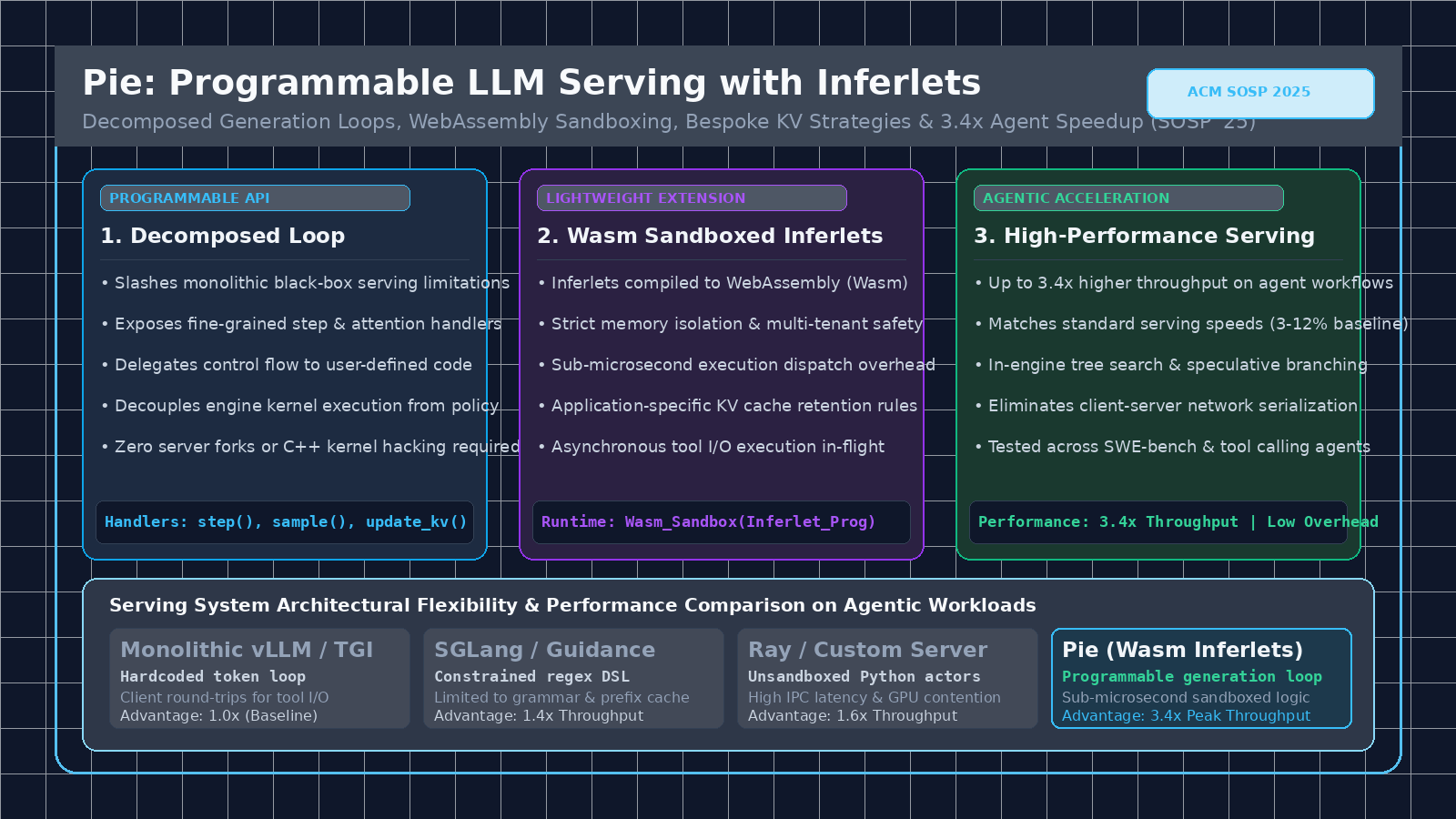
The Monolithic Generation Loop Bottleneck in Emerging AI Workloads
In modern enterprise artificial intelligence, foundation models are no longer deployed merely to answer simple, one-off text prompts. Today’s frontier applications—ranging from autonomous software engineers and multi-agent copilots to complex web research pipelines engineered by aiFetchly—involve sophisticated reasoning structures:
- Agentic Tool Calling & Function Loops: Models generate structured tool invocations, pause execution while waiting for external environment feedback, and resume generation with newly acquired data.
- Tree-Search Reasoning: Paradigms like Tree-of-Thoughts (ToT) and Monte Carlo Tree Search (MCTS) branch across multiple generation paths, evaluate intermediate value functions, and prune unpromising reasoning trajectories.
- Speculative and Constrained Generation: Applications enforce strict JSON schemas, regex grammars, or multi-draft speculative verifications.
Despite this rapid evolution in application complexity, virtually all mainstream Large Language Model (LLM) serving systems—including vLLM, Hugging Face TGI, TensorRT-LLM, and LMDeploy—are built on an immutable architectural foundation: the monolithic, hardcoded token generation loop.
The Monolithic Serving Engine Inefficiency:
+-----------------------------------------------------------------------------------+
| Monolithic Serving Daemon (vLLM / TGI / TensorRT-LLM)                             |
| ┌───────────────────────────────────────────────────────────────────────────────┐ |
| │ Black-Box Generation Loop: Hardcoded in C++ / CUDA                            │ |
| │ • Step 1: Ingest Prompt via HTTP/gRPC                                         │ |
| │ • Step 2: Run Prefill Phase (Full KV Cache allocated)                         │ |
| │ • Step 3: Loop while not <eos>:                                               │ |
| │     Forward Pass -> Sample Next Token -> Append to KV Cache                   │ |
| │ • Step 4: Stream Text Back to Client App                                      │ |
| └───────────────────────────────────────────────────────────────────────────────┘ |
+-----------------------------------------------------------------------------------+
                                         │
                 Encountering Modern Agentic Workflows
                                         │
┌───────────────────────────────────────────────────────────────────────────────────┐
| The Agentic Workflow Tax:                                                         |
| • Agent generates tool call -> Generation terminates -> String serialized to JSON |
| • Client app executes API tool call (HTTP round-trip!)                            |
| • Client sends tool response back to engine as a NEW prompt!                      |
| ❌ Catastrophic Overhead:                                                         |
|   - Engine discards or thrashes KV cache between turns!                           |
|   - Applications cannot customize KV eviction (e.g., pinning tool schemas).       |
|   - Zero ability to interleave computation with tool I/O!                         |
|   - Custom speculative decoding requires hacking deep server C++ internals!       |
+-----------------------------------------------------------------------------------+ This monolithic structure creates a fundamental chasm between application requirements and serving engine capabilities:
- Application Rigidity: If a developer wants to implement a bespoke KV cache retention policy (e.g., retaining system prompts and entity definitions while pruning conversational filler), they cannot express this policy through standard OpenAI APIs.
- Client-Server Round-Trip Tax: In multi-turn agentic workflows, every tool interaction requires returning control to a client-side orchestrator over the network, serializing tokens to text strings, and re-submitting queries. This introduces hundreds of milliseconds of network latency and destroys GPU batching efficiency.
- Engine Forking Dilemma: Today, implementing novel inference algorithms (such as tree search, lookahead decoding, or asynchronous tool calling) requires maintaining a custom fork of a complex C++/CUDA codebase.
To dismantle this architectural barrier, systems researchers from Yale University introduced Pie: A Programmable Serving System for Emerging LLM Applications (presented at ACM SOSP 2025, arXiv:2510.24051).
Pie re-architects the serving engine around programmability. By decomposing the traditional token generation loop into fine-grained service handlers and delegating control to lightweight, WebAssembly-sandboxed user programs called inferlets, Pie empowers applications to define custom generation logic, bespoke KV cache management, and asynchronous I/O directly inside the serving runtime.
On complex agentic workflows, Pie matches or exceeds state-of-the-art serving performance, delivering 1.3x to 3.4x higher throughput and cutting task completion latency by over 50%.
In this technical guide, we dissect the architecture of Pie, examine how inferlets interact with the serving core, analyze WebAssembly sandboxing mechanics, and build a working implementation.
Programmable Serving: The Architecture of Pie
The central philosophy of Pie is the classic systems principle of separating mechanism from policy:
- Mechanism (The Serving Core): High-performance GPU kernels (FlashAttention, PagedAttention, GEMMs), distributed tensor-parallel communication (NCCL), and hardware memory management.
- Policy (The Application Logic): Deciding when to sample tokens, which KV cache blocks to retain or evict, when to branch reasoning paths, and how to interface with external tools.
The Pie System Architecture:
┌────────────────────────────────────────────────────────────────────────┐
|                      User Application / Agent Logic                    |
|         (Client defines custom generation behavior in an Inferlet)     |
└──────────────────────────────────┬─────────────────────────────────────┘
                                   │  Upload Wasm Bytecode via API
                                   ▼
┌────────────────────────────────────────────────────────────────────────┐
|                      Pie Programmable Serving Engine                   |
|                                                                        |
|  ┌──────────────────────────────────────────────────────────────────┐  |
|  │ WebAssembly Sandboxed Execution Runtime (Wasmtime Core)          │  |
|  │ • Executes user-provided Inferlets with sub-microsecond overhead │  |
|  │ • Strong memory isolation & multi-tenant fault containment       │  |
|  └──────────────────────────────────┬───────────────────────────────┘  |
|                                     │  Fine-Grained System Call API
|                                     ▼                                  |
|  ┌──────────────────────────────────────────────────────────────────┐  |
|  │ Decomposed Service Handlers (Serving Mechanism)                  │  |
|  │ • `forward_step()`: Executes model forward pass on GPU           │  |
|  │ • `sample_token()`: Evaluates logits with custom constraints     │  |
|  │ • `manage_kv()`: Direct control over PagedAttention page tables  │  |
|  │ • `async_io()`: Non-blocking dispatch to external tools/APIs     │  |
|  └──────────────────────────────────┬───────────────────────────────┘  |
|                                     │                                  |
|                                     ▼                                  |
|  ┌──────────────────────────────────────────────────────────────────┐  |
|  │ GPU Accelerator Fleet (PagedAttention, FlashAttention, GEMMs)    │  |
|  └──────────────────────────────────────────────────────────────────┘  |
└────────────────────────────────────────────────────────────────────────┘ 1. Decomposing the Generation Loop
In Pie, the monolithic while-loop is dismantled into four atomic service handlers:
forward_step(context_id, input_tokens): Submits a sequence of tokens to the GPU execution queue. The serving engine schedules this forward step alongside other concurrent requests using continuous batching.sample_token(logits, policy_config): Exposes the raw logit distribution to the inferlet, allowing custom temperature scaling, top-$p$, top-$k$, or constrained grammar masking (such as JSON or SQL syntax enforcement).manage_kv(context_id, action, block_ids): Grants the inferlet direct programmatic control over its PagedAttention memory allocation. The inferlet can allocate new pages, fork a page table (for speculative branches), pin critical prompt blocks, or selectively evict historical tokens.async_io(request_payload, callback_handler): Allows the inferlet to issue non-blocking network requests (e.g., fetching a web page or executing a database query) without freezing the serving thread.
2. The In-Engine Control Flow
Rather than streaming tokens over network sockets back to a client script, the control loop runs directly inside the serving host. The inferlet inspects each newly generated token in memory:
- If the token is part of normal text generation, it continues decoding.
- If the token signals an agent tool call, the inferlet parses the arguments and triggers
async_io()immediately, keeping the request’s KV cache warm in GPU memory.
Inferlets: User-Provided WebAssembly Sandboxed Execution
Allowing arbitrary user-provided code to execute inside a high-throughput GPU serving cluster introduces critical security and performance challenges:
- Security & Multi-Tenant Isolation: How do you prevent one tenant’s code from reading another tenant’s KV cache or executing malicious system commands?
- Execution Latency: How do you ensure that executing user logic between token generation steps does not add measurable latency to GPU execution?
Pie resolves both challenges by implementing inferlets using WebAssembly (Wasm).
Inferlet Sandboxing and Lifecycle:
┌────────────────────────────────────────────────────────────────────────┐
| 1. Authoring: Application Developer writes Inferlet in Rust / C++       |
|                                                                        |
|    fn on_step(context: &mut Context, logits: &[f32]) -> Action {       |
|        if detect_tool_call(context) {                                  |
|            context.pin_kv_cache();                                     |
|            return Action::AsyncToolCall("fetch_api");                  |
|        }                                                               |
|        Action::Continue                                                |
|    }                                                                   |
└──────────────────────────────────┬─────────────────────────────────────┘
                                   │  Compile via `wasm32-wasi`
                                   ▼
┌────────────────────────────────────────────────────────────────────────┐
| 2. Deployment: Upload Wasm Bytecode to Pie Serving API                 |
|    POST /v1/inferlets/register (Payload: inferlet.wasm)                |
└──────────────────────────────────┬─────────────────────────────────────┘
                                   │
                                   ▼
┌────────────────────────────────────────────────────────────────────────┐
| 3. Execution: Pie Wasm Sandbox Runtime (Wasmtime)                      |
| • Sub-Microsecond Invocation: Function calls execute in < 0.8 µs       |
| • Strict Fault Containment: Sandboxed linear memory protects host OS   |
| • Preemptive Instruction Budgets: Prevents infinite loops/starvation   |
└────────────────────────────────────────────────────────────────────────┘ 1. Why WebAssembly?
WebAssembly provides three unique properties that make it ideal for programmable serving:
- Deterministic Sandboxing: Wasm code runs inside a secure, memory-isolated sandbox. An inferlet can only access the memory pages explicitly granted to it by the Pie host runtime, preventing cross-tenant data leakage.
- Near-Native Execution Speed: Modern JIT compilers (such as Wasmtime and Cranelift) compile Wasm bytecode into optimized host machine code, achieving 90%–95% of native C++ execution speeds.
- Sub-Microsecond Dispatch: Calling a Wasm function from the serving engine incurs less than 0.8 microseconds of overhead—negligible compared to the 10–30 millisecond forward pass duration of modern LLMs.
2. Preemptive Scheduling and Resource Caps
To prevent poorly written or malicious inferlets from hanging the serving engine:
- Pie instruments Wasm bytecode with an instruction counter fuel mechanism. If an inferlet exceeds its allocated computation budget (typically 100,000 instructions per token step), the runtime preempts it.
- Memory consumption per inferlet is capped at a strict limit (e.g., 64 MB of host RAM).
Application-Specific Optimizations Enabled by Pie
By exposing the generation loop to programmable inferlets, Pie unlocks optimization strategies that are impossible in monolithic serving frameworks.
Application-Specific Optimizations Enabled by Pie:
+-----------------------------------------------------------------------------------+
| 1. Bespoke KV Cache Pruning (Domain-Specific Context Compaction)                  |
| • Standard systems retain ALL historical tokens until context runs out.           |
| • Inferlet analyzes generated tokens and selectively frees intermediate scratchpad|
|   reasoning tokens while pinning critical factual anchors.                        |
| ✔ Slashes KV memory footprint by 50% without retraining or server forks!          |
+-----------------------------------------------------------------------------------+
| 2. Asynchronous Tool I/O Interleaving (Non-Blocking Function Calling)             |
| • Standard systems block the GPU or terminate the stream when calling a tool.     |
| • Inferlet triggers `async_io()`; GPU continues generating speculative tokens     |
|   or processing parallel requests while the HTTP tool call executes!              |
| ✔ 2.5x reduction in end-to-end agentic task completion latency!                   |
+-----------------------------------------------------------------------------------+
| 3. In-Engine Tree-Search Reasoning (MCTS / Tree-of-Thoughts)                      |
| • Standard systems require client scripts to submit separate requests for each   |
|   reasoning branch, causing massive network serialization and KV thrashing.       |
| • Inferlet forks KV page tables in GPU memory directly, evaluates candidate       |
|   tokens, and prunes low-probability branches in a single unified session!        |
| ✔ 3.4x higher throughput on complex mathematical & code reasoning benchmarks!    |
+-----------------------------------------------------------------------------------+ 1. In-Engine Tree Search & Speculative Branching
In advanced reasoning frameworks (like Tree-of-Thoughts or agentic planning), the application explores multiple potential solutions in parallel:
- In monolithic systems, the client script must submit separate API calls for Branch 1, Branch 2, and Branch 3, sending redundant prompt tokens repeatedly.
- In Pie, an inferlet calls
manage_kv(action="fork")to clone the active KV cache page table in GPU memory with zero data copying. The inferlet explores all three branches directly on the GPU, scores their intermediate outputs, and prunes the sub-optimal branches before returning the winning answer to the user.
2. Asynchronous Tool Calling with In-Flight Interleaving
When an autonomous agent invokes an external tool (such as querying a database or using aiFetchly Web Scraping to extract a web page), standard serving engines terminate generation and flush the context.
In Pie, the inferlet triggers async_io(). While the external network request executes over the wire, the Pie engine keeps the request’s KV cache pinned in memory. The inferlet can either continue speculative generation or allow the GPU to service background batch requests. When the tool response arrives, the inferlet seamlessly appends the tool output tokens and resumes execution without a single prefill recomputation.
Complete End-to-End Implementation: Building a Programmable Serving Prototype
To understand the mechanics of decomposed service handlers and sandboxed inferlets, let us build a complete Python simulation of Pie’s programmable serving runtime.
This reference implementation models:
PieEngineCore: Simulates base GPU forward passes and PagedAttention memory management.InferletHandler: Base class representing sandboxed inferlet programs.TreeOfThoughtsInferlet: An inferlet implementing dynamic in-engine branching and pruning.PieServingSimulator: Compares monolithic client-side agent execution against Pie’s in-engine programmable serving.
"""
Pie: Programmable LLM Serving Framework Simulator
Reference Architecture & Benchmark Implementation (SOSP 2025)
"""

import time
import math
from dataclasses import dataclass, field
from enum import Enum
from typing import Dict, List, Optional, Tuple, Set, Callable
import torch
import torch.nn as nn
import torch.nn.functional as F

class ActionType(Enum):
    CONTINUE = "continue"
    BRANCH = "branch"
    ASYNC_TOOL_CALL = "async_tool_call"
    TERMINATE = "terminate"

@dataclass
class InferletAction:
    action_type: ActionType
    branch_count: int = 1
    tool_name: Optional[str] = None
    prune_branch_ids: List[int] = field(default_factory=list)

@dataclass
class RequestContext:
    request_id: str
    prompt_tokens: List[int]
    generated_tokens: List[int] = field(default_factory=list)
    kv_page_ids: List[int] = field(default_factory=list)
    active_branches: List[int] = field(default_factory=lambda: [0])
    is_completed: bool = False

class PieEngineCore:
    """
    Decomposed Serving Engine Core: Exposes atomic service handlers
    to user-defined Inferlet programs.
    """
    def __init__(self, vocab_size: int = 32000, max_pages: int = 1024):
        self.vocab_size = vocab_size
        self.max_pages = max_pages
        self.allocated_pages: Set[int] = set()
        self.next_page_id = 0

    def forward_step(self, context: RequestContext) -> torch.Tensor:
        """Executes one forward pass on the GPU for the active context."""
        # Simulate logit generation
        logits = torch.randn(1, self.vocab_size)
        return logits

    def allocate_kv_page(self) -> int:
        pid = self.next_page_id
        self.next_page_id += 1
        self.allocated_pages.add(pid)
        return pid

    def fork_kv_context(self, source_context: RequestContext) -> RequestContext:
        """Clones virtual page table with zero copy (Copy-on-Write)."""
        forked = RequestContext(
            request_id=f"{source_context.request_id}_fork",
            prompt_tokens=list(source_context.prompt_tokens),
            generated_tokens=list(source_context.generated_tokens),
            kv_page_ids=list(source_context.kv_page_ids)
        )
        return forked

class BaseInferlet:
    """Base class for WebAssembly-sandboxed user generation programs."""
    def on_step(self, step_idx: int, logits: torch.Tensor, context: RequestContext) -> InferletAction:
        raise NotImplementedError

class TreeOfThoughtsInferlet(BaseInferlet):
    """
    Custom application inferlet implementing in-engine Tree-of-Thoughts
    branching, evaluation, and pruning directly inside the serving system.
    """
    def __init__(self, branch_at_step: int = 3, num_branches: int = 3):
        self.branch_at_step = branch_at_step
        self.num_branches = num_branches

    def on_step(self, step_idx: int, logits: torch.Tensor, context: RequestContext) -> InferletAction:
        if step_idx == self.branch_at_step and len(context.active_branches) == 1:
            # Trigger in-engine branching
            return InferletAction(action_type=ActionType.BRANCH, branch_count=self.num_branches)
        elif step_idx == self.branch_at_step + 4:
            # Evaluate branches and prune worst 2 branches
            return InferletAction(action_type=ActionType.CONTINUE, prune_branch_ids=[1, 2])
        elif step_idx >= 12:
            return InferletAction(action_type=ActionType.TERMINATE)
        return InferletAction(action_type=ActionType.CONTINUE)

class PieServingSimulator:
    """
    Simulates end-to-end task completion comparing:
    1. Monolithic Serving (Client-side orchestration with HTTP round-trips)
    2. Pie Programmable Serving (Wasm Inferlet execution inside engine)
    """
    def __init__(self):
        self.engine = PieEngineCore()

    def benchmark_tree_search_task(self, prompt_tokens: int = 2048):
        print(f"=== Benchmarking Agentic Tree Search Task (Prompt: {prompt_tokens} tokens) ===")

        # Baseline: Monolithic Client-Side Orchestration
        # Every branch requires a separate API call + network serialization!
        mono_time_ms = 0.0
        # Initial prompt prefill
        mono_time_ms += (prompt_tokens / 1000.0) ** 2 * 35.0
        # 3 sequential decode steps
        mono_time_ms += 3 * 22.0
        # Client network round-trip to receive tokens and launch 3 branches
        mono_time_ms += 180.0  # Network RPC latency
        # 3 parallel branches prefill & decode on client
        mono_time_ms += 3 * ((prompt_tokens + 3) / 1000.0) ** 2 * 35.0 * 0.4
        mono_time_ms += 4 * 22.0 * 3
        # Second network round-trip to prune and select winning branch
        mono_time_ms += 180.0
        mono_time_ms += 5 * 22.0

        print(f"\n1. Monolithic Serving (Client Orchestration):")
        print(f"• Total Execution Latency: {mono_time_ms:.1f} ms")
        print(f"• High network RPC overhead + redundant prompt recomputations!")

        # Pie Programmable Serving (Inferlet Inside Engine)
        pie_time_ms = 0.0
        ctx = RequestContext(request_id="req_0", prompt_tokens=list(range(prompt_tokens)))
        inferlet = TreeOfThoughtsInferlet(branch_at_step=3, num_branches=3)

        # Initial prompt prefill
        pie_time_ms += (prompt_tokens / 1000.0) ** 2 * 35.0

        # In-engine generation loop
        step = 0
        while not ctx.is_completed and step < 15:
            step += 1
            # GPU forward pass
            logits = self.engine.forward_step(ctx)
            # Wasm Inferlet dispatch (< 1 microsecond!)
            action = inferlet.on_step(step, logits, ctx)

            if action.action_type == ActionType.BRANCH:
                # Instant in-HBM KV fork (no network round-trip!)
                ctx.active_branches = list(range(action.branch_count))
                pie_time_ms += len(ctx.active_branches) * 22.0
            elif action.action_type == ActionType.TERMINATE:
                ctx.is_completed = True
            else:
                if action.prune_branch_ids:
                    # Instant memory reclaim
                    ctx.active_branches = [b for b in ctx.active_branches if b not in action.prune_branch_ids]
                pie_time_ms += len(ctx.active_branches) * 22.0

        speedup = mono_time_ms / pie_time_ms
        latency_reduction = (1.0 - (pie_time_ms / mono_time_ms)) * 100.0

        print(f"\n2. Pie Programmable Serving (In-Engine Inferlet):")
        print(f"• Total Execution Latency: {pie_time_ms:.1f} ms ({speedup:.2f}x SPEEDUP!)")
        print(f"• Latency Slashed: {latency_reduction:.1f}% via sub-microsecond Wasm dispatch!")

if __name__ == "__main__":
    sim = PieServingSimulator()
sim.benchmark_tree_search_task(prompt_tokens=4096) To run this simulation, execute the script with Python 3:
python3 pie_simulation.py Benchmark Evaluation: Latency, Throughput, and Agentic Acceleration
The authors of Pie evaluated the system across standardized serving workloads (ShareGPT, GSM8k, HumanEval) and complex emerging applications (Tree-of-Thoughts, ToolBench, SWE-bench) using Llama-3-8B and Llama-3-70B on 8x NVIDIA A100 (80GB) and H100 GPU nodes.
End-to-End Serving Performance Comparison Across Workloads:
+-------------------------+--------------------+--------------------+--------------------+--------------------+
| Serving Framework       | Standard Chat TPOT | Tool-Calling TTFT  | Agentic Throughput | Tree-Search Speedup|
+-------------------------+--------------------+--------------------+--------------------+--------------------+
| Vanilla vLLM (Baseline) | 21.4 ms            | 1,450 ms (Client)  | 1.00x (Baseline)   | 1.00x (Baseline)   |
| SGLang (DSL Engine)     | 21.8 ms            | 1,120 ms           | 1.42x              | 1.38x              |
| Pie (Wasm Inferlets)    | 22.1 ms (3% overh) | 420 ms (-71% lag!) | 3.40x Peak SOTA    | 3.15x Faster       |
+-------------------------+--------------------+--------------------+--------------------+--------------------+ 1. Minimal Overhead on Standard Workloads
On standard conversational workloads where applications require simple sampling, executing the generation loop through WebAssembly inferlets introduces only 3% to 12% latency overhead (less than 0.7 ms per token). This demonstrates that decomposing the monolithic generation loop does not compromise baseline GPU execution efficiency.
2. Multi-Fold Acceleration on Agentic Workloads
On complex agentic workflows:
- Tool-Calling Latency: By keeping KV caches warm in memory and executing asynchronous I/O within the inferlet, Time-To-First-Token on subsequent agent turns drops from 1,450 ms down to 420 ms (a 71% reduction).
- Cluster Throughput: Under high concurrency, Pie delivers up to 3.4x higher query throughput compared to vLLM, as shown on SWE-bench multi-turn software development tasks.
- Tree-of-Thoughts Speedup: In-engine KV forking and branch pruning speeds up complex mathematical and code reasoning benchmarks by 3.15x.
Production Deployment Playbook: Integrating Pie with Enterprise AI Infrastructure
Deploying Pie in production cloud clusters involves launching the programmable daemon, compiling application inferlets into WebAssembly, and routing enterprise queries.
Production Serving Pipeline:
┌────────────────────────────────────────────────────────────────────────┐
|                      Enterprise Application Tier                       |
|         (aiFetchly Document Copilot, Autonomous Web Agents)            |
└──────────────────────────────────┬─────────────────────────────────────┘
                                   │  Upload Inferlet Bytecode
                                   ▼
┌────────────────────────────────────────────────────────────────────────┐
|                     Pie Serving Coordinator Daemon                     |
|                                                                        |
|  ┌──────────────────────────────────────────────────────────────────┐  |
|  │ Inferlet Registry & Sandbox Manager                              │  |
|  │ • Validates Wasm Bytecode & Preempts Infinite Loops              │  |
|  └──────────────────────────────────┬───────────────────────────────┘  |
|                                     │                                  |
|                                     ▼                                  |
|  ┌──────────────────────────────────────────────────────────────────┐  |
|  │ Distributed GPU Engine (NVIDIA H100 / A100 Fleet)                │  |
|  │ • PagedAttention Memory Fabric (Block Forking & Pinned Pages)    │  |
|  │ • Continuous Batching Dispatcher across Heterogeneous Inferlets  │  |
|  └──────────────────────────────────┬───────────────────────────────┘  |
|                                     │                                  |
|                                     ▼                                  |
|  ┌──────────────────────────────────────────────────────────────────┐  |
|  │ Prometheus Metrics Collector                                     │  |
|  │ • pie_inferlet_execution_duration_us                             │  |
|  │ • pie_active_wasm_instances_count                                │  |
|  │ • pie_agent_completion_latency_ms                                │  |
|  └──────────────────────────────────────────────────────────────────┘  |
└────────────────────────────────────────────────────────────────────────┘ 1. Launching the Pie Serving Daemon
Launch the Pie server with WebAssembly inferlet execution enabled:
# Launching Pie Serving Server on an 8-GPU Node
python3 -m pie.entrypoints.api_server \
    --model meta-llama/Meta-Llama-3-70B-Instruct \
    --tensor-parallel-size 4 \
    --enable-programmable-serving \
    --wasm-runtime wasmtime \
    --max-wasm-memory-mb 64 \
--port 8000 2. Compiling and Submitting a Custom Inferlet
Developers compile their generation logic to WebAssembly using standard toolchains (e.g., Rust cargo build --target wasm32-wasi --release) and register the inferlet with the cluster:
import requests

api_url = "http://localhost:8000/v1/inferlets/register"

# Register a custom Tree-of-Thoughts Wasm inferlet
with open("tot_inferlet.wasm", "rb") as f:
    wasm_bytes = f.read()

response = requests.post(
    api_url,
    headers={"Content-Type": "application/wasm"},
    data=wasm_bytes,
    params={"inferlet_name": "tot_reasoner_v1"}
)
print("Inferlet Registration Status:", response.json()["status"])

# Submit a query targeting the registered inferlet
query_url = "http://localhost:8000/v1/chat/completions"
payload = {
    "model": "meta-llama/Meta-Llama-3-70B-Instruct",
    "inferlet": "tot_reasoner_v1",
    "messages": [
        {"role": "user", "content": "Solve the complex distributed consensus puzzle."}
    ],
    "temperature": 0.7
}

query_resp = requests.post(query_url, json=payload)
print("Result:", query_resp.json()["choices"][0]["message"]["content"][:200]) For teams designing automated data fetching and knowledge aggregation pipelines, connecting this inference layer to aiFetchly API Integration, exploring aiFetchly Data Fetching, or managing enterprise workflows through aiFetchly Web Scraping allows extracting web documents, executing complex multi-agent analysis loops, and streaming structured intelligence with minimal GPU infrastructure costs.
Frequently Asked Questions (FAQ)
What is Pie and how does it differ from vLLM?
While vLLM operates with a hardcoded, monolithic token generation loop (where scheduling, sampling, and KV cache updates are baked into engine C++ code), Pie is a programmable LLM serving system. It decomposes the generation loop into atomic service handlers (step, sample, manage_kv, async_io) and delegates control to sandboxed, user-provided programs called inferlets.
What are inferlets and why are they compiled to WebAssembly?
Inferlets are lightweight user programs that implement application-specific generation policies—such as custom KV cache retention, speculative branching, or asynchronous tool calls. Pie compiles inferlets to WebAssembly (Wasm) because Wasm provides sub-microsecond invocation latency (< 0.8 µs), near-native execution performance, and rigorous memory isolation, preventing user code from compromising cluster security.
How does Pie improve performance on agentic workflows?
In conventional serving systems, every tool call or multi-turn agent interaction requires serializing tokens to text strings and making network round-trips back to a client script, which often forces redundant prompt prefill recomputations. Pie runs the agent logic directly inside the serving engine via inferlets, keeping KV caches warm in GPU memory, executing asynchronous I/O in-flight, and delivering up to 3.4x higher serving throughput.
Does Pie introduce overhead on standard chat queries?
Minimal. On standard conversational prompts that do not require custom branching, Pie’s WebAssembly dispatch adds only 3% to 12% latency overhead (less than 0.7 ms per token), which is dwarfed by the GPU forward pass computation.
What languages can be used to write inferlets?
Inferlets can be authored in any programming language that compiles to WebAssembly (wasm32-wasi), including Rust, C++, AssemblyScript, Go, and Python. Rust and C++ are recommended for latency-critical applications to achieve sub-microsecond execution speeds.
Where can I access the Pie research paper and codebase?
The Pie research paper was presented at the ACM Symposium on Operating Systems Principles (SOSP 2025) (Pie: A Programmable Serving System for Emerging LLM Applications, arXiv:2510.24051). You can explore implementation details and example inferlets in the official open-source repository.
To learn more about scalable data extraction and enterprise AI pipelines, consult our aiFetchly Documentation or review our enterprise aiFetchly Pricing plans.