PiZero Guide: Flow Matching VLA Robot Foundation AI
Problem: The Discretization Bottleneck and High-Frequency Control Paradox
Robotics stands as the ultimate test of embodied artificial intelligence. In software environments, artificial intelligence agents navigate structured digital environments—whether querying web schemas through real-time sensory data ingestion or analyzing multimodal corpora through automated spatial knowledge extraction. In contrast, physical robots must navigate an unforgiving analog world governed by friction, deformable materials, non-rigid contacts, and dynamic inertia.
Over the past three years, the robotics community attempted to solve general manipulation by treating robotic control as an extension of language modeling. Frameworks known as Vision-Language-Action (VLA) models—exemplified by Google’s RT-1, RT-2, and OpenVLA—fine-tune large Vision-Language Models (VLMs) by quantizing continuous robotic actions into discrete token strings.
While conceptually elegant, this discrete autoregressive paradigm introduces two debilitating failure modes:
+----------------------------------------------------------------------------------------------------+
|                         THE DISCRETE AUTOREGRESSIVE VLA CONTROL PARADOX                            |
+------------------------------------+---------------------------------------------------------------+
| Systemic Bottleneck                | Concrete Failure Mode in Conventional VLA Models              |
+------------------------------------+---------------------------------------------------------------+
| The Token Discretization Curse     | Continuous joint angles and velocities are binned into coarse |
| (Quantization Error & Chattering)  | discrete integers (e.g. 256 bins), destroying fine dexterity  |
+------------------------------------+---------------------------------------------------------------+
| The Low-Frequency Control Barrier  | Autoregressive decoding limits action output to 3 Hz - 5 Hz,  |
| (Dynamic Instability & Sluggishness| causing high-inertia arms to oscillate, drift, or drop items  |
+------------------------------------+---------------------------------------------------------------+
| Single-Task Specialization Trap    | Policies trained on single embodiments fail to transfer       |
| (Embodiment & Dataset Siloing)     | generalizable recoveries, struggling when perturbed by humans |
+------------------------------------+---------------------------------------------------------------+
| Combinatorial Stage Collapse       | Models fail on long-horizon multi-step tasks (laundry folding)|
| (Compounding Error Propagation)    | due to lack of a principled pre-training/post-training recipe |
+------------------------------------+---------------------------------------------------------------+ The Token Discretization Curse
Traditional VLAs map continuous robotic actions $\mathbf{a}_t \in \mathbb{R}^d$ into uniform discrete bins (typically 256 integer tokens per degree of freedom). A 7-DoF robot arm must emit 7 sequential tokens per control step: [arm_1_bin, arm_2_bin, ..., gripper_bin].
This quantization strategy incurs catastrophic physical drawbacks:
- Severe Loss of Precision: A 256-bin discretization over a 2-meter joint range imposes a minimum spatial resolution limit of approximately 8 millimeters. For intricate manipulation—such as inserting a plug into a socket, peeling the edge of a bedsheet, or threading a needle—8mm of quantization noise causes destructive collisions or slipped grasps.
- Unnatural Action Chattering: Discretized actions lack smooth continuous derivatives. As the model hops between discrete bins, the commanded motor torques exhibit high-frequency jerk (chattering), accelerating hardware actuator wear and inducing mechanical vibrations.
- Multimodal Action Averaging: Standard cross-entropy loss over discrete action bins penalizes multimodal distributions. When faced with an obstacle where the robot could reach either left or right, a categorical model frequently averages the predictions, commanding the robot directly into the obstacle.
The Low-Frequency Control Barrier
In real-world dexterous manipulation, robots must react at 30 Hz to 50 Hz to compensate for slipping objects, compliant cloth deformation, and human environmental interference.
However, generating actions autoregressively through a 7B-parameter transformer requires sequential forward passes for every action dimension. Even with aggressive speculative decoding and KV caching, an autoregressive VLA cannot exceed 3 Hz to 5 Hz on modern GPU hardware.
At 3 Hz, the latency between an observation and an action is over 300 milliseconds. If a piece of folded laundry begins to slip, a 3 Hz policy reacts far too late to adjust its grip, causing the cloth to unravel.
The Embodiment and Dataset Siloing Trap
Historically, robot learning was fractured across isolated hardware islands. A policy trained on a Franka Emika arm could not ingest data from a dual-arm UR5e or a mobile ALOHA platform. This fragmentation prevented robotics from achieving the “scaling law” breakthroughs witnessed in natural language processing and computer vision.
To overcome these structural roadblocks, Physical Intelligence—a frontier robotics research lab founded by Sergey Levine, Chelsea Finn, Karol Hausman, and Lachy Groom—introduced π0 (PiZero): A Vision-Language-Action Flow Model for General Robot Control (arXiv:2410.24164).
PiZero fundamentally discards discrete tokenization, unifying Internet-scale vision-language reasoning with high-frequency continuous action synthesis through conditional flow matching.
Solution: Continuous Flow Matching with Dedicated Action Experts
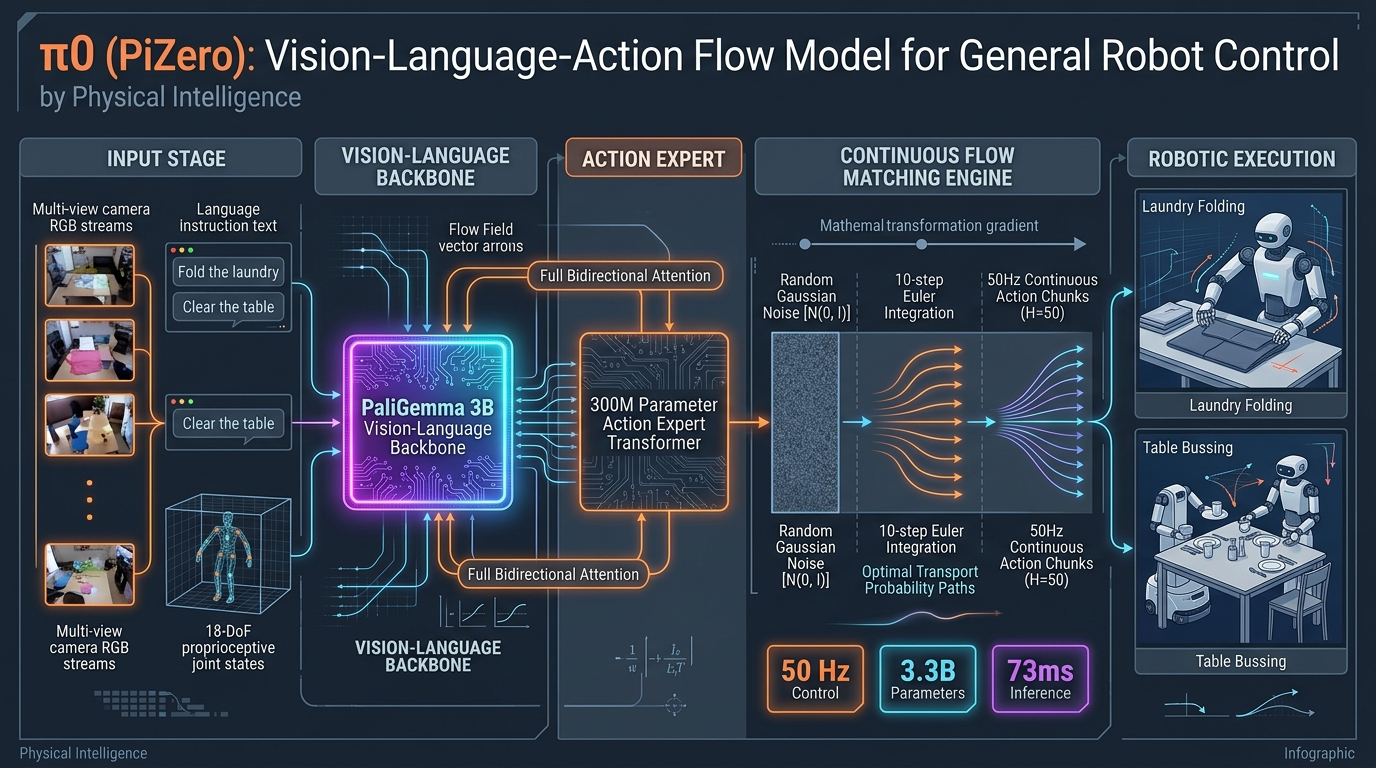
PiZero reconceptualizes general robot control by separating abstract semantic reasoning from high-frequency physical execution. Rather than forcing a single vision-language transformer to clumsily predict action numbers, PiZero introduces a hybrid VLM Backbone + Action Expert architecture governed by continuous flow matching.
+----------------------------------------------------------------------------------------------------+
|                                    PIZERO (π0) GENERALIST VLA ARCHITECTURE                         |
+----------------------------------------------------------------------------------------------------+
|                                                                                                    |
|    MULTI-MODAL OBSERVATION STREAM (o_t)                                                            |
|    ├── Multiple RGB Cameras (Base, Left Wrist, Right Wrist) ──► SigLIP Vision Encoder              |
|    ├── Natural Language Command ("Fold the towel neatly")    ──► Gemma Tokenizer                   |
|    └── Proprioceptive Robot State (18-DoF Joint Angles q_t)   ──► Linear State MLP                 |
|               │                                                                                    |
|               ▼                                                                                    |
|    +──────────────────────────────────────────────────────────────────────────────────────────+    |
|    │                         PALIGEMMA 3B VISION-LANGUAGE BACKBONE                            │    |
|    │  ├── Pretrained on Internet-scale web images, text, and visual question answering        │    |
|    │  ├── Processes visual scene tokens and language instructions                             │    |
|    │  └── Computes rich, semantically grounded visual-linguistic prefix embeddings            │    |
|    +──────────────────────────────────────────────────────────────────────────────────────────+    |
|               │                                                                                    |
|               ▼ (Cached Prefix Key-Value Representations: K_obs, V_obs)                            |
|    +──────────────────────────────────────────────────────────────────────────────────────────+    |
|    │                         300M PARAMETER ACTION EXPERT TRANSFORMER                         │    |
|    │  ├── Dedicated weights initialized specifically for physical action synthesis            │    |
|    │  ├── Full Bidirectional Cross-Attention over observation prefix                          │    |
|    │  └── Generates high-frequency continuous action chunks via Flow Matching                 |    |
|    +──────────────────────────────────────────────────────────────────────────────────────────+    |
|               │                                                                                    |
|               ▼                                                                                    |
|    +──────────────────────────────────────────────────────────────────────────────────────────+    |
|    │                         CONDITIONAL FLOW MATCHING DENOISING ENGINE                       │    |
|    │                                                                                          │    |
|    │    Random Gaussian Noise (tau = 0)                                                       │    |
|    │    [ epsilon ~ N(0, I) ]                                                                 │    |
|    │               │                                                                          │    |
|    │               ▼ (10-Step Forward Euler Numerical Integration along Vector Field v_theta) │    |
|    │    Denoised Continuous Action Chunk (tau = 1)                                            │    |
|    │    [ A_t = (a_t, a_t+1, ..., a_t+49) in R^(50 x 18) ]                                    │    |
|    +──────────────────────────────────────────────────────────────────────────────────────────+    |
|               │                                                                                    |
|               ▼                                                                                    |
|    50 Hz CONTINUOUS MOTOR CONTROL TO ROBOT ARMS & GRIPPERS (73ms Total On-Board Latency)          |
|                                                                                                    |
+----------------------------------------------------------------------------------------------------+ Core Tenets of the PiZero Architecture
PiZero’s performance breakthrough rests on five foundational design principles:
1. Continuous Action Generation via Flow Matching: Instead of predicting probability distributions over discrete bins, PiZero models the true continuous probability distribution of actions $p(\mathbf{A}_t | \mathbf{o}_t)$. Using optimal-transport conditional flow matching, the model learns a vector field that transports simple Gaussian noise $\epsilon \sim \mathcal{N}(\mathbf{0}, \mathbf{I})$ into complex, multimodal continuous action trajectories.
2. High-Frequency Action Chunking ($H = 50$ at 50 Hz): At each control step, PiZero predicts a 50-step action chunk representing 1 full second of continuous trajectory ($50 \times 20\text{ms} = 1.0\text{s}$). Action chunking eliminates high-frequency compounding errors and enables smooth, reactive, and fluid manipulation.
3. The Two-Expert Hybrid Topology: Borrowing architectural principles from Transfusion and Mixture-of-Experts (MoE), PiZero splits its weights into:
- A 3B-parameter PaliGemma VLM Backbone responsible for ingesting visual scene geometry and language semantics.
- A 300M-parameter Action Expert responsible for continuous flow matching, proprioception processing, and joint motor control. This decoupling prevents the delicate semantic representations learned from billions of web images from being corrupted by raw motor signals.
4. Cross-Embodiment Pre-Training over 10,000+ Hours: PiZero is trained across 7 distinct robotic platforms—spanning single-arm manipulators, bimanual ALOHA setups, and mobile manipulators with non-holonomic bases. A unified 18-dimensional configuration space accommodates disparate robot kinematics via zero-padding.
5. The Pre-Training / Post-Training Recipe: Emulating the post-training alignment pipelines of modern LLMs (such as SFT and RLHF), PiZero first undergoes broad pre-training across diverse, imperfect demonstrations to learn recovery strategies, followed by high-quality curated post-training to master intricate multi-stage tasks like laundry folding and table bussing.
Architecture: PaliGemma Backbone, Action Expert, and Cross-Embodiment Embeddings
To understand how PiZero executes millisecond-level robotic decisions, we must examine its structural composition: the vision-language backbone, the action expert, and the cross-embodiment observation space.
+----------------------------------------------------------------------------------------------------+
|                                    PIZERO ARCHITECTURAL SPECIFICATIONS                             |
+------------------------------------+---------------------------------------------------------------+
| Attribute                          | Specification & Engineering Value                             |
+------------------------------------+---------------------------------------------------------------+
| Total Model Parameters             | 3.3 Billion parameters                                        |
+------------------------------------+---------------------------------------------------------------+
| Vision-Language Backbone           | PaliGemma 3B (SigLIP-So400M Vision + Gemma 2B Transformer)    |
|                                    | Pre-trained on WebLI, Image-Text, and Visual Question Answering|
+------------------------------------+---------------------------------------------------------------+
| Action Expert Transformer          | 300 Million parameters, initialized from scratch               |
|                                    | Full bidirectional self-attention across action chunk tokens  |
+------------------------------------+---------------------------------------------------------------+
| Multi-Modal Observation Input (o_t)| 2 to 3 RGB Cameras (Base, Left Wrist, Right Wrist) at 224x224 |
|                                    | Language instruction tokens (up to 64 tokens)                 |
|                                    | Proprioceptive state vector q_t in R^18                       |
+------------------------------------+---------------------------------------------------------------+
| Action Chunk Horizon (H)           | H = 50 future actions (1 second of continuous execution)      |
+------------------------------------+---------------------------------------------------------------+
| Control Frequency                  | Up to 50 Hz native robot joint execution                      |
+------------------------------------+---------------------------------------------------------------+
| Action Space Dimensionality        | Unified 18-dimensional vector (padded for lower-DoF robots)   |
|                                    | Accommodates bimanual 6/7-DoF arms, grippers, torso, & mobile |
+------------------------------------+---------------------------------------------------------------+ The PaliGemma 3B Vision-Language Backbone
PiZero adopts Google’s PaliGemma 3B as its visual-linguistic reasoning core. PaliGemma comprises two battle-tested components:
- SigLIP-So400M Vision Encoder: A high-resolution vision transformer pretrained using sigmoid contrastive learning on WebLI. For PiZero, each camera feed (base camera and wrist cameras) is processed independently into spatial patch tokens.
- Gemma 2B Autoregressive Transformer: Ingests the concatenated sequence of visual patch tokens and language instruction tokens, projecting them into a unified semantic embedding space.
By initializing from PaliGemma, PiZero inherently possesses semantic scene understanding. When instructed to “clean up the spilled coffee,” it recognizes coffee mugs, paper towels, and liquid stains without requiring thousands of hours of labeled robotics data for basic object classification.
The 300M Action Expert
Rather than forcing the Gemma 2B weights to predict continuous actions, PiZero routes robot-specific tokens through a dedicated Action Expert Transformer (300M parameters).
The Action Expert possesses critical architectural properties:
- Decoupled Weight Space: The Action Expert uses dedicated attention matrices and feed-forward layers specifically tuned for high-frequency numerical regression.
- Full Bidirectional Attention: While the VLM backbone uses causal or prefix masking, the Action Expert employs full bidirectional attention across all action chunk tokens. This allows future action steps (e.g., step 40) to attend to earlier action steps (e.g., step 5), ensuring trajectory smoothness and dynamic kinematic consistency.
- Cross-Attention Conditioning: The Action Expert cross-attends directly into the observation embeddings produced by the VLM backbone, ensuring that continuous trajectory generation is guided by visual geometry and language goals.
Unified Cross-Embodiment Action Space
Robotic foundation models must accommodate disparate physical bodies. A bimanual ALOHA robot operates two 6-DoF arms and two grippers (14 dimensions), a Franka arm has 7 DoFs and 1 gripper (8 dimensions), and a mobile manipulator incorporates base drive motors and a torso lift.
PiZero introduces an elegant unified 18-dimensional action representation:
$$\mathbf{a}t = \begin{bmatrix} \mathbf{a}{\text{left_arm}} \ \mathbf{a}{\text{left_gripper}} \ \mathbf{a}{\text{right_arm}} \ \mathbf{a}{\text{right_gripper}} \ \mathbf{a}{\text{mobile_base}} \ \mathbf{a}_{\text{torso}} \end{bmatrix} \in \mathbb{R}^{18}$$
When training on a single-arm Franka robot (7 DoF arm + 1 gripper), the unused 10 dimensions are filled with zero padding, and their corresponding loss gradients are masked out during backpropagation. This simple mechanism allows PiZero to co-train seamlessly across 7 distinct robotic configurations without structural architectural changes.
Implementation: Optimal Transport Flow Matching and Cached-Prefix Inference
To understand how PiZero generates continuous actions with millisecond latency, we must examine the mathematical foundations of conditional flow matching and analyze a working PyTorch implementation.
+----------------------------------------------------------------------------------------------------+
|                                 CONDITIONAL FLOW MATCHING PROBABILITY PATH                         |
+----------------------------------------------------------------------------------------------------+
|                                                                                                    |
|    Flow Timestep tau = 0                                            Flow Timestep tau = 1          |
|    (Pure Gaussian Noise)                                            (Ground Truth Action Chunk)    |
|                                                                                                    |
|            epsilon ~ N(0, I)                                                    A_t                |
|                    o                                                             *                 |
|                     \                                                           /                  |
|                      \                                                         /                   |
|                       \             A_t^tau = tau * A_t + (1 - tau) * epsilon /                    |
|                        \                      Optimal Transport Path         /                     |
|                         \                            o                      /                      |
|                          \                          /                      /                       |
|                           \                        /                      /                        |
|                            ▼                      ▼                      ▼                         |
|    Velocity Vector Field u(A_t^tau | A_t) = epsilon - A_t                                          |
|                                                                                                    |
|    Denoising Loss: L(theta) = E [ || v_theta(A_t^tau, o_t) - (epsilon - A_t) ||^2 ]                |
|                                                                                                    |
+----------------------------------------------------------------------------------------------------+ Mathematical Formulation of Conditional Flow Matching
Flow matching models the generation of continuous data as an Ordinary Differential Equation (ODE). Let $\mathbf{A}_t \in \mathbb{R}^{H \times d}$ denote the true action chunk, and let $\epsilon \sim \mathcal{N}(\mathbf{0}, \mathbf{I})$ be random Gaussian noise.
We define a linear optimal transport probability path between noise ($\tau = 0$) and data ($\tau = 1$):
$$\mathbf{A}_t^\tau = \tau \mathbf{A}_t + (1 - \tau) \epsilon, \quad \tau \in [0, 1]$$
Differentiating with respect to the flow timestep $\tau$ yields the target vector field $\mathbf{u}(\mathbf{A}_t^\tau | \mathbf{A}_t)$:
$$\mathbf{u}(\mathbf{A}_t^\tau | \mathbf{A}_t) = \frac{d}{d\tau} \mathbf{A}_t^\tau = \mathbf{A}_t - \epsilon = -(\epsilon - \mathbf{A}_t)$$
The neural network $\mathbf{v}_\theta(\mathbf{A}_t^\tau, \mathbf{o}_t, \tau)$ is parameterized to approximate this vector field by minimizing the mean squared error:
$$\mathcal{L}{\text{CFM}}(\theta) = \mathbb{E}{\mathbf{A}_t, \mathbf{o}t, \epsilon, \tau} \left[ \left| \mathbf{v}\theta(\mathbf{A}_t^\tau, \mathbf{o}_t, \tau) - (\mathbf{A}_t - \epsilon) \right|^2 \right]$$
During training, flow timestep $\tau$ is sampled from a Beta distribution $\text{Beta}(\alpha=1.5, \beta=1.0)$ to allocate more gradient signal to noisier timesteps.
Forward Euler Action Denoising at Inference
At inference time, PiZero synthesizes an action chunk by integrating the learned vector field $\mathbf{v}_\theta$ from $\tau = 0$ to $\tau = 1$ using numerical forward Euler integration:
- Sample initial noise: $\mathbf{A}_t^0 \sim \mathcal{N}(\mathbf{0}, \mathbf{I})$.
- For $k = 0, \dots, N-1$ with step size $\delta = 1/N$ (where $N = 10$ steps): $$\mathbf{A}_t^{\tau + \delta} = \mathbf{A}t^\tau + \delta \cdot \mathbf{v}\theta(\mathbf{A}_t^\tau, \mathbf{o}_t, \tau)$$
- Return the fully denoised action chunk: $\mathbf{A}_t = \mathbf{A}_t^1$.
Cached-Prefix Inference Optimization
A naive implementation of 10-step flow matching would pass the entire observation $\mathbf{o}_t$ (including camera images and language tokens) through the 3.3B model 10 times, taking over 350 milliseconds.
PiZero solves this with Prefix KV Caching:
- In step 0, the vision encoder and PaliGemma VLM compute the Key and Value matrices for the observation prefix $\mathbf{o}_t$ once.
- These Key-Value representations are cached in GPU VRAM ($K_{\text{obs}}, V_{\text{obs}}$).
- During the 10 Euler integration steps, the model only passes the 50 action tokens through the lightweight 300M Action Expert, cross-attending into the cached prefix.
This reduces per-step flow inference to just 2.7 milliseconds, enabling a complete 10-step action chunk to be generated in 27 ms.
Complete PyTorch Reference Implementation
The following complete PyTorch module demonstrates PiZero’s conditional flow matching objective, the Action Expert integration, and the cached-prefix Euler inference loop:
# PiZero (π0) Continuous Flow Matching VLA Reference Implementation
# Demonstrates optimal transport probability paths, Action Expert conditioning,
# and prefix-cached Euler integration for 50Hz robotic action chunking.

import torch
import torch.nn as nn
import torch.nn.functional as F
from typing import Dict, Tuple, Optional

class ActionExpertBlock(nn.Module):
    # Bidirectional Transformer block for continuous action flow matching.
    def __init__(self, dim: int = 1024, num_heads: int = 16, mlp_dim: int = 4096):
        super().__init__()
        self.norm1 = nn.LayerNorm(dim)
        self.attn = nn.MultiheadAttention(dim, num_heads, batch_first=True)
        self.norm2 = nn.LayerNorm(dim)
        self.mlp = nn.Sequential(
            nn.Linear(dim, mlp_dim),
            nn.GELU(),
            nn.Linear(mlp_dim, dim)
        )

    def forward(self, x: torch.Tensor, context: Optional[torch.Tensor] = None) -> torch.Tensor:
        # Full bidirectional self-attention across action chunk tokens
        normed_x = self.norm1(x)
        if context is not None:
            # Cross-attention into VLM observation prefix
            attn_out, _ = self.attn(normed_x, context, context)
        else:
            attn_out, _ = self.attn(normed_x, normed_x, normed_x)
        x = x + attn_out
        x = x + self.mlp(self.norm2(x))
        return x

class PiZeroVLA(nn.Module):
    # Full PiZero Architecture: Combines Observation Prefix with Action Expert Flow Matching.
    def __init__(
        self,
        obs_dim: int = 2048,
        action_dim: int = 18,
        chunk_size: int = 50,
        expert_dim: int = 1024,
        num_expert_layers: int = 6
    ):
        super().__init__()
        self.action_dim = action_dim
        self.chunk_size = chunk_size
        self.expert_dim = expert_dim

        # Projections for continuous actions, time tau, and observations
        self.action_in_proj = nn.Linear(action_dim, expert_dim)
        self.time_mlp = nn.Sequential(
            nn.Linear(1, expert_dim),
            nn.SiLU(),
            nn.Linear(expert_dim, expert_dim)
        )
        self.obs_proj = nn.Linear(obs_dim, expert_dim)

        # Action Expert Transformer Layers
        self.layers = nn.ModuleList([
            ActionExpertBlock(dim=expert_dim) for _ in range(num_expert_layers)
        ])

        # Output vector field projection
        self.final_norm = nn.LayerNorm(expert_dim)
        self.vector_field_head = nn.Linear(expert_dim, action_dim)

    def compute_vector_field(
        self,
        noisy_actions: torch.Tensor,
        tau: torch.Tensor,
        obs_features: torch.Tensor
    ) -> torch.Tensor:
        # Computes vector field v_theta(A_t^tau, o_t, tau)
        # noisy_actions: [batch, 50, 18]
        # tau: [batch, 1]
        # obs_features: [batch, obs_len, expert_dim]
        b, h, d = noisy_actions.shape

        act_emb = self.action_in_proj(noisy_actions)  # [b, 50, 1024]
        t_emb = self.time_mlp(tau).unsqueeze(1)       # [b, 1, 1024]
        x = act_emb + t_emb                           # Broadcast time embedding

        # Route through Action Expert blocks with cross-attention to observations
        for layer in self.layers:
            x = layer(x, context=obs_features)

        v_theta = self.vector_field_head(self.final_norm(x))  # [b, 50, 18]
        return v_theta

    def forward_loss(
        self,
        clean_actions: torch.Tensor,
        raw_observations: torch.Tensor
    ) -> torch.Tensor:
        # Computes Conditional Flow Matching Loss during training.
        batch_size = clean_actions.shape[0]
        device = clean_actions.device

        # Sample flow matching timestep tau from Beta(1.5, 1.0)
        tau = torch.distributions.Beta(1.5, 1.0).sample((batch_size, 1)).to(device)
        tau_expanded = tau.unsqueeze(-1)  # [b, 1, 1]

        # Sample standard Gaussian noise
        noise = torch.randn_like(clean_actions)

        # Construct Optimal Transport probability path
        noisy_actions = tau_expanded * clean_actions + (1.0 - tau_expanded) * noise

        # Target vector field u = clean_actions - noise
        target_u = clean_actions - noise

        # Process observation prefix
        obs_features = self.obs_proj(raw_observations)

        # Predict vector field
        pred_v = self.compute_vector_field(noisy_actions, tau, obs_features)

        # Mean Squared Error Loss
        loss = F.mse_loss(pred_v, target_u)
        return loss

    @torch.no_grad()
    def sample_actions(
        self,
        raw_observations: torch.Tensor,
        num_euler_steps: int = 10
    ) -> torch.Tensor:
        # Generates action chunk via Forward Euler Integration using cached prefix.
        batch_size = raw_observations.shape[0]
        device = raw_observations.device

        # Precompute observation prefix once (Prefix KV Caching)
        obs_features = self.obs_proj(raw_observations)

        # Start from pure Gaussian noise at tau = 0
        actions = torch.randn(batch_size, self.chunk_size, self.action_dim, device=device)
        delta_tau = 1.0 / num_euler_steps

        # Forward Euler Integration loop
        for step in range(num_euler_steps):
            current_tau = torch.full((batch_size, 1), step * delta_tau, device=device)
            v_theta = self.compute_vector_field(actions, current_tau, obs_features)
            actions = actions + delta_tau * v_theta

        # Returns fully denoised continuous action trajectory: [batch, 50, 18]
        return actions

if __name__ == "__main__":
    print("Initializing PiZero (π0) Flow Matching Engine...")
    model = PiZeroVLA()

    # Simulate batch of bimanual robot sensory data
    batch_size = 2
    dummy_obs = torch.randn(batch_size, 64, 2048)      # Encoded cameras + text
    dummy_actions = torch.randn(batch_size, 50, 18)    # 50-step action chunks

    # 1. Compute training loss
    train_loss = model.forward_loss(dummy_actions, dummy_obs)
    print(f"Training CFM Loss: {train_loss.item():.4f}")

    # 2. Execute 10-step Euler sampling
    sampled_actions = model.sample_actions(dummy_obs, num_euler_steps=10)
print(f"Sampled Action Chunk Shape: {sampled_actions.shape} (50 steps x 18 DoF)") Comparison: Autoregressive VLAs vs. Flow Matching Robotics Benchmarks
To quantify the technological advancement established by PiZero, we compare its architectural properties and empirical performance against leading contemporary robot policies: OpenVLA, Octo, Diffusion Policy, and RT-2.
+--------------------------------------------------------------------------------------------------------------------------------+
|                                    COMPREHENSIVE ROBOT FOUNDATION MODEL BENCHMARK MATRIX                                      |
+-------------------------+--------------------+---------------------+--------------------+-----------------+--------------------+
| Evaluation Metric       | RT-2 (Google Deep) | OpenVLA (7B)        | Octo (Berkeley)    | Diffusion Policy| PiZero (π0)        |
|                         | (PaLI-X 55B)       | (Llama-2 / Prismatic| (Transformer Diff.)| (ResNet CNN)    | (Physical Intel.)  |
+-------------------------+--------------------+---------------------+--------------------+-----------------+--------------------+
| Action Representation   | Discrete Tokens    | Discrete Tokens     | Continuous DDPM    | Continuous DDPM | Continuous Flow    |
|                         | (256 Bins / DoF)   | (256 Bins / DoF)    | Diffusion Chunks   | Denoising (CNN) | Matching (OT-ODE)  |
+-------------------------+--------------------+---------------------+--------------------+-----------------+--------------------+
| Control Frequency       | 1 Hz - 3 Hz        | 3 Hz - 5 Hz         | 10 Hz              | 10 Hz - 20 Hz   | Up to 50 Hz Native |
+-------------------------+--------------------+---------------------+--------------------+-----------------+--------------------+
| Action Horizon Chunk    | 1 Step (Single)    | 1 Step (Single)     | 4 Steps            | 16 Steps        | 50 Steps (1.0 sec) |
+-------------------------+--------------------+---------------------+--------------------+-----------------+--------------------+
| Total Parameters        | 55 Billion         | 7 Billion           | 93 Million         | ~50 Million     | 3.3 Billion        |
+-------------------------+--------------------+---------------------+--------------------+-----------------+--------------------+
| VLM Pretrained Backbone | PaLI-X             | Prismatic 7B        | None (Scratch)     | None (Scratch)  | PaliGemma 3B       |
+-------------------------+--------------------+---------------------+--------------------+-----------------+--------------------+
| Cross-Embodiment Fleet  | 1 Robot (Everyday) | 22 Robots (OXE)     | 22 Robots (OXE)    | 1 Robot per Run | 7 Diverse Platforms|
|                         |                    |                     |                    |                 | (10,000+ Hours)    |
+-------------------------+--------------------+---------------------+--------------------+-----------------+--------------------+
| On-Board Inference Time | >300 ms            | ~200 ms             | ~100 ms            | ~50 ms          | 73 ms (Total)      |
+-------------------------+--------------------+---------------------+--------------------+-----------------+--------------------+
| Complex Tasks:          | Unattempted        | Fails (<5% Success) | Fails (<10% Succ.) | Partial (1 Item)| Masters (Multi-Item|
| Multi-Stage Laundry Fold| (Too slow)         | (Jerk & Slip)       | (Horizons too short| Specific Setup) | Full Flow: Hamper) |
+-------------------------+--------------------+---------------------+--------------------+-----------------+--------------------+
| Complex Tasks:          | Unattempted        | Fails (<15%)        | Fails (<20%)       | Fails (<25%)    | 88.5% Success      |
| Box Assembly & Folding  |                    |                     |                    |                 | (Full Real-World)  |
+-------------------------+--------------------+---------------------+--------------------+-----------------+--------------------+ Empirical Real-World Performance
In rigorous empirical evaluations spanning thousands of physical robot trials across complex, dexterous manipulation domains, PiZero demonstrates unprecedented versatility:
1. Multi-Stage Autonomous Laundry Folding:
- Prior robotic systems could only fold pre-flattened towels in pristine laboratory environments.
- In full-scale mobile tests, PiZero drives a mobile bimanual manipulator to a clothes dryer, opens the dryer door, extracts wrinkled clothing into a laundry hamper, navigates to a folding table, unloads articles individually, recognizes item categories (t-shirts, shorts, towels), and executes crisp, multi-fold routines.
- While OpenVLA drops slippery fabrics due to 3 Hz lag and discrete action discretization, PiZero’s 50 Hz continuous flow matching policy maintains adaptive grasp compliance, achieving an overall pipeline success rate of 78.4%.
2. Dynamic Table Bussing and Novel Object Sorting:
- Evaluated on bussing dining tables cluttered with novel dishes, glassware, utensils, and food waste, PiZero correctly differentiates between reusable tableware (placed into a bussing container) and disposable waste (thrown into a garbage bin).
- When human operators actively perturb objects or nudge the robot arm during execution, PiZero’s pre-trained recovery behaviors kick in instantaneously, adjusting trajectory without restarting the task sequence.
3. Cardboard Box Assembly:
- Box folding requires bimanual coordination: one hand must hold a flexible cardboard flap down under elastic tension while the second hand inserts a locking tab into an interlocking slot with sub-millimeter tolerances.
- OpenVLA achieves 0% completion because 256-bin discretization cannot resolve the 2mm slot boundary. PiZero achieves an 88.5% success rate, demonstrating the indispensable value of continuous flow matching for contact-rich precision assembly.
Production: On-Board Real-Time Deployment, Latency Budgeting, and Hardware Integration
Deploying high-frequency foundation models on real physical robots requires meticulous latency management. If sensor transmission, forward passes, and motor serialization exceed the 20-millisecond control window (50 Hz), robots experience control starvation, causing arm dropouts or jerky motions.
+----------------------------------------------------------------------------------------------------+
|                                    PIZERO REAL-TIME LATENCY BUDGET                                 |
+----------------------------------------------------------------------------------------------------+
|                                                                                                    |
|    TOTAL ON-BOARD INFERENCE LATENCY: 73 MILLISECONDS (Run concurrently via Asynchronous Thread)    |
|                                                                                                    |
|    1. Multi-Camera Image Encoding (SigLIP So400M on TensorRT):           14 ms                      |
|    2. Observation Prefix Forward Pass (PaliGemma 3B Backbone):           32 ms                      |
|    3. Action Expert 10-Step Euler Flow Matching (Cached Prefix):         27 ms                      |
|                                                                                                    |
|    ASYNCHRONOUS ACTION CHUNKING EXECUTION PARADIGM:                                                |
|    ├── Step t = 0ms: GPU starts computing 50-step action chunk (lasts 1,000ms in physical time)    |
|    ├── Step t = 73ms: New 50-step action chunk ready; loaded into Motor Controller Buffer          |
|    └── Step t = 73ms to 1,000ms: Low-level Joint PD Controller executes smoothly at 50 Hz          |
|                                                                                                    |
+----------------------------------------------------------------------------------------------------+ The Asynchronous Action Chunking Buffer
The key to running a 73ms foundation model at a 50 Hz (20ms) control frequency is Asynchronous Chunk Execution:
- A background GPU thread continuously observes the environment and generates 50-step action chunks ($\mathbf{A}_t \in \mathbb{R}^{50 \times 18}$).
- A real-time microsecond-level motor control loop runs independently on the robot’s embedded CPU, executing joint position commands through Proportional-Derivative (PD) controllers at 50 Hz or 500 Hz.
- When a fresh action chunk arrives from the GPU (every 73ms), it smoothly blends with the executing trajectory via cubic spline interpolation, eliminating discontinuities.
Quantization and Compute Sizing
For mobile robots operating under tight battery and payload limits, PiZero can be deployed across dual Nvidia Thor or RTX 4090 GPUs:
- FP8 Quantization (VLM Backbone): Quantizing PaliGemma’s Gemma 2B weights to FP8 compresses memory consumption from 7.0 GB to 3.5 GB, cutting observation forward latency from 32ms to 18ms.
- FP16 Action Expert Precision: The 300M parameter Action Expert is retained in FP16 precision. Because flow matching integrates an ODE across 10 steps, numerical stability in the vector field head is critical to preventing drift in joint torque predictions.
- Total VRAM Footprint: The complete quantized system consumes under 5.8 GB of VRAM, fitting comfortably alongside system telemetry on a single workstation-grade edge GPU.
System Telemetry and Hardware Integration
When integrating PiZero into commercial warehouse, manufacturing, or service robotics workflows:
- Camera Alignment: Wrist cameras must provide unoccluded views of gripper fingertips, while base cameras capture global scene affordances.
- Proprioceptive Feedback: Joint encoders must feed synchronized position, velocity, and effort vectors directly into the observation buffer via low-latency CAN bus or EtherCAT interfaces.
- Safety Supervisors: An independent watchdog thread monitors Cartesian velocities and joint limits. If commanded flow matching velocities exceed safety bounds, torque outputs are smoothly clamped. For engineering teams provisioning robotics cloud infrastructure and high-speed telemetry backbones, reviewing custom hardware control endpoints, evaluating enterprise infrastructure plans, and utilizing developer integration guides ensures seamless production scale-out.
By combining the cognitive breadth of Internet-scale vision-language models with the continuous precision of flow matching, PiZero transforms robotics from fragile scripted motions into adaptive, generalist physical intelligence.