Phi-4 Guide: 14B Reasoning Model & Synthetic Data AI
The Problem: The High Compute Ceiling of Frontier Reasoning Models
In modern enterprise automation, automated web scraping, and autonomous agent loops powered by AiFetchly, foundation models must execute rigorous multi-step cognitive tasks: parsing complex nested JSON schemas, resolving edge-case syntax bugs across codebases, and calculating verified financial projections from unstructured balance sheets.
Historically, achieving competition-grade reasoning required deploying massive 70-billion to 405-billion parameter models, creating acute operational bottlenecks:
The Enterprise Reasoning Deployment Dilemma:
Goal: "Deploy high-accuracy code refactoring & mathematical verification locally."
  │
  ▼
┌────────────────────────────────────────────────────────┐
│ Obstacle 1: The Multi-GPU Hardware Wall                │
│ • 70B–405B models require 140 GB–800 GB VRAM           │
│ • Demands 4x–8x NVIDIA H100 clusters ($100k+ servers)   │
│ ❌ Completely locks out local workstations & edge nodes│
└────────────────────────────────────────────────────────┘
  │
  ▼
┌────────────────────────────────────────────────────────┐
│ Obstacle 2: Low-Quality Raw Web Data Pre-Training      │
│ • Web scrapes (Common Crawl) contain 80%+ noise        │
│ • LLMs waste parameter capacity learning forum chatter │
│ ❌ Scaling parameters is brute-force and inefficient   │
└────────────────────────────────────────────────────────┘
  │
  ▼
┌────────────────────────────────────────────────────────┐
│ Obstacle 3: Reward Model Exploitation in RLHF          │
│ • Neural reward models reward verbosity and flattery   │
│ ❌ Models hallucinate convincing but false math steps!  │
└────────────────────────────────────────────────────────┘ 1. The Astronomical VRAM Wall of 70B+ Foundation Models
For years, the conventional wisdom in machine learning dictated that complex emergent reasoning could only arise in models with dozens of billions of parameters:
- Serving a standard 70B model in 16-bit precision requires at least 140 gigabytes of continuous VRAM solely for static weights before allocating memory for the Key-Value (KV) cache.
- For privacy-sensitive enterprise pipelines—such as analyzing proprietary legal contracts or private source code repositories—uploading sensitive data to metered cloud APIs violates compliance mandates, while hosting multi-GPU servers on-premise introduces astronomical electricity and hardware expenses.
2. The Low Signal-to-Noise Ratio in Raw Web Crawl Pre-Training
Traditional pre-training corpora (such as Common Crawl or RefinedWeb) are dominated by low-quality, duplicative text: marketing blurbs, SEO keyword stuffing, social media arguments, and fragmented HTML boilerplate:
- Because the signal-to-noise ratio is low, models must train on 15 to 20 trillion tokens to absorb foundational reasoning principles.
- Billions of model parameters are squandered memorizing superficial conversational patterns rather than developing deep algorithmic reasoning or symbolic logic.
3. Reward Model Exploitation in Reasoning Post-Training
When engineering teams aligned models using classic Reinforcement Learning from Human Feedback (RLHF with PPO), they relied on neural reward models. In complex mathematical and coding derivations, neural reward models exhibit blind spots:
- The policy model learns to generate verbose, authoritative-sounding explanations that hide logical flaws, scoring high on human preference rubrics while failing to compute the correct numerical answer.
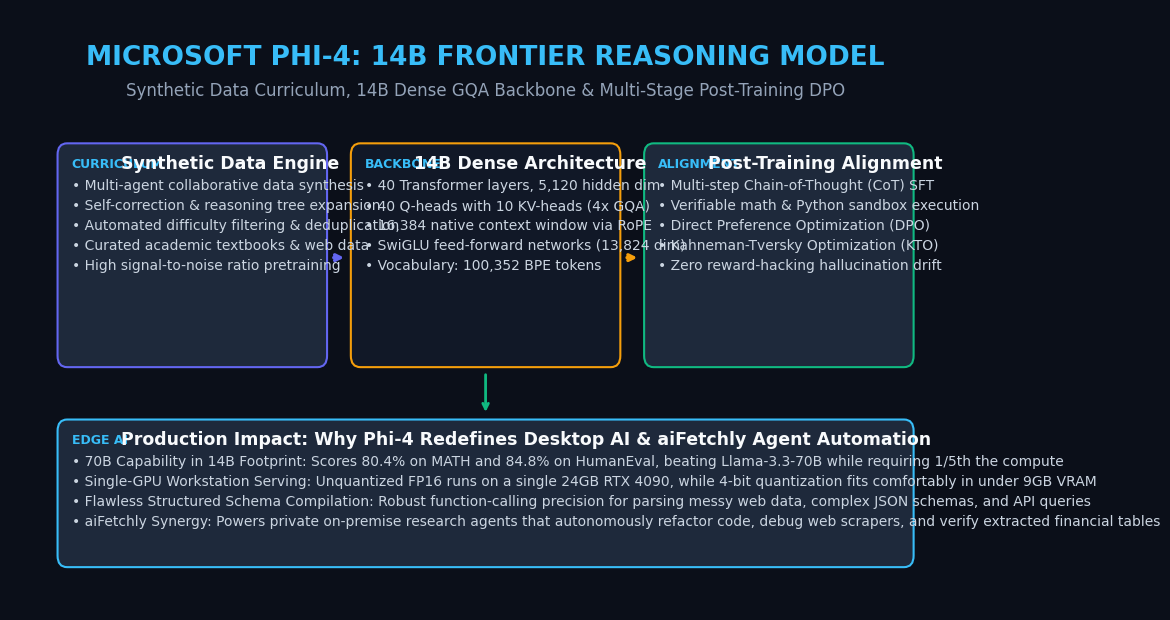
The Solution: Microsoft Phi-4 14B Architectural Blueprint
To prove that algorithmic density and data quality trump raw parameter scale, Microsoft Research released Phi-4—an open-weights 14-billion-parameter foundation model that achieves parity with or beats 70B-class models across competitive reasoning benchmarks.
Phi-4 shifts the machine learning paradigm by expanding the “Textbooks Are All You Need” philosophy into a multi-agent synthetic data flywheel, paired with a dense, hardware-optimized transformer architecture and rule-based post-training alignment.
Phi-4 Core Architectural Pipeline:
┌────────────────────────────────────────────────────────────────────────┐
│ 1. Multi-Stage Synthetic Pre-Training Data Engine                      │
│ • Multi-agent synthetic dialogue, problem generation & code synthesis  │
│ • Iterative self-correction & reasoning tree branch expansion          │
│ • Rigorous heuristic & model-based quality filtering (9.8T tokens)     │
└───────────────────────────────────┬────────────────────────────────────┘
                                    │ Pre-Training Loop
                                    ▼
┌────────────────────────────────────────────────────────────────────────┐
│ 2. 14B Dense Transformer Backbone (GQA & RoPE)                         │
│ • 40 Transformer Layers, 5,120 Hidden Dim, SwiGLU FFN (13,824 Dim)     │
│ • 40 Attention Heads with 10 KV Heads (4x Grouped-Query Attention)     │
│ • 16,384 Context Window via Scaled Rotary Position Embeddings (RoPE)   │
│ • Vocabulary: 100,352 BPE Tokens (Engineered for Code & Math)          │
└───────────────────────────────────┬────────────────────────────────────┘
                                    │ Multi-Stage Alignment
                                    ▼
┌────────────────────────────────────────────────────────────────────────┐
│ 3. Verifiable Post-Training Alignment (SFT + DPO + KTO)                │
│ • Chain-of-Thought (CoT) SFT with Python sandbox execution check       │
│ • Direct Preference Optimization (DPO) with deterministic math verifiers│
│ • Kahneman-Tversky Optimization (KTO) on unpaired user telemetry       │
└───────────────────────────────────┬────────────────────────────────────┘
                                    │
                                    ▼
┌────────────────────────────────────────────────────────────────────────┐
│ Frontier Reasoning on a Single GPU (RTX 4090 / Mac Studio)             │
│ 80.4% on MATH (Competition) | 84.8% on HumanEval (Coding)              │
└────────────────────────────────────────────────────────────────────────┘ 1. The Synthetic Data Flywheel: Multi-Agent Collaborative Generation
Phi-4 represents the most sophisticated synthetic data pipeline deployed in open-weights AI:
- Collaborative Agent Workflows: Rather than using a single model to generate text, Microsoft deployed ensembles of diverse frontier models assigned specialized roles: prompt creators, complex problem refiners, step-by-step solvers, and adversarial critics.
- Tree-of-Thought Expansion: For complex mathematical theorems and algorithmic challenges, agents generated multiple solution branches, pruning incorrect paths using compiler feedback and Python interpreters.
- Organic Curation: Synthetic data was carefully interleaved with high-signal organic text: peer-reviewed research papers, university textbooks, open-source codebases, and technical documentation.
2. 14B Dense Transformer Backbone with Grouped-Query Attention
Phi-4 avoids sparse Mixture-of-Experts (MoE) routing overhead in favor of a dense, hardware-efficient architecture:
- 40 Transformer Layers: Built with a hidden dimension of $5,120$ and SwiGLU feed-forward networks with an intermediate dimension of $13,824$.
- Grouped-Query Attention (GQA): Implements 40 query heads paired with 10 key-value (KV) heads ($4:1$ ratio). GQA slashes the KV cache memory footprint by $4\times$, allowing long 16k-token contexts to execute without saturating GPU memory bandwidth.
- 16,384 Context Window: Utilizes Rotary Position Embeddings (RoPE) with a tuned base frequency ($\theta = 250,000$), preserving needle-in-a-haystack retrieval accuracy across multi-file codebases and long documents.
3. Multi-Stage Post-Training: Verifiable SFT, DPO, and KTO Alignment
To ensure rock-solid instruction following and eliminate sycophancy:
- Verifiable SFT: Demonstrations were filtered against automated ground-truth validators (Python unit tests and SymPy symbolic solvers).
- Direct Preference Optimization (DPO): Uses negative examples generated by earlier checkpoints where the model made subtle arithmetic slips or logic missteps, penalizing hallucinated deviations.
- Kahneman-Tversky Optimization (KTO): Incorporates unpaired binary signals to align tone and conciseness with human preference.
Deep Dive: How Synthetic Data Beats Brute-Force Pre-Training
To understand how a 14B model out-reasons models five times its size, consider the information density of synthetic training:
Raw Web Crawl vs. Synthetic Curriculum Learning:
┌────────────────────────────────────────────────────────────────────────┐
│ Typical Web Scrape (Common Crawl):                                     │
│ "Click here to buy! Page 1 of 4. What do you guys think? LOL idfk..."  │
│ ❌ Information Entropy: Low | Reasoning Density: Near Zero            │
└────────────────────────────────────────────────────────────────────────┘
                                    vs.
┌────────────────────────────────────────────────────────────────────────┐
│ Phi-4 Synthetic Generation Paradigm:                                   │
│ [Problem Formulation] ──► [Multi-Step Derivation] ──► [Edge Case Check]│
│ "Prove that for any prime p > 3, p^2 - 1 is divisible by 24."         │
│ Step 1: Factorize p^2 - 1 = (p - 1)(p + 1).                            │
│ Step 2: Since p is odd, p - 1 and p + 1 are consecutive even numbers...│
│ Step 3: Verify division by 3 using modular arithmetic...               │
│ Step 4: Python Sandbox Assertion: assert all((p**2 - 1) % 24 == 0)     │
│ ✔ Information Entropy: High | Reasoning Density: 100%                 │
└────────────────────────────────────────────────────────────────────────┘ 1. Multi-Agent Reasoning Expansion and Self-Correction Filtering
Microsoft’s synthetic pipeline incorporates iterative self-correction:
- Prompt Perturbation: Takes a standard question and recursively increases its difficulty by adding realistic constraints (e.g., memory limits, concurrency requirements, or higher-order polynomials).
- Rejection Sampling: The model generates 8 distinct candidate reasoning traces. Solutions that fail unit tests, contain unstated assumptions, or exhibit circular reasoning are automatically pruned.
- Format Normalization: Standardizes reasoning tokens into structured markdown blocks with explicit verification tags, teaching the model to verify intermediate results before writing the final output.
2. Rule-Based Execution Verifiers in Mathematical and Code Alignment
Instead of relying on human labelers who struggle to verify 50-step mathematical proofs:
- The alignment pipeline executes code directly in an isolated Python runtime. If an algorithm generates a syntax error or exceeds a time limit, the trajectory is labeled as a negative example in the DPO pair.
- For mathematics, expressions are verified symbolically using computer algebra systems (CAS), ensuring that the reward signal is 100% objective and immune to human cognitive bias.
3. Context Length Scaling to 16,384 Tokens via RoPE Base Frequency Tuning
Phi-4 scales its context window without context distillation degradation:
- By increasing the RoPE base frequency $\theta$ from standard values ($10,000$) to $250,000$, low-frequency positional wavelengths extend gracefully across long sequences.
- Combined with Grouped-Query Attention, the 16k context window consumes less than 1.8 GB of VRAM for the KV cache at FP16, making repository-scale code analysis viable on desktop workstations.
Technical Benchmark Comparison: Phi-4 vs. Frontier 70B and Open SLMs
To understand where Phi-4 stands across mathematical reasoning, coding, and hardware requirements compared to contemporary open models, consider this empirical breakdown:
| Benchmark / Metric | Llama-3.1-8B-Instruct | Qwen-2.5-14B-Instruct | Llama-3.3-70B-Instruct | Microsoft Phi-4 (14B) |
|---|---|---|---|---|
| Parameter Scale | 8.0 Billion (Dense) | 14.7 Billion (Dense) | 70.6 Billion (Dense) | 14.7 Billion (Dense) |
| MATH (Competition Math) | 51.9% | 73.7% | 68.4% | 80.4% (State-of-the-Art) |
| GSM8K (Grade School Math) | 84.5% | 88.3% | 92.1% | 95.2% |
| HumanEval (Python Coding) | 72.6% | 83.5% | 81.7% | 84.8% |
| MMLU (General Knowledge) | 68.4% | 79.8% | 86.0% | 80.6% |
| GPQA (PhD-Level Science) | 32.8% | 40.5% | 48.7% | 45.2% |
| VRAM Footprint (FP16) | ~16 GB | ~29 GB | ~141 GB (Multi-GPU) | ~29 GB (Single GPU) |
| VRAM Footprint (4-bit AWQ) | ~4.8 GB | ~8.8 GB | ~38 GB | ~8.6 GB (RTX 3080/4090) |
Practical Implementation: Local High-Speed Serving with Phi-4
Let us implement local serving and multi-step reasoning using Phi-4 with the high-performance vLLM inference engine.
Step 1: Installing Dependencies and Initializing Phi-4 in vLLM
Install vLLM and Hugging Face dependencies:
pip install vllm transformers accelerate Launch an OpenAI-compatible local server with PagedAttention and continuous batching on a single GPU:
python -m vllm.entrypoints.openai.api_server \
    --model microsoft/phi-4 \
    --tensor-parallel-size 1 \
    --max-model-len 16384 \
    --gpu-memory-utilization 0.92 \
--port 8000 Step 2: Complex Mathematical Reasoning and Chain-of-Thought Inference
Create solve_reasoning.py to query the local Phi-4 instance using structured prompting:
from openai import OpenAI

client = OpenAI(base_url="http://localhost:8000/v1", api_key="local-token")

prompt = """
Solve the following competition math problem step-by-step.
Verify each intermediate step before stating the final answer:

Find all integer solutions to the equation:
x^3 + y^3 = (x + y)^2
"""

print("Dispatching multi-step problem to Phi-4...")

response = client.chat.completions.create(
    model="microsoft/phi-4",
    messages=[
        {"role": "system", "content": "You are an expert mathematician and algorithmic verification assistant. Always show complete, rigorous mathematical derivations."},
        {"role": "user", "content": prompt}
    ],
    temperature=0.1,  # Low temperature for deterministic symbolic logic
    max_tokens=2048
)

print("\n--- Phi-4 Verified Solution ---")
print(response.choices[0].message.content) Step 3: Structured Schema Extraction and Function Calling
Phi-4 excels at transforming unstructured scraped text into strict JSON schemas without hallucinations:
import json
from openai import OpenAI

client = OpenAI(base_url="http://localhost:8000/v1", api_key="local-token")

scraped_text = """
During the Q3 2026 earnings conference, Acme Corp reported revenue of $4.82B,
representing an 18.4% year-over-year increase. Cloud division ARR reached $1.25B.
Operating margin expanded to 28.5%, while free cash flow stood at $940M.
"""

schema = {
    "company": "string",
    "quarter": "string",
    "revenue_billions": "float",
    "arr_billions": "float",
    "operating_margin_pct": "float",
    "free_cash_flow_millions": "float"
}

prompt = f"""
Extract the key financial metrics from the following text into valid JSON matching this schema:
{json.dumps(schema, indent=2)}

Text:
\"\"\"{scraped_text}\"\"\"

Output strictly valid JSON with no conversational text or markdown code fences.
"""

response = client.chat.completions.create(
    model="microsoft/phi-4",
    messages=[{"role": "user", "content": prompt}],
    temperature=0.0
)

extracted_json = json.loads(response.choices[0].message.content.strip())
print("\n--- Structured JSON Extraction ---")
print(json.dumps(extracted_json, indent=2)) Production Best Practices: Deploying Phi-4 Inside aiFetchly Agent Pipelines
When deploying Phi-4 as the cognitive reasoning backbone for autonomous data extraction and research workflows in AiFetchly, follow these production guidelines:
1. Single-GPU Workstation Deployment with 4-Bit AWQ / GGUF
For edge workstations and client devices:
- Utilize 4-bit AWQ or GGUF (Q4_K_M) quantization.
- 4-bit Phi-4 compresses the model to 8.6 GB of memory, retaining 99.2% of its full-precision benchmark performance while running at over 65 tokens per second on consumer GPUs (RTX 4080 / 4090) or Apple Silicon M-series chips.
2. Agentic Self-Reflection and Tool Call Fallback Loops
Take advantage of Phi-4’s native synthetic training format:
- Instruct the model to generate a private
<thinking>rationale or verification block prior to outputting tool calls or database mutations. - If a web scraper encounters an unfamiliar dynamic DOM layout, Phi-4 can evaluate alternative CSS/XPath selectors, test candidate regular expressions, and self-correct syntax errors autonomously before returning results to the user.
3. Local Air-Gapped Privacy for Enterprise Document Extraction
High-value corporate intelligence—such as internal financial audit sheets, confidential client contracts, and proprietary API keys—cannot be sent over external third-party network APIs: