PaliGemma 2 Guide: Google Vision-Language Architecture
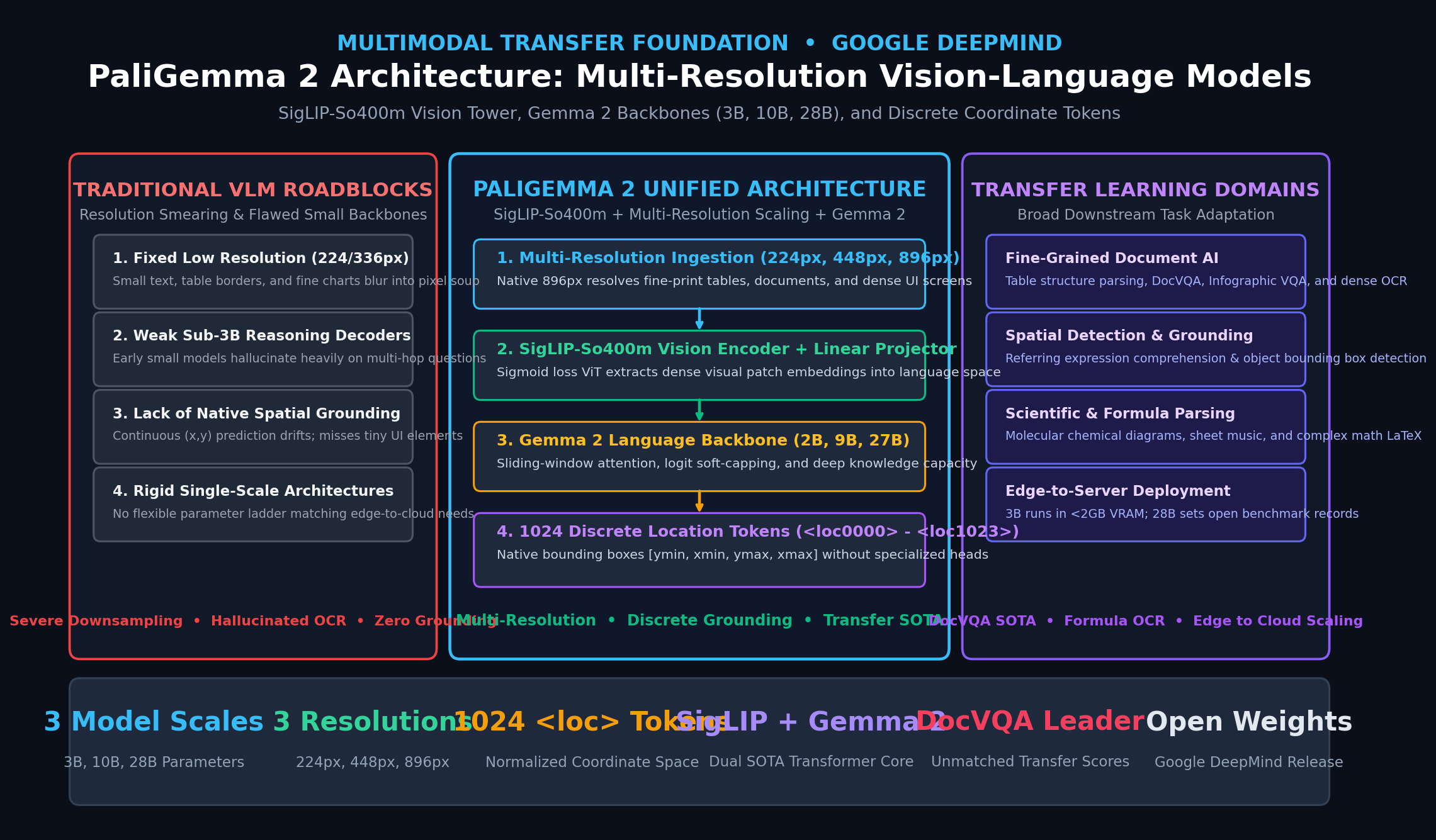
The Problem: The Resolution and Reasoning Trade-Offs in Open VLMs
In modern document intelligence, automated research workflows, visual web harvesting, and desktop agent ecosystems like AiFetchly, multimodal Vision-Language Models (VLMs) have become primary perception engines. Whether localizing interactable buttons on dense web layouts, parsing multi-tier tables in financial reports, reading chemical structures, or transcribing scanned documents, agents require vision models that simultaneously possess high spatial acuity and sophisticated semantic reasoning.
However, before modern second-generation visual models, open-weights multimodal architectures were trapped between two conflicting operational bottlenecks:
The Open Vision-Language Deployment Paradox:
┌─────────────────────────────────────────────────────────────────┐
│ Trap 1: The Low-Resolution Downsampling Smear                   │
│ • Squeezing 2K/4K documents into 224px or 336px square grids    │
│ ❌ Obliterates fine typography, decimal points, and chart axes   │
│ ❌ Fails on dense document OCR and small UI icon detection      │
├─────────────────────────────────────────────────────────────────┤
│ Trap 2: The Weak Reasoning Backbone of Compact Models           │
│ • Pairing vision towers with under-trained sub-2B text decoders │
│ ❌ Hallucinates logic on multi-step visual question answering   │
│ ❌ Inability to follow complex formatting constraints           │
├─────────────────────────────────────────────────────────────────┤
│ Trap 3: The Missing Native Spatial Grounding Coordinate Space   │
│ • Text-only autoregression blind to bounding boxes [y, x, y, x] │
│ ❌ Requires fragile external detection heads or yields drift    │
└─────────────────────────────────────────────────────────────────┘
Result: Developers either pay for massive cloud APIs or suffer 40%+ error rates on complex visual documents! 1. The Resolution Downsampling Smear in First-Generation VLMs
Early multimodal architectures—such as vanilla LLaVA-1.5, CLIP-based models, and early PaliGemma-1—were trained at rigid, low resolutions (typically $224 \times 224$ or $336 \times 336$ pixels):
- High-Frequency Information Loss: An enterprise PDF page or desktop UI screenshot contains thousands of fine-grained alphanumeric glyphs. Forcibly downscaling an image by $4\times$ or $8\times$ smears adjacent text lines together, causing numbers like
8andBor3and8to become visually indistinguishable. - Aspect Ratio Distortion: Squeezing rectangular documents into square tensors warps geometric proportions, corrupting table column alignments and destroying spatial cues.
2. The Language Capacity Ceiling of Sub-3B Decoders
While first-generation compact models were fast, their underlying language backbones lacked the parametric capacity required for deep semantic synthesis:
- When asked simple questions (“What color is the car?”), small models performed adequately.
- When tasked with complex, multi-hop reasoning over visual artifacts (“Calculate the year-over-year revenue difference between Table 2 and Table 4”), models with older, weak language decoders collapsed into hallucinations.
3. The Continuous Coordinate Drift in Spatial Grounding
Autonomous visual agents require spatial coordinates to pinpoint elements—whether localizing clickable buttons as explored in OmniParser or bounding document headers.
When models predict continuous floating-point coordinates (e.g., x=0.452, y=0.819), tokenization artifacts cause severe spatial drift. The model lacks a dedicated, discrete vocabulary representing geometric bounding boxes directly.
The Solution: The PaliGemma 2 Architecture
To resolve the resolution smear, language reasoning limitations, and spatial coordinate drift, researchers at Google DeepMind introduced PaliGemma 2.
PaliGemma 2 is a versatile family of vision-language models designed specifically for broad transfer fine-tuning across multimodal tasks. It bridges the gap between lightweight edge deployment and frontier cloud capabilities by systematically scaling along three distinct dimensions: model size (3B, 10B, 28B), native resolution (224px, 448px, 896px), and discrete spatial location tokens.
PaliGemma 2 High-Level Pipeline Flow:
Input: High-Resolution Image (up to 896x896) + Text Prompt
 │
 ▼
┌─────────────────────────────────────────────────────────────────┐
│ SigLIP-So400m Vision Encoder (Contrastive ViT)                  │
│ • Computes patch embeddings with Sigmoid contrastive loss       │
│ • 896px: Extracts 3,136 visual tokens with microscopic acuity   │
└─────────────────────────────────────────────────────────────────┘
 │ (Visual Patch Embeddings)
 ▼
┌─────────────────────────────────────────────────────────────────┐
│ Linear Multi-Modal Projector                                    │
│ • Projects visual patch embeddings directly into Gemma 2 space  │
└─────────────────────────────────────────────────────────────────┘
 │
 ▼
┌─────────────────────────────────────────────────────────────────┐
│ Gemma 2 Autoregressive Decoder (2B, 9B, or 27B Parameters)      │
│ • Local sliding-window attention + global attention interleaving│
│ • Logit soft-capping to prevent gradient instability            │
│ • 1,024 discrete spatial coordinate tokens (<loc0000>-<loc1023>)│
└─────────────────────────────────────────────────────────────────┘
 │
 ├──► Task 1: Fine-Grained Document OCR & Table Extraction (DocVQA)
 ├──► Task 2: Spatial Object Bounding Box Grounding (<loc> Tokens)
└──► Task 3: Scientific Molecular & Math LaTeX Transcription Comparing Open Vision-Language Architectures
The table below contrasts PaliGemma 2 against predecessor open VLMs:
Vision-Language Model Comparison:
┌───────────────────────────┬───────────────────────────────┬───────────────────────────────┬───────────────────────────────┐
│ Dimension / Feature       │ PaliGemma-1                   │ LLaVA-1.5                     │ PaliGemma 2                   │
├───────────────────────────┼───────────────────────────────┼───────────────────────────────┼───────────────────────────────┤
│ Language Decoder          │ Gemma-1 (2B)                  │ Vicuna (7B / 13B)             │ Gemma 2 (2B, 9B, 27B)         │
│ Total Model Parameters    │ ~3 Billion                    │ 7B – 13B                      │ 3B, 10B, and 28B Scales       │
│ Native Resolutions        │ 224px, 448px                  │ 336px                         │ 224px, 448px, and 896px       │
│ Visual Token Count        │ 256 or 1,024 patches          │ 576 patches                   │ Up to 3,136 patches (at 896px)│
│ Vision Backbone           │ SigLIP-So400m                 │ CLIP ViT-L/14                 │ SigLIP-So400m (Enhanced)      │
│ Spatial Bounding Tokens   │ 1,024 Location Tokens         │ None (Continuous text/floats) │ 1,024 Location Tokens         │
│ Architecture Innovations  │ Standard Attention            │ Monolithic Attention          │ Sliding Window + Soft-Capping │
│ Edge VRAM Requirement    │ ~6 GB (FP16)                  │ 14 GB – 26 GB                 │ <2 GB (3B 4-bit) to 56 GB     │
│ Transfer Scope            │ Captioning & Basic QA         │ General Chat                  │ SOTA DocVQA, Tables, Science  │
└───────────────────────────┴───────────────────────────────┴───────────────────────────────┴───────────────────────────────┘ Deep Dive into PaliGemma 2 Architecture & Primitives
PaliGemma 2 achieves state-of-the-art transfer capability through a modular composition of three foundational subsystems: the SigLIP Vision Tower, the Multi-Resolution Patch Grid, and the Gemma 2 Decoder Core.
1. The SigLIP-So400m Vision Encoder
Unlike earlier vision models that relied on OpenAI’s original CLIP (trained with softmax cross-entropy across batch samples), PaliGemma 2 employs SigLIP (Sigmoid Loss for Language-Image Pre-training):
- Pairwise Sigmoid Objective: SigLIP replaces the global softmax normalizer with independent binary sigmoid losses over all positive and negative image-text pairs: $$\mathcal{L}{\text{SigLIP}} = -\sum{i=1}^B \log \sigma(t_i \mathbf{v}_i^\top \mathbf{t}i) - \sum{i \neq j} \log \sigma(-t_i \mathbf{v}_i^\top \mathbf{t}_j)$$
- Decoupled Batch Sizing: Softmax-based contrastive learning requires massive, synchronized batch sizes across GPU clusters to generate negative samples. SigLIP’s pairwise sigmoid formulation enables stable, sample-efficient contrastive pretraining on smaller hardware clusters.
- The Shape-Optimized ViT (So400m): Uses a customized 400-million parameter Vision Transformer with a 16-channel patch projection ($14 \times 14$ pixel patches), preserving fine local gradients.
2. Multi-Resolution Input Scaling: 224px, 448px, and 896px
PaliGemma 2 explicitly trains distinct checkpoints across three spatial resolutions to match different inference budgets:
Visual Token Scaling across Resolutions:
1. 224px Resolution:
   Image Tensor: 224 x 224 px ──► (224 / 14)^2 = 16 x 16 = 256 Visual Tokens
   Best For: High-throughput video frame classification, real-time edge agents.

2. 448px Resolution:
   Image Tensor: 448 x 448 px ──► (448 / 14)^2 = 32 x 32 = 1,024 Visual Tokens
   Best For: General visual question answering, natural scene understanding.

3. 896px Resolution:
   Image Tensor: 896 x 896 px ──► (896 / 14)^2 = 64 x 64 = 3,136 Visual Tokens
Best For: Dense document OCR, multi-column tables, fine-print disclaimers, DocVQA. At 896px resolution, the model ingests $3,136$ visual patch embeddings. This density allows PaliGemma 2 to read 6-point typography, decipher overlapping lines in financial charts, and resolve dense circuitry in engineering schematics without tiling artifacts.
3. Gemma 2 Language Backbone: 3B, 10B, and 28B Parameter Scaling
The language reasoning engine in PaliGemma 2 is powered by Gemma 2, which introduces significant architectural enhancements over Gemma 1:
- Interleaved Sliding-Window Attention: Layers alternate between local sliding-window attention (attending to a local window of 4,096 tokens) and global full self-attention (attending across the full sequence). This reduces Key-Value cache memory overhead by up to $50%$ while maintaining global context.
- Logit Soft-Capping: To prevent logits from growing unbounded and destabilizing training on large multimodal datasets, Gemma 2 bounds attention and output projection values: $$\text{SoftCap}(x, C) = C \cdot \tanh\left(\frac{x}{C}\right)$$ where $C = 50.0$ for attention projections and $C = 30.0$ for the final vocabulary projection.
- Parameter Ladder: Developers can deploy
PaliGemma 2-3Bon edge devices (laptops, mobile chipsets) or scale toPaliGemma 2-28Bfor state-of-the-art enterprise document intelligence.
4. Discrete Spatial Coordinate Tokens (<loc0000> to <loc1023>)
To support native object detection, referring expression comprehension, and spatial grounding without adding complex YOLO/Faster-RCNN heads, PaliGemma 2 introduces 1,024 special location tokens:
- The 2D image coordinates are normalized to the integer interval $[0, 1023]$.
- Bounding boxes are formatted as a sequence of four discrete tokens: $$\text{Bounding Box} = \langle \text{loc}{y{\min}} \rangle , \langle \text{loc}{x{\min}} \rangle , \langle \text{loc}{y{\max}} \rangle , \langle \text{loc}{x{\max}} \rangle$$
- When prompted to
detect table headers, PaliGemma 2 outputs standard text tokens interleaved directly with spatial<loc>tokens. This unified representation enables downstream agents to extract text while simultaneously pinpointing its exact bounding polygon on the screen.
Hands-On Implementation: Building with PaliGemma 2
PaliGemma 2 is natively supported in the Hugging Face transformers library, making integration into Python data pipelines straightforward.
1. Installation
Install the latest versions of transformers, torch, accelerate, and pillow:
pip install --upgrade transformers torch torchvision accelerate pillow 2. High-Resolution Document VQA with PaliGemma 2-3B (896px)
The following implementation loads the 896px resolution checkpoint to extract structured information from a complex document page:
import torch
from PIL import Image
from transformers import AutoProcessor, PaliGemmaForConditionalGeneration

# 1. Load model and processor at 896px resolution
model_id = "google/paligemma2-3b-ft-docvqa-896"
device = "cuda" if torch.cuda.is_available() else "cpu"

print(f"Loading PaliGemma 2 on {device}...")
processor = AutoProcessor.from_pretrained(model_id)
model = PaliGemmaForConditionalGeneration.from_pretrained(
    model_id,
    torch_dtype=torch.bfloat16 if device == "cuda" else torch.float32,
    device_map="auto"
)

# 2. Ingest document image
image_path = "financial_balance_sheet.png"
raw_image = Image.open(image_path).convert("RGB")

# 3. Format prompt using task instruction format
prompt = "answer en What is the total operating income for the fiscal year ended 2025?"

# 4. Preprocess inputs (handles 896px resizing and normalization)
inputs = processor(text=prompt, images=raw_image, return_tensors="pt").to(device)

# 5. Autoregressive inference
with torch.inference_mode():
    output_tokens = model.generate(
        **inputs,
        max_new_tokens=128,
        do_sample=False
    )

# 6. Decode output response
decoded_answer = processor.decode(output_tokens[0], skip_special_tokens=True)
print("\n--- Document Question Answering Result ---")
print(decoded_answer) 3. Spatial Object Grounding with Discrete Location Tokens
The code below demonstrates how PaliGemma 2 detects UI elements or document components and translates discrete <loc> tokens into normalized pixel bounding boxes:
import re
import torch
from PIL import Image
from transformers import AutoProcessor, PaliGemmaForConditionalGeneration

model_id = "google/paligemma2-3b-pt-448"
device = "cuda" if torch.cuda.is_available() else "cpu"

processor = AutoProcessor.from_pretrained(model_id)
model = PaliGemmaForConditionalGeneration.from_pretrained(
    model_id,
    torch_dtype=torch.bfloat16 if device == "cuda" else torch.float32,
    device_map="auto"
)

image = Image.open("dashboard_screenshot.png").convert("RGB")
prompt = "detect submit button"

inputs = processor(text=prompt, images=image, return_tensors="pt").to(device)

with torch.inference_mode():
    outputs = model.generate(**inputs, max_new_tokens=64, do_sample=False)

raw_prediction = processor.decode(outputs[0], skip_special_tokens=False)

# Extract location tokens: <loc0124> <loc0340> <loc0180> <loc0520>
loc_matches = re.findall(r"<loc(\d{4})>", raw_prediction)

if len(loc_matches) >= 4:
    ymin, xmin, ymax, xmax = [int(val) / 1024.0 for val in loc_matches[:4]]
    img_w, img_h = image.size

    # Calculate physical pixel coordinates
    box_pixels = {
        "x": int(xmin * img_w),
        "y": int(ymin * img_h),
        "width": int((xmax - xmin) * img_w),
        "height": int((ymax - ymin) * img_h)
    }
print("Detected Bounding Box (Pixels):", box_pixels) Production Architecture & Best Practices for aiFetchly
Integrating PaliGemma 2 into autonomous desktop workflows like AiFetchly provides a high-fidelity visual perception layer for document processing, web scraping, and computer-use automation.
aiFetchly Multimodal Desktop Architecture:
┌─────────────────────────────────────────────────────────────────┐
│ User Request: "Extract the balance sheet from quarterly 10-K"   │
└─────────────────────────────────────────────────────────────────┘
 │
 ▼
┌─────────────────────────────────────────────────────────────────┐
│ aiFetchly Desktop Application & Orchestration Agent             │
│ • Rasterizes PDF pages into 896px images                        │
│ • Routes visual frames to local PaliGemma 2 instance            │
└─────────────────────────────────────────────────────────────────┘
 │
 ▼
┌─────────────────────────────────────────────────────────────────┐
│ PaliGemma 2-3B (896px) Local VLM Service                        │
│ ├──► SigLIP: Extracts 3,136 visual tokens                       │
│ ├──► Location Tokens: Detects table boundaries [<loc> tokens]   │
│ └──► Gemma 2: Transcribes tabular text with structural Markdown │
└─────────────────────────────────────────────────────────────────┘
 │
 ▼
┌─────────────────────────────────────────────────────────────────┐
│ Downstream Knowledge Stores                                     │
│ ├──► ColPali Multi-Vector Search (MaxSim Page Retrieval)        │
│ └──► Qdrant Vector Engine (Semantic Knowledge Base)             │
└─────────────────────────────────────────────────────────────────┘ 1. Hybrid Resolution Cascading
In high-volume document pipelines, running every page through an 896px model ($3,136$ visual tokens) consumes substantial GPU compute. Deploy a hybrid resolution cascade:
- Stage 1 (Low-Resolution Filter): Run incoming pages through
PaliGemma 2-3B-224($256$ visual tokens). Classify whether the page contains complex financial tables, diagrams, or standard plain text. - Stage 2 (High-Resolution Extraction): If the page contains dense tables or fine print, route the image to
PaliGemma 2-3B-896for microscopic OCR. If it contains standard body text, route it to lightweight text extractors.
2. Synergy with ColPali Multi-Vector Retrieval
PaliGemma forms the foundational vision-language backbone for ColPali document retrieval:
- Use ColPali to index raw PDF pages directly as multi-vector patch embeddings in vector stores like Qdrant.
- When a user asks a question, ColPali’s MaxSim late interaction retrieves the exact document page image in under 20 milliseconds.
- Pass the retrieved page image directly into PaliGemma 2-896 to generate the final, cited synthesis.
3. Local Edge Optimization (4-bit Quantization & Pruning)
For client-side desktop agents with limited VRAM:
- Quantize
PaliGemma 2-3BusingbitsandbytesNF4 or AWQ. This reduces the complete model footprint to under 2.2 GB of VRAM, allowing it to run concurrently alongside desktop applications without thermal throttling. - Implement attention-based token pruning techniques like FastV during late Gemma 2 decoder layers to discard redundant visual background patches, accelerating inference by up to $35%$.
Summary: The New Standard for Multimodal Transfer
PaliGemma 2 represents a significant advancement in open-weights Vision-Language Models. By systematically pairing the contrastive SigLIP-So400m vision encoder with the high-capacity Gemma 2 language backbone, supporting native 896px resolutions, and standardizing spatial grounding via discrete location tokens, Google DeepMind has delivered an engine engineered for precision transfer learning.
From fine-grained financial document OCR to zero-shot bounding-box localization in autonomous GUI copilots, PaliGemma 2 gives developers the exact architectural knobs needed to balance inference latency, memory footprint, and visual intelligence. For research copilots, desktop automation systems, and high-precision data harvesting platforms built on AiFetchly, PaliGemma 2 provides the ideal visual intelligence foundation.