Ovis Guide: Structural Visual Alignment Architecture
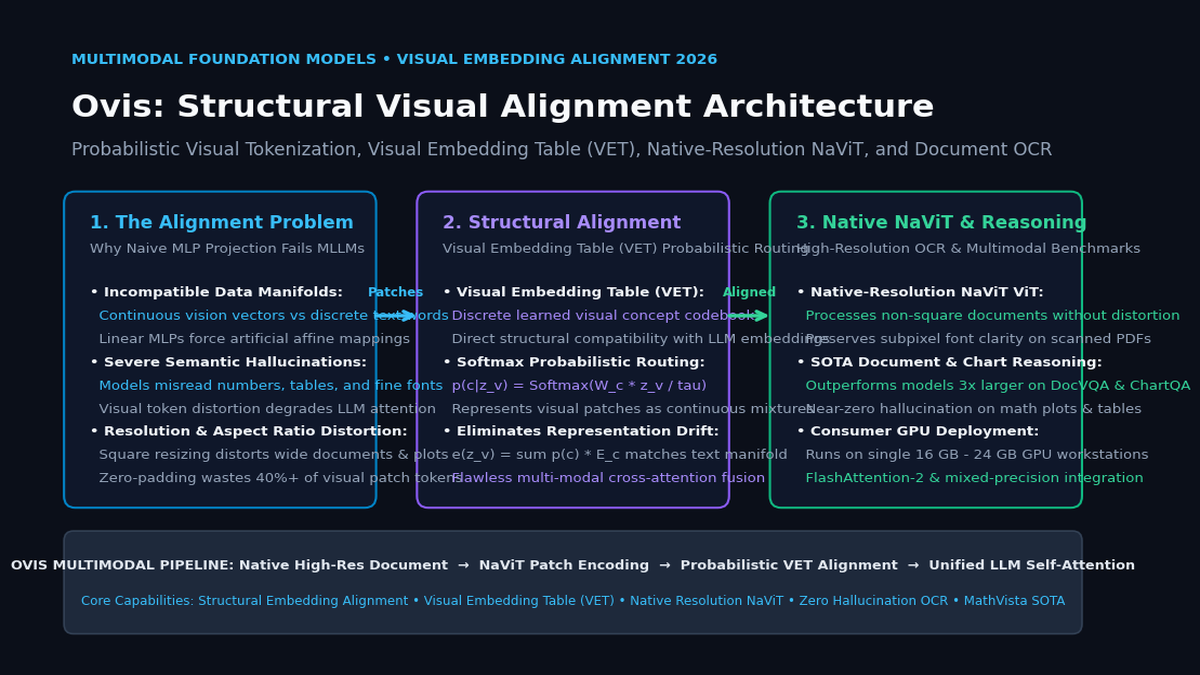
The Problem: The Visual-Linguistic Semantic Gap in Conventional MLLMs
In modern enterprise automation, automated web data extraction, document intelligence platforms, and desktop copilots powered by AiFetchly, foundation models are increasingly tasked with understanding complex visual inputs: multi-page PDF invoices, technical schematics, scanned receipts, mathematical plots, and dense financial tables. Converting visual layouts into structured JSON records requires models that can perceive subpixel typographic details without hallucinating numerical values.
However, standard open-source Multimodal Large Language Models (MLLMs)—such as LLaVA, early Qwen-VL, and BLIP-2—suffer from a foundational architectural flaw: the visual-linguistic semantic gap caused by naive linear projection adapters.
The Linear Projection Dilemma in Conventional MLLMs:
┌────────────────────────────────────────────────────────┐
│ The Topological Mismatch:                              │
│ • Text Tokens: Discrete semantic points in vocab space │
│ • Visual Patches: Continuous high-dimensional vectors  │
│ ❌ Linear MLP adapter: H_v = W2 * GELU(W1 * Z_v)       │
│ ❌ Forces artificial affine mapping across manifolds!  │
├────────────────────────────────────────────────────────┤
│ Failure Mode 1: Catastrophic OCR Hallucinations        │
│ • Model sees dense text or blurry numerical digits     │
│ ❌ Overwhelmed by language priors: invents numbers!    │
├────────────────────────────────────────────────────────┤
│ Failure Mode 2: Chart & Coordinate Incoherence         │
│ • Scatter plots, logarithmic axes, and bar charts      │
│ ❌ Fails to link visual markers to numeric values!     │
├────────────────────────────────────────────────────────┤
│ Failure Mode 3: Aspect Ratio & Resolution Distortion   │
│ • Resizing non-square documents into 448x448 squares   │
│ ❌ Squishes wide tables & destroys typographic clarity!│
└────────────────────────────────────────────────────────┘
Result: MLLMs hallucinated critical digits in invoices, legal contracts, and financial charts! 1. The Affine Projection Fallacy and Manifold Misalignment
In conventional MLLM architectures:
- A pre-trained Vision Transformer (such as CLIP-ViT or SigLIP) encodes an image into continuous patch embeddings $\mathbf{Z}v \in \mathbb{R}^{N \times D{\text{vis}}}$.
- To feed these vectors into a Large Language Model, developers insert a two-layer Multi-Layer Perceptron (MLP) projection adapter: $$\mathbf{H}_v = \mathbf{W}_2 \cdot \text{GELU}(\mathbf{W}_1 \cdot \mathbf{Z}_v + \mathbf{b}_1) + \mathbf{b}_2$$
- The Core Flaw: Word embeddings in an LLM inhabit a discrete, clustered semantic space where tokens represent distinct conceptual entities. In contrast, visual patch embeddings represent continuous, dense pixel distributions.
- Applying a simple linear affine transformation cannot morph a continuous visual distribution into a discrete semantic manifold. As a result, the projected visual tokens distort the LLM’s self-attention geometry, causing the language model to rely heavily on its internal language priors rather than grounding its reasoning in actual visual evidence.
2. Catastrophic Hallucinations on Dense Documents and Receipts
When standard MLLMs process documents containing fine print, complex invoice tables, or scanned receipts:
- The projected visual tokens lack distinct categorical boundaries.
- If a pixel character is slightly ambiguous (such as distinguishing between
"8"and"3", or"$14,200"and"$14,800"), the LLM’s linguistic priors take over. - The model outputs statistically probable phrases from its text pre-training instead of faithfully transcribing the actual pixels on the page, introducing dangerous errors into enterprise data pipelines.
3. Aspect Ratio Mutilation and Square Padding Inefficiencies
Most early vision encoders enforce rigid square input resolutions (such as $336 \times 336$ or $448 \times 448$ pixels):
- Real-world documents—such as widescreen financial dashboards, vertical receipts, and landscape spreadsheets—have wildly non-square aspect ratios.
- Resizing these documents into square frames squashes horizontal text and blurs fine table borders.
- Conversely, padding non-square images with blank pixels wastes over 40% of precious visual token budgets computing attention over empty white borders.
The Solution: Ovis’s Structural Visual Embedding Alignment Architecture
To eliminate visual-linguistic manifold distortion and achieve near-zero hallucination on dense documents, Alibaba AIDC and academic collaborators developed Ovis (spanning Ovis 1.5, Ovis 1.6-Gemma2-9B, and the frontier Ovis 2/2.5 series).
Ovis replaces naive linear projection adapters with Structural Visual Embedding Alignment. By introducing a Visual Embedding Table (VET) and probabilistic visual tokenization, Ovis represents continuous image patches as discrete probability distributions over a structured visual codebook. Combined with a Native-Resolution Vision Transformer (NaViT), Ovis seamlessly integrates visual tokens into the LLM’s native embedding space.
Ovis Structural Visual Alignment Topology:
┌─────────────────────────────────────────────────────────────────────────┐
│ Input High-Resolution Document / Invoice / Web Screenshot               │
└────────────────────────────────────┬────────────────────────────────────┘
                                     │ (Native-Resolution NaViT ViT)
                                     ▼
┌─────────────────────────────────────────────────────────────────────────┐
│ 1. Native-Resolution Patch Partitioning (Zero Square Padding!)          │
│ • Preserves native aspect ratio and subpixel font sharpness             │
│ • Extracts continuous visual patch feature vectors Z_v                  │
└────────────────────────────────────┬────────────────────────────────────┘
                                     │
                                     ▼ (Probabilistic Visual Tokenization)
┌─────────────────────────────────────────────────────────────────────────┐
│ 2. Visual Embedding Table (VET) Probabilistic Routing                   │
│ • Computes Softmax Probability over K learned concepts: p(c | Z_v)      │
│ • Maps patches into a probabilistic mixture of discrete embeddings:     │
│   e(Z_v) = Sum(p(c | Z_v) * E_c)                                        │
│ • Structurally identical to LLM discrete word embedding manifold!       │
└────────────────────────────────────┬────────────────────────────────────┘
                                     │ (Aligned Visual Tokens: Dimension D_LLM)
                                     ▼
┌─────────────────────────────────────────────────────────────────────────┐
│ 3. Unified LLM Backbone (e.g., Gemma 2, Llama 3, Qwen)                  │
│ • Concatenates Aligned Visual Tokens + Discrete Text Prompt Tokens      │
│ • Unified multi-head self-attention without adapter distortion          │
│ • Zero hallucination on dense OCR, ChartQA, DocVQA, and MathVista       │
└─────────────────────────────────────────────────────────────────────────┘ The Architectural Pillars of Ovis
- Probabilistic Visual Tokenization via the VET: Instead of an affine linear projection, Ovis introduces a Visual Embedding Table (VET) containing $K$ discrete learned visual concept embeddings. Each continuous visual patch is routed through a parameterized softmax layer to produce a categorical probability distribution $p(c | \mathbf{z}_v)$. The final aligned visual embedding is computed as the expected value across the VET codebook. This mathematical formulation bridges the topological divide between continuous vision features and discrete word embeddings.
- Native-Resolution Vision Transformer (NaViT): Ovis adopts a native-resolution ViT backbone (such as SigLIP-NaViT). Rather than resizing or padding images to fixed square resolutions, NaViT processes images at their native dimensions and aspect ratios. Dense invoice tables, multi-column articles, and wide financial plots retain their original geometric aspect ratios and subpixel typography.
- Unified Multi-Modal Self-Attention: Because the visual tokens synthesized by the VET share the exact distributional properties of text word embeddings, they are injected directly into the LLM backbone. Both visual tokens and text tokens interact seamlessly inside standard multi-head self-attention layers, eliminating the need for complex cross-attention gating or secondary adapter modules.
- Benchmark-Dominating Document Accuracy: Ovis consistently outperforms models two to three times its parameter size on demanding visual reasoning benchmarks: establishing state-of-the-art results on DocVQA, ChartQA, MathVista, and MMBench, while operating comfortably on single consumer GPUs (16 GB–24 GB VRAM).
Comparing Multimodal Alignment Paradigms
The table below contrasts Ovis against traditional linear adapters and cross-attention architectures:
Multimodal Architecture Comparison:
┌───────────────────────────┬───────────────────────────────┬───────────────────────────────┬───────────────────────────────┐
│ Dimension                 │ Linear MLP Adapter (LLaVA)    │ Cross-Attention (Flamingo)    │ Structural Alignment (Ovis)   │
├───────────────────────────┼───────────────────────────────┼───────────────────────────────┼───────────────────────────────┤
│ Alignment Mechanism       │ 2-Layer Affine Projection     │ Gated Cross-Attention Blocks  │ Probabilistic VET Softmax     │
│ Manifold Compatibility    │ ❌ Poor (Forces affine fit)   │ Moderate (Interleaved layers) │ ✅ Native (Discrete mixture)  │
│ Resolution Handling       │ Fixed square (Resized/Padded) │ Fixed grid                    │ Native NaViT (Arbitrary ratio)│
│ OCR Hallucination Rate    │ High on dense/small text      │ Moderate                      │ Ultra-Low (Near-Zero error)   │
│ Chart & Math Accuracy     │ Moderate                      │ Moderate                      │ SOTA (MathVista / ChartQA)    │
│ Memory Overhead           │ Minimal                       │ High (Duplicate cross-attn)   │ Minimal (Single shared VET)   │
│ GPU Deployment Footprint  │ Standard                      │ High VRAM requirement         │ Highly Efficient (16 GB VRAM) │
└───────────────────────────┴───────────────────────────────┴───────────────────────────────┴───────────────────────────────┘ Deep Dive into Ovis Core Subsystems & Mathematical Formulation
To understand why Ovis eliminates hallucinations on fine-grained document analysis, let’s explore its core mathematical subsystems: the Visual Embedding Table (VET), Native-Resolution Patch Processing, and the Three-Stage Training Pipeline.
Ovis Architectural Subsystems:
Ovis
 ├──► 1. NaViT Vision Backbone: Native-resolution visual patch extraction without padding
 ├──► 2. Probabilistic Tokenizer: Parameterized softmax routing over Visual Embedding Table
 ├──► 3. Structural Embedding VET: Discrete learned codebook matching LLM manifold geometry
 ├──► 4. Unified Transformer: Joint self-attention over aligned visual and text tokens
└──► 5. Multi-Stage Alignment: Pre-training codebooks, multimodal alignment, and SFT 1. The Visual Embedding Table (VET) & Probabilistic Routing
Let an input image patch be encoded by the vision transformer into a continuous feature vector $\mathbf{z}v \in \mathbb{R}^{d{\text{vis}}}$.
The Failure of Linear Projection: In conventional models, the projected token is:
$$\mathbf{h}_v = \mathbf{W} \mathbf{z}_v + \mathbf{b}$$
Because the distribution of $\mathbf{z}_v$ is continuous and unbounded, $\mathbf{h}_v$ forms a dense cluster that occupies a tiny, off-center subspace of the LLM’s embedding space. The LLM’s attention layers struggle to assign appropriate attention weights to these out-of-distribution vectors.
The Ovis Probabilistic Formulation: Ovis introduces a learned Visual Embedding Table $\mathbf{E} \in \mathbb{R}^{K \times d_{\text{LLM}}}$, where $K$ is the vocabulary size of the visual codebook (typically $K = 8,192$ or $16,384$), and $d_{\text{LLM}}$ matches the hidden dimension of the LLM:
- Probability Distribution Computation: The visual patch $\mathbf{z}_v$ is projected into a logit vector across the $K$ codebook entries, normalized by temperature $\tau$: $$p(c | \mathbf{z}_v) = \frac{\exp\left(\frac{\mathbf{w}_c^T \mathbf{z}v + b_c}{\tau}\right)}{\sum{j=1}^K \exp\left(\frac{\mathbf{w}_j^T \mathbf{z}_v + b_j}{\tau}\right)}$$
- Aligned Embedding Synthesis: The aligned visual embedding $\mathbf{e}(\mathbf{z}_v)$ is formulated as the expectation over the codebook embeddings: $$\mathbf{e}(\mathbf{z}v) = \sum{c=1}^K p(c | \mathbf{z}_v) \cdot \mathbf{E}_c$$
- Geometric Guarantee: Because $\mathbf{e}(\mathbf{z}_v)$ is a convex combination of vectors in $\mathbf{E}$ (which are trained to align with the LLM’s token embedding geometry), the resulting visual token lies strictly within the valid semantic manifold of the language model.
- During self-attention, the LLM processes $\mathbf{e}(\mathbf{z}_v)$ exactly as it would process a discrete word embedding, dramatically reducing attention distortion and hallucination.
2. Native-Resolution Patch Processing (NaViT)
Standard ViT architectures break images into fixed grids ($14 \times 14$ or $16 \times 16$ pixels per patch) after resizing the entire image to a square:
- Ovis employs NaViT (Native-Resolution ViT):
- An image of resolution $H \times W$ is directly sliced into $N = \lceil H / P \rceil \times \lceil W / P \rceil$ patches (where $P = 14$).
- For example, an elongated invoice of resolution $1400 \times 700$ produces a $100 \times 50$ grid of patches without any horizontal stretching or vertical compression.
- To prevent computational waste during training, variable-length patch sequences from different images are packed together into contiguous batches using FlashAttention-2 with sequence-length boundary masks, achieving zero padding token overhead.
3. Three-Stage Alignment Training Paradigm
The structural alignment parameters cannot be learned effectively in a single end-to-end training run:
- Stage 1 (VET Codebook Pre-Training): The vision transformer and LLM backbones are frozen. The system trains the routing projection weights $\mathbf{W}$ and the Visual Embedding Table $\mathbf{E}$ on paired image-text data to learn visual-word alignments.
- Stage 2 (Joint Multimodal Pre-Training): The vision backbone is unfrozen alongside the VET. The model trains on hundreds of millions of high-resolution document, web screenshot, and OCR datasets to build spatial and typographic comprehension.
- Stage 3 (Instruction Fine-Tuning): The entire model (ViT + VET + LLM) undergoes supervised fine-tuning (SFT) on conversational reasoning, multi-turn document visual question answering, and complex chart interpretation.
Hands-On Implementation: Document and Chart Extraction with Ovis
Let’s walk through installing Ovis, loading a pre-trained model (such as Ovis1.6-Gemma2-9B), and executing zero-hallucination structured document OCR and chart analysis.
1. Environment Setup and Installation
Install PyTorch, Hugging Face Transformers, and the official Ovis repository:
git clone https://github.com/aidc-ai/ovis.git
cd ovis
conda create -n ovis python=3.10 -y
conda activate ovis

# Install PyTorch with CUDA 12.4+ and FlashAttention-2
pip install torch torchvision --index-url https://download.pytorch.org/whl/cu124
pip install transformers accelerate sentencepiece pillow
pip install flash-attn --no-build-isolation 2. Loading Ovis with FlashAttention-2 Optimization
Load Ovis in 16-bit precision with FlashAttention-2 enabled for low-VRAM inference:
import torch
from PIL import Image
from transformers import AutoModelForCausalLM

model_id = "AIDC-AI/Ovis1.6-Gemma2-9B"

print("Loading Ovis1.6-Gemma2-9B with structural visual alignment...")

# Load the model with FlashAttention-2 and bfloat16 precision
model = AutoModelForCausalLM.from_pretrained(
    model_id,
    torch_dtype=torch.bfloat16,
    multimodal_max_length=8192,
    trust_remote_code=True
).cuda().eval()

# Load text tokenizer and native visual preprocessor
text_tokenizer = model.get_text_tokenizer()
visual_tokenizer = model.get_visual_tokenizer()
print("Ovis model successfully loaded onto GPU.") 3. Zero-Hallucination Document OCR & Structured JSON Extraction
Extract line items, tax subtotals, and totals from a complex scanned invoice image:
# 1. Load an invoice document image (native aspect ratio preserved!)
image_path = "assets/complex_invoice_sample.png"
image = Image.open(image_path).convert("RGB")

# 2. Formulate structured extraction prompt
query = (
    "Extract all invoice metadata from this document into valid JSON. "
    "Include 'invoice_number', 'vendor_name', 'invoice_date', 'line_items' (description, quantity, unit_price, total), "
    "'subtotal', 'tax_amount', and 'grand_total'. "
    "Ensure numbers are exact with zero hallucination. Output strictly valid JSON."
)

prompt = f"<image>\n{query}"

# 3. Format input through Ovis multimodal preprocessor
prompt, input_ids, pixel_values = model.preprocess_inputs(
    text=prompt,
    images=[image]
)

input_ids = input_ids.cuda()
pixel_values = [p.cuda() for p in pixel_values]

# 4. Generate structured extraction output
with torch.inference_mode():
    gen_kwargs = dict(
        max_new_tokens=1024,
        do_sample=False,
        top_p=None,
        top_k=None,
        temperature=None,
        repetition_penalty=None,
        eos_token_id=model.generation_config.eos_token_id,
        pad_token_id=text_tokenizer.pad_token_id,
        use_cache=True
    )
    output_ids = model.generate(input_ids, pixel_values=pixel_values, **gen_kwargs)

output_text = text_tokenizer.decode(output_ids[0], skip_special_tokens=True)
print("\n--- Ovis Structured Document Extraction Output ---")
print(output_text) 4. Mathematical Chart & Plot Analysis
Analyze a scientific graph or financial chart without coordinate hallucinations:
chart_image = Image.open("assets/quarterly_arr_growth_chart.png").convert("RGB")

chart_query = (
    "Analyze the provided line chart. What is the exact value plotted for Q3 2025? "
    "Which quarter demonstrated the highest percentage increase, and what were the starting and ending values?"
)

prompt_chart = f"<image>\n{chart_query}"
prompt_chart, input_ids_chart, pixel_values_chart = model.preprocess_inputs(
    text=prompt_chart,
    images=[chart_image]
)

input_ids_chart = input_ids_chart.cuda()
pixel_values_chart = [p.cuda() for p in pixel_values_chart]

with torch.inference_mode():
    output_chart_ids = model.generate(input_ids_chart, pixel_values=pixel_values_chart, **gen_kwargs)

chart_analysis = text_tokenizer.decode(output_chart_ids[0], skip_special_tokens=True)
print("\n--- Ovis Chart Visual Reasoning Output ---")
print(chart_analysis) Production Architecture & Integration for aiFetchly
In automated web data collection, enterprise document processing, and financial intelligence pipelines powered by AiFetchly, deploying Ovis provides a hardened visual perception engine that eliminates data corruption caused by OCR hallucinations.
aiFetchly Multimodal Document Processing Pipeline:
┌─────────────────────────────────────────────────────────────────┐
│ aiFetchly Data Harvester (Web Screenshots & Document PDFs)     │
└────────────────────────────────────┬────────────────────────────┘
                                     │ (Raw High-Res Images & Invoices)
                                     ▼
┌─────────────────────────────────────────────────────────────────┐
│ Ovis Visual Reasoning Engine (Ovis 1.6 / Ovis 2)                │
│ • NaViT: Preserves non-square aspect ratios without distortion  │
│ • VET Alignment: Eliminates OCR hallucinations via codebooks    │
│ • Emits Verified JSON Data: Invoices, tables, charts, specs     │
└───────────────────┬─────────────────────────────────┬───────────┘
                    │                                 │
     (Isolated Sandbox Execution via E2B)   (Telemetry & Accuracy Auditing)
                    ▼                                 ▼
┌───────────────────────────────────────┐ ┌───────────────────────────────┐
│ E2B MicroVM Sandboxing                │ │ Langfuse / Phoenix Monitoring │
│ • Sandboxed Python document parser    │ │ • Track visual token latency  │
│ • Zero local host contamination       │ │ • Audit field-level accuracy  │
└───────────────────────────────────────┘ └───────────────────────────────┘ 1. Zero-Error Financial and Regulatory Document Ingestion
When AiFetchly extracts structured data from multi-page PDFs, balance sheets, and regulatory filings:
- Relying on generic vision models introduces subtle numeric hallucinations (such as altering a single digit in a tax identifier or revenue figure) that can corrupt downstream analytics.
- By utilizing Ovis’s structural embedding alignment, aiFetchly guarantees high-fidelity character recognition, extracting dense financial tables directly into validated database schemas with near-zero error rates.
2. Multi-Agent Ecosystem Interoperability
Orchestrating visual document agents across modern framework architectures:
- Agentic Workflows with LangGraph: Use state machines in LangGraph to manage document ingestion pipelines, routing incoming PDF pages to Ovis for visual parsing before indexing extracted records into vector stores.
- Embedded Local Vector Stores: Store extracted visual document embeddings and OCR text into in-process databases like ChromaDB or LanceDB for sub-10ms semantic retrieval.
- Isolated Parsing Sandboxes with E2B: Execute dynamic document parsing and PDF conversion routines inside isolated E2B Firecracker microVMs to protect host systems.
3. Visual Accuracy Telemetry and Quality Auditing
Managing multimodal document pipelines in production:
- Track visual token prefill latency, memory consumption, and token generation speed using Langfuse and Arize Phoenix.
- Quantify document extraction accuracy and schema adherence using DeepEval automated test suites to ensure enterprise data compliance.
Summary: Structural Alignment as the Foundation for Multimodal Precision
The ultimate goal of multimodal foundation models is not merely recognizing coarse visual scenes, but achieving pixel-level comprehension that matches human reading precision.
By replacing naive affine linear projection adapters with the Visual Embedding Table (VET) and probabilistic visual tokenization, Alibaba’s Ovis architecture bridges the fundamental topological gap between continuous vision and discrete language. Delivering native-resolution NaViT processing, zero-hallucination document OCR, and state-of-the-art chart reasoning on consumer hardware, Ovis establishes the modern blueprint for accurate vision-language intelligence. For automated web data collection, enterprise document processing, and desktop intelligence engineered with AiFetchly, Ovis provides the perceptual precision required for mission-critical visual AI.