ORPO Explained: Reference-Free LLM Alignment Guide
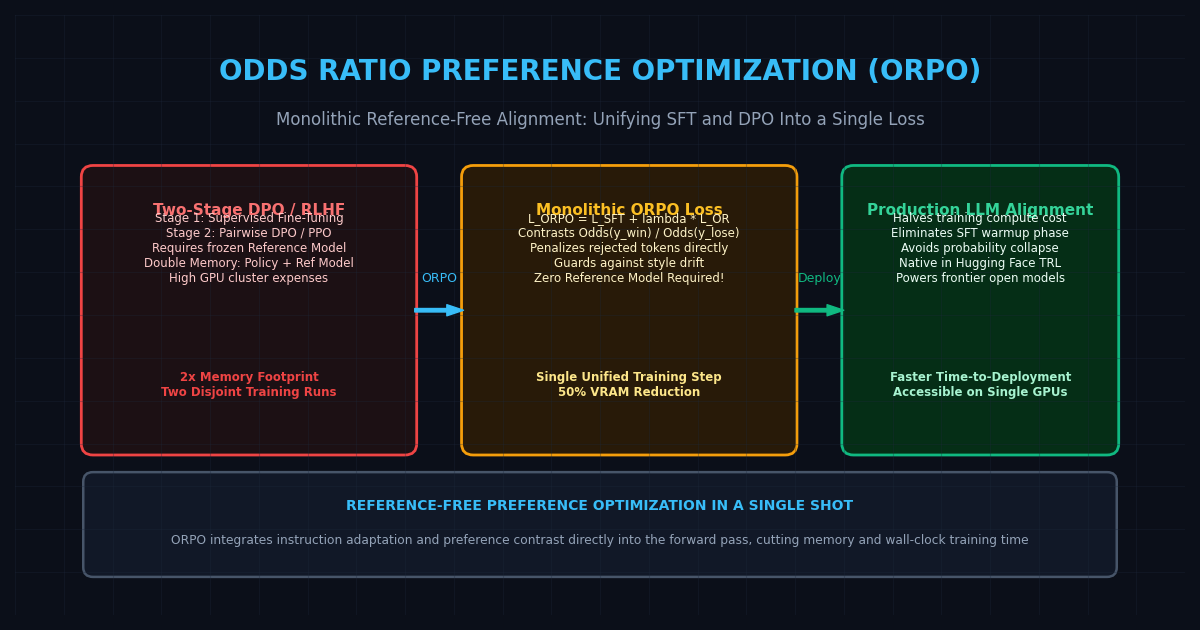
The Problem: The Two-Stage Training Tax and Reference Model Memory Bloat
In generative AI deployments—such as automated data extraction pipelines and structured reasoning agents in AiFetchly—aligning foundation models to follow complex instructions and adhere to user preferences is essential.
Historically, post-training alignment relied on Reinforcement Learning from Human Feedback (RLHF) via Proximal Policy Optimization (PPO). However, PPO requires loading four massive models simultaneously into GPU memory: the Policy, the Critic (Value) network, the Reference model, and the Reward model.
1. The Limitations of Direct Preference Optimization (DPO)
To escape the four-model complexity of PPO, the AI ecosystem embraced Direct Preference Optimization (DPO) (Rafailov et al., 2023). DPO mathematically derived an exact closed-form solution that optimizes preferences directly through cross-entropy, eliminating the Reward model and Critic network.
Despite this breakthrough, DPO imposes two severe engineering constraints in production pipelines:
- The Reference Model Memory Tax: To prevent the active policy $\pi_\theta$ from collapsing or drifting away from natural language distribution, DPO enforces a Kullback-Leibler (KL) divergence constraint against a frozen reference model $\pi_{\text{ref}}$: $$\mathcal{L}{\text{DPO}} = -\mathbb{E}{(x, y_w, y_l)} \left[ \log \sigma \left( \beta \log \frac{\pi_\theta(y_w \mid x)}{\pi_{\text{ref}}(y_w \mid x)} - \beta \log \frac{\pi_\theta(y_l \mid x)}{\pi_{\text{ref}}(y_l \mid x)} \right) \right]$$ This requires keeping two complete model checkpoints in GPU VRAM throughout the entire alignment stage. For a 70B parameter model, hosting both $\pi_\theta$ and $\pi_{\text{ref}}$ alongside optimizer states demands expensive multi-node GPU clusters (e.g., 8x H100 80GB nodes), pricing out single-GPU workstations.
- The Fragility of Two-Stage Training: DPO is inherently an offline preference-tuning step that assumes the model has already completed extensive Supervised Fine-Tuning (SFT). If DPO is applied without adequate prior SFT warmup, the model suffers from probability degeneration: it learns to decrease the probability of rejected tokens $y_l$ without adequately reinforcing the generation of preferred tokens $y_w$, degrading general fluency.
Managing two distinct training stages (SFT, followed by dataset re-indexing and DPO) doubles data preparation cycles, increases checkpoint synchronization overhead, and increases cloud compute bills.
The Architecture: Monolithic Odds Ratio Preference Optimization
Introduced by researchers from KAIST (Jiwoo Hong, Noah Lee, and James Thorne, EMNLP 2024), Odds Ratio Preference Optimization (ORPO) replaces the cumbersome two-stage alignment pipeline with a single, monolithic loss function.
Crucially, ORPO requires zero reference models.
The Mathematical Formulation of ORPO
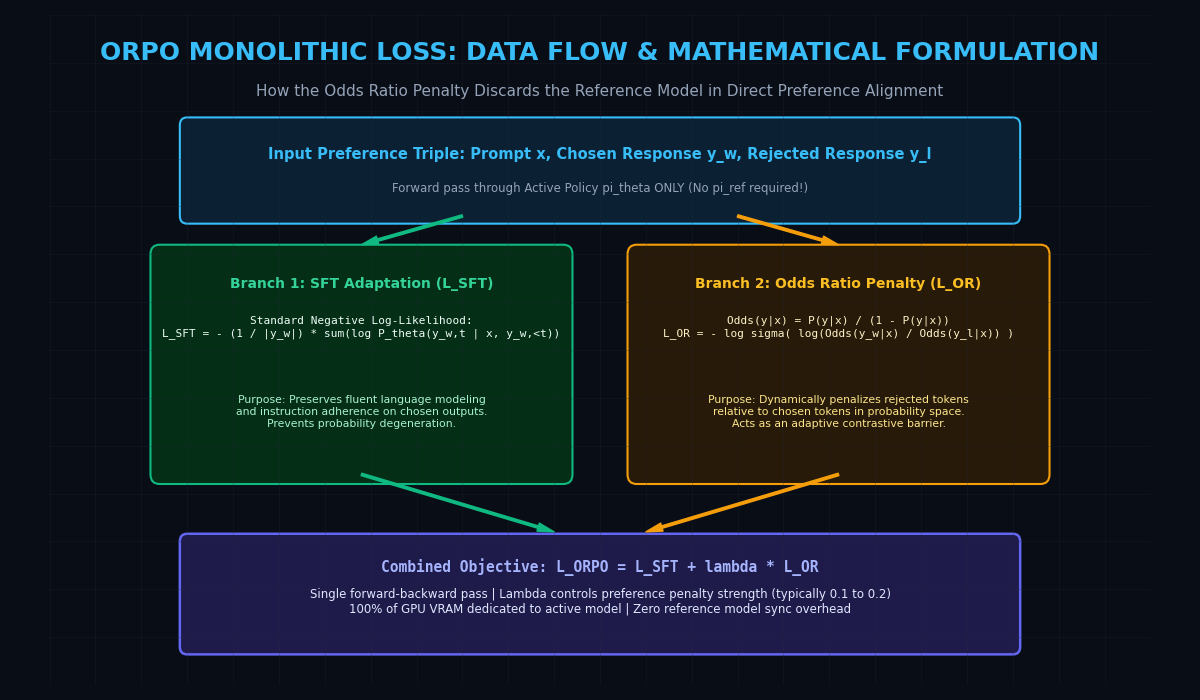
ORPO merges language modeling and pairwise preference discrimination into a unified objective:
$$\mathcal{L}{\text{ORPO}} = \mathcal{L}{\text{SFT}} + \lambda \cdot \mathcal{L}_{\text{OR}}$$
Where $\lambda$ is a balancing hyperparameter (typically set between $0.1$ and $0.2$).
1. The SFT Anchor ($\mathcal{L}_{\text{SFT}}$)
To preserve the natural syntax and instruction-following capability of the model on winning responses $y_w$, ORPO applies standard causal cross-entropy loss:
$$\mathcal{L}{\text{SFT}} = - \frac{1}{|y_w|} \sum{t=1}^{|y_w|} \log P_\theta(y_{w, t} \mid x, y_{w, <t})$$
Because $\mathcal{L}{\text{SFT}}$ actively optimizes token log-probabilities on preferred outputs, it acts as an inherent regularizer, **obviating the need for an external frozen reference model $\pi{\text{ref}}$**.
2. The Odds Ratio Penalty ($\mathcal{L}_{\text{OR}}$)
To penalize rejected candidate outputs $y_l$ without causing probability collapse, ORPO formulates the likelihood of generating sequence $y$ given input $x$ in terms of Odds:
$$\text{odds}\theta(y \mid x) = \frac{P\theta(y \mid x)}{1 - P_\theta(y \mid x)}$$
Where sequence probability $P_\theta(y \mid x)$ is computed as the length-normalized geometric mean of token probabilities:
$$\log P_\theta(y \mid x) = \frac{1}{|y|} \sum_{t=1}^{|y|} \log P_\theta(y_t \mid x, y_{<t})$$
The Odds Ratio (OR) between chosen response $y_w$ and rejected response $y_l$ measures how much more likely the policy is to generate $y_w$ versus $y_l$:
$$\text{OR}\theta(y_w, y_l \mid x) = \frac{\text{odds}\theta(y_w \mid x)}{\text{odds}_\theta(y_l \mid x)}$$
The final preference penalty minimizes the negative log-sigmoid of the log-odds ratio:
$$\mathcal{L}{\text{OR}} = - \log \sigma \left( \log \left( \frac{\text{odds}\theta(y_w \mid x)}{\text{odds}_\theta(y_l \mid x)} \right) \right)$$
Key Mechanics: Why the Odds Ratio Eliminates Reference Models
A central question in preference learning is: Why does DPO fail without a reference model, while ORPO succeeds?
1. Unbounded Cross-Entropy vs. Bounded Odds
In standard cross-entropy, minimizing the loss on negative examples can push token logits to $-\infty$. If a loss function naively penalizes $y_l$ without an anchor, the model destabilizes, outputting garbled syntax or empty strings.
DPO solves this by anchoring policy logits $\pi_\theta$ to $\pi_{\text{ref}}$. However, ORPO solves this through the mathematical properties of the odds function:
- When probability $P_\theta(y \mid x) \to 0$, the odds $\frac{P}{1-P} \to 0$.
- When probability $P_\theta(y \mid x) \to 1$, the odds $\frac{P}{1-P} \to \infty$.
Because the odds ratio compares the relative ratio of probabilities, the gradient update scaled by $\mathcal{L}_{\text{OR}}$ applies a gentle, self-moderating contrastive penalty. It suppresses the likelihood of rejected tokens only in direct relation to how confidently the model generates the chosen tokens.
2. Single-Step Efficiency and Memory Halving
Because the active policy $\pi_\theta$ is the only network evaluated during training:
- 50% VRAM Savings: Memory previously consumed by storing $\pi_{\text{ref}}$ weights, activations, and KV buffers is completely liberated.
- Zero Synchronization Overhead: Distributed training frameworks (DeepSpeed, FSDP) no longer need to broadcast and freeze a duplicate set of model parameters across GPU ranks.
- Unified Pipeline: Engineering teams can feed raw instruction-preference datasets directly into base foundation models, converging in a single training run.
Alignment Algorithm Comparison: PPO vs. DPO vs. KTO vs. ORPO
| Dimension | PPO (Standard RLHF) | DPO (Direct Preference) | KTO (Prospect Theory) | ORPO (Odds Ratio) |
|---|---|---|---|---|
| Models in GPU Memory | 4 (Actor, Critic, Ref, Reward) | 2 (Policy, Ref Model) | 2 (Policy, Ref Model) | 1 (Policy Only) |
| Memory Footprint | Extremely High (~4x model size) | High (~2x model size) | High (~2x model size) | Low (1x model size) |
| Pipeline Architecture | 3-Stage (SFT $\to$ RM $\to$ PPO) | 2-Stage (SFT $\to$ DPO) | 2-Stage (SFT $\to$ KTO) | 1-Stage (Monolithic SFT + Alignment) |
| Reference Model | Required ($\pi_{\text{ref}}$) | Required ($\pi_{\text{ref}}$) | Required ($\pi_{\text{ref}}$) | None (Zero reference model) |
| Feedback Data Format | Pairwise rankings | Pairwise $(x, y_w, y_l)$ | Unpaired binary (Up/Down) | Pairwise $(x, y_w, y_l)$ |
| Hardware Accessibility | Multi-node GPU clusters | 4x - 8x high-end GPUs | 4x - 8x high-end GPUs | Single workstation GPU (with QLoRA) |
Practical Implementation: Training with ORPO in PyTorch and TRL
Hugging Face’s TRL (Transformer Reinforcement Learning) library provides native support for ORPO via ORPOTrainer. Below is a complete, production-ready recipe using PyTorch and TRL.
1. Training Script (train_orpo.py)
import torch
from datasets import load_dataset
from transformers import AutoModelForCausalLM, AutoTokenizer
from trl import ORPOConfig, ORPOTrainer

def run_orpo_training():
    model_id = "meta-llama/Meta-Llama-3-8B"

    # 1. Initialize tokenizer
    tokenizer = AutoTokenizer.from_pretrained(model_id)
    tokenizer.pad_token = tokenizer.eos_token

    # 2. Load model (single instance in VRAM; no reference model needed!)
    model = AutoModelForCausalLM.from_pretrained(
        model_id,
        torch_dtype=torch.bfloat16,
        device_map="auto"
    )

    # 3. Load pairwise preference dataset
    # Expects columns: 'prompt', 'chosen', 'rejected'
    dataset = load_dataset("argilla/dpo-mix-7k", split="train[:1000]")

    # 4. Configure ORPO Hyperparameters
    orpo_args = ORPOConfig(
        output_dir="./results_orpo",
        learning_rate=5e-6,
        lr_scheduler_type="cosine",
        max_length=1024,
        max_prompt_length=512,
        beta=0.1,  # Lambda hyperparameter weighting L_OR
        per_device_train_batch_size=2,
        gradient_accumulation_steps=4,
        num_train_epochs=1,
        fp16=False,
        bf16=True,
        logging_steps=10,
        save_strategy="epoch"
    )

    # 5. Initialize ORPOTrainer
    trainer = ORPOTrainer(
        model=model,
        args=orpo_args,
        train_dataset=dataset,
        processing_class=tokenizer
    )

    print("--- Starting Monolithic ORPO Training ---")
    trainer.train()
    print("Training complete. Model aligned without reference model overhead.")

if __name__ == "__main__":
run_orpo_training() 2. Standalone PyTorch Loss Function
For custom architectures and inference engines, here is a self-contained implementation of the ORPO loss function:
import torch
import torch.nn as nn
import torch.nn.functional as F

class ORPOLoss(nn.Module):
    """
    Monolithic Odds Ratio Preference Optimization (ORPO) Loss.
    Combines causal Cross-Entropy on chosen tokens with an Odds Ratio penalty.
    """
    def __init__(self, alpha: float = 0.1):
        super().__init__()
        self.alpha = alpha # Weighting factor lambda

    def forward(
        self,
        policy_chosen_logps: torch.Tensor,
        policy_rejected_logps: torch.Tensor,
        sft_loss: torch.Tensor
    ) -> torch.Tensor:
        """
        Calculates L_ORPO = L_SFT + alpha * L_OR
        logps are sequence-level length-normalized log probabilities.
        """
        # 1. Convert sequence log-probabilities to log-odds:
        # log(odds) = log(p / (1 - p)) = log(p) - log(1 - p)
        # Using numerically stable log1p: log(1 - p) = log1p(-p) = log1p(-exp(log_p))
        chosen_log_odds = policy_chosen_logps - torch.log1p(-torch.exp(policy_chosen_logps) + 1e-7)
        rejected_log_odds = policy_rejected_logps - torch.log1p(-torch.exp(policy_rejected_logps) + 1e-7)

        # 2. Log-odds ratio
        log_odds_ratio = chosen_log_odds - rejected_log_odds

        # 3. Odds Ratio Loss: -log(sigmoid(log_odds_ratio))
        or_loss = -F.logsigmoid(log_odds_ratio).mean()

        # 4. Total Monolithic Loss
        total_loss = sft_loss + self.alpha * or_loss
return total_loss Production Scaling: Aligning Domain Agents in aiFetchly
In enterprise data automation platforms like AiFetchly, deploying customized Small Language Models (SLMs) and 8B foundation models is critical for high-volume tasks:
1. Training Specialized Schema Extractors on Single GPUs
Engineering teams training models to extract structured JSON from unstructured HTML often struggle with formatting compliance. Unaligned models hallucinate invalid keys, omit required attributes, or output conversational commentary.
Using ORPO with QLoRA, teams can align an 8B parameter model directly on a single NVIDIA A10G (24GB VRAM) or RTX 4090 workstation. The SFT term teaches the model valid JSON syntax, while the Odds Ratio term penalizes malformed responses and markdown conversational filler in a single training run.
2. Eliminating Drift and Post-Training Bottlenecks
Because ORPO eliminates the reference model, post-training infrastructure avoids memory-bandwidth bottlenecks and multi-node synchronization latencies. Teams update agent policies weekly as new edge cases arise, compressing the iteration cycle from days to hours.
By unifying instruction tuning and preference optimization into a reference-free objective, ORPO represents a powerful advancement for efficient, scalable post-training in 2026.