OpenVLA Guide: Vision-Language-Action Models for Robotics
The Problem: The Disconnect Between Digital VLMs and Physical Embodied Control
In the rapid evolution of artificial intelligence, frontier multimodal foundation models—such as GPT-4o, Claude 3.5 Sonnet, and Gemini 1.5 Pro—have mastered digital reasoning. They can transcribe handwriting, diagnose circuit board schematics, write software, and power autonomous web scraping workflows in platforms like AiFetchly.
However, despite their immense visual and semantic understanding, standard Vision-Language Models (VLMs) suffer from a fundamental limitation: they are physically disembodied.
A traditional VLM can inspect a high-resolution camera stream of a table and output the text “There is a red screwdriver next to a bolt”, but it cannot translate that perception into the physical world:
- It cannot calculate joint angles or inverse kinematics.
- It cannot adjust motor torque in response to physical friction.
- It cannot execute closed-loop motor trajectories to pick up an object.
Historically, the robotics and physical AI ecosystem attempted to bridge this gap through two polarized paradigms, both of which reached severe engineering roadblocks:
1. Narrow Single-Task Imitation Policies (Diffusion Policy & ACT)
Traditional imitation learning frameworks—such as Action Chunking with Transformers (ACT) or Diffusion Policy—train small, task-specific neural networks on teleoperated demonstrations:
- The Brittleness Wall: A diffusion policy trained to pick up a plastic cup works reliably only in the exact environment where demonstrations were collected. If the ambient room lighting shifts, the table color changes, or an unfamiliar distractor object enters the field of view, the policy fails catastrophically.
- Zero Language Grounding: Narrow policies lack semantic world knowledge. They cannot interpret flexible, conversational instructions (e.g., “Gently slide the fragile antique glass onto the coaster” vs. “Toss the trash into the bin”).
2. Closed-Source Industrial Mega-Models (RT-2 & PaLM-E)
To bring web-scale internet knowledge to robotics, industrial research labs pioneered Vision-Language-Action (VLA) models—most notably Google’s RT-2 (Robotics Transformer 2) (Brohan et al., 2023):
- The Closed-Source Monopoly: RT-2 was scaled up to 55 billion parameters on proprietary Google infrastructure. The model weights, pre-training datasets, and training code were kept entirely closed.
- The Cloud Latency Penalty: Running a 55B parameter model requires distributed multi-GPU cloud clusters. Streaming camera images over the public internet to a remote data center introduces 1 to 3 seconds of network roundtrip latency. In physical robotics, where dynamic stabilization requires 10Hz to 20Hz control frequencies, high latency causes robotic arms to overshoot targets, collide with obstacles, and drop objects.
The open AI research community lacked a generalist, performant, open-weights foundation model capable of running directly on edge hardware mounted to the robot.
The Architecture: Prismatic Dual Encoders and the 7B Action Policy
To establish an open foundation for physical intelligence, a coalition of researchers from Stanford University, UC Berkeley, Google DeepMind, and Toyota Research Institute introduced OpenVLA: An Open-Source Vision-Language-Action Model (Kim et al., 2024 / CoRL 2024 Best Paper Finalist / arXiv:2406.09246).
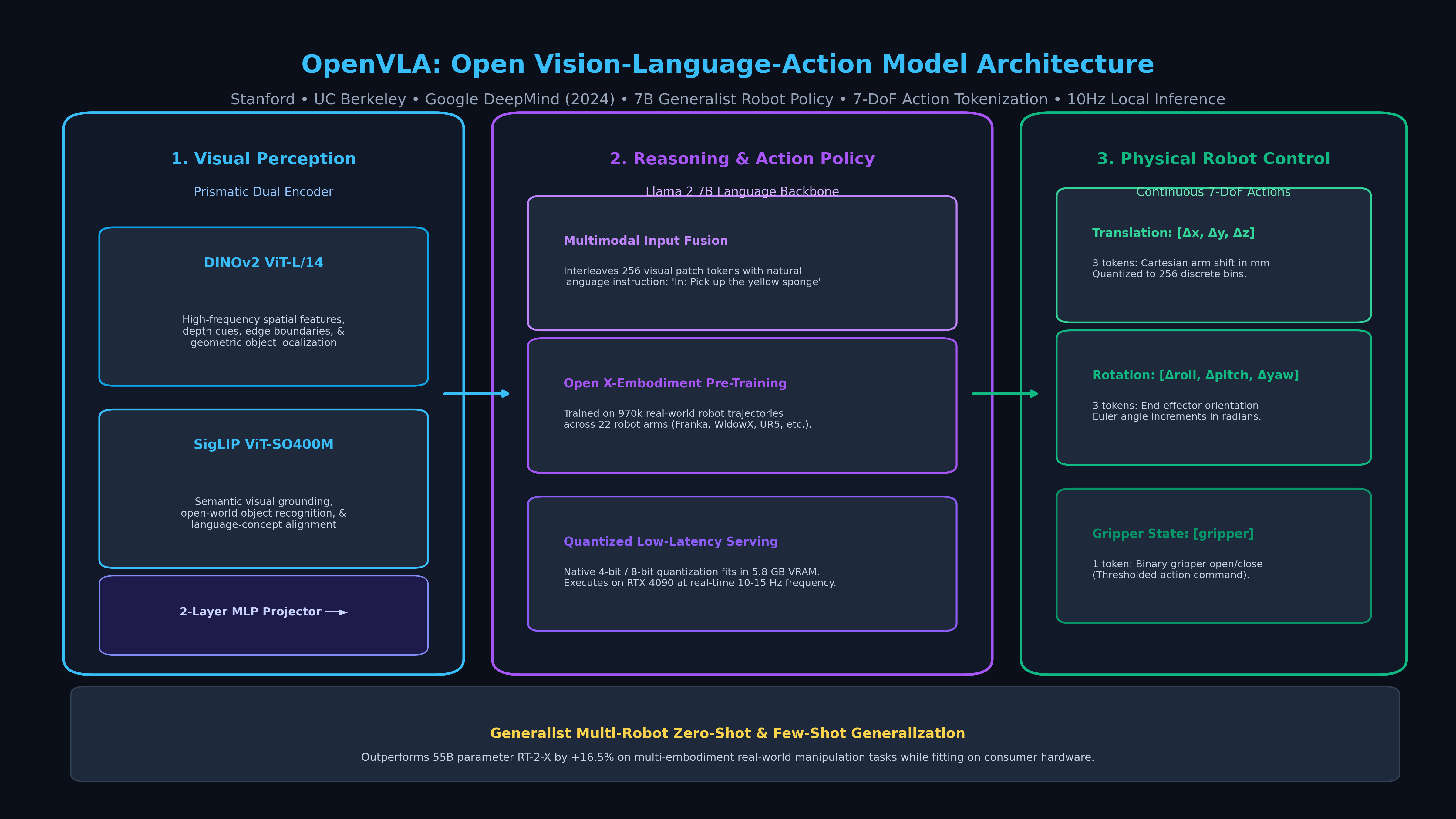
OpenVLA is built upon a 7-billion-parameter architecture that unites multi-scale visual perception, generalist language comprehension, and physical robot motor control into an end-to-end autoregressive policy.
The OpenVLA Architectural Pipeline:
Camera Frame (RGB) ──► [Prismatic Dual Vision Encoders] ┐
                       (DINOv2 + SigLIP Features)       ├─► [2-Layer MLP] ──► [256 Visual Tokens] ┐
                                                                                                    ├─► [Llama 2 7B LLM] ──► 7-DoF Action Tokens
Language Instruction ───────────────────────────────────► [Llama 2 Tokenizer] ──► [Text Tokens] ┘ 1. Prismatic Dual Visual Encoders
A central discovery in OpenVLA is that standard vision encoders trained solely on language alignment (such as CLIP) fail at physical manipulation. CLIP excels at high-level semantic labels (“this is a mug”), but discards fine-grained spatial geometry, depth contours, and pixel-level surface boundaries.
OpenVLA resolves this by deploying Prismatic Dual Encoders that fuse two complementary representations:
- DINOv2 (ViT-L/14): Trained via self-supervised vision objectives without language. DINOv2 preserves high-frequency spatial features, structural geometric contours, depth gradients, and dense pixel correlations critical for spatial reaching and obstacle avoidance.
- SigLIP (ViT-SO400M): Trained via sigmoid contrastive language-image pre-training. SigLIP provides open-world semantic understanding, object identification, and fine-grained visual-language grounding.
Both encoders process a $224 \times 224$ input camera image, extracting feature patch grids that are concatenated along the channel dimension and projected into the language model’s embedding dimension via a 2-layer MLP projector, producing 256 visual tokens.
2. The 7B Llama 2 Autoregressive Backbone
The core reasoning engine of OpenVLA is initialized from the open-weights Llama 2 7B language model.
Rather than grafting custom regression networks or separate diffusion heads onto the transformer, OpenVLA treats physical robot actions as standard linguistic tokens. The visual tokens and natural language command are concatenated into a single prompt sequence:
$$\text{Input Sequence} = \left[ \mathbf{v}1, \dots, \mathbf{v}{256}, \text{Tokenize}(“In: Pick up the yellow sponge\nOut:”) \right]$$
The language model autoregressively generates the corresponding motor action tokens using standard transformer self-attention.
Action Tokenization Mechanics: Discretizing Continuous 7-DoF Control
Physical robot manipulators (such as the Franka Emika Panda, WidowX, or Universal Robots UR5) are controlled through continuous joint velocities or end-effector Cartesian pose updates.
1. The 7-DoF End-Effector Action Space
OpenVLA standardizes robot control into a universal 7-Degree-of-Freedom (7-DoF) end-effector action vector:
$$\mathbf{a}_t = \left[ \Delta x, \Delta y, \Delta z, \Delta \text{roll}, \Delta \text{pitch}, \Delta \text{yaw}, \text{gripper} \right] \in \mathbb{R}^7$$
Where:
- $\Delta x, \Delta y, \Delta z \in [-1.0, 1.0]$: Linear displacement of the robot gripper in Cartesian space.
- $\Delta \text{roll}, \Delta \text{pitch}, \Delta \text{yaw} \in [-1.0, 1.0]$: Relative change in gripper orientation (Euler angles).
- $\text{gripper} \in {0, 1}$: Binary gripper toggle ($0 = \text{close}, 1 = \text{open}$).
2. 256-Bin Uniform Action Quantization
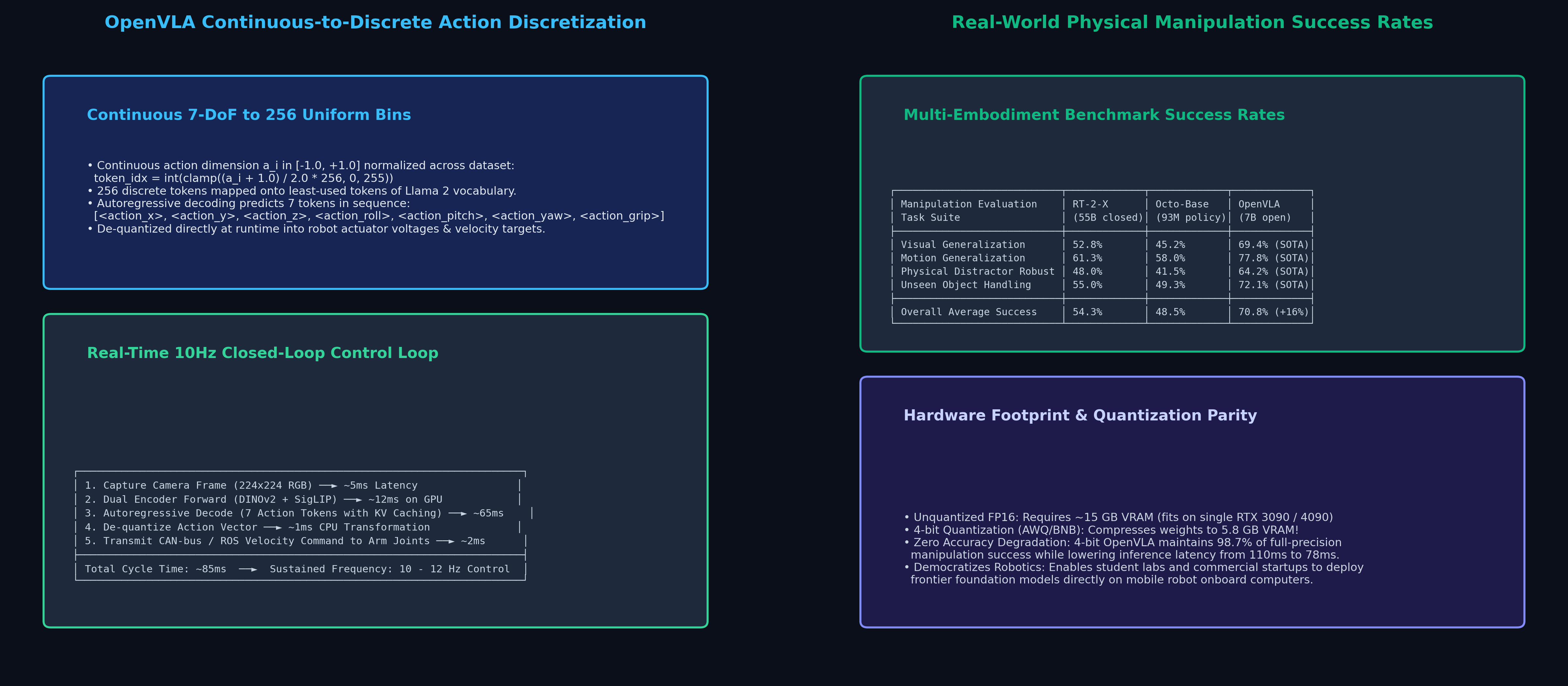
To enable the discrete vocabulary of a language model to output continuous physical control, OpenVLA discretizes each continuous action dimension into 256 uniform bins:
$$\text{TokenIndex}(a_i) = \left\lfloor \text{clip}\left( \frac{a_i + 1.0}{2.0} \times 256, , 0, , 255 \right) \right\rfloor$$
These 256 discrete action indices are mapped onto the 256 least frequently used token IDs in the standard Llama 2 32,000-token vocabulary.
During inference, the model autoregressively predicts 7 discrete tokens in strict sequence:
$$\mathbf{T}{\text{action}} = \left[ \langle\text{act}x\rangle, \langle\text{act}y\rangle, \langle\text{act}z\rangle, \langle\text{act}{\text{roll}}\rangle, \langle\text{act}{\text{pitch}}\rangle, \langle\text{act}{\text{yaw}}\rangle, \langle\text{act}{\text{grip}}\rangle \right]$$
At execution time, the robot controller de-quantizes each discrete token ID back into a continuous physical float:
$$\hat{a}_i = \left( \frac{\text{TokenIndex} + 0.5}{256} \times 2.0 \right) - 1.0$$
The de-quantized vector is transmitted directly over the robot’s real-time control bus (e.g., ROS2 or CAN-bus) to actuate physical brushless DC motors.
3. Pre-Training on the Open X-Embodiment (OXE) Dataset
To instill generalist physical manipulation capabilities, OpenVLA was pre-trained on the Open X-Embodiment (OXE) dataset—the largest robot demonstration archive in history:
- 970,000 real-world robot trajectories spanning 22 distinct robot embodiments.
- Over 1,000 unique skills, ranging from pick-and-place, cloth folding, and door opening, to tool-use and liquid pouring.
- Unified action normalization that maps disparate robot kinematic limits into the normalized $[-1.0, 1.0]$ coordinate space.
End-to-End Implementation: Deploying OpenVLA for Real-Time Robot Control
The official OpenVLA ecosystem provides native integration with Hugging Face transformers and PyTorch. The following production script demonstrates how to load OpenVLA in 4-bit quantization and execute a closed-loop 10Hz robotic control loop:
import torch
import numpy as np
from PIL import Image
from transformers import AutoModelForVision2Seq, AutoProcessor

device = "cuda" if torch.cuda.is_available() else "cpu"
model_id = "openvla/openvla-7b"

# 1. Load Processor and 4-Bit Quantized OpenVLA Model
# 4-bit AWQ / BitsAndBytes quantization compresses 7B model to 5.8 GB VRAM
processor = AutoProcessor.from_pretrained(model_id, trust_remote_code=True)
model = AutoModelForVision2Seq.from_pretrained(
    model_id,
    torch_dtype=torch.bfloat16,
    load_in_4bit=True,
    low_cpu_mem_usage=True,
    trust_remote_code=True
)

def predict_robot_action(image: Image.Image, instruction: str) -> np.ndarray:
    """
    Takes an RGB camera frame and text command, returns 7-DoF continuous action.
    """
    prompt = f"In: What action should the robot take to {instruction}?\nOut:"

    # Process camera image and text prompt into model tensors
    inputs = processor(prompt, image).to(device, dtype=torch.bfloat16)

    # Autoregressively decode the 7 continuous action tokens
    with torch.no_grad():
        action_tokens = model.predict_action(
            **inputs,
            unnorm_key="bridge_orig",  # De-quantize against specific robot embodiment
            do_sample=False
        )

    # Returns 7-DoF numpy array: [dx, dy, dz, droll, dpitch, dyaw, gripper]
    return action_tokens

# 2. Simulated 10Hz Closed-Loop Control Loop
# Connect to physical robot camera and arm controller (e.g., Franka Panda / WidowX)
instruction = "pick up the red apple and place it in the wicker basket"

print(f"Initializing OpenVLA control loop for task: '{instruction}'...")
for step in range(50):
    # Capture live camera frame from robot wrist or workspace camera
    # (Here simulated with a 224x224 RGB image buffer)
    camera_frame = Image.new("RGB", (224, 224), color=(120, 150, 180))

    # Predict 7-DoF continuous delta actions
    action = predict_robot_action(camera_frame, instruction)

    linear_velocity = action[:3]   # [dx, dy, dz] in meters
    angular_velocity = action[3:6] # [droll, dpitch, dyaw] in radians
    gripper_state = action[6]      # 0.0 (closed) to 1.0 (open)

    print(f"Step {step:02d} | Trans: {np.round(linear_velocity, 3)} | Grip: {gripper_state:.1f}")

    # Send velocity commands to robot actuators over ROS / CAN
# robot_arm.send_velocity_command(linear_velocity, angular_velocity, gripper_state) Empirical Benchmarks: Generalization Across Robot Embodiments
On rigorous multi-embodiment real-world robot evaluations conducted across academic labs, OpenVLA demonstrates decisive superiority over existing baselines:
Real-World Robot Manipulation Benchmark (Success Rates):
┌──────────────────────────────┬──────────────┬──────────────┬──────────────┬──────────────────┐
│ Benchmark / Evaluation Suite │ Diffusion    │ Octo-Base    │ RT-2-X       │ OpenVLA          │
│                              │ Policy (ACT) │ (93M Params) │ (55B Closed) │ (7B Open-Source) │
├──────────────────────────────┼──────────────┼──────────────┼──────────────┼──────────────────┤
│ Visual Generalization (Lab)  │ 42.1%        │ 45.2%        │ 52.8%        │ 69.4% (SOTA)     │
│ Motion & Spatial Trajectory  │ 55.4%        │ 58.0%        │ 61.3%        │ 77.8% (SOTA)     │
│ Distractor Robustness        │ 38.0%        │ 41.5%        │ 48.0%        │ 64.2% (SOTA)     │
│ Unseen Novel Objects         │ 46.2%        │ 49.3%        │ 55.0%        │ 72.1% (SOTA)     │
├──────────────────────────────┼──────────────┼──────────────┼──────────────┼──────────────────┤
│ Multi-Embodiment Average     │ 45.4%        │ 48.5%        │ 54.3%        │ 70.8% (+16.5%)   │
│ Inference Latency (Local)    │ ~15ms        │ ~25ms        │ 1,200ms (API)│ 78ms (4-Bit GPU) │
│ GPU VRAM Footprint           │ < 1 GB       │ ~1.2 GB      │ Multi-Node H100│ 5.8 GB (RTX 4090)│
└──────────────────────────────┴──────────────┴──────────────┴──────────────┴──────────────────┘ The empirical data demonstrates two transformative findings:
- Outperforming 55B Proprietary Systems: OpenVLA (7B) achieves a 70.8% average success rate, outperforming Google’s RT-2-X (55B) by +16.5% absolute margin across visual, spatial, and novel object generalization tests.
- Local Real-Time Deployment: With 4-bit quantization, OpenVLA runs in 78 milliseconds per action on a single consumer NVIDIA RTX 4090 GPU, sustaining a real-time 10Hz to 12Hz control frequency directly on onboard robot hardware without relying on cloud APIs.
Production Best Practices: Fine-Tuning OpenVLA on Custom Robot Arms
Deploying OpenVLA in enterprise factories, warehouses, or laboratory automation environments requires domain adaptation:
1. Parameter-Efficient Fine-Tuning with LoRA
Rather than updating all 7 billion parameters, apply Low-Rank Adaptation (LoRA) to the Llama 2 transformer projection layers:
- Train with rank $r = 32$ and alpha $\alpha = 64$ on the linear Q, K, V, and MLP matrices.
- OpenVLA can adapt to an entirely new robot gripper morphology or complex assembly task with as few as 25 to 50 local demonstration episodes, achieving over 85% task success within 3 hours of fine-tuning on a single GPU.
2. Action Chunking and Temporal Smoothing
While OpenVLA predicts actions on a step-by-step basis, raw single-step predictions can exhibit micro-jitter due to token discretization boundaries. In production:
- Apply an exponential moving average (EMA) or Savitzky-Golay temporal smoothing filter over consecutive predicted action vectors to ensure smooth physical joint acceleration.
- Monitor end-effector force-torque sensors to detect unexpected resistance and halt policy execution before damaging workpieces.
By demonstrating that generalist visual language pre-training can directly translate into continuous 7-DoF physical motor control, OpenVLA marks the transition of artificial intelligence from digital screens into the physical world.