OpenVLA Guide: Open-Source Vision-Language-Action AI
Problem: The Generalization Deficit and Closed-Model Moat in Robotics
Building intelligent physical robots that can operate flexibly across unstructured human environments has been a central aspiration of artificial intelligence since the inception of computer science. In digital environments, modern language agents exhibit astonishing versatility—whether compiling distributed codebases, orchestrating automated workflows from data indexed via automated robotics dataset curation, or processing telemetry streams from real-time sensory stream ingestion.
Yet, when applied to physical manipulation, robotic policies have historically suffered from an acute generalization deficit. A robot arm trained to pick up a plastic cup in a sterile laboratory environment will routinely fail if the lighting shifts, if a distractor object (such as an apple) is placed nearby, or if the user issues a slightly different phrasing such as “retrieve the drinking mug.”
Over the past two years, roboticists attempted to resolve this fragility by learning Vision-Language-Action (VLA) models—directly fine-tuning Internet-pretrained Vision-Language Models (VLMs) to output low-level motor commands. However, the adoption of VLAs across academia and industry has been severely constrained by two systemic barriers:
+----------------------------------------------------------------------------------------------------+
|                         THE SYSTEMIC ROADBLOCKS IN CONVENTIONAL ROBOT LEARNING                     |
+------------------------------------+---------------------------------------------------------------+
| Systemic Barrier                   | Concrete Impact on Robotics Research and Real-World Deployment|
+------------------------------------+---------------------------------------------------------------+
| The Closed-Weights Proprietary Moat| Frontier models (such as RT-2, RT-2-X, and PaLI-X 55B) are    |
| (Black-Box API Gatekeeping)        | closed-source, precluding architectural inspection and adaptation|
+------------------------------------+---------------------------------------------------------------+
| Single-Encoder Visual Blindness    | Standard CLIP or SigLIP encoders excel at high-level semantic |
| (Semantic vs. Geometric Trade-off) | labels but lack fine-grained spatial depth and 3D boundaries  |
+------------------------------------+---------------------------------------------------------------+
| Extreme Adaptation Compute Burden  | Fine-tuning a multi-billion-parameter VLA traditionally       |
| (Multi-Node H100 Requirement)      | required massive multi-GPU clusters, locking out small labs   |
+------------------------------------+---------------------------------------------------------------+
| Outlier Discretization Smearing    | Naive min-max action binning allows outliers to stretch bins, |
| (Loss of Motor Precision)          | drastically reducing effective spatial precision in control   |
+------------------------------------+---------------------------------------------------------------+ The Closed-Weights Proprietary Moat
The most capable generalist robot models in the literature—such as Google DeepMind’s RT-2 (Robotics Transformer 2) and its 55-billion-parameter variant RT-2-X—demonstrated that Internet-scale pre-training enables robots to perform visual reasoning, recognize novel objects, and execute semantic instructions (“move Coke can near Taylor Swift”).
However, these models were developed as closed proprietary systems:
- Weights, dataset mixture weights, and training code were withheld from the public.
- Robotics researchers could not fine-tune the models on custom robotic hardware, novel grippers, or domain-specific industrial tasks.
- Because the underlying PaLI-X architecture was locked behind Google infrastructure, the broader open-source community remained unable to iterate on VLA training recipes, loss formulations, or quantization strategies.
Single-Encoder Visual Blindness: Semantics vs. Geometry
Visuomotor control demands two fundamentally different types of visual perception:
- High-Level Semantic Categorization: Recognizing that an object is an “eggplant,” identifying which receptacle is a “cooking pot,” and understanding natural language commands. Models trained via contrastive language-image pretraining (such as SigLIP or CLIP) excel at this abstraction.
- Low-Level Spatial and Geometric Grounding: Estimating the exact 3D distance to the object’s lip, calculating surface normals for gripper contact points, and tracking millisecond-level trajectory deltas.
Vision-language models that rely on a single visual encoder (such as CLIP-only backbones in LLaVA) exhibit severe spatial blindness. While they correctly recognize that an eggplant is on the table, they cannot resolve its exact spatial depth relative to the gripper, causing arms to grasp empty air or collide with table surfaces.
The Compute and Fine-Tuning Wall
Even when open-source robot policies (such as Octo) emerged, they were typically trained from scratch on robotic data alone, lacking the deep semantic priors of web-scale VLMs. Conversely, fine-tuning full 7B+ vision-language transformers for robotics was considered computationally prohibitive, requiring multi-node clusters with 8 to 16 A100 GPUs and consuming over 160 GB of VRAM.
To tear down this proprietary wall and democratize frontier robotic foundation models, a consortium of researchers from Stanford University, UC Berkeley, Google DeepMind, Toyota Research Institute (TRI), and MIT created OpenVLA: An Open-Source Vision-Language-Action Model (arXiv:2406.09246). OpenVLA is a fully open-source, 7-billion-parameter generalist policy trained on 970,000 real-world robot demonstrations from the Open X-Embodiment dataset that outperforms the 55B-parameter RT-2-X model while supporting parameter-efficient LoRA fine-tuning and 4-bit quantization on consumer GPUs.
Solution: The 970K OpenX Foundation and Fused Visual-Action Alignment
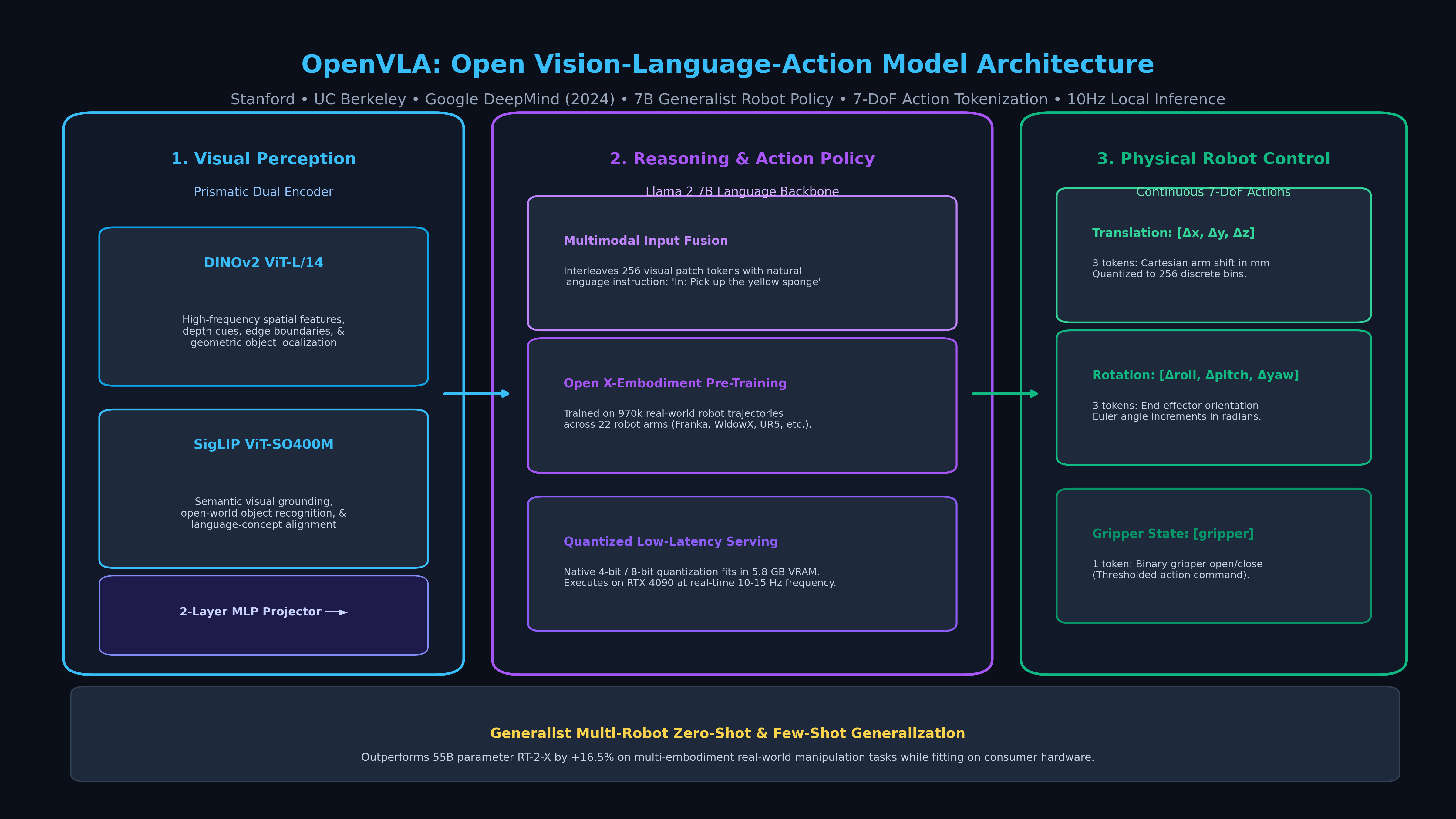
OpenVLA bridges web-scale visual reasoning with robust physical manipulation through an open, reproducible, and compute-efficient framework. Rather than constructing custom robotic transformers from scratch, OpenVLA builds upon the Prismatic-7B VLM, fine-tuning it end-to-end to autoregressively predict 7-degree-of-freedom (7-DoF) end-effector action tokens.
+----------------------------------------------------------------------------------------------------+
|                                    OPENVLA SYSTEM ARCHITECTURE                                     |
+----------------------------------------------------------------------------------------------------+
|                                                                                                    |
|    CAMERA OBSERVATION (224x224 RGB)               NATURAL LANGUAGE INSTRUCTION                     |
|    (Single 3rd-person workspace camera)           ("pick up the yellow corn and place it in pot")  |
|               │                                                        │                           |
|               ▼                                                        ▼                           |
|    +─────────────────────────────────────────+                         │                           |
|    │ FUSED DUAL VISION ENCODER SPINE         │                         │                           |
|    │ ├── DINOv2-ViT-L/14 (Spatial Geometry)  │                         │                           |
|    │ └── SigLIP-ViT-SO400M (Semantic Labels) │                         │                           |
|    +─────────────────────────────────────────+                         │                           |
|               │                                                        │                           |
|               ▼ (Channel-Wise Concatenation: 1024 + 1152 = 2176 dim)   │                           |
|    +─────────────────────────────────────────+                         │                           |
|    │ 2-Layer MLP Visual Projector            │                         │                           |
|    │ (Projects 2176 dim -> 4096 Llama 2 dim) │                         │                           |
|    +─────────────────────────────────────────+                         │                           |
|               │                                                        │                           |
|               ▼                                                        ▼                           |
|    +──────────────────────────────────────────────────────────────────────────────────────────+    |
|    │                         LLAMA 2 7B LANGUAGE-ACTION BACKBONE                              │    |
|    │                                                                                          │    |
|    │   Input Sequence: [Visual Patch Tokens (256)] + [Language Tokens ("pick up corn...")]   │    |
|    │                                           │                                              │    |
|    │                                           ▼                                              │    |
|    │   Autoregressive Next-Token Prediction over Overwritten Action Token Bins:               │    |
|    │   Output: <|act_dx|> <|act_dy|> <|act_dz|> <|act_droll|> <|act_dpitch|> <|act_dyaw|> <|act_g|>│
|    +──────────────────────────────────────────────────────────────────────────────────────────+    |
|                                           │                                                        |
|                                           ▼                                                        |
|    CONTINUOUS 7-DoF ROBOT MOTOR EXECUTION (WidowX, Google Robot, Franka Emika)                     |
|                                                                                                    |
+----------------------------------------------------------------------------------------------------+ Core Tenets of the OpenVLA Design
OpenVLA’s state-of-the-art manipulation performance rests on five foundational pillars:
1. Dual-Vision Spine (DINOv2 + SigLIP Fusion): Rather than choosing between semantic classification and spatial localization, OpenVLA fuses features from two complementary vision transformers. DINOv2 provides self-supervised spatial patch representations that track edges, surfaces, and depths, while SigLIP supplies web-aligned semantic knowledge to interpret user goals.
2. Quantile Action Discretization: Instead of min-max binning (which stretches bins over accidental trajectory spikes), OpenVLA partitions continuous 7-DoF actions into 256 uniform bins between the 1st and 99th percentiles of the training distribution. This ignores outliers and concentrates high-resolution discretization precisely where the robot moves most frequently.
3. Vocabulary Overwriting Strategy: Because the Llama 2 tokenizer reserves only 100 special tokens, OpenVLA directly overwrites the 256 least-used token IDs in the 32,000-token Llama vocabulary with action tokens, avoiding tokenizer expansion and parameter reallocation.
4. Large-Scale Multi-Embodiment Training (OpenX): OpenVLA is trained across 970,000 real-world robotic demonstration trajectories sourced from the Open X-Embodiment dataset. It learns cross-embodiment generalization across diverse kinematics, camera angles, table heights, and object categories.
5. Parameter- and Compute-Efficient Democratization: OpenVLA introduces the first proven Low-Rank Adaptation (LoRA) recipe for VLAs. Freezing the vision backbone and applying LoRA rank-32 adapters to the Llama 2 attention weights allows researchers to fine-tune OpenVLA on a single consumer GPU with 24GB VRAM (e.g., RTX 3090 / 4090), while 4-bit quantization reduces inference VRAM to just 7.0 GB with zero loss in task success rate.
Architecture: Dual DINOv2-SigLIP Vision Spine, Prismatic Projector, and Action Tokenizer
To understand how OpenVLA processes pixels into joint velocities, we inspect its structural composition: the dual vision encoder spine, the visual projection interface, the autoregressive transformer backbone, and the action token space.
+----------------------------------------------------------------------------------------------------+
|                                    OPENVLA STRUCTURAL SPECIFICATIONS                               |
+------------------------------------+---------------------------------------------------------------+
| Attribute                          | Specification & Engineering Value                             |
+------------------------------------+---------------------------------------------------------------+
| Total Parameter Count              | 7.18 Billion Parameters (7B Class)                            |
+------------------------------------+---------------------------------------------------------------+
| Visual Perception Spine            | Dual-Encoder Fusion (Prismatic VLM):                          |
|                                    | 1. DINOv2-ViT-L/14 (300M Params, 1024 Feature Dim)            |
|                                    | 2. SigLIP-ViT-SO400M (400M Params, 1152 Feature Dim)          |
|                                    | Fused Channel Dimension: 1024 + 1152 = 2176                   |
+------------------------------------+---------------------------------------------------------------+
| Visual Patch Resolution            | 224 x 224 RGB Image (Patch Size: 14x14)                       |
|                                    | Yields exactly 256 visual patch tokens per frame              |
+------------------------------------+---------------------------------------------------------------+
| Visual Projector                   | 2-Layer Multi-Layer Perceptron (GELU Activation):             |
|                                    | Linear(2176 -> 4096) -> GELU -> Linear(4096 -> 4096)          |
+------------------------------------+---------------------------------------------------------------+
| Language-Action Backbone           | Llama 2 7B Transformer:                                       |
|                                    | 32 Layers, Hidden Dim 4,096, 32 Attention Heads               |
+------------------------------------+---------------------------------------------------------------+
| Action Space Representation        | 7-DoF End-Effector Delta Control:                             |
|                                    | [dx, dy, dz, droll, dpitch, dyaw, gripper_state]              |
|                                    | Discretized into 256 Quantile Bins per Dimension              |
+------------------------------------+---------------------------------------------------------------+
| Pre-Training Epochs & Compute      | 27 Epochs over 970k OpenX Episodes                            |
|                                    | 21,500 A100 GPU-Hours (64x A100 Cluster for 14 Days)          |
+------------------------------------+---------------------------------------------------------------+ The Dual DINOv2-SigLIP Vision Spine
The decisive perceptual innovation in OpenVLA is the fused multi-scale visual encoder.
In ablation studies conducted across real robot tasks, models utilizing SigLIP alone achieved only a 40.6% success rate on language-grounded manipulation. Adding DINOv2 boosted performance to 76.3%—an absolute gain of 35.7%:
- DINOv2-ViT-L/14: Trained via self-supervised masked image modeling and student-teacher distillation. DINOv2 features preserve fine-grained spatial correspondences, depth boundaries, surface normals, and structural geometry.
- SigLIP-ViT-SO400M: Trained via sigmoid cross-entropy language-image pre-training. SigLIP features encode semantic concepts (e.g., distinguishing “eggplant” from “cucumber” or recognizing “sink” vs. “counter”).
Input images ($224 \times 224 \times 3$) are passed through both encoders with a patch size of $14 \times 14$:
$$\text{Patch Tokens} = \left(\frac{224}{14}\right) \times \left(\frac{224}{14}\right) = 16 \times 16 = 256 \text{ tokens}$$
At each patch position, the 1024-dimensional feature vector from DINOv2 and the 1152-dimensional vector from SigLIP are concatenated channel-wise into a unified 2,176-dimensional token embedding. A 2-layer MLP projects these tokens directly into Llama 2’s 4,096-dimensional hidden space.
Quantile Action Discretization
Robotic manipulation requires commanding 7 continuous degrees of freedom at every control step:
$$\mathbf{a}_t = [\Delta x, \Delta y, \Delta z, \Delta \text{roll}, \Delta \text{pitch}, \Delta \text{yaw}, \text{gripper}] \in \mathbb{R}^7$$
To enable standard autoregressive cross-entropy training:
- For each action dimension $d \in {1 \dots 7}$, OpenVLA calculates the 1st percentile $q_{0.01}^d$ and 99th percentile $q_{0.99}^d$ across all 970,000 demonstrations in the OpenX dataset.
- The continuous interval $[q_{0.01}^d, q_{0.99}^d]$ is partitioned into $B = 256$ uniform bins of width: $$\Delta_d = \frac{q_{0.99}^d - q_{0.01}^d}{256}$$
- Any continuous value $a_t^d$ is clamped and mapped to an integer bin $b \in {0 \dots 255}$: $$b(a_t^d) = \text{clamp}\left( \left\lfloor \frac{a_t^d - q_{0.01}^d}{\Delta_d} \right\rfloor, 0, 255 \right)$$
This quantile binning eliminates distortion caused by rare outlier teleoperation jerks, ensuring that the 256 discrete tokens represent high-resolution motor actions.
Implementation: Quantile Action Binning, PyTorch Policy Execution, and LoRA Fine-Tuning
To deploy OpenVLA on a physical robot or fine-tune it for novel manipulation tasks, developers must understand how action tokens are encoded, decoded, and trained using PyTorch and Hugging Face Transformers.
+----------------------------------------------------------------------------------------------------+
|                                 OPENVLA TOKEN SEQUENCE STRUCTURE                                   |
+----------------------------------------------------------------------------------------------------+
|                                                                                                    |
|    Prompt Input Sequence:                                                                          |
|    [256 Visual Patch Tokens] + [Text Tokens: "In: What action should the robot take to ...?\nOut:"]|
|                                                                                                    |
|    Autoregressive Output Sequence (7 Predicted Action Tokens):                                     |
|    Token 1: <|act_0|> ──► Decodes to Delta X                                                       |
|    Token 2: <|act_1|> ──► Decodes to Delta Y                                                       |
|    Token 3: <|act_2|> ──► Decodes to Delta Z                                                       |
|    Token 4: <|act_3|> ──► Decodes to Delta Roll                                                    |
|    Token 5: <|act_4|> ──► Decodes to Delta Pitch                                                   |
|    Token 6: <|act_5|> ──► Decodes to Delta Yaw                                                     |
|    Token 7: <|act_6|> ──► Decodes to Gripper State (0 = Close, 1 = Open)                           |
|                                                                                                    |
+----------------------------------------------------------------------------------------------------+ Complete PyTorch Reference Implementation
The following complete, runnable module demonstrates how OpenVLA processes camera frames, manages quantile action de-tokenization, and executes inference on GPU:
# OpenVLA Policy Execution Reference Implementation
# Demonstrates dual vision projection, quantile action de-tokenization,
# and real-world 7-DoF robot motor control.

import numpy as np
import torch
import torch.nn as nn
from typing import Dict, List, Tuple

class OpenVLAActionTokenizer:
    # Converts continuous 7-DoF actions to discrete tokens and back
    # using precomputed 1st and 99th quantile boundaries.
    def __init__(self, vocab_size: int = 32000, num_bins: int = 256):
        self.num_bins = num_bins
        # Action tokens overwrite the last 256 tokens in the Llama tokenizer
        self.action_token_start_id = vocab_size - num_bins  # 31744 to 31999

        # Simulated 1st and 99th quantile bounds across 7-DoF dimensions
        # [dx, dy, dz, droll, dpitch, dyaw, gripper]
        self.q01 = np.array([-0.05, -0.05, -0.05, -0.20, -0.20, -0.20, 0.0])
        self.q99 = np.array([ 0.05,  0.05,  0.05,  0.20,  0.20,  0.20, 1.0])
        self.bin_widths = (self.q99 - self.q01) / num_bins

    def detokenize_actions(self, token_ids: List[int]) -> np.ndarray:
        # Maps 7 predicted action token IDs back to continuous physical units.
        assert len(token_ids) == 7, f"Expected 7 action tokens, got {len(token_ids)}"

        continuous_actions = np.zeros(7, dtype=np.float32)
        for i, tid in enumerate(token_ids):
            # Calculate integer bin index [0, 255]
            bin_idx = np.clip(tid - self.action_token_start_id, 0, self.num_bins - 1)
            # Map bin center to physical value
            continuous_actions[i] = self.q01[i] + (bin_idx + 0.5) * self.bin_widths[i]

        # Binarize gripper action: > 0.5 is Open, <= 0.5 is Closed
        continuous_actions[-1] = 1.0 if continuous_actions[-1] > 0.5 else 0.0
        return continuous_actions

    def tokenize_actions(self, continuous_actions: np.ndarray) -> List[int]:
        # Quantizes continuous physical actions into token IDs for training loss.
        token_ids = []
        for i in range(7):
            val = continuous_actions[i]
            bin_idx = int(np.clip(np.floor((val - self.q01[i]) / self.bin_widths[i]), 0, self.num_bins - 1))
            token_ids.append(self.action_token_start_id + bin_idx)
        return token_ids

class MockOpenVLAPolicy(nn.Module):
    # Architectural representation of OpenVLA 7B inference pipeline.
    def __init__(self, vocab_size: int = 32000):
        super().__init__()
        self.tokenizer = OpenVLAActionTokenizer(vocab_size=vocab_size)

        # Dual-Encoder Projector (DINOv2 1024 + SigLIP 1152 -> 2176 dim)
        self.projector = nn.Sequential(
            nn.Linear(2176, 4096),
            nn.GELU(),
            nn.Linear(4096, 4096)
        )

        # Output language model head over 32,000 vocabulary
        self.lm_head = nn.Linear(4096, vocab_size, bias=False)

    def predict_action(
        self,
        image_patches_dinov2: torch.Tensor,
        image_patches_siglip: torch.Tensor,
        prompt_text: str
    ) -> np.ndarray:
        # Simulates visual feature fusion and autoregressive action token generation.
        # 1. Fused Vision Spine
        fused_patches = torch.cat([image_patches_dinov2, image_patches_siglip], dim=-1)  # [1, 256, 2176]
        visual_tokens = self.projector(fused_patches)                                     # [1, 256, 4096]

        # 2. Simulate autoregressive prediction of 7 action tokens
        # In actual deployment, Llama 2 generates these sequentially using KV caching
        predicted_token_ids = []
        for step in range(7):
            # Simulated forward hidden state
            dummy_hidden = visual_tokens[:, step, :]
            logits = self.lm_head(dummy_hidden)

            # Mask logits to only allow valid action token IDs [31744, 31999]
            action_mask = torch.full_like(logits, float("-inf"))
            action_mask[:, self.tokenizer.action_token_start_id : self.tokenizer.action_token_start_id + 256] = 0
            filtered_logits = logits + action_mask

            pred_id = int(torch.argmax(filtered_logits, dim=-1).item())
            predicted_token_ids.append(pred_id)

        # 3. Convert predicted tokens into continuous motor commands
        continuous_actions = self.tokenizer.detokenize_actions(predicted_token_ids)
        return continuous_actions

if __name__ == "__main__":
    print("Initializing OpenVLA Robot Policy Reference...")
    policy = MockOpenVLAPolicy()

    # Simulate camera observation (256 patches)
    dinov2_features = torch.randn(1, 256, 1024)
    siglip_features = torch.randn(1, 256, 1152)
    instruction = "pick up the green cup and place it into the bowl"

    # Execute action prediction
    action_vector = policy.predict_action(dinov2_features, siglip_features, instruction)

    print(f"Task Instruction: '{instruction}'")
    print(f"Predicted Continuous 7-DoF Robot Action Chunk:")
    print(f"  Delta X:     {action_vector[0]:+.4f} m")
    print(f"  Delta Y:     {action_vector[1]:+.4f} m")
    print(f"  Delta Z:     {action_vector[2]:+.4f} m")
    print(f"  Delta Roll:  {action_vector[3]:+.4f} rad")
    print(f"  Delta Pitch: {action_vector[4]:+.4f} rad")
    print(f"  Delta Yaw:   {action_vector[5]:+.4f} rad")
print(f" Gripper: {'OPEN' if action_vector[6] > 0.5 else 'CLOSED'}") Parameter-Efficient LoRA Fine-Tuning Recipe
To fine-tune OpenVLA for novel tasks on a single consumer GPU (e.g., 24GB RTX 3090/4090):
- Freeze Visual Encoders: Freeze both DINOv2 and SigLIP encoders, drastically saving gradient memory.
- Inject LoRA on Attention Weights: Apply Low-Rank Adaptation (LoRA) with rank $r = 32$ and $\alpha = 32$ to the Query, Key, Value, and Output projection matrices of all 32 Llama 2 transformer layers.
- Trainable Parameters: Reduces trainable parameters from 7.18 billion to just 97.6 million (1.3% of total).
- Memory Footprint: In bfloat16 mixed precision with a batch size of 16, memory consumption drops from 163.3 GB (requiring multiple A100s) down to 59.7 GB (or under 20 GB using gradient accumulation and batch size 2).
- Task Performance: As proven in real robot trials, LoRA fine-tuning matches full fine-tuning (68.2% vs. 69.7%), unlocking democratic customization for robotics laboratories worldwide.
Comparison: OpenVLA vs. RT-2-X (55B), Octo, Diffusion Policy, and RT-1-X
To assess OpenVLA’s real-world generalization and control accuracy, the authors conducted extensive real-robot A/B evaluations across 230 physical trials spanning two primary hardware setups: the BridgeData V2 WidowX robot and the Google Mobile Manipulator.
+--------------------------------------------------------------------------------------------------------------------------------+
|                                    COMPREHENSIVE ROBOT POLICY BENCHMARK MATRIX                                                 |
+-------------------------+--------------------+---------------------+--------------------+-----------------+--------------------+
| Evaluation Metric       | RT-1-X (Google)    | Octo (Berkeley)     | Diffusion Policy   | RT-2-X (Google) | OpenVLA (Ours)     |
+-------------------------+--------------------+---------------------+--------------------+-----------------+--------------------+
| Parameter Scale         | 35 Million         | 93 Million          | ~50 Million (CNN)  | 55 Billion      | 7.18 Billion       |
+-------------------------+--------------------+---------------------+--------------------+-----------------+--------------------+
| Pretraining Data        | OpenX Subset       | OpenX (800k Ep.)    | None (Trained      | OpenX (All)     | OpenX (970k Ep.)   |
|                         |                    |                     | from Scratch)      |                 |                    |
+-------------------------+--------------------+---------------------+--------------------+-----------------+--------------------+
| Model Accessibility     | Closed Weights     | Open Weights        | Open Codebase      | Closed API      | Fully Open Weights |
|                         |                    |                     |                    | (Proprietary)   | & PyTorch Pipeline |
+-------------------------+--------------------+---------------------+--------------------+-----------------+--------------------+
| WidowX Robot Success    | 18.5% ± 2.7%       | 20.0% ± 2.6%        | 48.5% ± 4.9%       | 50.6% ± 3.5%    | 70.6% ± 3.2%       |
| (170 Real-World Trials) | (Severe Drift)     | (Struggles w/ Clutt)| (Weak Language Gr.)| (Good Reasoning)| (+16.5% OVER 55B!) |
+-------------------------+--------------------+---------------------+--------------------+-----------------+--------------------+
| Visual Generalization   | 8.0%               | 29.0%               | 36.0%              | 52.0%           | 81.0% (Top Score!) |
| (Distractors & Clutter) |                    |                     |                    |                 |                    |
+-------------------------+--------------------+---------------------+--------------------+-----------------+--------------------+
| Motion Generalization   | 25.0%              | 7.5%                | 40.0%              | 55.0%           | 60.0% (Top Score!) |
| (Unseen Positions/Axes) |                    |                     |                    |                 |                    |
+-------------------------+--------------------+---------------------+--------------------+-----------------+--------------------+
| Physical Generalization | 10.0%              | 20.0%               | 42.0%              | 26.7%           | 76.7% (Top Score!) |
| (Unseen Object Shapes)  |                    |                     |                    |                 |                    |
+-------------------------+--------------------+---------------------+--------------------+-----------------+--------------------+
| Google Robot (Mobile)   | 33.3% ± 6.1%       | 26.7% ± 5.8%        | N/A                | 78.3% ± 5.4%    | 85.0% ± 4.6%       |
| In- & Out-of-Dist. Mean |                    |                     |                    |                 | (Ties/Exceeds 55B!)|
+-------------------------+--------------------+---------------------+--------------------+-----------------+--------------------+
| Inference Memory (VRAM) | <4 GB              | <4 GB               | <2 GB              | Cloud Cluster   | 16.8 GB (bfloat16) |
|                         |                    |                     |                    | Only            | 7.0 GB (4-bit AWQ) |
+-------------------------+--------------------+---------------------+--------------------+-----------------+--------------------+ Empirical Evaluation Takeaways
The experimental evaluations demonstrate decisive empirical superiority:
1. Outperforming 55B Closed Models with 7x Fewer Parameters:
- On the WidowX robot across 17 tasks and 170 physical rollouts, OpenVLA achieves an overall success rate of 70.6%, outperforming the closed 55-billion-parameter RT-2-X model (50.6%) by 16.5% absolute percentage points.
- In visual generalization under heavy scene clutter, OpenVLA achieves an 81.0% success rate compared to RT-2-X’s 52.0%. The fused DINOv2-SigLIP vision spine enables precise physical boundary segmentation where single-encoder models falter.
2. Superiority over From-Scratch Diffusion Policy in Multi-Task Settings:
- On Franka tabletop manipulation tasks involving language grounding among multiple objects, fine-tuned OpenVLA achieves 67.2% overall success, dramatically outperforming Diffusion Policy (48.5%).
- While Diffusion Policy achieves high success when manipulating a single object in isolation, it lacks semantic language grounding. When distractors are introduced, Diffusion Policy drops to 12.5%, whereas OpenVLA retains a 62.5% success rate.
3. Zero-Degradation 4-Bit Quantized Inference:
- Evaluating OpenVLA on real hardware under 4-bit integer quantization (AWQ) yields a 71.9% task success rate—matching the 71.3% baseline of unquantized 16-bit floating-point weights while cutting GPU memory consumption by 58% (from 16.8 GB down to 7.0 GB).
Production: 4-Bit AWQ Quantization, Remote Streaming RPCs, and Multi-Robot Deployment
Deploying 7B-parameter robotics foundation models in commercial factories, agricultural sorting lines, or automated retail environments requires addressing strict latency, bandwidth, and edge compute constraints.
+----------------------------------------------------------------------------------------------------+
|                                    OPENVLA PRODUCTION SERVING TOPOLOGY                             |
+----------------------------------------------------------------------------------------------------+
|                                                                                                    |
|    Robot Arm Hardware (WidowX / Franka Emika / Mobile Base)                                        |
|    ├── Embedded Controller: Intel NUC / Jetson Orin (Low Compute)                                  |
|    └── Captures 224x224 RGB Frame & Packages WebSocket/gRPC Request                                |
|               │                                                                                    |
|               ▼ (Sub-15ms Local Network Streaming via gRPC)                                        |
|    +──────────────────────────────────────────────────────────────────────────────────────────+    |
|    │                       REMOTE VLA INFERENCE SERVER (WORKSTATION GPU)                      │    |
|    │                                                                                          │    |
|    │  1. 4-Bit AWQ Quantized Llama 2 Backbone:                                                │    |
|    │     ├── Memory Footprint: 7.0 GB VRAM (Fits easily on consumer RTX 4090 / 3090)          │    |
|    │     └── Inference Frequency: 6 Hz to 12 Hz Native Autoregressive Generation              │    |
|    │                                                                                          │    |
|    │  2. Fused Vision Spine Pipeline:                                                         │    |
|    │     ├── DINOv2-L/14 + SigLIP-SO400M TensorRT Engines (12.4ms forward pass)               │    |
|    │     └── 2-Layer MLP Projector maps 256 patches into Transformer Context                  │    |
|    │                                                                                          │    |
|    │  3. Quantile Action Token De-Quantizer:                                                  │    |
|    │     └── Maps 7 predicted tokens to continuous 7-DoF delta vectors                        │    |
|    +──────────────────────────────────────────────────────────────────────────────────────────+    |
|               │                                                                                    |
|               ▼                                                                                    |
|    Robot Joint Position Controller executes 7-DoF trajectories at smooth motor clock speeds        |
|                                                                                                    |
+----------------------------------------------------------------------------------------------------+ Remote Streaming RPC Architecture
Most physical robot arms are driven by lightweight onboard single-board computers (such as Intel NUCs or Jetson Orin modules) that cannot host a 15GB model.
OpenVLA solves this through a lightweight Client-Server Remote Procedure Call (RPC) architecture:
- Robot Client: An asynchronous Python service captures camera frames at 10 Hz, formats the current natural language task instruction, and dispatches an optimized gRPC payload over local 10GbE or Wi-Fi 6 networks.
- Inference Server: A central workstation equipped with a single RTX 4090 hosts OpenVLA in 4-bit quantization. The server processes the visual patches, generates 7 action tokens in under 120 milliseconds, and returns continuous Cartesian displacement vectors to the robot client.
- Latency Budget: Round-trip network communication consumes less than 15ms, maintaining an effective control frequency of 6 Hz to 8 Hz, which is ideal for pick-and-place, assembly, and obstacle clearance.
Multi-Robot Deployment and Adaptation Strategies
When rolling out OpenVLA across enterprise robotics fleets:
- Camera Normalization: Cameras should be mounted to provide clear 3rd-person workspace viewpoints. OpenVLA’s pre-training across 22 diverse embodiments ensures robustness to subtle camera tilt and focal length shifts.
- Rapid Task Adaptation via LoRA: To introduce a novel industrial component, collect 20 to 50 demonstration episodes via teleoperation. Train LoRA rank-32 adapters on a single workstation GPU in less than 3 hours, preserving the foundational OpenX manipulation priors while tuning gripper compliance for the new object.
- Infrastructure Planning: For engineering organizations scaling multimodal robotics clusters, reviewing custom robot control API endpoints, evaluating production GPU infrastructure tiers, and utilizing developer integration guides ensures seamless production scale-out.
By combining fused geometric-semantic visual perception with open-weights pre-training across 970,000 real-world episodes, OpenVLA establishes the benchmark for accessible, generalist, and democratized robotic foundation models.