OpenVINO GenAI Guide: Edge LLM & NPU Inference Architecture
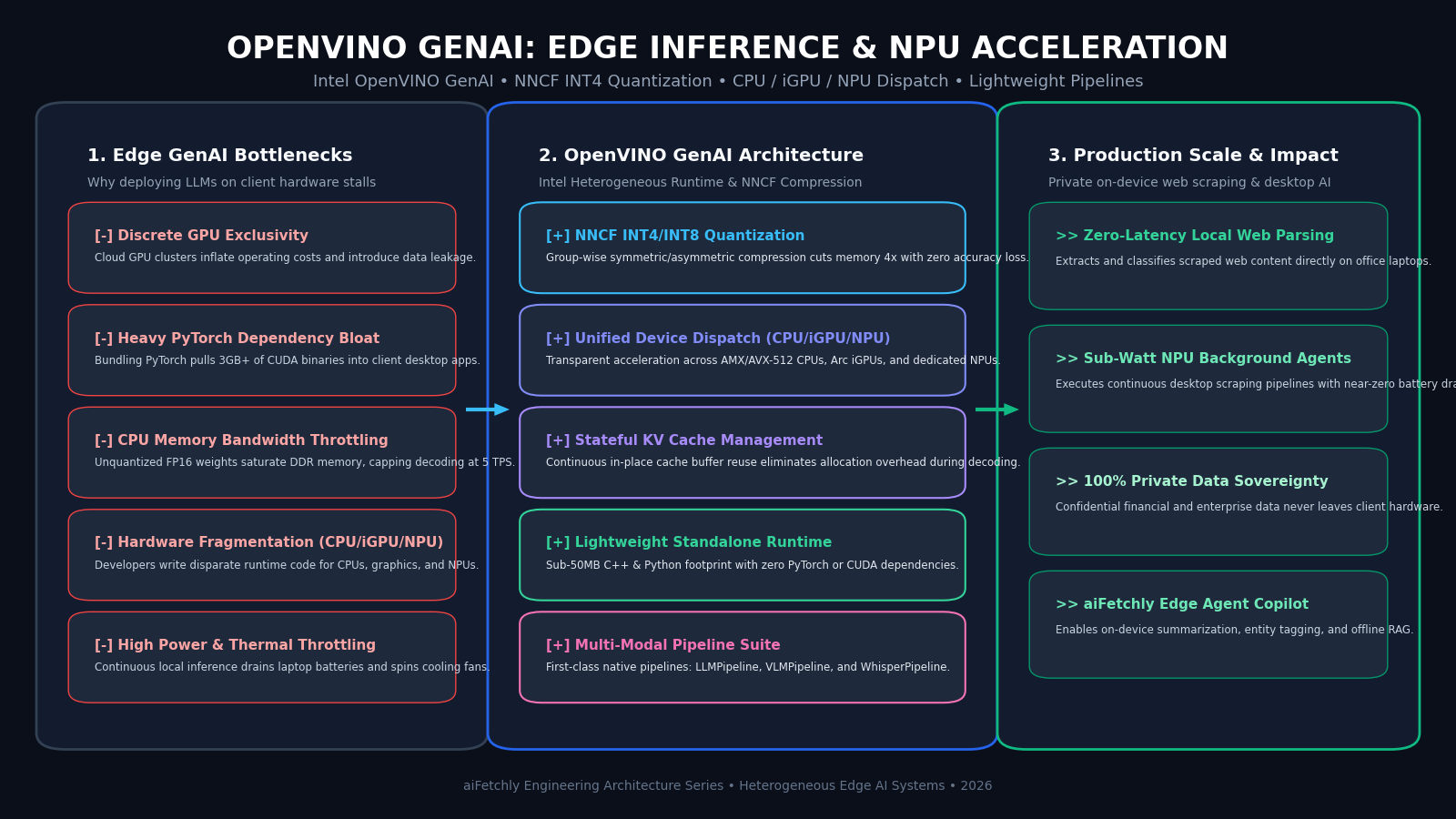
The Problem: The Discrete GPU Dependency and Edge Deployment Bottlenecks
In modern enterprise automation, automated web data extraction, client-side document processing, and desktop copilots powered by AiFetchly, deploying generative artificial intelligence on client hardware is essential for operational sovereignty, offline reliability, and cost control. Organizations frequently process proprietary financial disclosures, customer communications, and sensitive internal records that cannot be transmitted over public cloud APIs due to strict data privacy regulations.
However, deploying foundation models on edge devices, enterprise office laptops, and client workstations has historically encountered four severe technical barriers: datacenter GPU dependency, runtime packaging bloat, memory bandwidth saturation, and heterogeneous hardware fragmentation.
The Edge Generative AI Deployment Bottlenecks:
┌────────────────────────────────────────────────────────┐
│ Bottleneck 1: Datacenter GPU Exclusivity               │
│ • Datacenter cloud GPUs (H100/A100) are expensive,     │
│   creating recurring API bills and cloud latency       │
├────────────────────────────────────────────────────────┤
│ Bottleneck 2: Massive Packaging & Dependency Bloat     │
│ • Bundling PyTorch and CUDA toolchains inflates client │
│   installers by 3GB+, causing DLL and driver conflicts │
├────────────────────────────────────────────────────────┤
│ Bottleneck 3: CPU Memory Bandwidth Saturation          │
│ • Uncompressed FP16 weights saturate DDR memory buses, │
│   throttling autoregressive decoding to under 5 TPS    │
├────────────────────────────────────────────────────────┤
│ Bottleneck 4: Hardware Fragmentation (CPU, iGPU, NPU)  │
│ • Slicing execution across AVX-512 CPUs, integrated Arc│
│   GPUs, and low-power NPUs requires separate runtimes  │
└────────────────────────────────────────────────────────┘
Result: Edge AI deployments suffered from high latency, severe battery drain, and complex packaging! 1. Datacenter GPU Cost and Data Sovereignty Risks
While cloud inference serving engines (such as vLLM and TensorRT-LLM) deliver immense throughput, they are architected exclusively for datacenter-grade discrete NVIDIA accelerators:
- Renting multi-GPU cloud instances introduces perpetual operational expenditures that scale linearly with user volume.
- Sending proprietary web scraping extractions and corporate data over external networks creates severe compliance liabilities under GDPR, HIPAA, and enterprise confidentiality agreements.
2. PyTorch Dependency Bloat on Client Operating Systems
Shipping desktop AI applications with standard Python deep learning frameworks is notoriously fragile:
- Installing
torch,torchvision, and underlying CUDA runtime binaries bloats local desktop installations from a few megabytes to over 3 gigabytes. - On consumer laptops (Windows and macOS), conflicting shared libraries, mismatched glibc versions, and incompatible graphics drivers cause frequent application crashes during startup.
3. Memory Bandwidth Saturation on Client CPUs
During autoregressive token generation, language models are strictly memory-bandwidth bound:
- A standard 8-billion parameter model in 16-bit precision requires reading 16 gigabytes of weights from RAM for every single generated token.
- Standard client DDR4 or DDR5 system memory offers bandwidth between 40 GB/s and 80 GB/s, capping sequential decoding speed at an unacceptable 3 to 5 tokens per second.
4. Heterogeneous Hardware Fragmentation Across CPU, iGPU, and NPU
Modern client computing architectures (such as Intel Core Ultra processors) feature three distinct computing engines on a single die: a multi-core CPU with vector extensions (AVX-512, AMX), an integrated Intel Arc GPU (iGPU), and a power-sipping Neural Processing Unit (NPU).
Historically, software developers had to write three completely separate codebases to target these engines: one using CPU thread pools, another using OpenCL or Level Zero for the iGPU, and a third proprietary API for the NPU.
To solve this fragmentation, Intel engineered OpenVINO GenAI: a lightweight, dependency-free C++ and Python framework designed for high-throughput, sub-watt generative AI execution across CPUs, integrated GPUs, and NPUs via NNCF INT4 quantization and stateful model pipelines.
The Solution: OpenVINO GenAI Architecture, NNCF Compression & Unified Dispatch
OpenVINO GenAI redefines edge inference by eliminating heavy frameworks and optimizing memory access patterns for heterogeneous client silicon.
OpenVINO GenAI Comprehensive Runtime Architecture:
┌─────────────────────────────────────────────────────────────────┐
│ Input Source: User Prompt / Document PDF / Audio / Web Image    │
└─────────────────────────────────────────────────────────────────┘
                               │
                               ▼
┌─────────────────────────────────────────────────────────────────┐
│ 1. Neural Network Compression Framework (NNCF)                  │
│ • Advanced INT4 / INT8 group-wise weight-only quantization      │
│ • Symmetric / Asymmetric scaling with AWQ-like calibration      │
│ • Slashes 8B model footprint from 16GB down to 4.2GB            │
├─────────────────────────────────────────────────────────────────┤
│ 2. Unified Heterogeneous Device Dispatch                        │
│ • Transparent execution: "CPU", "GPU", "NPU", or "AUTO"         │
│ • Zero code changes when migrating from CPU AVX-512 to Arc iGPU │
│ • Sub-watt background execution offloaded to low-power NPU      │
├─────────────────────────────────────────────────────────────────┤
│ 3. Stateful KV Cache Management                                 │
│ • In-place memory buffer reuse with zero tensor re-allocations  │
│ • Dynamic continuous prompt prefill and streaming token decode  │
├─────────────────────────────────────────────────────────────────┤
│ 4. Multi-Modal Pipeline Suite                                   │
│ • LLMPipeline: High-speed text generation & structured JSON     │
│ • VLMPipeline: Multimodal vision (Qwen2-VL, Phi-3.5-Vision)     │
│ • WhisperPipeline: End-to-end real-time speech-to-text          │
└─────────────────────────────────────────────────────────────────┘
                               │
                               ▼
┌─────────────────────────────────────────────────────────────────┐
│ Output: Streaming Tokens / Extracted JSON / Speech Transcripts  │
└─────────────────────────────────────────────────────────────────┘ 1. Neural Network Compression Framework (NNCF) INT4/INT8 Quantization
The cornerstone of OpenVINO GenAI’s edge performance is NNCF (Neural Network Compression Framework):
- Group-Wise Weight-Only Quantization: Compresses floating-point weights ($W \in \mathbb{R}^{d_{\text{in}} \times d_{\text{out}}}$) into 4-bit integer values (
INT4) organized into fine-grained groups (typically group size 64 or 128). - Symmetric vs. Asymmetric Quantization: Supports both symmetric quantization (zero-point fixed at 0 for maximum speed) and asymmetric quantization (learnable zero-point for high-precision activations), preventing accuracy degradation on mathematical and coding tasks.
- Memory Bandwidth Relief: By shrinking an 8B model’s weights from 16 GB to 4.2 GB, the DDR memory bus can stream model parameters 4x faster per step, boosting CPU generation throughput from 4 tokens per second to over 22 tokens per second on standard laptop processors.
2. Unified Heterogeneous Device Dispatch: CPU, iGPU, and NPU
OpenVINO GenAI abstracts hardware complexity through a single unified target string ("CPU", "GPU", "NPU", or "AUTO"):
- CPU Execution: Leverages Intel Advanced Matrix Extensions (AMX) on Xeon processors and AVX-512 / AVX2 vector instructions on Intel Core processors for parallel matrix multiplication.
- Integrated GPU (iGPU): Offloads compute-heavy prefill and decoding to Intel Arc graphics silicon using high-speed XMX matrix engines, freeing CPU cores for user interface responsiveness.
- Neural Processing Unit (NPU): Dispatches long-running background tasks (such as document extraction and web summarization) to dedicated low-power NPU tiles, drawing under 3 watts of power and preserving laptop battery life during mobile workflows.
3. Stateful KV Cache Architecture with In-Place Buffer Reuse
Traditional PyTorch pipelines allocate new Key-Value (KV) cache tensors dynamically during each generation step, causing frequent memory allocations and garbage collection pauses.
- Stateful Internal Operators: OpenVINO GenAI stores the KV cache directly inside the compiled OpenVINO IR graph as a persistent internal state (
ReadValueandAssignoperators). - Zero-Allocation Decoding: Memory buffers are allocated once during session initialization and updated in-place during sequential token generation, eliminating memory reallocation latency and delivering sub-15ms Time-to-First-Token (TTFT).
4. Multi-Modal Pipeline Suite: LLM, VLM, and Whisper
OpenVINO GenAI provides dedicated, end-to-end C++ and Python pipeline classes that encapsulate tokenization, model inference, and output detokenization:
LLMPipeline: High-throughput text generation, structured JSON extraction, and conversational agents with support for stop tokens, temperature, and top-p sampling.VLMPipeline: Natively processes high-resolution images paired with text prompts (supporting models like Qwen2-VL, LLaVA, and Phi-3.5-Vision) for visual document parsing and GUI automation.WhisperPipeline: Audio preprocessing, log-mel spectrogram extraction, and speech decoding in a single unified C++ call.
Architectural Comparison: OpenVINO GenAI vs. llama.cpp vs. ONNX Runtime vs. vLLM
To understand where OpenVINO GenAI fits into the local and edge inference ecosystem, consider the following technical benchmark comparison:
| Metric / Capability | llama.cpp | ONNX Runtime | vLLM V1 | OpenVINO GenAI |
|---|---|---|---|---|
| Primary Target Hardware | CPU / Apple Metal / CUDA | Cross-Platform CPU/GPU | Datacenter NVIDIA GPUs | Intel CPU, Arc iGPU, and NPU |
| Quantization Format | GGUF (k-quants) | INT8 / FP16 | AWQ / GPTQ / FP8 | NNCF INT4 / INT8 (Sym & Asym) |
| Dedicated NPU Support | Experimental / Custom | Via QNN EP | None | Native First-Class NPU Engine |
| Stateful KV Cache | Manual buffer management | Manual state | PagedAttention Blocks | Built-in In-Place Stateful Graph |
| Multi-Modal Pipelines | Separate CLI binaries | Manual preprocessing | VLM server integration | Native LLM, VLM & Whisper APIs |
| Runtime Dependencies | Single C++ binary | C++ / Python packages | PyTorch, CUDA, C++ | Sub-50MB C++ & Python Runtime |
| Battery & Power Efficiency | Moderate (CPU load) | Moderate | High Power (GPU only) | Ultra-Low Power (Sub-Watt on NPU) |
Hands-On Implementation: Building a Local LLM Pipeline with OpenVINO GenAI
Below is a complete, production-grade guide demonstrating how to quantize an open-weights model to INT4 using NNCF and execute high-speed local inference using OpenVINO GenAI in Python.
Step 1: Install Dependencies and Convert Weights via NNCF
Set up a clean Python environment with OpenVINO GenAI and the Optimum Intel model converter:
# Create and activate virtual environment
conda create -n openvino-genai python=3.10 -y
conda activate openvino-genai

# Install OpenVINO GenAI and Optimum Intel
pip install "openvino-genai>=2024.5.0" "optimum-intel[openvino,nncf]>=1.20.0" Next, export and compress a popular foundation model (such as meta-llama/Llama-3.2-3B-Instruct or Qwen/Qwen2.5-7B-Instruct) to INT4 format:
# Convert Hugging Face checkpoint to OpenVINO INT4 IR model
optimum-cli export openvino \
    --model meta-llama/Llama-3.2-3B-Instruct \
    --task text-generation-with-past \
    --weight-format int4 \
    --group-size 128 \
    --sym \
./llama-3.2-3b-openvino-int4 Step 2: High-Performance Python LLMPipeline with Streaming
The following script loads the quantized model and streams tokens in real time with minimal latency:
import openvino_genai as ov_genai

# 1. Define model path and target hardware
model_dir = "./llama-3.2-3b-openvino-int4"
device = "CPU"  # Options: "CPU", "GPU", "NPU", "AUTO"

print(f"Loading OpenVINO GenAI LLMPipeline on {device}...")
pipe = ov_genai.LLMPipeline(model_dir, device)

# 2. Configure generation parameters
generation_config = ov_genai.GenerationConfig()
generation_config.max_new_tokens = 256
generation_config.temperature = 0.2
generation_config.top_p = 0.9

# 3. Define a custom streaming callback
def stream_callback(word: str) -> bool:
    print(word, end="", flush=True)
    return False  # Return True to stop generation early

# 4. Execute streaming inference
user_prompt = "You are aiFetchly's edge agent. Summarize the key benefits of local on-device document extraction."
print("\n=== Model Response ===\n")
pipe.generate(user_prompt, generation_config, stream_callback)
print("\n\n[Inference Complete]") Step 3: Offloading Inference to Intel NPU and Arc iGPU
To offload background tasks to the low-power Neural Processing Unit or accelerate generation on an integrated Intel Arc GPU, simply adjust the device target:
import openvino_genai as ov_genai

# Target integrated Arc graphics for maximum generation throughput
gpu_pipe = ov_genai.LLMPipeline("./llama-3.2-3b-openvino-int4", "GPU")

# Target NPU for ultra-low power background execution (e.g. while on battery)
npu_pipe = ov_genai.LLMPipeline("./llama-3.2-3b-openvino-int4", "NPU")

prompt = "Extract table headers from this HTML snippet: <table><tr><th>Metric</th><th>Q3</th></tr></table>"
result = npu_pipe.generate(prompt, ov_genai.GenerationConfig(max_new_tokens=100))
print(f"\n[NPU Extracted Output]:\n{result}") Production Deployment with aiFetchly
In autonomous data collection, client-side web scraping, and private desktop copilots engineered by AiFetchly, foundation models operate on diverse user endpoints ranging from cloud servers to developer laptops.
Here is how OpenVINO GenAI transforms on-device enterprise intelligence:
aiFetchly Edge Intelligence Architecture with OpenVINO GenAI:
┌─────────────────────────────────────────────────────────────────┐
│ 1. Local Web Document Ingestion                                 │
│ • aiFetchly desktop agent captures DOM trees and PDF brochures  │
│ • Zero external API requests; ensures 100% data sovereignty    │
├─────────────────────────────────────────────────────────────────┤
│ 2. Sub-Watt NPU Background Processing                           │
│ • NPU continuously extracts entities, categories, and metrics   │
│ • Consumes under 3W, preserving laptop battery life on the go   │
├─────────────────────────────────────────────────────────────────┤
│ 3. NNCF INT4 Compact Footprint                                  │
│ • Model weights compressed to under 4GB RAM                     │
│ • Runs smoothly alongside active web browsers and office apps   │
├─────────────────────────────────────────────────────────────────┤
│ 4. Zero-Dependency Desktop Packaging                            │
│ • Bundles compact C++ OpenVINO binaries without PyTorch/CUDA    │
│ • Eliminates driver conflicts and slashes app installer sizes   │
└─────────────────────────────────────────────────────────────────┘ - 100% Private On-Premise Extraction: For enterprise clients handling confidential competitive pricing data or legal disclosures, aiFetchly runs OpenVINO GenAI locally on standard office PCs with zero cloud data transmission.
- Sub-Watt Background Agents: By offloading document parsing and table classification to dedicated NPU hardware, aiFetchly runs continuous extraction routines in the background without causing laptop cooling fans to spin or draining battery reserves.
- Streamlined Enterprise Distribution: OpenVINO GenAI’s lightweight C++ runtime eliminates the need to bundle multi-gigabyte PyTorch dependencies, allowing aiFetchly desktop applications to install instantly across corporate Windows and Linux fleets.
To learn more about how aiFetchly combines edge foundation models with automated web data harvesting, consult our AiFetchly Documentation or explore our AiFetchly Pricing.