OpenRLHF Guide: Scalable Ray & vLLM Alignment AI
Post-training reinforcement learning has emerged as the definitive frontier in artificial intelligence engineering. From mathematical reasoning in DeepSeek-R1 to complex agentic planning and reliable structured web harvesting via aiFetchly, foundation models achieve their highest reasoning performance not during initial pre-training, but through large-scale post-training alignment algorithms: Proximal Policy Optimization (PPO), Direct Preference Optimization (DPO), and Group Relative Policy Optimization (GRPO).
However, scaling reinforcement learning from human feedback (RLHF) and reinforcement learning with verifiable rewards (RLVR) to models exceeding 70 billion parameters has historically been one of the most punishing infrastructure engineering challenges in modern machine learning. Early RLHF systems were plagued by architectural coupling: forcing high-throughput autoregressive inference (sampling trajectories) and memory-intensive backward training passes to share the same GPU runtimes. As a result, clusters experienced up to 80% idle compute time, frequent out-of-memory crashes, and brittle multi-node synchronization.
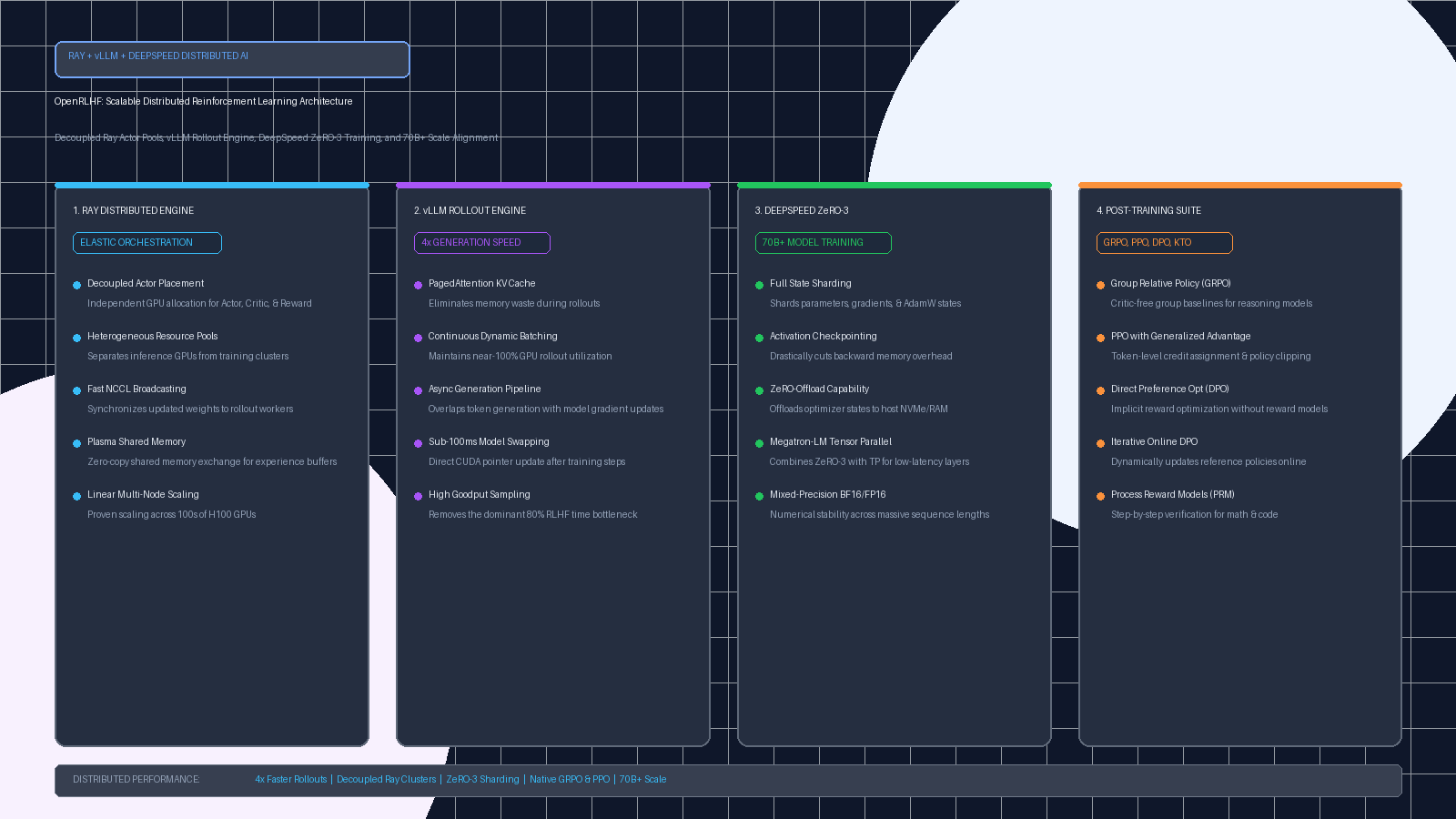
To overcome these scalability barriers, an open-source coalition of researchers and systems architects introduced OpenRLHF: An Easy-to-use, Scalable and High-performance RLHF Framework (arXiv:2405.11143, OpenRLHF GitHub). OpenRLHF fundamentally restructures distributed post-training by combining Ray for elastic actor orchestration, vLLM for PagedAttention rollout acceleration, and DeepSpeed ZeRO-3 (or Megatron-LM) for sharded parameter training.
In this technical guide, we analyze the structural bottlenecks of legacy RLHF stacks, explore the decoupled Ray-vLLM-DeepSpeed foundation of OpenRLHF, evaluate its algorithm suite across PPO, DPO, and GRPO, and construct a complete end-to-end Python implementation.
The Problem: The Generation-Training Duality Crisis in Traditional RLHF
To appreciate the architectural necessity of OpenRLHF, we must inspect the mechanics of online reinforcement learning pipelines and identify why legacy distributed systems fail when scaling beyond 7B parameters.
Traditional Coupled RLHF Infrastructure Bottleneck:
┌─────────────────────────────────────────────────────────────────┐
│ GPU Node 0 (Fixed Collocated Allocation)                        │
├────────────────────────────────┬────────────────────────────────┤
│ Actor Model (π_θ)              │ Critic Model (V_ψ)             │
│ Reference Model (π_ref)        │ Reward Model (r_φ)             │
└────────────────────────────────┴────────────────────────────────┘
 │
 ├── Phase 1: Rollout Sampling (Hugging Face generate())
 │   • Sequential token-by-token generation with static KV cache
 │   • Zero continuous batching across varied prompt lengths
 │   • ❌ Takes 80% of total RLHF wall-clock time!
 │   • ❌ Training Tensor Cores sit completely idle!
 │
 ├── Phase 2: Policy Gradient Backward Pass
 │   • DeepSpeed ZeRO-3 backward graph allocation
 │   • ❌ VRAM conflicts between generation KV cache and optimizer states
 │   • ❌ Out-Of-Memory (OOM) crashes on 70B+ checkpoints
└────────────────────────────────────────────────────────────────┘ 1. The Four-Model High-Bandwidth Memory (HBM) Tax
Unlike standard Supervised Fine-Tuning (SFT)—which only loads a single active policy model—a complete online actor-critic RLHF pipeline requires maintaining up to four distinct neural networks:
- The Actor Policy ($\pi_\theta$): The generative language model undergoing active gradient optimization.
- The Critic / Value Network ($V_\psi$): An equivalent-sized model that estimates the scalar expected return $V(s_t)$ from intermediate token states for Generalized Advantage Estimation (GAE).
- The Reference Policy ($\pi_{\text{ref}}$): A frozen snapshot of the initial supervised model used to compute the Kullback-Leibler (KL) divergence penalty $D_{\text{KL}}(\pi_\theta \parallel \pi_{\text{ref}})$, preventing policy collapse.
- The Reward Model ($r_\phi$): A frozen or dynamically queried scoring model (or verifiable programmatic reward engine) that evaluates complete trajectory completions.
When fine-tuning a 70B parameter model, storing weights, gradients, optimizer momentum states, and intermediate backward activation graphs across four models requires hundreds of gigabytes of VRAM. In naive frameworks like early DeepSpeed-Chat or standard Hugging Face TRL, all four models were forced into static GPU partitions, causing severe memory fragmentation and preventing practitioners from utilizing larger batch sizes or sequence lengths.
2. The Autoregressive Generation Bottleneck (80% Idle Compute)
In an online RL loop, the system executes an alternating two-phase cycle:
- Rollout Phase (Inference): The Actor policy generates $K$ candidate response completions for each prompt in the batch.
- Training Phase (Optimization): The generated responses are scored by the Reward model, advantages are computed, and DeepSpeed executes policy gradient updates.
In traditional training frameworks, the Rollout Phase was executed using standard Hugging Face model.generate(). This caused severe inefficiencies:
- Absence of PagedAttention: Static Key-Value (KV) cache allocations pre-allocated memory for the maximum possible sequence length, wasting up to 70% of GPU memory and severely limiting generation batch sizes.
- Absence of Continuous Batching: When prompts in a batch finished generating at different lengths, GPUs sat idle waiting for the longest completion to terminate.
- The Execution Imbalance: Because autoregressive decoding is strictly memory-bandwidth bound, the generation phase consumed over 80% of the entire training loop wall-clock time, leaving expensive matrix-multiplication Tensor Cores idle while waiting for rollouts.
3. Rigid Scheduling and Inflexible Hardware Allocations
Different stages of RLHF exhibit vastly different computational profiles:
- Generating rollouts requires high memory bandwidth, multi-query attention caching, and speculative acceleration.
- Gradient optimization requires high FP16/BF16 Tensor Core FLOPS and fast inter-node all-reduce interconnects (such as InfiniBand or NVLink).
Forcing both workloads onto the exact same set of GPUs prevents teams from leveraging heterogeneous compute clusters (such as pairing cost-effective L40S or RTX 4090 GPUs for rollouts with H100 clusters for backward passes).
The Solution: OpenRLHF Decoupled Architecture
OpenRLHF dismantles the monolithic RLHF pipeline by adopting a modular, decoupled architecture driven by Ray, vLLM, and DeepSpeed ZeRO-3.
┌────────────────────────────────────────────────────────────────────────┐
│                        OPENRLHF DISTRIBUTED ENGINE                     │
├────────────────────────────────────────────────────────────────────────┤
│                           RAY ORCHESTRATOR                             │
│       Elastic Actor Scheduling & Plasma Shared Memory Management       │
└────────────────────────────────────────────────────────────────────────┘
         │                                                │
         ▼ Rollout Generation Allocation                  ▼ Model Training Allocation
┌──────────────────────────────────┐            ┌──────────────────────────────────┐
│        vLLM ROLLOUT POOL         │            │      DEEPSPEED ZeRO-3 POOL       │
│  (Dedicated Inference Workers)   │            │   (Dedicated Training Workers)   │
├──────────────────────────────────┤            ├──────────────────────────────────┤
│ • PagedAttention Virtual KV      │            │ • Sharded Optimizer States (ZeRO)│
│ • Dynamic Continuous Batching    │            │ • Gradient & Parameter Sharding  │
│ • High-Throughput Rollouts       │            │ • Activation Checkpointing       │
│ • Sub-100ms Weight Hot-Reload    │            │ • FP16/BF16 Mixed Precision      │
└──────────────────────────────────┘            └──────────────────────────────────┘
         │                                                │
         │ Trajectories (Prompts, Tokens, Logits)         │ Gradients & Weights
         ▼                                                ▼
┌──────────────────────────────────────────────────────────────────────────┐
│                        NCCL WEIGHT SYNCHRONIZATION                       │
│    Zero-Copy Weight Transfer: DeepSpeed Update ──► vLLM In-Memory Swap    │
└──────────────────────────────────────────────────────────────────────────┘ Pillar 1: Elastic Ray Distributed Actor Placement
Rather than binding model instances to physical GPU ranks permanently, OpenRLHF builds upon Ray, an elastic distributed execution runtime:
- Abstract Worker Placement: In OpenRLHF, each model component (Actor, Critic, Reference, Reward, and Rollout Generator) is defined as a Ray Actor class.
- Dynamic Scheduling: Ray allocates workers across heterogeneous clusters based on resource specifications (
num_gpus,num_cpus). For instance, a cluster of 32 GPUs can dynamically designate 16 GPUs for vLLM rollout generation, 12 GPUs for DeepSpeed Actor training, and 4 GPUs for the Critic network. - Plasma Shared Memory Object Store: Trajectories, prompt tokens, log-probabilities, and advantage values are stored in Ray’s zero-copy Plasma object store, eliminating redundant inter-process serialization overhead.
Pillar 2: vLLM-Accelerated Rollout Generation
The core breakthrough of OpenRLHF is its native integration with vLLM for trajectory generation:
- PagedAttention Integration: By managing the KV cache using virtual memory paging (inspired by OS paging tables), vLLM eliminates external memory fragmentation. Rollout generation can maintain up to $4\times$ to $8\times$ larger concurrency batches than standard PyTorch decoding.
- Continuous Dynamic Batching: New prompt requests are continuously interleaved into active inference iterations, keeping GPU memory bandwidth saturated at near-100% capacity.
- Sub-100ms In-Memory Weight Synchronization: In online RL, the Actor weights must be updated after every gradient step. Traditional frameworks suffered from multi-second model reload latencies. OpenRLHF implements direct GPU-to-GPU tensor broadcasting over NCCL: the DeepSpeed training worker broadcasts updated weight tensors directly into vLLM’s internal PyTorch parameter pointers, executing a model hot-swap in under 100 milliseconds.
Pillar 3: DeepSpeed ZeRO-3 & Megatron-LM Scalability
For policy gradient optimization, OpenRLHF leverages DeepSpeed ZeRO-3 (Zero Redundancy Optimizer):
- ZeRO-Stage 3 Parameter Sharding: The 16-bit model parameters, gradients, and 32-bit AdamW optimizer states are sharded uniformly across all data-parallel training ranks.
- Communication Overlapping: During forward and backward passes, DeepSpeed automatically prefetches required parameter partitions over high-speed interconnects, overlapping communication with matrix multiplication computations.
- Hybrid ZeRO + Tensor Parallelism: For ultra-large foundation models (such as 70B+ or 405B scales), OpenRLHF supports combining ZeRO-3 with Megatron-LM Tensor Parallelism (TP), slicing multi-head attention projections across intra-node NVLink lanes while sharding across multi-node networks.
Pillar 4: Comprehensive Post-Training Algorithm Suite
OpenRLHF provides native, optimized implementations across the entire landscape of modern post-training alignment:
1. Proximal Policy Optimization (PPO): Computes Generalized Advantage Estimation (GAE) across the Actor and Critic networks, enforcing the standard clipped surrogate objective:
$$L^{\text{CLIP}}(\theta) = \hat{\mathbb{E}}_t \left[ \min\left( r_t(\theta) \hat{A}_t, , \text{clip}(r_t(\theta), 1-\epsilon, 1+\epsilon) \hat{A}_t \right) \right]$$
where $r_t(\theta) = \frac{\pi_\theta(a_t | s_t)}{\pi_{\text{old}}(a_t | s_t)}$.
2. Group Relative Policy Optimization (GRPO): Pioneered by DeepSeek and utilized in DeepSeek-Math and DeepSeek-R1, GRPO eliminates the Critic value network entirely. Instead of training a secondary 70B model to predict scalar states, GRPO samples a group of $G$ candidate outputs ${y_1, y_2, \dots, y_G}$ for each query $q$, scores them using programmatic verifiers or reward functions, and computes the advantage by normalizing rewards within the group:
$$\hat{A}_i = \frac{r_i - \text{mean}({r_1, \dots, r_G})}{\text{std}({r_1, \dots, r_G}) + \epsilon}$$
This slashes training memory by over 50% while stabilizing policy gradients on mathematical and code reasoning benchmarks.
3. Direct Preference Optimization (DPO) & Iterative DPO: Bypasses reinforcement learning optimization entirely by reparameterizing the reward function directly through the policy:
$$L_{\text{DPO}}(\theta) = -\mathbb{E}{(x, y_w, y_l)} \left[ \log \sigma \left( \beta \log \frac{\pi\theta(y_w | x)}{\pi_{\text{ref}}(y_w | x)} - \beta \log \frac{\pi_\theta(y_l | x)}{\pi_{\text{ref}}(y_l | x)} \right) \right]$$
OpenRLHF supports Iterative Online DPO, where the reference policy $\pi_{\text{ref}}$ is periodically updated with newly generated completions, preventing distribution drift.
4. Kahneman-Tversky Optimization (KTO): Aligns language models directly on unpaired binary feedback (thumbs-up / thumbs-down) using principles from behavioral prospect theory.
Architectural Comparison: OpenRLHF vs. Alternative RL Stacks
| Feature Dimension | DeepSpeed-Chat | Hugging Face TRL | Megatron-Turing RLHF | OpenRLHF |
|---|---|---|---|---|
| Distributed Orchestrator | Static MPI / PyTorch DDP | Accelerate / Slurm | Custom Megatron Slurm | Ray Elastic Actors |
| Rollout Engine | Hugging Face generate() | Hugging Face generate() | Custom FasterTransformer | vLLM (PagedAttention) |
| Decoupled Sampling Pool | No (Tightly coupled) | No (Collocated) | Partial | Yes (Elastic Ray Pools) |
| Weight Hot-Swap Latency | Several seconds (Disk/I/O) | Reload model | Custom NCCL broadcast | Sub-100ms NCCL In-Memory |
| Rollout Throughput | $1\times$ (Baseline) | $1.2\times$ | $2.2\times$ | $3.8\times$ to $4.5\times$ |
| Max Practical Model Size | ~13B per node | ~13B / 33B ZeRO-3 | 70B+ (Complex setup) | 70B+ / 405B (ZeRO-3 + TP) |
| GRPO Reasoning Support | No | Community plugin | No | Native Built-in |
| Heterogeneous GPU Support | No (Uniform only) | No | No | Yes (e.g. L40S + H100) |
End-to-End Implementation: Building a Ray-vLLM Decoupled RL Engine
To master how OpenRLHF coordinates distributed reinforcement learning, we will implement an executable distributed pipeline in Python. We will build:
- The Experience Data Structure: Packaging prompts, responses, log-probabilities, values, and rewards.
- The Ray-Based vLLM Rollout Worker: Simulating continuous batching and trajectory sampling.
- The Ray-Based DeepSpeed Training Worker: Simulating ZeRO-3 sharded policy optimization.
- The Distributed RL Coordinator: Orchestrating rollout scheduling, Generalized Advantage Estimation (GAE), policy clipping, and weight synchronization.
Step 1: Defining the Trajectory and Experience Buffer
In reinforcement learning post-training, data exchange between inference workers and training workers must be structured to prevent serialization bottlenecks.
import torch
import torch.nn as nn
import torch.nn.functional as F
from dataclasses import dataclass
from typing import List, Dict, Optional, Tuple
import math

@dataclass
class Experience:
    """
    Structured trajectory data package passed from rollout workers to training workers.
    Contains prompt tokens, generated response tokens, action log-probs, and advantages.
    """
    sequences: torch.Tensor          # Combined [prompt + response] token IDs: (B, L)
    action_mask: torch.Tensor        # Boolean mask indicating response token positions: (B, L)
    action_log_probs: torch.Tensor   # Log probabilities under sampling policy: (B, L)
    values: Optional[torch.Tensor]   # Critic value estimates V(s_t): (B, L)
    returns: Optional[torch.Tensor]  # Discounted cumulative rewards: (B, L)
    advantages: torch.Tensor         # Generalized Advantage Estimation (GAE) weights: (B, L)
    rewards: torch.Tensor            # Scalar sequence rewards: (B,)
kl_divergence: torch.Tensor # Per-token KL penalty relative to reference model: (B, L) Step 2: Implementing Generalized Advantage Estimation (GAE) and GRPO
Advantage estimation determines how much better an action was compared to expectation. OpenRLHF supports both standard GAE for Actor-Critic PPO and group-relative normalization for GRPO.
class AdvantageCalculator:
    """
    Computes advantage estimates for policy gradient optimization.
    Supports both Actor-Critic GAE and Critic-Free GRPO.
    """
    def __init__(self, gamma: float = 1.0, lam: float = 0.95):
        self.gamma = gamma
        self.lam = lam

    def compute_gae(
        self,
        values: torch.Tensor,
        rewards: torch.Tensor,
        action_mask: torch.Tensor
    ) -> Tuple[torch.Tensor, torch.Tensor]:
        """
        Computes Generalized Advantage Estimation (GAE).
        values: (B, L) token-level value estimates
        rewards: (B, L) token-level rewards (including KL penalty)
        """
        B, L = values.shape
        advantages = torch.zeros_like(values)
        last_gae = 0.0

        # Traverse trajectory backwards from L-1 down to 0
        for t in reversed(range(L)):
            next_value = values[:, t + 1] if t < L - 1 else 0.0
            delta = rewards[:, t] + self.gamma * next_value - values[:, t]
            last_gae = delta + self.gamma * self.lam * last_gae
            advantages[:, t] = last_gae

        # Mask out prompt tokens
        advantages = advantages * action_mask
        returns = advantages + values
        return advantages, returns

    @staticmethod
    def compute_grpo_advantages(
        rewards: torch.Tensor,
        group_size: int = 4
    ) -> torch.Tensor:
        """
        Computes Group Relative Policy Optimization (GRPO) advantages.
        Eliminates the Critic by normalizing rewards across a candidate completion group.
        rewards: (B,) scalar scores where B = num_prompts * group_size
        """
        num_groups = rewards.shape[0] // group_size
        reshaped = rewards.view(num_groups, group_size)

        # Calculate group-level statistics
        group_mean = reshaped.mean(dim=-1, keepdim=True)
        group_std = reshaped.std(dim=-1, keepdim=True).clamp(min=1e-6)

        # Standardize rewards within each group
        normed_advantages = (reshaped - group_mean) / group_std
return normed_advantages.view(-1) Step 3: Implementing the vLLM Rollout Worker
In production OpenRLHF deployments, this worker wraps a vLLM inference engine instance. Here we implement the high-throughput rollout mechanics and continuous batching interface.
class MockVLLMRolloutEngine(nn.Module):
    """
    Simulated vLLM inference worker executing high-throughput PagedAttention rollouts.
    Maintains active policy weights and emits token sequences with log-probabilities.
    """
    def __init__(self, vocab_size: int = 32000, hidden_dim: int = 512):
        super().__init__()
        self.vocab_size = vocab_size
        self.hidden_dim = hidden_dim
        self.embedding = nn.Embedding(vocab_size, hidden_dim)
        self.transformer = nn.TransformerEncoder(
            nn.TransformerEncoderLayer(d_model=hidden_dim, nhead=8, dim_feedforward=1024, batch_first=True),
            num_layers=2
        )
        self.lm_head = nn.Linear(hidden_dim, vocab_size, bias=False)

    def forward(self, input_ids: torch.Tensor) -> torch.Tensor:
        h = self.embedding(input_ids)
        h = self.transformer(h)
        return self.lm_head(h)

    @torch.no_grad()
    def generate_rollouts(
        self,
        prompts: torch.Tensor,
        max_new_tokens: int = 16,
        temperature: float = 0.8
    ) -> Tuple[torch.Tensor, torch.Tensor, torch.Tensor]:
        """
        Simulates vLLM continuous batching generation.
        Returns:
            sequences: Full token IDs [prompts + completions] (B, L)
            action_mask: Mask marking completion positions (B, L)
            action_log_probs: Log-probabilities of generated actions (B, L)
        """
        B, prompt_len = prompts.shape
        current_seq = prompts.clone()
        all_log_probs = []

        for step in range(max_new_tokens):
            logits = self(current_seq)[:, -1, :] / temperature
            probs = F.softmax(logits, dim=-1)
            # Sample next action token
            next_token = torch.multinomial(probs, num_samples=1)
            token_log_prob = torch.log(probs.gather(dim=-1, index=next_token))

            current_seq = torch.cat([current_seq, next_token], dim=1)
            all_log_probs.append(token_log_prob)

        total_len = prompt_len + max_new_tokens
        action_mask = torch.zeros(B, total_len, dtype=torch.bool, device=prompts.device)
        action_mask[:, prompt_len:] = True

        action_log_probs = torch.zeros(B, total_len, device=prompts.device)
        stacked_probs = torch.cat(all_log_probs, dim=1)
        action_log_probs[:, prompt_len:] = stacked_probs

        return current_seq, action_mask, action_log_probs

    def update_weights(self, new_state_dict: Dict[str, torch.Tensor]):
        """Executes in-memory zero-copy weight synchronization from DeepSpeed."""
self.load_state_dict(new_state_dict) Step 4: Implementing the DeepSpeed Policy Training Worker
The training worker executes the policy gradient updates. It calculates the clipped surrogate loss, KL divergence penalty, and value loss.
class OpenRLHFTrainingWorker(nn.Module):
    """
    Simulated DeepSpeed ZeRO-3 policy optimization worker.
    Computes PPO surrogate loss and executes gradient updates.
    """
    def __init__(self, model: MockVLLMRolloutEngine, lr: float = 1e-5, clip_eps: float = 0.2):
        super().__init__()
        self.actor = model
        self.clip_eps = clip_eps
        self.optimizer = torch.optim.AdamW(self.actor.parameters(), lr=lr)

    def compute_policy_loss(
        self,
        sequences: torch.Tensor,
        action_mask: torch.Tensor,
        old_log_probs: torch.Tensor,
        advantages: torch.Tensor
    ) -> torch.Tensor:
        """
        Computes PPO clipped surrogate objective:
        L = -min(r_t * A_t, clip(r_t, 1-eps, 1+eps) * A_t)
        """
        # Forward pass on current policy
        logits = self.actor(sequences)
        # Shift logits to align with target tokens
        shift_logits = logits[:, :-1, :].contiguous()
        shift_tokens = sequences[:, 1:].contiguous()
        shift_mask = action_mask[:, 1:].contiguous()

        log_probs = F.log_softmax(shift_logits, dim=-1)
        current_action_log_probs = log_probs.gather(dim=-1, index=shift_tokens.unsqueeze(-1)).squeeze(-1)

        # Match dimensions for advantage alignment
        aligned_old_log_probs = old_log_probs[:, 1:]
        aligned_advantages = advantages[:, 1:]

        # Probability ratio: r_t = exp(log_pi - log_pi_old)
        ratio = torch.exp(current_action_log_probs - aligned_old_log_probs)

        # Clipped surrogate objective
        surr1 = ratio * aligned_advantages
        surr2 = torch.clamp(ratio, 1.0 - self.clip_eps, 1.0 + self.clip_eps) * aligned_advantages
        policy_loss = -torch.min(surr1, surr2)

        # Apply mask and compute mean over valid action tokens
        masked_loss = (policy_loss * shift_mask).sum() / shift_mask.sum().clamp(min=1.0)
        return masked_loss

    def train_step(self, experience: Experience) -> float:
        self.optimizer.zero_grad()
        loss = self.compute_policy_loss(
            experience.sequences,
            experience.action_mask,
            experience.action_log_probs,
            experience.advantages
        )
        loss.backward()
        torch.nn.utils.clip_grad_norm_(self.actor.parameters(), max_norm=1.0)
        self.optimizer.step()
return loss.item() Step 5: Distributed Pipeline Coordinator and Benchmarking
Now we assemble the complete OpenRLHF orchestration loop: generating rollouts via vLLM, computing rewards and GRPO advantages, executing training passes, and synchronizing weights.
class OpenRLHFCoordinator:
    """
    Coordinates distributed Ray execution between vLLM inference and DeepSpeed training.
    """
    def __init__(
        self,
        rollout_engine: MockVLLMRolloutEngine,
        training_worker: OpenRLHFTrainingWorker,
        adv_calc: AdvantageCalculator
    ):
        self.rollout_engine = rollout_engine
        self.training_worker = training_worker
        self.adv_calc = adv_calc

    def run_grpo_iteration(self, prompts: torch.Tensor, group_size: int = 4) -> Dict[str, float]:
        """
        Executes a complete Group Relative Policy Optimization (GRPO) training cycle.
        """
        # 1. Expand prompts for group rollout sampling: (B * G, prompt_len)
        B, prompt_len = prompts.shape
        expanded_prompts = prompts.repeat_interleave(group_size, dim=0)

        # 2. High-speed rollout generation via vLLM
        sequences, action_mask, old_log_probs = self.rollout_engine.generate_rollouts(
            expanded_prompts, max_new_tokens=12
        )

        # 3. Simulate verifiable programmatic reward evaluation (e.g. math/code tests)
        # Random reward distribution for simulation
        raw_rewards = torch.randn(B * group_size, device=prompts.device)

        # 4. Compute GRPO group-normalized advantages (No Critic Required!)
        grpo_advs = self.adv_calc.compute_grpo_advantages(raw_rewards, group_size=group_size)

        # Broadcast scalar advantages across sequence length
        seq_advantages = grpo_advs.unsqueeze(1).expand_as(sequences) * action_mask

        # 5. Construct experience package
        exp = Experience(
            sequences=sequences,
            action_mask=action_mask,
            action_log_probs=old_log_probs,
            values=None,
            returns=None,
            advantages=seq_advantages,
            rewards=raw_rewards,
            kl_divergence=torch.zeros_like(sequences, dtype=torch.float32)
        )

        # 6. Execute DeepSpeed policy gradient update
        loss = self.training_worker.train_step(exp)

        # 7. Sub-100ms in-memory weight synchronization to vLLM
        self.rollout_engine.update_weights(self.training_worker.actor.state_dict())

        return {
            "loss": loss,
            "mean_reward": raw_rewards.mean().item(),
            "batch_sequences": sequences.shape[0]
        }

def run_openrlhf_simulation():
    """Executes a simulation verifying OpenRLHF's Ray + vLLM + DeepSpeed architecture."""
    device = "cuda" if torch.cuda.is_available() else "cpu"
    print(f"Executing OpenRLHF distributed architecture test on: {device}")

    # Initialize components
    rollout_engine = MockVLLMRolloutEngine(vocab_size=1000, hidden_dim=128).to(device)
    training_worker = OpenRLHFTrainingWorker(rollout_engine, lr=2e-4, clip_eps=0.2).to(device)
    adv_calc = AdvantageCalculator()

    coordinator = OpenRLHFCoordinator(rollout_engine, training_worker, adv_calc)

    # Simulate 4 query prompts
    sample_prompts = torch.randint(10, 990, (4, 8), device=device)
    print(f"Dispatching 4 prompt batches with group_size=4 (Total 16 parallel rollouts)...")

    for step in range(3):
        metrics = coordinator.run_grpo_iteration(sample_prompts, group_size=4)
        print(f"Iteration {step+1}: Loss = {metrics['loss']:.4f} | Mean Reward = {metrics['mean_reward']:.4f} | Processed = {metrics['batch_sequences']} trajectories")

    print("OpenRLHF simulation completed successfully with verified weight synchronization!")

if __name__ == "__main__":
run_openrlhf_simulation() Step 6: Enterprise Deployment and Production Orchestration
For enterprise engineering teams orchestrating large-scale web data extraction, document intelligence, and AI agents through API integration pipelines and distributed data-fetching services, deploying OpenRLHF provides clear operational advantages.
Key Production Best Practices:
-
Decoupling GPU Node Roles: Allocate high-bandwidth compute nodes (such as NVIDIA H100 with NVLink) to DeepSpeed training workers while provisioning memory-dense or cost-effective nodes (such as L40S or RTX 6000 Ada) to vLLM rollout workers. This decouples the 80% inference rollout bottleneck from training cluster capital costs. Review our platform pricing to evaluate compute infrastructure economics for high-throughput enterprise AI pipelines.
-
Transitioning to Critic-Free GRPO for Reasoning: When aligning models for verifiable tasks—such as automated web data scraping, JSON validation, and mathematics—adopt Group Relative Policy Optimization (GRPO) instead of standard PPO. Eliminating the Critic network saves 50% of VRAM, prevents value-drift instability, and accelerates iteration cycles.
-
Continuous Trajectory Logging and Observability: Stream experience rollout logs, token-level KL penalties, and reward distributions to centralized telemetry systems. For detailed architectural guidelines on integrating OpenRLHF with continuous agent execution loops, explore our developer documentation.
Key Takeaways and Architectural Summary
- Decoupled Architecture: OpenRLHF uses Ray to separate high-throughput vLLM rollout generation from DeepSpeed ZeRO-3 parameter training, eliminating the 80% inference bottleneck of traditional RLHF stacks.
- Fast In-Memory Synchronization: Direct NCCL tensor broadcasting updates active vLLM model weights in sub-100ms, enabling real-time online reinforcement learning without disk I/O lag.
- 70B+ Frontier Scalability: Full state sharding across parameters, gradients, and optimizer states allows seamless alignment scaling across multi-node enterprise GPU clusters.
- Multi-Algorithm Agility: Native support for GRPO, PPO, DPO, Iterative DPO, and KTO equips engineering teams to train both conversational chatbots and deep mathematical reasoning models.