OpenManus Guide: Autonomous General AI Agent Architecture
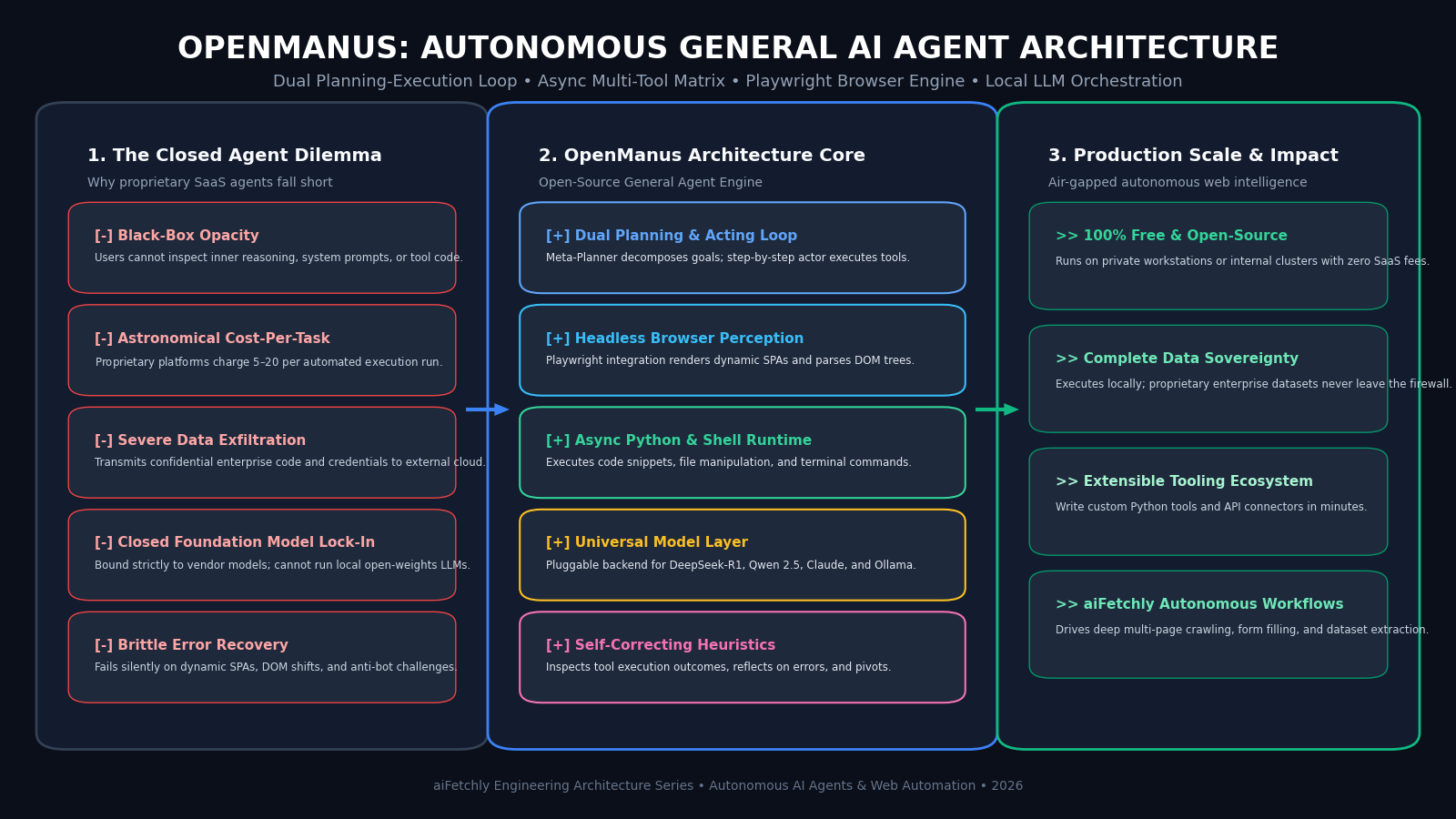
The Problem: The Walled Gardens and Opacity of Commercial Autonomous Agents
In modern enterprise automation, automated market research, and high-velocity web data extraction platforms powered by AiFetchly, the artificial intelligence industry has undergone a seismic shift: moving beyond static text-completion chatbots toward autonomous general-purpose AI agents. Rather than expecting humans to manually execute terminal scripts, copy-paste browser results, or write intermediate glue code, general agents receive open-ended high-level goals (“Research the top 5 competitors in serverless GPU hosting, extract their pricing models, verify their uptime SLAs, and compile a board-ready report”), autonomously decomposing the objective into multi-hour execution plans.
However, the initial commercial rollout of autonomous general agents (such as proprietary closed platforms like Manus AI, Devin, or cloud browser operators) introduced severe systemic and operational liabilities:
The Commercial Autonomous Agent Dilemma:
┌─────────────────────────────────────────────────────────────────┐
│ Liability 1: Proprietary Cloud Black-Box Opacity                │
│ • Zero visibility into hidden system prompts or reasoning chains│
│ ❌ Developers cannot audit why the agent deviated or failed     │
│ ❌ Impossible to customize internal tools or browser heuristics │
├─────────────────────────────────────────────────────────────────┤
│ Liability 2: Severe Intellectual Property Exfiltration          │
│ • Prompts, API secrets, and sensitive files leave corporate VPC │
│ ❌ Transmitted to third-party hosted cloud virtual machines     │
│ ❌ Violates strict enterprise GDPR, HIPAA, and SOC 2 governance │
├─────────────────────────────────────────────────────────────────┤
│ Liability 3: Astronomical Pay-Per-Task SaaS Pricing             │
│ • Commercial platforms charge $5.00 to $20.00+ per complex task │
│ ❌ Prohibitive for continuous, high-volume automated scraping   │
│ ❌ Unpredictable billing spikes from runaway agent loops        │
├─────────────────────────────────────────────────────────────────┤
│ Liability 4: Foundation Model Vendor Lock-In                    │
│ • Hardcoded to vendor-chosen proprietary cloud LLMs             │
│ ❌ Cannot run cost-effective local open models (DeepSeek, Qwen) │
│ ❌ Brittle error recovery when vendor cloud endpoints degrade   │
└─────────────────────────────────────────────────────────────────┘
Result: Organizations remain locked into expensive, opaque cloud monopolies! 1. The Closed Cloud Black-Box and Token Markups
Commercial agent platforms operate as closed services:
- Users are presented with a web interface where tasks run on remote, ephemeral cloud containers.
- The Opacity Penalty: Developers cannot inspect the exact prompts, tool parameters, or error traces that guided the agent. When an agent fails to extract a complex web table or enters a circular loop, developers have zero diagnostic recourse.
- Cost Inflation: Vendors charge steep subscription markups on top of underlying LLM token costs, often billing $10 to $30 per complex execution run.
2. Intellectual Property and Security Exposure
Enterprise data workflows require operating on sensitive internal assets:
- When an autonomous agent is instructed to refactor internal source code, query staging databases, or download confidential competitor disclosures, streaming those credentials and documents to third-party SaaS cloud runners creates unacceptable compliance risks.
- For financial institutions, healthcare providers, and regulated enterprises, running autonomous code on external infrastructure violates security policies.
3. Brittle Tool Execution and Lack of Customizability
Proprietary agents provide static, pre-packaged tools:
- Teams cannot easily inject custom corporate REST APIs, internal PostgreSQL connectors, private VPN proxies, or domain-specific data extractors.
- When an agent encounters modern bot detection (e.g., Cloudflare Turnstile or Akamai Web Application Firewalls), closed platforms fail with generic error messages, lacking the ability to apply custom browser evasions or residential proxy pools.
To dismantle these walled gardens, the open-source engineering community created OpenManus: an extensible, transparent, fully open-source general agent framework that brings autonomous multi-step reasoning, browser automation, and code execution directly to local developer workstations and private server clusters.
The Solution: OpenManus Architecture, Dual Planning & Async Multi-Tool Matrix
OpenManus is engineered around a modular, asynchronous Python architecture that decouples high-level task planning from low-level tool execution. Built to interface with both local open-weights reasoning models (such as DeepSeek-R1 and Qwen 2.5) and frontier cloud APIs, OpenManus provides a transparent, customizable foundation for general-purpose automation.
OpenManus Comprehensive System Architecture:
┌─────────────────────────────────────────────────────────────────┐
│ User Objective: Natural Language Goal / Complex Automation Task │
└────────────────────────────────┬────────────────────────────────┘
                                 │
                                 ▼
┌─────────────────────────────────────────────────────────────────┐
│ OpenManus Core Orchestrator (Async Python Runtime)             │
│ • Meta-Planner: Decomposes goals into a dynamic Task Graph      │
│ • ReAct Execution Loop: Thought ──► Action ──► Observation      │
│ • Self-Correction Engine: Error reflection & adaptive replanning│
└────────────────────────────────┬────────────────────────────────┘
                                 │
        ┌────────────────────────┼────────────────────────┐
        ▼                        ▼                        ▼
┌─────────────────┐      ┌─────────────────┐      ┌─────────────────┐
│ Headless Browser│      │ Local Execution │      │ Universal Model │
│ Engine          │      │ Sandbox         │      │ Gateway         │
│ • Playwright    │      │ • Async Python  │      │ • DeepSeek-R1/V3│
│ • DOM Perception│      │ • Shell / Bash  │      │ • Qwen 2.5 Coder│
│ • Click/Type/Nav│      │ • File I/O R/W  │      │ • Local Ollama  │
│ • SPA Rendering │      │ • Custom Tools  │      │ • Claude / OpenAI│
└─────────────────┘ └─────────────────┘ └─────────────────┘ 1. The Dual-Stage Planning and Acting Architecture
OpenManus separates cognitive planning from physical tool execution to prevent context saturation and circular drift:
- The Meta-Planner: Upon receiving a complex objective, the planning module evaluates the goal and synthesizes an ordered execution roadmap. It establishes sub-goals, identifies required tools, and defines measurable success criteria for each phase.
- The Execution Actor Loop: Operating on a single sub-goal at a time, the actor executes iterative ReAct (Reasoning + Acting) cycles:
- Thought: The model analyzes the current progress against the overall roadmap.
- Action: The model emits a structured tool call (e.g., navigating a URL or writing a Python script).
- Observation: The environment executes the action and returns the raw output back into the context buffer.
- Dynamic Replanning: If an action fails (e.g., a target web page returns an HTTP 404 or a Python script raises an import error), the Meta-Planner reassesses the roadmap and selects an alternate path without restarting the entire mission from scratch.
2. Headless Browser Automation via Playwright
A cornerstone of OpenManus’s general agency is its native integration with Playwright:
- Dynamic SPA Hydration: Unlike naive HTTP request libraries that fail on JavaScript-heavy Single Page Applications (SPAs), OpenManus spawns an asynchronous headless Chromium process capable of handling client-side rehydration, WebSockets, and dynamic infinite scrolls.
- DOM Perception & Element Locators: OpenManus converts complex DOM trees into clean, interactive representations. It assigns deterministic numeric indices to clickable links, form inputs, and buttons, allowing language models to interact with complex web applications via concise commands (e.g.,
browser_click(index=14),browser_type(index=3, text="Q3 revenue")). - Visual Screenshots & Multimodal Verification: When paired with vision-language models (such as Qwen 2.5-VL or Claude 3.5 Sonnet), OpenManus captures viewport screenshots to visually confirm page states, solve layout ambiguities, and audit rendered charts.
3. Asynchronous Python & Shell Sandboxing
OpenManus equips agents with full local compute capabilities:
- Python Interpreter Tool: The agent writes and executes arbitrary Python code to parse complex JSON payloads, perform mathematical calculations, normalize web scrape datasets, and format output reports.
- Shell Command Tool: Allows the agent to issue shell commands (e.g.,
git,curl,grep,unzip), compile software packages, and interact with the local filesystem directly. - Structured File Management: Agents create, read, update, and organize files within an isolated working directory, assembling multi-file project outputs, Markdown documentation, and CSV datasets.
4. Model-Agnostic LLM Routing (DeepSeek-R1, Qwen 2.5, Cloud APIs)
OpenManus avoids proprietary lock-in through a pluggable foundation model interface:
- Local Open-Weights Serving: Connects seamlessly to local inference backends (Ollama, vLLM, SGLang), empowering teams to run the entire agent loop using open-weights reasoning models like DeepSeek-R1 or Qwen 2.5-Coder with zero cloud API costs.
- Frontier Cloud Integration: Teams can route high-order planning to frontier APIs (e.g., Claude 3.5 Sonnet, GPT-4o) while dispatching low-level scraping and formatting steps to fast, economical local SLMs.
5. Dynamic Reflection and Self-Correcting Execution Loops
OpenManus incorporates explicit reflection heuristics:
- Rather than blindly accepting tool responses, the agent compares environment feedback against expected milestones.
- If a downloaded CSV is empty or a Python script fails with a syntax error, the agent captures the exception traceback, reflects on the underlying cause, patches the code, and re-executes automatically.
Architectural Comparison: OpenManus vs. Manus AI vs. Devin vs. Browser-Use
The table below contrasts OpenManus with leading commercial and open-source autonomous agent architectures:
| Architectural Metric | Manus AI (Proprietary) | Devin (Cognition) | Browser-Use | OpenManus |
|---|---|---|---|---|
| Open Source | No (Closed Commercial) | No (Closed Commercial) | Yes (MIT License) | Yes (Apache/MIT Open Source) |
| Execution Environment | Remote Proprietary Cloud | Remote Ephemeral Cloud | Local / Remote Browser | Local Workstation / Private VPC |
| Primary Domain | General Multi-Modal Tasks | Software Engineering | Browser Automation Only | General Tasks (Web + Code + Shell) |
| Local Model Support | None (Closed Vendor) | None (Closed Vendor) | Supported via LangChain | Native (Ollama, vLLM, DeepSeek-R1) |
| Tool Extensibility | None (Fixed SaaS Tools) | Restricted Integrations | Browser Tools Only | Full Python Tool Customization |
| Data Privacy | Cloud Exfiltration | Cloud Exfiltration | Local Execution | 100% Air-Gapped Data Sovereignty |
| Operational Cost | $10–$30+ per Task | Enterprise Subscription | Token Costs Only | Zero Platform Fees / Token Only |
| Multi-Step Planning | Black-Box Planner | Proprietary Planner | Basic ReAct | Dual-Stage Meta-Planner + Actor |
Hands-On Implementation: Configuring and Running OpenManus Locally
Below is a complete, step-by-step implementation guide demonstrating how to set up OpenManus, configure model endpoints (including local open-weights models and cloud APIs), author custom tools, and execute an autonomous end-to-end data intelligence mission.
Step 1: Clone Repository and Configure Python Dependencies
Ensure you have Python 3.11+ and Node.js installed. Clone the OpenManus repository and initialize a virtual environment:
# Clone the open-source OpenManus codebase
git clone https://github.com/mannaandpoem/OpenManus.git
cd OpenManus

# Create and activate an isolated Python virtual environment
python3 -m venv .venv
source .venv/bin/activate  # On Windows: .venv\Scripts\activate

# Install core dependencies and Playwright browser binaries
pip install -r requirements.txt
playwright install chromium Step 2: Configure Pluggable Model Providers (Local Ollama vs. Cloud)
OpenManus uses a centralized configuration file (config/config.toml) to manage model endpoints and API keys. You can configure OpenManus to run entirely locally using Ollama or connect to cloud foundation models:
# config/config.toml

# Global LLM configuration
[llm]
model = "deepseek-r1:latest"
base_url = "http://localhost:11434/v1"
api_key = "ollama"
max_tokens = 4096
temperature = 0.0

# Optional: Configure secondary frontier model for complex planning
[planning_llm]
model = "claude-3-5-sonnet-20241022"
base_url = "https://api.anthropic.com/v1"
api_key = "sk-ant-your-anthropic-key"
max_tokens = 8192
temperature = 0.0

# Browser automation settings
[browser]
headless = true
timeout = 30000
viewport_width = 1280
viewport_height = 800 Step 3: Execute an Autonomous Multi-Step Web Harvesting Mission
Launch OpenManus to execute an open-ended multi-step research and extraction task:
python main.py --prompt "Navigate to news.ycombinator.com, find the top 5 articles related to AI or Large Language Models, extract their discussion URLs and point counts, and save the structured results to output/hn_ai_report.json." Below is the conceptual Python implementation showing how OpenManus’s underlying actor coordinates Playwright, the LLM loop, and file storage:
import asyncio
import json
from pathlib import Path
from playwright.async_api import async_playwright
from openai import AsyncOpenAI

class OpenManusActor:
    def __init__(self, base_url: str = "http://localhost:11434/v1", api_key: str = "ollama", model: str = "deepseek-r1:latest"):
        self.client = AsyncOpenAI(base_url=base_url, api_key=api_key)
        self.model = model
        self.memory = []

    async def execute_task(self, prompt: str):
        print(f"[OpenManus] Initiating Autonomous Goal: {prompt}")

        async with async_playwright() as p:
            # 1. Launch Headless Browser
            browser = await p.chromium.launch(headless=True)
            page = await browser.new_page()

            # 2. Navigate and perceive DOM
            await page.goto("https://news.ycombinator.com", wait_until="domcontentloaded")
            content = await page.content()

            # 3. Query LLM for Structured Extraction Plan
            system_prompt = (
                "You are an autonomous web extraction agent. "
                "Analyze the provided HTML and extract the top 5 AI-related stories as JSON: "
                "[{'title': str, 'url': str, 'points': int}]."
            )

            response = await self.client.chat.completions.create(
                model=self.model,
                messages=[
                    {"role": "system", "content": system_prompt},
                    {"role": "user", "content": f"Target HTML snippet:\n{content[:8000]}"}
                ],
                temperature=0.0
            )

            extracted_json = response.choices[0].message.content
            print("\n[OpenManus] Extracted Intelligence:\n", extracted_json)

            # 4. Save Deliverable to Disk
            output_dir = Path("output")
            output_dir.mkdir(exist_ok=True)
            output_file = output_dir / "hn_ai_report.json"

            output_file.write_text(extracted_json, encoding="utf-8")
            print(f"\n[OpenManus] Mission Accomplished. Report saved to: {output_file.resolve()}")

            await browser.close()

if __name__ == "__main__":
    actor = OpenManusActor()
asyncio.run(actor.execute_task("Scrape top AI stories from Hacker News")) Production Deployment with aiFetchly
In high-concurrency automated data harvesting, competitive benchmarking, and private market research pipelines engineered by AiFetchly, OpenManus represents the next generation of autonomous worker architectures.
aiFetchly Enterprise Intelligence Integration with OpenManus:
┌─────────────────────────────────────────────────────────────────┐
│ 1. Autonomous Mission Dispatch                                  │
│ • aiFetchly schedules multi-page research and data collection    │
│ • Dispatches OpenManus agent instances across local worker nodes│
├─────────────────────────────────────────────────────────────────┤
│ 2. Air-Gapped Web Navigation & Extraction                       │
│ • OpenManus navigates complex portals, solves forms, extracts DOM│
│ • Runs locally with DeepSeek-R1; zero cloud API dependency      │
├─────────────────────────────────────────────────────────────────┤
│ 3. Automated Code Execution & Schema Validation                 │
│ • Agents execute Python scripts to clean and normalize tables   │
│ • Validates extracted datasets against strict Pydantic schemas  │
├─────────────────────────────────────────────────────────────────┤
│ 4. Verified Enterprise Knowledge Ingestion                      │
│ • Output datasets saved directly to local Parquet / DuckDB lakes│
│ • 100% confidential; eliminates third-party data exfiltration   │
└─────────────────────────────────────────────────────────────────┘ - Elimination of SaaS Agent Subscriptions: By integrating OpenManus into private infrastructure, enterprise operations teams deploy autonomous general agents across thousands of daily web extraction tasks without paying exorbitant per-run fees to closed cloud vendors.
- Deep Autonomous Navigation: Unlike simple single-page scrapers, OpenManus navigates multi-step authentication gates, dynamic pagination, and nested iframe modals autonomously, extracting deep web data that traditional scrapers miss.
- Complete Intellectual Property Protection: Because OpenManus executes directly within the enterprise firewall and connects to local open-weights foundation models, proprietary corporate research and competitive monitoring strategies remain 100% confidential.
To learn more about how aiFetchly combines automated data extraction with autonomous open-source agent architectures, explore our AiFetchly Documentation or review our AiFetchly Pricing.