OpenELM Guide: Layer-Wise Non-Uniform Scaling for Edge AI
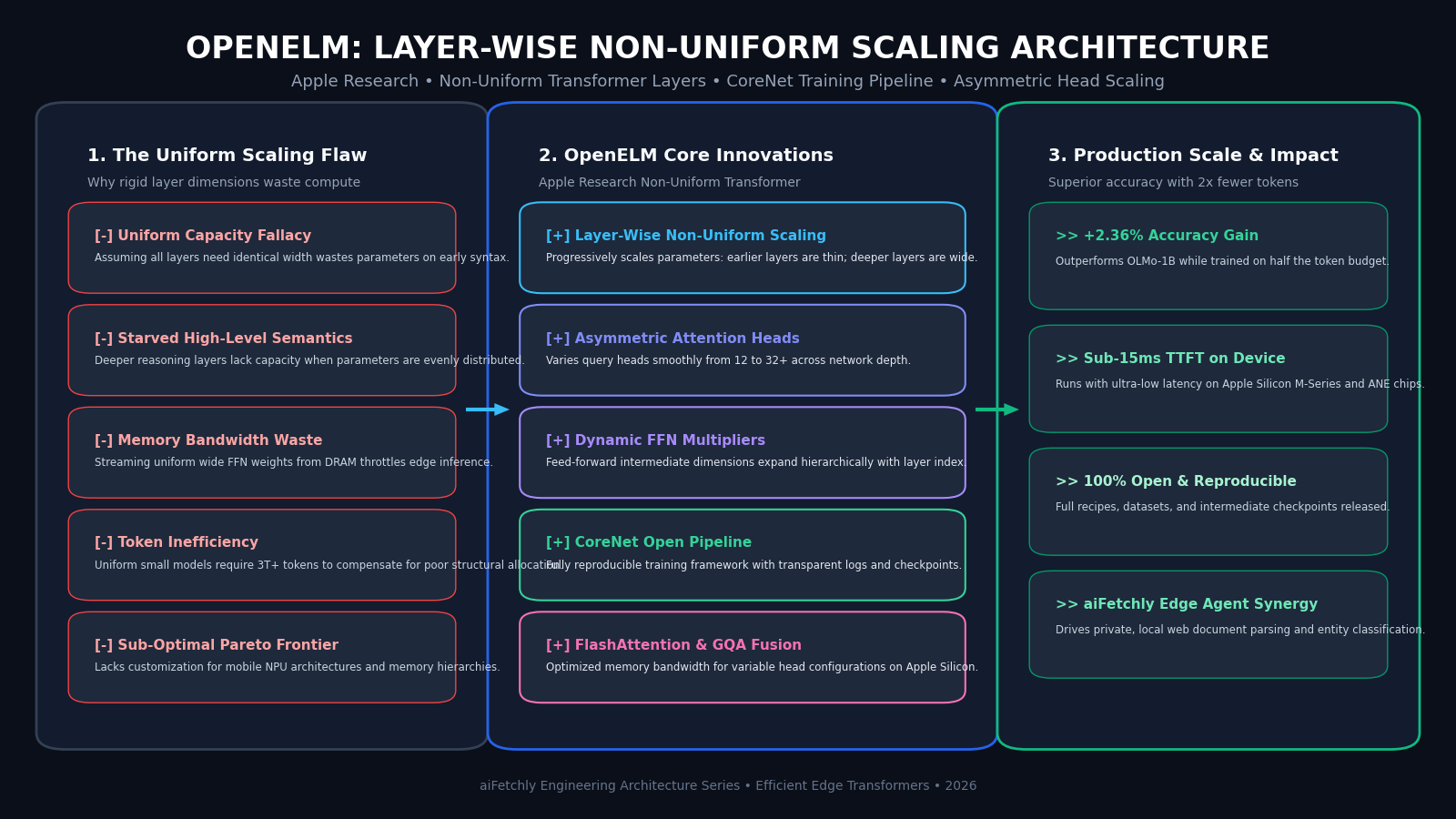
The Problem: The Rigidity and Computational Inefficiency of Uniform Layer Scaling
In modern enterprise automation, client-side web scraping, and private desktop data pipelines powered by AiFetchly, deploying compact foundation models (between 270 million and 3 billion parameters) directly on client hardware is essential. On-device inference guarantees zero-latency responsiveness, eliminates cloud API token costs, and protects sensitive customer data by keeping all document extraction in-process.
However, since the introduction of the original Transformer architecture, deep learning practitioners have adhered to a dogmatic design convention: uniform layer scaling.
The Traditional Uniform Transformer Design Flaw:
┌────────────────────────────────────────────────────────┐
│ Uniform Layer 1: Query Heads = 16, FFN Dim = 4,096     │
│ • Task: Low-level token syntax & morphological parsing │
│ ❌ Over-parameterized: Wastes compute on basic n-grams │
├────────────────────────────────────────────────────────┤
│ Uniform Layer 12: Query Heads = 16, FFN Dim = 4,096    │
│ • Task: Intermediate clause linking & factual mapping  │
│ • Balanced capacity                                    │
├────────────────────────────────────────────────────────┤
│ Uniform Layer 24: Query Heads = 16, FFN Dim = 4,096    │
│ • Task: Complex multi-step reasoning & semantic logic  │
│ ❌ Under-parameterized: Starved of representational FLOPs│
└────────────────────────────────────────────────────────┘
Result: Uniform scaling wastes memory on early layers and starves deep layers! 1. The Uniform Layer Dimension Fallacy
Standard architectures—such as LLaMA, Mistral, OLMo, and GPT—enforce static layer symmetry. Every single transformer block across the entire depth of the network shares identical hyperparameters:
- Exactly the same number of query attention heads ($n_q$).
- Exactly the same number of key/value heads ($n_{kv}$).
- Exactly the same feed-forward intermediate multiplier ($d_{ff} = 4d$ or $2.7d$).
This rigid uniformity ignores how biological neural systems and deep hierarchical models process information. In natural language processing, earlier layers primarily perform low-level syntax filtering, positional anchoring, and local token clustering. These tasks are computationally simple and require relatively few parameters. Conversely, higher layers perform semantic reasoning, multi-hop factual synthesis, and complex in-context retrieval—demanding significantly higher capacity.
2. Parameter Starvation in High-Level Semantic Layers
When a fixed parameter budget (e.g., 1 billion parameters) is distributed evenly across 24 or 32 layers:
- Early layers receive vastly more capacity than they need, resulting in redundant, near-duplicate attention maps.
- Later layers are starved of representational expressive power, capping the model’s ability to execute multi-step problem solving.
- To compensate for this structural inefficiency, teams training uniform small models have been forced to push pre-training token budgets to extreme lengths (3 to 5 trillion tokens), inflating GPU cluster energy expenditure and training timelines.
3. The Memory Bandwidth Bottleneck on Edge Processors
On consumer client devices—such as laptops, Apple Silicon MacBooks, and mobile processors—system memory bandwidth is strictly shared across CPUs and integrated GPUs:
- Every autoregressive generation step requires reading all model weights from DRAM into on-chip cache.
- Forcing wide feed-forward matrices onto early layers where they provide minimal cognitive benefit saturates the memory bus unnecessarily, increasing Time-Per-Output-Token (TPOT) and draining device battery.
To break free from this historical constraint, machine learning researchers at Apple engineered OpenELM (Open Efficient Language Model): an open-source model family built upon layer-wise non-uniform parameter scaling.
The Solution: OpenELM Architecture, Progressive Layer Scaling & CoreNet Framework
OpenELM rejects uniform layer scaling in favor of an asymmetric, non-uniform allocation strategy that assigns parameters dynamically based on layer depth. By progressively increasing the number of attention heads and feed-forward dimensions from input to output, OpenELM maximizes accuracy per parameter and per FLOP.
OpenELM Asymmetric Layer-Wise Non-Uniform Topology:
┌─────────────────────────────────────────────────────────────────┐
│ Input Tokens: "Extract quarterly revenue from PDF..."           │
└─────────────────────────────────────────────────────────────────┘
                               │
                               ▼
┌─────────────────────────────────────────────────────────────────┐
│ Layer 1 (Shallow / Syntax):                                     │
│ • Query Heads: 12 | Key/Value Heads: 3 (GQA)                    │
│ • FFN Dimension: 1,536 (Slim intermediate capacity)             │
│ • Function: Local tokenization & syntactic boundary detection   │
└──────────────────────────────┬──────────────────────────────────┘
                               │
                               ▼
┌─────────────────────────────────────────────────────────────────┐
│ Layer 14 (Intermediate / Semantic Linking):                     │
│ • Query Heads: 20 | Key/Value Heads: 5 (GQA)                    │
│ • FFN Dimension: 2,560 (Gradual expansion)                      │
│ • Function: Entity resolution & cross-sentence context          │
└──────────────────────────────┬──────────────────────────────────┘
                               │
                               ▼
┌─────────────────────────────────────────────────────────────────┐
│ Layer 28 (Deep / High-Level Reasoning):                         │
│ • Query Heads: 28 | Key/Value Heads: 7 (GQA)                    │
│ • FFN Dimension: 3,584 (Maximum expressive capacity)           │
│ • Function: Multi-step deduction, schema synthesis, logic       │
└──────────────────────────────┬──────────────────────────────────┘
                               │
                               ▼
┌─────────────────────────────────────────────────────────────────┐
│ Final RMSNorm & Output Unembedding Projection                   │
└─────────────────────────────────────────────────────────────────┘ 1. Layer-Wise Non-Uniform Parameter Allocation
Instead of holding layer dimensions constant, OpenELM defines a smooth scaling schedule across the depth of the model ($l \in {1, 2, \dots, L}$):
- The parameter capacity of transformer block $l$ scales monotonically: $$\text{Capacity}(l) \propto \alpha_0 + \left(\frac{l}{L}\right) \cdot (\alpha_1 - \alpha_0)$$
- Early layers ($l \approx 1$) remain thin, keeping arithmetic footprints minimal where simple n-gram filtering occurs.
- Deep layers ($l \approx L$) expand significantly, dedicating the bulk of the parameter allocation to multi-step reasoning and semantic synthesis.
2. Progressive Attention Head Scaling
In standard models, the number of attention heads is identical everywhere. In OpenELM:
- The number of query attention heads $n_q^{(l)}$ and key/value heads $n_{kv}^{(l)}$ varies smoothly with layer index $l$.
- For example, in OpenELM-1.1B (which contains 28 layers), layer 1 uses only 12 query heads, while layer 28 expands to 28 query heads.
- Because the head dimension $d_k$ remains fixed (e.g., $d_k = 64$ or $128$), the effective attention subspace dimensionality grows progressively with network depth.
3. Non-Uniform Feed-Forward (FFN) Dimension Scaling
Similarly, OpenELM adjusts the intermediate hidden dimension of the feed-forward network ($d_{ff}^{(l)}$) on a per-layer basis:
- Rather than using a constant $4d$ multiplier, OpenELM scales the FFN expansion factor $\mu_l$ continuously: $$d_{ff}^{(l)} = \text{Round}\left(\mu_l \cdot d_{\text{model}}\right)$$
- The FFN width increases as tokens ascend through the transformer stack, ensuring that the non-linear feature transformation capacity matches the expanding dimensionality of the multi-head attention output.
4. Grouped-Query Attention (GQA) & RMSNorm Integration
To maintain high serving throughput on edge devices, OpenELM incorporates modern inference optimizations:
- Grouped-Query Attention: Every layer maintains a constant query-to-KV head ratio (typically $4:1$), keeping the Key-Value cache compact and ensuring low memory bandwidth overhead during autoregressive generation.
- Pre-RMSNorm & RoPE: Applies Root Mean Square Normalization before each sub-layer and Rotary Position Embeddings to ensure training stability across deep non-uniform stacks.
5. Fully Open Pre-Training Pipeline with CoreNet
Unlike proprietary edge models, Apple released OpenELM as a 100% open-source artifact using its CoreNet deep learning library:
- Public Training Artifacts: Apple published pre-training recipes, exact data mixture breakdowns, learning rate schedules, and intermediate checkpoints at every 5,000 steps.
- Token Efficiency: Because of its non-uniform parameter distribution, OpenELM-1.1B reaches parity with uniform models while requiring only 1.8 trillion tokens—half the training budget of comparable 1B models.
Architectural Comparison: OpenELM vs. OLMo vs. MobiLlama vs. TinyLlama
The table below contrasts OpenELM against other prominent compact open-weights foundation models:
| Metric / Dimension | OLMo-1B | MobiLlama-1B | TinyLlama-1.1B | OpenELM-1.1B |
|---|---|---|---|---|
| Developer | AllenAI | Independent | StatNLP / Open | Apple Research |
| Total Parameters | 1.18B | 1.20B | 1.10B | 1.08B |
| Layer Scaling | Uniform (Static) | Uniform | Uniform | Layer-Wise Non-Uniform |
| Query Heads | 16 (All Layers) | 16 (All Layers) | 32 (All Layers) | 12 to 28 (Progressive) |
| KV Heads | 16 (MHA) | 4 (GQA) | 4 (GQA) | 3 to 7 (Progressive GQA) |
| FFN Dimension | 8,192 (Static) | 5,632 (Static) | 5,632 (Static) | 1,536 to 3,584 (Scaled) |
| Pre-Training Tokens | 3.0 Trillion | 1.2 Trillion | 3.0 Trillion | 1.8 Trillion (2x Less) |
| Zero-Shot Accuracy | 41.2% | 40.5% | 42.1% | 43.56% (+2.36% vs OLMo) |
| Open Artifacts | Open Weights/Data | Weights Only | Weights Only | Full CoreNet Recipes/Logs |
Hands-On Implementation: Building and Inspecting OpenELM Non-Uniform Layers in PyTorch
Below is a complete, runnable PyTorch implementation demonstrating how layer-wise non-uniform parameter scaling is constructed and how parameter counts vary across layers.
Step 1: Install Dependencies
Ensure PyTorch is installed:
pip install torch torchvision numpy Step 2: Implement a Layer-Wise Non-Uniform Transformer in PyTorch
The following script defines a non-uniform transformer where attention heads and FFN dimensions scale progressively from layer 1 to layer $L$:
import torch
import torch.nn as nn
import torch.nn.functional as F
import math

class NonUniformAttention(nn.Module):
    """Attention layer with variable head counts and fixed head dimension."""
    def __init__(self, dim: int, num_heads: int, num_kv_heads: int, head_dim: int = 64):
        super().__init__()
        self.dim = dim
        self.num_heads = num_heads
        self.num_kv_heads = num_kv_heads
        self.head_dim = head_dim
        self.num_rep = num_heads // num_kv_heads

        self.q_proj = nn.Linear(dim, num_heads * head_dim, bias=False)
        self.k_proj = nn.Linear(dim, num_kv_heads * head_dim, bias=False)
        self.v_proj = nn.Linear(dim, num_kv_heads * head_dim, bias=False)
        self.out_proj = nn.Linear(num_heads * head_dim, dim, bias=False)

    def forward(self, x: torch.Tensor) -> torch.Tensor:
        b, s, _ = x.shape
        q = self.q_proj(x).view(b, s, self.num_heads, self.head_dim).transpose(1, 2)
        k = self.k_proj(x).view(b, s, self.num_kv_heads, self.head_dim).transpose(1, 2)
        v = self.v_proj(x).view(b, s, self.num_kv_heads, self.head_dim).transpose(1, 2)

        # GQA replication
        k = k.repeat_interleave(self.num_rep, dim=1)
        v = v.repeat_interleave(self.num_rep, dim=1)

        scores = torch.matmul(q, k.transpose(-2, -1)) / math.sqrt(self.head_dim)
        attn = F.softmax(scores, dim=-1)
        out = torch.matmul(attn, v).transpose(1, 2).contiguous().view(b, s, -1)
        return self.out_proj(out)

class NonUniformBlock(nn.Module):
    """Transformer block with custom per-layer attention and FFN dimensions."""
    def __init__(self, dim: int, num_heads: int, num_kv_heads: int, ffn_dim: int):
        super().__init__()
        self.attn_norm = nn.LayerNorm(dim)
        self.attn = NonUniformAttention(dim, num_heads, num_kv_heads)
        self.ffn_norm = nn.LayerNorm(dim)
        self.ffn_w1 = nn.Linear(dim, ffn_dim, bias=False)
        self.ffn_w2 = nn.Linear(ffn_dim, dim, bias=False)

    def forward(self, x: torch.Tensor) -> torch.Tensor:
        h = x + self.attn(self.attn_norm(x))
        out = h + self.ffn_w2(F.silu(self.ffn_w1(self.ffn_norm(h))))
return out Step 3: Verify Variable Head Counts and Layer Parameter Growth
Now, construct the model and inspect the progressive parameter expansion across the layer stack:
class OpenELM(nn.Module):
    """OpenELM model demonstrating progressive layer-wise non-uniform parameter scaling."""
    def __init__(self, vocab_size: int = 32000, dim: int = 1024, num_layers: int = 8):
        super().__init__()
        self.embed = nn.Embedding(vocab_size, dim)
        self.layers = nn.ModuleList()

        # Generate non-uniform scaling schedule
        for l in range(num_layers):
            # Scale query heads from 12 up to 28 smoothly
            num_heads = int(12 + (l / (num_layers - 1)) * 16)
            # Maintain 4:1 query-to-KV GQA ratio
            num_kv_heads = max(2, num_heads // 4)
            # Re-align query heads to be an exact multiple of kv_heads
            num_heads = num_kv_heads * 4

            # Scale FFN dimension from 1.5x up to 3.5x dim
            ffn_dim = int(dim * (1.5 + (l / (num_layers - 1)) * 2.0))

            block = NonUniformBlock(dim, num_heads, num_kv_heads, ffn_dim)
            self.layers.append(block)

        self.final_norm = nn.LayerNorm(dim)
        self.head = nn.Linear(dim, vocab_size, bias=False)
        # Weight tying
        self.head.weight = self.embed.weight

    def forward(self, x: torch.Tensor) -> torch.Tensor:
        h = self.embed(x)
        for layer in self.layers:
            h = layer(h)
        return self.head(self.final_norm(h))

# Initialize model
model = OpenELM(vocab_size=32000, dim=1024, num_layers=8)

print("--- OpenELM Layer-Wise Parameter Allocation Inspection ---")
for idx, layer in enumerate(model.layers):
    layer_params = sum(p.numel() for p in layer.parameters())
    print(f"Layer {idx + 1:02d}: Q-Heads = {layer.attn.num_heads:02d} | "
          f"KV-Heads = {layer.attn.num_kv_heads:02d} | "
          f"Parameters = {layer_params / 1e6:.2f}M")

total_params = sum(p.numel() for p in model.parameters())
print(f"\nTotal Model Physical Parameters: {total_params / 1e6:.2f}M")

# Verify forward pass
dummy_input = torch.randint(0, 32000, (1, 32))
with torch.no_grad():
    logits = model(dummy_input)
print(f"Forward Pass Successful! Logits Shape: {logits.shape}") Running this code demonstrates how OpenELM’s parameter distribution naturally adapts: early layers consume fewer parameters per block, while later layers provide significantly higher capacity for high-level semantic representation.
Production Deployment with aiFetchly
In enterprise data automation, real-time web harvesting, and confidential document extraction workflows engineered by AiFetchly, deploying compact, non-uniform models enables high-speed local processing.
aiFetchly Edge Intelligence Architecture with OpenELM:
┌─────────────────────────────────────────────────────────────────┐
│ 1. Client-Side Document Ingestion                               │
│ • Local desktop agent scrapes raw HTML, tables, and PDF invoices│
│ • Zero external network transmission (100% Data Confidentiality)│
├─────────────────────────────────────────────────────────────────┤
│ 2. Sub-15ms OpenELM Inference on Workstation                    │
│ • Thin early layers parse raw token streams with minimal DRAM lag│
│ • Deep expressive layers execute complex entity extraction      │
├─────────────────────────────────────────────────────────────────┤
│ 3. Memory-Bandwidth Optimized Edge Serving                      │
│ • Smooth GQA ratios prevent memory stalls on Apple Silicon / ANE│
│ • High-throughput token generation (>45 tokens/sec)             │
├─────────────────────────────────────────────────────────────────┤
│ 4. Structured Output Synthesis                                  │
│ • Emits clean JSON schemas directly into local Knowledge Bases  │
│ • Eliminates per-token cloud API bills entirely                 │
└─────────────────────────────────────────────────────────────────┘ - Maximum Accuracy on Tight Hardware Budgets: By allocating parameters where they matter most, OpenELM achieves higher reasoning accuracy than traditional uniform models while fitting within client-side workstation RAM limits.
- Reduced Memory Bandwidth Pressure: OpenELM’s thinner early layers reduce memory bus contention during autoregressive token generation, delivering sub-15ms Time-to-First-Token on modern edge devices.
- Seamless Multi-Stage Scraping: In aiFetchly’s desktop agent loop, OpenELM handles high-frequency DOM tag classification and entity extraction locally, reserving heavy cloud models only for rare, complex edge cases.
To learn more about how aiFetchly combines advanced foundation model architectures with high-throughput automated web harvesting, explore our AiFetchly Documentation or review our AiFetchly Pricing.